

There was a Putnam, and eventually there was a city, but there never was a Putnam City.
I attended Putnam City schools from first through twelfth grades. But I never lived in Putnam City, because it never officially existed.
Israel Mercer Putnam

Israel Putnam arrived in Oklahoma City on July 4, 1901, a dozen years after 5,000 people settled it overnight in a land run. He was 27 years old, out of law school in Georgia.
He expanded his law business into real estate, developing residential additions. A common scheme at the time was to construct interurban streetcar lines out to undeveloped land, build amusement parks at the end of the lines to drive weekend traffic, and sell lots.
Putnam Park was one such operation for his Putnam Heights addition. It included a boating lake, gazebo, and picnic area. In 1928, it became Memorial Park, with a fountain replacing the lake, and is one of the city’s oldest parks at 36th and Classen Blvd.

Putnam was also instrumental in other Oklahoma City institutions. He and fellow land developer Anton Classen brought Epworth University to town, which would evolve to become Oklahoma City University. In 1905, he donated 40 acres at modern-day 63rd & Pennsylvania Ave. to a Baptist group known as the Indian Territory-Oklahoma Territory Orphan’s Home. The Baptist Orphans Home was sold in 1981 and the site is now the Waterford Hotel, office complex, and condominiums.
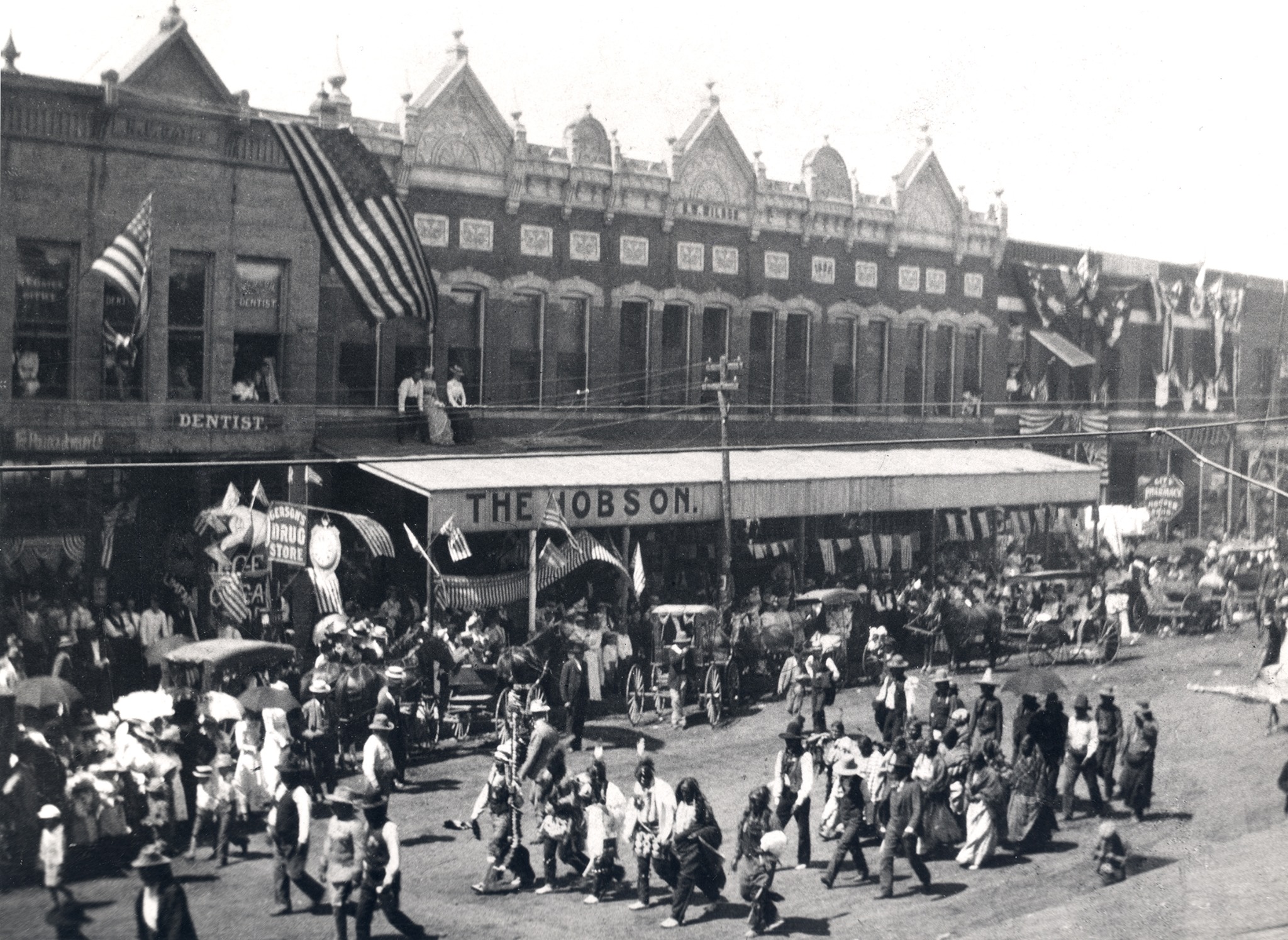
In 1907, when Oklahoma became a state, Putnam was elected to the legislature. In 1910, voters approved moving the state capital from Guthrie to Oklahoma City. Putnam purchased 2,000 acres northwest of the city, just west of some of his earlier additions and along the interurban streetcar line being constructed that ran west to El Reno along what is now NW 39th Expressway/Route 66. He initially called it “Oklacadia”.

Putnam later called his land “Model City” and began to make improvements. Partnering with John Shartel, he created a layout for “Putnam City’ and then offered “Putnam City Grove” within that layout to the state as a site for the new capitol building.
The Grove’s northwest corner was at what is now the intersection of Grove Avenue and 39th Expressway, and it extended south to 34th Street and east to what is now Ann Arbor Avenue. The Putnam City Central schools campus would later develop directly to the north of that between 39th and 40th streets. Today various businesses along Route 66, homes, and the Woodbrier Apartments occupy what was labeled Putnam City Grove and intended for the capitol building. Putnam’s land is now partially in the south end of the City of Warr Acres and partially in greater Oklahoma City. Putnam and Shartel planned to recoup their investment by selling lots around the new capitol building.

Governor Haskell and a State Capitol Commission agreed to the proposal, and Putnam began development. North of the future capitol along the interurban route, he built a block of brick-front stores and a hotel that was to house out-of-town legislators. But then the state Supreme Court ruled that legislative approval was needed to select a site for the capitol.

The state House of Representatives accepted Putnam and Shartel’s land deal, but the Senate objected. Other Oklahoma City business leaders argued the site was too far from downtown and the central business district. William F. Harn and John J. Culbertson offered 40 acres at NE 23rd Street and Lincoln Boulevard northeast of downtown, and a Senate commission stunned Putnam by choosing that site for the new capitol building.
Putnam’s reputation suffered, a bank he was associated with failed, and the bottom fell out of his stock as he was branded a “land shark”. In 1914, he donated 40 acres of the unplatted land and his Putnam building to the leaders of four one-room schools so they could consolidate under a new state law, asking only that the new school district be named for him and the city that never existed.
Putnam went on to land development schemes in Ardmore and Miami, OK and later moved to San Antonio, TX where he developed a resort, a hotel, and Pan American College. He died there in 1961.

Using the land donated by Putnam in Oklahoma City, Consolidated School District No. 1 was formed in 1914. They initially held classes in the Putnam building, but after building a brick school at present-day 40th and Grove, they sold the sprawling Putnam building to the eccentric Eugene Arnett, who became the Putnam City prophet.
The Putnam City Prophet

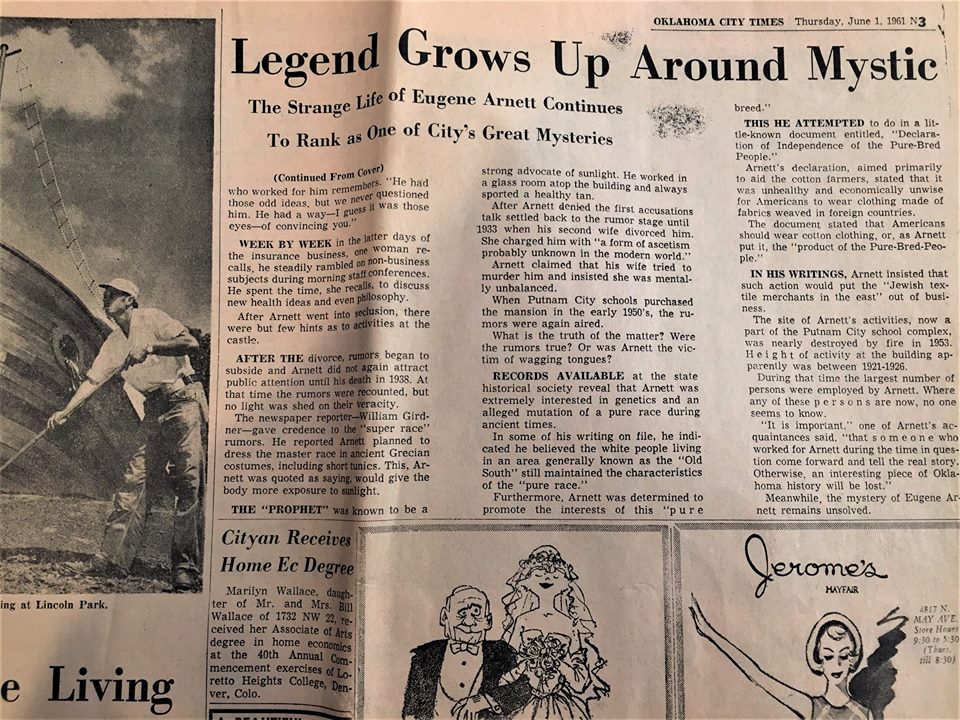
Arnett had become a millionaire as an insurance broker in Oklahoma, Louisiana, and Arkansas. He began steadily rambling on about health ideas and philosophy at morning staff conferences in the former Putnam building, confounding his employees. A reporter infiltrated his organization and reported on his interest in developing a “super-race” which he planned to dress in ancient Grecian costumes, including short tunics in order to give the body more exposure to sunlight.
At age 42, he suddenly retired, proclaiming himself the Prophet of the Purebred People. He had a stone sign placed around the building saying, “Place of the Poor Prophet” and in later years dubbed it “Arnett Athenoreium”. He had a glass room atop the east wing where he would work in the sunlight and reportedly sunbathe in the nude. About 40 to 50 employees lived and worked on the grounds, with mandatory daily exercises, eating foods that he insisted not be fried or contain caffeine. He disapproved of smoking, drinking, and girdles.
Arnett had peculiar racist and anti-Semitic ideas that white people living in the “Old South” maintained traits of the “Purebred People” and urged Americans to not wear clothing made of fabrics woven in foreign countries. He said Americans should wear cotton clothing to support southern farmers and put the “Jewish textile merchants in the east” out of business.
Arnett became a recluse, with rumors swirling about his activities after divorcing his first wife and marrying his secretary. In 1930, A.W. Whitten of Birmingham, Alabama sued Arnett for libel, demanding $100,000 because Arnett had written a letter stating Whitten was “the greatest egoist the Lord has ever allowed to live.” In 1933 he divorced the secretary, claiming she was mentally unbalanced and had tried to shoot him while riding in an automobile, while she charged him with “a form of asceticism probably unknown in the modern world.” He then remarried his first wife.
Arnett had employees build a brick-lined tunnel southward under the interurban tracks (present-day 39th Expressway/Route 66) with plans to transfer coal and cement from the interurban to his mansion using his own underground cars. The tunnel was reportedly never used, however, and was allowed to fill with water. It had hatches inside the Arnett building and in what was later the back lot of a car dealership on the south side of Route 66. A Warr Acres fireman claimed it also extended north past 42nd St.

The Arnett Building/East Annex
Arnett died in 1938, and the building was found to include a library with more than 60,000 volumes and pamphlets. His widow, Mabel Arnett, continued to live in the rambling 56-room mansion, which became dilapidated. She sold it back to the Putnam City school district in 1950, but the west wing was lost to fire on December 27, 1951.
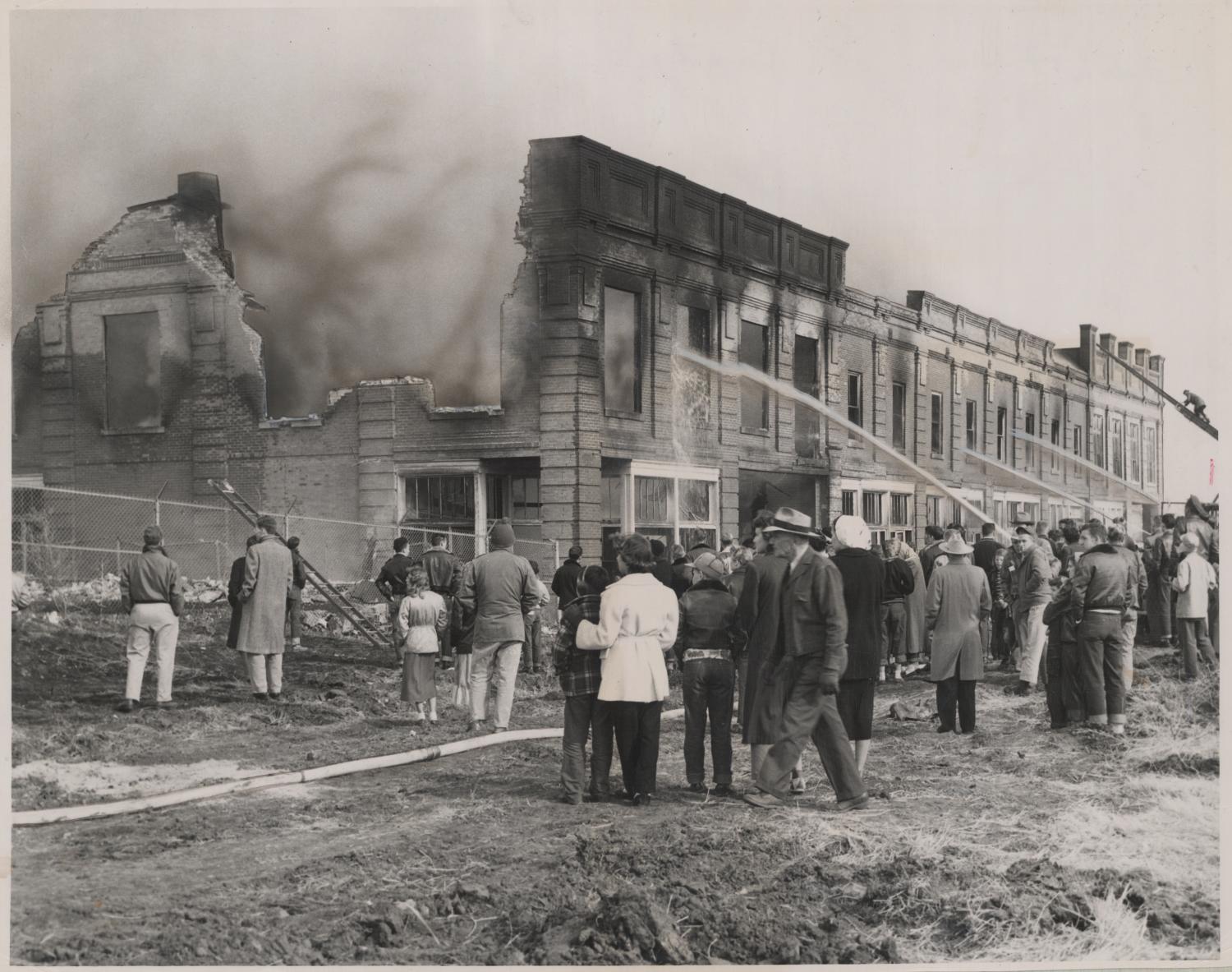
The remaining east wing had housed construction equipment at the time of the fire, in support of the new junior high being built across State Street, which later became Central Intermediate. The remaining portion of the Arnett building was heavily remodeled to become the district’s maintenance building with wood and metal shops.
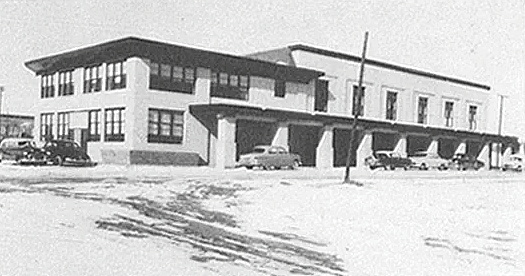
In my childhood, the Arnett building was an imposing oddity just across State Street from the playground of Central Intermediate, where I attended grades 4-6. A beige painted exterior hid its original brick, and by then it had huge metal louvers over the windows. I never saw inside the “east annex” but was told that the junior high shop classes were held in there. In sixth grade, I walked by it each week on my way to and from the west end of campus where I was a crossing guard for kindergarten kids headed to after-school care across 40th street.

In addition to Arnett’s abandoned tunnel under 39th Expressway, there was a tunnel leading westward from the Arnett building underneath the practice field; it was exposed when the Arnett building was demolished in 2017. I presume it was for steam pipes and other utilities, since there used to be a central plant along 40th.
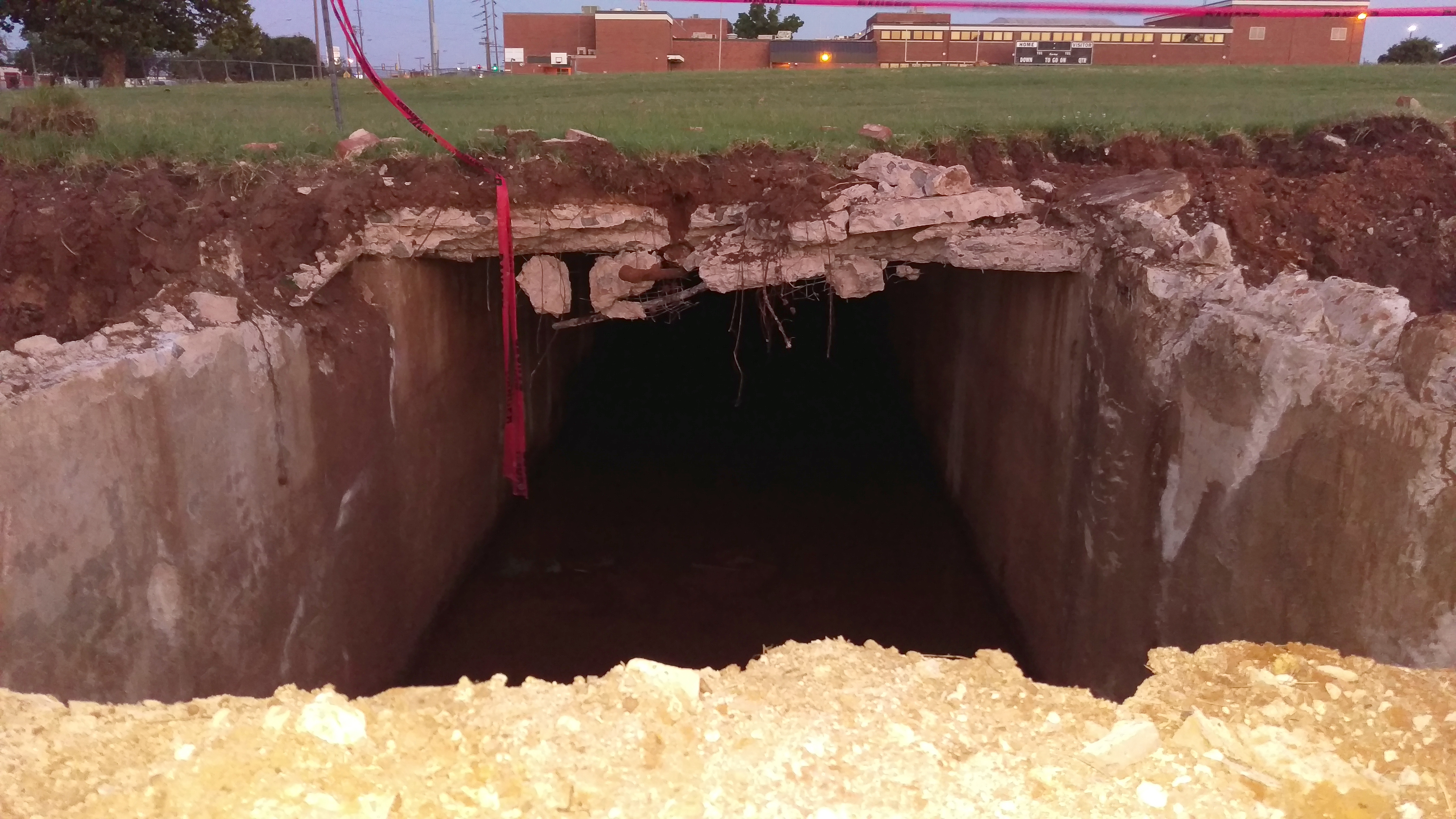
There were likely additional utility tunnels underneath the various other buildings across the campus.
My memories of the PC Central buildings
In 1971-72, I lived with my parents in the Western Village addition near Hefner & Western, over six miles northeast of PC Central. I walked a half-mile along 104th Terrace to and from kindergarten at the neighborhood school in the Oklahoma City school district. But then court-ordered busing was going to bus me miles across town, and my parents moved to Bethany. The Bethany school district, however, was only about a square mile and smaller than the town’s borders, and I ended up going to Putnam City Central for grades 1-6.
For my first day at the new school, my mother put me on the bus. My recollection is that she was the homeroom mother and was heading to the school early to help my teacher set up. I’d never ridden a school bus, but Mom told me which building to head for when I got to school, where to find the classroom, etc. The problem was that the campus extended for 2100 feet along 39th Expressway and was so large that there were three bus stops, and my mother didn’t know that.

The first bus stop was on the east end for grades 4-6 at Central Intermediate, originally built as a junior high in 1952. It had a separate fourth grade building in the center, surrounded on three sides by a building for grades five and six, with asphalt playgrounds on the south along 39th Expressway. There were old wooden barracks-style buildings east of the playground which were the district offices. While I was in fourth grade, they built a new gym on the east end of the playground.

The second bus stop was for Central Junior High. Parts of it reportedly dated back to 1914, but 1961 and 1971 additions made it look much newer than the rest of the campus. It became James L. Capps Middle School years later. There was a practice field to the east, and the old Arnett building was between it and Central Intermediate.
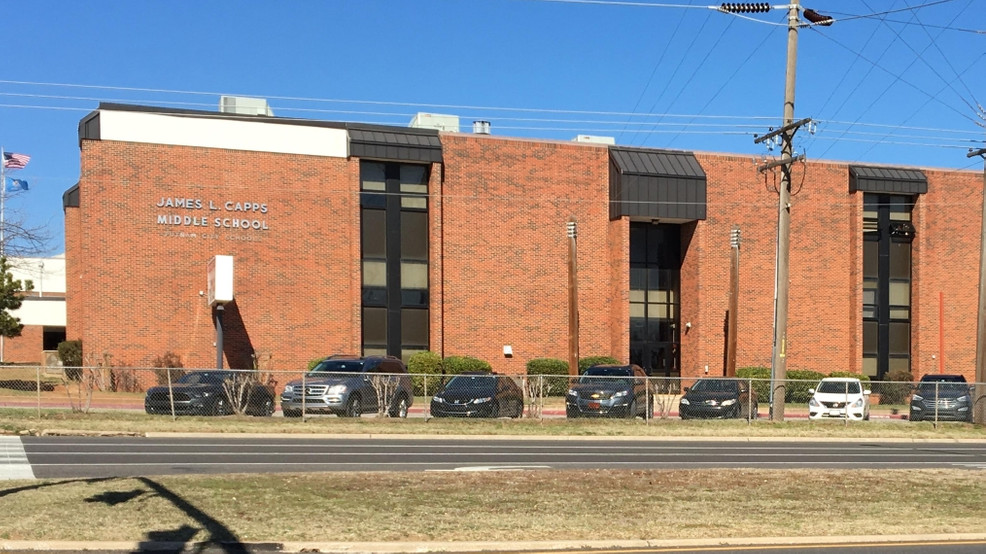
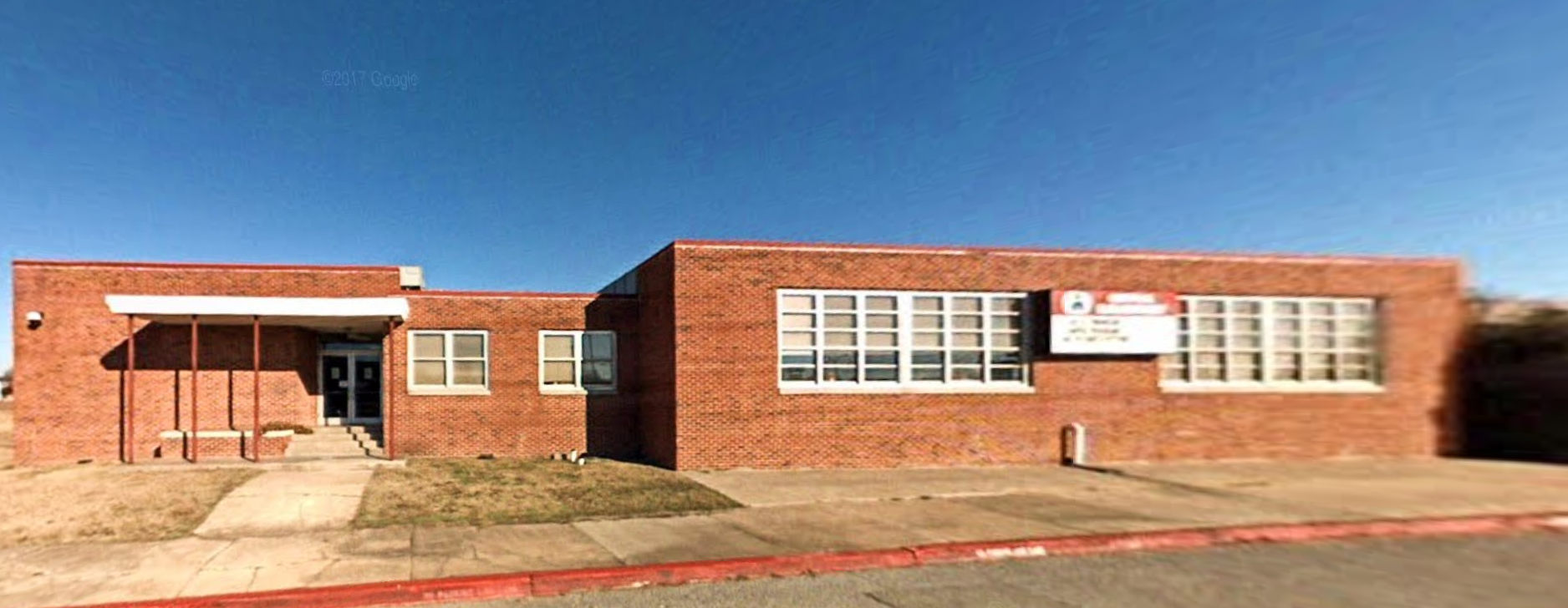
The final stop was for Central Elementary, which had its own newer cafeteria building on the east side, which also housed the district police. There was a polygonal brick building, dating back to 1931, for second and third grades. First grade was in a separate building to the west built in 1948.

On my first day of school, I unknowingly got off at Intermediate, not realizing I needed to wait two more stops. My mother had told me to go to the building on the left. I marched up the steps into the leftmost building, went down the hall as instructed to what should be my first grade classroom, and peered in. I was shocked to see a classroom of sixth graders with no mommy in sight.
I remember how a sweet sixth grade boy noticed me, realized what had happened, and took me by the hand. He led me on what seemed like an endless walk west along 39th Expressway across a street and past the Arnett building, the practice field, and the junior high, across another street and past the elementary cafeteria, past the grades 2-3 building, and finally into the first grade building at the opposite end of the huge campus and marched me up to my mother. What a way to start! But at least I knew this was a campus with people willing to help! Little did I know that I would be repeating that walk regularly myself when I became a sixth grader headed to and from crossing guard duty at the kindergarten, learning to hide my Junior Policeman sash as I walked by the junior high to avoid being taunted.
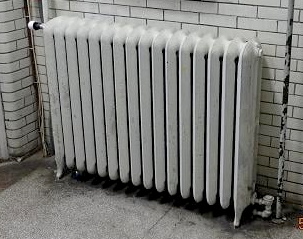
The 1931-1948 buildings still had old steam radiators, bathrooms with long porcelain urinal troughs, and long trough drinking fountains, including some outside that were supported only by their pipes. The playgrounds were asphalt with no protection under the jungle gyms, so a fall meant plenty of scrapes and cuts or worse. And the decrepit boys bathrooms in the second and third grade building made that entire building stink.
I was aghast, since I was used to a school in Oklahoma City that had been built in 1963. What was this old backward place we had moved to? Our house in Bethany was old too, but made interesting by an oversized lot and newer additions…hmmm…sounds a lot like PC Central!


Some of the classrooms in the old elementary buildings had full-width coatrooms at one end where we could hang up our coats and line up our galoshes. Nowadays, those would be completely filled with teaching supplies and junk that resource-poor teachers are unwilling to throw out.
At that time, Putnam City’s patrons passed a bond issue like clockwork year after year. So, in addition to building more schools across the growing district, they started renovating one grade at a time at old Central Elementary. But they did each renovation the year after I exited that grade level. So I saw that facility at its worst. We did get lucky one year, with air conditioning being added. But it was an immense window unit that was so loud that our teacher could only turn it on during guided practice when no one was talking. So we still sweated our way through many lessons.
When I graduated to 4th grade, I began getting on and off the bus at Intermediate. A new gymnasium was constructed on part of the playground while I was there, which was nice. And they eventually added rubber mats below the playground equipment, but that didn’t save me from my worst injury there.
There were long steel single-pipe handrails along the sides of the playgrounds, and in fifth grade I was walking alongside the handrail during recess when a fellow student was running and slammed into me. He was probably playing a ball game and not paying enough attention. That flipped me a full 360 degrees around the handrail to land face-first on the asphalt. Nowadays handrails usually have an extra lower rail to prevent such rotations.
I had just gotten braces and glasses that year. My glasses had durable and flexible black plastic frames, but my braces cut up my mouth, and I was a bloody mess. My mother was called to retrieve me and she took me to the dentist to have my teeth checked. The braces cut me up, but they did prevent me from losing any teeth. My mother placed a high value on education, so she took me back to school, and I was deposited in my empty classroom while my classmates were in the gym for physical education. I remember them coming up the alleyway and seeing me looking down out of the classroom. They ran in to gawk at my facial cuts and swollen mouth. Several told me that they thought I had died!
The Intermediate building was newer than the Elementary ones, but it had tiles coming loose in the bathrooms. My fifth grade teacher designated me to make sure my classmates didn’t keep pulling tiles off the walls of the boys bathroom when we went for a break. Despite always being a short and thin lad of no athletic ability, I was bossy and confident enough to protect our restroom from further vandalism.
Sixth grade at Central Intermediate was interesting since we had separate teachers specializing in English, Math, Science, and Social Studies, and were assigned to one of them for homeroom. The teachers banded together to give themselves some grading and planning time by marching the entire grade to room 201 each Friday after lunch for films. It was extra large and had a small stage.
We would watch 16mm educational films all afternoon with one teacher at a time taking her turn to monitor while the rest worked in their rooms. We watched a lot of Encyclopedia Brittanica travelogues, leading us to think most countries were filled with people who dressed in native costumes and danced. And there was a slew of hokey mental hygiene films from Coronet and Centron.
I only remember the stage in Room 201 being used once. My classmate Carter Steph had been watching the 1976 BBC Television production of I, Claudius on the local PBS channel; we only had NBC 4, ABC 5, CBS 9, and PBS 13 back then. He convinced several of us to play roles in an adaptation of it he wrote, which we performed for the sixth grade. I remember the climax being Claudius eating a poisoned mushroom given to him by his wife, Agrippina, and having a protracted death. As bright and energetic as he was, I’m not surprised that Carter went into law and made good money in real estate.
My mother was homeroom mother so much, handling parties and crafts, that one year at Central Intermediate, I asked if she could not be homeroom mother, just for a change. She laughed and acquiesced, but still volunteered here and there. We moved from Bethany to the Windsor Hills neighborhood after sixth grade. Even though we then lived closer to Central than before, district boundaries meant I was then destined for Leo C. Mayfield Junior High and Putnam City West High School, while all of my Central friends advanced to Central Junior High and then to Putnam City High School. But my sixth grade teachers at Central liked my mother so much that they asked her to still come do crafts with the kids, and she did that for years after I had left Central behind.

Our move out of Bethany meant that I never experienced Central Junior High except when they marched us to its auditorium for a special program, usually to hear an orchestra perform. It seemed absolutely enormous to us, and I remember watching the 1974 movie Where the Red Fern Grows in there. I was a nerd, so I was fascinated that they showed it in widescreen and with reel changes I could see two halves of the image on the screen being realigned. We had passed the projection booth on our way in, and I snuck back up to it to see how they had synchronized two 16mm projectors to pull it off. Is it any surprise that I would go on to run projectors and other audiovisual equipment in junior high?
Gone, all gone
Time marches on, and 45 years after leaving it, everything I knew at Central is now gone.
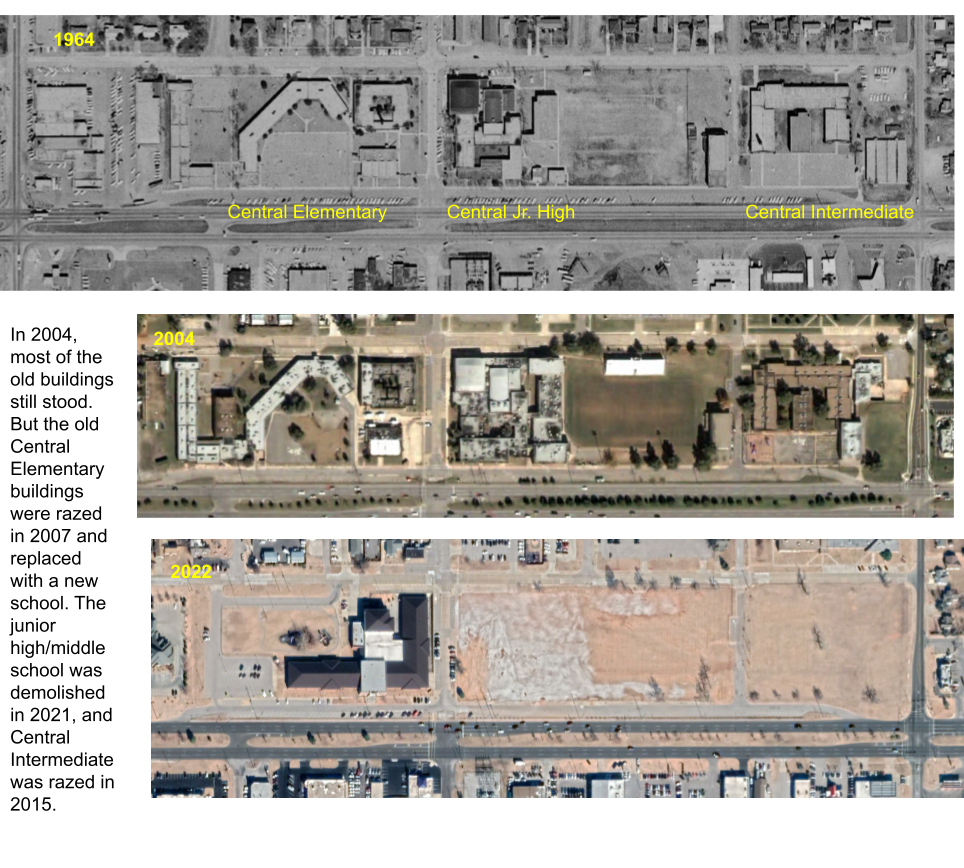

Central Elementary was demolished in 2007, and a new building opened on the former playground and cafeteria plot in 2009. One of my father’s friends saved some bricks from the old building, and Dad gave me one. Despite writing this post and my gratitude to the many good teachers I had at Central, I had no fond feelings for the run-down old buildings. So I’ll confess that I’m using that brick to conserve water…it sits in one of the toilet tanks at Meador Manor.
Central Intermediate became Arbor Grove Elementary by 2009 when the new Central Elementary opened, and then was razed in 2015 after a new Arbor Grove Elementary opened at 5430 NW 40th.
The Arnett building, the former home of the Prophet of the Purebred People, was razed in 2017.


Central Junior High became Central Middle School in the early 1990s and finally Dr. James L. Capps Middle School in 2006. It was razed in 2021, with a new Capps Middle School built at 5300 NW 50th St.
So there is now almost nothing left of Putnam City, the city that never existed.






 Meador Manor
Thanks for this history–fascinating, albeit depressing! Prophet of the Purebred People!!!! omg
This was a great read and brought back many memories. I went to PC from 1st grade to 12th grade. Played football on that field, did shop and wrestled in the Arnett building. It was good to read about how it all developed and changed. I was the first class at Western Oaks Jr. High back in 63-64 and then got to the high school in 64. But it was all technically Putnam City.
Wow, I went all 12 years from 56 to 68. I thoroughly enjoyed this. I grew up on Libby street about 4 blocks east. Great memories even all the old buildings
Thank you for your interesting and informative article. It’s not a surprise that the area was started by land developers of questionable ethics—that is an Oklahoma tradition. I am about ten years older than you and went all the way through twelfth grade at Putnam City. Some of my lifetime best memories were during my school days. When I was at Central Elementary, I’m pretty sure the Arnett Building was painted green then. Also, what became 4-6th grade was actually the high school back in the 50s. I remember moving to Oklahoma City at age four. The new high school (present location) had been hit by a tornado before we moved there. It went through the auditorium. When the building was repaired the bricks were a slightly different color. When looking from the west side, for many years, you could see the outline of where the tornado went through.
I very much enjoyed your article. I graduated from PC West in 1975 and went to Western Oaks Elementary and Junior High. I often wondered what is was like to go Central and what its history was. Of course, at the time, my schools were very new and modern.
I very much loved your article on Putnam City. Graduated in 1974 from original, I started at 39th 1st grade building and next year to 2nd grade building. I also remember the principals office being one of the longest walks ever. Thanks for the memories. Gary Bertrem 1974
Thank you for your wonderful article. I went all 12 years to Putnam City. Attended PC Elementary, Intermediate, Central Jr. High and graduated in 1972 from PC High School. I do remember the Arnett Building as green and the old wooden slide and monkey bars. Lots of memories and sad that nothing exists on 39th Street any more.
I attended Putnam City schools from 1-12 grades. I remember what the old buildings looked like. I drove by the place where old PC Central used to be and didn’t recognize it at all. Well I guess time brings change, but the memories are still the same. I enjoyed your article very much. I remember getting lost on that campus too. Thanks.
I enjoyed this article and the memories it invoked. Started at Central Intermediate in 4th grade, moved and went to Windsor Hills, then Central Jr High and Graduated from original in 1970. Us girls used those handrails you fell over to do flips around the bar “on purpose!”
Very interesting stories!
Regarding the location of Putnam City’s plan for the capital at Grove Park, you state, “The Grove’s northwest corner was at what is now the intersection of Grove Avenue and 39th Expressway, and it extended south to 34th Street and east to what is now Ann Arbor Avenue.” But where is the southern boundary (34th Street) today? Is this 23rd St?
It seems that Eugene Arnett named his property, “Home of the Poor Prophet” and placed cement letters of this name on the front lawn. He lived here and also “attempted to carry out sociological experiments and reforms” (see “Oklahoma, a Guide to the Sooner State” p. 227). Any idea what these experiments were?
His death made the NY Times:
EUGENE ARNETT; Man Who Spent Fortune Seeking ‘Super Race’ Is Dead
Eugene Arnett, who reputedly spent two decades and part of a million-dollar insurance fortune seeking a formula for a race of “supermen,” died yesterday at the age of 62. Mr. Arnett once termed himself “years ahead of time.” “I have no hope that the work I’m doing now will be accepted during my lifetime,” he said, “but it will benefit future generations.”
It would be great if you could also provide references for your info.
Thank you!
I lived in The Village till I was 10 in 1978. Bussing threatened, and my folks decided to move to 63rd and Rockwell where I went to Tulakes 5th and 6th grade. Attended PC Central Junior High starting in 1980 and graduated PC High in 1986. I enjoyed reading about the history of the area. Thanks for your contribution to my understanding of it. Pretty cool.
Hey this was a very interesting article. Thanks for the research. I graduated from West in 74 but went to central grades1-3. My third grade was at the east end in those old wooden barracks across from Whit’s (?) where we could walk over and buy a hamburger. You could stay in the building if you brought your lunch or walk all the way down to the cafeteria (where my whole family received the polio vaccine in sugar cubes) do you remember those giant wooden merry go rounds? Some boy challenged me to climb the flag pole in front of the 4,5,6 building when i was in 3rd grade. I scrambled to the top. The hem of my brand new dress my mother had just cross-stitched an intricate border on got draped over the top. I sold down and the skirt ripped off the waist all the way around. 🤣😢
Thanks for the article! I thoroughly enjoyed the trip down memory lane! I started kindergarten in 1968. My classroom was in the first grade building on the north end.
I was in first grade in the same building and second grade was also in the same building, but in one of the four rooms at the east end going out to the playground. Third grade was in the roundish building over on the east end. I went to 4th-6th in Central Intermediate and then Central Jr. High. I remember the Arnett Building. The new intermediate gym was built when I was in 7th grade, so I remember seeing it, but never was in it.
I went on to Putnam City HS. I lived on 47th St off of Ann Arbor, three houses down with my backyard facing the HS. I remember the house to the west of us was an annex of the school. We went to the cellar of that house once when there was a tornado threat. After about 2 weeks into my Sophomore year, we moved to Tuttle.
But I remember so many teachers and friends from those days. Thanks for posting the photos and for sharing your memories.
I graduated from the original Putnam city in 1968 attended all 12 years. My parents owned the A1 Café on 39th St. and we lived on Libby until we move to 43rd and Meridian
My grandmother was Eugene Arnett’s sister, Roberta Fay, Arnett. When Eugene died he left haft of his estate to my grandmother Roberta Fay Arnett. The funding he received as a young man from his family his father L A Arnett, he promised to give to his sister her share of their family estate. The wife Mabel Arnett he had divorced and remarried, returned from California with their daughter and he let them live in the Arnett building. After Eugene’s death and his estate went to probate court, his wife hired Israel Mercer Putnam, who she married after his death to stop my grandmother from claiming her haft of the estate. They tied the estate up in probate court for over 30 years. The estate was finely settled in 1965 after Putnam’s death in 1961. Putnam had looted the estate of millions of dollars after Mable’s death in 1953, with hair-brain investments, building a collage in Texas and went through all the estate. My grandmother died in 1966, and received $5K, my mother Helen Fay Murphy received $2,500.00 and my four siblings received $1,200 each….
Thank you for sharing your family history, although it was obviously a painful and frustrating experience.
Thanks for the message Granger, my Great Uncle Eugene Arnett, had quite a history in Oklahoma, he met Mercer Putnam, in late eighteen hundreds, when the Oklahoma Territory had settlers were coming from the east to find land and settlements in the Indian territories. Mercer and Eugene worked together developing plots of land to market to new family’s coming west. Putnam had big ideas in developing his Putnam City to be the Capitol of Oklahoma. Eugene and Putnam made a huge effort to get that done with Putnam donating 2000 acres to the state for the Capitol to be in Putnam City. They fought hard to make this opportunity work but other political power players fought them saying Putnam City was to far away from OK City. Mercer lost his wealth when his dream failed. Eugene bought the Arnett Building from Putnam after his failure to get the Capitol to Putnam City. One of my fondest stories my grandmother told me when I was young was when she was working in Earlisboro for her brother Eugene in one of his Banks. The Bank got robed one day and my grandmother Roberta Arnett Fay, said the bandit with his gun pointing at her behind he window said ” I wish we could have met under other circumstances”. Eugene saw very smart he didn’t invest in the stock market, when the crash of 29 hit he had his money oil leases, his insurance business. All of his friends like Putnam lost all their money in the crash. Eugene’s best collage classmate was Charles Fay from Wichita Kansas where he was raised. Charles Fay was my grandmothers husband, which was arranged through Eugene making sure his sister married into a well to do family. My son has a passion for genealogy and has traced our family history past the American Revaluation, to Europe and Ireland. It was a painful journey for my grandmother to have to go through all those years of court battles trying to get he inheritance but she had a large estate from her husband my grandfather Charles Fay. My grandfather Charles Fay was a good friend and worked together with Tomas Edison on projects. …Pat
I went to Villa Teresa from preschool to Kindergarten and then attended Putnam City Central elementary from 1st to 3rd grade. I was born in 1963 I remember we had recess with the special Ed children and that was a great experience because we learned to have empathy for others. My second grade teacher was Mrs spelling in my third grade teacher was Mrs Miller. Then I was a four eyed kid that was bused to an all black school, Harding Middle School. Thank goodness that didn’t last long because I was beat up on a weekly basis. Then we moved West and I went to Mayfield then Madill Oklahoma and finally Atoka Oklahoma for my Junior and senior year. 7 Mile classmates for Kim Hall, Cindy Cummings and Scott Boyle. I have lost touch with everyone from those days.