
In 2011, I perused the Modern Library’s listing of the 100 best novels of the 20th century. Upon finding that I had only read 10 on the board’s list, I decided to read Nabokov’s Lolita and Lowry’s Under the Volcano. In 2019, I returned to the listing to discover and read McCullers’ The Heart is a Lonely Hunter. I returned to the board’s listing today, rightly convinced that my latest read would be on it; my tally is now 17.
#17 for me was #79 on their list: A Room with a View by E.M. Forster. Since it was published in 1908, it was a free download from Project Gutenberg. Forster has two other novels ranked higher in their list: A Passage to India at #25 and Howards End at #38. So what prompted me to read my first Forster novel and make it A Room with a View?
The Machine Stops, Merchant Ivory, and Julian Sands
Director James Ivory, his business and life partner Ismail Merchant, and screenwriter Ruth Prawer Jhabvala gave us movie versions of Forster’s A Room with a View in 1985, Maurice in 1987, and Howards End in 1992. I saw each of them years ago, but I hadn’t considered reading the Forster novels they were based on.
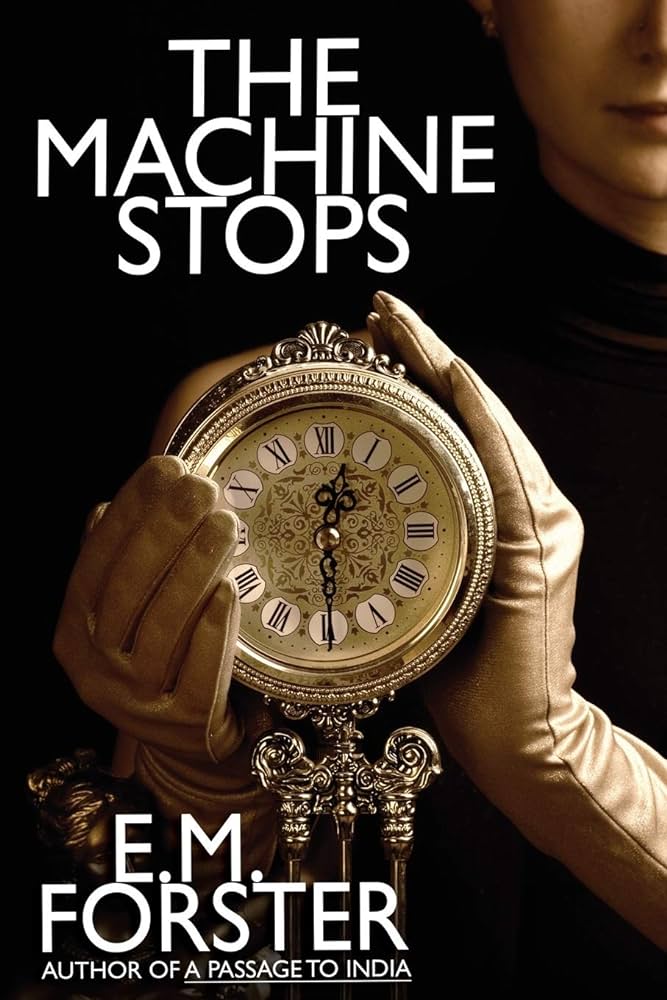
Years later I came across Forster’s science fiction short story of 1909, The Machine Stops. The story is set in a time when humanity lives underground and relies on a giant machine to provide its needs. It predicted technologies similar to instant messaging and the Internet, and I found the prescient and chilling tale quite stunning. While that primed me to consider reading one of his novels, I took no action.

Back in 1985, at age 27, Julian Sands starred as George Emerson in Merchant Ivory’s A Room with a View. He shared the screen with a bevy of talented actors, including Helena Bonham Carter, Maggie Smith, Denholm Elliott, Daniel Day-Lewis, Judi Dench, Simon Callow, and Rupert Graves. In January 2023, at age 65, Sands went hiking in the San Gabriel Mountains near Los Angeles and disappeared. In June his remains were finally discovered.
When I read about his death, I realized that I remembered little from the movie, which I hadn’t seen in almost 40 years. Thus a seed was planted in my subconscious.
Skip ahead a few months to when I finish reading Mercury Pictures Presents on my Kindle. As I had encountered with The Lincoln Highway a year earlier, the prose was truly impressive, but the plot failed to engage me, and I found myself distracted by other pursuits after each chapter. I knew there were books waiting on my Kindle with more gripping plots, but less skilled prose. I yearned for something that would excel on both fronts.
That gave my subconscious the opportunity to surface A Room with a View. It whispered, “You liked the plot of A Room with a View when you saw the movie adaptation in 1985. Why not download the book, read it, and then rewatch the movie?” So I downloaded the novel, used Send to Kindle to load it onto my devices, and sampled the first chapter.
Highlights
I was immediately struck by how rapidly and skillfully Forster created a milieu for female characters whose repressed manners were happily reminiscent of the best of Jane Austen’s work. The tone reminded me of the humor I found in Emma, which I read in 2012 after enjoying the 1996 movie version with Gwyneth Paltrow. So I read on.
Chapter 2 rewarded me with this:
The chapel was already filled with an earnest congregation, and out of them rose the voice of a lecturer, directing them how to worship Giotto, not by tactful valuations, but by the standards of the spirit.
“Remember,” he was saying, “the facts about this church of Santa Croce; how it was built by faith in the full fervour of medievalism, before any taint of the Renaissance had appeared. Observe how Giotto in these frescoes—now, unhappily, ruined by restoration—is untroubled by the snares of anatomy and perspective. Could anything be more majestic, more pathetic, beautiful, true? How little, we feel, avails knowledge and technical cleverness against a man who truly feels!”
“No!” exclaimed Mr. Emerson, in much too loud a voice for church. “Remember nothing of the sort! Built by faith indeed! That simply means the workmen weren’t paid properly. And as for the frescoes, I see no truth in them. Look at that fat man in blue! He must weigh as much as I do, and he is shooting into the sky like an air balloon.”
He was referring to the fresco of the “Ascension of St. John.” Inside, the lecturer’s voice faltered, as well it might. The audience shifted uneasily, and so did Lucy. She was sure that she ought not to be with these men; but they had cast a spell over her. They were so serious and so strange that she could not remember how to behave.
At that point, I knew I was in good hands and would happily read multiple chapters at a sitting.
Forster’s Novels
E.M. Forster only produced six novels. Although he lived from 1879 to 1970, all of them were published by 1924, except for one which he held back for posthumous publication since it was a tale of homosexual love. Forster lived in the closet, since homosexual acts were still grounds for imprisonment in Britain until 1967. I wonder how many who enjoyed the romantic tale of heterosexual love in A Room with a View without realizing it was written by a gay man. Probably a similar proportion to those who see and hear the songs of Curly and Laurey in Oklahoma! without knowing the story of Lynn Riggs.
Forster’s novels repeatedly address issues of class in Edwardian England, with Howards End notably revolving around social conventions, codes of conduct, and relationships among three families representing the upper, middle, and working classes. I am certain that I shall read it some day, but first I must revel in A Room with a View.
The character of Mr. Emerson, the liberal father of George, provides some of the best lines. Early on, he remarks:
We know that we come from the winds, and that we shall return to them; that all life is perhaps a knot, a tangle, a blemish in the eternal smoothness. But why should this make us unhappy? Let us rather love one another, and work and rejoice. I don’t believe in this world sorrow.
Forster also wonderfully evoked what playing the piano once meant for me:

It so happened that Lucy, who found daily life rather chaotic, entered a more solid world when she opened the piano. She was then no longer either deferential or patronizing; no longer either a rebel or a slave. The kingdom of music is not the kingdom of this world; it will accept those whom breeding and intellect and culture have alike rejected. The commonplace person begins to play, and shoots into the empyrean without effort, whilst we look up, marvelling how he has escaped us, and thinking how we could worship him and love him, would he but translate his visions into human words, and his experiences into human actions. Perhaps he cannot; certainly he does not, or does so very seldom. Lucy had done so never.
I particularly enjoyed the character development of Lucy, the protagonist, who matures through the book from a confused girl into a self-directed woman. Here is an adept passage about her struggle in which I have emphasized a key insight Forster had about human foibles:

The contest lay not between love and duty. Perhaps there never is such a contest. It lay between the real and the pretended, and Lucy’s first aim was to defeat herself. As her brain clouded over, as the memory of the views grew dim and the words of the book died away, she returned to her old shibboleth of nerves. She “conquered her breakdown.” Tampering with the truth, she forgot that the truth had ever been. Remembering that she was engaged to Cecil, she compelled herself to confused remembrances of George; he was nothing to her; he never had been anything; he had behaved abominably; she had never encouraged him. The armour of falsehood is subtly wrought out of darkness, and hides a man not only from others, but from his own soul. In a few moments Lucy was equipped for battle.
And that is soon followed by:
She disliked confidences, for they might lead to self-knowledge and to that king of terrors—Light.
My highlighted passages conclude with two, again from the character of Mr. Emerson as he prods Lucy to stop lying to the world and to herself about her love for his son, George:
It isn’t possible to love and to part. You will wish that it was. You can transmute love, ignore it, muddle it, but you can never pull it out of you. I know by experience that the poets are right: love is eternal.
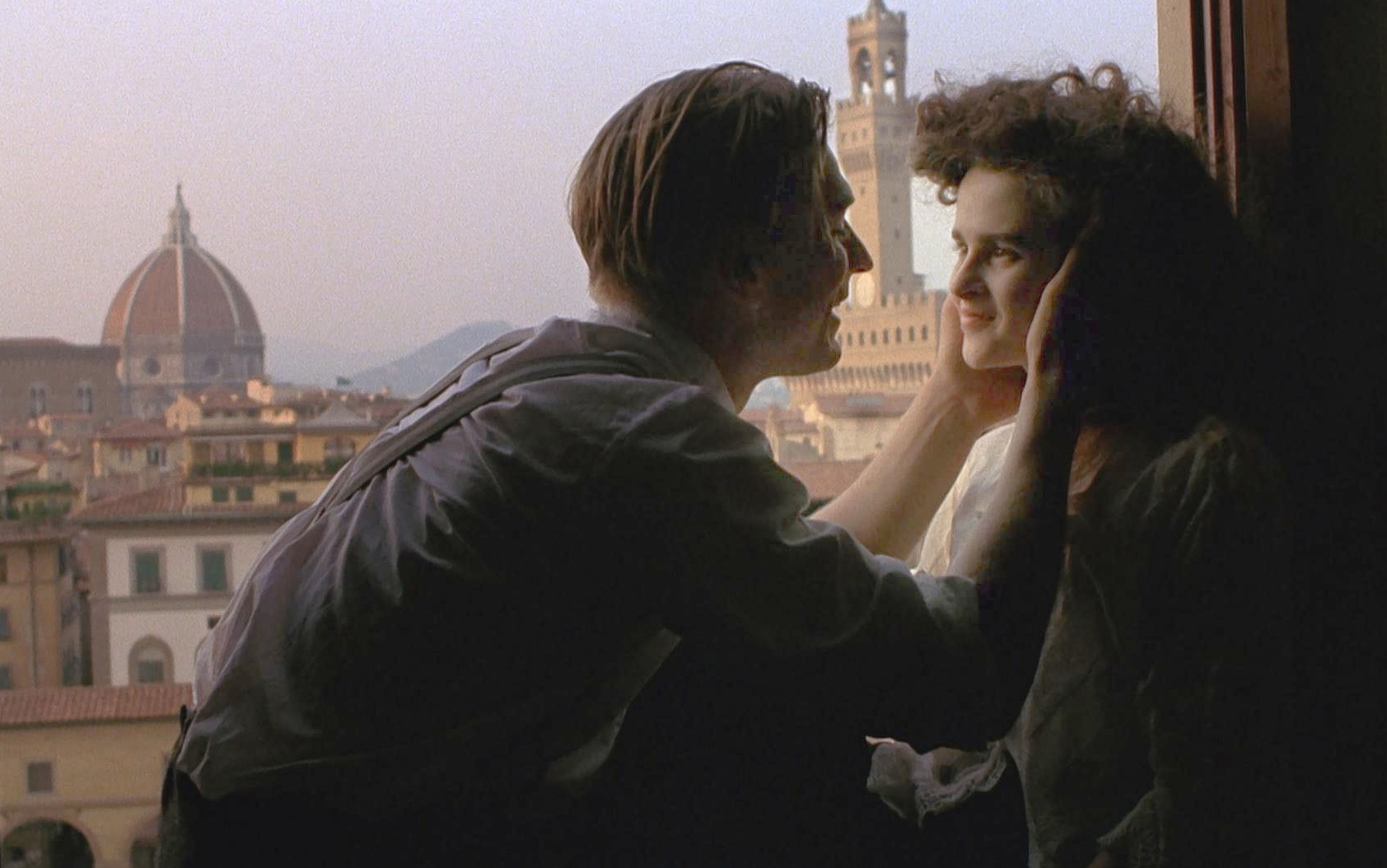
When I think what life is, and how seldom love is answered by love—Marry him; it is one of the moments for which the world was made.
Forster embues his novel with such humanity, such tender understanding and forgiving regard for human nature even as he points out our failings. It helps me understand what Lord Annan meant when he spoke about the novelist after his death:
…his friendship was one of the things that one could never forget, because he was both very loyal to his friends and also very critical, and you had to keep up the mark. You were frequently deflated if you appeared to be insensitive, because that was the thing that he cared about so much…he had a greater sensitivity to the complexities of life and the complexities of morality, and that is why I think he will live as a great force in our literature.
I was touched by how the novelist, playwright, and screenwriter Christopher Isherwood spoke about his late friend:
Forster once said, “I have only got down on to paper, really, three types of people: the person I think I am, the people who irritate me, and the people I’d like to be.” My guess is that Mr. Emerson is a person Forster would have liked to be, that Lucy’s fiancé, Cecil, represents Forster in some ways, and cousin Charlotte would have irritated him. Yet a careful reading shows Charlotte to have been instrumental in eventually uniting Lucy and George. There is something profound in that.
A Beautiful Adaptation
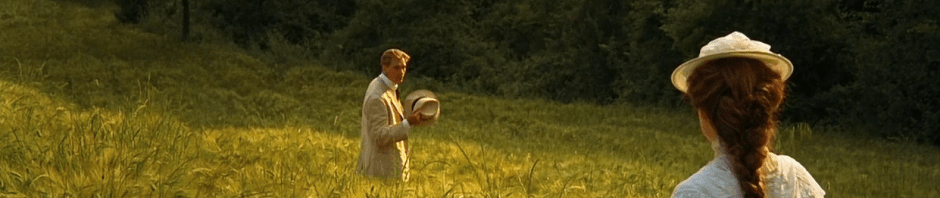
After finishing the novel, I immediately rented and watched the movie on my iPad. It was delightful. Here is a glimpse of the start, which illustrates screenwriter Jhabvala’s skill at adapting the book:
It is a beautiful film:
Hence I am grateful to Merchant, Ivory, Jhabvala, and the other talented professionals, including the poor late Julian Sands, for helping me find Forster. More treasures await.








 Meador Manor
Such irony i our writings. After reading two novels set in Paris during Gertrude Stein’s reign over literature plus one novel that took us to Italy, all three mentioned Forester A ROOM WITH A VIEW. I read the book this spring and watched the video lying for answers as to why he seemed to be so populate. He had talents!
When you wrote about Mouradian golf course and it’s history in Oklahoma City, my daughter and I began to follow your blog. She lives off 36 in Meridian and I live in Norman. Her granddad, my father was a golf pro from the 30s through the 70s. He played most all of the OKC golf courses and knew the great babe Didrikson.
I am writing the history of my country club in Miami, Oklahoma, golf and country club. It is much more extensive and in-depth than I ever plan to write but it has been fun.
I write two blogs, so I stay quite busy when I’m not playing golf, traveling, playing with the dog, gardening, or just enjoying life, like reading a good book. My husband and I are both avid readers.
Our writings seem to follow similar paths.