
November 8, 2023

This is a look back at the key shifts in how I listened to recorded music over my lifetime, with examples of what I was listening to at the time.
1960s vinyl record albums
I was born in the mid-1960s, and at first the only recorded music stored in our home was on vinyl long-playing records that my mother could play on her phonograph, a Sears model from the late 1950s.


My mother taught me to play records on my own, cleaning and handling them carefully. My favorites were a 1957 performance of Peter and the Wolf by the Philadelphia Orchestra with Eugene Ormandy conducting and Cyril Ritchard narrating, the 1955 Songs of the West album by the Norman Luboff Choir, and 1962’s Pianos in Paradise by Ferrante & Teicher.


1970s vinyl record albums
By the mid-1970s, 46% of U.S. recorded music sales were still on long-playing 33-rpm vinyl records, 32% on vinyl 45-rpm singles, 18% on 8-track tape cartridges, and 4% on compact cassettes. I was nine years old when I acquired the first album of my own: 1975’s Goofy Greats by K-tel. I had received a blue plastic fishing tackle box as a gift but didn’t like fishing, so my best friend Gene Freeman, who owned Goofy Greats, traded it for my tackle box.
The album was entirely novelty songs, with favorites of mine being Shirley Ellis’s The Name Game, the Playmates’ The Little Nash Rambler (The Beep Beep Song), and especially the Royal Guardsmen’s Snoopy vs. the Red Baron.
The records I encountered were either long-playing (LP) 12-inch diameter albums you were supposed to play at 33 1/3 rpm or 7-inch diameter singles you were to play at 45 rpm. But 78 rpm records were produced until 1958, and Mom’s player could also handle rare 16 2/3 rpm records, which were typically talking books for the blind. So Gene and I had fun even with the songs we didn’t care for, adjusting the speed on the 1950s record player from 33 1/3 rpm to 45 or 78 to make it sound like the Chipmunks were performing or to 16 rpm to slow a song way down.
That ready ability to change speeds on record players allowed for great discoveries to be made. This included transforming Dolly Parton into what we imagined to be a black male singer by playing her song Jolene on a 45 rpm single at the reduced speed of 33 1/3:
Not much later I somehow acquired the record Convoy during the Citizens band radio craze of the mid-1970s. I was still a bit young to identify with Hot Chocolate’s You Sexy Thing, Donna Summer’s Love to Love You, or the Ohio Players’ Love Rollercoaster, although I did like Silver Convention’s Fly, Robin, Fly, John Denver’s Country Boy, and his Fly Away.


Physical media dominated U.S. recorded music sales until the mid-2000s. The RIAA chart below shows how they then faded away. As of 2022, sales of physical media were only 11% of U.S. recorded music revenues, while 58% of revenues were via paid subscription services and most of the rest via various types of ad-supported streaming services. The light blue bars in the graph show the rise and then disappearance of cassette tapes.

Reel-to-reel, 8-track, and compact cassette tapes
For those too young to recall tape formats, the first audio tapes I remember seeing were reel-to-reel units that some audiophiles would purchase for home use. Our family never had one, but the father of a friend of mine in junior high did, although we didn’t mess with it. Reel-to-reel units were mostly discontinued by the 1980s.

The first tape formats to gain widespread popularity were the 8-track cartridge and the compact cassette, driven (pun intended) by their use in automobiles. Lear Jet designed a version of the 8-track that was quite popular, peaking at over 18% of U.S. recorded music sales in 1978.

In the 1970s, my father purchased an inexpensive Soundesign stereo system with a turntable to play vinyl records, an AM/FM radio, and 8-track recorder. He liked playing 8-tracks in his station wagon and accumulated quite a few, some purchased new and others at garage sales. He never used the recording feature much.
8-track tapes my parents liked included Johnny Rodriguez, Don Williams, the Statler Brothers, and Freddy Fender.
8-tracks had drawbacks, including how as an endless loop they couldn’t be rewound and had to be split into four “programs” with two tracks in each program for stereo sound. That led to songs sometimes being split across two programs. Such songs would fade out, you would hear a clunk as the tape head shifted to two new tracks, and then the song faded back in.


In the early 1970s, my parents purchased a compact cassette recorder from Radio Shack for use with my piano lessons. That was a significant purchase at the time, with $74.50 in 1971 equivalent to $563 in 2023. We used it for years, and I had a lot of fun one summer in junior high with a neighborhood tomboy recording our own “Batgirl and Robin” adventures on it. I wish I had saved those tapes!

Compact cassette tape ran at a slower speed than 8-track tapes, so originally 8-tracks had better sound quality. Cassettes, however, were less bulky, could have a longer run time, could be rewound, and only had a side A and side B.
So gradually cassettes edged out 8-tracks, and eventually noise reduction technology reduced their tape hiss and different tape formulations improved their sound. 8-track sales volumes started plummeting in 1979, when I was still in junior high school, and the format was essentially dead by 1983 before I graduated from high school.
I had another cassette recorder in 1981, a Radio Shack CTR-80A we purchased to link to my TRS-80 Color Computer so it could save and retrieve programs as a 1500 baud audio signal. It worked, but I was very glad to eventually replace it with some 160 kilobyte 5.25″ floppy disk drives.
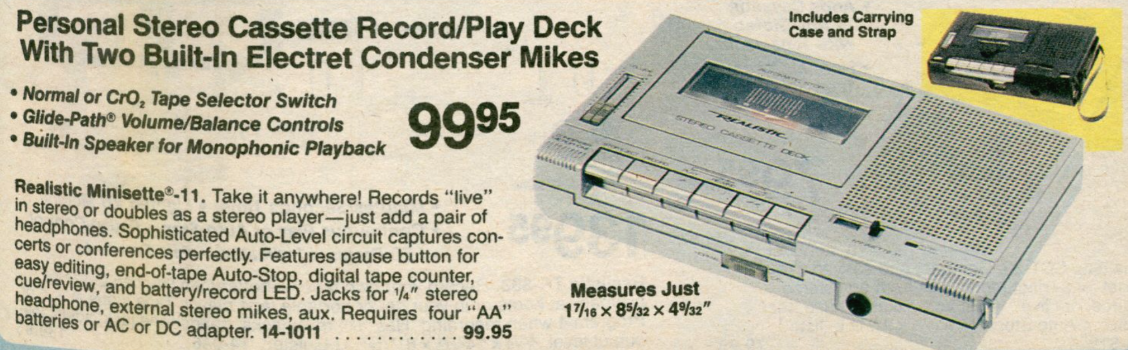
In 1983, I purchased a Radio Shack Realistic Minisette-11 for the equivalent of over $300 in 2023 when adjusted for inflation. I wanted something more functional than a typical Sony Walkman portable cassette player, although I eventually had one of those too…which I almost never used.
Vinyl with cassettes
In junior high I began purchasing some vinyl long-playing records from Columbia House, which let me acquire a bunch of albums in the mail for next-to-nothing so long as I agreed that I would pay for another album they sent me each month unless I remembered to reject it in advance.

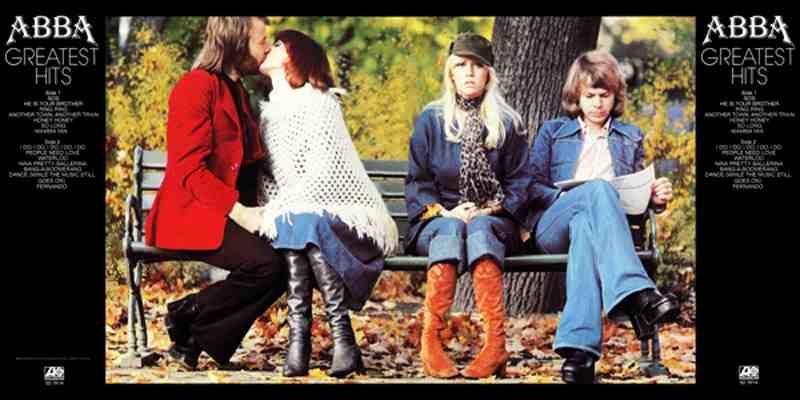
My favorite album from my initial purchase was ABBA’s Greatest Hits, so I bought their Greatest Hits Vol. 2, and eventually all of their albums from Columbia House, and remained a customer of theirs for several years until I could drive myself to a record store.

In high school I would hear songs on the radio and see music videos on the MTV cable channel. I would purchase my favorite songs as 45-revolution-per-minute vinyl singles, usually at the Sound Warehouse in the Cornerstone Plaza shopping center at 39th Expressway and McAlester Boulevard in Warr Acres.
My first car, a 1976 Toyota Corolla, originally just had an AM radio and no way to play recorded music. So I saved up money to address that issue, which required a new home stereo and a new unit in the car.


In high school I had a checking account with a debit card. I remember nervously making what was then an immense withdrawal of about $200 at an automated teller machine to purchase my own stereo system at a Service Merchandise.

Service Merchandise was an interesting retailer. It had an extensive catalog of items along with “catalog showrooms” where you could see a working demonstration model of an item. If you wanted to purchase an item at the showroom, you grabbed a clipboard and pencil and filled out the item number, description, and price in pencil on an order form, which you submitted at a cash register to pay for it.

You then went to the pick-up area where items would come in on a conveyor belt from their warehouse area. I remember being impressed when they updated to computer terminals where shoppers could enter an item directly into their system, immediately letting you know if it was in stock.

My stereo, like my parents’, had an AM/FM radio and a turntable, but while theirs had an 8-track recorder, mine had an 8-track player and a compact cassette recorder.
For the car, I had a new AM/FM radio unit with a cassette deck installed. That allowed me to play my vinyl albums and singles on my home stereo, record the playback onto compact cassette tapes, and then play my “mix tapes” in the car.

By then it was the early 1980s and one of my friends had fixed up an old muscle car and would go “cruising” in it along 39th Expressway/US 66 in Warr Acres and Oklahoma City. My girlfriend and I once had fun cruising the strip in my pathetic green 1976 Corolla, blasting I Love Rock and Roll by Joan Jett and the Blackhearts on my cassette deck. We would provoke the muscle cars to go tearing off at stoplights, leaving us laughing and choking on their exhaust.

I was nerdy enough, and my handwriting poor enough, that I actually used a typewriter for the cassette labels and the track listings on the case inserts. Soon I had a briefcase in the backseat filled with cassettes, almost all being ones I had recorded off vinyl records, not commercial cassette tapes, since I liked being able to listen to my songs on vinyl records at home and on cassette tapes in the car.
So what were some memorable albums I purchased in high school? ABC’s The Lexicon of Love, Peter Gabriel’s Security, and Synchronicity by The Police.


Upgrading my stereo equipment
In 1986 I updated my stereo system from an all-in-one to components when I was mid-way through my undergraduate work at The University of Oklahoma. I spent about $100 each on a Technics tuner, phonograph, and cassette player. By then, U.S music sales by volume were 20% vinyl albums, 15% vinyl singles, and 56% cassettes. Compact discs had appeared, but were still less than 9% of sales volume.
I bought a Technics SL-QD3 direct-drive turntable. I liked how it had quartz lock and a stroboscope to help ensure it was turning at the correct number of revolutions per minute, whereas my cheap Soundesign phonograph had some noticeable wow and flutter.

But that nicer turntable needed a dedicated tuner to amplify its phonograph output, and I needed a compatible cassette recorder. So I also purchased a Technics SA-150 tuner and a cassette deck. The tuner provided AM/FM radio and allowed me to switch between the phonograph and the cassette tape monitor.

I didn’t keep the original silver cassette deck for long, opting to replace it a year later with a Technics RS-B105-KM unit that had Dolby B noise reduction and supported Type II chromium dioxide and Type IV metal tapes.

So what sort of albums was I purchasing in college? Favorites would be Paul Simon’s Graceland, U2’s The Joshua Tree, and Promise by Sade. I had them all on vinyl, and would eventually buy them on compact disc as well.


Compact discs

Compact discs were wonderful, being digital and having anti-skip error correction. I was so glad to be rid of the distracting pops and crackles and jumped grooves of aging vinyl records, and I embraced the greater dynamic range and simpler handling of CDs.
I remain bemused that some people prefer vinyl. If they say a vinyl record sounds better than a compact disc, they might also be the type who like the “cinematic look” of 24-frames-per-second movies and are not annoyed by flicker or motion blur.
As I was completing my undergraduate degree, I finally purchased my first compact disc player in 1988, almost six years after the first players became available. It was a Technics SL-P1, which was quite expensive and was 13.1 inches deep, while my tuner was only 9.5 inches deep and the cassette deck was 8.66 inches deep. I put my new CD player on the bottom of the stack and was grateful that the cassette deck and tuner did not block its top rear vents.


Compact discs were originally specified to support indices within a track, which allowed you to jump to different parts of a given track. My SL-P1 could display the index during a track, and I could jump to an index. My first compact disc was Stravinsky’s Le Sacre du Printemps (The Rite of Spring) by the Montréal Symphony Orchestra conducted by Charles Dutoit. Like many early classical compact discs, it supported the index feature, but I don’t recall ever using the index function on another disc, and none of my later players supported them.
I also spent $60 in 1988 on a Sony CFS-1000 AM/FM Cassette portable stereo with speakers that could be detached and extended on wires. I never used it much.


Looking at a photograph of my stereo system taken in an Oklahoma City apartment in early 1989, I see that by then I had 24 compact discs as well as the various vinyl record albums, vinyl singles, and a few cassette tapes – with a bunch more out in the car. I see that the system was still hooked up to some old Zenith speakers that each had a tweeter and a woofer.
Although I had updated from the 1976 Corolla to a 1978 Chevrolet Monte Carlo and then a 1981 Toyota Celica Supra, I was still using cassettes in the car, since I didn’t have a car with a compact disc player until I bought a new Honda Accord in 1991.
When I moved into a rental house in 1990, I could finally play music as loud as I wanted to. I found I enjoyed turning off all the lights at night and lying on the couch, listening to a compact disc. But there were times I wanted a mix of songs, and CDs sounded much better than cassette mix tapes. So in 1992 I replaced the original compact disc player with a Technics SL-PD827 carousel unit that could play five discs at a time. I could program it to jump to a particular track on any of the five discs.

That setup was stable for over a decade. The CDs I purchased during my early teaching career included various ones by Basia, Pet Shop Boys, Sinéad O’Connor, Sting, and U2. At a Science Club Christmas party at my rental house in the early 1990s, I remember some students were impressed that I had about 40 CDs…that would grow to over 400 by 2010.


Television brings an audio update
My music system evolved again in 2003 when I upgraded my television. By then the stereo in the living room was hooked up to the big old speakers my parents had purchased with their 1970s Soundesign system and there were also wires tucked under baseboards leading back to my office where my old Zenith speakers were available as remotes.

I decided to purchase a new 30″ high-definition cathode-ray-tube television to replace my 19″ television from 1982. In addition to the high-resolution 16:9 screen, I wanted surround sound for movies. So I upgraded to a Panasonic SAHE100S receiver with Onkyo surround sound speakers to use with a VCR and DVD player, which could also play CDs.
Those 2003 speakers are still what we use twenty years later in the living room, albeit with a different tuner/receiver/amplifier that could support a 7.1 system if we wanted that. 5.1 systems have a center speaker, left and right front, and left and right back plus a subwoofer for low-frequency sounds. That’s plenty for us, but some folks splurge on 7.1 systems that add side left and right speakers, and a few folks add in-ceiling or up-firing speakers for Dolby Atmos.
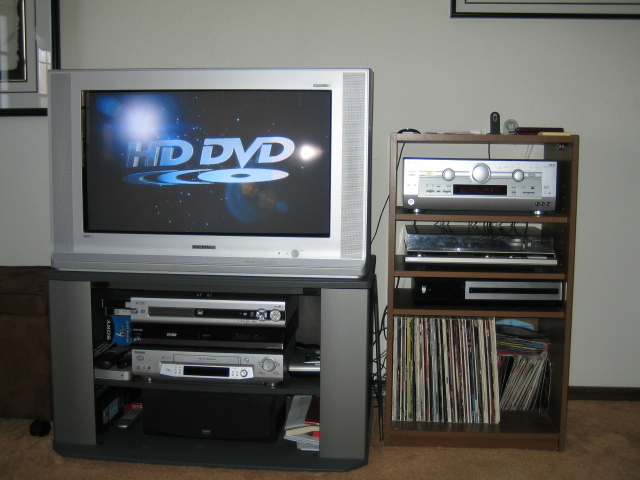
2003 was when I abandoned playing cassettes in the house, and that was also the last year cassette recordings had a measurable amount of sales volume in the U.S. Soon I would make the switch to downloading music as MP3 files.
MP3 files

The MP3 compression format for digital audio files came along in 1993. That eventually allowed the Napster file sharing network to make pirated music readily available. I refused to use Napster or LimeWire to steal music…I was never a Boy Scout, but my wife says I might as well have been one. I continued to purchase compact discs, although once I had an iPod, I did begin “ripping” them on my home computer into the MP3 format so I could load them onto it.
In 2004 I purchased a 4th-generation Apple iPod for $500 (equivalent to $819 in 2023). It was exhilarating to carry so many songs in high quality around in my pocket on its tiny 40 gigabyte spinning hard drive. The click wheel was a great interface for the time.
I will never forget taking my iPod with me on a hike on Mount Rainier in Washington State in the summer of 2005. I was hiking on a snowy trail in short sleeves listening to my iPod on shuffle play. Just as I came to a tremendous vista, Hanson’s MMMBop of 1997 started playing, and I couldn’t resist singing along as I bounded down the snowy mountainside.


Since I was building up MP3 music files, I also purchased an Philips AZ 115517 MP3-CD player boombox for my home office. You had to burn MP3 files on a recordable compact disc to play them; the unit didn’t support USB flash drives. It survived until the great Meador Manor cleanout in 2016.
My first iPod still used a spinning hard drive, but it was replaced by solid-state iPod Nanos in 2005 and 2007 and then my first iPhone in 2008. I had so many music files, all of which I had paid for in one form or another, that I had to buy iPhones with larger storage capacities to handle them, and for several years still couldn’t fit my entire collection on the devices. My 2008 iPhone 3G only had 16 gigabytes of memory, while my 2022 iPhone 14 Pro has 16 times more.
MP3 killed the CD star
Compact discs were less attractive once I had an iPod, since I could connect it to a cheap cassette adapter to play songs in my 2001 Toyota Camry and dispense with having to create cassette tapes or playing CDs in the car. So sometime after 2004 I shifted from purchasing CDs to purchasing music as digital files via the iTunes Store. That led me to upgrade the computer speakers in my home office for awhile since I found myself playing songs there on iTunes instead of on CDs in the living room.
For awhile I was fascinated by the iTunes Visualizer, and I would playback songs like Fatboy Slim’s Praise You with the room lights off, watching the Visualizer.
I found it fascinating to see how Fatboy Slim created his remixes back in the day:
I still love his remix of Brimful of Asha, which really amped up the original song. And of course I identify with how Tjinder Singh was singing and writing about listening to Bollywood cinema star Asha Bhonsle “on the 45”, referring to the vinyl record singles I listened to back in high school.
I finally abandoned physical musical recordings altogether in 2010, when I decided to sell off most of my books and compact discs to fund the purchase of my first iPad. Longtime readers of this blog will know that I enthusiastically embraced the Amazon Kindle along with my Apple iPods and iPhones.
I managed to get paid $631 for 364 compact discs in 2010. By then, downloads accounted for most U.S. recorded music sales, with compact discs accounting for only 16% of the sales volumes and vinyl for a paltry 0.2%. I crammed all of my old phonograph records and cassette tapes into a bedroom closet, where they sat until Wendy and I got rid of them in 2016.
Car surgery
2010 was also when the cassette player in my 2001 Toyota Camry automobile wore out, forcing me to switch to FM transmitters to get the music on my Apple devices into the car’s amplifier. In 2012 I pulled the stereo from my car so I could wire in an FM modulator. That provided a line-in port from my devices to the stereo. It was quite a task for someone like me, but it gave me much better sound in the car for a couple of years until I finally sold the Camry in 2014 when it had over 236,000 miles on it.
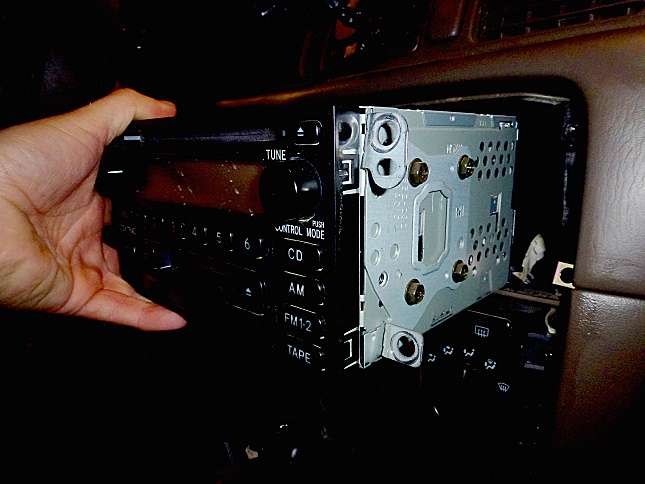
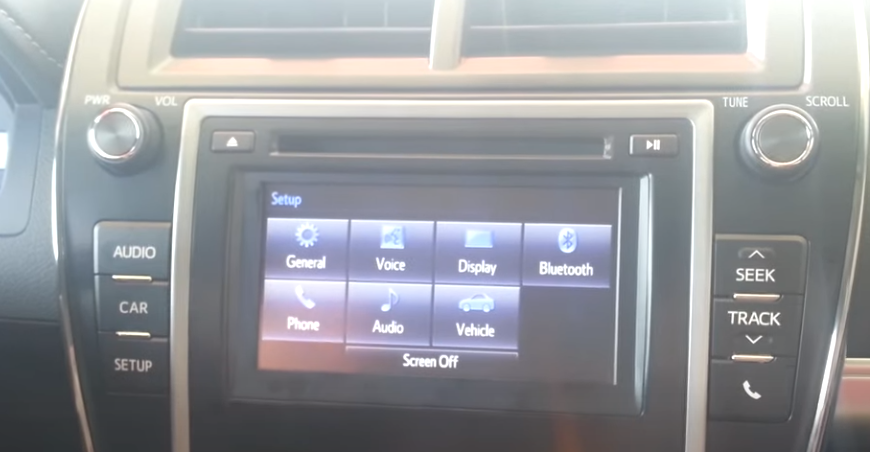
Thankfully my 2014.5 Toyota Camry XLE sedan, which I am still driving in 2023, has Bluetooth allowing me to easily use my iPhones in it for music playback. Wendy’s 2018 minivan is new enough to support CarPlay.
Modern music
So how do I acquire and listen to music in 2023? Wendy and I have access to three different services which each provide access to over 100 million songs. I pay $33 per month for Apple One Premier, which provides 2 terabytes of iCloud+ storage along with Apple TV+, Music, Arcade, Fitness+, and News+ which I can share with up to five people. The Apple Music component lets me stream over 100 million songs, and I actually purchase very few songs these days — only rarities which are so precious to me that I would never want to lose access to them should they disappear from the streaming platforms.
I also still pay $25 per year for iTunes Match, which is an older service that provides high-quality versions of songs I ripped many years ago into my iTunes library and syncs all of my music across devices. I could probably cancel that, but I fear that might cause weird glitches for my Apple music library, which I began building in 2004 and now includes over 17,800 songs on 2,154 albums from 1,336 artists across 138 genres. So I just keep paying for iTunes Match as a form of insurance.


There are two other music streaming services available to us. I pay $23 per month for YouTube Premium, which gives Wendy and me ad-free YouTube videos. It happens to include access to over 100 million songs via YouTube Music, but I rarely use that service, although Wendy uses it often via the Google Home Hubs around the house. I also pay $139 annually for Amazon Prime, mostly for free Amazon deliveries and renting streaming movies, but it is a third streaming music option that now also includes over 100 million songs, but it has skip limits on playlists.
Across the U.S. in 2022, recorded music sales volume was about half of what it was in the 1970s, about one-fourth of what it was in the 1990s, and about one-sixth of its peak in 2008. People mostly just stream their music these days.
Personal music
Much of my music listening is in my 2014.5 Toyota Camry, which connects via Bluetooth to my iPhone 14 Pro. I rarely play music on speakers in the home. Wendy’s hearing is far more acute than mine; I have high-frequency loss and tinnitus. So around the house, I usually wear headphones of some sort.
For music and audiobooks on the trail, I use wired Apple earbuds with my iPhone, while around the house I sometimes listen to music on my iPad using AfterShokz Aeropex bone conduction Bluetooth headphones, but I mostly listen to videos with them. If I want to listen to high-quality music in the house, I connect my Tribit XFree Tune Bluetooth headphones to my iPhone or iPad. When working at my home office desktop computer, I wear Mpow HC6 USB headphones. The bone conduction headphones are so comfortable I can wear them for hours, while headphones with cups get annoying after awhile.


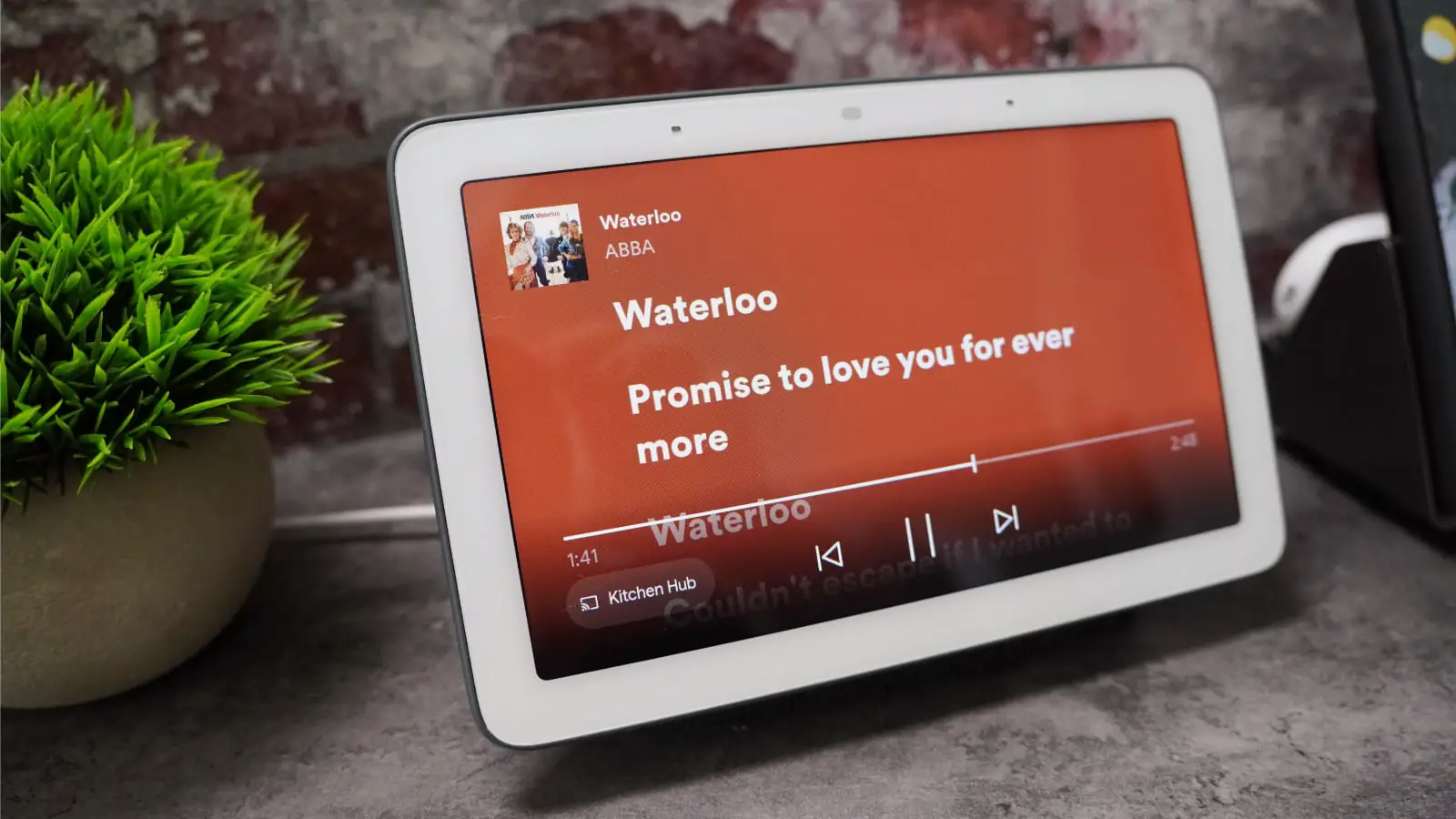
When Wendy and I want to listen to a song together in the home, we usually just tell one of our Google Home Hubs to play it. We could also pull up a song on the Apple TV to play through the living room speaker system, but we never bother with that.
Nostalgia only gets you so far
I certainly don’t miss messing around with the vintage technology of vinyl, 8-tracks, cassettes, and compact discs. But I do get a kick out of the many obscure formats and players that Mat Taylor of Techmoan has explored, and I have supported him on Patreon since 2016. A great example is the Tefifon, which had a needle playing music on cartridges of endless loop plastic tape.
That was so weird that Mat produced a follow-up video. He’s covered an amazing variety of music formats. I also greatly enjoyed Alec Watson’s Technology Connections coverage of early sound technology and compact discs, and I have supported him on Patreon since 2017.
Nowadays, Wendy and I can stream whatever we want, whenever we want. Recorded music has come a long way in the past half-century…we have no use for record stores or most physical media.
What comes next? I don’t have a vision for much more innovation in our audiovisual technology at home, just occasional updates of aging devices with new ones that operate similarly; virtual or augmented reality headsets have never appealed to me. Having navigated the transitions from vinyl records to 8-track cartridges to compact cassette tape to compact discs to MP3 files to online streaming services, I’m pretty happy that physical media have mostly disappeared from my life.






 Meador Manor
Hi Granger, Nice summary of dramatic changes in audio technology during the 20th century. Our problem in OKC was not access to technology, it was that our exposure and access to the world’s wonderful diversity of music was so limited. OKC radio played only pop, conventional music. However, there were two record shops where one could explore and purchase unconventional music:
1. Did you know Wilcox Records? It was originally at 1423 NW 23, just west of Classen, where it had been since 1934, and then moved to 5517 N Penn, across from Penn Square Mall. I remember how one could sit in a small room and sample a variety of 45’s before buying one. They sold records to 3 to 4 generations in OKC before closing in 1988.
2. What happened to Rainbow Records? Walking into that wonderful used record store (at 23rd and Classen) was like entering another world: the artistic concert posters on the walls, the knowledgable owners, and odd music lovers that hung out there. They also allowed customers to sample their records, and I spent many hours exploring and learning about rock, jazz, blues, R&B, reggae, and even classical music; music that one could not find at Sound Warehouse. I suspect that it too closed, but I can’t find anything information about it.
Thanks, Dustin. Rainbow Records’ main store at 23rd and Classen opened in April 1978. The operations manager was Lavon Pagan, while the actual owner of the stock and silent partner in the concern was Taylor Truesdell. Truesdell hailed from Seattle and Tulsa, and Pagan was from Tulsa. The other employees in 1986 were Mike Surber, Craig Carlton, and Ross Shoemaker, all trained by Pagan. The original store had over 25,000 albums and at one point was moving between 300 and 1,000 albums daily.
The original store was remodeled in 1986, and its second location at 7617 N May was expanded from 1,100 to 3,300 square feet in 1987. In 1988 they opened a third store at 2116 SW 74th. Other managers over time included Craig Busch Jr., Scott Booker, Jerry Church, and Larry Hollis.
Pagan left in 1989 to start a record store in Dallas called Pagan Rhythms, next to a Sound Warehouse. In 1990, Digital Connection Inc. bought out the Rainbow Records partners, with Kim Shoemake as the majority owner, and Truesdell moved to Florida. The third location on SW 74th was sold off at that time and operated under a different name. The Classen store began emphasizing blues and jazz, while the May store specialized more in indie rock, classic rock, and imports.
Pagan said that big box stores and their deals with record labels undermined independent stores by the mid-1990s, and that ended his store in Dallas. In 2004, the original Rainbow Records store in OKC was sold to Michael Stone, a Norman musician, and he moved the store to 3709 N Western, next to Cock O’ the Walk, with longtime Rainbow manager Larry Hollis helping man the new location. That final incarnation closed in 2007.