December 2023

When I was a kid, my parents read The Daily Oklahoman newspaper each morning and the Oklahoma City Times in the evenings, both being published for decades by the Gaylord family. The daily editions were over 50 pages and the Sunday could easily exceed 200 if you included the various inserts. The evening paper had a circulation of 123,867 in 1964 and the morning one peaked at over 300,000 statewide. But all that is old news.

The evening paper folded as I was graduating from high school 40 years ago, with a circulation of 82,335. The Gaylords’ politics were anathema to me, but they sold off the paper in 2011, and it was acquired by GateHouse Media in 2018, which acquired Gannett and took its name in 2019.
The morning paper survives under Gannett, but its circulation is only 25,000 daily and 33,000 on Sunday, so about one-tenth of what it once was. When I was a kid, the papers were printed as broadsheets, about 60 inches wide, but that was narrowed to 44 inches in 2008. These days, the paper is a couple dozen pages on weekdays, discounting non-local extra pages tacked onto the electronic edition, while the Sunday edition is 60 or less.
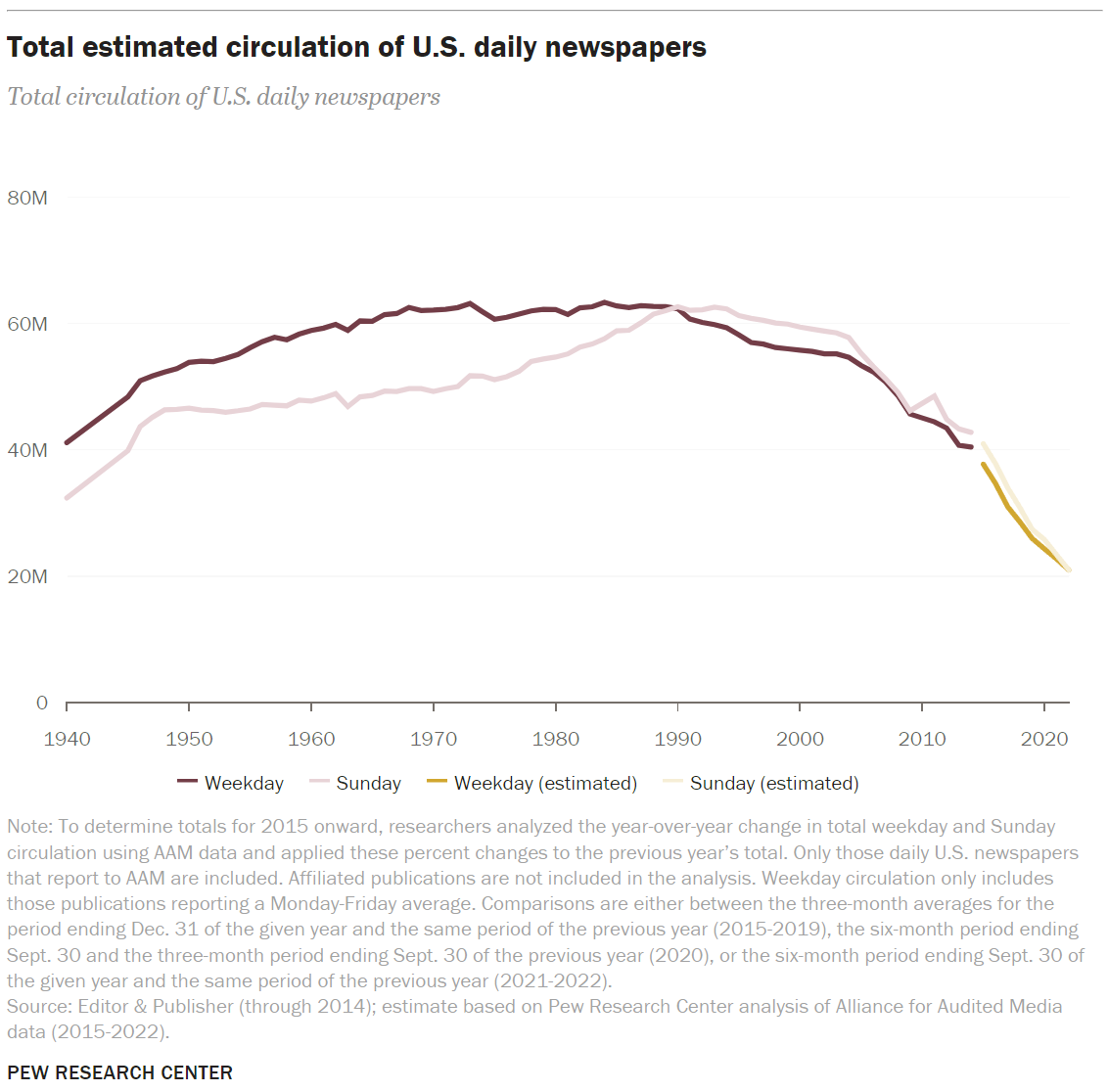
That decline is reflected in daily newspapers nationwide. Their circulation, counting both digital subscriptions and print circulation, has fallen by 2/3 since 1990.

As an adult, I followed in my parents’ footsteps, reading a daily newspaper. I currently subscribe to five of them in digital form: the Tulsa World, The Oklahoman, The Washington Post, The New York Times, and the Bartlesville Examiner-Enterprise. I read the first two on my iPad after waking each morning, and occasionally consult the others online.
Originally I just subscribed to the Bartlesville Examiner-Enterprise. But, like most local newspapers, it was hollowed out over time. I am still a digital subscriber, but the “E-E” is down to one local reporter/photographer, and it doesn’t even have a physical office anymore. Nevertheless, it and the Bartlesville Radio news page are my go-to sources for local news.
I subscribed to the print edition of the Tulsa World newspaper for several years, switching to a digital subscription in 2011. It was once a paper of a far higher quality than The Oklahoman. It was owned by the Lorton family from 1911 to 2013, entering a joint operating agreement with the rival Tulsa Tribune in 1941 and acquiring its assets in 1992. At the start of the 21st century, it had a circulation of 160,000 daily and 220,000 on Sundays, and in 2005 it had over 700 employees.
However, the Tulsa World has, like The Oklahoman, declined sharply. By 2012, after a series of layoffs, it had a daily circulation of 95,000 and 133,000 on Sundays. It became part of the BH Media Group in 2013, which was acquired by Lee Enterprises in 2020. I noticed a sad decline in the quality of its copy editing after BH Media took over, and by 2022 the daily circulation was down to 35,000 with 38,000 on Sundays.
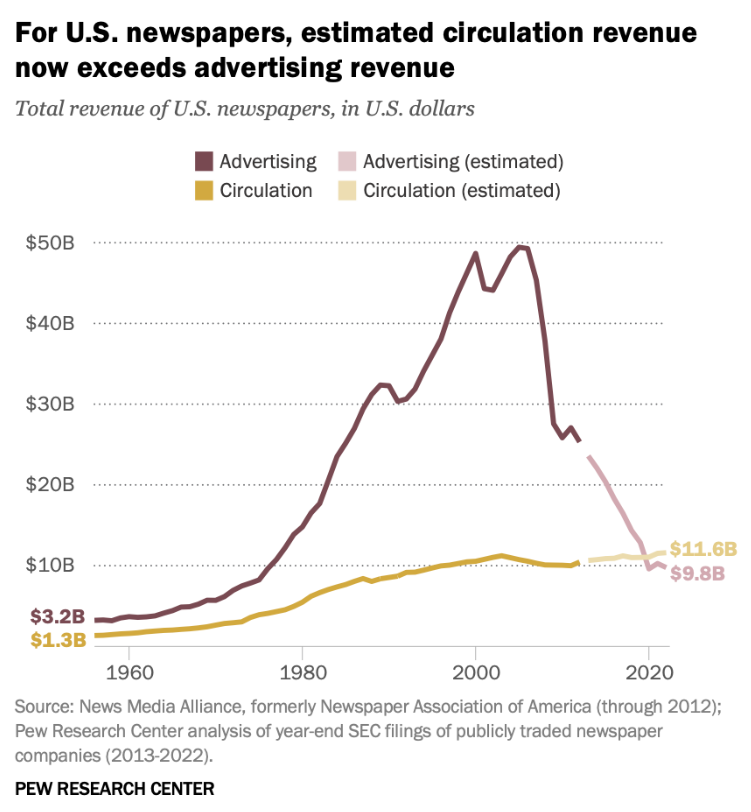
Early in the 21st century, newspapers’ advertising revenues collapsed, halving in a few years and continuing to fall so that they are now at the levels of the 1970s, when a dollar would buy almost 7 times what it will today thanks to inflation. They now rely more upon circulation revenue than advertising revenue to stay in business.
Newspapers have gone online, of course, as their printed editions became obsolete. But the average minutes per visit for the nation’s top 50 newspapers was only 2.5 minutes in 2014 and is now down to about 1.5 minutes. I am an outlier, spending 20-40 minutes each day reading my online newspapers.
On top of that, I also subscribe to Apple News+, which shares articles from 44 newspapers and almost 400 magazines, and I frequently peruse its newsfeed. But I don’t know how much longer my local newspaper will even exist, and the decline of the two leading state newspapers is dimming the lights that help disinfect and protect our institutions from the lies, authoritarianism, and corruption of our state’s frequently dreadful politicians.
Realizing that my news-gathering habits are atypical, I looked up how people prefer to get their news these days. Courtesy of Pew Research:
| Preferred News Platform | TOTAL | Ages 18-29 | Ages 30-49 | Ages 50-64 | Ages 65+ |
|---|---|---|---|---|---|
| Television | 27% | 8% | 17% | 36% | 50% |
| News websites or apps | 25% | 22% | 29% | 27% | 18% |
| Search | 15% | 22% | 17% | 12% | 7% |
| Social media | 12% | 30% | 15% | 5% | 3% |
| Radio | 6% | 3% | 8% | 8% | 5% |
| Podcasts | 6% | 9% | 8% | 4% | 2% |
| Print publications | 5% | 4% | 3% | 4% | 10% |
It is helpful to chart the preferred platforms, breaking them down into age groups:
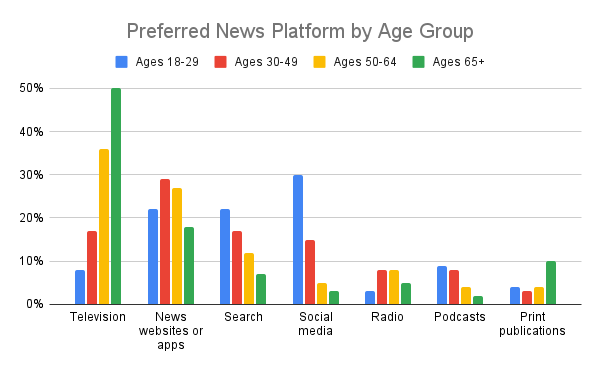
While television is the most dominant preferred platform overall, when you look at age groups, that is only for those 50 and older. I am again an outlier, as I almost never watch television news. I have long viewed it as shallow, violence-focused, and plagued with bias and inaccuracies. The very low interest in television news among those under 30 shows its creeping obsolescence, and local TV news viewing declined from over 4 million in 2016 to about 3 million in 2022, out of a US adult population of 258 million. Its collapse is manifested in how Tulsa’s ABC affiliate has consolidated its news production in Oklahoma City, with only remote reporters in Tulsa.
News websites or apps are the next most preferred platform overall, and presumably will soon surpass television. But still, only 1/4 of adults are like me, preferring to get their news via online news websites or apps.
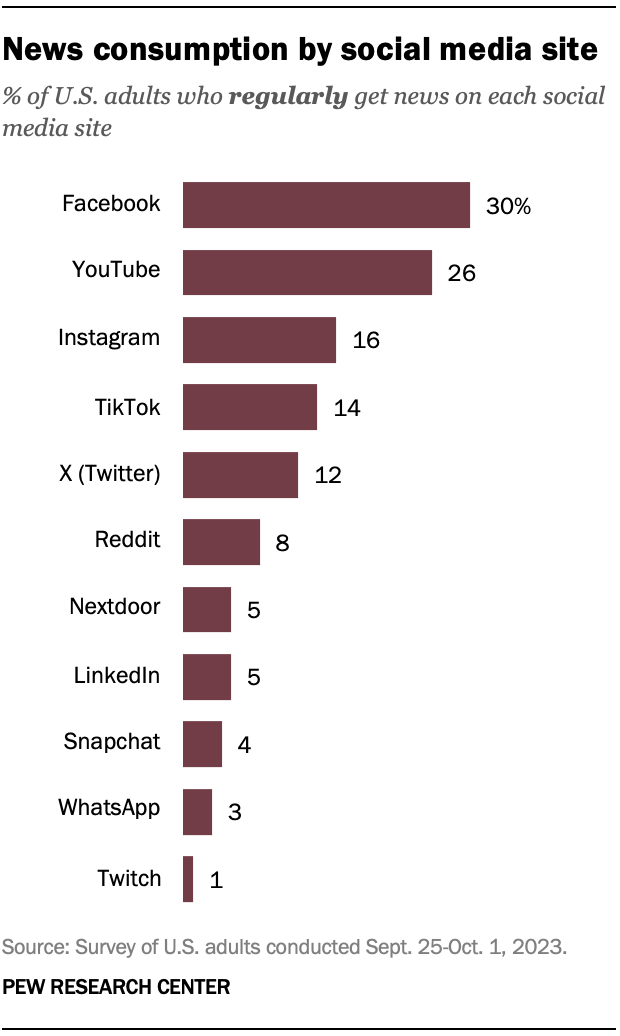
I don’t find it surprising that the most preferred news platform for those under 30 is social media. Other data shows that 19% of U.S. adults often get news from social media, and 31% sometimes get it that way. At right are the percentages of U.S. adults who regularly get news on each social media site. As for trends, the ones showing growth instead of decline in the past few years are TikTok, Instagram, Twitch, and Nextdoor, which are all of low quality.
Reddit, TikTok, and Instagram’s news consumers are mostly those under 30. Facebook’s, X’s (Twitter’s), and YouTube’s news consumers are mostly 30-49, and Nextdoor’s news consumers are generally over 29.
Looking beyond social media, print publications are the least preferred platform for those under 65, hence printed newspapers and news magazines are doomed.
Radio is actually preferred over print by those 30-64, but radio is far more limited in how in-depth it can go across a range of stories. National Public Radio still does some good journalism, and our local radio station offers news in an abbreviated format, but neither tackle some of the issues the newspapers do.
The consequences of the changes in how news is gathered, published, and distributed are stark. Many of my fellow citizens display delusional hypocrisy and have been embracing and electing corrupt authoritarian demagogues. The ongoing erosion of standards and democracy in our great republic is connected to the decline in quality journalism. Over a century ago, the great Walter Lippmann explained what we can now readily observe:
Men who have lost their grip upon the relevant facts of their environment are the inevitable victims of agitation and propaganda. The quack, the charlatan, the jingo, and the terrorist, can flourish only where the audience is deprived of independent access to information. But where all news comes at second-hand, where all the testimony is uncertain, men cease to respond to truths, and respond simply to opinions. The environment in which they act is not the realities themselves, but the pseudo-environment of reports, rumors, and guesses. The whole reference of thought comes to be what somebody asserts, not what actually is.
When I was in junior high, my best friend was a paperboy. When his family went on vacations, I would take over his route. A bundle of papers would be dropped off on a street corner, where I would fold them and put rubber bands on them. Then I would load them into a big bag on my shoulders and awkwardly pedal my bicycle across the neighborhood, doing my best to deliver the paper to the correct addresses in convenient locations.
I wasn’t fast, but I was conscientious.
Those days are now only a distant memory…in more ways than one.








 Meador Manor