October 13-14, 2023 | Photo Album

My Fall Break 2023 started out rough. The latest COVID vaccine was available, and I had never received the Shingrix vaccine for shingles. So around noon on Wednesday, the day before the break, I got a dose of one in my left arm and the other in my right. In the past I have often felt fatigued the day after a COVID vaccine, and I had been warned that the shingles vaccine often has strong side effects. So Wendy and I had delayed an escape to Kansas City until Friday to give me time to recover. That was a wise decision.
I had the usual sore arms and fatigue, but the shingles vaccine left me with a headache and muscle aches that persisted until 6 p.m. on Thursday. Thankfully I felt much improved by bedtime and was ready to go on Friday. I will need a second dose of Shingrix in a few months, and I will definitely schedule that up against another break.
The Doll Cradle

We reached the outskirts of Kansas City before noon. Wendy has been re-rooting the hair of vintage and newer Barbie dolls for some time, and she wanted to shop for Barbies at a place one of her YouTube contacts had told her to check out: The Doll Cradle in Shawnee, a Kansas City suburb. They have been repairing dolls for over 50 years and even have a fun Doll Ambulance.
She was rewarded with good deals on two dolls she had been wanting for some time: a Princess of the Incas Barbie and Northwest Coast Native American Barbie.


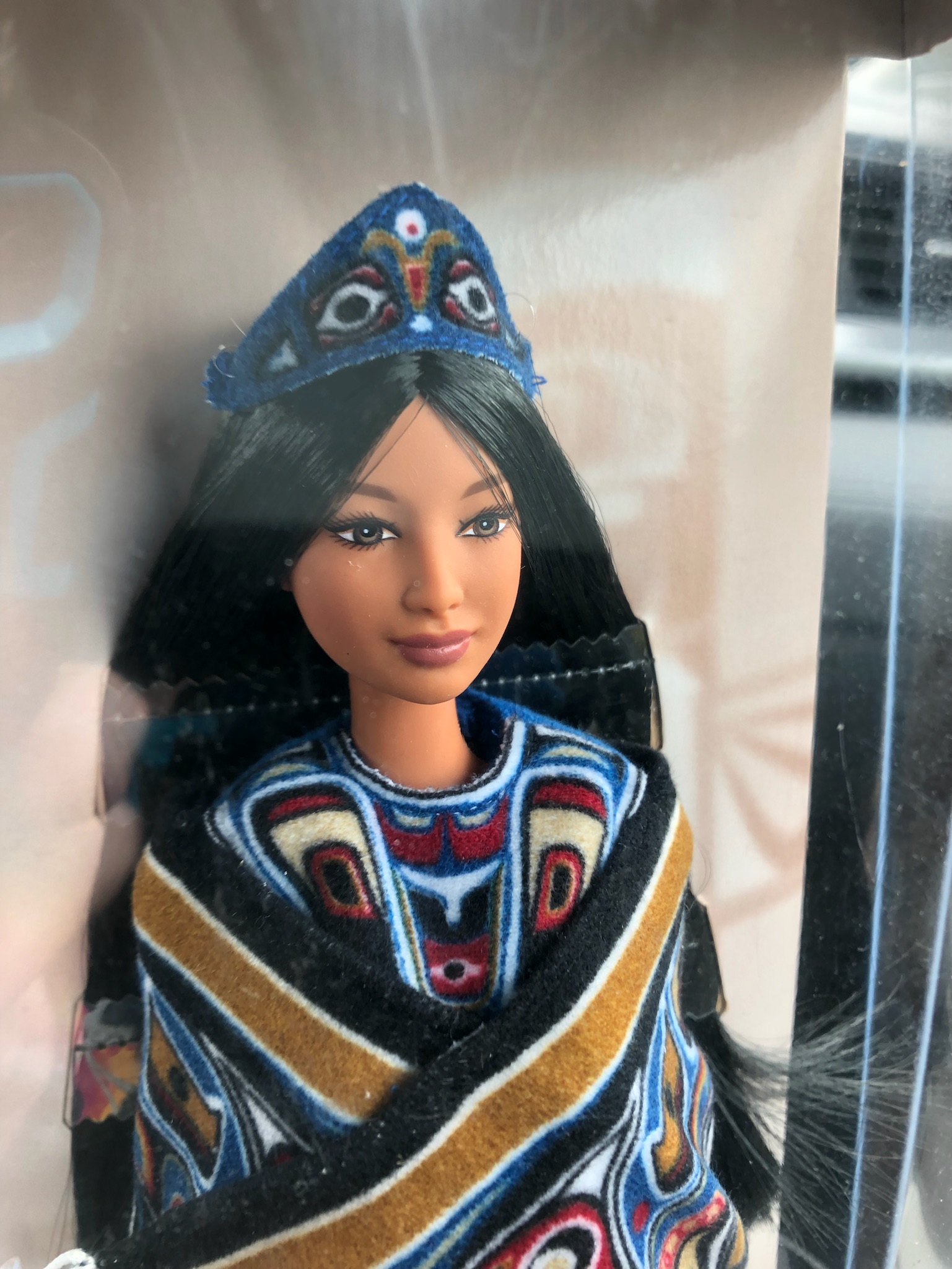

And here is that doll after Wendy re-rooted her hair, joined by one of Wendy’s paintings:

While Wendy hunted for Barbies, I hung out in the front of The Doll Cradle, surrounded by baby dolls. I was doing better than a little one in a bunny suit, although I was a bit unnerved by how one doll winked at me while another explored the uncanny valley.

Kemper Museum of Contemporary Art
We then drove to the Country Club Plaza for lunch at The Cheesecake Factory, followed by stops at our two favorite art museums: the Kemper Museum of Contemporary Art and the Nelson-Atkins.
Wendy liked two abstract pieces at the Kemper: Coral Wedge and Midnight Shore by Helen Frankenthaler.


We both admired Spandita Malik’s Jāḷī: Meshes of Resistance exhibition of photographic portraits of women in northern India who are survivors of domestic and gender-based violence. With the support of nonprofit organizations, they have learned to embroider in styles particular to their regions, offering them a means of greater financial independence, creativity, and self-expression. Each subject was invited to embroider her own portrait.

Parween Devi III is a photographic transfer print on khaddar fabric, with phulkari silk thread embroidery. Saffron and scarlet stitches surround a mirror, drawing your gaze to Parween, who sits on a stool, facing her reflection. Large bolts on her door and windows hint at her domestic circumstance.

Jyoti has embroidered her image in rich red silk, tying it to her image in a mirror with gold threads, and she covered the floor in an embroidered design.

Rukmesh Kumari‘s flowers spread across a back room of her home, climbing up the walls with her embroidery reflecting the colors of the flowered spread she sits upon. She added a lovely gradient of hues to her border design.

Radha Rani IV shows Radha’s bedroom, with a red stuffed teddy bear as a companion beneath a water-stained ceiling.

Noshad Bee has applied zardozi embroidery on khadi fabric. She painstakingly outlined the flowers on the fabrics, created flowers extending up the walls, and added a golden border. But what you immediately notice are the beautiful flowers she extended from her top across her face to form a veil.

We truly enjoyed Malik’s first museum solo exhibition.
Nelson-Atkins Museum of Art

Our next stop was the Nelson-Atkins. They have long had an installation of Donald Judd’s Large Stack Plexiglass panels from 1968, which came in 32 versions. He refused to be labeled a Minimalist, but his effort to remove all meaning from his sculptures is certainly related to that movement. Lighting is important to the work, as the patterns of the shadows on the wall strike me as integral to it.
Forty years ago, there was something of that sort installed on a wall in the lobby of Dale Hall at the University of Oklahoma, where I would wait to be seated in an introductory psychology class in a huge lecture hall. I’m not surprised to find that facility opened in 1967. It screamed late 1960s to me as early as the mid 1980s.
We wound our way into the Rozzelle Court Restaurant at the museum, but found that we were still too full from the Cheesecake Factory meal to contemplate any dessert.
Wandering through the modern art exhibits, Wendy liked Interior with a Book by Richard Diebenkorn and Masks by Emil Nolde.

I liked Gaberndorf II by Lyonel Feininger.

Lodging at Country Club Plaza
Over the years, we have stayed in various hotels near Country Club Plaza. I used to stay at the Best Western Seville Plaza, and later we stayed several times at the Courtyard by Marriott. But the lack of breakfast at those venues led us to try The Raphael Hotel in 2021, where we could get a room service breakfast. This time we stayed at the Hilton, which had a breakfast buffet.

Our room had a view to the southeast across part of the Plaza. In the background was the 20-story Sulgrave Regency Condominiums, built in 1967. North of it along Ward Parkway are a series of impressive century-old apartment buildings which provided the residential density needed to sustain the Country Club Plaza shops.

We enjoyed seafood at McCormick and Schmick’s, which was just a short walk from the Hilton.
Scarritt Point and Corinthian Hall
Our final KC adventure for this brief stay was driving eight miles north and east to the Kansas City Museum. It is housed in Corinthian Hall, built in 1910 as the private residence of lumber baron R.A. Long atop the cliffs above the Missouri River.

We parked along Walrond Avenue at Scarritt Point, which was once the home of Nathan Scarritt, a Methodist minister who relocated there in 1862 from Westport to escape Civil War skirmishes, which had marred life in that town which is today a historic neighborhood just north of Country Club Plaza.

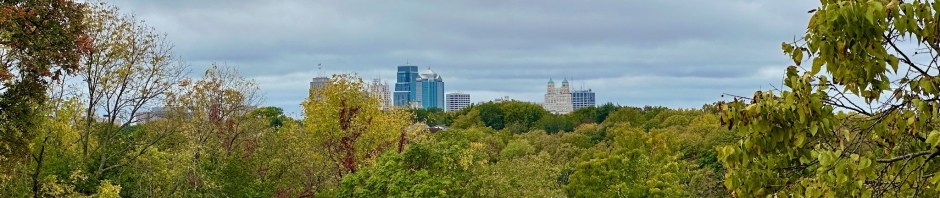
Scarritt and his wife had nine children and gave them property for homes, some of which still exist in one of the oldest neighborhoods of Kansas City. Some of the downtown skyscrapers peek over the trees at Scarritt Point.
Wendy was impressed by the copper gutters and valleys on one of the nearby homes. Corinthian Hall was donated to the city in 1939 and once focused on natural history with hundreds of stuffed animals. It later gained a planetarium and 1910-style soda fountain. Union Station is now the home of the city’s science museum, and the Long mansion focuses on city history.

There are old photographs showing the mansion when it was still a residence, and modern ones showing what remains of its architectural features. While the displays we saw in the mansion would interest locals, Wendy and I lacked the background to appreciate them.
Nevertheless, we enjoyed our brief escape to Kansas City. We have to agree with Will Parker: Everything’s up-to-date in Kansas City.






 Meador Manor
I’m sorry you had a bad reaction the Shibgrex shot. I did not but was expecting it. I loved reading this and enjoyed the art. Thanks for sharing.