
The elastic heart of youth cannot be compressed into one constrained shape long at a time.
Mark Twain, The Adventures of Tom Sawyer
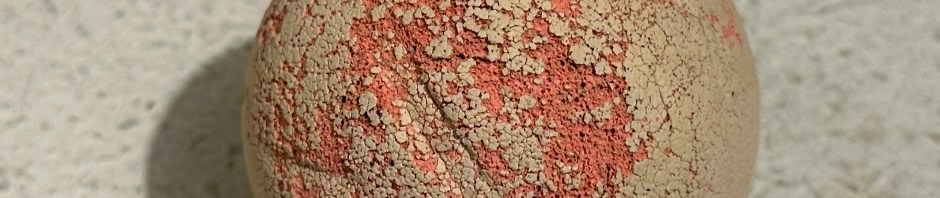
Almost all of my childhood belongings were sold off over time in garage sales, given to younger relatives or charities, or simply discarded. When I scrounged around for the oldest item I still possess, I came up with a bouncy ball from 1968.

My bouncy ball features in one the portraits my parents had taken of me at age two by Olan Mills.

Olan Mills was once renowned for photographic portraits. It was founded in the 1930s in Selma, Alabama by Olan and Mary Mills, working out of an old woodshed they had converted into a darkroom. They sold the concept of studio-quality photographic portraits door-to-door across the south, opening their first permanent studio in Pine Bluff, Arkansas in 1938. The company later shifted to telemarketing and in 1952 began selling a package deal. For three bucks, customers received three sittings to be taken any time in a 12-month period. 40 years later, the deal was still available for only $15. At one point the company operated 1,000 free-standing studios, and it thrived into the 1990s. Gradually it lost market share to competitors and was finally sold to Lifetouch in 2011.
As for my toy ball, it has lost much of its elasticity and the white surface is flaking off to reveal a pink core on one side, while the other side has become lumpy and discolored. Light, oxygen, and heat all take their toll on elastomers by adding crosslinks to the synthetic rubber molecules.
The sad state of that bouncy ball after a half century of storage led me to think about two bouncy balls I used back when I taught physics. One was a Super Ball which when dropped lost very little energy to heat via internal friction, so in physics jargon it had low elastic hysteresis and fairly elastic collisions. The other was made of polynorbornene and had such high hysteresis that it barely bounced with highly inelastic collisions. Here is a demonstration at the University of Maryland:
That in turn led me to link up Super Balls, Wham-O, and Bartlesville.
The Super Ball
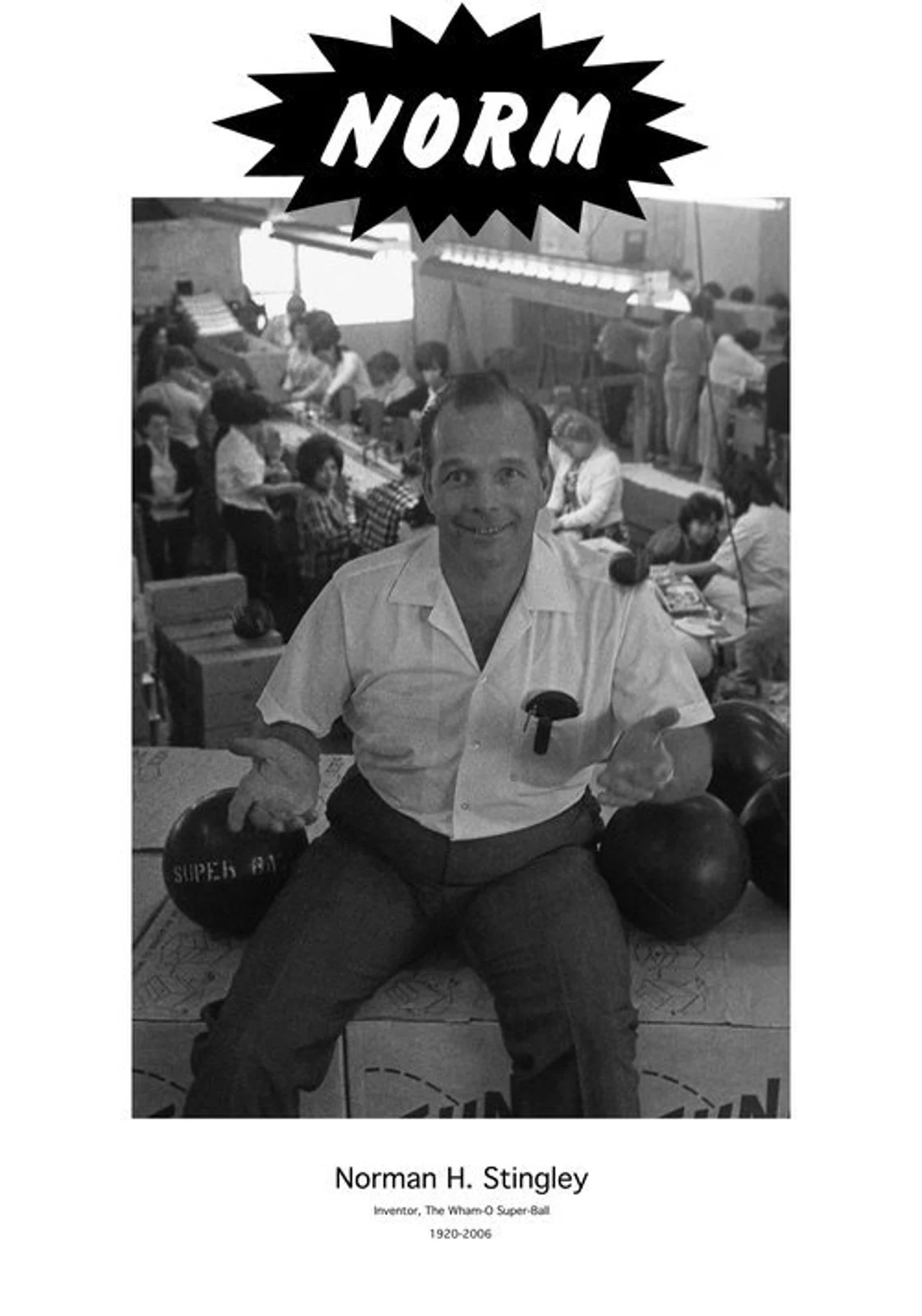
In 1964, Norman Stingley was a chemical engineer working for the Bettis Rubber Company in Whittier, California. He experimented in his spare time. After combining polybutadiene and other ingredients and vulcanizing that with sulfur at 329 degrees Fahrenheit at a pressure of 3,500 pounds per square inch, he created a rubber with a very high Yerzley resilience of about 92%. It wasn’t durable enough to interest his employer, so he approached the Wham-O toy company.
Wham-O had made a fortune in the late 1950s with the Hula Hoop and the Frisbee. They agreed to play ball if Norm could make his compound more durable. Soon he had perfected it, Wham-O named it Zectron, and another hit toy was born.
If you dropped a Wham-O Super Ball, it would bounce back amazingly well, and if you threw one down, it would rebound high into the air. It had about three times the resilience of a tennis ball.
Wham-O sold the original 1 13/16″ diameter balls for 98 cents at retail and was eventually producing over 170,000 per day. They had sold six million by December 1965.

Bartlesville & Wham-O
In the late 1950s, Wham-O had a strong connection to Bartlesville, Oklahoma, where Wendy and I live. Prompted by the demand for plastics after World War II, Phillips Petroleum Company invested $50 million to bring Marlex to market in 1954. That synthetic polymer was invented by research chemists J. Paul Hogan and Robert L. Banks in their work on gasoline additives. They modified a nickel oxide catalyst to include small amounts of chromium oxide, expecting to produce low-molecular-weight hydrocarbons.

Their experiment produced the expected liquids along with a white, solid material. That solid was a new polymer: crystalline polypropylene. Mass-producing it proved difficult, and the company was stuck with warehouses full of dingy, off-size pellets. The company searched for new customers, and Wham-O came to the rescue.
Wham-O introduced the Hula-Hoop in 1958, after a fad began in Norway of girls twirling rings made of cane. That toy craze traveled to Australia, where high demand led to the introduction of polyethylene hoops. When Wham-O introduced the toys to the USA, its first hoops were made of Grex, a plastic produced in Pennsylvania by the Skyline Plastics Company of Titusville. Skyline eventually had 125 employees working three shifts, seven days a week, to try to keep up with demand.

The fad simply outstripped their capacity, and Phillips convinced Wham-O to start making hoops with Marlex. The warehouses were emptied of the old Marlex pellets, and the Phillips plant’s entire output was used for Hula-Hoops for almost six months, giving the company time to improve the production process and expand the available product grades. Phillips president Paul Endacott was so happy that he kept a hoop in his office for demonstrations. By 1960, Wham-O had sold 100 million hoops, and as the Hula-Hoop fad faded, Wham-O continued to use tons of Marlex — to produce Frisbees.
Time is the enemy of fads & flexibility
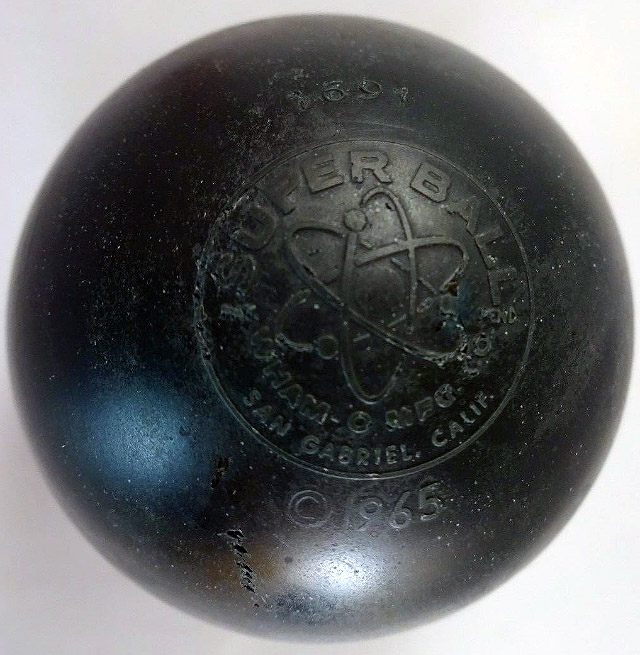
By 1970, Wham-O had sold about 20 million Super Balls. It even spawned the moniker for the biggest football game of each year. The first NFL and AFL contests were labeled the “World Championship Game”, but the owners wanted a catchier title. After the second contest, Lamar Hunt, owner of the AFL’s Kansas City Chiefs, recalled watching his daughter play with a Super Ball a few days earlier. A few days before I was born, Hunt wrote to NFL commissioner Pete Rozelle, “I have kiddingly called it the ‘Super Bowl’, which obviously can be improved upon.” Evidently, it needed no improvement.
The Super Bowl lasted, but in the 1970s, the Super Ball fad began to fade, and competitors introduced a variety of colorful bouncy balls that sapped Wham-O’s energy.
I see that Wal-Mart sells a “Mega Bounce” ball with 85% resilience, but why settle for that when you can still buy a Super Ball from Wham-O?






 Meador Manor
Thanks for your tidbits of history on the lives we led as children a few decades ago. After loving the hula-hoop I have now found a place in OKC to buy them. My grandkids and I often get out the hoops in the back yard and swirl and twist.