
The green thumbs of the former owners of Meador Manor should be stained red, given the poisonous and polluting species they planted. In the early 1990s, they completely reworked the yard, and admittedly it looked good when I bought the property in 1994. I do not enjoy gardening or yardwork, and I have added almost nothing to their designs. Instead, I have merely gradually eliminated some of their worst mistakes. This week came the most expensive fix, and that led me to share my landscaping lamentations.
The previous owners labored long and hard to rip out the front lawn, replacing clay soil with better topsoil and planting shade-friendly grass under the trees and plant beds on the front and back of the house. However, most of the plants were mistakes, and I haven’t done much better myself. Mea culpas all around.

Design Drawbacks

The previous owners planted several Nandina domestica, Asian heavenly bamboo, on three sides of the house, and they lined the front sidewalk with dwarf Nana cultivars. I kept all of them, as I found the plants hardy and beautiful, especially liking the clumps of red berries on the tall plants. They survived decades of occasional drastic pruning with no watering or other care, only suffering in a couple of harsh winters.
However, every part of these plants is toxic to some animal, and cedar waxwings and cats should not eat the berries. They are now considered invasive in Texas, and I can’t recommend planting them.
I made the mistake of having a pest control company treat our yard a few times, and something they used poisoned the tall and dwarf Nandinas. They haven’t thrived since, and this spring I plan to cut down the ones in the front. Let the animals rejoice!
More successful were clumps of striped grass that were planted in front of the dwarf Nandinas along the front bed. Liriope, or monkey grass, is a member of the asparagus family from Asia, and the creeping form, Liriope spicata, has runners and will spread and smother out other plants. It also forms a welcoming environment for mosquitos.
Thankfully, what the landscapers planted decades ago was a striped variety of Liriope muscari, which forms clumps and does not spread with runners. It is very hardy and has narrow, arching leaves. In the late summer, it has pretty purple flowers. Early each spring I just lower the mower on each clump to cut off the withered yellow leaves to the ground, and soon pretty green shoots will appear.

Some choices by the landscapers, however, were so annoying that I eliminated them long ago. They planted a few Berberis barberry bushes, which sport vicious spines on their shoots. I would prune them back while wearing gloves and still get cut up, so those had to go. My torturers also planted some Lagerstroemia crepe myrtles too close to the corners of the house. The crepe myrtles shot up against the eaves of the roof, and even if I cut them off at the ground, they would just grow back. So I had to dig out their roots to eliminate them, which was a joyless task. The largest problem I inherited, however, was trees.
The Bad Bradford Pear
The Bradford pear is a cultivar of Pyrus calleryana, the Callery pear. Arborists made the mistake of importing it into our country multiple times. In 1916, the U.S. Department of Agriculture introduced it after the commercial pear industry was devastated by fire blight. The Bradford pear was used as rootstock for the common pear before its ornamental value was recognized.

The Maryland Department of Agriculture started planting them in the mid-1960s as an “excellent option” for ornamental landscaping. True, the tree does have a compact, stable, and symmetrical shape and pretty blossoms, although some find them quite stinky. The tree is also fast-growing and disease-resistant.
By 1967, Oklahoma State University horticulturalists and county extension agents were recommending them across Oklahoma. The City of Bartlesville once planted a long series of them along the median on Frank Phillips Boulevard east of Washington Boulevard all the way to the Will Rogers school. I remember how yellow ribbons adorned them during the Persian Gulf War in 1990-1991. Many of them were also planted on the west side of Jo Allyn Lowe Park.
Unfortunately, as both I and the city learned, the Bradford pear is prone to splitting and cracking upon maturity. It has little chance of long-term survival in the high winds and storms of Oklahoma. As trees began to crack and crash, the city redid the medians, eliminating all of the Bradford pears there, and over the years many of them have been removed at Jo Allyn Lowe Park. But each spring those beautiful yet dangerous trees are increasingly apparent all over town.

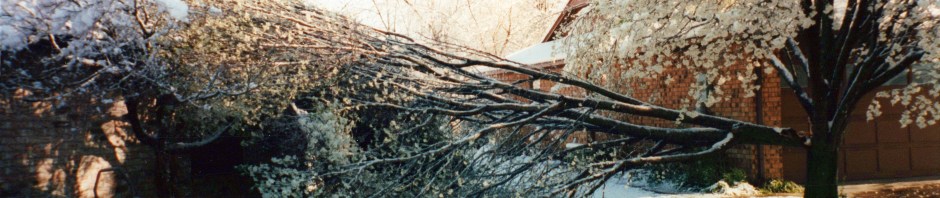
One of my two Bradford Pears had a limb break off in a snow storm in May 2000. Thankfully it did not damage my neighbor’s house, but it sure came close. I paid a tree service to remove both of the trees and grind the stumps.

We now know that the Bradford pear is not only too fragile for our climate, but it is also a rapidly spreading and harmful invasive species. Native to Vietnam and China, the Bradford was originally a hybrid cultivar over here that couldn’t, in theory, reproduce. But a wide variety of cultivars were planted in high volumes, leading to cross-pollination and the production of viable seeds. It outcompetes native trees and you will see clumps of them spreading across untended areas of town, such as the floodplain south of Lowe’s and along one side of north Bison Road. I’m glad to note that Green Country Village, where my mother lives, has a plan to remove all of its Bradford pears.
Cherry Laurel
I replaced the two Bradford pears with a fresh mistake: a cutting of Cherry Laurel from my parents’ backyard in Oklahoma City. Prunus laurocerasus is a species of cherry native to regions around the Black Sea. I was attracted to its evergreen nature, since the big River Birch and small redbud in the front yard were always bare in the winter.
The shrub or small tree thrives in sun or shade, grows rapidly, and is commonly used in hedging. However, like the Nandinas, it is a toxic plant if consumed, and I discovered that it also can’t handle our snow and ice storms. At my parent’s house, it had grown in a corner of the fence, where it was protected. But it was exposed in my yard, and a bad ice storm in 2007 bent much of it over, such that I wondered if it would survive. It bounced back and still looked good in 2014.

However, a snow at the start of 2021 illustrated how fragile the tree was. Part of it broke and died, leaving it ugly and misshapen.
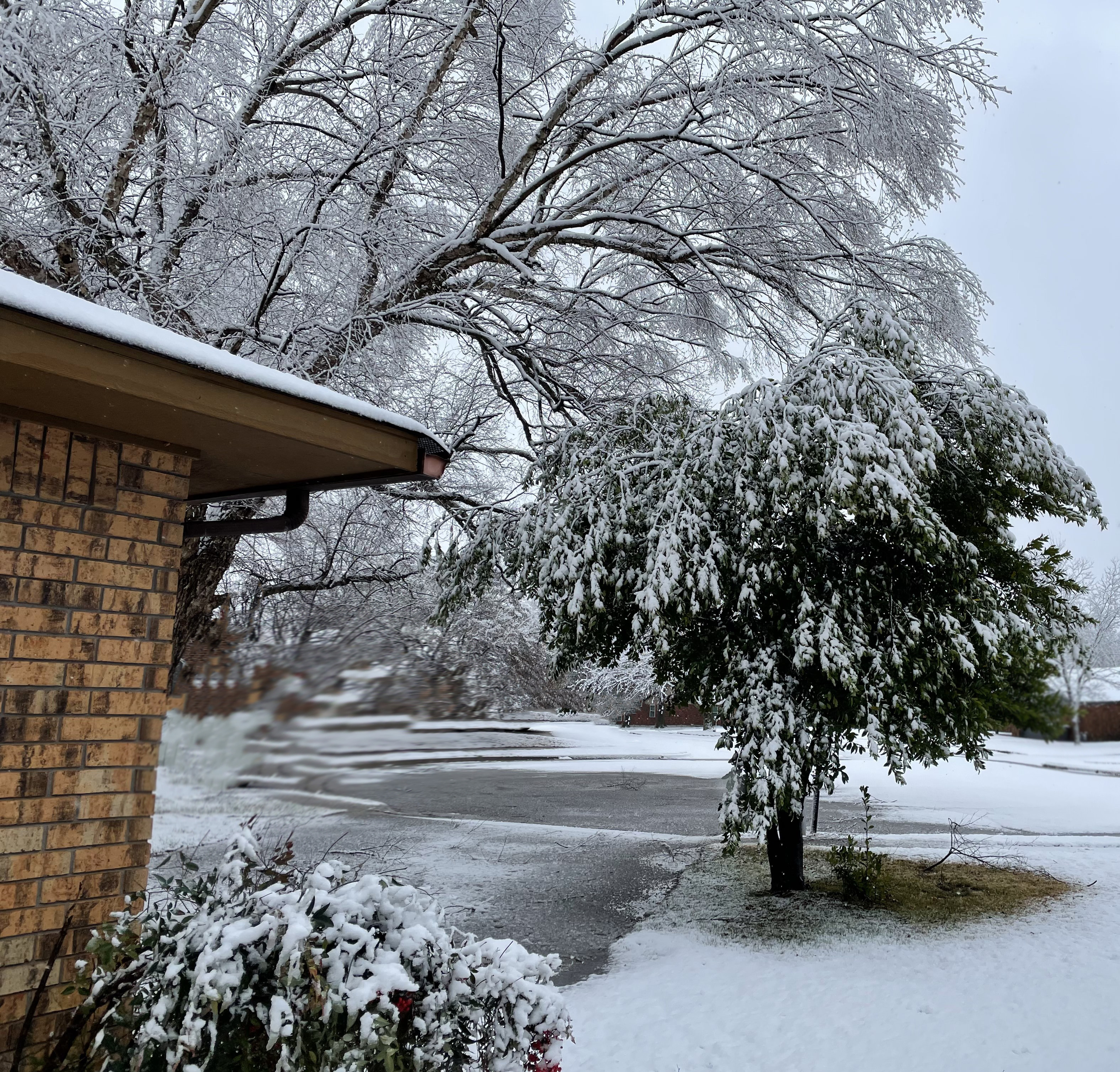
This week I had what remained of the original tree taken down and the stump ground down. There are still some big stems rising out of one its shallow roots which I plan to eliminate.
Leaving my lamentable side strip, let’s turn to my one decent tree, which thankfully declined to die despite my ill treatment.
Oklahoma Redbuds
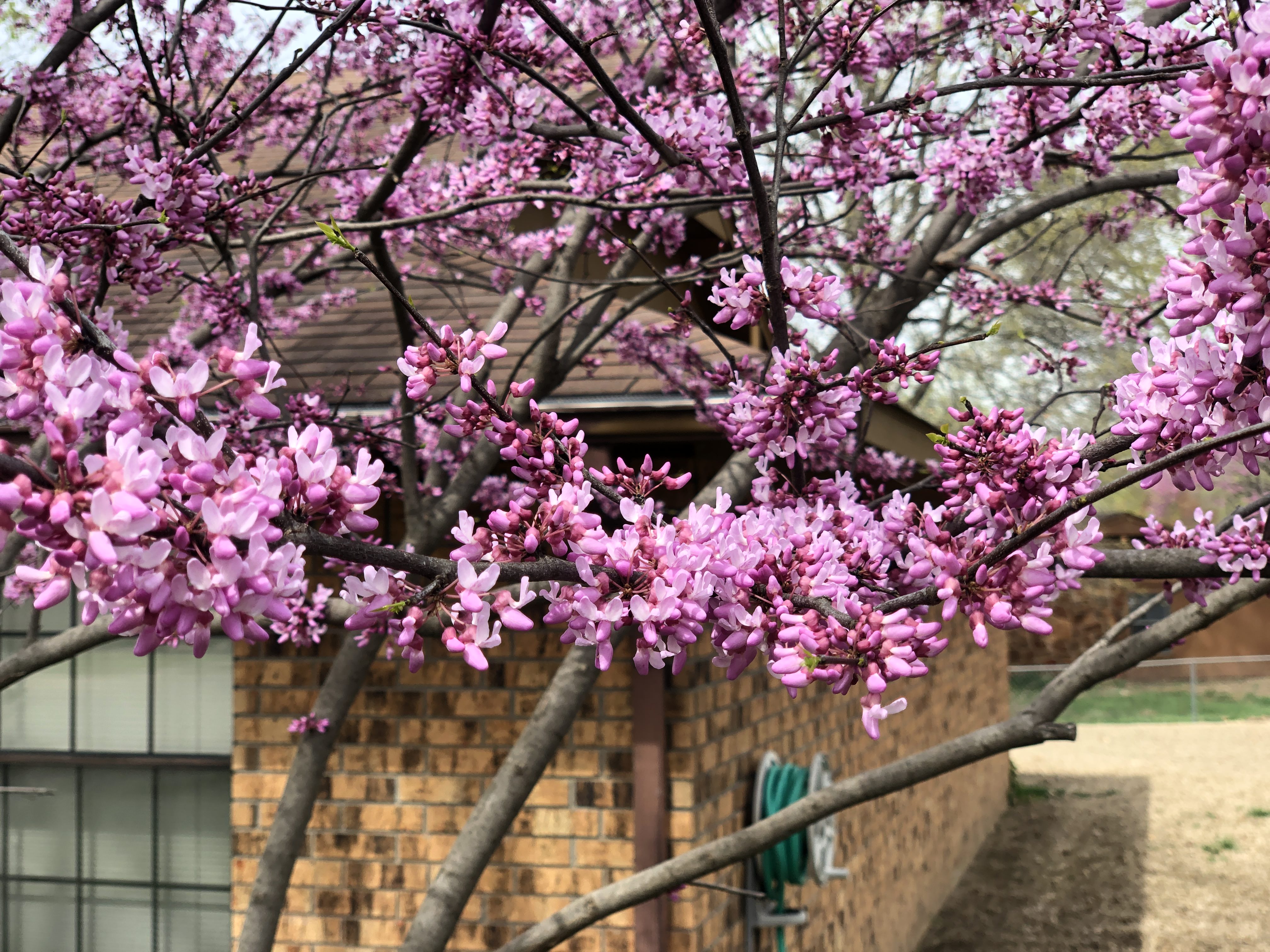
The Eastern redbud, Cercis canadensis, is a medium-sized tree from the Leguminosae family that boasts an array of purple-pink clustered blossoms in the spring. It is native to the state, hardy, and desirable. Okies know it as our state tree, but in the late 1930s, whether or not the Eastern redbud should be an emblem of Oklahoma became a bone of contention between two future Oklahoma Hall of Famers.
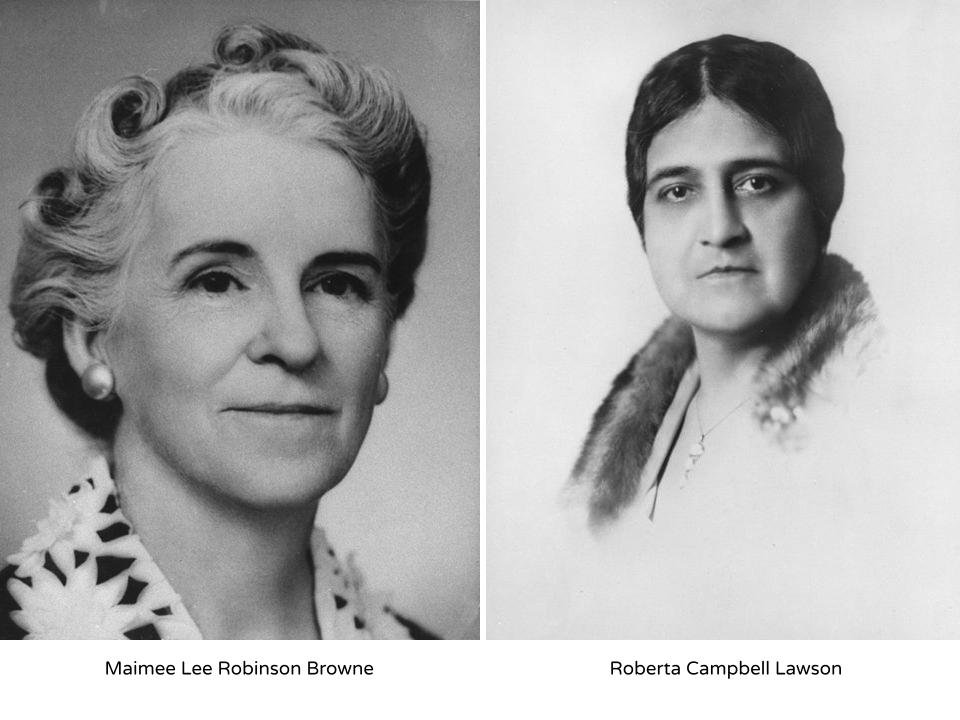
Maimee Lee Robinson Browne chaired the Oklahoma City Beautification Committee and pushed for the recognition. The Daughters of the American Revolution got a bill through the Sixteenth Legislature in 1937 and onto Governor Marland’s desk.
However, that did not sit well with Roberta Campbell Lawson, a granddaughter of Delaware chief Charles Journeycake and leader in the Federation of Women’s Clubs. Lawson sent Marland a telegram objecting to the redbud’s adoption as the state tree, saying it was the tree on which the disciple Judas hanged himself. She declared, “It would be most unseemly to have such a tree as Oklahoma’s state symbol.”
Lawson was referring to a myth that Judas Iscariot hanged himself from a Cercis siliquastrum tree, a European redbud, an event which supposedly changed its flowers from white to red. This weird idea may have arisen from a translation error, as the European redbuds were referred to as ‘arbre de Judee’ in French, meaning Judea’s tree, which probably got corrupted into ‘Judas tree’.
Despite the controversy, Governor Marland signed the bill naming the Eastern redbud an emblem of “sturdy and hardy pioneers.” Marland commented, “This resolution is signed at the earnest request of the good women of Oklahoma, and I hope they plant enough redbud to hang every Judas in the state.” He went on to say, “What is the date–the 30th? I couldn’t put this off until the first of April, could I?”
As for Ms. Browne, she led a campaign to plant redbuds, including a slew of them in what was once Platt National Park at Sulphur. In 1939, the legislature made it illegal to harm redbuds growing along Oklahoma’s highways. In 1971, Governor Hall signed a statute naming the redbud as the official tree of the state. Hmm…given the moral failings of both Marland and Hall, was Lawson onto something? Er, no.
My redbud was long an understory tree below the big River birch. As it grew, some of its branches had a shallow angle, and I would struggle to mow around it. In June 2010, a summer storm blew down one section that had begun to rot. Removing that left an asymmetrical mess that was still hard to mow under, so while I had the chainsaw out I cut it all down. I was left with about one-third of a rick of wood and a little stump in the lawn.


It wasn’t long before several shoots rose up from the stump, and over time I pruned those that leaned over too much. Eventually I had four that grew into a reborn tree in the shadow of the River birch. In the 2022 photo below, the redbud is just to the right of the edge of the house. The Lily turf striped grass clumps are visible behind and left of it in front of the hedge, and you can spot a large Nandina in front of the left window and dwarf Nandinas behind the Lily turf at the bottom left of the photo. That was before they were poisoned in 2023.

The River Birch
I was very glad that the redbud returned, but that victory brings us to what was literally the biggest yard mistake I inherited: the Betula nigra River birch and the fescue grass surrounding it. River birches are found along water courses and lowlands. Like fescue, they crave water.
For three decades I have reeled out hoses in the summer months and set up sprinklers for the shaded front lawn. When I wasn’t diligent in my watering, the fescue would die off, and for years I have paid to have it reseeded. Without watering, the River birch tree’s leaves would turn yellow and fall off in droves. I refused to have a sprinkler system installed, as that would reduce my incentive to eventually get rid of the annoying tree and pretty but demanding fescue grass.
The River birch did its best to mess with me. It was self-pruning, meaning it continually dropped thin branches that I picked up from the lawn, beds, driveway, roof, and street. I have filled an entire city trash can with those things at one go.
It also has male flowers that are arranged in catkins that are several inches long. They shed pollen and then drop from the tree, clogging the gutters on the house and piling up on any hard surface. Once they dry out, they disintegrate into little flakes that are perfect for clogging downspouts. The trees also have winged seeds packed between the bracts of female catkins on the tree which are the largest seeds of all birches native to the USA.
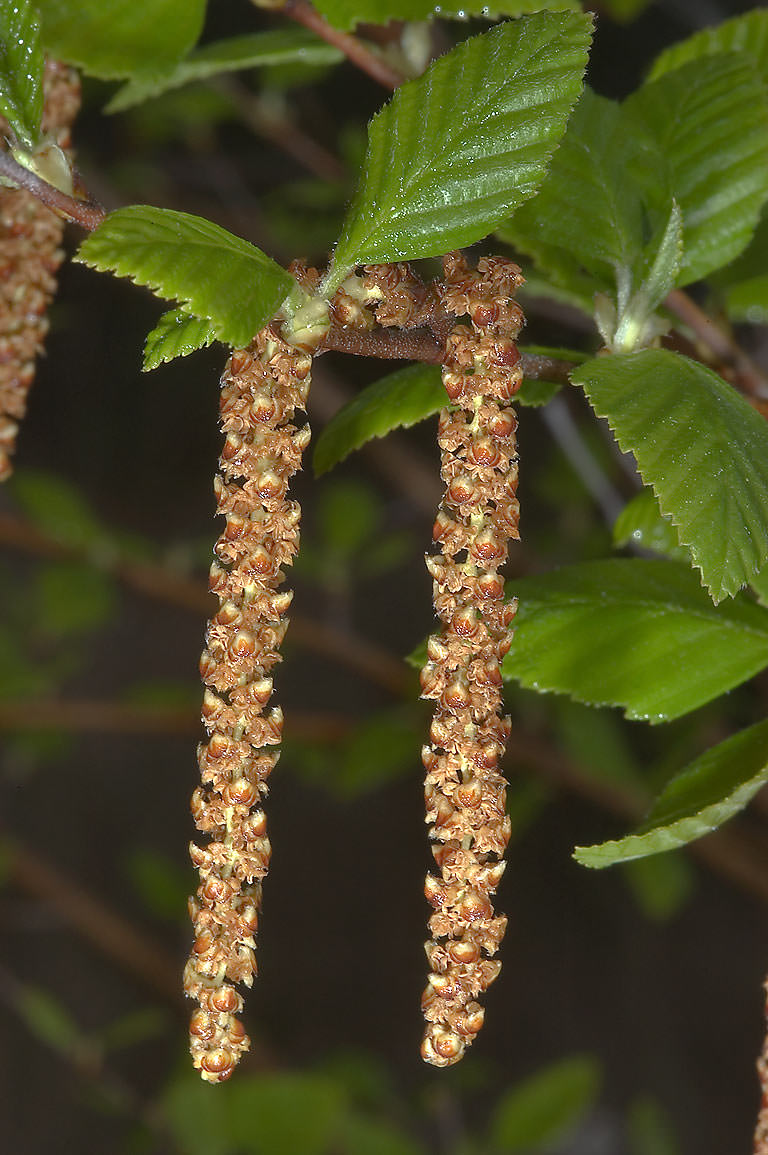

Back in 2015, I covered the gutters on the house with plastic filter screens. That prevented the downspouts from getting clogged by the catkins, but the darn tree covered the screens in a couple of areas, leading to water backflow that damaged the eave near the front door. So I had to remove the screens in a couple of areas and remember to clear the gutters.
The tree of course continued to grow over the past 30 years. A neighbor trimmed part of it back from over his driveway well over a decade ago to ensure it didn’t drop a branch on his vehicles, and every few years I would have to break out my pole trimmer to cut off branches that were too close to the roof or hanging down into the street or threatening the streetlight.

The tree was lovely in the summertime, and its shade was nice. But I’ve reached an age where I should not be climbing up on the roof to clear gutters, I’m tired of picking up sticks, and Wendy rightly considered the tree a menace in a wind storm. But cost and procrastination combined to leave me in limbo until this past summer, when the latest drought made watering the lawn expensive and increasingly problematic.
So this month I finally contracted with Jeff Beck (918-766-5440) to have the massive tree taken down. I couldn’t resist peeking through the window blinds from time to time as he and his helper vanquished my nemesis of the past 30 years.

By the end of the second evening of work, they had reduced the tree to a stump that was over four feet in diameter.

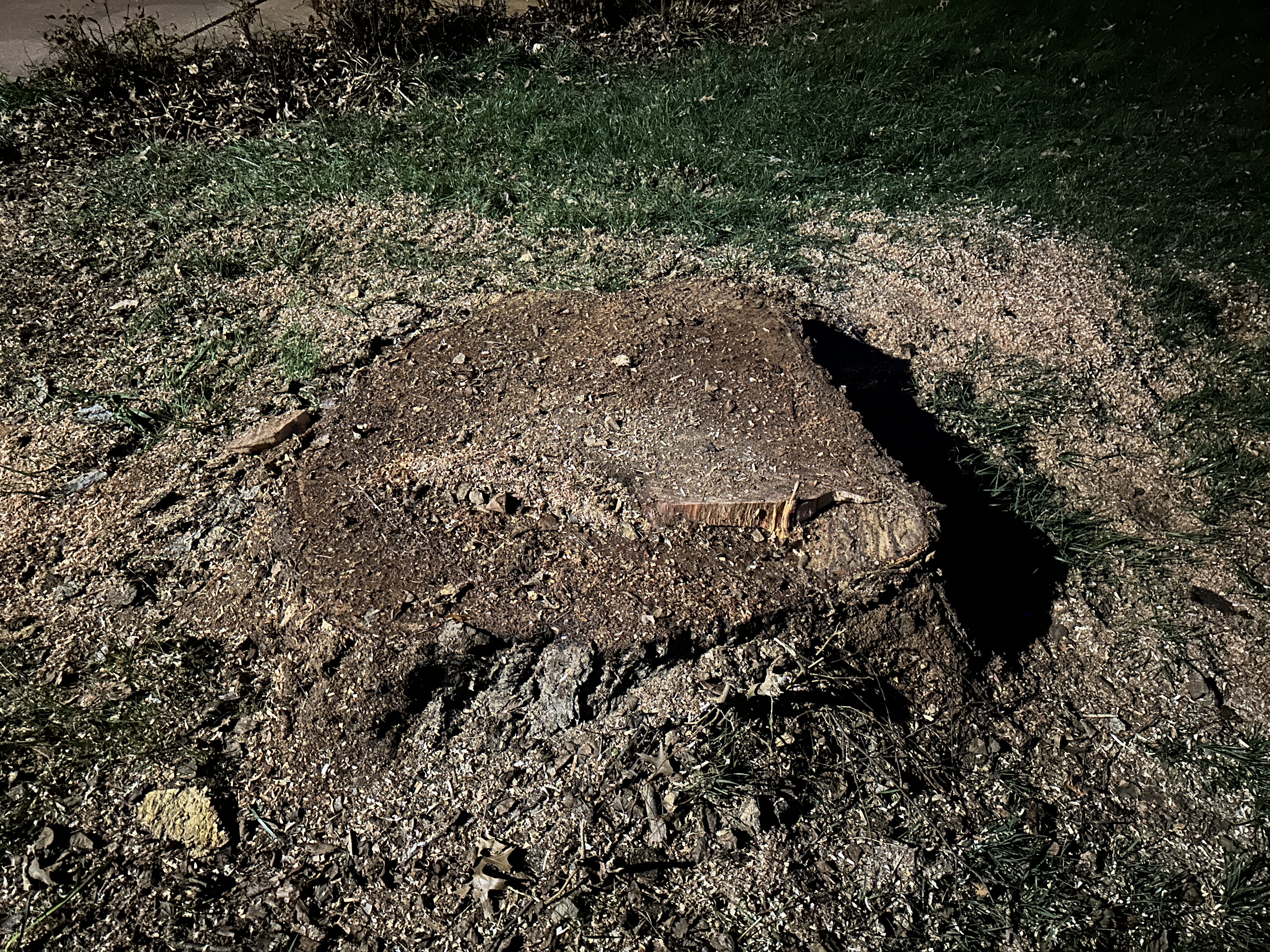
On the third evening, they ground the stumps. I was impressed with their work.
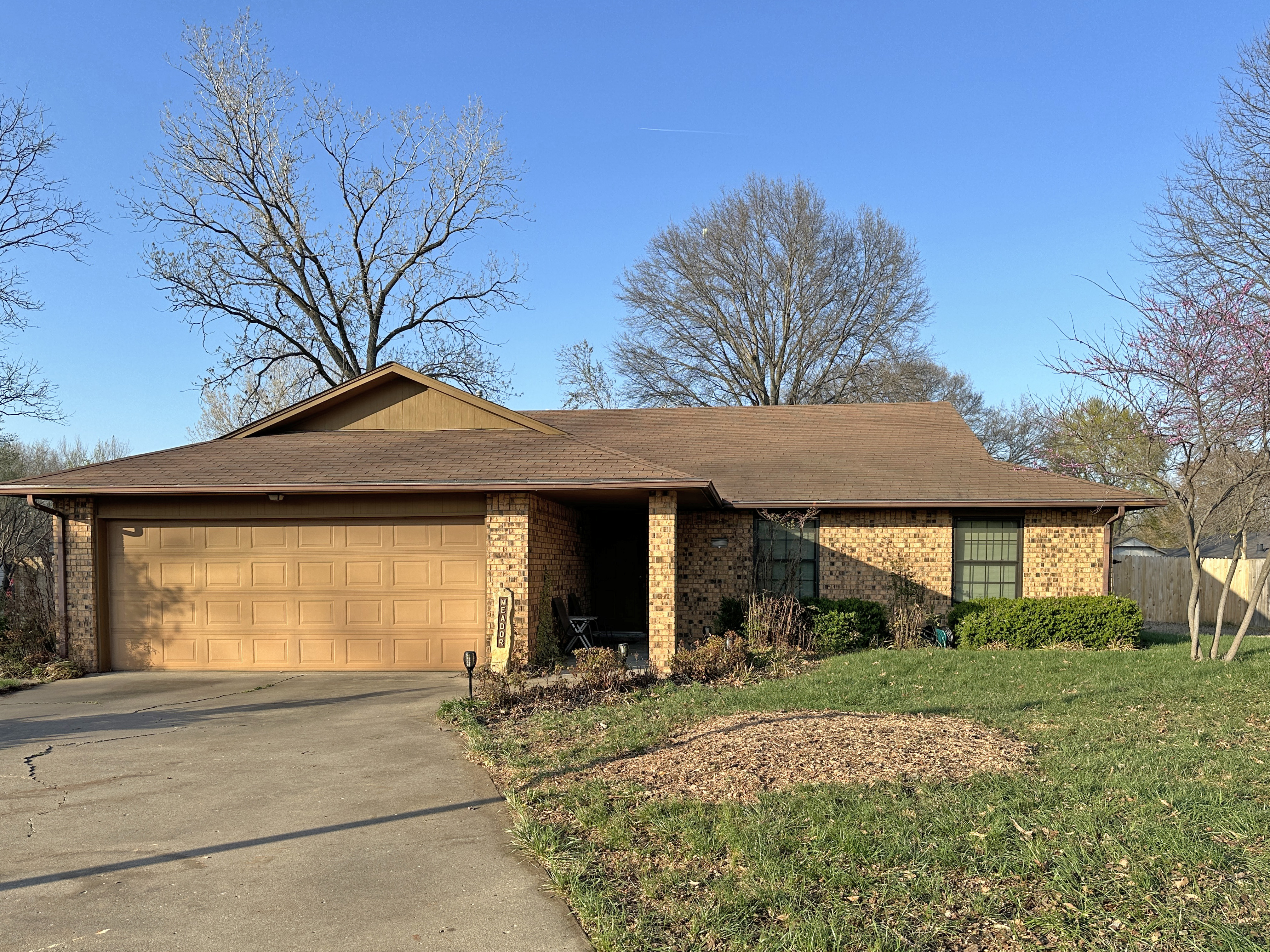
It will be interesting to see how the redbud responds to the loss of its huge neighbor. I want to eventually stop watering the lawn, so I plan to seed Cynodon dactylon Bermuda grass over the now-sunny front lawn and have it choke out the fescue. Bermuda’s above-ground stolon stems and underground rhizome stems spread like crazy, and it is a mainstay of my back yard, which I never water. Bermuda tolerates drought well, simply going dormant in the hottest summer months. However, it requires full sun, so for decades it couldn’t grow out front. That has finally changed, and here’s hoping that I finally put one of my yard’s invasive species to good use.








 Meador Manor
Your blog posts are mesmerizing. Who would think I would read an entire article about a man’s plight with his yard. LOL Plus you are such a history hero that you entangled some Oklahoma red bud history into the story too. Thank you!
Thanks, Debbie. Sharing how a couple of Hall of Famers clashed on something as innocuous as the state tree was too good to pass up. Years ago, Jerry Pournelle wrote a “slice of life” column in Byte magazine called “Computing at Chaos Manor” about his travails with technology around his home. I subscribed to Byte for years to get that column, and that certainly influenced my blog. Failures are more fun when shared. Thanks for reading!
Thank you for sharing your adventures and creating smiles.