
In 1972, my parents moved us to Bethany, Oklahoma after I graduated from kindergarten. I was excited to explore our new home, which consisted of a 1949 house with a large addition constructed sometime in the 1960s. My bedroom was in the 1949 part of the home, which had the standard toggle light switches that were invented in 1916. The new addition, however, had different switches that are quite uncommon these days.
Low-Voltage Sierra Despard Switches

The addition was wired with low-voltage light switches, which first came on the market in the late 1950s and were discontinued in the 1980s. You can see a gang of three on the wall plate behind my father in the photo from Christmas 1972.
They were 24-volt momentary switches. You briefly pressed a tab upward to turn on a circuit or briefly pressed it downward to turn it off, and a spring always returned the tab to the central position.
Pressing the tab one way or the other briefly energized a 24-volt line leading to one of several latching relays on regular 120-volt circuits for the various lights. The set of relays were all mounted together in a panel in the garage. The relays were what opened or closed the actual lighting circuits, themselves being triggered by thin 24-volt lines leading off to the various switches.

This odd approach to wiring meant you could have any number of switches for a given circuit without complicated wiring paths. It was also used in some high-end housing because it could be used to control multiple areas or zones. Smarter Circuits showed how his home has a rotating switch in the master bedroom that once could be used to control up to nine different circuits scattered around his home.
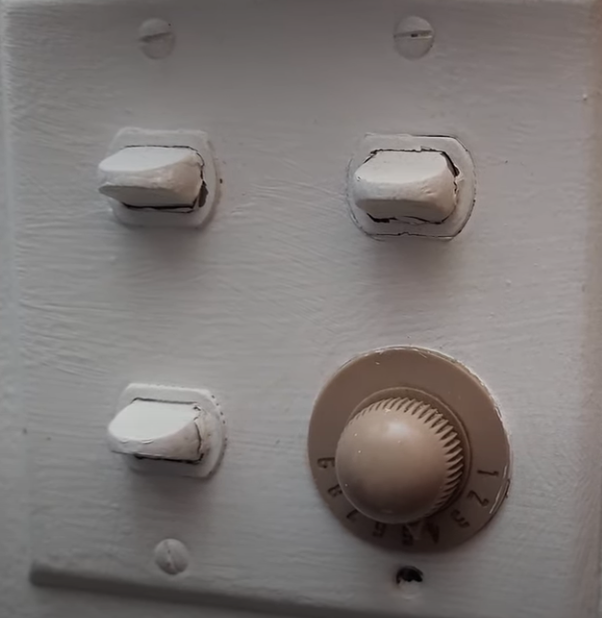
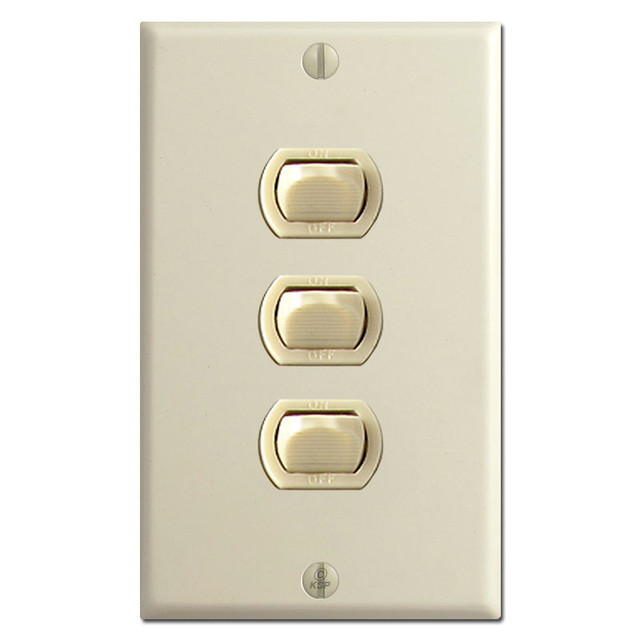
Our home didn’t have anything that fancy, but it did have panels with little Sierra despard switches. If you removed the cover plate, you found units like the one shown below.

Despard switches and outlets are compact units that allow you to cram more components onto a plate when wall space is limited.
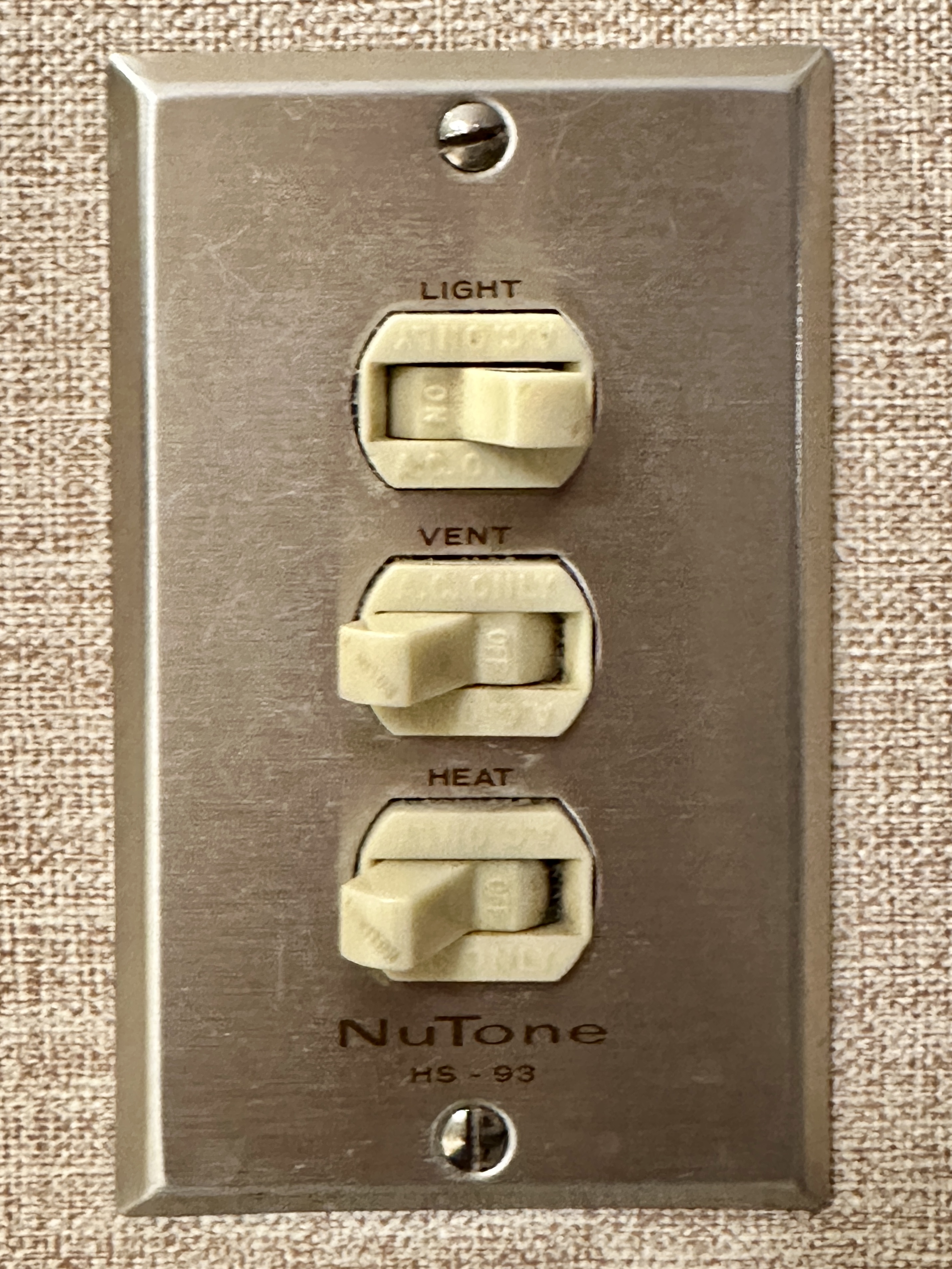
My current home, constructed in 1981, has a set of three despard switches in each bathroom that operate the light, vent, and heat in NuTone units in their ceilings. However, they are typical full-voltage switches, not low-voltage momentary switches connected to hidden relays.
Low-voltage switching didn’t catch on. Sierra Electric went out of business in the early 1980s, and my impression is that most low-voltage switch-relay systems have been abandoned.
20th Century Evolution
Several different light switch types came and went in the 20th century, and Nils Rasmusson did a nice job illustrating them, although he omitted the variants using low-voltage momentary switches and relays.
We had one of those old mercury silent light switches in one of our houses, and it was also outfitted with a tiny internal neon lamp that made the switch glow. I didn’t care for it, however, as I preferred to give a toggle switch a quick snap on or off as I walked by.
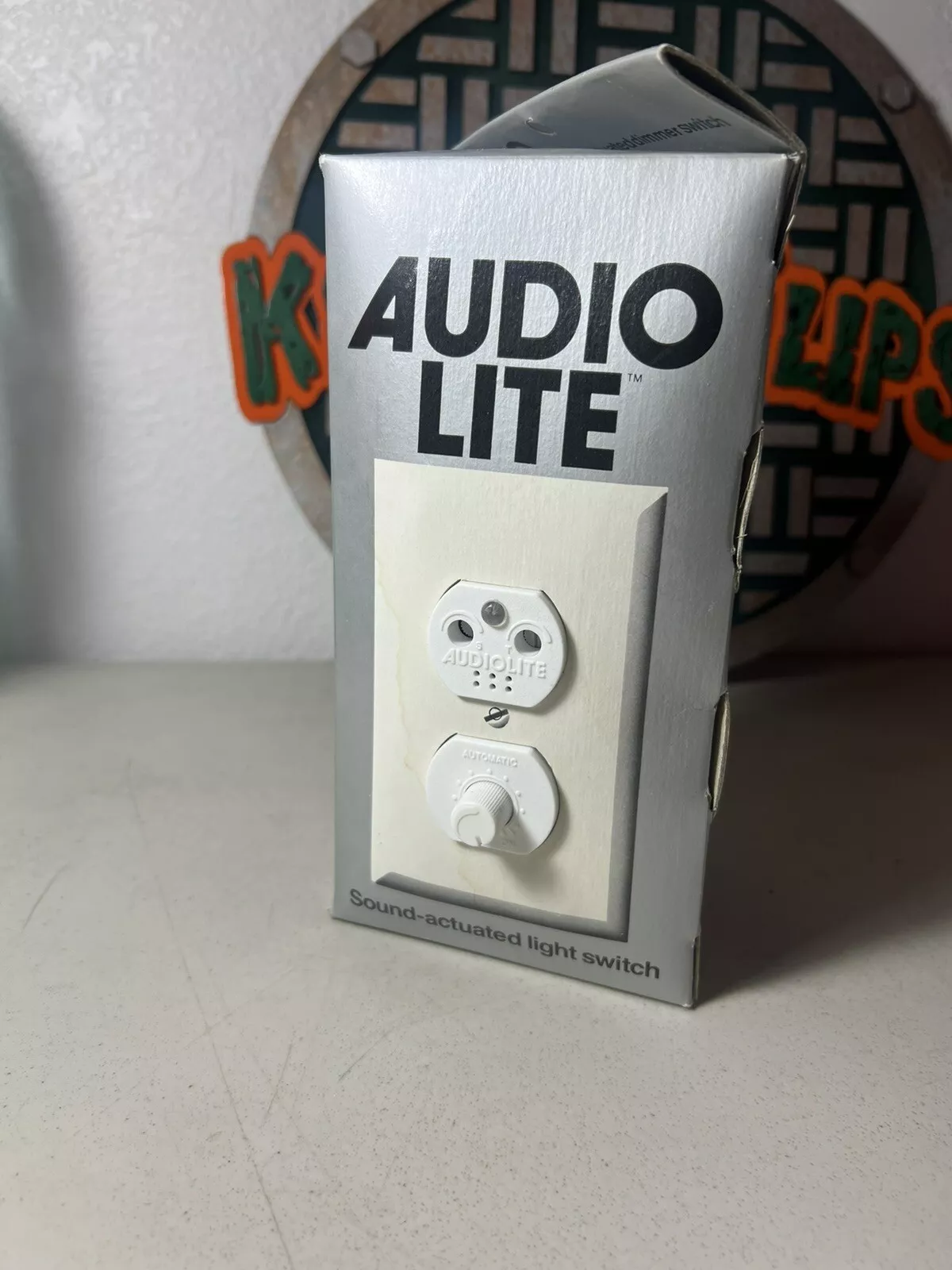
Later I was a teenager fascinated with gadgets, and in our next home I swapped a toggle switch in my bedroom for an Audio Lite. It turned on the light if it detected sound and had a dimming function. The novelty wore off quickly, and eventually I replaced it with a simple Decora switch.
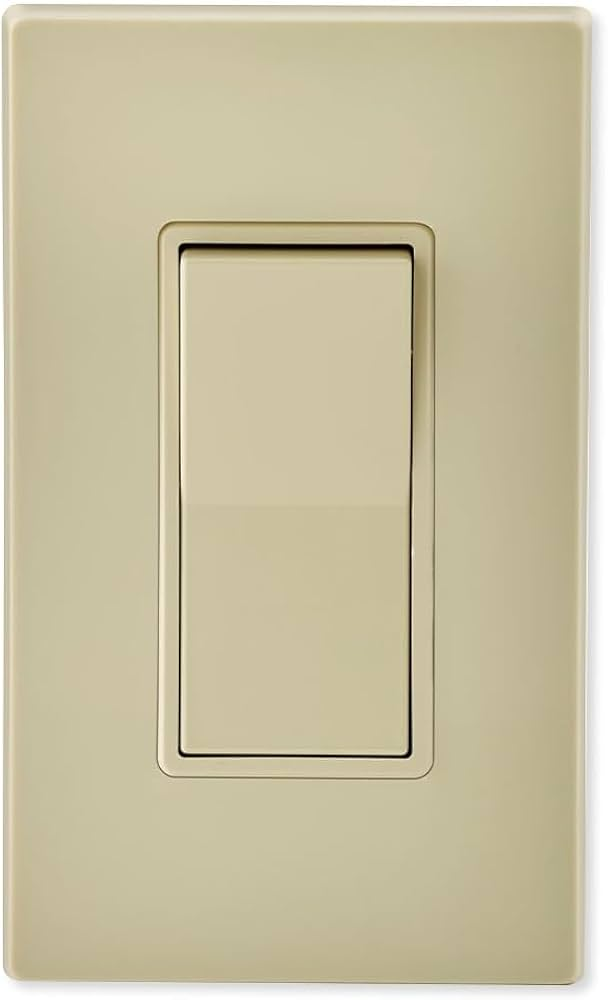
Leviton introduced those rocker switches in the 1970s, and they were popular enough that the Decora brand has morphed into a generic name for rocker switches, just as Kleenex became a generic term for facial tissues. When my mother sold the home forty years later, that bedroom still had its oddball Decora light switch.
At work, I encounter some motion sensor light switches. Technology Connections explained how passive infrared motion sensors work. I understand their utility in turning the lights off in unoccupied rooms, but they are endlessly annoying, and I would never consider having them at home.
Pet Peeve
Another light switch type that I’ve never liked is the rotary dimmer that you push to turn on and off and rotate to adjust the brightness. I don’t like their look and feel and how easily the dial can turn when you push them on or off.
My 1981 home came with five of the damnable things in the living room. A gang of three in one corner operates some little-used ceiling can lights, and those have survived my wrath. However, two near the kitchen were used constantly for some switched outlets for living room lamps and for the dining area chandelier.
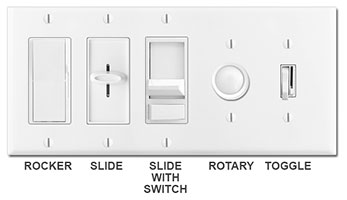
So soon after I moved into the house 30 years ago, I replaced those two rotary dimmers with toggle ones. They have a thinner toggle switch with a dimmer slider alongside. That lets us flip a switch on or off without inadvertently affecting the amount of dimming, while still providing full dimming control.
Various types of dimmer switches are available, including expensive fancy ones with online access, but eventually I’ll just replace our three surviving rotary dimmers with toggle switches and slide dimmers.
Smart Lights
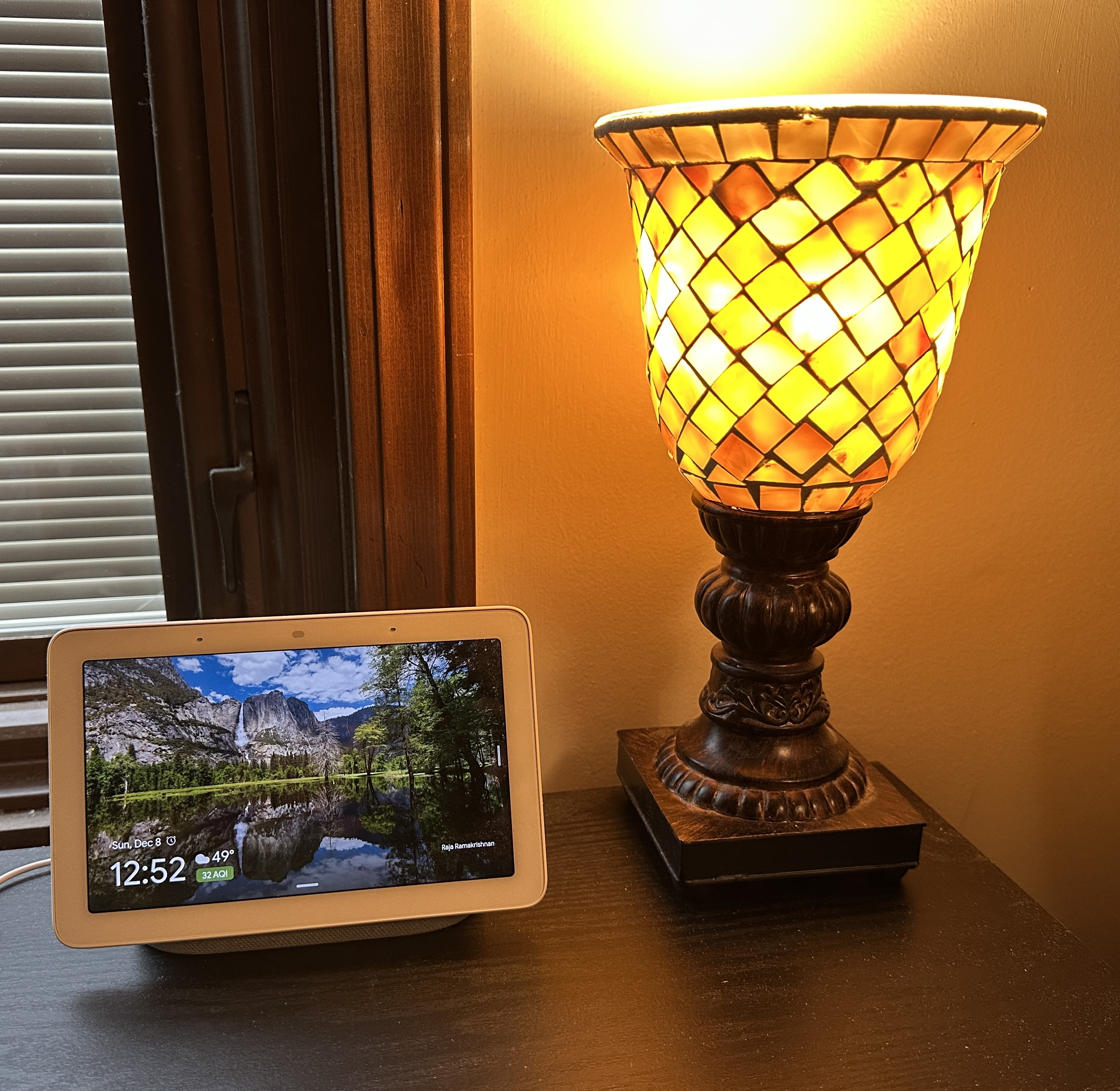
As a lifelong technology and gadgets guy, years ago I bought some of the Philips Hue smart light bulbs, which can be dimmed and set to various colors, and they are programmed into our Google Home system. But the only one I ever use for its smart features is in a bedside table lamp. Instead of messing about with the lamp’s clumsy inline power switch, I just tell the Nest Hub on my nightstand to turn the light on or off, adjust its brightness, etc. Plus I have preprogrammed bedtime and wake-up routines on the Nest Hub that involve that lamp.
Wendy and I also use smart switches linked to our Google Home system for a few other lights that otherwise would be awkward to control. Otherwise, we have stuck with dumb switches.
Modern Bulbs
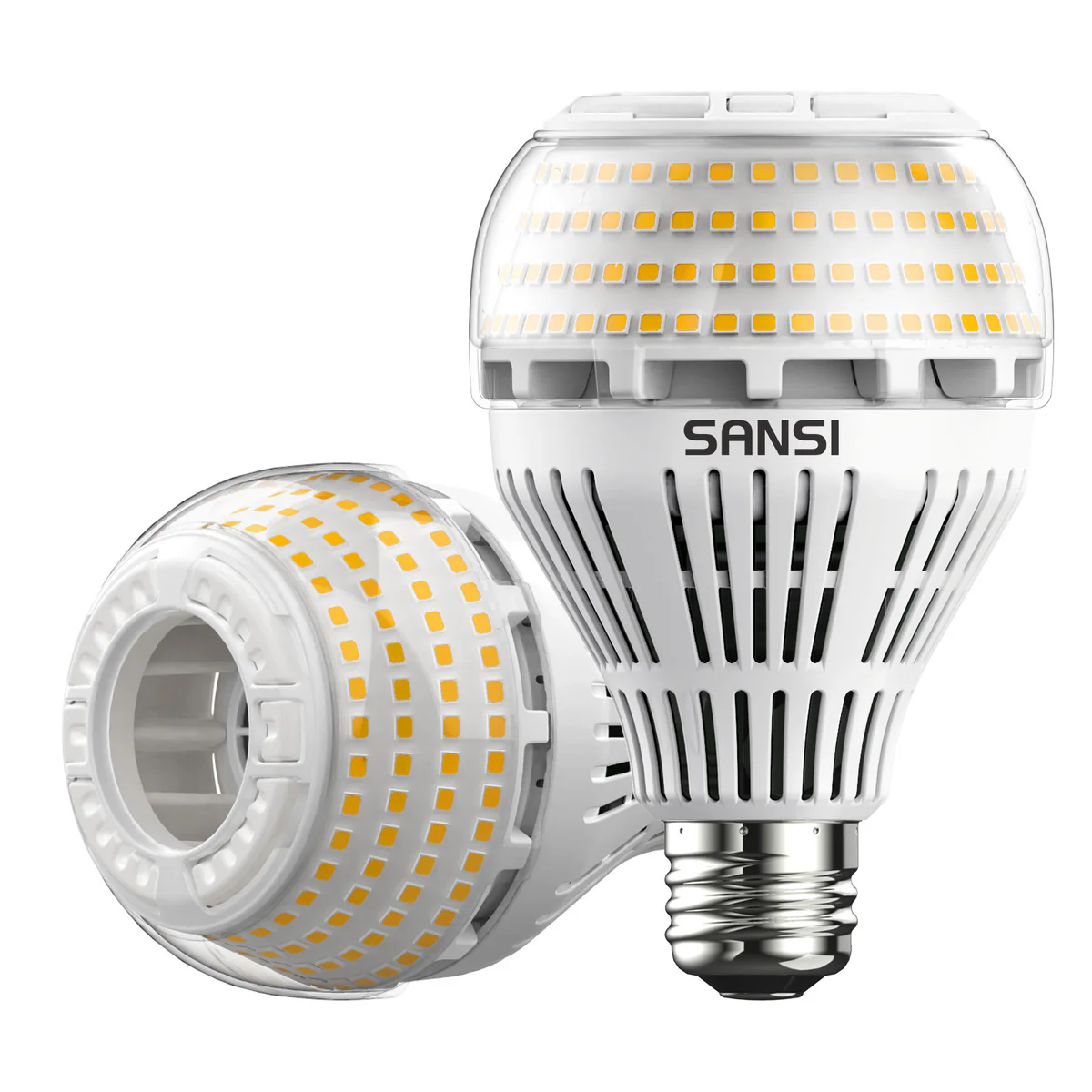
I switched to LED bulbs over a decade ago, and Wendy has installed LED strips in a few spots around the house. However, our main living room light is a torchiere lamp hooked into a wall outlet controlled by one of the dimmer switches. Until 2022, I still had to regularly replace its 50/200/250 watt bulb since the 200 watt tungsten filament had a limited life but there were no LED bulbs capable of rivaling its 4000-lumen output that were dimmable and had the 3000 Kelvin warm white color I prefer.
I finally was able to order a bulb from SANSI meeting my specifications. It has 156 LED chips that collectively only consume 27 watts. That means the only incandescent bulb I still have to regularly replace is the 40-watt appliance bulb in our 1981 JennAir oven.
LEDs and their associated circuitry remain vulnerable to heat. Over the past decade I have replaced almost all of the LED bulbs at least once, some multiple times, particularly in enclosed or tight fixtures.
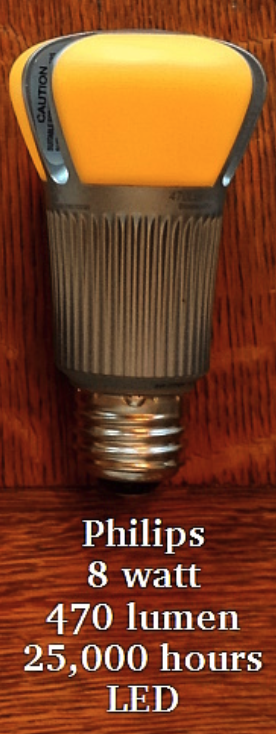
However, my two oldest LED bulbs are still going. Back in 2011 or so, I purchased those Philips Ambient bulbs. They were primitive by today’s standards, with a light output equivalent to only a 40-watt incandescent bulb, huge heat sinks, and yellow-orange covers for the LEDs to produce a warm white.
I put them in a table lamp beside my recliner in the same circuit as the big living room torchiere, so those lights are used every day. But, with those huge heat sinks, their relatively low power, and placement in a lamp with adequate ventilation, they have endured. I’ve grown fond of them, and I am glad that they weren’t recalled like some of their 12.5-watt brethren. I’ll be sad when they finally expire.
This year I also replaced the only remaining fluorescent light in our home when a 1981 fixture for a 24″ T12 bulb above our kitchen stove finally gave out. I had known for years that it was difficult to get started, so the old ballast was shot, but that didn’t matter since we left the light on continuously. Finally it went out and wouldn’t restart, even with a new bulb.
Rather than mess with the ballast in a cheap 43-year-old fixture, I wired in a new LED light, wedging the old light cover over it to reduce its glare. That wrapped up the modernization of the lighting in our home for the foreseeable future.







 Meador Manor