

The modern world is, in many ways, an introvert’s paradise. Technological progress allows me to enact part of the science fiction future I read about in childhood. While practical limits denied us flying cars and human travel beyond the moon, I have at my instantaneous beck and call incredible computing power, world-spanning knowledge, over two hundred million songs, millions of books, and billions of videos.

However, unmanaged blessings can devolve into curses, and it is striking how technological innovations as well as services like Amazon, DoorDash, and Instacart provide access to a lifestyle that could approximate the dystopian vision that E.M. Forster shared in 1909 with The Machine Stops. If you’ve never read the tale, it is now public domain, and you might explore what influenced many later works, including George Lucas’s THX 1138, Issac Asimov’s The Naked Sun, and Pixar’s WALL-E.
Back in 2000, Robert Putnam’s Bowling Alone documented the decline of social capital in the USA in the second half of the 20th century. He described reductions in many forms of in-person social intercourse, arguing that it undermined civic engagement.
In the February 2025 issue of The Atlantic, Derek Thompson updated the concept in “The Anti-Social Century“, documenting how Americans are now spending more time alone than ever, and arguing that is changing our personalities, our politics, and our relationship to reality.
Consider the change from 2003 to 2022 in average minutes per day spent at home, which spiked during the pandemic and has remained highly elevated:


Granted, time at home does not equate to time spent alone for those with roommates, spouses, and/or children. However, an analysis showed that each additional hour spent at home was associated with an increase of 7.4 minutes in time spent with family, a decline of 5.0 minutes spent with friends, and an increase of 21.0 minutes spent alone.
The same analysis found that activities conducted at home were associated with lower levels of happiness and viewed as less meaningful, although there was a much weaker relationship between time spent at home and sadness and and an inconsistent relationship with stress.
The rise in time spent at home is largest among adults under 35 and smallest among those 55 and older. While younger adults spend less time at home than elders, their time spent at home has risen most sharply, and it is pronounced for those with high levels of educational attainment. Adults are spending more time sleeping and using a computer for leisure and less time shopping, socializing, volunteering, and traveling, but a larger driver was a shift in the location of existing activities.

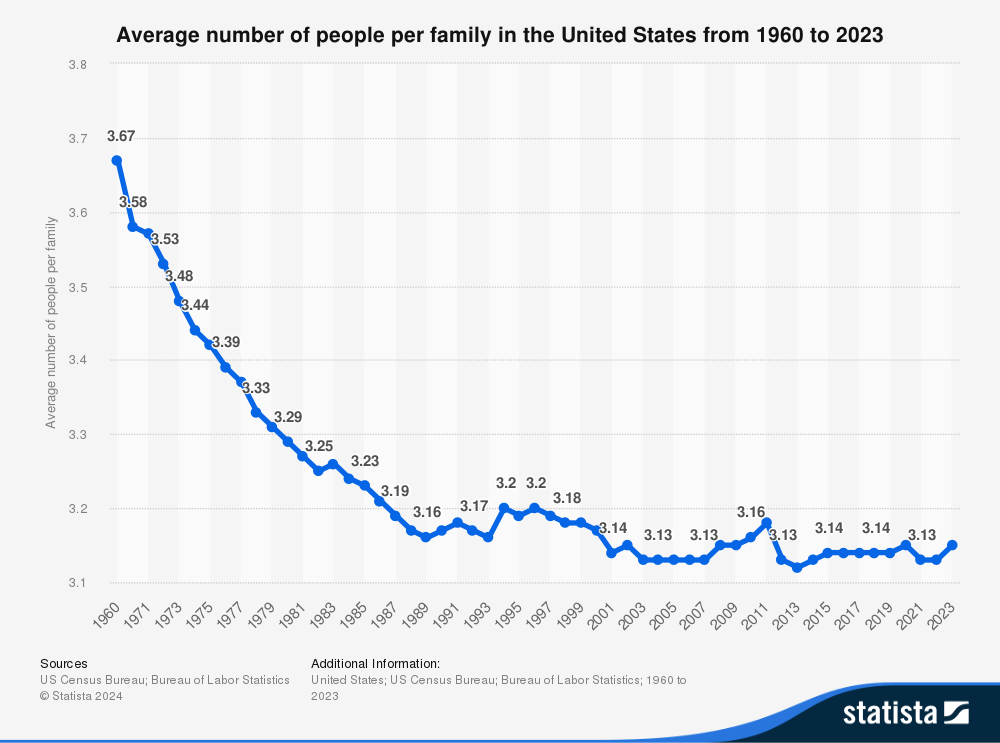
The shutdowns in the early days of the COVID-19 pandemic certainly drove much of that shift in location, including remote work, virtual church services and school, and in-person dining restrictions. The shifts were enabled not only by technology but also by how over my lifetime the size of the average new single-family home has increased by 50% and the share of them with air conditioning has doubled to 98%. Meanwhile, the average number of people per family dropped from 1960 to 1990 before stabilizing.
The shuttering of in-person schools from March through May 2020 by Oklahoma’s State Board of Education forced my wife and I to work remotely, and while we returned to in-person work in August 2020, we also had sixteen virtual days in 2020-2021 unrelated to inclement weather, nine in 2021-2022, and three in each of the later years, many of those in the earlier years due to pandemic-related staffing issues from quarantines and isolations. Some of the folks reporting to me now work remotely during personal or family health issues, while in the past they would have had to take sick leave.
Restaurant delivery
I was startled to read in The Atlantic that 74% of all restaurant traffic came from “off premises” customers in 2023, which means via takeout and delivery. GloriaFood reported that in 2024, nearly 1/3 of people ordered meals online, and the average person ordered delivery 4.5 times per month while dining out only 3 times per month.
The popularity of ordering food online declines with age:

During the pandemic, my wife and I made much greater use of DoorDash for the delivery of restaurant food, and we Gen X introverts have persisted in making frequent use of that service despite its cost.
Online versus in-person retail
The retail industry has about one million stores in the USA and is its largest employment sector, employing about one out of every four workers nationwide. Despite all of the talk of the “death of retail”, in 2022, physical stores still accounted for 87% of all sales.
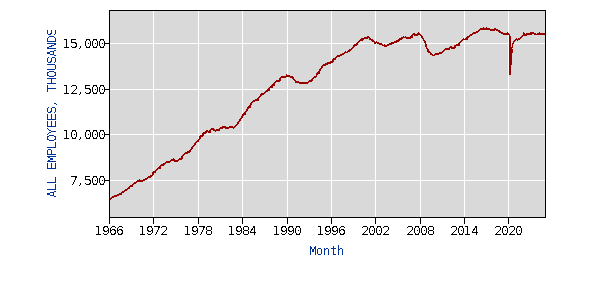
The next graph shows the number of retail employees in the USA over my lifetime. Notice how it roughly stabilized a bit above 15 million in this century, with dips in the Great Recession of 2008 and the 2020 COVID-19 pandemic.
The next graph shows the number of private retail establishments in the 21st century. Again, the Great Recession reduced it from 2008-2011, but notice how it has been growing since the COVID-19 pandemic.

Here are the top retail companies in the USA, ranked by market capitalization:
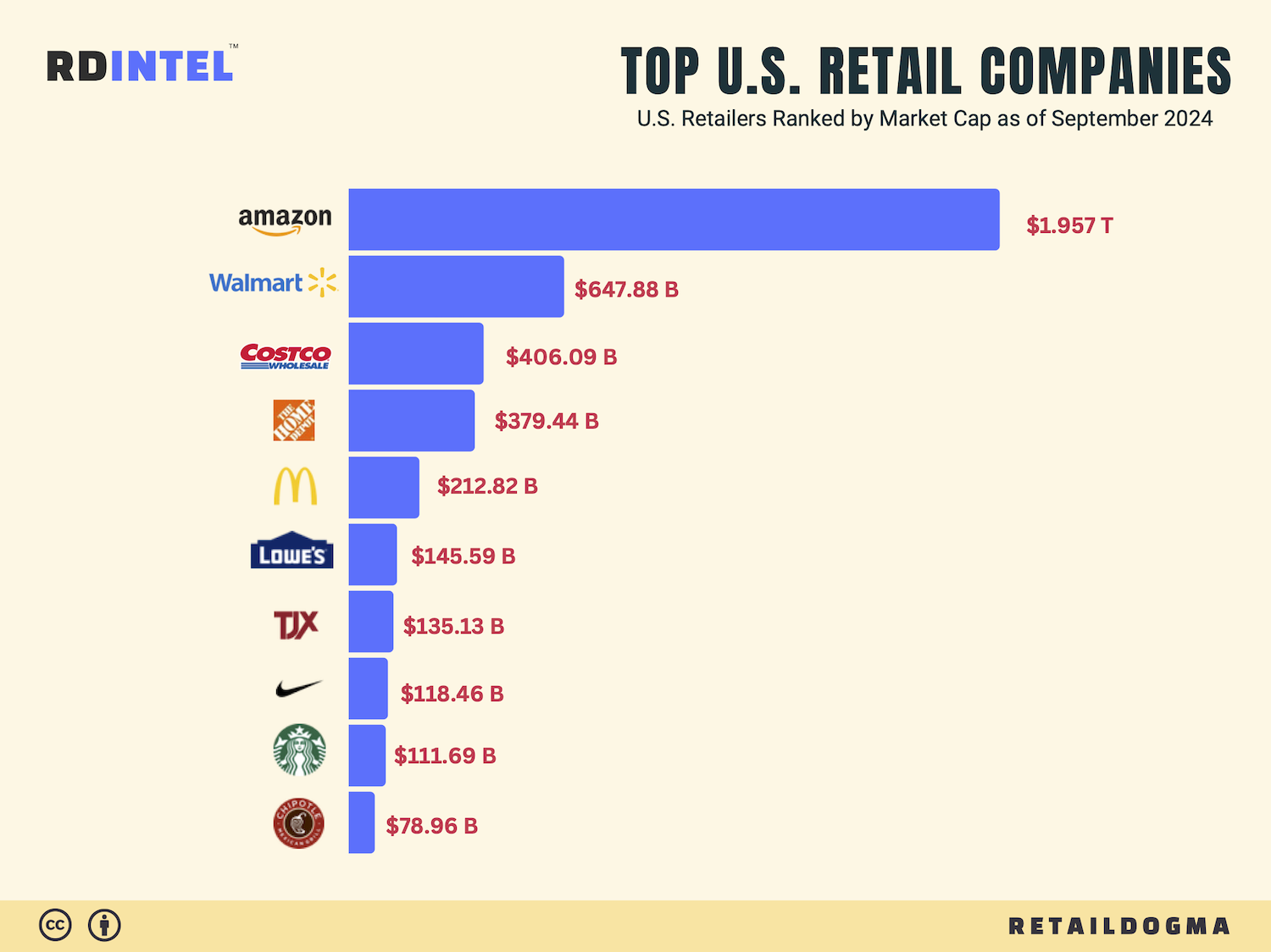
Amazon is famous as the e-commerce giant which helped doom many department and discount stores. I’ve had an Amazon account since 1998, and it now has about a 40% share of the e-commerce market in the USA, which is over six times larger than that of its nearest rival, Walmart. Amazon does have some physical stores, such as Whole Foods Market, but Walmart has many more physical stores.

I have done most of my shopping online for years, but Wendy still buys many of our groceries at a store. Some of our grocery items, however, have shifted to online. For example, after my paternal grandmother could no longer supply me with homemade black raspberry jelly, I started buying it from Smuckers. They’ve now stopped its production, so I’ve resorted to ordering it from various vendors via Amazon as the small jars available locally were too pricey.

For many years, I bought most of my clothes at J.C. Penney stores in Tulsa, but for well over a decade most of my clothes have been ordered online via Blair Corporation.
I also began buying my Reebok sneakers and Dressports shoes online, although in October 2020 I bought my first pair of hands-free Kizik shoes, and I have bought several more pairs in various styles. I still have a spare unused pair of Dressports as well as of Reeboks in my closet, and it is conceivable that I might never buy any more dress shoes or sneakers, given that I’ll be retiring in June 2026 and after that intend to mostly wear Kizik slip-on shoes except when I’m hiking in my Columbia boots.
The number of retail establishments by market segment shows that collectively the top three of food and beverage, general merchandise, and motor vehicles and parts collectively employ just over half of the retail workers.

Mail order pharmacies
Genetics, time, diet, and stress have led to me having six different daily prescription medications, which is one reason I decided to retire in June 2026. I used to make regular trips to Walgreens to pick up prescriptions, but then the store I prefer closed its pharmacy on weekends. Then I had another slew of medications to pick up at CVS when my mother moved into independent living in town.
I grew increasingly frustrated by frequent trips to Walgreens and CVS, finding the latter especially slow. So I shifted all of our chronic medications to Amazon Pharmacy for automatic refills by mail, which has been a true blessing. Wendy still uses Walgreens, and I still rely on it for some vaccinations and short-term prescriptions, but I’m going to the drugstores far less often now.
Between 2016 and 2021, there was a 95% increase in the number of Americans receiving their drugs from home health care, a 45% increase in drugs received from clinics, and a 35% increase from mail-order pharmacies. Over the same period drugs received from long-term facilities dropped by 17%, federal facilities by 9%, and independent pharmacies by 5%. Independent pharmacies have been squeezed by pharmacy benefit managers, with the Oklahoma attorney general alleging that CVS Caremark has been under-reimbursing them.
Home entertainment
Video games have been part of home entertainment for over 50 years. I was never into them much, although I played a few on my TRS-80 Color Computer in the early 1980s and in the 1990s I did play Railroad Tycoon, Sim City, and Myst games on my personal computers, and this year I’ve played some pinball on my Mac.
Arcades games were a big deal in my teenage years, although I wasn’t a customer. I have noticed retro arcades appearing, but the one in Bartlesville and another I’ve seen on YouTube seem to focus on old games. I guess it shouldn’t surprise me that revenue from arcade gaming collapsed in the 21st century, with most revenue now coming from mobile, then personal computers and consoles.

Back in the mid-1950s, movie studios panicked over the rising popularity of television, implementing wide screen ratios and eventually improved sound, and the gimmick of three-dimensional movies which didn’t last long and made a brief odd resurgence in the early 2000s.
I drastically curtailed my visits to cinemas years ago, and Derek Thompson reported that today the typical American adult buys only three movie tickets a year while watching almost 19 hours of television (about eight movies worth) each week. He also shared, “Men who watch television now spend seven hours in front of the TV for every hour they spend hanging out with somebody outside their home. The typical female pet owner spends more time actively engaged with her pet than she spends in face-to-face contact with friends of her own species.”
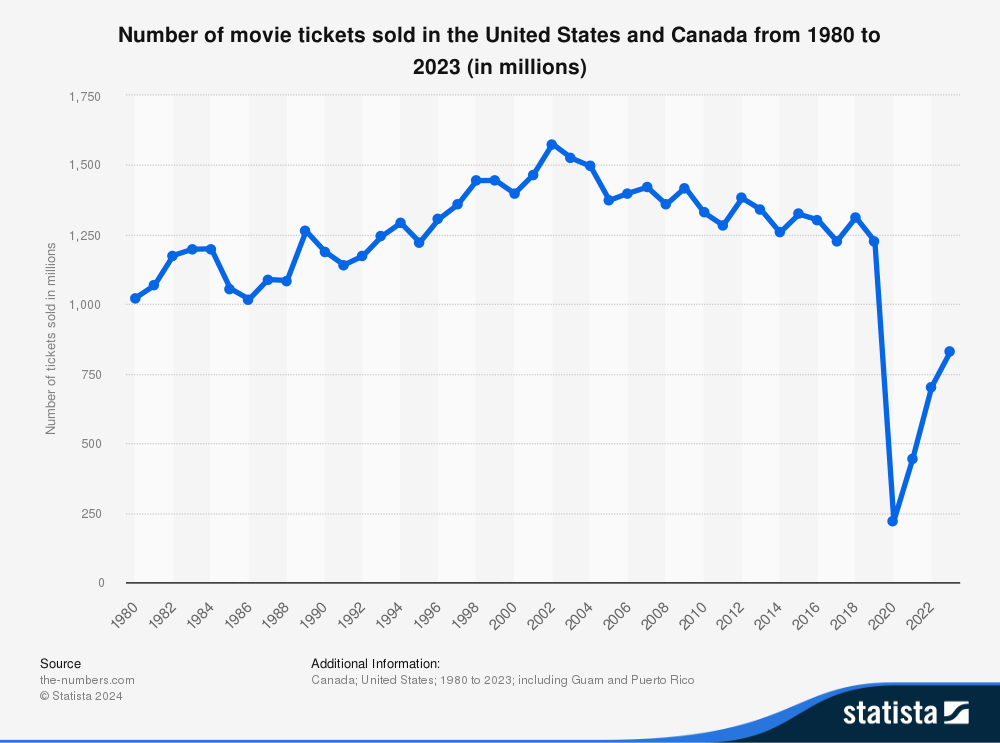

You might think that movie ticket sales were okay until the pandemic, but bear in mind that all the while the population was increasing. The per capita movie ticket sales declined from 5.5 tickets per person in 2002 to 2.5 tickets per person in 2023, a 54% decline.
While traditional television viewing has collapsed among younger viewers, the time spent per day with digital media continues to grow.
Teenagers & Smartphones
This year, our school district’s administrators read and discussed The Anxious Generation by Jonathan Haidt, which argues that the spread of smartphones, social media, and overprotective parenting have led to a “rewiring” of childhood and a rise in mental illness.
Derek Thompson’s reporting points out, “The typical person is awake for about 900 minutes a day. American kids and teenagers spend, on average, about 270 minutes on weekdays and 380 minutes on weekends gazing into their screens, according to the Digital Parenthood Initiative. By this account, screens occupy more than 30 percent of their waking life.”


“Young people are less likely than in previous decades to get their driver’s license, or to go on a date, or to have more than one close friend, or even to hang out with their friends at all. The share of boys and girls who say they meet up with friends almost daily outside of school hours has declined by nearly 50 percent since the early 1990s, with the sharpest downturn occurring in the 2010s.”
I’m struck by the huge declines after 1990, thus over the course of my teaching career, in the percentages of high school seniors who have consumed alcohol, got a driver’s license, and who work, along with a significant but more modest decline in how many have had sexual intercourse.

Haidt argues that smartphone use by teens correlates with elevated teen anxiety and depression, and provides plenty of data to augment the anecdotal evidence that many teenagers and adults are addicted to their smartphones. It is no surprise that social media can exacerbate self image problems, especially for girls, and that negative consequences of various technologies and societal changes, including economic issues, can sometimes lead to a failure to launch for young adults.
While there is a whiff of moral panic about it all, I agree that restricting smartphone use at school would decrease distraction and increase socialization, and adult smartphone usage often negatively impacts community fellowship and parenting. There are also a number of adults whose smartphone addiction appears to be both a symptom of and contributor to their attention deficit hyperactivity disorder.
Both stronger and weaker bonds
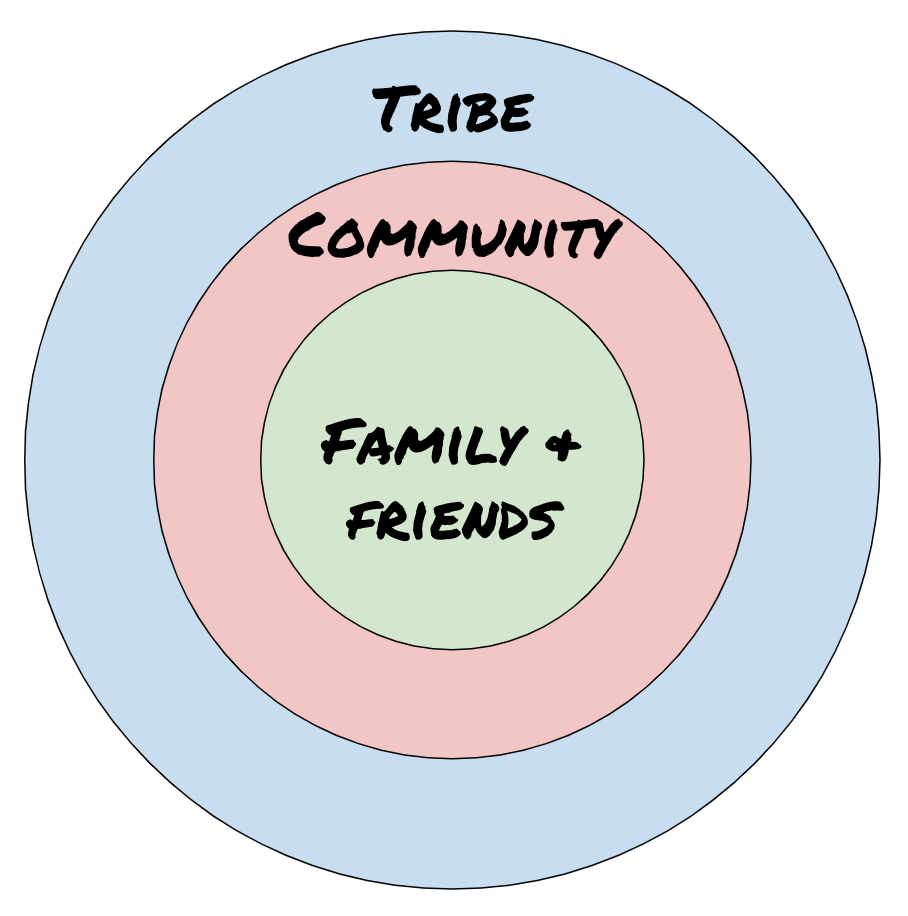
Derek Thompson points out, “Home-based, phone-based culture has arguably solidified our closest and most distant connections, the inner ring of family and best friends (bound by blood and intimacy) and the outer ring of tribe (linked by shared affinities). But it’s wreaking havoc on the middle ring of ‘familiar but not intimate’ relationships.”
He points out how the erosion of the village, the middle ring, has coincided with poisonous partisanship. In a 2021 poll, “nearly a third of college students who identified as Republican said they wouldn’t even go on a date with a Democrat, and more than two-thirds of Democratic students said the same of members of the GOP.”
Thompson argues, “Social disconnection also helps explain progressives’ stubborn inability to understand Trump’s appeal.”
He adds, “Too many progressives were mainlining left-wing media in the privacy of their home, oblivious that families down the street were drifting right. . . .If progressives still consider MAGA an alien movement, it is in part because they have made themselves strangers in their own land.”
Thompson also points out how the Amish famously shun many modern innovations, such as cars and television, but many do have refrigerators and washing machines. Amish adopt only those innovations that support their religious and communal values. I am reminded of how my maternal grandparents shunned television and movies and restricted the radio to news and religious broadcasts.
Thompson offers this insight: “Although technology does not have values of its own, its adoption can create values, even in the absence of a coordinated effort. For decades, we’ve adopted whatever technologies removed friction or increased dopamine, embracing what makes life feel easy and good in the moment. But dopamine is a chemical, not a virtue. And what’s easy is not always what’s best for us.”
That is something for us to ponder, not only alone at home but in conversation with friends and family…and maybe strangers in our community, before the Machine stops.









 Meador Manor