
Pew Research Center periodically examines religious and political beliefs of the populace, and it is interesting to note their shifts over time.
They recently released their latest Religious Landscape Study, a decade after the previous one. It is interesting to note Oklahoma’s proportions of various religious and political beliefs and how they have changed over time and how they compare with national statistics.
Religion
Oklahoma is known as a very religious and politically conservative state, but the study confirms a significant increase in the religiously unaffiliated over the past two decades.

Christians still dominate with 47% of Oklahomans being Evangelical Protestant, 11% Mainline Protestant, 8% Catholic, 4% Historically Black Protestant, and 1% Latter-day Saints (Mormons), while all of the other Christian categories combined are less than 1%.
Since 2007, the percentage of Oklahomans who believe in nothing in particular has risen from 9% to 12%, agnostics have risen from 3% to 9%, and atheists have risen from less than 1% to 5%. Another lens to apply is belief in God:
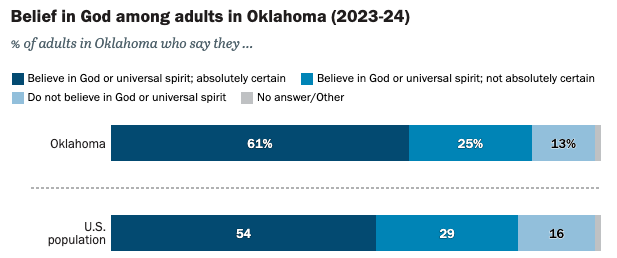
I threw in the nationwide percentages for comparison, and you can examine many other religious beliefs and practices in the study, including religious attendance and belief in heaven and hell.
Politics
The Republican party is particularly dominant in the central and southern states, but I well remember the decades when the Democratic party had a lock on the Oklahoma legislature and most statewide offices. In 2007, most Oklahomans were Democrats, but now the Republicans hold immense sway.

The lopsided party affiliations in Oklahoma in 2024 contrasts to how nationwide 46% identify with Republican politics, 46% with Democratic politics, and 8% with neither.
Back in the day, many Oklahomans were conservative or “Blue Dog” Democrats. In 2007, when most Oklahomans were still affiliated with the Democratic party, 39% of Oklahomans identified as conservative, 36% as moderate, 18% as liberal, and 7% gave no answer. Since then, liberals have increased to 20% and conservatives to 41%.

Notice how nationwide conservatives still outnumber liberals, with the plurality going to moderates. The tendency to overestimate Republican enthusiasm for all conservative ideological stances and Democratic support for all liberal ones is perhaps why some who look at how 46% of Americans lean Republican and 46% lean Democrat then wonder at the current seismic shifts in national politics.
The lopsided politics in Oklahoma have yielded a draconian approach of abortions only being legal if necessary to save the life of a mother. However, it is worth noting that the majority say abortion should be legal in all or most cases.

Such views were in the minority back in 2007.
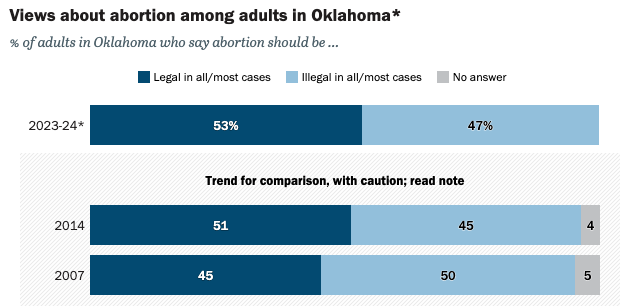
The study explores other social and political topics, including homosexuality, same-sex marriage, immigration, and evolution. I find it helpful to see actual data about Oklahomans’ views, as opposed to the hyperbole and rhetoric of politicians and the intensely anecdotal and biased posts one finds on social media.








 Meador Manor
Thank you again for your interesting compilations of stats and such! I am so glad you live in our town. Ann C.