
When I was growing up, there was much talk about “The Generation Gap”, which at the time referred to Baby Boomers’ counterculture and divergence from their parents’ values. Eventually, another gap developed between the Baby Boomers and my subsequent Generation X, a smaller cohort formed in the baby bust.
Up to now, the Baby Boomers have always been larger and more dominant than Generation X, but deaths from old age are slicing away at their ranks, and we Gen-Xers are on the verge of finally outnumbering them. Our numerical victory still won’t mean cultural dominance, however, as our baby bust generation will always be outnumbered by both the later Millennials and Generation Z.
When I moved to Bartlesville and began my professional career in 1989, the Baby Boomers were the dominant group, while the Greatest Generation was then rapidly diminishing due to age-related deaths, and the Millennials were still forming:
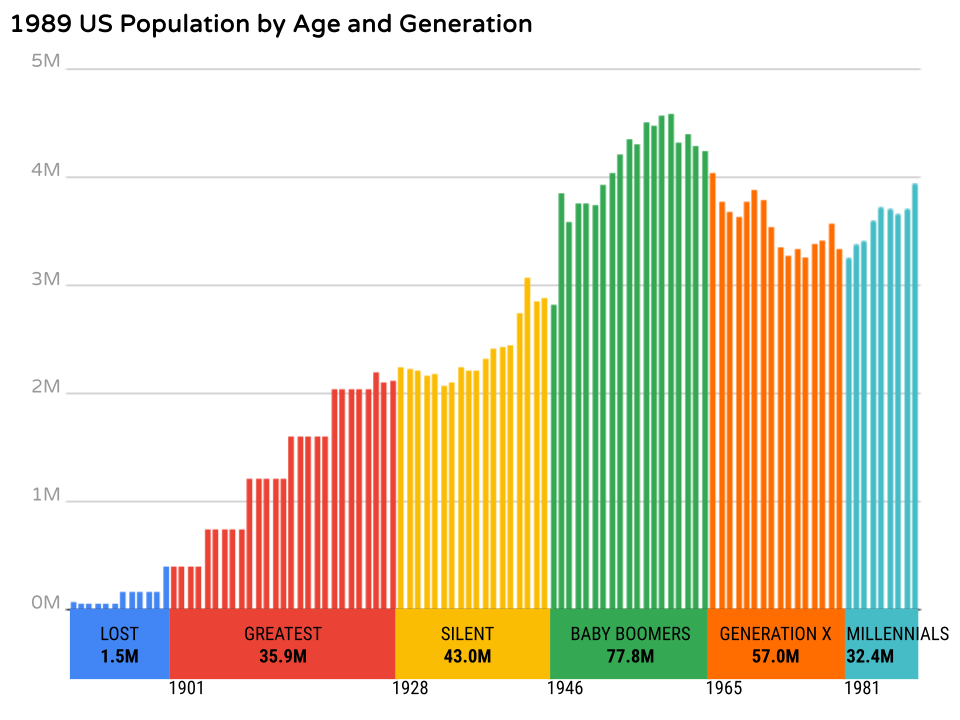
My father was from the Greatest Generation, while my mother was from the Silent Generation, and I was born near the beginning of the great baby bust in the mid-1960s. So I am among the oldest of Generation X.
Now, as I am concluding my professional career, the Greatest Generation is almost extinct, and the Silent and Boomer generations are the ones in the steep death decline. The Boomers are already outnumbered by both the Millennials and Generation Z, and Generation X is finally within striking distance, although soon old age will begin to noticeably gnaw away at our own cohort:
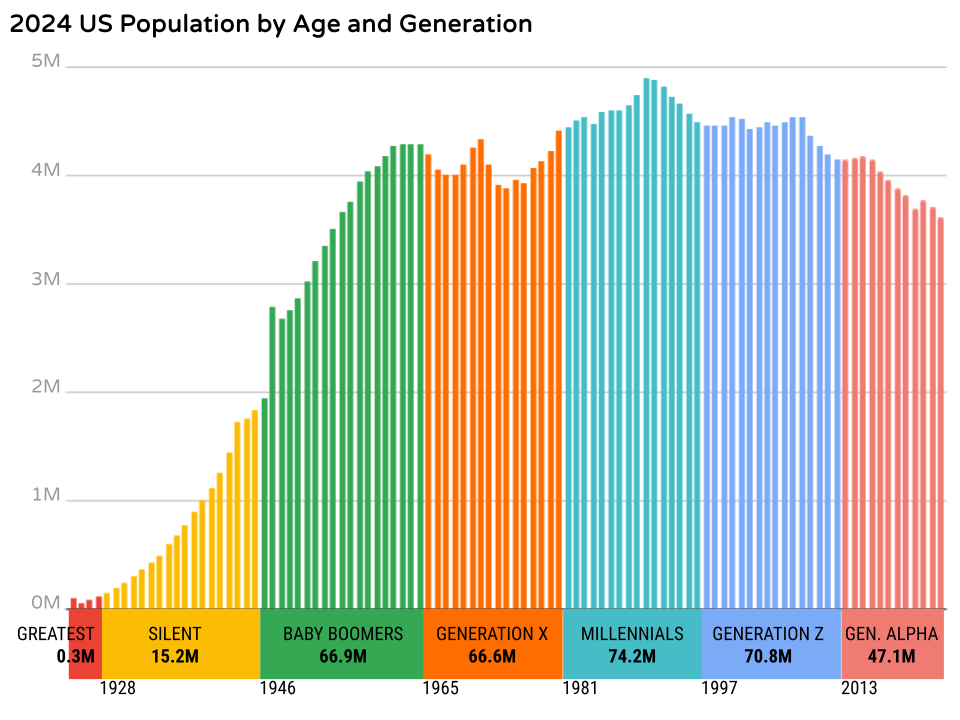
Sharp-eyed observers will note that Generation X is actually larger in the 2024 chart than in 1989 chart. I attribute that to both immigration and differences in the census methodologies of the available data sources. The relative sizes of the different generations for a given year is what is relevant for this post.
Baby Boomer stereotypes
The Greatest and Silent Generations, having endured the Great Depression and World War II, invested mightily in their post-war offspring, who grew up in an era of strong economic growth with ever-expanding Civil Rights and an increasingly elaborate social safety net.
A stereotype I learned about Baby Boomers as I was growing up was that many were non-conformist hippies, members of the “Me” generation who allowed self-fulfillment to overshadow social responsibility. However, that certainly wasn’t true of many of the Boomers I worked with over the years.
Danielle Sachs claims the following Boomer stereotypes are often valid:
- They are still deeply attached to their newspapers, radios, and televisions
- They think online shopping and banking is a scam
- They have workaholic tendencies
- They demand face-to-face communication
- They stay loyal to brands for a lifetime
- They’re tight with their money
- They are technology-challenged
- They love Classic Rock and 1970s songs
- They have a hard time with change
- They have a strong sense of duty
If you are a Baby Boomer, do any of those actually ring true for you?
Generation X stereotypes
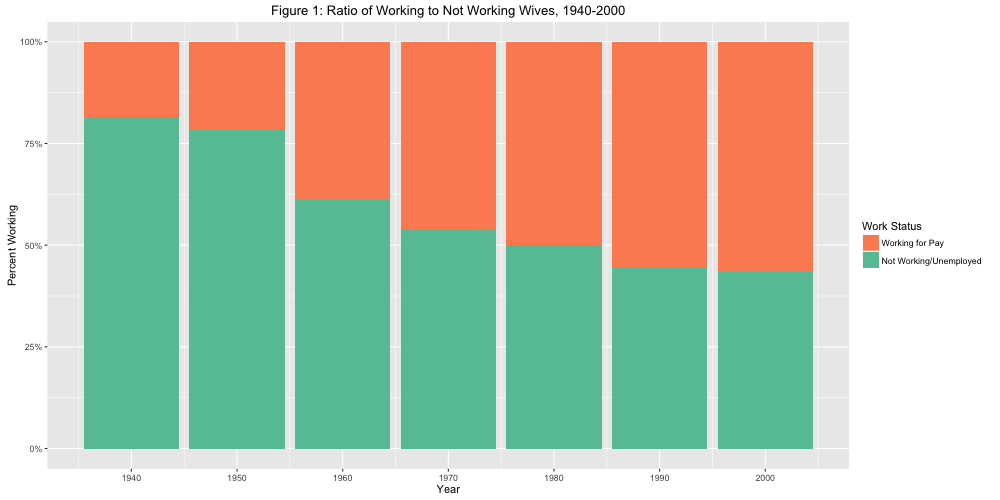
My generation was the baby bust, when the post-war procreation boom ended. Changing demographics meant that many of us grew up in a time when school enrollments had dropped dramatically and about half of our mothers who were still married started working full or part-time to sustain their family’s economic status. The bar chart below illustrates the dramatic increase in the proportion of working wives from 1940 to 2000, and that doesn’t account for single mothers.
The decreasing stigma associated with divorce also meant that many kids of my generation had divorced parents. While my parents stayed together, I was the product of my father’s second marriage. My only half-sibling died before I was born, and I was an only child.
My mother stayed home with me from birth to age 15 months, and then again from when I was in kindergarten through seventh grade. So for grades 8-12 I was a stereotypical Gen-X “latchkey kid” who came home from school to an empty house, although my father was forced into retirement at the start of 1984, when I was a senior in high school. And yes, I certainly was a member of the MTV Generation.
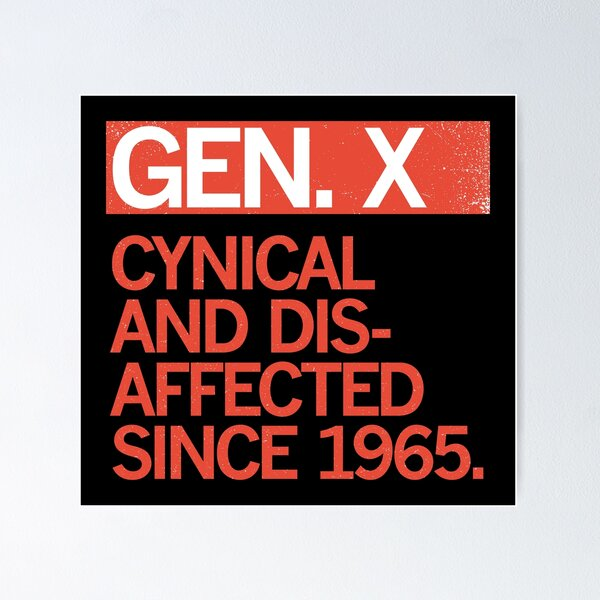
My generation is most often stereotyped as cynical slackers whose formative years were times of economic hardship and social change, leading to skepticism of institutions and authority figures.
Emma Singer claims that these Gen-X characteristics generally ring true:
- They are expert do-it-yourselfers
- Their sartorial style is decidedly dressed-down
- They’ve got the whole work-life balance thing down pat
- They’re tech-savvy, but not tech-dependent
- They’re fiercely independent
- They like to learn new skills
- They prefer a casual workplace
- They have a cynical streak
Most, but not all, of those apply to me and my Gen-X wife.
Political leadership
Here are the generations for the main Presidential candidates across the past 60 years:
| Year | Democrat | Republican |
| 1964 | Johnson – Greatest | Goldwater – Greatest |
| 1968 | Humphrey – Greatest | Nixon – Greatest |
| 1972 | McGovern – Greatest | Nixon – Greatest |
| 1976 | Carter – Greatest | Ford – Greatest |
| 1980 | Carter – Greatest | Reagan – Greatest |
| 1984 | Mondale – Silent | Reagan – Greatest |
| 1988 | Dukakis – Silent | G.H.W. Bush – Greatest |
| 1992 | W. Clinton – Baby Boomer | G.H.W. Bush – Greatest |
| 1996 | W. Clinton – Baby Boomer | Dole – Greatest |
| 2000 | Gore – Baby Boomer | G.W. Bush – Baby Boomer |
| 2004 | Kerry – Silent | G.W. Bush – Baby Boomer |
| 2008 | Obama – Baby Boomer | McCain – Silent |
| 2012 | Obama – Baby Boomer | Romney – Baby Boomer |
| 2016 | H. Clinton – Baby Boomer | Trump – Baby Boomer |
| 2020 | Biden – Silent | Trump – Baby Boomer |
| 2024 | Harris – Baby Boomer | Trump – Baby Boomer |
So Biden was the only member of the Silent Generation to be elected President, and although my generation currently ranges in age from 45 to 60, no one in Generation X has been selected by either dominant political party as its Presidential candidate. There are still scads of Boomers in their 60s and 70s, so we might have to wait awhile longer, and we could get shut out completely. I’m cynical enough to expect the latter.
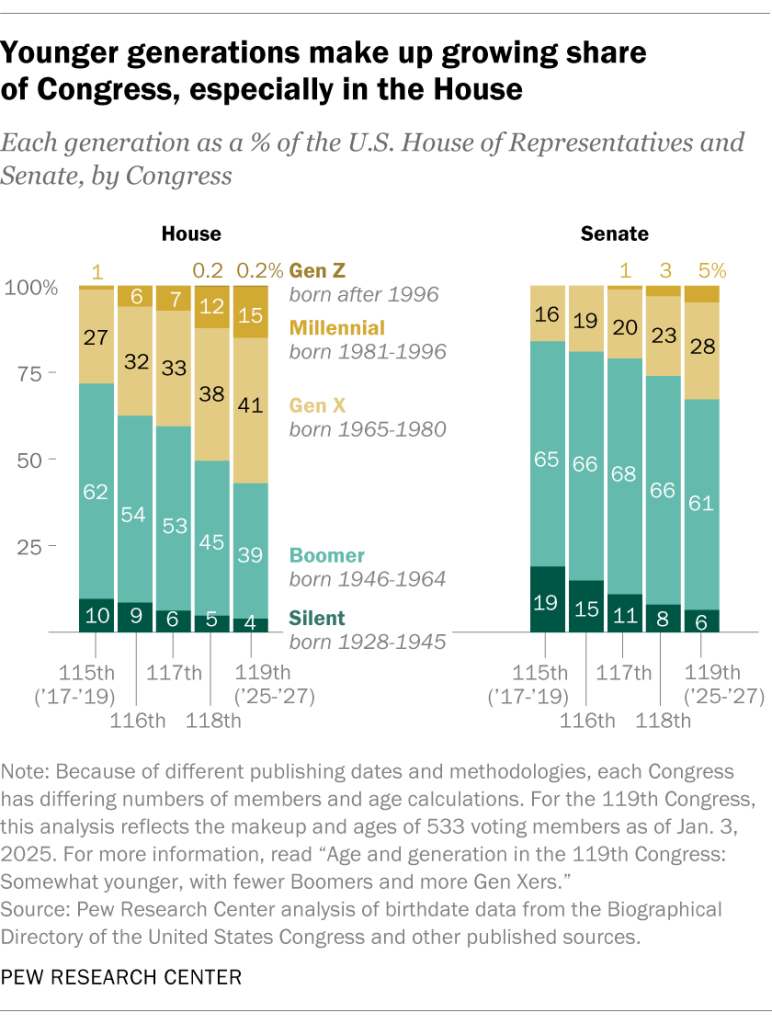
While the Boomers still completely dominate the U.S. Senate, my generation currently holds a slim plurality in the U.S. House of Representatives.
Cynicism isn’t necessarily a bad thing
Each of the generations following the Baby Boomers is getting an increasingly raw deal, economically. We cynical Gen-Xers entered our careers doubting that we would receive our promised Social Security benefits. I was a couple of years from entering the workforce when the Social Security Amendments of 1983 raised my full retirement age, effectively cutting my generation’s benefits by 13%, and I’ll be just reaching that age when projections say that the Social Security trust fund will be exhausted.
Given the complete dysfunction in the federal government, I have little hope that meaningful or progressive reforms will save me from a further cut in net Social Security benefits, which could be as large as 20% on top of the 13% cut made when I was just getting started. Even if Congress finally tries to prevent such cuts, they will probably end up further ballooning the outrageous deficit, which neither political party has the will or wisdom to contain, and thus jeopardize our nation’s economic future.
However, my cynicism led me to save back 19% of my gross salary for retirement investments over the decades, on top of a defined benefit pension. As a public school educator, I have never been paid my worth, but at least I had that benefit, available to about 75% of state and local government workers but only about 15% of those working in private industry. Pensions began to disappear in private industry just as my generation was entering the workforce.
That long-term discipline will allow me to retire just before I turn 60 years of age, paying for my own health insurance for five years until Medicare reduces that expenditure, and waiting at least two years before collecting a Social Security benefit. My retirement is nevertheless timely, as my cynicism has been greatly amplified, and my patience exhausted, by the demagogues now dominating state and national politics.
Millennials attacking Boomers
Before becoming a school district administrator, I taught high school juniors and seniors from 1989 to 2017, so I would estimate that 2/7 of them were Generation X, 4/7 were Millennials, and 1/7 were Generation Z. I see plenty of bashing of Millennials and Generation Z, with them stereotyped as spoiled and entitled beings who are hopelessly glued to their smartphones and often unable to launch successfully into independent adulthood.

Some Millennials argue that they have been screwed by the Baby Boomers. Author Bruce Gibney said, “The boomers inherited a rich, dynamic country and have gradually bankrupted it. They habitually cut their own taxes and borrow money without any concern for future burdens. They’ve spent virtually all our money and assets on themselves and in the process have left a financial disaster for their children.”
He points out that during the Baby Boomers’ era of dominance, there was a massive shift to prioritize privatized gains while socializing the risks for big banks and financial institutions, trends that accelerated in the Great Recession of 2008.
When interviewing Gibney, Sean Illing said, “They inherited a country they had no part in building, failed to appreciate it, and seized on all the benefits while leaving nothing behind.”
Gibney added, “This is a generation that is dominated by feelings, not by facts. The irony is that boomers criticize millennials for being snowflakes, for being too driven by feelings. But the boomers are the first big feelings generation. They’re highly motivated by feelings and not persuaded by facts. And you can see this in their policies.
Take this whole fantasy about trickle-down economics. Maybe it was worth a shot, but it doesn’t work. We know it doesn’t work. The evidence is overwhelming. The experiment is over. And yet they’re still clinging to this dogma, and indeed the latest tax bill is the latest example of that.
Time after time, when facts collided with feelings, the boomers chose feelings.”
Amidst the tirade, Illing did correctly point out that, if Millennials and Gen-Xers would have voted in greater numbers, they could have unseated the Boomers. Plus, I know that many Gen-Xers support poor fiscal policies. However, our small-slice generation is often ignored.
Approaching doom with equanimity
Generational change is on my mind more these days since I’m approaching retirement, the odds are against me living another 30 years, I lost my two best friends from childhood when we were in our early 50s, and almost all of my mentors are dead and buried. I realize that my intellectual light is dimming, and my approval of state and national politics is at a nadir. Yeah, I’m very much a Buster, not a Boomer.
While I note these generational trends, stereotypes, and complaints, I do so without malice. They help me model my world, but there is little point in spending my remaining time and energy railing against Boomers or Millennials or any other generation, which are just sloppy labels we use to simplify our thinking.
I think of my generational cynicism as a spark for a more sustainable flame of stoicism. I try to embrace happiness by minimizing my misanthropy and confrontations. I embrace resilience through reason, virtue, self-control, and acceptance of what is beyond my control. That is my pathway to inner peace.
I expect most of my fellow Gen-Xers would respond, “Whatever, dude.”









 Meador Manor
I think you’d enjoy Ken Wilber’s novel, Boomeritis, which pretends to be written by a Millennial while actually being written by a Boomer, one of many clever but cynical sleights of hand to support his theory that these generational differences are the group manifestation of individual moral development. It’s an irritating but unforgettable read.
Thanks for the recommendation. I am appalled by the demagoguery, magical thinking, and narcissism that pervades our current state and national politics, problems which are multi-generational.