
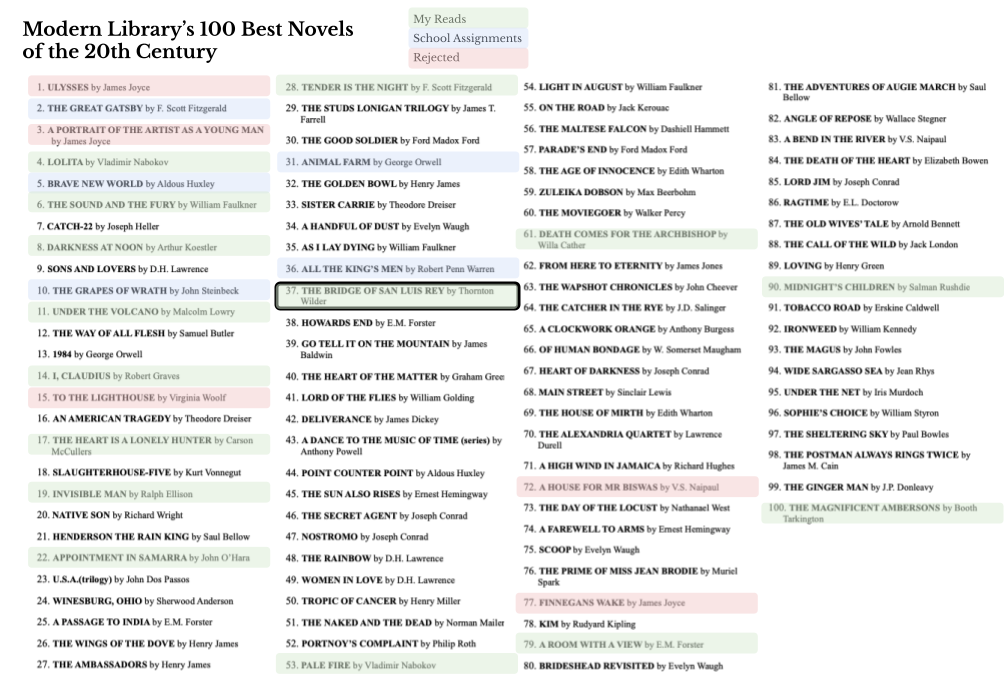
Thanks to Thornton Wilder, I have now read 1/5 of the 100 novels that Modern Library proclaimed to be the best of the 20th century. Before picking it from the list, I questioned whether or not I had ever heard of The Bridge of San Luis Rey, although I immediately recognized Wilder as the playwright of Our Town.
I rather suspect that Wilder’s novel only sounded familiar because of its similar title to The Bridge Over the River Kwai by Pierre Boulle, who also authored Planet of the Apes, although I’ve not read either of them, having merely seen the corresponding movie adaptations of 1957 and 1968. Kwai doesn’t even merit a ranking in The Greatest Books meta-analysis, while Apes ranks 13,716th. San Luis Rey is far more highly regarded, currrently ranked 622nd in the meta-analysis and #37 on Modern Library’s century list.
I’ve seen Our Town performed multiple times by high school students over the years. It was the most popular play for high schools in the 1950s, 1960s, and 1990s, and it was still in the top 6 in the 2010s. Its minimal sets, large number of roles, and prominent roles for females were key features bolstering its popularity.

I was always struck by its use of a stage manager character as narrator. That meta-narrative and its memorable third act feel strangely modern despite the play being written in 1938 and depicting the fictional American town of Grover’s Corners between 1901 and 1913.
After finishing Wilder’s novel, I invoked the incredible power of the internet to revisit the 1977 television production of Our Town. It featured the wonder that was Hal Holbrook, joined by Ned Beatty, Barbara Bel Geddes, Sada Thompson, and Ronny Cox. I highly recommend it, even with the distracting video effects they used in the wedding scene.
I watched the play, rather than reading it, since I lack an internal monologue and never enjoy reading plays…for me, they must be performed.
Our Town leans hard into the “typical American town” vibe, and I’ve always enjoyed it, even though I don’t share its characters’ religious beliefs and disagree with some of its philosophy.

The Bridge of San Luis Rey was written a decade earlier than Our Town and is similarly philosophical, but its setting is radically different: Lima, Peru circa 1714. It tells the story of five people who died in the collapse of an Incan rope bridge and the events that led up to their being on the bridge at the fateful moment.
A friar who witnessed the collapse inquired into the lives of the victims, seeking a spiritual answer to the question of why they were killed, an inquiry that ends in fire.
The novel won the 1928 Pulitzer Prize and can be read or downloaded for free at Project Gutenberg. Wilder would go on to win Pulitzers for Our Town in 1938 and his play The Skin of Our Teeth in 1943, as well as the 1968 National Book award for his novel The Eighth Day. He was no slouch.
The novel was far removed in many ways from my own experience, but it was touching in its search for meaning. The final lines are thus:
But soon we shall die and all memory of those five will have left the earth, and we ourselves shall be loved for a while and forgotten. But the love will have been enough; all those impulses of love return to the love that made them. Even memory is not necessary for love. There is a land of the living and a land of the dead and the bridge is love, the only survival, the only meaning.
Reading those lines brought a song into mind, one that inevitably brings the sting of tears. Mark Knopfler wrote it after reading Only Love and Then Oblivion four days after September 11, 2001.
Wilder would share similar sentiments in a much later letter to Montgomery Clift, as recalled by Clift’s onetime romantic partner, Jack Larson, best remembered for his portrayal of Jimmy Olsen in the 1950s Adventures of Superman television series:
In the novel, Wilder was tackling the great conundrums of religious faith: Why do some people die and others don’t? and Why do bad things happen to good people (and vice versa)?
My answers to those questions are not Wilder’s, but despite our philosophical differences I greatly appreciate Our Town and The Bridge of San Luis Rey, mostly for when they challenge orthodoxy and portray — and thus subtly critique — the banality, hypocrisy, cruelty, and irrationality that pervade human affairs.
I highlighted this description of the abbess of a convent who connects each of the doomed:
She was one of those persons who have allowed their lives to be gnawed away because they have fallen in love with an idea several centuries before its appointed appearance in the history of civilization. She hurled herself against the obstinacy of her time in her desire to attach a little dignity to women.
It is apparent to me that Wilder chose a land distant in location and time so as to undermine readers’ preconceptions. Had he written his book a few decades later, I wonder if he might have chosen a distant planet in the far future, crafting a work of science fiction.
So what’s next? Well, I’m going to try for a trilogy of sorts. I’ve purchased Wilder’s The Eighth Day, which he wrote in 1962 and 1963, when he was around retirement age and spent twenty months in hibernation, away from family and friends, in the Mexican border town of Douglas, Arizona. It will be interesting to see how a lifetime of experience affected his work.







 Meador Manor