

Cynicism has been building among my fellow Americans throughout my lifetime. This post charts the erosion of trust in the government, political parties, news and information sources, science, educational institutions, and almost all professions.
There is politics in this personal post, so I reiterate that nothing in this post reflects the views of my employer…and yes, I do look forward to retiring from public service in about 300 days.
Trust in the federal government
In 1964, at the start of Lyndon Johnson’s Presidential administration, over 3/4 of Americans trusted the government to do what is right just about always or most of the time. By my birth just a couple of years later, that had eroded to 2/3 of Americans. The Vietnam War, Civil Rights era, Watergate, Arab oil embargo, and Iran hostage crisis each contributed to its continued slide, with less than 1/3 still trusting in the government by the end of the Carter administration.

Trust in the government rebounded somewhat under Reagan but it then fell again to a new record low. It was rebuilt during the Clinton administration, but after the 2001 terrorist attacks it again steadily eroded and has remained quite low ever since, with only about 1/5 of Americans trusting the federal government to do what is right.
Separating the views for the executive, legislative, and judicial branches, a majority now distrusts all three.

I see little point in focusing on the presidency, which is dominated by partisanship, but the judicial branch is traditionally less partisan and thus often had the highest trust. It is notable how that has plummeted over the past few years. If we focus in on the U.S. Supreme Court, its approval has flipped from strongly positive to notably negative.

The court’s legitimacy was undermined in the 21st century by the controversial Bush v. Gore, Citizens United v. Federal Election Commission, Obergefell v. Hodges, Dobbs v. Jackson Women’s Health Organization, and Trump v. United States decisions, the machinations of Mitch McConnell to change the political balance of the court, the ethical lapses of justices Thomas and Alito, and the turbulent confirmation of Kavanaugh.
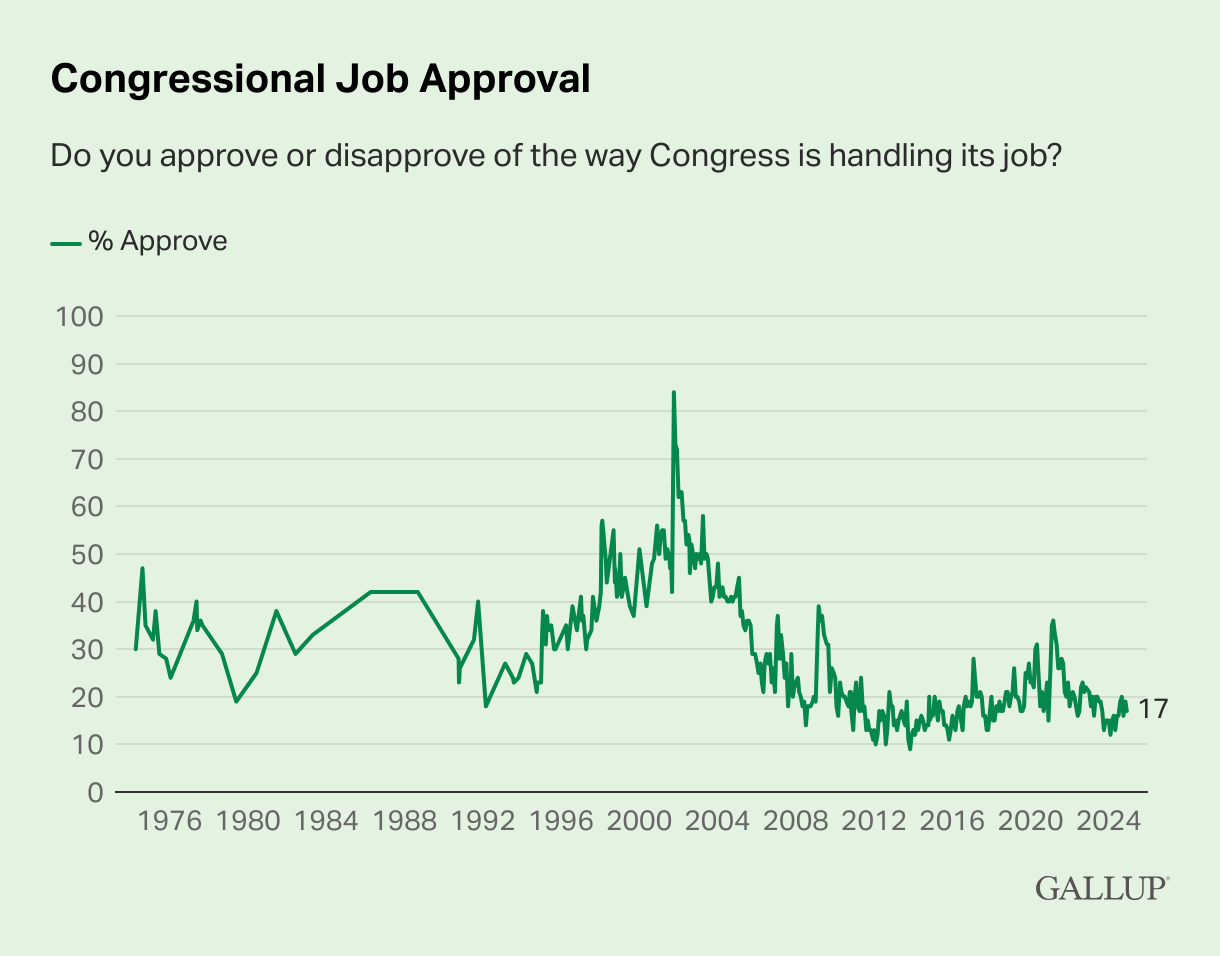
Overall Congressional job approval has traditionally been low, with telling remarks dating back to Will Rogers, Mark Twain, and much earlier. In general, people tend to favor their members of Congress far more than the institution. Its approval briefly spiked above 50% in the late 1990s and again after the 2001 terrorist attacks, but it has been quite low for most of the past two decades.
Trust in political parties
When asked about them separately, about 60% of Americans view each of the major political parties unfavorably.
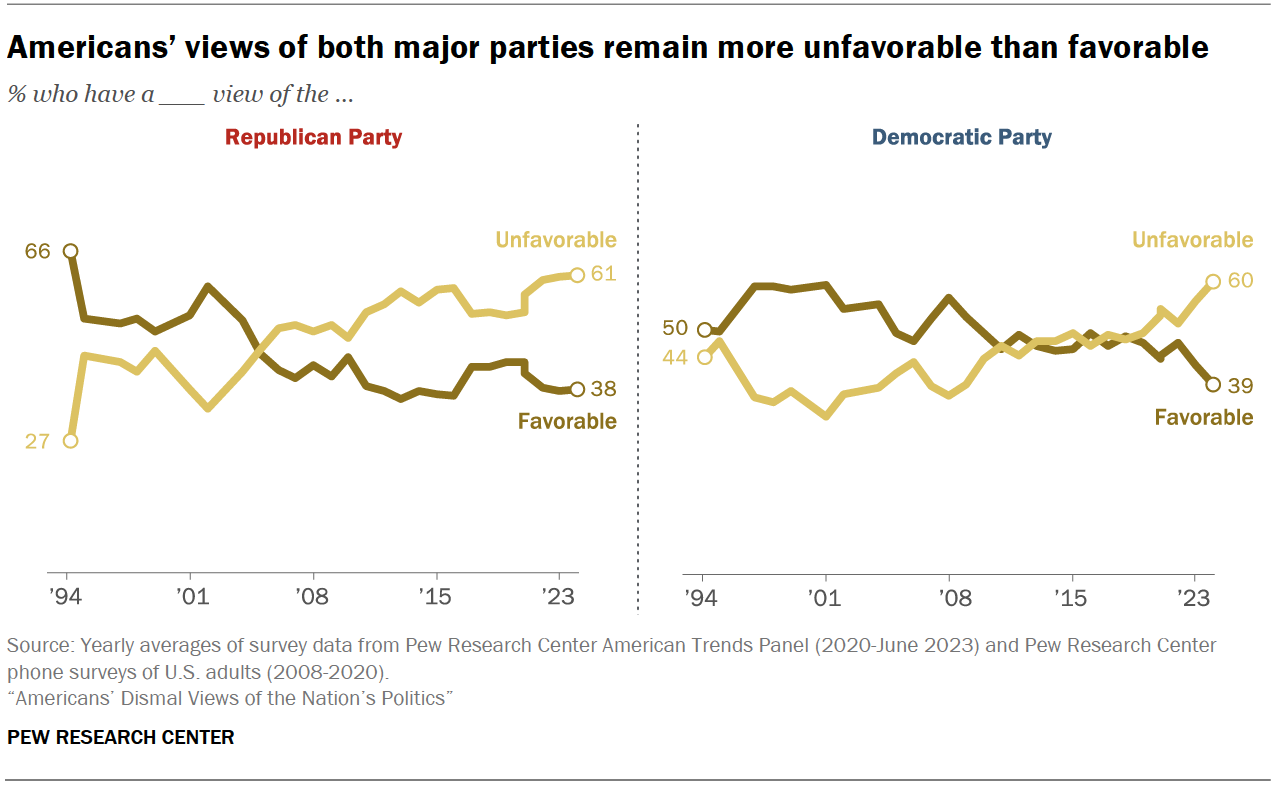
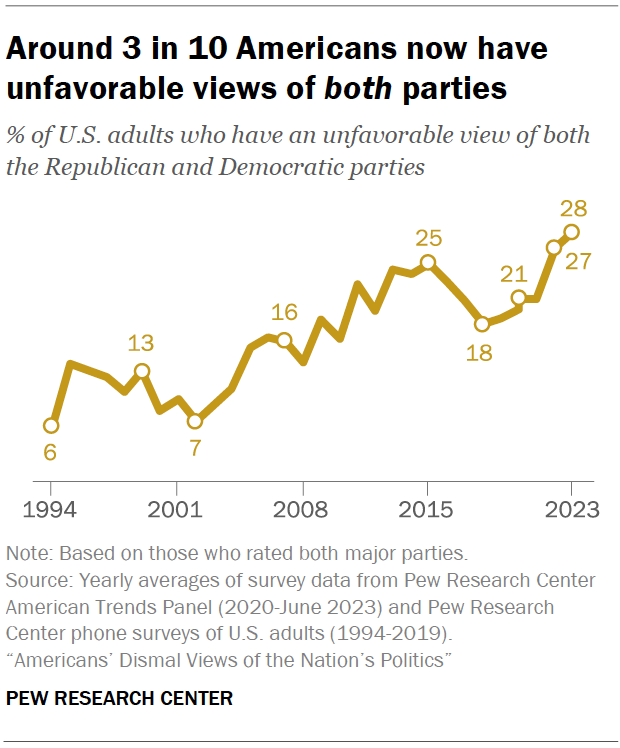
Those figures naturally reflect ever-increasing partisanship, but note how a few decades ago they both held net favorable ratings. The flip was driven by those who dislike both of the parties, which has increased from about 1 in 20 adults to now more than 1 in 4.
The winner-take-all single-member district system in the United States promotes a stable two-party system and makes it very difficult for third parties to emerge.
Increasing partisanship, with fewer Republican or Democratic moderates being elected, creates problems for states in which one side of the political spectrum has overwhelming dominance.
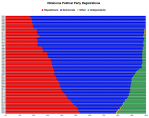
Oklahoma’s Political Parties

I was born and bred an Oklahoman, and I have devoted my life to serving its citizens. However, I am clear-eyed about its dark history and benighted politics. There are some truly dedicated public servants from both political parties serving in Oklahoma, but their good works are often overshadowed by the antics of crooks, cranks, and crackpots.
Oklahoma has long been dominated by conservatives. The increasing association of Democrats with liberalism and Republicans with conservatism, which some younger folks may take as a given but older folks like myself know has evolved over time, means that currently most races in Oklahoma have no viable Democratic candidates outside of a few gerrymandered urban districts.
The combination of gerrymandering with Oklahoma’s semi-closed primary races and single-party control since 2011 has resulted in increasing far-right extremism. Many races are decided in closed Republican primaries, in which a lack of moderates and liberals empowers the far right and Christian nationalists.
Registering as an independent or as a Democrat in Oklahoma prevents one from voting in the Republican primary, which is now the deciding event for almost all of the elections. State Question 836 is an attempt to address this by establishing open primaries, but its future is far from certain.
Another consequence of Oklahoma’s dominance by conservatives and Republicans is extreme voter apathy. In the 2020 and 2024 general elections, Oklahoma’s voter turnout was the lowest of any state. Unfortunately, in recent years the lack of moderates and liberals in closed Republican primaries and their failure to vote in the general elections has led to the election of corrupt and incompetent demagogues to statewide offices.

Alongside its strong populist streak, the state has a long history of state-sanctioned racism and oppression, which shouldn’t be a surprise given how it was used as a dumping ground for forcibly relocated First Peoples, with several of the tribes themselves being racist slaveholders until the federal government intervened after the Civil War.
Republicans were once the party of Lincoln, abolition, and reconstruction, with southern Democrats endorsing slavery and then racial segregation and voter suppression. Oklahoma’s widespread racism was part and parcel of its near total control by the Democrats throughout most of the 20th century.
However, in the 1960s President Johnson led the Democratic party to support integration and Civil Rights, which gradually led to the Republicans dominating the southern states. In Oklahoma, which has always been an oddity in southern politics due to its location and history, Republicans began to win federal offices and governorships, but it wasn’t until the 21st century that the Republicans took control of the legislature. By then, the shift in Oklahoma was based less on race politics and more to do with many conservatives leaving the Democratic party and many liberals leaving the Republican party amidst decades of relentless and depressing culture wars.

Trust in news and information sources
We are witnessing the slow but inexorable decline of newspaper, radio, and television journalism. Their business models have been disrupted by the internet and social media, along with an increasing reliance on platforms that are highly biased and sometimes actively promote misinformation and falsehoods.
It is interesting to note that the erosion in trust of local and national news organizations is largely driven by Republicans, while trust in social media is similar for members of both political parties, although understandably low.

Younger people have less trust in national and local news, with a corresponding increase in their trust of social media sites.

However, trust in national news outlets does not vary by age among Republicans.

Trust in science
Trust in the scientific establishment took a hit during the COVID-19 pandemic. In April 2020, 87% of Americans had confidence in scientists to act in the public’s best interests, but that declined to 73% by the fall of 2023, driven by a steep loss of confidence among Republicans.

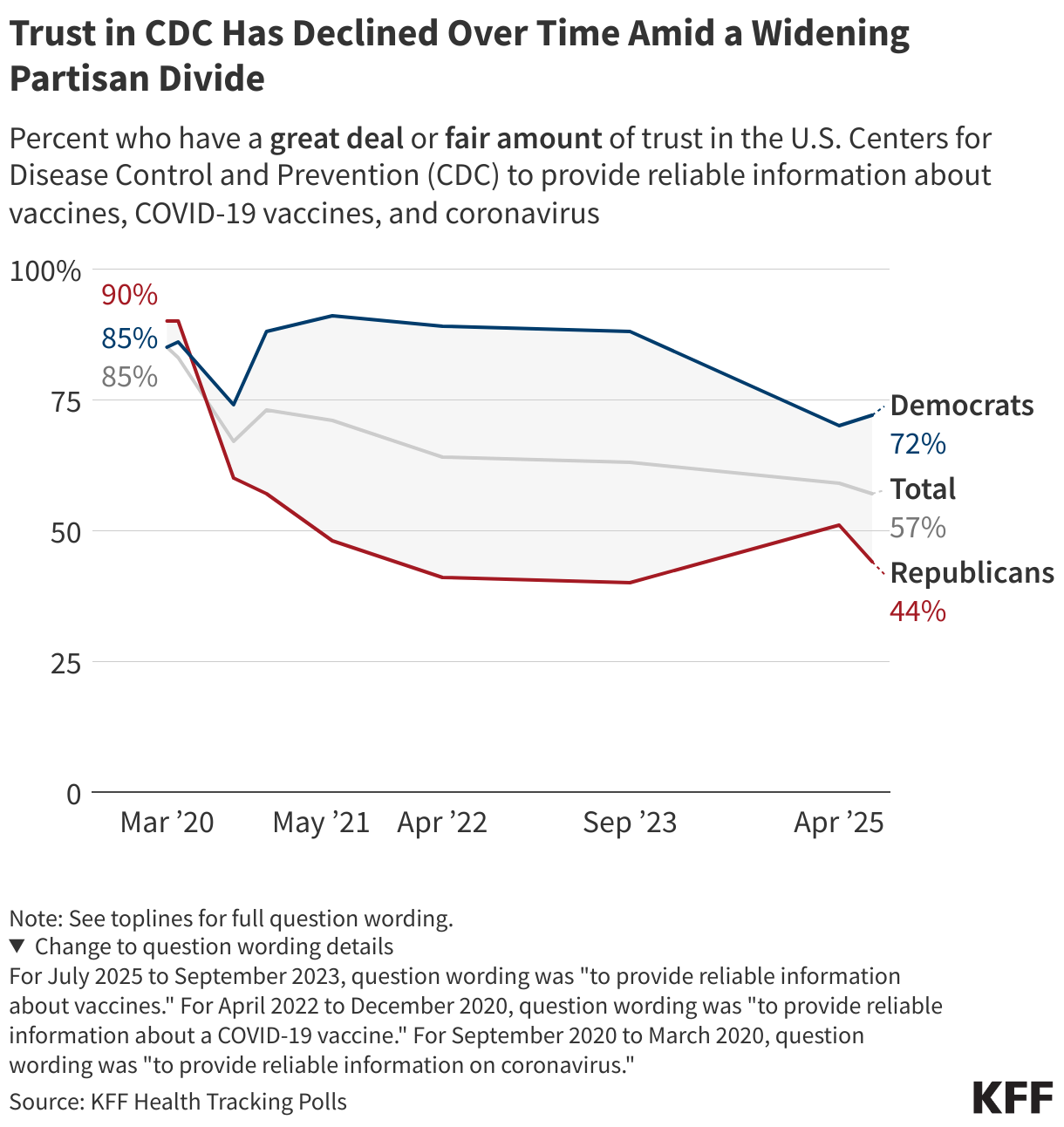
That partisan divide is especially evident for the Centers for Disease Control, which is now coming apart at the seams thanks to the appointment of the crackpot Robert F. Kennedy Jr. as the Secretary of Health and Human Services. Public health in the United States is rapidly deteriorating, and Oklahoma was already one of the worst states in health care.
Trust in educational institutions
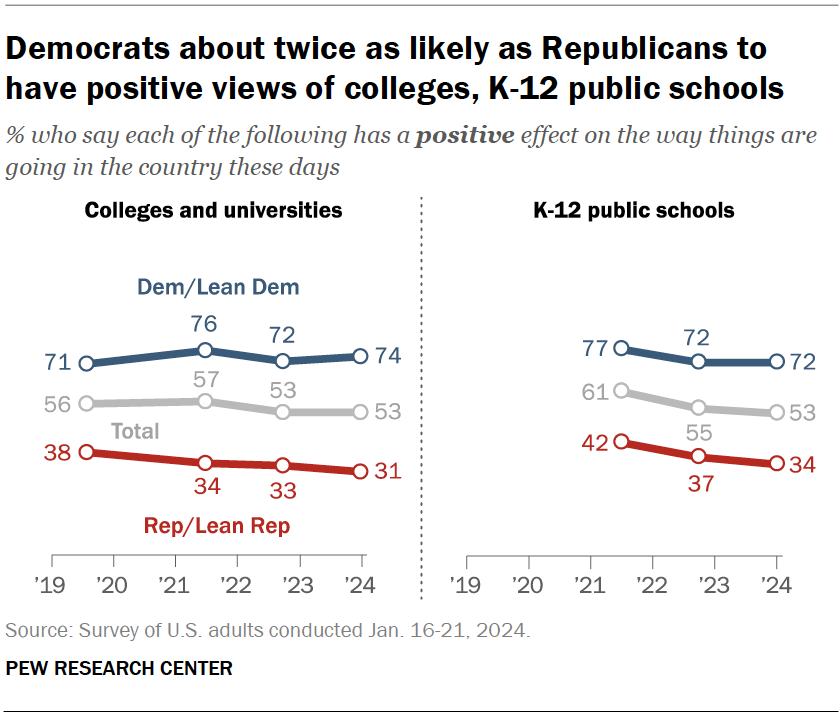
The past decade has seen a widening partisan divide in trust of educational institutions. Having worked in Oklahoma public schools since 1988, I am disheartened that only 1/3 of Republicans say they have a positive effect on the way things are going in the country. Culture wars and demagoguery have exacted a heavy toll. As with health care, Oklahoma’s public school rankings are extremely low, with consequent impacts on the quality of life.
Trust in the professions
Perhaps the most depressing news is that ratings of the honesty and ethical standards of people in many different professions have fallen.
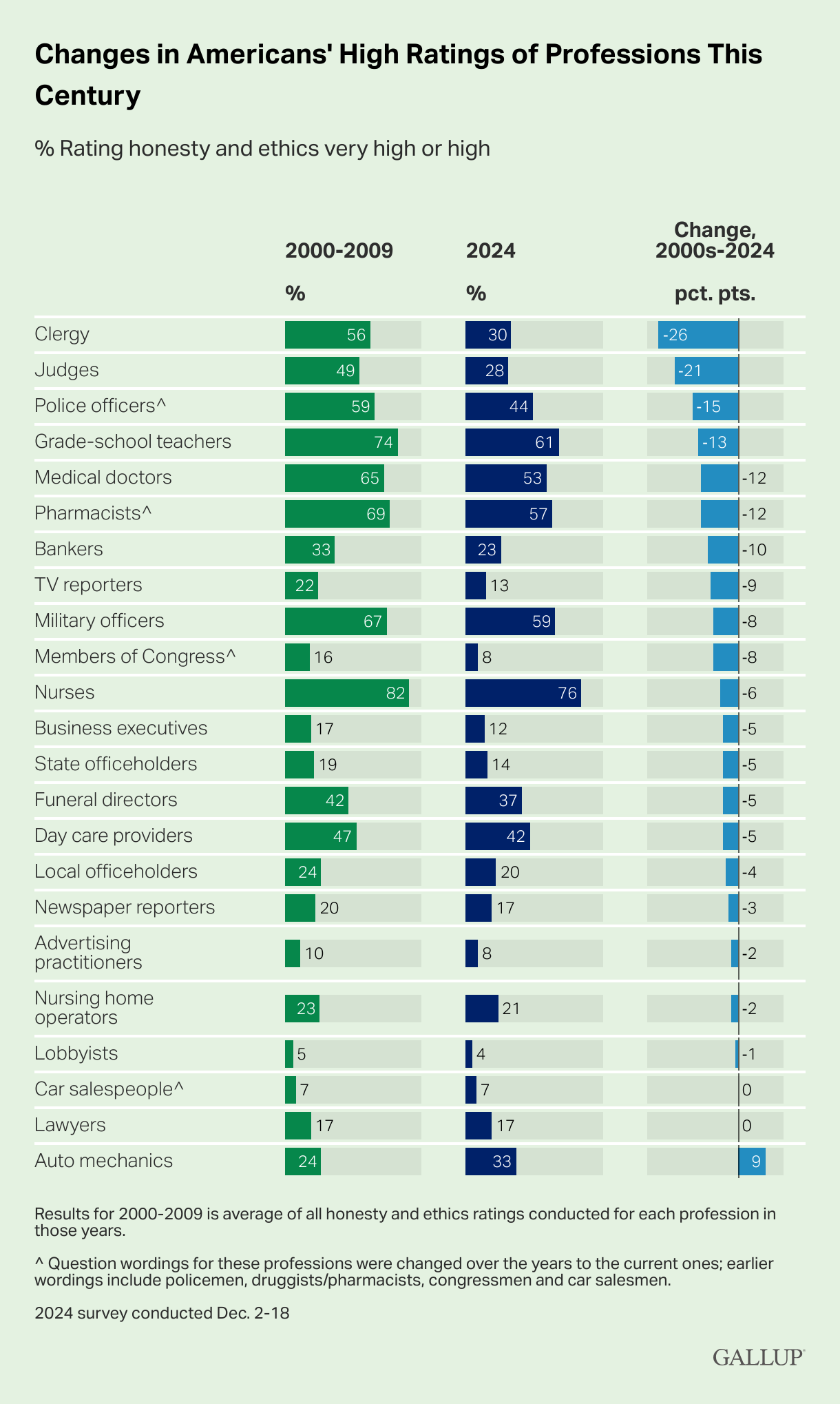
Note the immense loss of trust in clergy, judges, and police officers. Grade school teachers have also taken a big hit, but thankfully trust in them remains relatively high, with only nurses rated higher. Sadly, Oklahoma’s current state superintendent is striving mightily to further erode the trust in our state’s teachers.
The age of anxiety has given way to one of cynicism. While I do value cynics — H.L. Mencken is a favorite — one should not confuse cynicism with intelligence. To borrow from Robert Frost, too much cynicism can leave you with “nothing to look backward to with pride, and nothing to look forward to with hope”.
While it has also been said that cynicism is critical thinking without hope, Dr. Alexander Katrompas argues that to a Stoic, “hope is the first defense of a weak and undisciplined mind, and the last refuge of a coward.” He advises us to rather engage in critical thinking with a sense of optimism born from resilience and discipline. I plan to remain an optimistic cynic.
I do not hope for things to be easier; I prepare to meet them with strength.
-Alexander Katrompas






 Meador Manor