

Culture wars and identity politics, initially amplified by broadcast media and now metastasized by social media, corrode our quality of life.
Recently Judith Martin and her children Nicholas and Jacobina, writing in their Miss Manners column, shared this take:
The old rule was that politics, sex and religion should not be discussed in casual conversation among people whose sensitivities and opinions were unknown to one another. The rationale was to avoid offending anyone unintentionally.
This rule fell into disuse — and ridicule from some, who responded, “So, we are only supposed to talk about the weather?” They would argue that those three subjects are important, and that people can be trusted to handle them in a mature way.
Ha.
Now, almost any topic causes offense. Politics, of course. Sex, not because people are squeamish (which has not been the case in a century, if ever), but in regard to issues of orientation and identity. Religion, not only because it is intertwined with politics and sex, but also as an identity issue.
But those three are not all. Food, for example, has become a controversial subject in terms of both nutrition and ethics. As for the weather being the only “safe” topic left — not if the conversation turns to climate change.
The real problem is not subject matter, but people who no longer care whether they cause casual offense. They may relish doing so — not only to those whose affiliations and opinions they do not know, but also, perhaps especially, among those they do know. Such as their own relatives.
Their justification is that they are challenging ignorance, prejudice and bigotry of whatever kind. Which would be noble, if only it worked.
Miss Manners regrets to observe that the usual current method of pointing out others’ errors is to belittle them. And oddly enough, this does not prod them to respond, “Wait, you have a point. I am totally wrong. Please straighten me out.”
Miss Manners does not want to limit topics; she just wants to limit the way they are discussed. People who listen respectfully to those with whom they disagree, refrain from using personal invectives, state their points objectively and, if necessary, accept that differences remain, should be able to hold conversations on any topic with those who observe the same courtesies.
But such people seem to be in short supply now.

Demagogues harness culture wars and identity politics to propel themselves into high elective offices. Sadly, it is no longer surprising for autocratic federal and state elected and appointed officials to routinely demonize people they should instead be serving and to portray segments of society as threats to the community rather than members of it.
In broadcast and social media, people are freely labeled as racists, bigots, misogynists, homophobes, xenophobes, fascists, socialists, communists, ad nauseam. Labels lack nuance and often mischaracterize the complex and contradictory behavior inherent in human nature. Even when they accurately reflect past or current behavior, they imply permanence. However, we all know that people often change and evolve.
Malcolm X and George Wallace famously renounced their prior racist views. Bill Clinton went from signing the Defense of Marriage Act to being an outspoken supporter of marriage equality. Charlie Kirk shifted from supporting the separation of church and state to views associated with Christian nationalism. Ronald Reagan went from being a committed liberal and admirer of Franklin D. Roosevelt to become the leader of a conservative political movement.
If we don’t believe people can change, then what is the point of argument, debate, or other attempts at persuasion? Moderation, mutual respect, and compromise are key tools in creating strong communities, but increasingly those have receded behind extreme public partisanship, intransigence, and hateful words and actions.
Stereotypes have developed about right-wing violence and left-wing cancel culture, but violence and cancel culture are now utilized by extremists on both ends of the political spectrum to the detriment of everyone. People of widely polarized political and cultural beliefs invoke supposed rights of free speech without understanding its legal limits, and sometimes suffer doxing, employer discipline, loss of employment, and worse.
Kate Harner has written about how digital and broadcast media promote anger-provoking content to increase engagement, create detachment that promotes cruelty to others and a lack of empathy, and feed an attention economy that exploits extreme emotions for profit. She wrote:
If you stay true to your principles, they will offend somebody and you will get ‘canceled’. With a large enough audience that is a guaranteed outcome. Someone would wake up in a bad mood and forget to take their pills, and your principles would become a convenient target for their rage. . . . So for self-preservation, people stay silent – and who can blame them? In America you may not face imprisonment if someone does not like your views, but be prepared to lose your job.
Increasingly, we see government being weaponized in the culture wars. Partisans may temporarily rejoice as political norms are violated and authoritarian tactics promote their views while suppressing others, but power will eventually shift with victors transformed into victims.
Identity politics
Progressives often promote the rights of interest groups, particularly people who have historically suffered discrimination and persecution. However, when progressive politics is perceived as mostly about promoting disfavored groups, autocrats can portray progressive policies as favoring the disfavored few at the expense of the majority. Human rights are portrayed as a zero-sum game with winners and losers, as if someone else gaining equality somehow robs you of it. Autocrats use that mindset to divide and conquer.
Examples of how much people can change are Americans’ views on sexual orientation. Gay marriage had spread across 36 states before the Supreme Court nationalized it in 2015 with Obergefell v. Hodges. While only 27% of U.S. adults supported it thirty years ago, now over 2/3 do, albeit it with the usual partisan divide.

As for employment discrimination, back in 1978, Oklahoma passed a law allowing schools to fire teachers for public homosexual conduct. That law was struck down by the Court of Appeals and its stance then affirmed by a divided Supreme Court. Nevertheless, a “don’t ask, don’t tell” mindset prevailed for decades in Oklahoma schools. That also became official U.S. policy on military service from 1994 to 2011. However, in 2020, employment discrimination on the basis of sexual orientation and gender identity was prohibited nationwide under Bostock v. Clayton County.
Over time, views on homosexual relations had shifted, and the courts were following that trend. Whereas only 40% of Americans held that homosexual relations were morally acceptable back in 2001, that has risen to 64%.
However, condemnation of minority sexual orientations and unusual gender identities is still quite common in Oklahoma, where 47% of adults are Evangelical Protestants and 42% say homosexuality should be discouraged, compared to only 30% nationwide who feel that way. Bartlesville has ongoing efforts to censor library books, ban drag shows, and so forth.
Transgender politics is especially fraught. Less than 1% of the U.S. adult population, and only 0.7% of Oklahoma adults, identify as transgender, but in recent years they have been treated as cannon fodder in the culture wars.
Equality v. equity
Things get particularly dicey when people seek to use the law in pursuit of equity rather than equality.

At first glance, we’re glad that equity means everyone can reach an apple. But what if the apple is employment or certification and the taller boxes represent identity-based scholarships, admittance requirements, or test score adjustments? How one achieves equity can drastically reduce support for interventions. For example, if we want more racial, economic, or religious diversity in certain professions, are we willing to enact quotas? Would we support scholarships and programs targeted at underprivileged groups? What about lower standards for groups that have suffered historic discrimination?
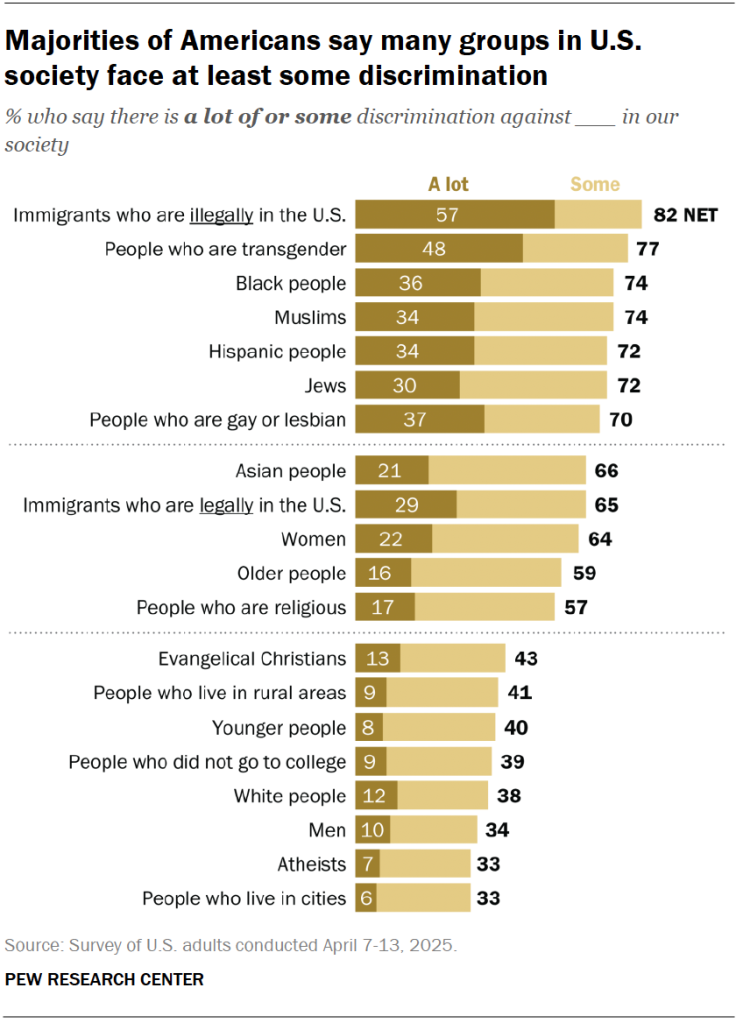
Majorities of Americans say many groups do face some discrimination, but equality before the law is embraced far more broadly than are attempts at creating equity.
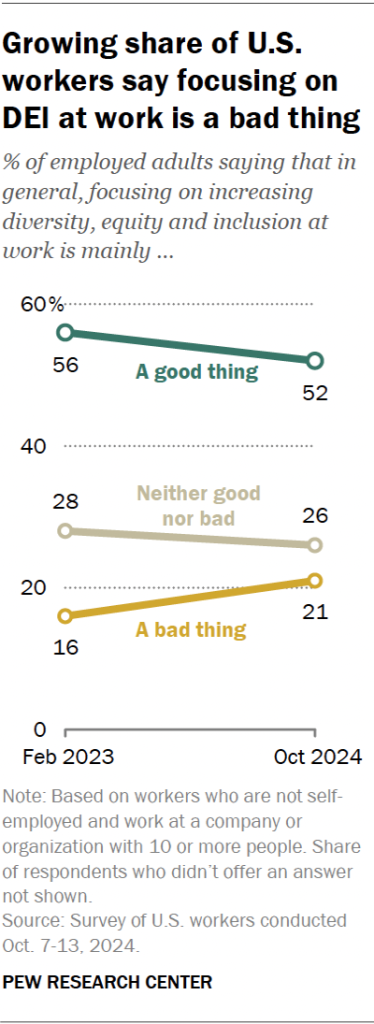
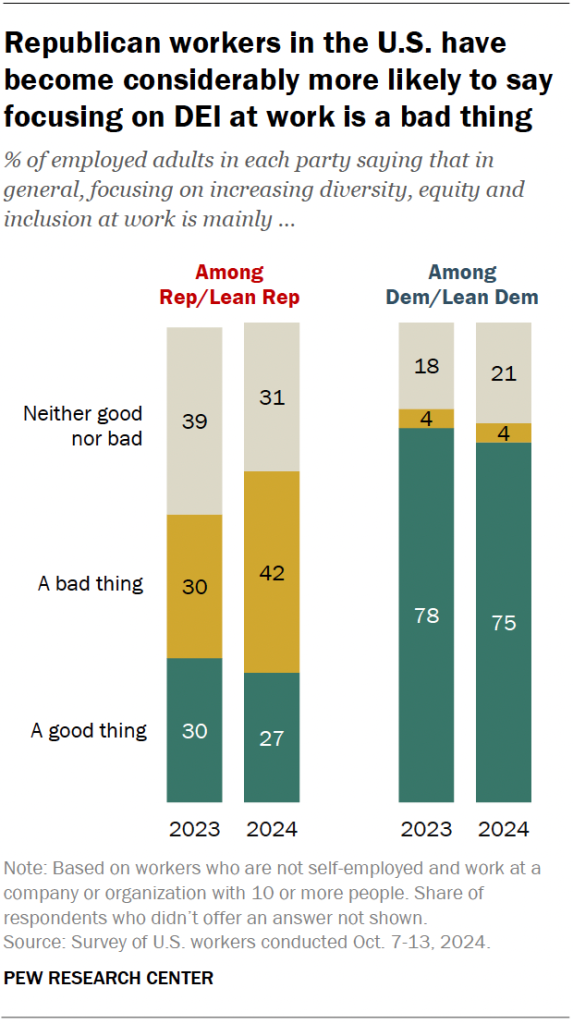
Recently many Republican politicians have pushed to ban diversity, equity, and inclusion (DEI) efforts in the government, workplace, and education. Support for DEI in the workplace has been slipping as it has become an extremely partisan issue.
Evangelicals
The aspects of the culture war that I am most frequently exposed to as an Oklahoman are promoted by Christian evangelicals, with a strong uptick this month after Charlie Kirk’s assassination.
Evangelicals often think of themselves as one of the most marginalized groups in American society. Data from the American National Election Study does show that feelings toward Christian fundamentalists have steadily deteriorated over the past 20 years, with the average feeling toward them now being far colder than toward Muslims, Jews, or Christians in general.

When interpreting that chart, please bear in mind that while all fundamentalists are evangelicals, not all evangelicals are fundamentalists.
I would attribute some of the negativity toward evangelicals as arising from the very nature of evangelizing, the active preaching of their beliefs in hopes of conversions. Backlash becomes inevitable whenever that strays into harnessing secular power to impose their values and beliefs on others. Such bullying behavior is particularly noticeable in Oklahoma, with elected state officials who repeatedly violate the separation of church and state, capitalizing on how Christians still compose 70% of the state’s adult population.
Oklahoma’s demagogues are well aware that evangelicals are anything but marginalized in this state, with only Arkansas having a larger share of its population identifying as evangelical Protestants.

Evangelicals who are particularly strident in seeking to impose their beliefs on others have little fear of being ‘canceled’ in Oklahoma since they now outnumber even Mainline Protestants by over four to one.

However, the state’s 70% share of Christians is down from 85% in 2007, with drops from 2007 to 2024 in the overall share of Oklahomans in the Evangelical Protestant, Mainline Protestant, and Catholic divisions of Christianity. The share of Oklahomans who are religiously unaffiliated has more than doubled over that same timespan, with over 1 out of 4 now identifying as atheists, agnostics, or professing nothing in particular.

Modern society provides access to different worldviews through the internet, offering moral guidance outside of religion and reduced social pressure to conform to religious norms. Some evangelicals view the rise of the religiously unaffiliated as both a challenge and an opportunity, but the strong alignment of many evangelical groups with conservative political ideologies is a “push factor” driving some people away from religion; the religiously unaffiliated tend to be more politically liberal.
The religiously unaffiliated nevertheless have diverse beliefs. Only about 5% of people, both nationwide and in Oklahoma, identify as atheists. That’s up from 2% nationwide and less than 1% among Oklahomans back in 2007. As one would expect, atheists and evangelicals often take a dim view of each other.

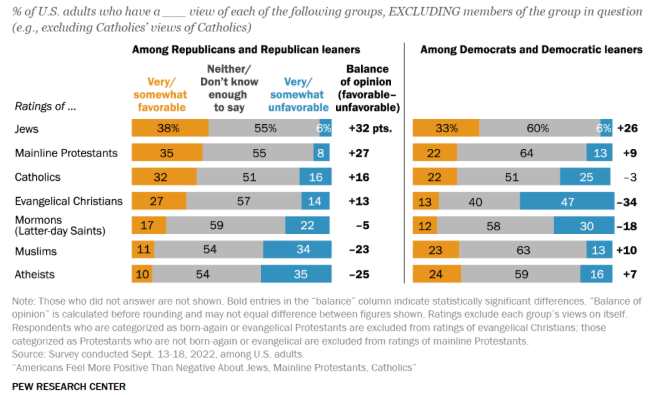
Here are how U.S. adults as a whole viewed various groups in 2022:

Consider how partisan groups viewed the various categories.
Survival strategies
I take a dim view of both culture wars and identity politics. My decade of directing my school district’s communications efforts has led me to avoid “feeding the beast”. Some state officials make outrageous proclamations and demands, which usually lack legal force. My approach is to avoid actively responding to those provocations, which are really about “ginning up the base” and fanning the flames of the culture war or distracting from the latest scandal arising from incompetency and corruption.

The reality is that both broadcast media and most social media warriors of both liberal and conservative bents have an extremely short attention span. Rapid scrolling and constant notifications foster a need for immediate emotional gratification, regardless of whether that is positive or negative. The warriors typically move on within days, and sometimes hours, minutes, or seconds, to their next outrage, with little if any follow-up.
My advice is to minimize your engagement with such posts and avoid broadcasting to entire groups about issues that likely only interest the fringes. When you do respond to direct inquiries, stick to the facts as much as possible using neutral language and tone. If the warrior you are directly communicating with is an acquaintance, you may be able to disarm them with some mild humor so long as it is not aimed at them or their concerns. Model mutual respect and, if it is not returned and you are disrespected, bear in mind this advice Marcus Aurelius gave to himself:
Keep this thought handy when you feel a fit of rage coming on—it isn’t manly to be enraged. Rather, gentleness and civility are more human, and therefore manlier. A real man doesn’t give way to anger and discontent, and such a person has strength, courage, and endurance—unlike the angry and complaining. The nearer a man comes to a calm mind, the closer he is to strength.
If you need help in letting go of anger, here is some detailed advice from another Stoic, Seneca.

In regards to your own posts on social media, I don’t believe they can change most people’s minds. I’ve seldom seen anything approaching a reasoned or productive debate in the comments. Rather, social media reinforces existing beliefs through personalized algorithms and echo chambers.
Furthermore, research published in Nature showed that decreased exposure to like-minded views made little difference. Over 23,000 Facebook users had their exposure to content from like-minded sources reduced by about 1/3 during the 2020 U.S. presidential election. That increased their exposure to content from cross-cutting sources and decreased their exposure to uncivil language, but it had no measurable effects on ideological extremity, candidate evaluations, belief in false claims, or affective polarization, a term I define below.
There are significant psychological barriers which make social media users resistant to contrary arguments:
- Confirmation bias: people seek out and favor information that aligns with their existing beliefs and dismiss contradictory information
- Motivated reasoning: when confronted with counter-arguments, people are more critical of information that contradicts their views and more lenient toward information that confirms them
- Cognitive dissonance: confronting a contrary argument creates mental discomfort, motivating people to reject new information to avoid the discomfort and protect their ego and public image
- Affective polarization: social media intensifies dislike and distrust of the opposing side, making purely factual arguments less effective than those rooted in identity
So my advice is to save your fingers. Avoid engaging in online “debates” and arguments with strangers. Avoid reacting to every little outrage. Avoid insults, both created by you and directed at you. Focus on the genuine positive aspects of social media: keeping in touch with real-world friends and acquaintances; enjoying positive posts of beauty, nature, and fun events; providing positive support, information, and advice for those who seek it out.
Each of us shall continue to make mistakes, but we can embrace a growth mindset. As Maya Angelou’s advice to Oprah Winfrey has been paraphrased:







 Meador Manor
Wow! Yes! You should copyright and publish. Thank you!