
Thornton Wilder is still widely remembered for his 1938 play Our Town, and his second novel, The Bridge of San Luis Rey, won the Pulitzer in 1927 and made Modern Library’s list of the 100 best novels of the 20th century.
After reading that novel and rewatching Our Town, I decided to jump to his penultimate novel, The Eighth Day, which was published in 1967. That turned out to be his longest work, over four times longer than his novel I’d just finished. Slogging through it reminded me of picking Emma as my first Jane Austen novel to read back in 2012, not realizing it ran to about 158,000 words, almost twice the length of her most popular book, Pride and Prejudice.
I only found one YouTube video about The Eighth Day, and it was AI slop. I found a handful of online articles about it and reference a couple of them in this post, but it has fallen utterly out of fashion despite winning the National Book Award for fiction in 1968.
The Neglected Book Page offered, “…it sold over 70,000 copies in hardback, was picked up by the Book of the Month Club as a featured title, and stayed on the New York Times best-seller list for half a year. Nor was it a complete critical failure. Edmund Wilson [the influential literary critic who championed Hemingway, Faulkner, Fitzgerald, and Nabokov] called it Wilder’s best work ever, and it received the National Book Award for fiction.”

However, the Neglected Book Page also shared: “Stanley Kauffmann, writing for The New Republic, called it ‘a book that means nothing.’ Josh Greenfield in Newsweek assessed Wilder’s message in the novel ‘a worthless bauble.’ In The New Yorker, Edith Oliver judged that ‘none of the characters, major or minor, rings credible to the reader.'”
The Greatest books of All Time‘s meta-analysis ranked the book at 10,696 considerably below other works of his such as The Bridge of San Luis Rey, Ides of March, Theophilus North, and Our Town. Nevertheless, I opted to read it, based on its national award and its plot device of a murder mystery.
I purchased and read the Kindle edition, with little initial impression of its considerable length. Wilder’s early novels were quite short; his most famous work, The Bridge of San Luis Rey, is only 33,000 words. The Eighth Day turned out to be his longest novel at 141,000 words.
While that is not nearly as daunting as All the King’s Men, which we were assigned in high school, despite its word count of 286,000, or Jonathan Strange and Mr. Norell at a rather numbing 309,000 words, it is still considerable. Wilder split his longest work into six parts, which reminds me of how Tolkien’s 455,000-word Lord of the Rings was similarly subdivided, although it was wisely published as a trilogy.
The character of Dr. Gillies in the novel says, “The Bible says that God created man on the sixth day and rested, but each of those days was many millions of years long.” Reading The Eighth Day similarly took me awhile…about a month.
I was thankful that Wilder structured his meandering tale around the mysteries of a murder and a daring rescue from execution. That provided an impetus to carry me through his digressions and the multitude of pronouncements by his omniscient narrator.
Wilder began the book during a self-imposed exile of 20 months in the desert town of Douglas, Arizona along the Mexican border. In 1962, a month after turning 65, Wilder fled the distractions of too much travel, talk, and busy-ness and steered his Thunderbird convertible out of his Connecticut driveway towards the Southwest. He broke down outside Douglas and stayed there, enjoying “solitude without loneliness.”


He extended a night at the Gadsden Hotel into a stay of a couple of months and then rented a three-room furnished apartment in what is now, over sixty years later, an assisted living center.
Wilder had earned three Pulitzers, including ones for the plays Our Town and The Skin of Our Teeth. Over the 15 years since his last novel, he had written five plays, but during his Arizona exile an idea took shape that was more suited for the page than the stage.
During his exile, he went by his middle name, Niven, and peppered people with questions, including how one would set up a boardinghouse, with the answers becoming part of his new novel. Wilder didn’t finish it in Douglas, leaving town in late 1963 to resume his peripatetic ways. He accepted the Medal of Freedom from President Johnson and continued writing during trips to Nice and Cannes, to the Netherlands Antilles, to Casablanca, and more. It was finally published in 1967, three weeks before his 70th birthday.
But what of the book itself? Wilder shared that its writing was influenced by the works of the Danish theologian and philosopher Søren Kierkegaard, the German novelist and Nobel laureate Thomas Mann, and the French Jesuit and polymath Pierre Teilhard de Chardin. I confess to possessing only fragmentary interest in and frequent exasperation with literary analysis and philosophy, so I read Wilder’s novel with little regard to such influences.
1927’s The Bridge of San Luis Rey was set in 1714. I leapt ahead four decades in Wilder’s career in following that up with 1967’s The Eighth Day, which was set between 1880 and 1905. The later novel consists of six parts, identified by location and durations of years. I enjoyed Part I, set in Coaltown, Illinois from 1885 to 1905. The Horatio Alger story of how a daughter of a convicted murderer rescued her family by setting up their home as a boardinghouse intrigued me with its sharply drawn character portraits, although I found the mother figure rather bland and impervious to empathy.
Here is an example of the maxims and observations that pepper the pages:
So defenseless is hope before the court of reason that it stands in constant need of fashioning its own confirmations. It reaches out to heroic song and story; it stoops to superstition. It shrinks from flattering consolations; it likes its battles hard won, but it surrounds itself with ceremonial and fetish.
Hope, like faith, is nothing if it is not courageous; it is nothing if it is not ridiculous. The defeat of hope leads not to despair, but to resignation. The resignation of those who have had a grasp of hope retains hope’s power.

[generated by Google Gemini]
Part II relates the story of the escaped fugitive’s travels and adventures as he fled south to Chile from 1902 to 1905 and was quite a diversion. While I enjoyed some of the character sketches, particularly of three wise independent women who spirit him along different phases of his flight, the fugitive remained a remote personality to me, perhaps intentionally so.
He is a figure of faith, but not piety. Wilder shares these views on such people:
We have described these men and women in negative terms—fearless, not self-referent, uninteresting, humorless, so often unlearned. Wherein lies their value?
We did not choose the day of our birth nor may we choose the day of our death, yet choice is the sovereign faculty of the mind. We did not choose our parents, color, sex, health, or endowments. We were shaken into existence, like dice from a box. Barriers and prison walls surround us and those about us—everywhere, inner and outer impediments. These men and women with the aid of observation and memory early encompass a large landscape. They know themselves, but their self is not the only window through which they view their existence. They are certain that one small part of what is given us is free. They explore daily the exercise of freedom. Their eyes are on the future. When the evil hour comes, they hold. They save cities—or, having failed, their example saves other cities after their death. They confront injustice. They assemble and inspirit the despairing.
When the evil hour comes, they hold. That’s a good line, worthy of Tolkien, but I particularly like We were shaken into existence, like dice from a box.
The entertaining and empowered character of Mrs. Wickersham is a humanitarian and widow who runs a hospital, school, and orphanage in addition to her hotel. She labors to save the fugitive from capture and destruction, and shares this amidst a torrent of words after the fugitive shares his story:

“. . . Cities come and go, Mr. Tolland, like the sand castles that children build upon the shore. The human race gets no better. Mankind is vicious, slothful, quarrelsome, and self-centered. If I were younger and you were a free man, we could do something here—here and there. You and I have a certain quality that is rare as teeth in a hen. We work. And we forget ourselves in our work. Most people think they work; they can kill themselves with their diligence. They think they’re building Atenas, but they’re only shining their own shoes. When I was young I used to be astonished at how little progress was made in the world—all those fine words, all those noble talkative men and women, those plans, those cornerstones, those constitutions drawn up for ideal republics. They don’t make a dent on the average man or woman. The wife, like Delilah, crops her husband’s hair; the father stifles his children. From time to time everyone goes into an ecstasy about the glorious advance of civilization—the miracle of vaccination, the wonders of the railroad. But the excitement dies down and there we are again—wolves and hyenas, wolves and peacocks.—What time is it?”
And then, abruptly, just as the fugitive appears to have again escaped into the future, we get this lonely line about his fate as Part II comes to a close: He was drowned at sea.
What? We have travelled many miles with this character and the mysteries swirling about him, with hopes and plans for an eventual redemptive return to his family, buoyed by a mention in the book’s prologue that he would eventually be exonerated, but then nature sweeps him into the abyss? There is a disquieting and disturbing symbolism in that.
Part III shifts us back north in geography and backward in time to Chicago in 1902, where the son of the fugitive stumbles his way into good works as a newspaper columnist, reminding me of the early idealistic portrayal of Orson Welles’ protagonist in Citizen Kane. Various characters are introduced, offering their own takes on life and its meanings or lack thereof. One garrulous character pronounces:
“What’s that? What’s that you’re saying? Listen to me: there is no sense behind the universe. There is no reason why people are born. There is no plan. Grass grows; babies are born. Those are facts. For thousands of years men have been manufacturing interpretations: life’s a test of our character; rewards and penalties after death; God’s plan; Allah’s Paradise, full of beautiful girls for everybody; Buddha’s nirvana—we get that anyway, it means ‘see nothing, feel nothing’; evolution, higher forms, social betterment, Utopia, flying machines, better shoelaces—nothing but THISTLE DUST! Will you get that into your draughty head?”
Contrast that to a hospital orderly who shares his vision of people reborn countless times as they ascend a ladder of merit, with none able to step over a threshold into supreme happiness until “all of the men on all the stars have purified themselves.”
Wilder’s characters frequently break with convention, in ways that challenge our expectations for the late Victorian and early Edwardian eras. The future fugitive and his common law wife had four children in nineteen years without having been formally married; the son who fights injustice and suffering has affairs with girls of many races and nationalities before marrying the daughter of the man his father supposedly murdered; a daughter who becomes a famous concert singer supports herself and her bastard son by singing in churches; and so forth.
Part III concludes as the fugitive’s son meets the daughter of the murdered man, with promises of revelations that might solve the murder mystery. We are given no satisfaction, however, as Part IV leaps way back to 1883 in Hoboken, New Jersey, and we are treated to more paragraphs extolling the virtues and delineating the shortcomings of the future fugitive. He hunts for a wife, making a choice by a process of elimination, and then elopes with her.
[generated by Google Gemini]
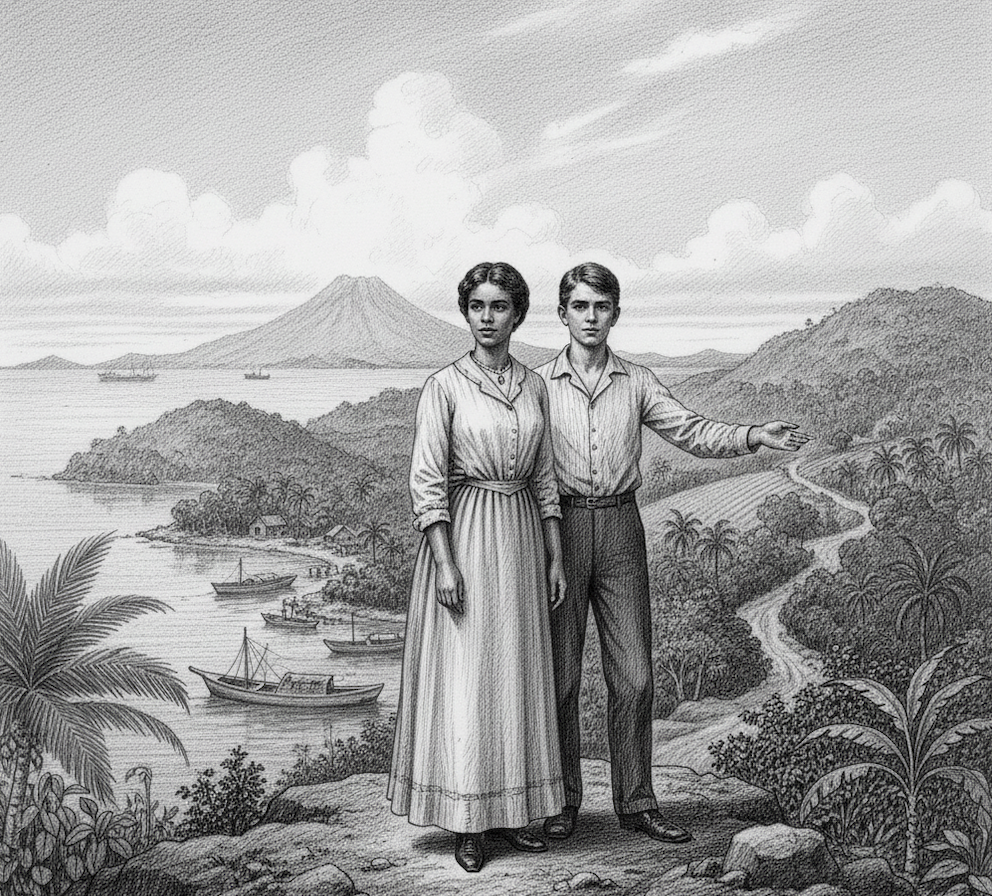
Part V jumps back a bit further and much farther, to St. Kitts, an island in the West Indies, in 1880. We are finally provided background on the murder victim’s family, something that had been given short shrift in the first 2/3 of the novel. Staging stories in long separate parts, as Wilder did in the 1960s, seems quite old-fashioned to the modern reader. I am used to books that interleave chapters, quickly jumping back and forth, often changing voices or narrators to increase the contrasts versus the drone of an omniscient narrator. I suspect that broadcast and cable television made such tight interleaving more commonplace, as holding the viewer’s attention was vital to the advertising that funded the programming back in the day, with frequent advertising breaks acting like chapter breaks.
Epistolary novels use a series of letters or other fictional documents for such interleaving. 1897’s Dracula is perhaps the most famous example, being composed entirely of letters, diary entries, newspaper clippings, telegrams, doctor’s notes, ship’s logs, etc. Wilder’s Ides of March is another example.
Part V finally provides a motive, previously portrayed as inexplicable, for the murder. I enjoyed the re-introduction of the murder victim:
Breckenridge Lansing was born in Crystal Lake, Iowa. As a boy he planned to enter the Army of the United States and to become a famous general. With his brother Fisher he did a great deal of hunting. Good Baptists cannot take life or do anything else enjoyable on Sunday, but they killed and killed on Saturdays and holidays.
The final Part VI was thankfully the strongest, with a superb opening:
This is a history.
But there is only one history. It began with the creation of man and will come to an end when the last human consciousness is extinguished. All other beginnings and endings are arbitrary conventions—makeshifts parading as self-sufficient entireties, diffusing petty comfort or petty despair. The cumbrous shears of the historian cut out a few figures and a brief passage of time from that enormous tapestry. Above and below the laceration, to the right and left of it, the severed threads protest against the injustice, against the imposture.

[misinterpreted by Google Gemini]
There is a superb sequence in which the fugitive son learns how his father was spared from execution. I especially enjoyed the symbolism of a home-made rug:
He returned into the house and placed the letter on the table beside the Deacon and sat down. The Deacon was gazing intently at the home-made rug at his feet and Roger’s eyes followed his. It had been woven long ago, but a complex mazelike design in brown and black could still be distinguished.
“Mr. Ashley, kindly lift the rug and turn it over.”
Roger did so. No figure could be traced on the reverse. It presented a mass of knots and of frayed and dangling threads. With a gesture of the hand the Deacon directed Roger to replace it.
“You are a newspaperman in Chicago. Your sister is a singer there. Your mother conducts a boardinghouse in Coaltown. Your father is in some distant country. Those are the threads and knots of human life. You cannot see the design.”
There was such a rag rug in one of my grandparents’ homes. The chaos of knots created a soft cushion beneath the order presented to the world. While I do not share the perception of a weaver, but instead only human pattern-seeking, the symbol is strong.
Existentialism is addressed as well:
Again he pointed to Coaltown: “They walk in despair. If we were to describe what is Hell it would be the place in which there is no hope or possibility of change: birth, feeding, excreting, propagation, and death—all on some mighty wheel of repetition. There is a fly that lives and lays its eggs and dies—all in one day—and is gone forever.”
I appreciated the novel’s concluding paragraph, once I defined arras as a rich tapestry:
There is much talk of a design in the arras. Some are certain they see it. Some see what they have been told to see. Some remember that they saw it once but have lost it. Some are strengthened by seeing a pattern wherein the oppressed and exploited of the earth are gradually emerging from their bondage. Some find strength in the conviction that there is nothing to see.
Less welcome were the glum glimpses of characters’ futures, reminding me of the epilogue montages in some movies. Wilder confessed in a 1965 letter, “It’s only lately come clear to me what an awful lot of suffering there is in the book. I never intended that. I hope it’s not immediately apparent to the reader because most of the characters don’t regard themselves as suffering—they’re learning and struggling and hoping.”
Well, Thornton, it was certainly apparent to me, as was your excision of much of one daughter’s story, not that I cared to read it. The book would have greatly benefited from a revival of his early “habit of compression” and, if he could not bring himself to do it, an editor demanding a culling, that the historian’s cumbrous shears be grasped far more firmly.
Nevertheless, I am glad to have read it given the exquisite prose he regularly manifested and the sharp wit he could deploy. However, while I found some of the characters interesting and well-drawn, the ones he spent the most time with remained too nebulous, vague, and impenetrable for my liking.

From 2016 to 2022, HarperCollins worked with the Wilder family on a reprinting of Wilder’s seven completed novels and three of his plays in what it called the Thornton Wilder Library. Paperbacks with new covers, linked by the use of the Londonderry Air font, incorporated revised afterwords by his nephew Tappan Wilder, who has served as the literary executor for a quarter-century. That Library is also available in audiobook and e-book formats.
Back in 1967, The Eighth Day became a bestseller in its second week and remained on the list for half a year. Before falling out of print in 1992, two million copies were printed and it had 17 foreign editions. It became his second-best selling and earning book.
I remain intrigued by Thornton Wilder’s handling of matters of faith and existentialism. I enjoy how he subverts expectations while incorporating biblical and Puritan traditions into his works. His Christian humanism led him to a sense of optimism grounded in a faith in improvement and redemption, without shying away from portraying the dull triteness, rank hypocrisy, and intellectual vacuity which readily afflict both the pious and the profane.
The length and many paragraphs of philosophy of The Eighth Day haven’t put me off reading Wilder, but I do need to be selective. I have not found ratings on Goodreads to be of any value, although the number of ratings is an indicator of a book’s popularity. I still prefer using LibraryThing over Goodreads to track my reading, but I continue to update both services given Goodreads’ popularity.
| Book | Greatest Books Rank | # of Goodreads Ratings | Words | Kindle Edition length | Year |
|---|---|---|---|---|---|
| The Cabala | — | 258 | 43,000 | 144 pages | 1926 |
| The Bridge of San Luis Rey | 623rd | 37,997 | 33,000 | 115 pages | 1927 |
| The Woman of Andros | — | 227 | 23,000 | 75 pages | 1930 |
| Heaven’s My Destination | — | 416 | 54,000 | 250 pages | 1935 |
| The Ides of March | 2,683rd | 2,180 | 87,000 | 315 pages | 1948 |
| The Eighth Day | 10,696th | 1,822 | 141,000 | 454 pages | 1967 |
| Theophilus North | 4,915th | 1,214 | 133,000 | 425 pages | 1973 |
After gathering the statistics and reviewing synopses, two of the remaining novels pique my interest the most. Heaven’s My Destination is a road farce about a born-again evangelist traveling across Texas, Oklahoma, Kansas, Missouri, and Arkansas peddling textbooks in the Great Depression. Having spent a lifetime surrounded by evangelicals, with one grandmother who was a Holy Roller Pentecostal who spoke in tongues, that sounds like fun since Jonathan Rosenbaum holds that the protagonist spreads “havoc and consternation wherever he goes with his hilarious and maddening fanaticism.”
I’m also somewhat intrigued by The Woman of Andros after reading its exquisite opening paragraph. Even if it proves to be a humorless tragedy, it is sublimely short. Theophilus North is lengthy, but portrayed as a series of related short stories, which prevents its immediate dismissal. The Cabala was early but also short, while I’ve little interest in The Ides of March having had my fill of Gaius Julius Caesar in various histories, plays, and in translating Commentarii de Bello Gallico in the original Latin decades ago.
However, after successive Thornton Wilder books, I need to cleanse my palate. My next target is The Moon-Spinners by Mary Stewart.








 Meador Manor