
I overindulged on “literature” in recent months. In August 2025, I read Thornton Wilder’s Pulitzer-winning The Bridge of San Luis Rey and in September I followed that up with his ponderous National Book Award-winning The Eighth Day. I used a light Mary Stewart romance suspense in my recovery, but that was not enough. I didn’t feel like reading another mystery, so I opted for science fiction, which I consumed greedily in my teenage years but have read much less of in the 21st century.
I read oodles of science fiction stories authored in the second half of the 20th century that involved interstellar travel, but the reality is that we never managed to get anyone beyond Earth orbit after 1972, and arguably even the dozen men who briefly walked on the moon were still orbiting the Earth. Only five robot spacecraft have interstellar trajectories, and they won’t be exiting our Oort cloud for tens of millennia. Physics tells me that nothing material can exceed the speed of light, so many sci-fi stories are just a form of fantasy.
I was an avid fan of the original Star Trek and The Next Generation, but the cultural momentum built up in childhood that carried me through Deep Space Nine, Voyager, and Enterprise was dissipated by the friction of my increasing skepticism, and I haven’t been able to muster any enthusiasm for the later series. In recent years I read a few still-active sci-fi authors, such as Alastair Reynolds and Becky Chambers, but I’m increasingly uninterested in stories that ignore physics or pretend there are workarounds to its limitations. As for cinema, many movies are now crafted by people who obviously grew up on video games, and the suspension of disbelief their computer-generated spectacles require is often simply beyond me.
There are still plenty of science fiction stories that take place within our solar system, however, and during the Covid-19 pandemic, I discovered the Bookpilled channel where Matt, a liberal arts major, offers thoughtful and insightful reviews of science fiction works. I respect his opinion, although we inevitably differ in our tastes, evidenced by how recently on Patreon he absolutely hated Niven’s Ringworld, which was one of my teenage favorites.
I am glad to support Matt on Patreon, as he approaches the genre from a more literary perspective and exposes me to many potential new reads, which is helpful since I am now so resistant to much of science fiction. He sometimes takes on classics from the major authors of my childhood, but he ranges widely across 20th century sci-fi.
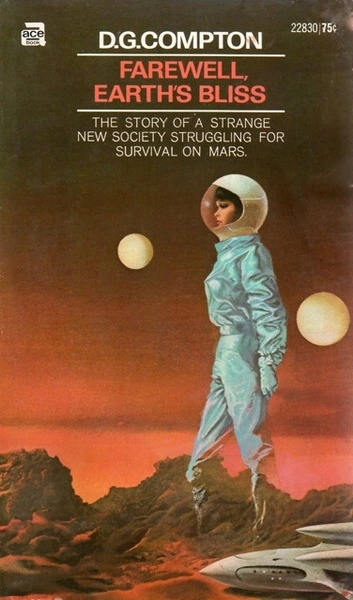
Back in May 2023, Matt reviewed D.G. Compton’s Farewell, Earth’s Bliss from 1966. He described it as one of the bleakest books he had ever read, with “wonderfully sharp and crystalline and well-realized characters” and being truly immersive. I was sufficiently intrigued to purchase and read the book, and it was as he had described. I certainly didn’t find it a pleasant read, but it was memorable and worthwhile.
In December 2023 he reviewed an even more obscure book, One on Me by Tim Huntley. He said it was a funny and well-written dystopia set on the Earth in a distant future, but significantly flawed by its inclusion of forbidden relations. Matt said, “I don’t know that I recommend it. If you can just hold your nose and plug your ears for a couple parts, it is a good book, but I don’t know if you should.”
The book is certainly not well known. I found only one review online, by Kenny in north Texas from 2019, and he opened with a paragraph of complaints about its objectionable elements, condemning it as “vulgar and gross”. However, he then echoed Matt by stating, “Despite all that, there is a compelling story.”
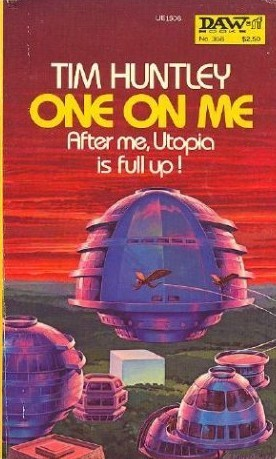
Well, that was enough to interest me. The book wasn’t available electronically, so I bought a used paperback copy on Amazon for $7, and if Amazon had not had a copy, I would have checked AbeBooks. I received it in early January and tossed it on a shelf.
Seventeen months later, finding the various possible reads in my Kindle library unappealing, I scanned my shelves and noticed that 221-page DAW paperback published in 1980. I vaguely recalled that it was considered off-putting, it didn’t appear to involve impossible interstellar travel, and since it happened to be Banned Books Week, I decided to read it.
My used copy had been embossed on its title page as having once been in the library of George H. Siehl III, and I had some fun tracking down who that was.
Going beyond the title page, I was thankful to discover that there was little detail in the novel’s treatment of disturbing relations, and they did serve a purpose in showing how different the dystopian culture was from our sensibilities, an effective illustration of the decadence of both sides in a later conflict. A bit of earthy humor about the narrator also struck me as far more comedic than offensive. It lacked the explicit intercourse that graces some trashy romances, but it certainly mentioned unfortunate sexual behavior, torture, and the like. I was glad to find those topics handled fairly quickly and at a remove; the book didn’t strike me as seeking to titillate.

The disturbing elements actually served the plot, which made sense to me since the book was published by DAW in 1980, when founder Donald A. Wollheim was still in charge. He was one of the major science fiction and fantasy editors, publishing pulp authors Robert E. Howard, Clark Ashton Smith, and H.P. Lovecraft in the 1930s and later nurturing future greats like Poul Anderson, Philip K. Dick, and Andre Norton at Avon and Ace Books before creating his own imprint.
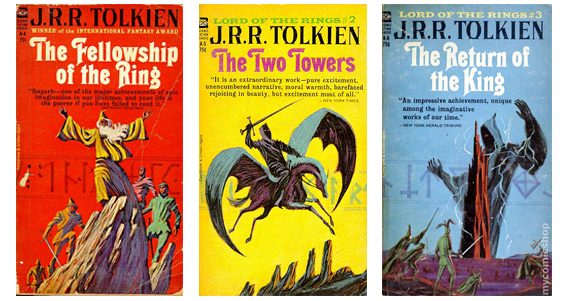
A fun story about Wollheim was how he called up J.R.R. Tolkien in 1964 to ask if he could publish Lord of the Rings as Ace paperbacks. Tolkien reportedly said he would never allow his work to appear in so “degenerate a form”. That is said to have incensed Wollheim, who discovered that Tolkien’s American hardcover publisher had neglected to protect the work in the USA, so he went ahead and published them as unauthorized Ace paperbacks.
Tolkien rewrote the books enough to obtain a new copyright, sold them to Ballantine, and successfully pressured Ace to stop publishing the unauthorized versions and pay him some royalties on the 100,000+ copies they had sold. The squabble helped ignite the Tolkien boom and launch the modern high fantasy field, but it also damaged Wollheim’s reputation.
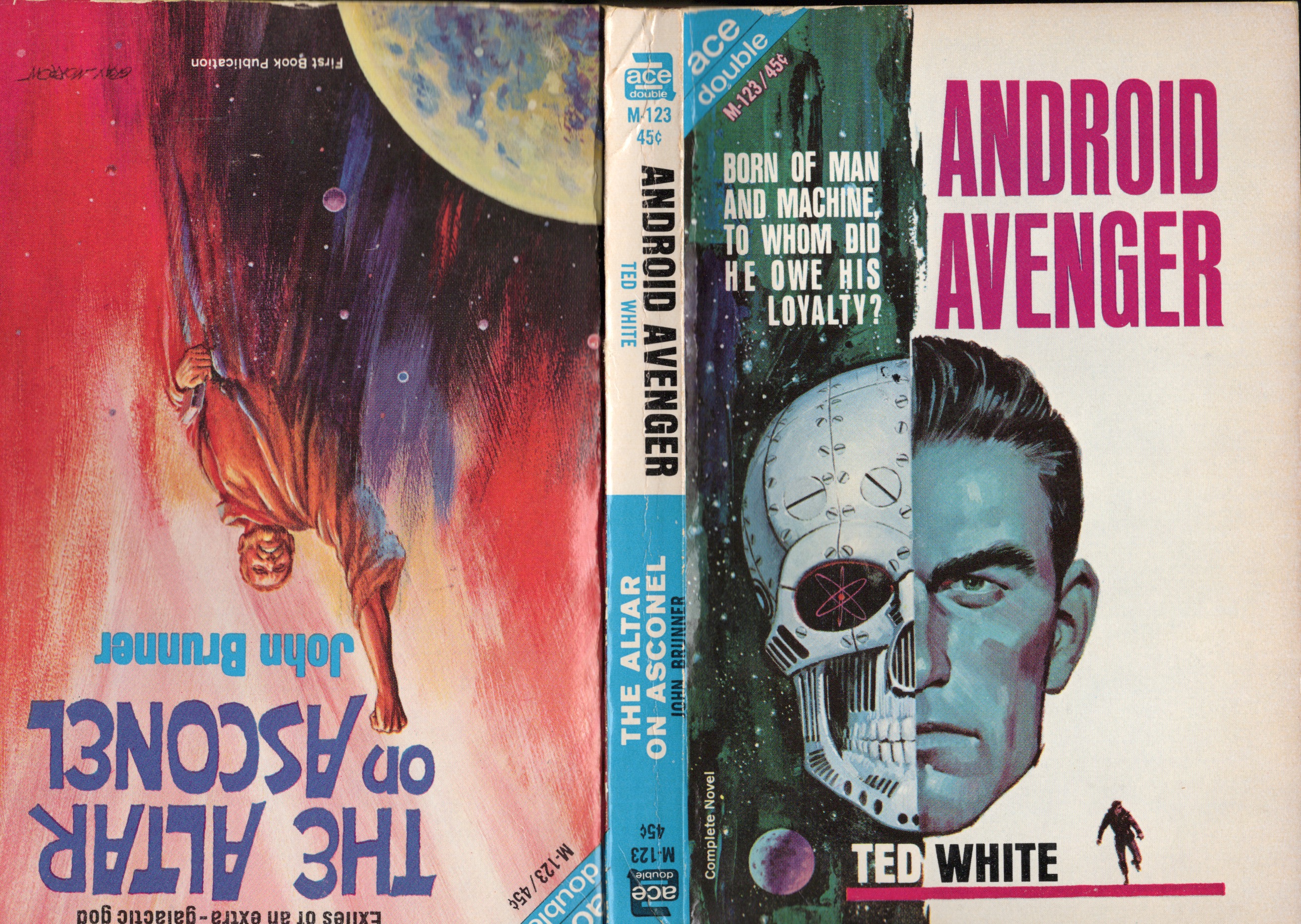
I have a soft sport for Ace paperbacks. When I was a young teenager, one of my uncles gifted me his science fiction paperbacks, which included several of the Ace doubles. The tête-bêche format books published from 1952 to 1973 each contained two novellas, with the front cover and interior of one novella rotated by 180 degrees and bound back-to-back with the front cover and interior of the other. That way neither novella is preferred, and if you buy one and end up abandoning it, you can always flip the book around and try again. I suppose you might occasionally like both stories! One of the old doubles managed to survive my Digital Age Downsizing in 2010.

As for DAW, you can read more about that imprint here. Wollheim published popular, though not always critically acclaimed, works. I wouldn’t expect him to publish outright trash, and I enjoyed One on Me. I couldn’t predict how its tale would unfold, and I found it prescient in several ways.
The book was good enough that I downloaded a sample of Huntley’s other novel, which was self-published 30 years later when he was about 70. It is even more obscure, but EarthGame: A Player’s Guide came out late enough that it is available on Kindle. The title is misleading, as the book is a comic novel. I’m not ready to try EarthGame, having just wrapped up One on Me, but it is on my list as a tempting final outing with Huntley, who died in 2019 a week before he would have been 79 years old.
My tastes have evolved considerably over the 40 years since I was a teenager, and I seldom seek out science fiction these days. Thankfully there are countless other books on offer, and my amazing access to them still strikes me as, ahem, feeling like science fiction.








 Meador Manor