
What is the second-largest religious group in the United States of America? We all know the largest is Christianity, which subsumes Catholicism and numerous Protestant denominations, and can include the more diverse beliefs of Mormons and Jehovah’s Witnesses, along with an increasing number of non-denominational churches. However, it might surprise you, given the outsize media attention given to the 2% who are Jewish and 1% who are Muslim, that the second-largest group are the Nones, those who identify as religiously unaffiliated.
The General Social Surveys of U.S. adults show the Nones have grown from about 5% in 1972 to over 25% today. This post is meant to inform, not evangelize. I have no interest in impacting your personal religious beliefs or nonbelief; rather, I seek to inform your understanding of over one-fourth of us.

Pew Research has found that the Nones vastly outnumber the Jews, Muslims, Buddhists, Hindus, or other non-Christian religions in America even when all of the non-Christian religious folks are grouped together. In fact, if we group the three basic types of Nones — those who believe nothing in particular, agnostics, and atheists — they collectively outnumber each of the primary Christian categories.
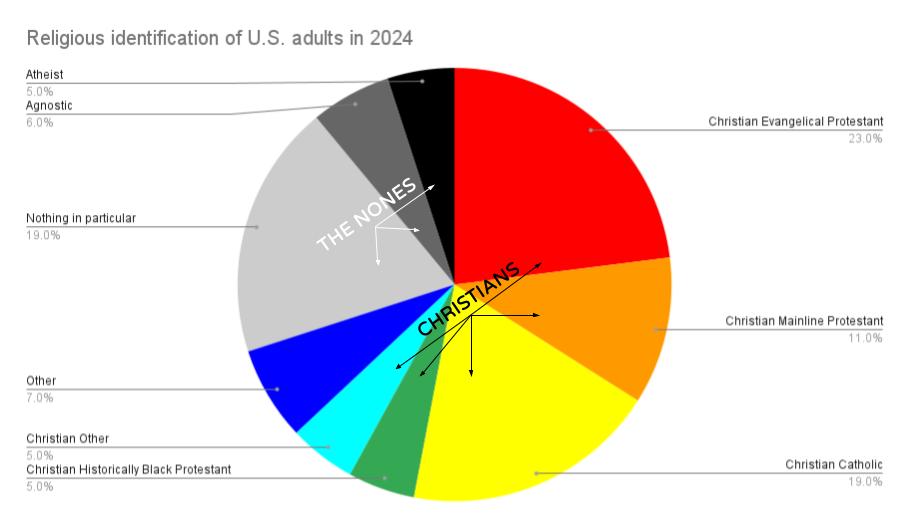
In 2024, 62% of U.S. adults identified as Christian and 29% as religiously unaffiliated. The largest Christian category was Evangelical Protestant at 23%, followed by Catholics at 19% and Mainline Protestants at 11%.
Oklahoma is a hotbed of Evangelical Christianity, with 47% of adults identifying as such, a proportion only exceeded in Arkansas. 70% of Oklahomans identify as Christians of one sort or another, 26% identify as Nones, and only 4% claim other forms of religious belief.

We can break this down even further to compare the religious make-up of Washington County in Oklahoma, where I live, to the nation as a whole, thanks to the Public Religion Research Institute’s 2023 Census.
| Religious Affiliation | Washington County, OK | USA |
| White Evangelical Protestant | 39.3% | 13% |
| Religiously Unaffiliated (The Nones) | 21.2% | 27% |
| White Mainline Protestant | 15.4% | 14% |
| Other Protestants of Color (e.g. First Peoples) | 7.8% | 2% |
| White Catholic | 5.3% | 12% |
| Hispanic Catholic | 2.5% | 8% |
| Black Protestant | 2.2% | 8% |
| Hispanic Protestant | 2.0% | 4% |
| Mormon | 0.6% | 2% |
| Other Non-Christian Religion | 0.6% | 2% |
| Jehovah’s Witness | 0.5% | 1% |
| Other Catholics of Color (e.g. First Peoples) | 0.5% | 2% |
| Jewish | 0.4% | 2% |
| Muslim | 0.4% | 1% |
| Buddhist | 0.4% | 1% |
| Orthodox Christian | 0.3% | <1% |
| Hindu | 0.3% | 1% |
| Unitarian Universalist | 0.3% | <1% |
If tables aren’t your thing, here’s a visualization of Washington County’s religious make-up:

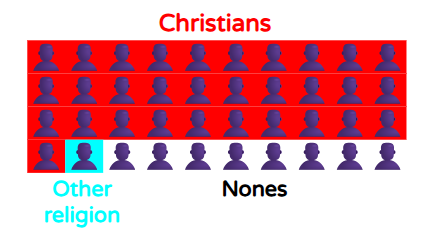
So if you gathered 40 random people where I live, about 31 would be Christians, one would adhere to some other religion, and eight would be Nones.
Atheists versus atheists
The Nones are not a cohesive group. The Pew Research Center breaks them down into those who identify as nothing in particular, agnostics, and atheists. Matt Baker of UsefulCharts earned his doctorate in education with a dissertation titled “Psychological type and atheism: why some people are more likely than others to give up God” and subdivides the Nones into Negative and Positive as well as Implicit and Explicit atheists.

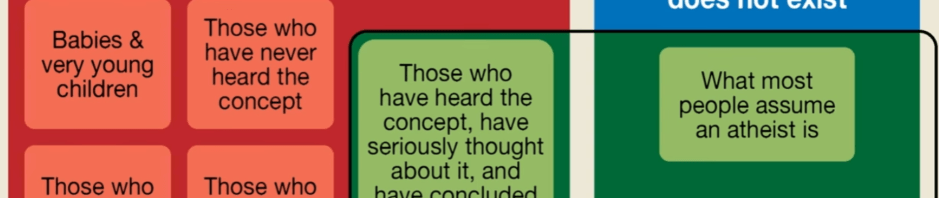
“Agnostics” are among the negative/weak/soft atheists while also being explicit about non-belief, while those who identify as “Atheists”, which I’ll distinguish when feasible with capitalization, are known as the positive/strong/hard type who are also, like the Agnostics, explicit about their non-belief but then go beyond skepticism and freethought to contend that God does not exist. You might expect the “nothing in particular” group to be among the negative/weak/soft and implicit atheists, but there is a contraindication for that.
Many nones are not actually atheists
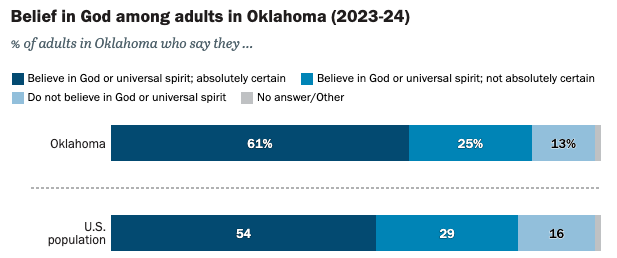
When people are asked about their belief in God instead of their religious affiliation, only 13% of Oklahomans do not believe in God or a universal spirit, which generally corresponds with the explicit atheism of the 9% who identify as Agnostic and 5% who identify as Atheists. But that implies that many of the “nothing in particulars” do in fact hold some sort of spiritual beliefs or are uncertain about their beliefs.
Political scientist and former Baptist pastor Ryan Burge wrote a whole book about the Nones. He points out that the religiously unaffiliated in the USA have grown in recent years, from 5% of adults in the early 1970s to 29% today, and that grows to over 40% among the youngest adults. He views that as “the largest shift in American culture in at least the last 40 years.”
Burge examined a wide range of factors that might have played a role in that trend, such as secularization, the rise of the internet, social isolation, changing family structures, etc. However, he concluded that “the best and clearest explanation of the rapid rate of religious disaffiliation can be traced back to the recent political history of the United States.” He cites an exodus of liberals from Christian churches since the rise of the religious right. As some religious leaders and groups became more visible and aligned with conservative politics, many young, liberal, and moderate Americans chose to disassociate from organized religion.

Burge says there has been a homogenization process where white religion has become overwhelmingly Republican, with no surviving large liberal white Christian tradition, and pockets of liberalism are often confined to urban and suburban areas.
He notes that only 1 in 20 Americans are positive Atheists, and the textbook Atheist is an upper-educated, upper-class white guy living in an urban or suburban area; the stereotype arises because 60% of Atheists are men and about half earned a four-year college degree. However, the “nothing in particulars” are the least educated religious group in America, with only 25% having a college degree, 1/3 having a high school diploma or less, and 60% of them making less than $50,000 per year as a household. He says many of them are struggling economically and socially.
Burge notes that many of the “nothing in particulars” are not politically active and “feel left out, left behind, lost, unmoored, and disconnected from the larger society.” Counter-intuitively, 15% of those who say their religion is nothing in particular actually attend religious services at least once a month.
Burge also points out that Campbell, Layman, and Green noted differences between being secular and nonreligious. He comments, “Secular people have thrown off the religious worldview and replaced it with something else. Nonreligious people have gotten rid of religious thought but have not replaced it with anything else. They are defined by what they are not rather than by what they are.“
He adds, “I think these ‘nothing in particulars’ are not antagonistic toward religion. They’re antagonistic towards a lot of institutions, and religion just happens to be an institution like banks or big business or politics or whatever. But they don’t have a specific beef against religion. That’s why they are still somewhat open to the idea of religious practice. A third of them say religion is at least somewhat important in their lives. They still see some value in it. But they’re not willing to be labeled as Protestant, Catholic, Mormon, Buddhist, or whatever.”
Burge’s categories
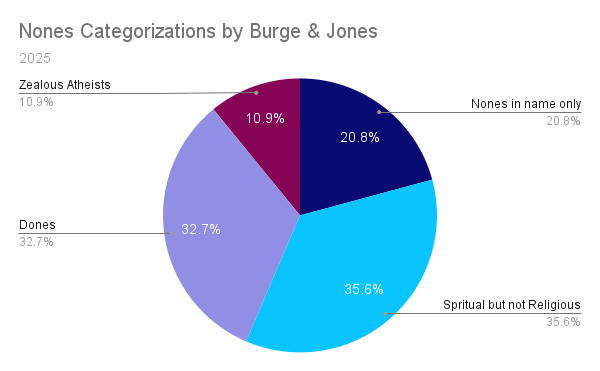
In The Four Types of Nones, an August 9, 2025 post on his Graphs About Religion substack, Burge shared some results from a grant he and Tony Jones won from the John Templeton Foundation for a large survey of the non-religious. Their questions were tailored to explore nuances and craft a new typology of the Nones. They identified four groups among the 30% of Americans who identify as non-religious:
Nones in Name Only

20% of 30% means about 6% of U.S. adults are NiNOs.
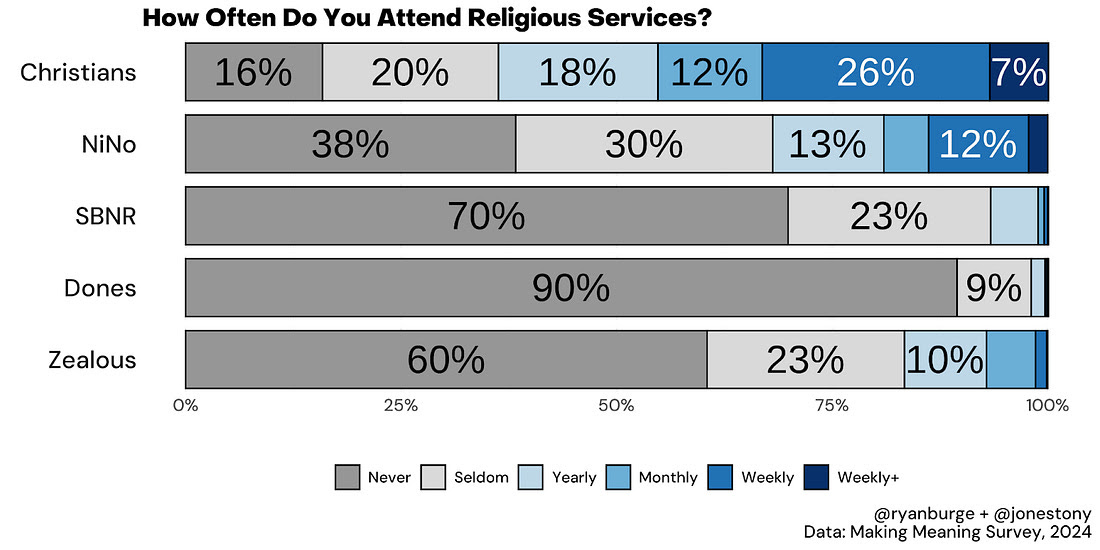
The NiNOs are actually fairly religious on various measures, but they don’t classify themselves as part of a religious group. 3/4 of them choose “nothing in particular” in the usual surveys, 1/3 attend a house of worship at least once per year, and over half of them say they pray on a daily basis, with a similar fraction holding a firm belief in God.
Spiritual But Not Religious

36% of 30% means about 11% of U.S. adults are SBNRs.
The SBNRs are deeply skeptical of religion but highly interested in spirituality. Few of them ever attend church, barely 1 in 10 of them ever prays, and only 1 in 20 holds a firm belief in God. They are the folks who say, “I believe in some Higher Power” and the like. New Age spiritualists who like crystals, yoga, meditation, nature walks, and the like are among the SBNRs.
Dones

33% of 30% means about 10% of U.S. adults are Dones.
They are done with religion entirely. Their metrics on the importance of religion and spirituality are in the basement. Over 2/3 of the Dones rated both religion and spirituality as not at all important to them, whereas only 1% of the SBNRs felt that way, and less than 1% of the NiNos. Burge says, “there is no clearly articulated ‘God-shaped hole’ in the hearts of these folks.”
Burge also shares that when asked if they agreed with, “When I die, my existence ends.”, 26% of NiNos agreed versus 39% of the SbnRs and 77% of the Dones.
Zealous Atheists

11% of 30% means about 3% of U.S. adults are ZAs.
77% of them have tried to convince someone else to leave religion in the past year, versus only 6% of the NiNos and almost none of the SBNRs or Dones. The ZAs tend to be much more visible on social media than the other Nones. As Burge phrased it, they are the folks who “are quick to point out that religious people believe in fairy tales or that they don’t need to pray to Sky Daddy or they mockingly worship the Flying Spaghetti Monster.”
One driver for ZAs, at least in Oklahoma, are frequent public proclamations of faith on social media by their evangelizing coworkers, acquaintances, and fellow community members, especially when that is accompanied by repeated attacks on and occasional breakdowns of the separation of church and state. Zealous Atheists get fired up by the public bullying and lifestyle oppression from demagogues and various wackadoodles. Those who push inevitably inspire pushback.
The ZAs actually engage with religion more than the Dones, with 17% of ZAs attending church once per year or more and about the same share praying in the past year. Burge and Jones speculate that such folks interact with religion enough to remind themselves why they dislike it. Perhaps their spouse or parents are still religious, and they get dragged to some services.
Comparing the Categories
Consider these heat maps of spiritual and religious importance:

Notice how the share who attach absolutely no importance to spirtuality or religion is more than double among the Dones compared to the Zealous Atheists. Interestingly, 44% of the ZAs pray at least occasionally, while 88% of the Dones never do:

Another distinction between the Dones and the ZAs are their ages:
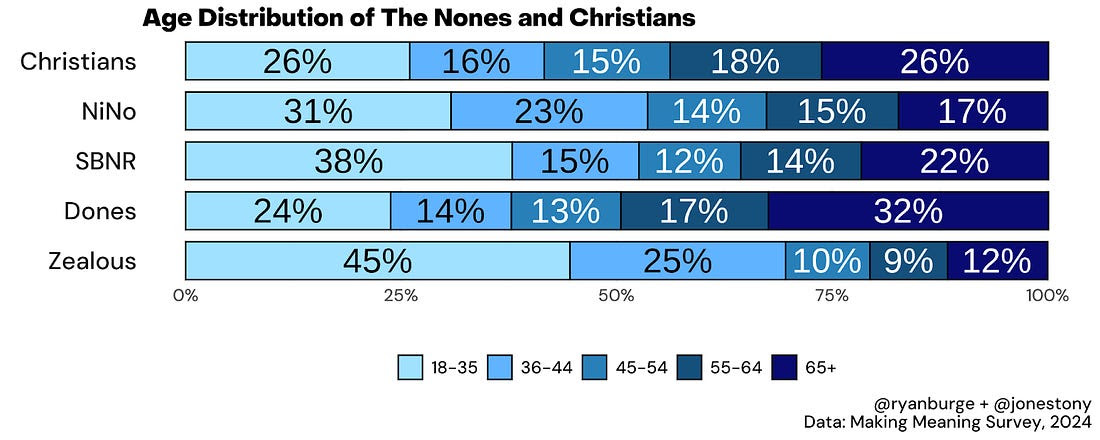
As Burge puts it, “In other words, these two categories represent entirely different generations of non-religion in the United States. The Dones are worn out from all the fights about religion. They’ve tried to evangelize their Christian friends to leave church behind. But they just sit back and shake their heads now. On the other hand, the Zealous Atheists still have a fire in their belly to try and change the world.”
Personalities
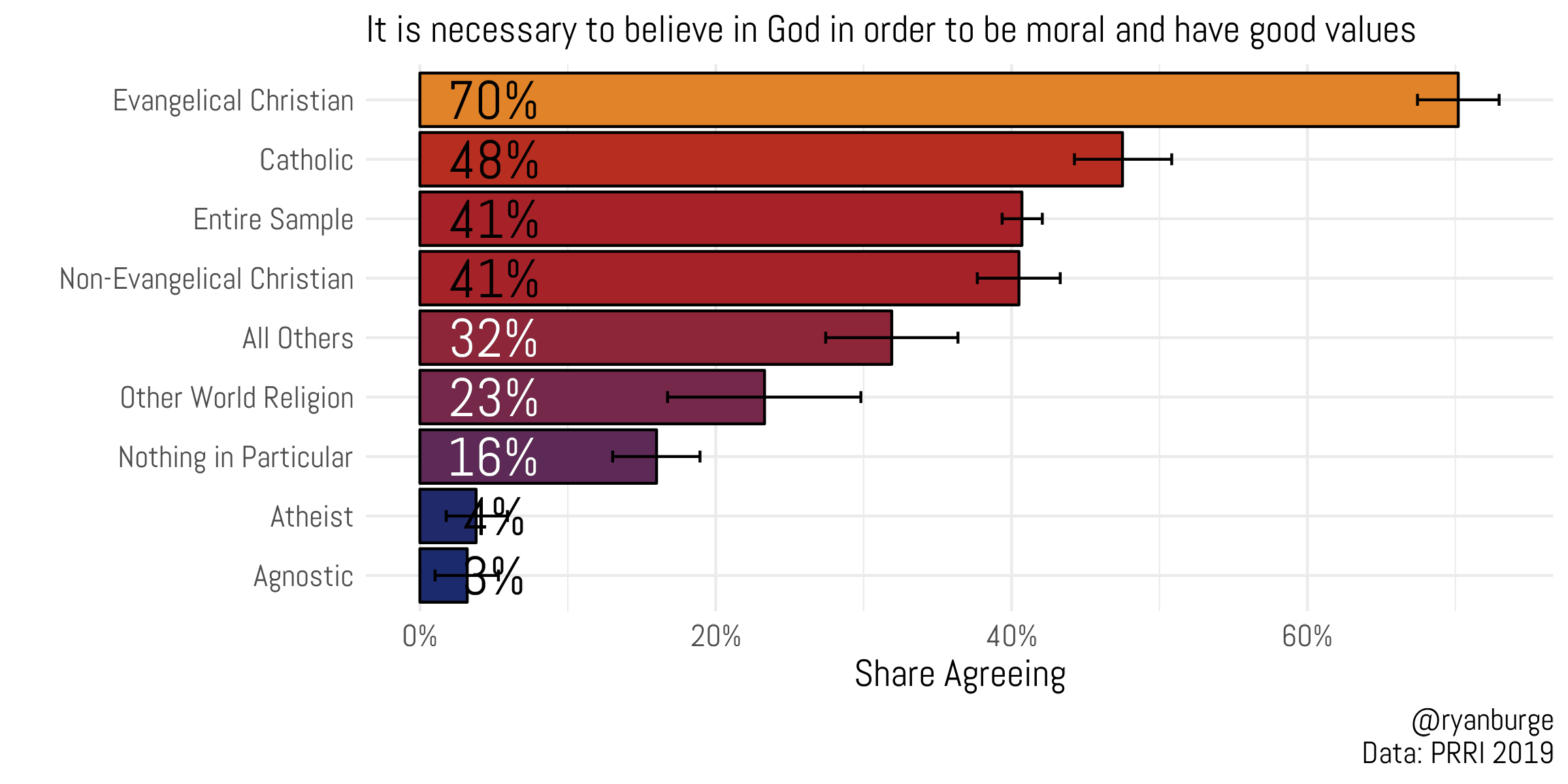
Evangelical Christians take a particularly dim view of Atheists since 70% of evangelicals think one must believe in God in order to be moral and have good values. Only 41% of people overall think that way, but that still means many people believe Atheists are immoral and lack good values. Unsurprisingly, only 4% of Atheists share that view.
The 2008 American Religious Identification Survey showed that most atheists in the USA were members of Christian churches as children and “deconverted” as adults. Baker explored how conservative Christians have cited selfishness, arrogance, anger at God, and poor father-child relationships as possible explanations for such deconversions. His research did not support those hypotheses. Less religious emphasis during childhood, deliberation in the pursuit of truth, and higher intelligence did appear to play a role, but they were not nearly as statistically significant as personality traits.
In a previous post I outlined several different personality measures. The one with the most scientific support is the five-factor model, and it is interesting to explore how it correlates with religiosity. A meta-analysis of 71 samples with over 20,000 participants from 19 countries showed that “individual differences in religiousness can be partly explained as a cultural adaptation of two basic personality traits, Agreeableness and Conscientiousness.”
It went on to share that Agreeableness and Conscientiousness seem to predict religiosity rather than be influenced by it. Baker found a much greater link between atheism and the Thinking and Perceiving personality types in the Myers-Briggs personality test, which conforms to those findings.
Unfavorable views
Evangelical Christians often portray themselves as being disfavored or persecuted, and they did indeed enjoy less favor than some other religious groups in a September 2022 survey by the Pew Research Center, faring far worse than Catholics, Mainline Protestants, or Jews, although the balance of opinion on Evangelicals was still marginally favorable.
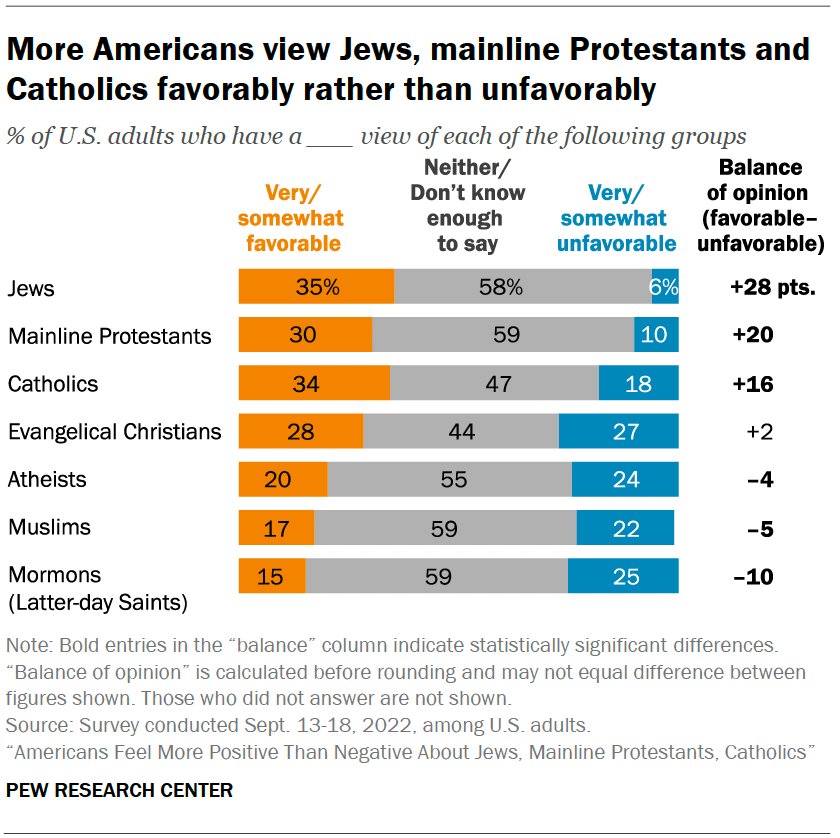
However, the balance of opinion went into the negative for Atheists, Muslims, and Mormons.
When thermometer scores of feelings toward various groups in 2012 were broken down by partisanship, the military and the working class always came out near the top, but Atheists were rated much less warmly than Christian Fundamentalists by Republicans (33% versus 58%), noticeably less by Independents (39% versus 45%), and they were virtually tied as the least favored groups by Democrats (at 42-43%), except for the Tea Party. You know you’re unpopular when both Democrats and Republicans feel more warmly toward Congress than toward you.
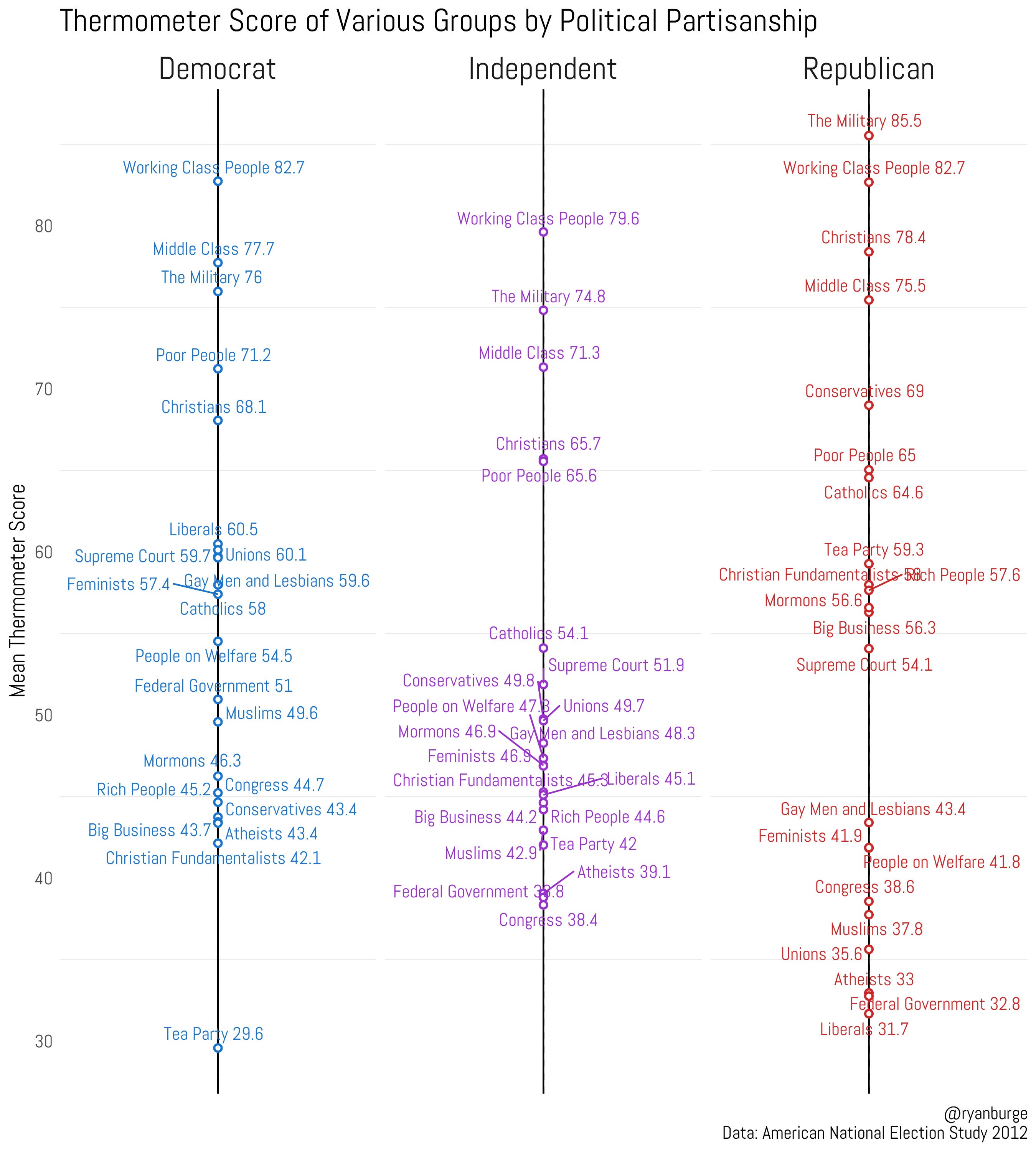
Different data from a decade later showed that on balance, Democrats viewed Atheists positively, while Republicans viewed them negatively.

Other indicators of the dim view most people take of atheists is that about half of Americans would be unhappy if a close family member married one, while only 1 in 10 would react that way to a born-again Christian. 77% of white evangelical Christians don’t want an atheist in their family. Interestingly, among the Nones, 28% don’t want a family member to marry an evangelical, but 13% don’t want them to marry an atheist, either, again illustrating there are Nones who are certainly not Atheists.
The bias against atheism displayed by people across the political spectrum helps explain why the social media presence of Nones is dwarfed in Oklahoma by the religious comments and posts by various Christians, particularly evangelicals who are enculturated to publicly share their views with and preach to others. Only the Zealous Atheists are likely to stick their necks out and actively promote their disbelief in such an environment, while the Dones are, well, Done.








 Meador Manor