
After J.L. Carr’s short and moving novella A Month in the Country, I remained in the mood for something of “quality” to read. Don’t get the wrong impression; I have always enjoyed genre books, being an avid consumer of mysteries and, in my younger days, of science fiction, and too much fine writing can produce intellectual indigestion.

However, I do deliberately seek out LIT-rah-chur when the mood strikes. I couldn’t readily try another book by Carr, as most of his works aren’t available as e-books but as printed works from the tiny press he founded in England. I had ordered a couple of used copies from Abebooks, but those wouldn’t arrive for weeks.
So I consulted my highlighted version of Modern Library’s 100 best novels of the 20th century and noted that Henry James captured three spots with his late-period works of 1902-1904. I couldn’t remember why I hadn’t read him earlier, so I downloaded The Ambassadors from Project Gutenberg.
It only took two long paragraphs in his introduction to convince me to abandon him. Here is the first:
Strether’s first question, when he reached the hotel, was about his friend; yet on his learning that Waymarsh was apparently not to arrive till evening he was not wholly disconcerted. A telegram from him bespeaking a room “only if not noisy,” reply paid, was produced for the enquirer at the office, so that the understanding they should meet at Chester rather than at Liverpool remained to that extent sound. The same secret principle, however, that had prompted Strether not absolutely to desire Waymarsh’s presence at the dock, that had led him thus to postpone for a few hours his enjoyment of it, now operated to make him feel he could still wait without disappointment. They would dine together at the worst, and, with all respect to dear old Waymarsh—if not even, for that matter, to himself—there was little fear that in the sequel they shouldn’t see enough of each other. The principle I have just mentioned as operating had been, with the most newly disembarked of the two men, wholly instinctive—the fruit of a sharp sense that, delightful as it would be to find himself looking, after so much separation, into his comrade’s face, his business would be a trifle bungled should he simply arrange for this countenance to present itself to the nearing steamer as the first “note,” of Europe. Mixed with everything was the apprehension, already, on Strether’s part, that it would, at best, throughout, prove the note of Europe in quite a sufficient degree.
No doubt that appeals to some, but certainly not to me. I shuddered, for the lengthy and complex sentences, with subordinate clauses and digressions which repeatedly interrupted their flow, dredged up from my memory an aborted attempt at The Turn of the Screw. I had made it all of four pages into that simpler work. I lack the patience to decode Henry James.
Funly enough, I found a clip of Ann Patchett, who wrote the book that prompted this post, and The Ambassadors is her favorite of his books. However, she wrly advises one to read his earlier, simpler works and gradually build up to his late “impossible” ones. That is a reading marathon I shan’t run, which wouldn’t surprise Ann.

Returning to the Modern Library listing, I noticed that Saul Bellow had two entries, and I actually saw him in person at Bartlesville High School in the early 1990s, back when famous authors were lured in by significant honoraria to speak in a Man and His World program. He was irascibly intelligent, and so I downloaded a sample of his bildungsroman, The Adventures of Augie March.
Alas, several pages in, I was bored by the characters and found his style annoying. A pushy immigrant boarder led me to suspect that one of Corrie Ten Boom’s intimidating aged aunts from The Hiding Place had wandered into a Neil Simon play. I have had my fill of that sort of thing, and of most bildungsromans to boot. I might try a different Bellow book…someday.
I considered another E.M. Forster novel, but I felt like something American set in more recent times. I save various samples on my Kindle as I come across possible future reads, and thus I noticed Ann Patchett’s The Dutch House.
Hmm…I had heard of her, the book was set in America, its plot spanned 1957 to early 2000s, and the Kindle About this book noted these accolades:


Okay, sure. I started the sample, and nine pages in, before finishing the first chapter, I was ordering the book. I had never read her work, although I remember seeing Bel Canto featured at bookstores at the dawn of this century.
The Greatest Books meta-analysis recently ranked Bel Canto at 924, and The Dutch House was 6,986th. Just for fun, let’s see…The Ambassadors was 243rd and The Adventures of Augie March was 283rd. I grant relative rankings little validity between authors, let alone genres, but I do find them useful in discerning differences within a given author’s work.
The Dutch House
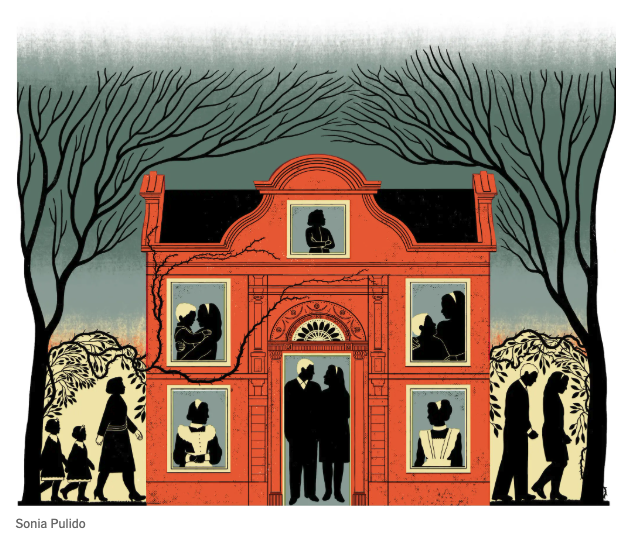
According to The Greatest Books, “The novel tells the story of siblings Maeve and Danny Conroy, who are raised in a grandiose mansion known as the Dutch House in suburban Philadelphia. After their mother abandons the family and their father dies, they are exiled from the house by their stepmother, Andrea. The siblings’ bond deepens as they navigate their lives, haunted by the loss of their home and the impact of their past. The narrative explores themes of memory, forgiveness, and the inescapable nature of family history, as Maeve and Danny grapple with their shared experiences and the legacy of the Dutch House.”
The protagonist being a damaged and detached son and the centralization of the relationship between the siblings reminded me of another novel that I read this year: Ann Napolitano’s Hello Beautiful. That book also centered on a son, unloved by his parents, while its sibling relationships were among four sisters. Both books explored complexities of family dynamics.
I have no siblings or children, so there are distinct gaps in my direct experience with several types of family relationships. I can only drawn upon my indirect and sporadic glimpses of the sibling relationships of my wife and closest friends, among my various aunts, uncles, and cousins, and what I read in books and see in media. When asked what influences their views of what makes a good family arrangement, well over half of U.S. adults said that what they read in books or see on television or in movies don’t matter much.

Then again, only about half of U.S. adults even read a book in a given year. Given my lack of direct experience with siblings and offspring, I am among those who do depend somewhat on books and media to better understand such relationships.
Family Stats
In the book, the protagonist’s mother leaves when he is three, and he is fifteen when his father dies in 1963. In 1968, over 85% of children lived with two parents, but that declined to about 70% by the mid-1990s before roughly stabilizing.

As for siblings, the baby bust from 1960 to 1975 ended in a plateau that has been slowly eroding since 2007 with a declining fertility rate.

The percentage of mothers in the USA with only one child doubled between 1976 and 2021, rising to 22%, while in the European Union half of families with children have only one child. A meta-analysis of 115 studies found no significant differences in academic achievement, social skills, or personality traits between only children and those with siblings, although only children do tend to be more independent and creative and have better relationships with their parents. While I don’t seek them out, I do find it interesting to read books about siblings, and I am struck by how many of my acquaintances have experienced both short-term and long-term sibling estrangements.
The Book

Patchett’s prose flowed smoothly, being graceful but seldom arresting. I was interested in how the protagonist was very detached and often oblivious, with his lack of curiosity hampering our own ability to understand his family members and their motivations. However, he did have moments of insight, and while I didn’t believe in his success at and abandonment of his medical school training, I did appreciate his relationship with his wife. Her transference of blame for his faults to his sister rang true, as did the eventual fate of their relationship and him repeating some of his father’s errors.
The house was a character in the story, and its lack of change over the decades was not credible, but rather reflected the novel’s connections with fairy tales. I felt that the ending of the novel involving the protagonist’s daughter was contrived — Patchett understandably resisted echoing Poe’s The Fall of the House of Usher, but her opposing solution wasn’t to my liking.
This novel stayed true to what Patchett said back in 2016: “I’ve been writing the same book my whole life — that you’re in one family, and all of a sudden, you’re in another family and it’s not your choice and you can’t get out.”
The cover of the book is terrific. Patchett is based in Nashville, where she runs her own bookstore, Parnassus Books. She turned to Nashville-based artist Noah Saterstrom to create a real version of a fictional painting featured in the novel. After his move to Tennessee in 2016, Patchett had mounted a show of his author portraits in her bookstore.

Patchett stipulated a few key details for the portrait: black hair, red coat, extravagant background wallpaper, with “her eyes bright and direct” as her brother narrates in the novel. Unlike Norman Rockwell, the famed illustrator who relied on live models, Saterstrom tends to source his portraits from old archival or family photographs, preferring that remove to avoid including his own engagement with the sitter in his work. However, I noticed the unusual pose of the girl’s empty hands, and those were in fact modeled on the hands of the artist’s six-year-old daughter.
I enjoyed my first outing with Patchett, although it did not move me like Napolitano’s Dear Edward and Hello Beautiful. I certainly hope to read more of Patchett’s work. While I’m not interested in Bel Canto, her best known work, as it centers on terrorists and their hostages and I find that repulsive, I am intrigued by Commonwealth, Tom Lake, and her early work The Magician’s Assistant.








 Meador Manor