After a truly horrid work week I was more than ready to escape on a good day hike. Saturday’s weather was overcast and rainy, but Sunday was sunny and warm. I rose late and drove south through Tulsa and southeast on the Muskogee Turnpike, turning off at the Muskogee Power Plant to drive over to Camp Gruber for a return to the Greenleaf Hiking Trail. The entire trail is 18 miles and back in May 2010 I’d hiked the first bit to a swinging bridge. This time I planned to hike about 10 miles, completing the south loop of the trail.
I’d read online that the Ankle Express group which maintains the trail sometimes does trail maintenance in February, I knew that sometimes the trail is closed for hunting and for military maneuvers in Camp Gruber, and they want you to sign in when you hike there. So I dutifully went to the road-accessible trailhead in Greenleaf State Park, signing in at the trail registry but then driving back out onto Highway 10 and crossing the highway bridge over to the abandoned asphalt road south of the dam. It was even more rutted and washed out than before, so I parked over to one side and hoofed it down the trail toward the lake.
I noticed a foot-travelled abandoned road leading east and knew that the asphalt road slowly curved down to the trail and this abandoned road looked like it would be a helpful cutoff. There were clear signs of trail maintenance along the path, with a ramp someone had set up for bike vaults.
At noon I reached a large flat rock which made a convenient spot for a tasty lunch, having another of the Turkey and Swiss on Berry Wheat sandwiches I now pick up at QuikTrip for each nearby hike, along with Fanta, a Payday, and Peanut M&Ms. I love those QuikTrip turkey sandwiches, although I can only eat about half of one at a sitting.
I passed another of several hill streams and was grateful to find a few orange leaves still hanging from some of the trees. Soon I reached a long inlet of the lake, fording it and admiring the clear water, a strong contrast to the muddy waters of the lakes near Bartlesville. The trail followed the inlet bank upstream until I could ford it. I deviated from the trail, which turned back downstream, walking upstream for a ways before backtracking. One could easily make your own connector trail here between the sides of the loop.
I heard voices and saw a fit man and woman in skintight running outfits exploring the stream. I figured they’d pass me eventually and headed on down the trail, passing an old hollow stump and campfire remains. I encountered a man with a boy and girl in their late teens or early twenties coming along the trail the opposite way, and not long afterward I heard a call behind me and, sure enough, the joggers trotted past, remarking on the beauty of the day. Those five people were the only ones I would see on the trail all day.
The trail showed a changing character, playing with variations of rock and vegetation and showing why this is considered a premiere trail in the state, being interesting to hike even on a nearly leafless sunny day in February. I forded Barbed Wire Stream. I call it that because when I walked a few feet upstream to see the sights, I was startled by a nearly invisible old strand of barbed wire strung across my path. There was no fence evident elsewhere. What was going on?
Examination revealed that an old fence had once run along here, but was completely gone except for a strand of barbed wire completely embedded in two trees. It ran smack through the middle of one, terminating an inch or two after its exit on the far side. The other tree showed the same thing. Had they grown up around the wire years before? How odd.
Passing mossy trees and rocks, I forded the inlet at Mary’s Cove and found the main camp area with its sign, some fire rings, and a camper-fashioned bench. I would need to turn off here to take the white-blazed connector trail to complete the south loop, but first I followed a bit of the north loop, having spotted some tents up along the far shore of the cove.
It was clear that most people turn off here to Mary’s Cove: the north loop of the trail was quite dim and rough along here. I could see the frequent blazes would be vital along that section, although they had been overkill on the south loop. Someday I’d like to start hiking early in the morning here so I could do the north loop. I’ve no interest in camping on the trail, so it would take some doing since taking both loops takes over nine hours and in the long summer days this area is replete with ticks.
I began returning on the high east side of the south loop. The blazes had changed to a combination of blue and orange. Along here I noticed my camera’s clock was twelve hours off. Evidently I messed up AM and PM sometime in the past. That would explain some of the weird date entries on Flickr! I fixed the settings and marched onward.
A fallen log had interesting insect roadways and then I walked by the remains of an old low rock dam, old enough for a sizable tree to be growing out of it. A half-cylinder tree was interesting and then I began losing some shots to the camera blur I’d seen on my previous trip. I’m waiting for reviews of the new Canon SX-260 HS to come out; if they are positive, it will be my new camera. The blur wasn’t continual, and I grabbed a shot of two new marker posts lying beside the trail near a road, awaiting placement.
The return to the car was uneventful and I wrapped up my 9.85 mile hike in 5 hours 15 minutes with plenty of time to freshen up at the car and drive to Tulsa for dinner. It was a gratifying day hike, especially since I’ll spend most of the next weekend facilitating teacher workshops at the senior high. I’m quite grateful for this unusually warm sunny February day which helped refresh my spirit.
I love my 2001 Toyota Camry, the most reliable car I’ve ever owned. Its stereo includes both a CD player and cassette deck, and I made good use of the former for a few years and ran mix tapes on the latter until I bought my first iPod for $500 back in 2004. It was amazing to have so much music at hand so easily, but there was the problem of how to get it to play over the car’s speakers since my old stereo did not sport a line-in port like new ones do today, let alone something so modern as a wireless Bluetooth connection.
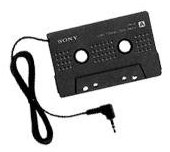
The cassette adapter I used for years
The first solution, as I’ve noted before, was an $11 Sony SPC-9C cassette adapter, which worked well for years, taking the iPod’s audio out and transmuting it for the car’s cassette player. There was occasional mechanical clicking from the adapter and high-band hiss in the speakers, but the sound quality was fine overall.
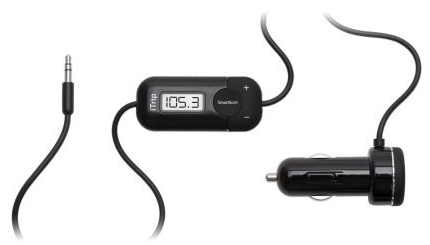
My FM transmitter/charger of choice was the Griffin iTrip Universal Plus
The Problems with FM Transmitters
But as noted in that April 2010 post, the cassette player in the car wore out and I had to switch to FM transmitters. I wasted money on three different models until I found the best compromise with my $30 Griffin iTrip Universal Plus. But it was still annoying. I had to max out the volume of the iPhone and set the car stereo to a very high volume to hear the output. Thankfully there wasn’t much hiss, but the sound was muffled and when I’d switch back to the radio my ears were blasted when I’d forget to adjust the volume beforehand.
Worse, with my frequent road trips to go on day hikes, I was always encountering interference from changing nearby radio stations. I’d have to press a button on the iTrip for it to scan for a clear frequency, then dial in the car stereo to the new frequency. If I was in traffic or listening to an audiobook this was a distracting pain and often the iTrip’s selection of a frequency still had considerable interference, forcing me to manually scan the radio frequencies to find one without a station’s broadcast.
So I’ve long dreamed of a car stereo with a line-in jack. But I’m both cheap and very dependent on my car. I haven’t bought an aftermarket car stereo in 30 years, and I didn’t want to pay for a new stereo when the existing one worked fine otherwise. Nor did I want to try and find a reputable installer and then have to make arrangements for transportation while the work was being done. Perhaps I could do this myself somehow?
Feeling Brave
I’d been emboldened by recent success repairing my home furnace and started scouring the internet for options. I quickly learned that my 2001 Camry could be easily retrofitted with an iPod/iPhone port if it had the factory CD changer in the trunk. Er, no.
So that meant I had to open up the dash a bit. I’d never want to take on a full dashboard removal, but my Camry just requires popping out a trim plate to get access to the stereo. I could handle that. So I could buy a new stereo and try to install it myself, but I wasn’t surprised to find there is no universal connection between a car stereo and the speakers and the like. There are all kinds of confusing harnesses and kits to make the needed changes and some folks mentioned still having to experiment with manual wire splices. I hate splicing and my soldering is terrible, so that did not appeal to me.
Modulators versus Transmitters
Then I found out that you can install an FM modulator in your car, rather than the simple transmitters, and get a line-in port that way with no interference and better sound quality. The modulator sits between the car’s antenna and the stereo, directly feeding its own FM signal into the car stereo on a specific frequency when you turn it on. The drawback it that it is much more complicated to install than a transmitter, which you just plug into a cigarette lighter port and hook to your iDevice.
You have to open up the dash, remove the car stereo, interrupt the antenna feed with the transmitter, mount a switch somewhere to turn the transmitter on or off, tap into a live circuit for power and make a connection to electrical ground, and have wires or a port to connect to the audio jack on your iDevice, hide the modulator all of this connects to inside the dash, and then reinstall the stereo.
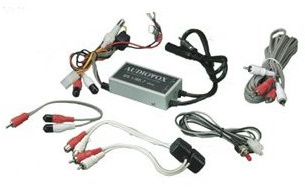
The Audiovox FMM-100 FM Modulator
It was a lot of hookup for a guy lacking great dexterity, but I spent considerable time reading about the different transmitters compatible with my car stereo, poring over blogs and forums where people wrote about their installation experience. I finally settled on the Audiovox FMM-100, which I ordered for $40 from Amazon.
Side Projects
I was also motivated to go ahead with this project because there were two issues I might also be able to fix if I opened up the dashboard a bit. First off was a second cigarette lighter-style power port, just under the main one, which had stopped working. Maybe I could fix that and have more flexibility in charging devices without using a cumbersome plug-in expander.
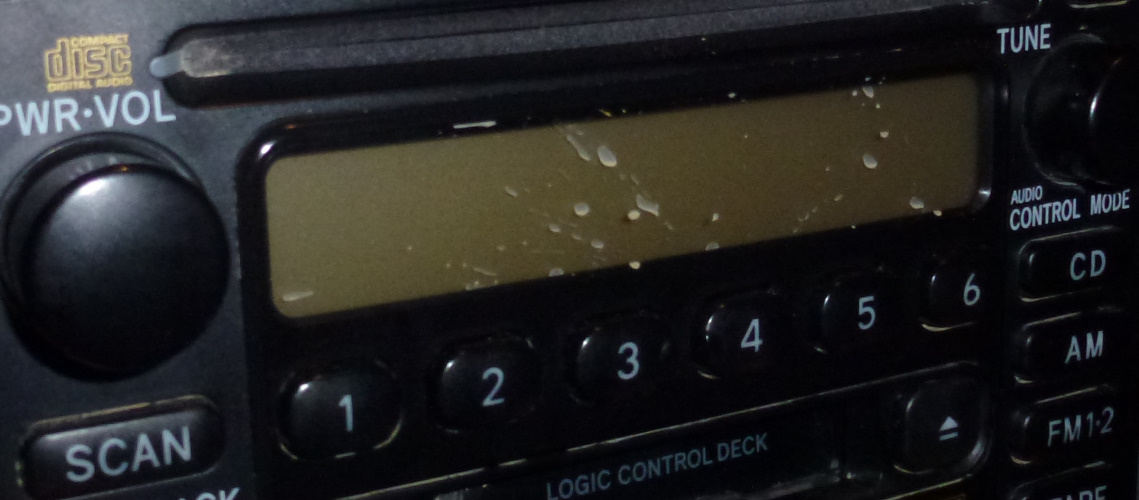
I had mud streaks on the inside of my stereo display from an incident last summer
The other problem was a cosmetic one. In July 2011 I tried to visit El Malpais National Monument in New Mexico, but the road was flooded and a police car unexpectedly roaring by sent a huge wave of muddy water all over the interior of the windshield and the dashboard. You can see the mud on the back window – imagine having a bucket of muddy water thrown in your passenger window toward the windshield while you’re driving and you’ll know how I felt. I spent a long time at an Albuquerque Wal-Mart lot cleaning up the mess that day, all except for some muddy streaks down the interior of the stereo display. No way to reach those without taking the sucker apart. Well, here was my chance.
THE PROJECT, STEP BY STEP
I’m including big photos of each step of the process since similar photos by other car owners for their own vehicles helped give me the courage to take on this project.
The Car Alarm
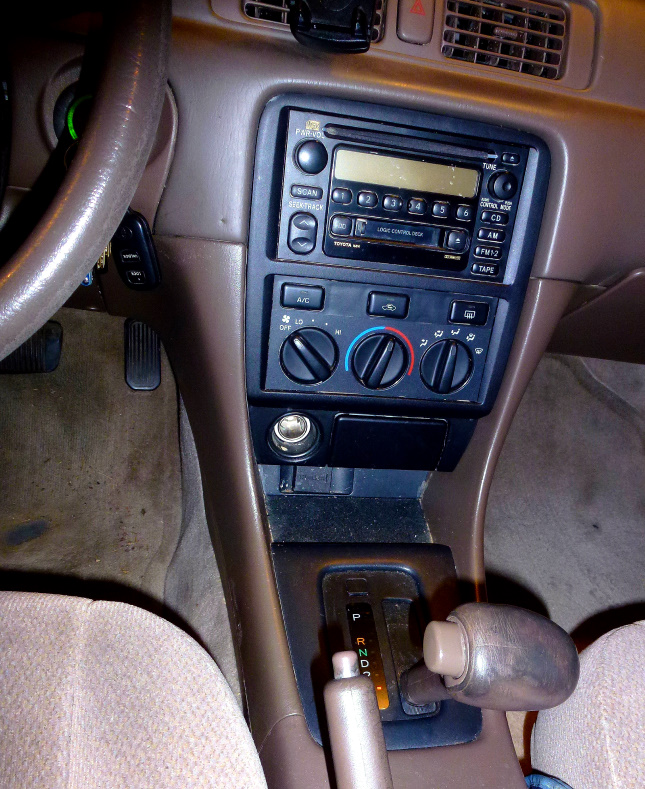
The first step in opening up the center dashboard console was to get the gearshift away from it. That’s a problem since the interlocks won’t let you put the car in gear without the ignition switch being in the on position, and I didn’t want power to the stereo while I was working. The best thing to do is to have the car off but the key in the on position, apply the emergency brake, put the car into 1st gear, and then disconnect the battery.
First attempt at moving the gearshift back
I tried that, but my car has a horrible built-in alarm system. I leave it disarmed in valet mode all of the time since I hate car alarms. I’ve even disabled the panic button on my keyless remote because occasionally I’d hit it and the horn would blare and lights flash and the whole miserable mess. I dread when the batteries in the remote or the car itself get old, because that too can cause the alarm system to fly off the handle.
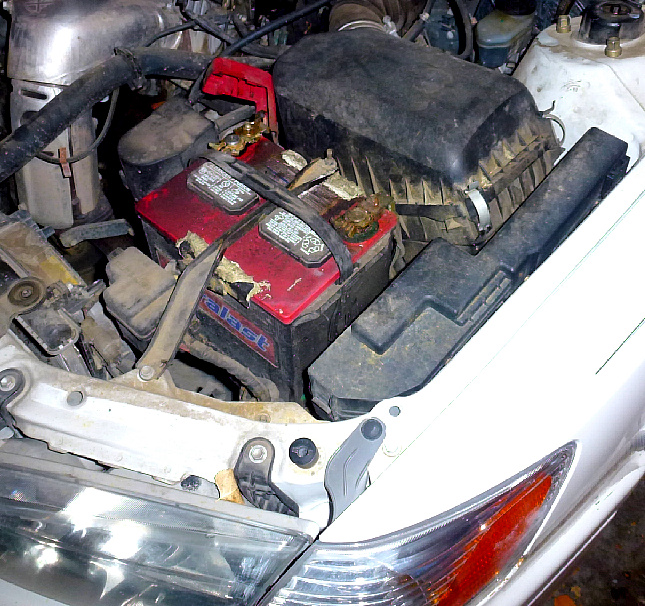
I messed with the car battery to begin with
As I feared, messing with the battery connections set off the alarm, with it blaring away in my garage and annoying everyone on the cul-de-sac, no doubt. They were kind enough to ignore it, as I do all car alarms, but I was still embarrassed. So I opted to leave the battery connected and try a different tack, one which worked for me but which I’m not recommending to you for liability reasons. 😕
Opening Up the Dashboard
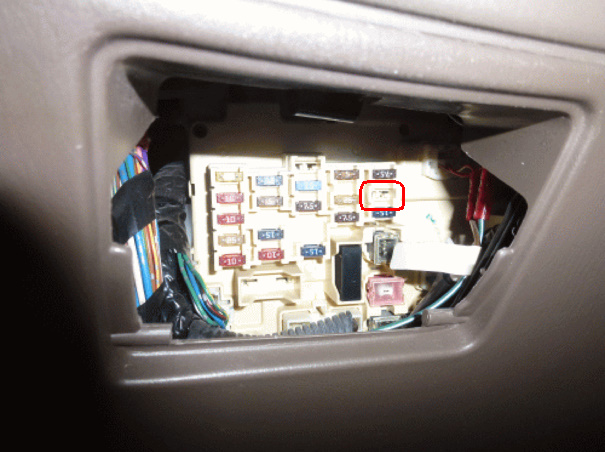
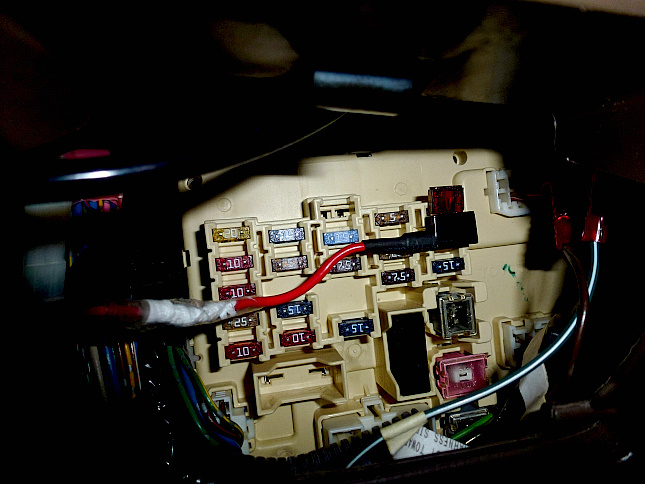
I pulled out the coin box to access the fuses and used needlenose pliers to pull out the tiny 7.5 amp one for the radio, checking that the stereo had truly lost power.
I removed the fuse for the car stereo
With the emergency brake on, I pried up the little plastic tab covering the gearshift interlock override. That revealed a button I could push to move the gearshift back without having the key in the ignition.
Moving the gearshift with the interlock override
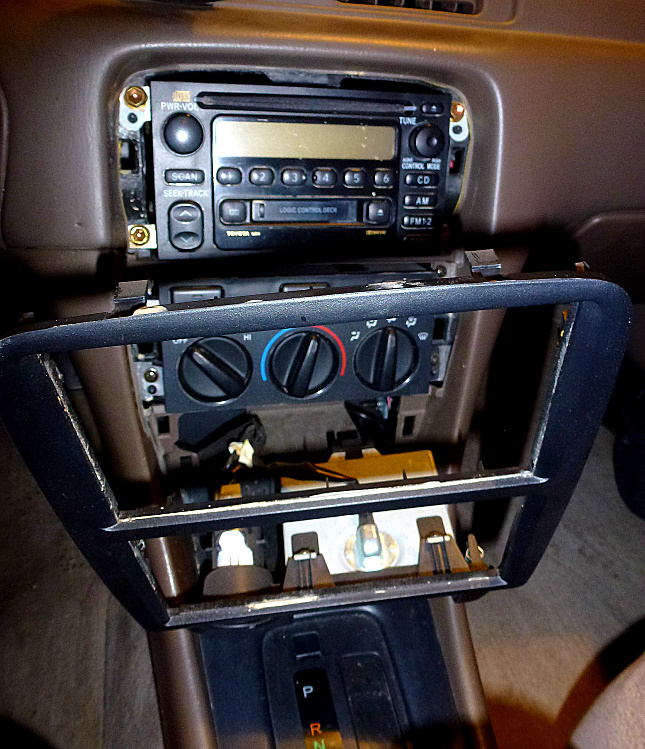
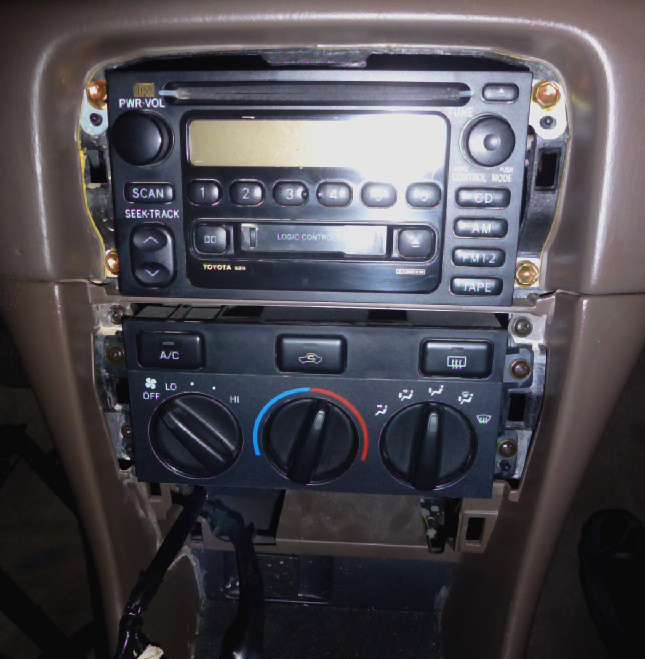
That gave me enough room to start prying away the trim around the center dash console. I removed the ashtray and then pulled gently but firmly on the bottom of the plastic trim to get it started. Then I used a palette knife to pry away around all of the edges of the plastic trim to release it.
Pry off the trim around the stereo
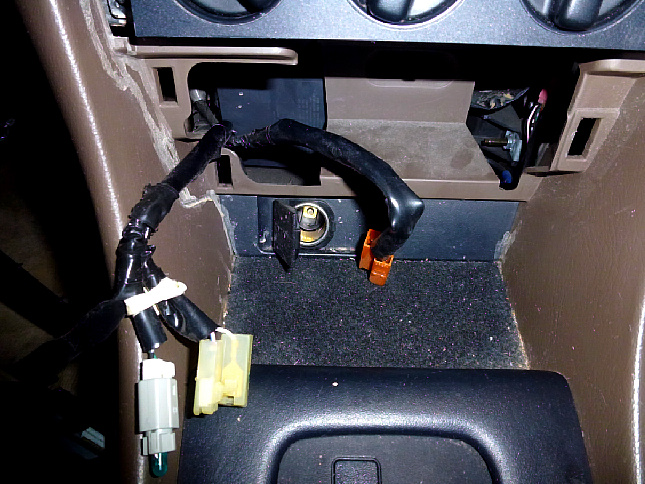
I then disconnected from the trim the bulb over the ashtray compartment, the bulb around the upper cigarette lighter, and pulled the wires off the lighter socket. I could then look down into the compartment at the lower cigarette lighter socket and, sure enough, the plug on its back had fallen off. That explains why it stopped working years ago. It was no surprise that there were muddy streaks exposed which I could clean up too. I cleaned things up and squeezed my thankfully small hand down into the dash and managed to reconnect the lower lighter socket.
The second lighter socket broke years ago – now I know the orange plug came off the back of it
Removing the Stereo and Inserting the Modulator
There are four bronze colored screws bolting the stereo in. I used a number 10 metric socket to take those out.
Use a number 10 socket to remove the four screws holding in the stereo
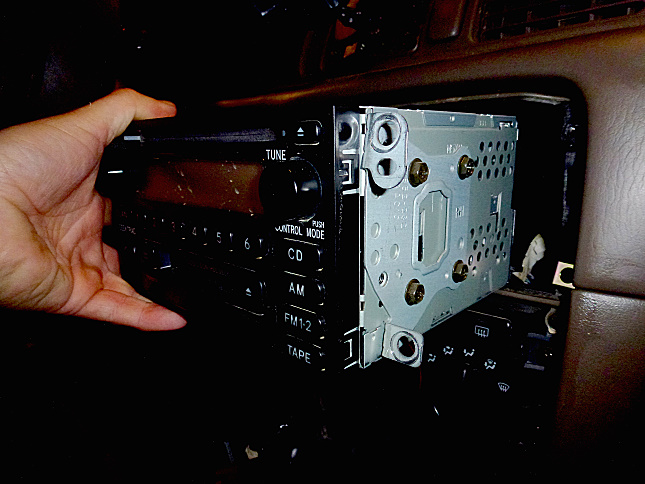
The stereo then slid right out.
Slide out the stereo
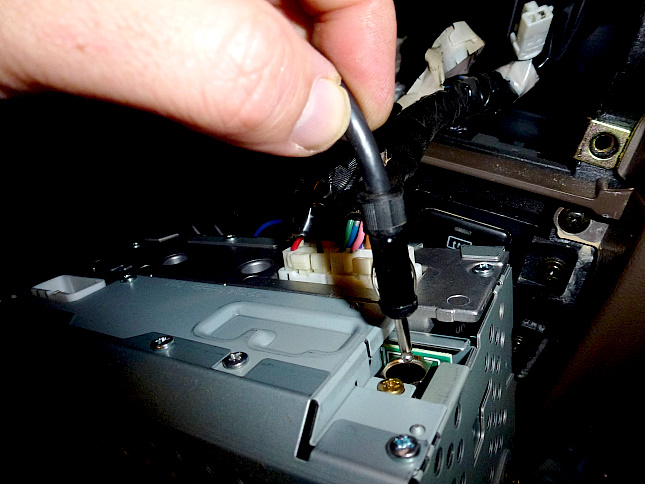
I disconnected the male antenna plug on the back.
Unplug the car’s antenna from the back of the stereo
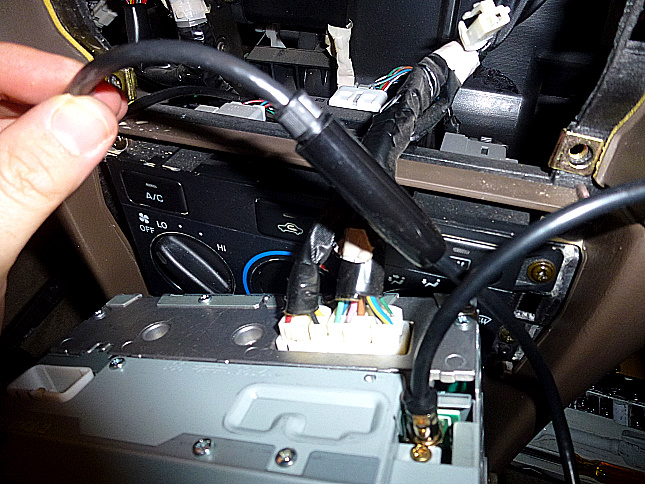
I plugged the car’s antenna wire into the FMM-100 modulator’s matching female cord, and plugged the FMM-100’s own male plug into the back of the stereo. This allows the antenna signal to feed on through but allows the modulator to send its own FM signal directly into the stereo rather than having to transmit a signal through the air to the car’s antenna. The interference from other signals also being received by the antenna is the downside of FM transmitters.
Insert the car antenna into the modulator’s female socket, and the modulator’s male plug into the back of the stereo
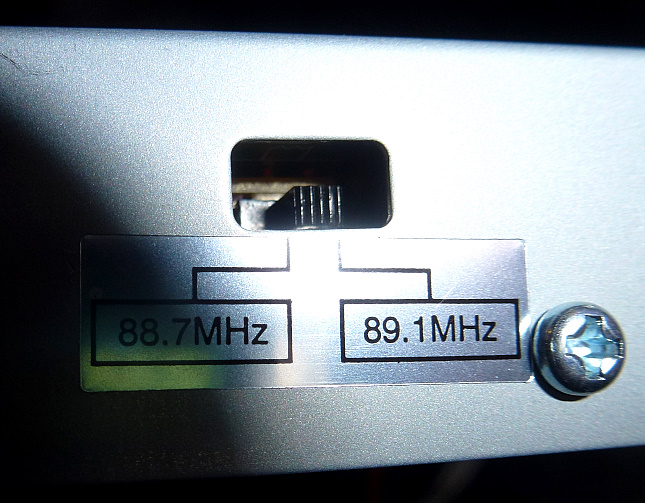
The FMM-100 can transmit its signal at either 88.7 or 89.1 MHz. The one-page instruction sheet said to pick the one with the least interference from area radio stations, which in my case was 89.1.
Set the modulator frequency to the one with less local interference
Connecting the Power
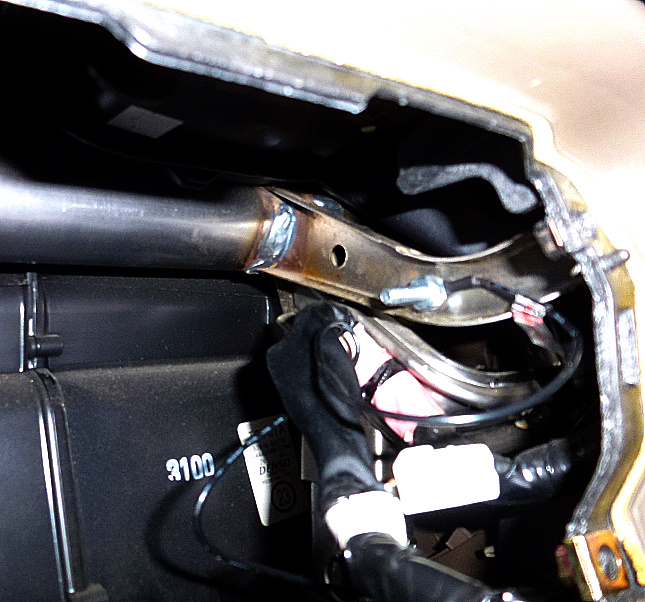
Now it was time to attach the modulator’s grounding wire. One “live” wire on the modulator has to tap into an existing circuit and to complete that circuit you need to attach another wire to ground – that is, to the car’s chassis. I scanned the interior of the dashboard and found a large pipe running the width of the car high up in the dashboard with braces welded to it which had a few convenient holes. So I stuck a bolt through one hole, connected the grounding wire to it, and used a nut to screw it down tight.
Connect the ground wire to the vehicle chassis
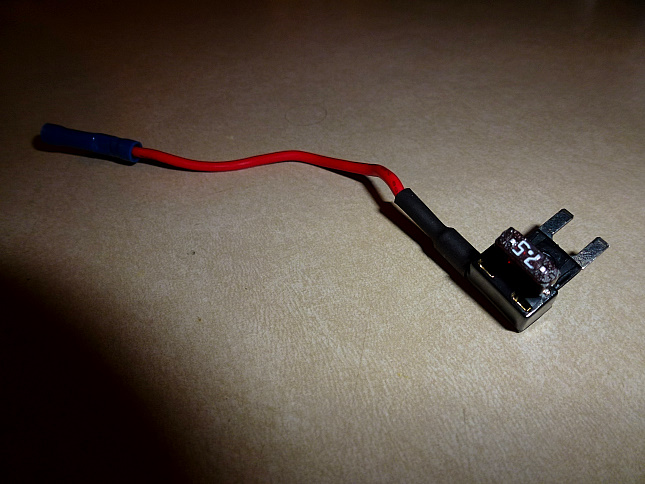
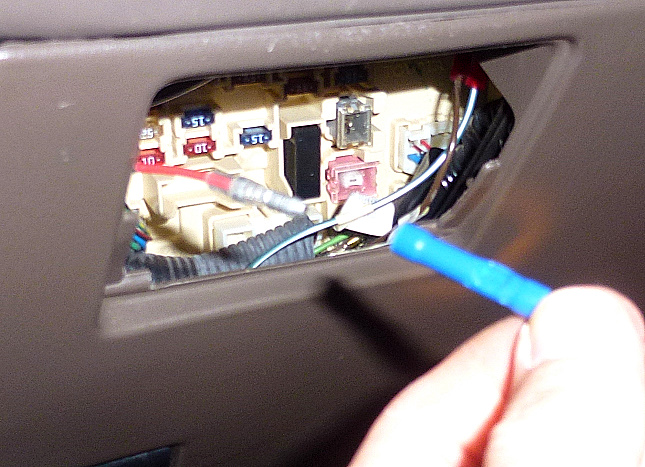
Next I threaded the live wire from the Audiovox box through the dash over to the fuse box where I’d later make the live power connection with the radio fuse connection using a fuse tap I picked up at the local Autozone. It takes the place of the fuse and gives you a live wire for power. I plugged the radio fuse into the tap, but wasn’t paying attention to how I would need to insert a second new fuse for the tap’s live wire. That would cause me some consternation later on.
I used a fuse tap to make it easy to power the modulator with the car’s stereo circuit
Some people like to splice into the nearby cigarette lighter sockets for power, but I wanted to have the box power down like the radio rather than having to manually switch it off to prevent battery drain, and wasn’t sure about the cigarette lighters.
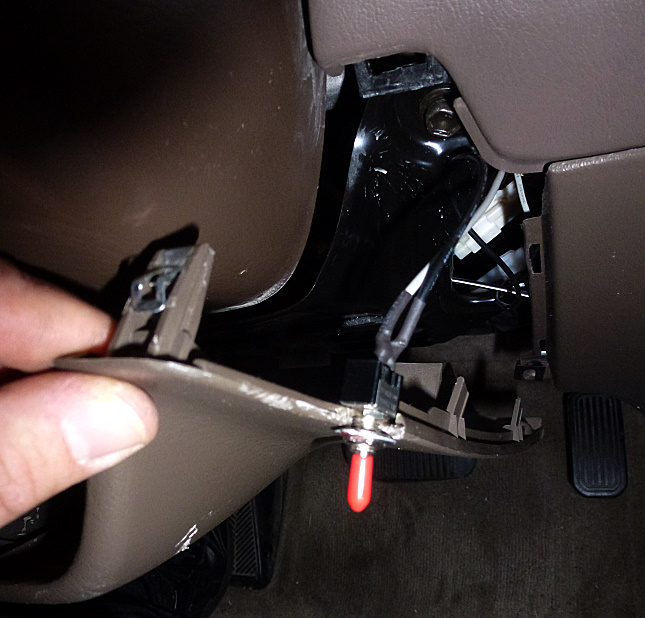
I still needed to install the power switch that came with the Audiovox because to listen to a radio station at 89.1 MHz I’d need to power down the modulator. I threaded the switch on its wire over to the lower dash in the driver well.
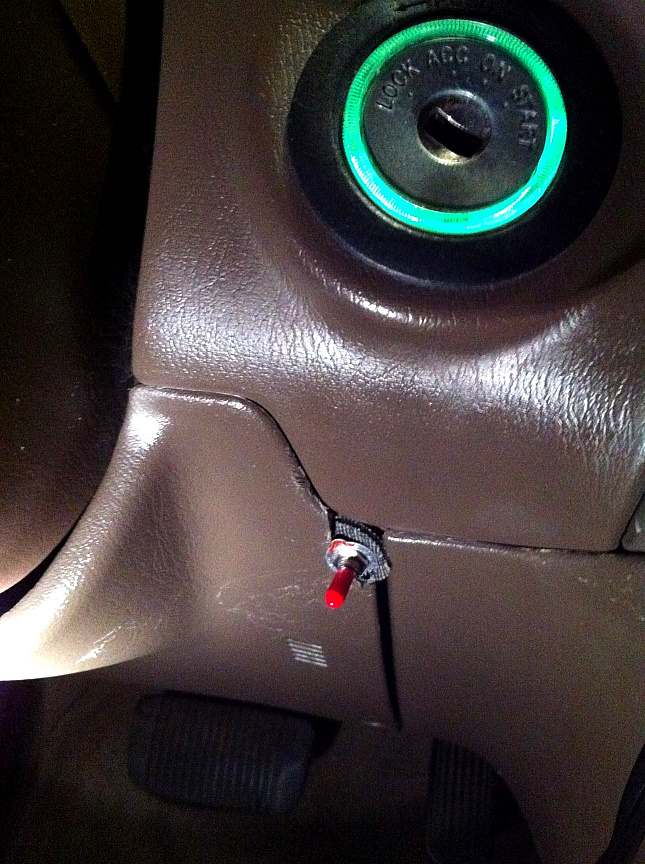
Mount the power switch somewhere on the dashboard; I am not good at drilling, so I used a corner of the driver side lower panel
More skilled workers would drill through the plastic for a nice clean mount, but I knew I’d struggle not to muck that up. So I opted to unscrew the lower panel of the dashboard in the driver well, which had one visible screw near the center console, another hidden behind the hood latch, and a final big screw hidden by a plate just above the floor near the door hinge. I then pried loose the top of the panel and cut off a bit near its top right corner so I could have a gap for the switch. I then used a rubber washer as a backer to help hold everything in place at the junction of several dashboard panels.It doesn’t look great, but it is in an inconspicuous spot yet easy to reach.
Mount the power switch somewhere on the dashboard
That seemingly simple task took me forever, with me fumbling around repeatedly with the big rubber washer, a tiny lock washer, the on/off label plate, outer ring, and dash panel. I finally got it all put together, but I’d exhausted most of my expletives doing so.
As for the live wire, I had hoped that the end of the wire on the Audiovox unit would simply plug into the fuse tap wire, but they were not compatible.
I’d hoped the fuse tap wire would plug into the Audiovox live wire, but they were incompatible
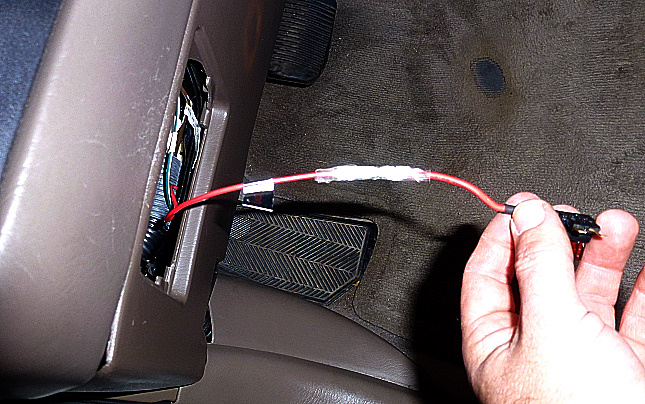
So I cut off the connector on the modulator’s wire, stripped it, and wrapped it around the metal plug on the fuse tap. I left my electrical tape at school, so I used thread seal tape and packing tape. Egad! Many would solder this connection, but my soldering jobs often go astray.
I spliced together the fuse tap wire and modulator’s live wire
I wasn’t ready to plug in for power yet, though. I still had other connections to complete.
The Audio Connection
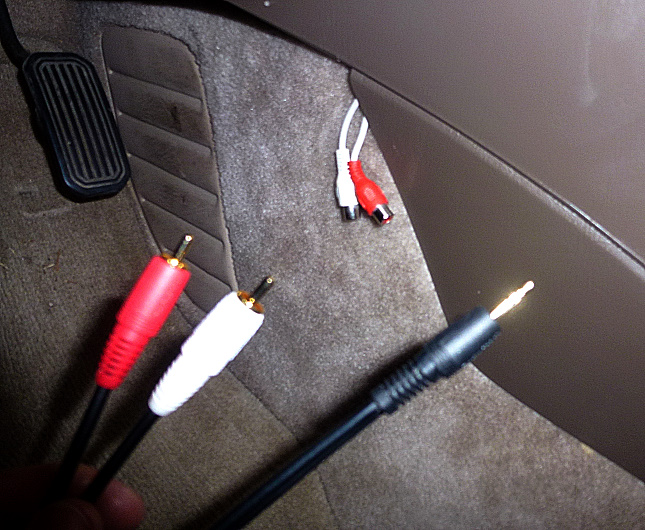
I threaded the modulator’s audio line in cables down through the dash so they would stick out down below. Unfortunately the FMM-100 uses standard RCA stereo audio plugs, so I need an adapter cable to connect it to my iPhone. Radio Shack sells such a cable but it is rather thick and so is the similar but far cheaper cable from monoprice.com, the best online source for low-cost cables. Whenever you need a cable and can wait for it to be shipped, I recommend you use monoprice.com. The above cable is a case in point: 76 cents plus shipping versus $8.99 at the shack.
The FMM-100 uses RCA plugs, so you probably need an adapter cable
I made the connections, but want a thinner cable leading into my iPhone, which I mount on the dash with an Amzer Universal Vent Mount. So I’ll be switching to a short adapter cable and patch cable. I own all of these cables already, having been a technology enthusiast for decades, but the ones I need are at school since I sometimes need them for school-related projects and technology support.
Cleaning Up
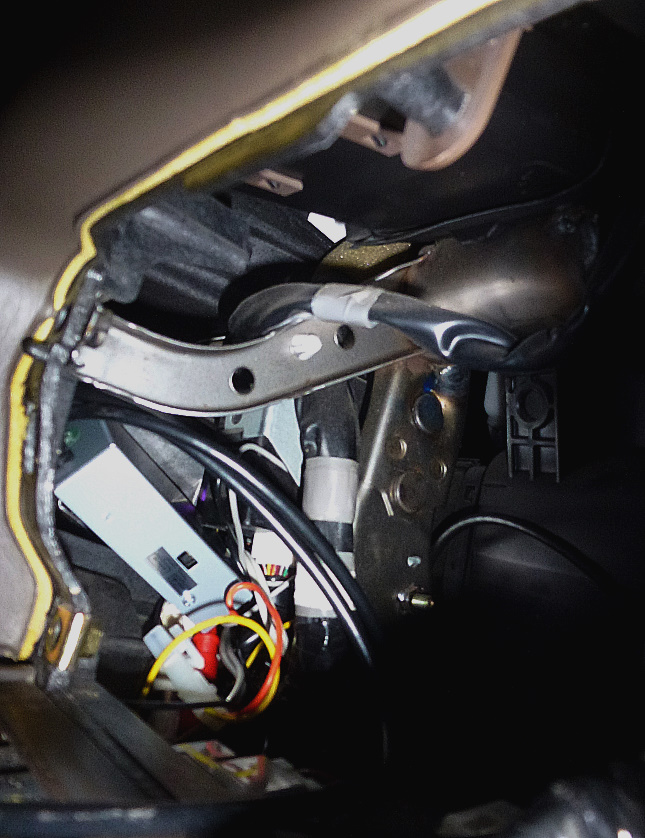
I nestled the Audiovox modulator box down in the crowded dashboard. There are so many wire harnesses that it was stable and wouldn’t rattle about.
Find a spot for the modulator to stay inside the dashboard
I reinstalled the stereo, but I really wanted to get those muddy streaks off the inside of the display. I debated whether or not to risk ruining the stereo by trying to take it apart. I decided to go slow and take a chance.
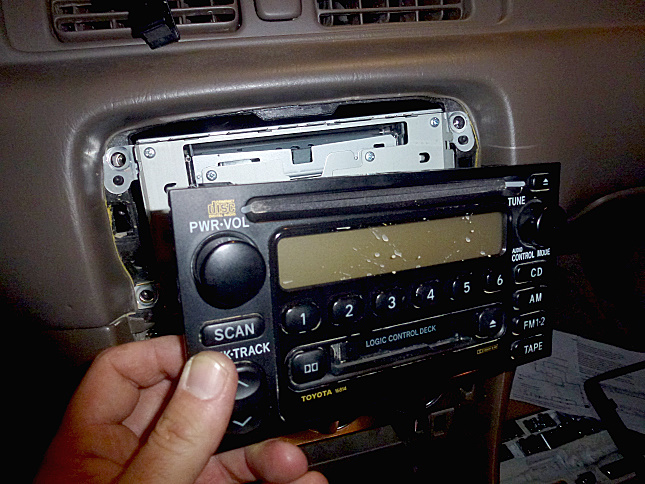
Eager to clean out some muddy streaks, I removed the stereo’s faceplate
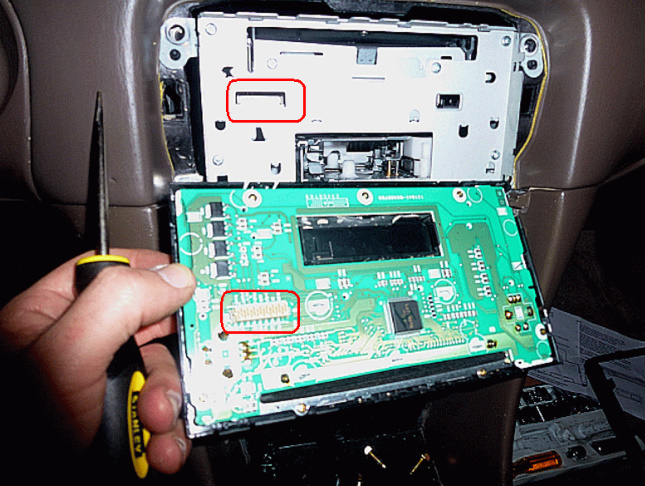
So I used a screwdriver to slowly pry off the faceplate, finding to my relief that it had a single large plug connecting it to the stereo cabinet. The front fascia was connected to the display and main circuit board.
A single plug connects the back side of the faceplate to the stereo box
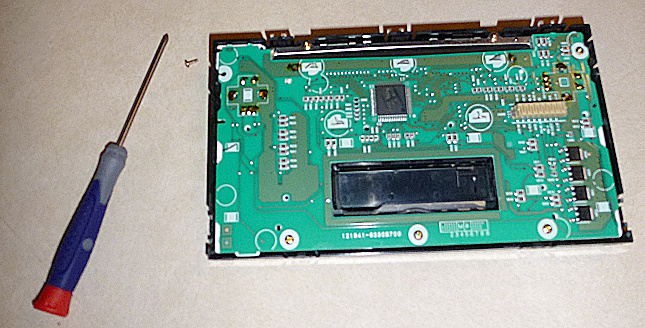
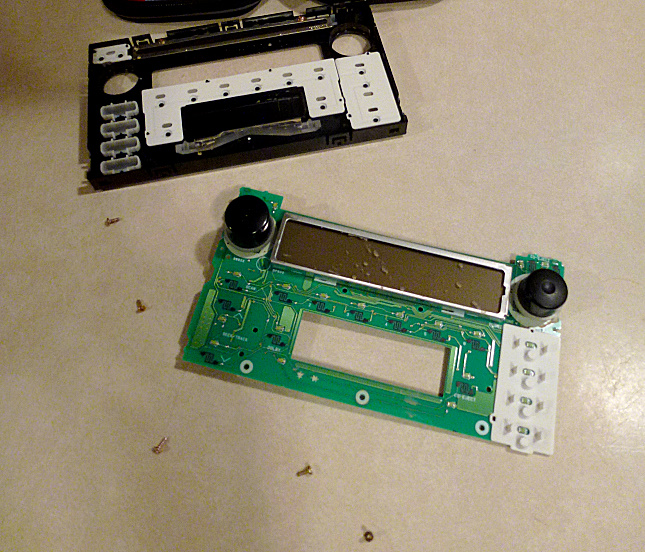
I carried the faceplate into the house for disassembly. A precision screwdriver allowed me to remove five screws holding the circuit board and display to the front fascia.
Five screws connect the circuit board and display to the stereo’s front fascia
I pulled up the circuit board and could then clean the muddy streaks off both the display and the plastic window on the fascia. For seven months I’d had to peer through the mud to see the display; I delighted in introducing the streaks to my friend Windex.
I could finally rid myself of those muddy streaks
I reassembled the stereo, screwed it back into place, reconnected the cigarette lighter socket power and light and the ashtray light, and popped the dashboard trim back into place. Now it was time to apply the power.
Powering Up…Or Not
I slid the fuse tap into place, and those of you who are familiar with the devices will see an error here.
I didn’t realize I needed two fuses in the tap
Unaware of my mistake, I powered on the stereo, hooked up my iPhone, dialed in 89.1, and…heard a distant radio station instead of my phone playing a favorite song. Curses!
I tried the other frequency, hoping I’d just forgotten to switch the modulator, but that made no difference. What could be wrong? Since the stereo worked, I knew the antenna and ground connections were good and the fuse tap was feeding power to the stereo. Maybe the modulator wasn’t receiving any power? The switch was in the ON position, and the label plate is threaded so you can’t accidentally mount it backwards.
So I pulled the fuse tap and examined it, finally noticing that there were holes for a second fuse. Oh, that would make sense. The original fuse should protect the original load and the new load should have its own fuse. I swapped the fuse and reinserted the tap, and sure enough the stereo no longer worked.
Did I have any of those tiny fuses on hand? Of course not, and a survey of the fuse functions on the back of the coin box didn’t show any I could easily sacrifice. So I cleaned everything up and drove to Wal-Mart to get a fuse.
Success!
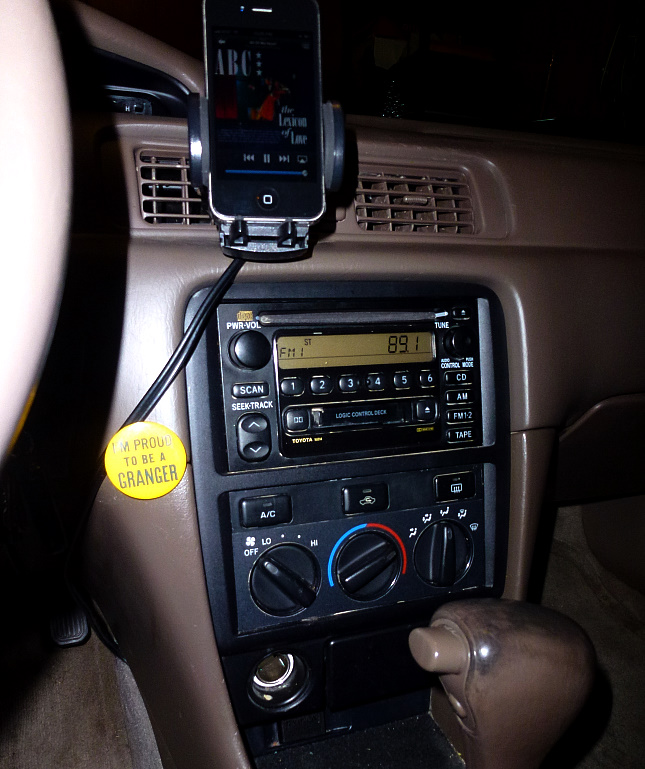
When I returned home I popped in the fuse, inserted the tap, and voilà, crystal clear sound came booming out of the stereo from my iPhone. Good volume, no interference. This project had worked! I tested the power switch and confirmed that it shut down the modulator so I could listen to radio stations at 89.1 MHz if I wanted to.
Now my iPhone plays crystal clear on FM 89.1 whenever I want it to
This was a fun project and I know I will enjoy its benefits for years to come. Not only will I be less distracted and annoyed on my road trips, but I have a cleaner stereo and center console and two working power sockets. Total cost in parts: $40 for the modulator, $8 for the fuse tap, $5 to $10 for adapter cables, $4 for a set of small fuses, a few bucks at most for some tape, a nut and bolt, and a rubber washer. I won’t throw in the $10 for the two lithium batteries I drained in my super-bright flashlight. 😯
$62
Plus labor, but I’m so unskilled that I work for free. That’s much cheaper than a new stereo and I learned some things by doing it all myself. But I had plenty of help from internet posts. The world wide web is pretty wonderful. That’s enough for this post. I’m going to go modulate Mercy, using my iPhone to blast that fantastic song in my car. Crank it up!
UPDATE: I finally traded in my 2001 Camry in August 2014; I had driven it over 236,000 miles. My new 2014.5 Camry XLE has a sound system that automatically connects to my phone using the Bluetooth radio communication protocol. I made sure to leave instructions in my old car on how to use the FM modulator so that the next owner can conveniently connect a smartphone or other music player to the stereo system.
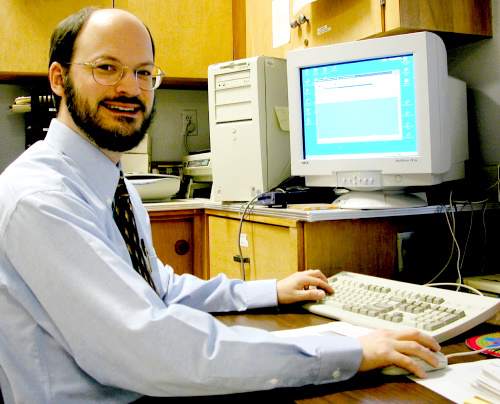
I’ve been providing technology help in our district for many years; this shot was in my old office before the science wing was built in 2003
For friends and colleagues I’ve always been the go-to guy for help with computers. I’ve written many training manuals and tip sheets, and after years of purely volunteer work I’m now paid a minimal annual stipend to help keep computers running and reduce user frustration at the high school. I can quickly grasp software interfaces and glitches, knowing how to find quick solutions via the internet for novel problems. Over the years I’ve installed memory, disk drives, interface cards, motherboards, and more. But in college my attempt to build a circuit to add lowercase letters to my Tandy Color Computer 2 mostly taught me I had no soldering ability.
Despite my mastery of computers, I never thought I’d become Mr. Fix-It when it came to home appliances and cars. Despite many years of piano lessons and decent typing ability, I’m not at all dextrous with tools. Maybe that’s because I’m left-handed and dextrous comes from dexter, Latin for right handed? And Latin’s left is sinistra, which became associated with evil and begat our word sinister. Yes, further bigotry against southpaws like me! But given my clumsiness with hand tools, I never expected to be much of a repairman or do-it-yourselfer.
For years I rented apartments and then a house, so the landlord was responsible for most repairs. I did diagnose and replace a faulty load selector switch in the old Maytag washer my parents had given me, happy to have avoided the cost of a service call. But I have always paid professionals do almost all of the maintenance and repairs to my automobiles. I did install a windshield wiper delay circuit in my first car, a bare-bones 1976 Toyota Corolla, but I paid professionals to upgrade it with air conditioning, a cassette deck stereo, and the like. Over the years I gave up changing the oil in my cars myself and began relying upon neighborhood lubrication shops. And I’ve always had car dealers deal with major maintenance and repairs. Given the high cost of skilled labor, I’m grateful that my 2001 Camry, unlike my four earlier vehicles, is so reliable that it seldom has to go into the shop.
But when I bought my home in 1994, it had its original 1981 appliances. I ordered a new rack for the dishwasher because the old one was rusting out: hardly a challenging fix! The refrigerator’s door seals were filthy and worn out, so I ordered new ones and at least I did have to use a screwdriver to swap those out. Over the years I paid professionals to install a new hot water heater and replace the furnace and air conditioner.
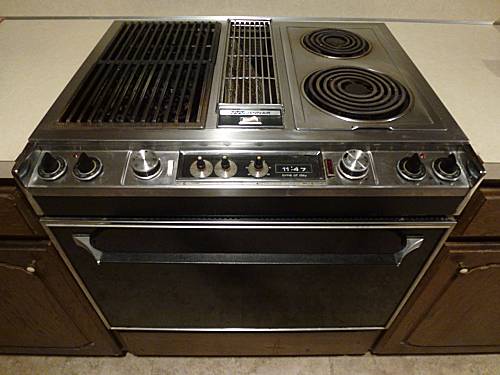
I replaced the thermostat in my Jenn-Air
But in 2007 my Jenn-Air oven had passed the quarter century mark and stopped working. I thought about a new range, but I liked to cook steaks on the broiler, so I concentrated on Jenn-Airs which could use the existing under-floor vent. Wow – I quickly decided I needed to fix it instead!
I was used to checking the internet for help with computers, so why not have it help out with the oven? The diagnosis was a faulty thermostat. I ordered one for $126 from PartSelect.com and was somewhat amazed that I could take apart the oven and get it working again.
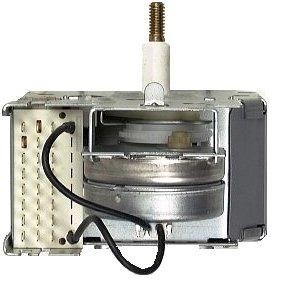
A timer I found on eBay brought my washing machine back to life
That experience didn’t prevent me from calling a repairman a year later when my own 12-year-old Maytag washer began behaving oddly, running its motor at the wrong speed and sometimes stopping in the middle of a cycle. The repairman said it was a bad timer and that model was no longer manufactured, so he couldn’t replace it. Remembering how much I’d saved previously on the oven, I wasn’t about to buy a new washer. So I paid the repairman for his time and as soon as he left I went on eBay and found the timer I needed for $88. When it arrived it was an easy install and I was back in business.
A month later the tile wall above my bathtub began to collapse. The seal was gone and the tile affixed to ordinary drywall rather than greenwall, so rot and mold had set in and undermined the wall all around the tub. The vinyl floor in my kitchen also looked bad and was peeling up, so I asked a couple of contractors for estimates. Their high prices led me to look for an alternate approach.
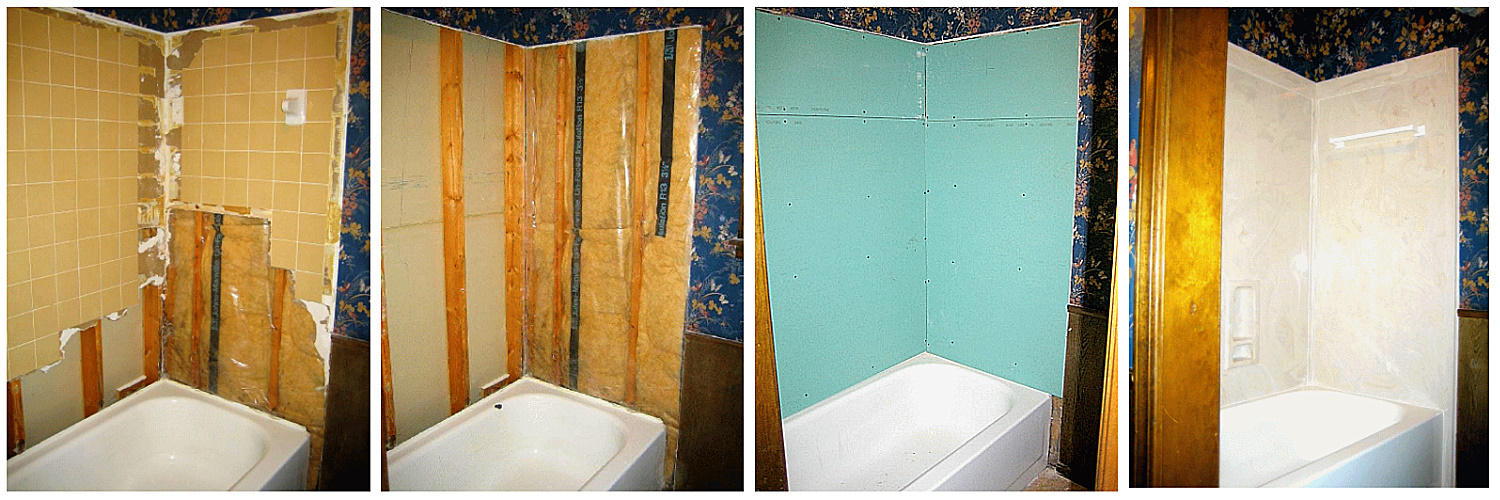
For the bathroom, I opted to hire The Quarry out of Dewey to install beautiful cultured marble panels to replace the tile walls. Cultured marble is a mixture of resin and marble dust. They had me pick out the style I preferred and were very friendly and did a great job, but they did not handle demolition. I’d have to remove the old tile walls myself.
I know my manual dexterity is poor, so I’m leery of power tools. But I bought a small reciprocating saw and went to work, peeling away the rim tiles and pulling out the rotten sections of the wall, then cutting out all of the rest. My only goof was dropping a section on the edge of the tub, chipping the porcelain. A patch kit from Wal-Mart solved that, and the odd bump on the tub is my “sinister reminder” of my own ineptitude! My kindly neighbor, who has since passed away, offered to haul the tile walls to the dump for me in his pickup.
I did the demolition on the walls (and a spot on the tub!) and The Quarry did the installation
Then The Quarry came out, installed greenboard and the marble, and had a plumber come out and install the new fixtures I’d picked up at Lowe’s. I’m delighted with the results. The bathroom looks much better and I just quickly wipe down the smooth walls after each shower and thus never have to clean the walls of mildew, soap scum, or dirt.
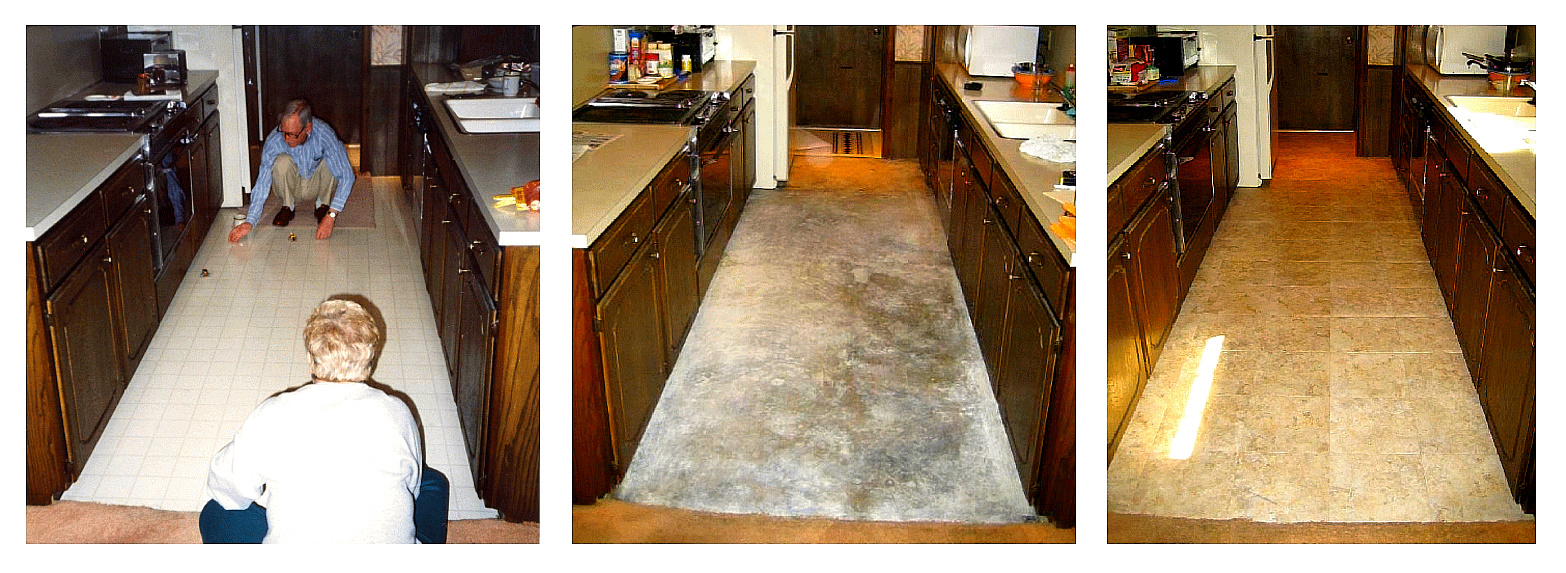
Next was the kitchen floor. I opted to do this entirely by myself. First the old vinyl floor covering had to be removed. The edges were peeling, but when I tried to peel it the rest of the way, it shredded, leaving patches of flooring and lots of glue adhering to the underlying concrete slab. I spent over eight hours slowly scraping away the gunk. I listened to a big chunk of the last Harry Potter book as I worked, cursing Harry and Hermione as they wandered about aimlessly after Ron deserted them. I knew what I’d be doing if I were them, and it wouldn’t be moping around about Ginger!
My parents race cars on the kitchen’s sheet vinyl floor in 1994; 14 years later I removed it and installed self-stick vinyl tiles
I finally got the gunk cleared away and began laying down self-stick Italia Stone vinyl tiles I’d purchased at Lowe’s. They went down fast until I reached the edges of my galley kitchen and had to start trimming them to fit. It was painstaking work to wrap them around the doorway into and throughout my small utility room. But the end product looked nice and saved me a fortune. Four years later the tiles still look nice, although there has been some shrinkage or shifting along one or two lines which someday I need to deal with.
My programmable thermostat
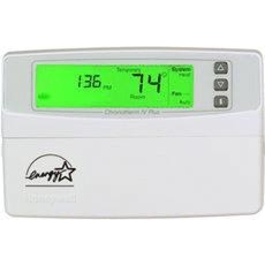
Three weeks ago I came home from work one afternoon to a chilly house. At first I thought the batteries in my programmable Honeywell thermostat must have failed; that replacement of the old standard thermostat was an easy 2001 project. After I installed it my average annual usage of natural gas dropped 32% and my electricity usage dropped by 6% because if I’m at work the system resets to 85 degrees in the warm months and 60 degrees in the cool ones, bringing things back to normal before I return home. On summer nights it lets the temperature warm to 78 degrees, while winter nights chill down to 65 degrees with me snug under my electric blanket.
I save less in the summer, and thus save much more on natural gas, since being a teacher I’m at home during the day in the hottest months. But I do save on utilities, if not travel costs, when I go on long summer vacations. Former student Ben Stallings wrote a nice article on utility bill analysis, although I’ll confess that I just averaged my annual usage over multiple years for my quick calculations.
But late in January the house had not been warmed up for me by the time I arrived home. My thermostat seemed fine and would trigger the fan, but there wasn’t any heat. I went ahead and swapped the batteries, but that made no difference. So I opened up the furnace, which I’d had installed six years earlier, and was naturally out of warranty. I saw a red light blinking. Oh dear. I changed out the air filter in case that might help, but no go. I then noticed that the red light was blinking in a pattern of four flashes. I grew up with furnaces that had no alert lights at all, so it hadn’t occurred to me that the furnace might be telling me what was wrong.
I dug out the manual and discovered that the High Pressure Limit Switch was acting up. The internet told me what to check and I verified that there was no good reason for it to be unhappy. So I studied the wiring diagram for the furnace controls. Perhaps I could jumper that sensor out before nightfall? It was growing quite cold in the house, so I stopped and loaded up the fireplace with wood for the first time in over a year and started a big fire. I could sleep by the fireside if I had to, but for now I’d try to jury-rig the furnace.
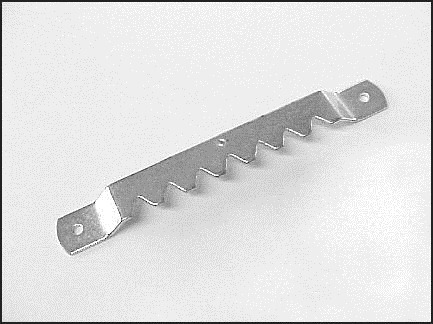
I jury-rigged around a bad furnace switch
I eventually found the correct wires to and from the switch, unplugged the furnace, pulled off the jumpers, and found that a sawtooth picture hanger fit them perfectly. I plugged each jumper onto my hanger and turned the furnace back on. I grinned when the second fan motor in my 80% efficient furnace kicked on for the first time that evening and whooped when the burners ignited. I felt like Scotty, rigging the engines for Captain Kirk.
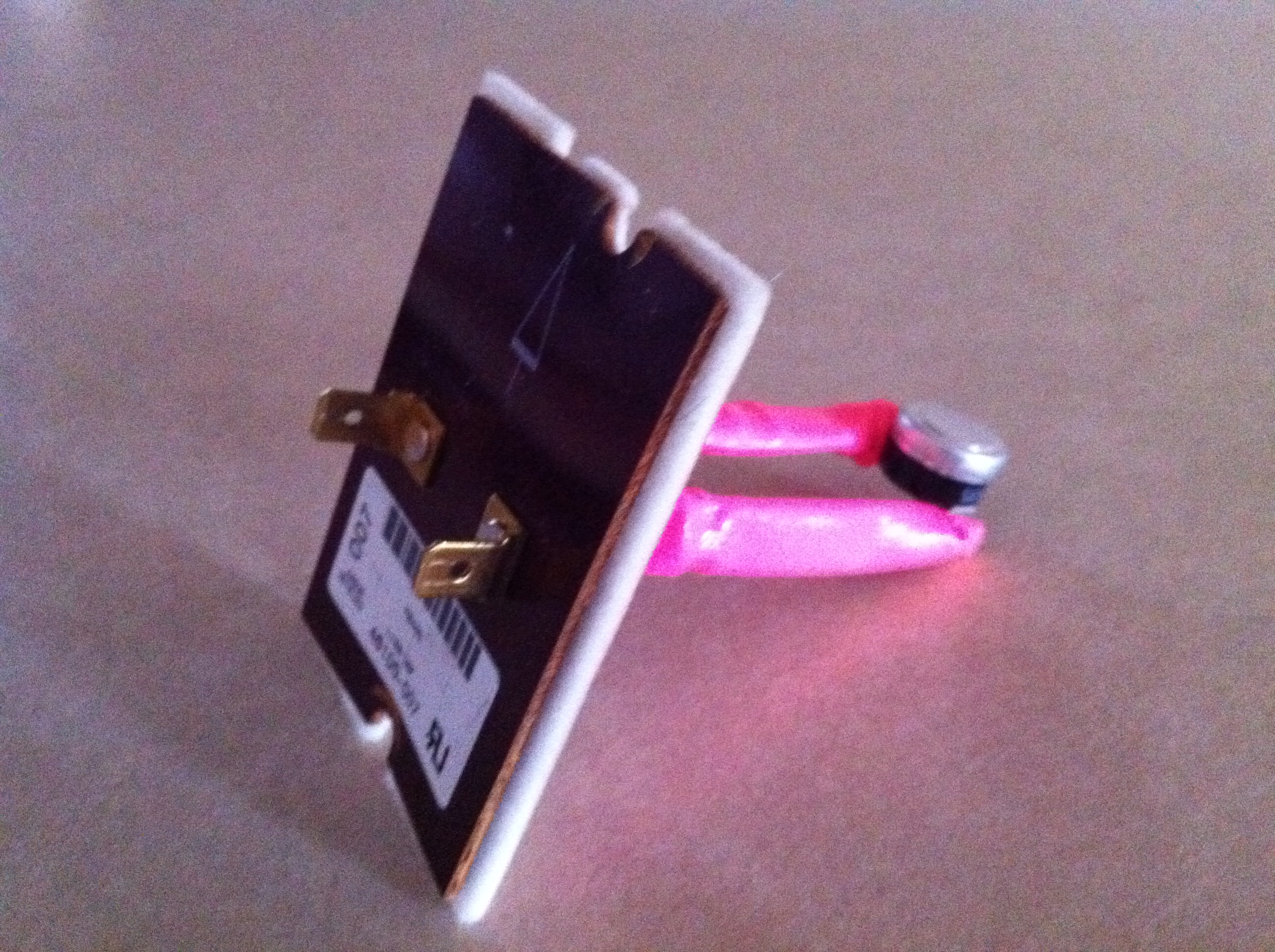
I installed a new high limit switch in my home furnace
I started shutting down the fireplace and then went back out into the garage and pulled the bad switch. It looked fine, but who can tell? I used the part number on it to locate a replacement which I ordered for $32 from New Jersey. The part arrived less than a week later, I swapped the new switch in and hooked it up, and the furnace is working just fine.
My repeated success at these little projects inspired me, despite my dexterity shortcomings, to contemplate a big project for me: ridding myself of the annoying FM transmitter I had to use to listen to my iPhone in the car. Back in 2001 when my car was new, a CD player and cassette deck were state of the art.
When I bought my first 40 GB hard drive iPod for $500 in 2004 (how times have changed), I started using a cassette adapter to connect it to the car’s stereo. But over the years the deck gearing had gotten too noisy and I’d struggled with several FM transmitters until I found a decent one, but even then on my trips I’d repeatedly run into interference from new radio stations and have to struggle to find a clear channel and resynchronize the transmitter and the car’s FM radio to it. Could the internet help me solve this long-standing problem? Yep! Click here to view that car improvement project.
For 2012 I’m going to pick a favorite new song each month to share: my favorite discovery of the preceding month, be it old or new and no matter what genre it occupies. At 45 I’m hardly the youth I was in high school and college, aware of all of the top hits, even the ones I despised. Now I have no earthly idea of what is popular since I no longer have music television or bearable radio stations to inform me.
Modern technology could come to my rescue if I were into Pandora or Spotify or other streaming music services. But the over ten thousand songs in my iTunes collection keep me satiated so that I have to actively decide to seek out something novel.
Regrets collect like old friends
Here to relive your darkest moments
I can see no way, I can see no way
And all of the ghouls come out to play
And every demon wants his pound of flesh
But I like to keep some things to myself
I like to keep my issues drawn
It’s always darkest before the dawn
And I’ve been a fool and I’ve been blind
I can never leave the past behind
I can see no way, I can see no way
I’m always dragging that horse around
And our love is pastured such a mournful sound
Tonight I’m gonna bury that horse in the ground
So I like to keep my issues drawn
But it’s always darkest before the dawn
Shake it out, shake it out, shake it out, shake it out, ooh woaaah
Shake it out, shake it out, shake it out, shake it out, ooh woaaaah
And it’s hard to dance with a devil on your back
So shake him off, oh woah
I am done with my graceless heart
So tonight I’m gonna cut it out and then restart
Cause I like to keep my issues drawn
It’s always darkest before the dawn
Shake it out, shake it out, shake it out, shake it out, ooh woaaah
Shake it out, shake it out, shake it out, shake it out, ooh woaaah
And it’s hard to dance with a devil on your back
So shake him off, oh woah
And it’s hard to dance with a devil on your back so shake him off
And given half the chance would I take any of it back
It’s a fine romance but its left me so undone
It’s always darkest before the dawn
Oh woah, oh woah…
And I’m damned if I do and I’m damned if I don’t
So here’s to drinks in the dark at the end of my road
And I’m ready to suffer and I’m ready to hope
It’s a shot in the dark and right at my throat
Cause looking for heaven, found the devil in me
Looking for heaven, found the devil in me
Well what the hell I’m gonna let it happen to me
Shake it out, shake it out, shake it out, shake it out, ooh woaaah
Shake it out, shake it out, shake it out, shake it out, ooh woaaah
And it’s hard to dance with a devil on your back
So shake him off, oh woah
Shake it out, shake it out, shake it out, shake it out, ooh woaaah
Shake it out, shake it out, shake it out, shake it out, ooh woaaah
And it’s hard to dance with a devil on your back
So shake him off, oh woah
I spent most of January 2012 fighting sinusitis, unable to take advantage of unseasonably warm weather for day hikes. Finally, four weeks after my previous day hike on New Year’s Eve, I had recovered sufficiently to contemplate hiking on the final weekend of the month, which again arrived weirdly warm, reaching the upper 50s on Sunday.
I knew I didn’t want to travel too far, yet I hoped for something novel. A perusal of the map showed I’d exhausted most of the nearby opportunities in Oklahoma. So I scrolled the map north into Kansas. Many months ago the husband of my friend and coworker Betty Henderson had mentioned there were trails at Big Hill Lake near Cherryvale, and I settled on them.
I spent Saturday doing laundry and reading a thin volume Betty had given me: The Benders: Keepers of the Devil’s Inn. It told the particulars of a group of four serial killers, an older couple and a younger couple, who set up a one-room Hell House on the Prairie near Cherryvale in the early 1870s and set about doing away with passersby on the Osage Trail linking Independence and Fort Scott. They evidently murdered 17 people over three years, mostly by hammering in their skulls and slitting their throats. They successfully fled the scene before locals caught on and were never held accountable. The house was dismembered by souvenir hunters, but their hammers are in the Cherryvale Museum and almost all of their victims are buried at Benders Mounds just north of Big Hill Lake.
I wouldn’t be driving by those mounds, but instead focused on the Ruth Nixon hiking trail located five miles south of them along the west shore of the lake near the dam. There is also a 17-mile bridle trail around the north end of the lake, but I couldn’t find any online trail maps, just a biking trail site saying the bridle trail is shaped like an H with the cross-segment along a gravel road across the lake called Rea Bridge. So I wasn’t sure if I could reach the bridle trail from the Nixon trail or not.
I arrived at the dam overlook at 10:15 a.m. and followed the signs to Pearson-Skubitz Big Hill Lake. Only a government bureaucrat could think of such a terrible name. Everyone really just calls it Big Hill Lake after the Osage Indian leader Pa-In-No-Pa-She (Not Afraid of Longhairs), or Big Hill Joe as he was known by whites. The band of Osage Indians he once led lived in a village a few miles to the northwest before their land was purchased/stolen and they were shifted south into Oklahoma in 1872. I have no idea who Pearson or Skubitz were; Public Law 95-625 gave the lake that terrible prefix without bothering to say why.
It turns out my camera was not focusing properly for the first part of my hike. I suppose it is as out of practice as I am after weeks of convalescence. So my shots of the arched observation platform and panorama from it had to be sharpened in Photoshop. I located the south trailhead for the Ruth Nixon Trail nearby, with a nice big trail map sign revealing that the trail hugged the shoreline northward to one of the parking areas for the bridle trail. So I could extend the roughly one-mile trail from there.
I was immediately greeted by a broken-down bridgelet and the discovery that the trail area had been burned over. So it is no great tragedy that my camera was on the blink and I can only offer post-sharpened images of the denuded surroundings and a burned-down tree. I trudged northward to where the lake has not been cleared for boats and finally reached a long fishing berm where the trail came to an end. I located the bridle trail parking area, where I was told the trail was closed from 10/30-12/11 and 1/1-1/8 during the firearm deer seasons. I was well out of that, so I continued northward some distance from the lake on the blue-blazed horse trail.
The trail followed the fence line long enough to worry me that it would not be worthwhile, but then turned toward the lake. Along here I spooked a group of five deer a couple of times, seeing their white tails rapidly bobbing away.
I’d not used the many benches along the Nixon trail and wondered where I’d sit down for lunch, but then right about noon I found a sawed stump where I could sit down and eat. After continuing northward only a bit more, I began hearing many nearby gunshots. They were close enough to be unnerving and I donned my orange cap and vest and reversed course back to the trailhead, finding an alternate route to avoid most of the fenceline section. I hope those shooters were having better luck than I: hours later, when I downloaded what I had in my camera, all I found was a blurry mess.
I’d hiked 7.75 miles but it wasn’t even 2 p.m. yet. Based on the poor winter scenery and gunshots I had no interest in hiking other parts of the trail system, but I had read about a new trail system being constructed just north of Parsons at Tolen Creek at the junction of highways 59 and 400. So that would be next.
I drove half an hour over to Parsons, pausing to look at the doughboy at the courthouse and then found the unmarked turnoff for the Tolen Creek Trails. This area is under development, with wide gravel trails and associated bridges under construction. It is currently somewhat unprepossessing and afflicted with highway noise, but once the trails are finished and more grass is planted it will make for a fairly pleasant two-mile walking loop excepting the noisy aural environment.
I liked how they had curbed the trail around the big fishing pond with rough rocks; I don’t know if they plan to line the entire trail that way, but it would make it look nicer. A new bridge with a bowed rail plank led across the creek to the unfinished east part of the property, which wound around to two more large bridges where I encountered some fellow walkers.
So I headed home, stopping off in Independence for a refreshing dipped cone at the Dairy Queen. When I arrived home I could tell I was out of shape from my month without any hikes and collapsed for a short nap. I quickly recovered, however, and was ready to edit photos and compose the blog post. I’m rather disappointed that my camera, which up to now had been a strong performer, is having focusing issues. Most of my later shots at Tolen Creek were fine, but a few showed the same lousy focus which plagued all of the shots at Big Hill Lake. It may be time for a new camera. If I do invest in one, I’ll steer away from a Panasonic Lumix this time, although I’ll insist on another pocketable one with superzoom and built-in GPS.












 Meador Manor
