
Here’s why I’m replacing my iPhone 3G this summer, especially since the 3G lacks the feature set of the 3GS!

Here’s why I’m replacing my iPhone 3G this summer, especially since the 3G lacks the feature set of the 3GS!

The Buffalo River (click image for slideshow)
I awoke Sunday at 6:30 am to a car horn pealing out, over and over again, somewhere in the parking lots at the Ozark Folk Center cabins. Someone had bungled their car alarm, I suppose, and I had to grin when I heard them driving off with the horn still bleating. Perhaps it was car thieves, but more likely some befuddled guests. That set me to work uploading the rest of Saturday’s photos and videos – tedious work since the WiFi was being quite dodgy and required frequent resets.
But I finally got everything posted and could then march up the road once again to the Skillet restaurant high on the hill. On the way in, I met Joan and Frank, an elderly couple from San Diego. They invited me to join them for breakfast and they told me of their love for elderhostels, their volunteer work back in Chula Vista (the suburb where they live), and Joan wondered if she would enjoy the collard greens they were promised as part of their current elderhostel trip, which had led them to drive over 1700 miles from Chula Vista to Mountain View, Arkansas.
I was glad for the company and grateful to them for pointing out a hidden trail that led down through the woods back to the cabins. It was too steep and uneven for them, but I happily used it to avoid walking in a concrete culvert and alongside the shoulderless asphalt roads. It was my first, and by far my easiest, hike of the day.
I then packed up and drove to Tyler Bend, the site of the Buffalo National Scenic River Visitor Center (BNSRVC to its friends?) and a 4.2 mile loop trail. I parked at a trailhead away from the visitor center at about 11:45 am. My feet ached after hiking ten miles the day before in tennis shoes, so I was glad that my hiking boots were dried out and serviceable. Even though the temperature would be in the 90s all afternoon, I wore long hiking pants since I figured some of the trail might be overgrown. And I sprayed 100% Deet around all of the openings in my clothing, hoping to keep the ticks at bay – I still found myself the victim of four ticks at the end of the day. I guess I’m just ticklish, not tickless.
The trail began as part of the Buffalo River Trail, which extends for dozens of miles along the river and will eventually span its entire length. The first stop was the Collier Homestead, constructed in 1928 by subsistence farmer and river guide Sod Collier, who lived here without electricity or indoor plumbing. After a half century, the property was purchased by the National Park Service for preservation and the Visitor Center a mile or two away was built in 1990. The house had several rooms of poor construction, with remnants of newspapers on the walls, once used for insulation. Sod and his family must have been pretty short. I had to duck under the porch overhang and the ceilings were only inches above my head, and I’m only 5′ 8″. The structure looked sturdier, if less picturesque, from the rear. There was a shed out front by a huge tree and the trail ran past another building behind the house. I can’t imagine living in such a place, especially with the heat, humidity, and bugs that plague the area…I don’t even want to camp out under these conditions.
The trail ran along a ridge circling a deep hollow, approaching the Buffalo River far below. The trees were cut away to provide a splendid panorama of the mountains, forest, fields, and river below. A bird of prey even flew by while a group floated in the river below, creating a postcard moment. My telephoto lens revealed it was an inflatable boat carrying three couples. It also revealed plowed fields and hay bales with the gorgeous river and its bluffs in the forested background.
The trail turned to follow the river and descended to another viewpoint, where I could see canoes on the shore. I used my superzoom camera to shoot a video of a couple navigating the river far below in their canoe, starting in close on them as they paddled toward me, and later pulling back out to show what it really looked like from my high vantage point.
A bit farther down the trail another vantage point had a bluff-hugging tree in the foreground, and a final viewpoint allowed me to look downstream. The trail dove down into a hollow and while the full sun streaming down on this part left me drenched in sweat, it also revealed many of the little creatures enjoying the wildflowers. My little guide couldn’t help me identify one blue flower with a long white stamen, nor a another blue one sporting a tiny bug. I couldn’t miss a yellow moth that looked like chevron patch in the bushes and spotted a little fellow atop an oxeye daisy, a long-winged blue-bodied fellow, as well as a tiny lizard. Some dragonflies, a rabbit, and a deer wouldn’t hold still for photos, however.
When I reached the visitor center, I was welcomed by a blast of cold air. It was delightful and helped compensate for my disappointment that all they had on offer for refreshment was a water fountain. Oh, how nice some ice cream would have been at that moment. The displays were of mild interest and it wasn’t long before I was back outside on a big back deck, snacking on some trail mix on a shady bench. After another visit inside for the cold air and water, I was ready to finish the hike.
The next segment of trail was the Rock Wall Trail, named for an old moss-covered boundary wall erected by settlers years ago. It ranged from knee to waist height and the trail was not nearly as well maintained as the one from the Collier Homestead to the Visitor Center. While the trail was easily discernable, the overgrowth left me grateful for my long pants. I saw butterflies alighting on leaves and purple coneflowers as I struggled up the rugged hillsides in the heat. Finally the trail made a lovely gentle curve around a hollow as I approached the trailhead.
And that concluded my final day hike of this trip, 4.2 miles in 90-degree weather with plenty of bugs and humidity. A far cry from the Pacific Northwest, where I prefer to hike in summer, but I handled the heat well and can still bear up as I approach my 44th birthday. The return trip was almost a straight shot along US 412 to Tulsa for a big dinner at El Chico and then back to Bartlesville to unpack, do some laundry, and prepare this final post from my five days of Arkansas day hikes. Here’s my updated map showing where I’ve performed day hikes since September 2009.
Click here for a slideshow from this day hike or click here for individual slides
<– Previous day hike: Rush and Buffalo Point

Rush, a ghost town (click image for slideshow)
Once I was out of bed on Saturday I checked to confirm that my videos from Friday had finished uploading to YouTube while I slept, so I could insert them in the blog post and publish it. Then I prepared for the day and headed up the hill to the Skillet restaurant for the breakfast bar. I knew I should have a hearty breakfast since my day hikes would leave me with lunch on the trail. Then I headed out toward the ghost town of Rush, Arkansas.
My route wound through the mountains for fifty miles, eventually leading me down the steep grade to the Buffalo River and back up the other side to the Rush Historic District turnoff. A few miles off the main drag, the road descended steeply toward Rush Creek and the Buffalo River, converting to gravel as it descended. As soon as I reached the bottom I made a sharp right and saw the shells of houses and buildings which were abandoned decades ago.
Rush began with a failed silver smelter in 1886 and then a series of zinc mines which boomed in the 1890s and peaked during World War I. The mines failed in the Great Depression and the last of the town’s structures closed in the 1960s. A trail winds past many of the ruins and then up the mountain past the sealed mine entrances and down to the Buffalo River and neighboring Clabber Creek.
It was a sunny, humid, and hot day. So I took along extra water and wore plenty of sunscreen and bug repellent. Unfortunately my hiking boots were still drying out, so I had to rely on my tennis shoes. I hiked the Rush trail in shorts, a decision I would later regret.
The first stop was a large stone smelter, the oldest structure in the ghost town. Three prospectors built it in 1886 because they thought they had found silver ore, and were so disappointed and broke when no silver appeared that they tried to sell the smelter to another prospector for a tin of oysters…and he turned them down. It was finally sold to later zinc miners and used to burn lime for mortar in 1898.
The smelter is on the site of the Morning Star zinc mine, which operated a general store visible across Rush Creek and the road. That store was the last center of the community until it finally closed in 1956. The ruin next door was the store owner’s home. Next was a blacksmith shop, built in 1925 when the Morning Star mine had a brief revival. It closed in 1931.
I then climbed the steep hillside up to the sealed entrance of the Morning Star Mine. A whole series of mines runs southeast along the mountainside toward the Buffalo River. They were all sealed after mine inspectors reported in 1984 that they had large, loose ceiling rocks, deep pits, water-filled pits, and several tunnels showing signs of recent cave-ins. I recognized the same sort of metal bars as were used to seal up Onyx Cave up north on the Sugar Camp Scenic Byway up in Missouri.
Along the trail I found a butterfly that was intensely focused on the orange blossoms of a large weed, sufficiently intent that it let me take several shots, even returning to the weed if I got too close. Later I found the plant is aptly named Butterfly Weed!
The trail passed by an old mining car and the heat was really bearing down as the trail crossed tailings piles. It was hard to believe that in 1982 a record flood of the Buffalo River brought it all the way up here, several stories above Rush Creek and over a half-a-mile inland from the river’s channel. This week the Caddo and Little Missouri rivers in Arkansas’ Ouachita Forest rose 20 feet overnight, killing at least 20 campers at the Albert Pike and other campgrounds, so I suppose the Buffalo River’s power should not be underestimated. But today the Buffalo was in its banks, and pickups carrying canoes and tubes kept buzzing by far down below, on their way to and from the popular Rush Landing, which I was approaching from on high.
The trail finally reached the end of the mountain and I took a side trail down to Rush Landing. Three dozen vehicles were parked there and at the landing itself three motorized launches were, well, launching and a couple of canoes were being paddled into shore. I stood by the shore and watched the green water roll by and then headed back uphill toward a shelter.
It was almost noon and I was getting hungry, but a semi-nude couple were occupying the shelter: a slim girl in a bikini and a big fellow in trunks. Despite the intensifying heat, I decided to leave them undisturbed and just have lunch somewhere out on the trail. So I clambered back up the mountain and headed onward to rise out of the Rush Creek watershed and enter the Clabber Creek one to the north.
The trail ran high above the south bank of Clabber Creek, eventually joining an old wagon road, which petered out at the Monte Cristo mine, which was reopened in the 1960s and then abandoned yet again. A large engine was rusting away along the bluff there, reminding me of the ones littering the abandoned oil fields in the Caney River floodplain around Bartlesville.
I had come 2.3 miles along the Rush Trail, with an unmaintained section ahead that ran back over the mountain’s crest to Rush. In my attire that was out of the question and the heat and humidity were pounding away. So I backtracked on the wagon road, activating my GPS and playing an audiobook for the first time that day on the trail.
I was approaching the climax of The Subtle Knife and was sufficiently distracted that I missed the trail turnoff up the mountainside. I blindly kept marching down that wagon road as it descended toward Clabber Creek, only halting when I was startled to see some abandoned buildings ahead. I couldn’t be back at Rush, so what was this? Looking about I realized I had reached some abandoned settlement on the banks of Clabber Creek. Perhaps this was the remains of the 1960s mining operations, as some building clearly were for missing machinery and the structures were in sad shape but far newer than what one sees in Rush.
My mistake was fortuitous, because I could easily reach Clabber Creek, which has hollowed out part of the bluff above a small creekbed waterfall. This cool and shady spot was perfect for my luncheon of trail mix and Gatorade. I entertained myself by offering seeds to tiny fish in the creek.
Refreshed, I headed back to Rush. It was around 90 degrees when I arrived back at the car after a hike of about five miles. I cranked the air conditioning and cooled off during the brief drive to Buffalo River State Park, where I would be hiking more two trail loops. My legs had several cuts from the Rush trail and I discovered three ticks had ignored the Deet I had applied.
So when I arrived at the Buffalo Point trailheads, despite the heat I changed back into the stinky long hiking pants I’d soaked on yesterday’s hike. I renewed the sunscreen and Deet, put three pints of water in my pack, and headed out for the most wearying hike of the trip thus far.
I felt like I was melting as I headed down the first loop to a viewpoint above the Buffalo River. But I did get a nice view of the campground downstream, spying a number of folks enjoying the water. This viewpoint reminded me of when I was high above the river at Broken Bow last year and a kayaker down below hollered up at me. The wildflowers along the trailside seemed to think the sunshine was A-OK, while I was grateful when the trail entered a part of the forest with tall trees.
After surviving that 1.2 mile loop, I was ready to tackle the 3.2 mile Indian Rockhouse one, which promised a variety of features I could enjoy in my dazed delirium. The “ice house sinkhole” is supposed to spew out cool air from the caverns below, and I struggled a few feet down its steep slope, having to hang onto a tree to spot its bottom. It wasn’t worth photographing, and I could barely feel a touch of cool air.
But I did cool off briefly after the trail passed a much smaller sinkhole and then ran below a small waterfall near Panther Creek, where a bluff was heavily eroded. Soon I saw a gash cut into the hillside by the trail, leading to an abandoned mine some homesteaders dug searching unsuccessfully for zinc.
My glasses fogged up when I entered a cool cave off the trail that formed a small rockhouse, complete with skylight courtesy of a section of collapsed roof. It took some courage to face the sunlight pouring in from the wide entrance and head back out onto the steamy trail. But I’d just finished The Subtle Knife and begun the final book in the His Dark Materials trilogy, The Amber Spyglass. The characters in those tall tales faced far worse, so I screwed up my courage and left my cave.
The trail ran beside Panther Creek, which was dry as a bone for the most part, but I did cross some creeks that were flowing. I had just crossed one when I spotted a bunch of butterflies gathered together on a creek stone. They were feasting on something, and declined to give up even with an annoying paparazzo hovering right over them. A few paces farther I came across a colorful blue-black-and-more butterfly like the one I’d seen on the King’s Bluff Trail yesterday, dining at a flower patch.
I crossed a section of Panther Creek that not only had water, but water which had carved a wriggly channel through the bedrock. Suddenly there was a distinct drop in temperature along the trail – I must be approaching the Indian Rockhouse. Yes, there it was – an immense gash in the hillside spewing cool air and the sound of rushing water. The huge shelter came complete with its own skylight, a creek roaring against one rear wall, and stalagmites.
I dawdled there for awhile, enjoying the cool air and the solitude. No one else was crazy enough to hike several miles through the forest in this heat and humidity, but I’d been rewarded with several interesting sights, and there was more to come.
The trail looped back to the car, passing by a natural bathtub where the water has scooped out a basin that seemed perfect for a cool dip. Later a creek supplied a big shallow pool which also looked inviting. As I ascended the final big hill, my iPhone’s GPS app chirped about losing its signal, which it never regained all the rest of the way to the car. I think it was too hot and bothered to care anymore about where I was going. A short side trail led to the old quarry where the CCC boys carved out the stones to build the park buildings and I rejoiced when I spotted my car through the trees.
After frightening off some Japanese tourists, who took one look at me and scurried off down the trail to find out what had happened down there, I peeled off my dripping garments and threw them into the trunk, scrubbing off the grime and chemicals with a washrag and putting on fresh socks, shorts, and a shirt to make myself presentable at the park restaurant.
It was 5:30 pm and all I’d had for lunch was some trail mix, so I thoroughly enjoyed two pieces of pressure-fried chicken with mashed potatoes and gravy, a trip to the salad bar, two scoops of chocolate ice cream, and three Cokes. There’s nothing like hiking almost ten miles in heat and humidity to make you throw out any dietary control!
I then zipped back to Mountain View, where I enjoyed a dip in the pool, which I had to myself. So I splashed and floated and even pretended to swim a bit, finally getting out as a chubby little fellow entered the area. As I left, he plaintively asked if I didn’t want to stay in the pool and play. I declined, although I did not point out that I had several hours of blogging and photo and video editing ahead of me before I could clamber into bed for a well-deserved rest.
In the end, the balky WiFi at the cabin forced to spend a few hours Sunday morning finishing up this extraordinarily long post. Now I’m ready to drive over to Tyler Bend for some hiking, and right after that I’m headed home.
Click here for a slideshow of today’s day hike or click here for individual slides
<—Previous hike: Pedestal Rocks and King’s Bluff
Next hike: Collier Bluff at Tyler Bend –>

Pedestal Rocks (click image for a slideshow)
I awoke Friday morning to hear wind rushing through the air conditioner at the La Quinta as a gusty heavy rainstorm pummeled the area. It had stopped by the time I finished breakfast and a check of the forecast told me that forty miles to the north, at the Pedestal Rocks trailhead, the rain should stop by 9 am with a window of dry weather for several hours.
That was good enough for me – I put on my new full-length hiking pants (with legs that zip off for conversion to shorts), my dried-out hiking boots, and set off to hike the Pedestal Rocks trail and, if the weather held, the adjoining King’s Bluff trail.
Arriving at the empty trailhead at 10 am, I found the rain had tapered off to an occasional drop here and there. After crossing a bridge I was given the choice of which trail to follow. My Hiking Arkansas book said the Pedestal Rocks trail was higher and dryer than King’s Bluff, so I set off down it with my silly umbrella hat on my head and no pack, for if a rainstorm arose I wanted to be able to move fast.
The foliage and the trail were quite wet, with Black-Eyed Susans popping out here and there. I crossed atop a small waterfall, winding my way along the soaked trail until I reached a sign that said, “WARNING HIGH CLIFF AREA – Watch Your Children.” That sounded promising!
I descended past a dripping bluff and then reached Arch Rock, which rose up two or three stories. I couldn’t put myself in frame for scale, as I’d left my handy GorillaPod tripod in the pack back at the car. Trudging onward, I saw my first pedestal rock, resembling a huge ice cream cone. I managed to prop the camera up on a rock to give it some scale. Later I came upon a viewpoint, obscured by clouds, but I took a seat for a portrait anyway.
The trail ran along the edge of a cliff with pedestals here and there set off a bit from it, and I couldn’t resist posing on one of its jutting edges. Descending to a trail below, I found that the underside of the cliff was riddled with caves, a welcome shelter from the rain. I was careful in case any animals were taking shelter there as well, but I only encountered a fungus.
Walking through one cave I encountered a small waterfall off the cliff edge, and another stroll revealed a cave with a support pillar, which will some day become a pedestal after enough erosion has occurred. I posed in a final cave before heading back up to the main trail, where I posed on the top of the cliff and appreciated one last pedestal set against the forest and the clearing sky.
On my return to the trailhead I encountered a beautiful prairie rose bush, which various insects were appreciating even more than I did. But I was truly grateful to reach my car after spending 2.5 hours poking about the pedestals, as I was famished. I found two vans had joined my car, although I had not spotted the arrivals, having had the entire trail to myself thanks to the weather. Trail mix and a chocolate bar restored my spirits, as did the sun beginning to peek through the clouds. I decided the weather would hold and, since the sun was coming out, it was time to slather on some sunscreen and bug repellent and tackle the King’s Bluff Trail.
The trail book was right, King’s Bluff was quite soggy. But the sunlight cutting through the heavy clouds kept me going. I encountered Dave and Eleanor, a couple who said there were two nice waterfalls ahead. The trail soon opened out onto the expansive top of the bluff, towering over the forest below. A creek to one side was swollen with rain, pouring over the side of the bluff in a lovely waterfall. On the opposite side of the bluff I could hear a second waterfall from a creek which had eroded back the bluff considerably.
The trail crossed the creek and then led on around to a long eroded bluff with a great view of the forested hills. The long cliff even had one or two more pedestals of its own.
Then the trail plunged back into the forest. There I found a patient blue butterfly which happily posed for me, and the sunlight filtering down through tall trees warmed my heart…and my body. It only reached 80 degrees on the trail, but the humidity was intense. I’d hiked about five miles, what with the switchbacks to reach trails both above and below the cliffs.
I encountered a couple from New York who were headed onto the trails as I exited. Noticing that the vans had left and a New York PT Cruiser was the only vehicle at the trailhead besides mine, I knew it was safe to disrobe. I happily peeled off my soggy boots and clothes, stripping down to my underwear to wash off before putting on some fresh duds.
I then flew up and down and around the scenic mountain roads to reach Mountain View, home of the Ozark Folk Center State Park. I checked into my cabin, which had a somewhat modern shape but quaintly furnished interior, with two walls of windows looking out onto the forest. The trail mix had been digested long ago, so I strode up a steep hill to the park’s Skillet restaurant where I treated myself to a ribeye steak dinner.

Ozark Folk Center Performers (click image for a slideshow)
At 7 pm I was at the park auditorium for the live show, which featured square dancing, Mike Sutter of Mountain View on guitar, The Traveling Blueberries on piano, fiddle, and bass fiddle, banjo expert Clarke Buehling and dancing drummer Kent Bayette from Fayetteville, and down from Yellville there was Jimmy Joe Sasser and Friends playing guitars and fiddle with harmony singing.
Saturday it will be sunny and hot, and I’ll be headed to the ghost town of Rush and the Indian Rockhouse trail.
Click here for a slideshow from today’s day hike or click here for individual slides
Click here for a slideshow of the Ozark Folk Center show or click here for individual slides
Next hike: Rush and Buffalo Point –>
<– Previous hike: Pedestal Rocks and King’s Bluff
Misty Mount Magazine (click image for slideshow)
I started my day with breakfast at the La Quinta and hit the road, arriving in the Benefield Picnic Area on the southeast tip of Mount Magazine by 8:30 am. It was overcast and I ascended into wispy clouds to reach the top. The viewing today was even worse than yesterday and included rains throughout the afternoon, but I still managed to hike twelve miles, straddling yesterday’s day hike around the central portion of the summit with a 7.5 mile loop around the eastern part of the summit and a 4.5 mile loop out to the western edge.
I took the Benefield Trail first to the southeast edge of the mountain’s rim, where the trail ran to the east along the south bluffs overlooking the Petit Jean River over two thousand feet below. The impressive bluffs had some wildflowers growing out of their sides, and I found berries on the trailside. I then made my way through the unmown grass covering the trail over to the eastern side’s Sunrise Rock. The view was greatly impaired by clouds, so I scrambled up past the upper bluffs over to Inspiration Point, where I could gaze north and see dim sunlight peeking out from under heavy clouds that were driving north past me.
I proceeded north via the Bear Hollow Trail along the mountain rim’s eastern edge, which is heavily eroded by Big Shoal Creek into two long arms stretching eastward. I found spiderwort, blue trumpets, and other flowers growing along this trail, which afforded occasional glimpses across the way through the clouds but no decent shots.
Arriving at the horse camp on the mountain’s northeast tip, I headed west along its northern edge on Will Apple’s Road Trail, part of the first roadway that reached the mountain summit. A side trail led down the mountainside to where a family once built a spring-fed swimming pool for their inn out of rock and tar. The site was abandoned in the Great Depression and all I could recognize was a basin to capture the spring water up above the pool, which was a completely overgrown pit. I didn’t bother to photograph any of it since the overgrowth was so thick, but I did like a purple coneflower along the Apple Road Trail and a zebra butterfly entertained me for awhile.
Arriving at the visitor center, I enjoyed a Sprite and some Peanut M&Ms since I had miles to go before returning to my vehicle. I then repeated yesterday’s southward journey down the Greenfield Trail to the Mossback Ridge Trail, this time heading east back along Mossback Ridge toward the Benefield Picnic Area, rather than west toward the lodge as I did yesterday. That completed a 7.5 mile loop as well as my The Big Short audiobook. It was almost 12:30 pm, so I cleaned up and drove over to the lodge for a delicious country-fried chicken meal.
Heavier clouds were rolling in and the forecast said it would likely rain, but I really wanted to see the western part of the mountain and it is only accessible by hiking since the only road is closed to the public. So I drove over to the Brown Spring Picnic Area, and located the unnamed trail that headed west along the mountain top’s northern rim. A group of overflow tent campers were rapidly packing out, no doubt having heard that rain was a’comin’. I threw my silly umbrella hat into my backpack and put on my alternate Tilley hat, one that is better sealed against rain than my usual one, and set out.
The trail was the least maintained one in the park, but still comfortable to walk in my hiking boots, although I did wonder if my insect repellent would suffice since I had not brought my long hiking pants. The weather was wonderfully cool as I trekked past a field of wildflowers to a viewpoint looking northwest from the mountain.
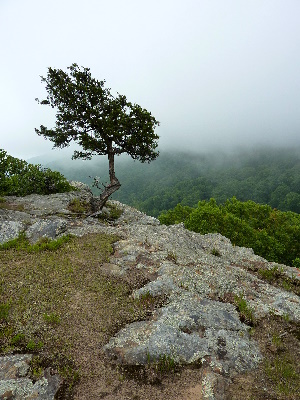
Farther to the west I came across the “Window” viewpoint with a lone tree struggling to survive at the cliff edge. The clouds were rolling in, and the forest became misty and quite beautiful. Suddenly the trail popped out on a new road leading to a big antenna station. Just as I reached the station the heavens opened up and a steady rain began. I scrambled under the station’s northern eaves and waited for the rain to lessen. It intensified, blown by winds, and I struggled in vain to get a decent radar image of the storm on my iPhone. Data reception up on the mountain, outside of the lodge area, is spotty at best.
After 25 minutes the rain finally lessened and I put on my umbrella hat and ventured out, wandering about looking for a way to head on out to the mountain’s western tip. I finally located the gravel road which is closed to the public, which the iPhone GPS showed to be making a straight shot westward. Shielding my iPhone from the constant sprinkles with my Tilley hat, I trekked past one communication tower after another. I lost count of how many stations dot this portion of the mountain, finally reaching the westernmost tip. Reaching the rocky edge, I was disappointed but not surprised to find the view to the west completely obscured by mist and rain. Reversing course back down the road, I used it to loop back to the Brown Spring area and conclude my hike. I’d hiked another 4.5 miles, with half of that in rain. My hiking socks were squishing in my sodden boots and I eagerly pulled them off and switched to tennis shoes for the drive back to Russellville. That silly umbrella hat, however, had kept me fairly comfortable.
Hungry when I arrived in town during the rush hour, I used a wet washcloth to scrub away the insect repellent and sunscreen so I could dine at Joe’s Pizza and Pasta Italian Grill, where I had a delicious lasagna. Then it was back to the La Quinta for a relaxing soak in the jacuzzi followed by blogging while the hotel hair dryer shrieked, drying out my boots. I managed to get 19 miles of hiking in up on Mount Magazine over a day-and-a-half, which ain’t bad.
The forecast calls for more rain tomorrow, which may cancel my hikes on the Pedestal Rocks and King’s Bluff trails. Perhaps the scattered thunderstorms will give me a break, however. I’ll be heading northeast to Mountain View to stay in a cabin at the Ozark Folk Center. At least its auditorium is enclosed, so I should be able to enjoy some music there even in wet weather.
Click here for a slideshow from today’s day hike or click here for the individual slides
Next hike: Pedestal Rocks and King’s Bluff –>
<—Previous hike: A Cloudy Afternoon Atop Mount Magazine








 Meador Manor