My search for a better light bulb

August 11, 2013
My experiments in 2700 kelvin home lighting

My experiments in 2700 kelvin home lighting

A bright blue flash and a POP! greeted me when I flipped the switch in the utility room this morning, followed by a dimmer light than normal. Yes, one of two 60 watt incandescent bulbs in the ceiling fixture blew out. I screwed in one of my newer compact fluorescent (CFL) replacements, and was appalled by the dim, sickly green color it started out with. I knew that if I waited 30 seconds or so, it would brighten up and look okay. I have tolerated crummy CFL bulb start-ups in my home office, since they eliminated a problem with short-lived bulbs. But I hate their start-up behavior when used in a bathroom, closet, or utility room where I want instant, warm, and bright light.

I could have just screwed in a traditional bulb, since a few weeks ago I bought a dozen of the old-style long-life 60 watt soft-white incandescent bulbs. I had done so as a cheap precaution, since they only cost 56 cents each and I knew that they would be phased out in 2014, along with traditional 40 watt bulbs. The traditional 75 and 100 watt bulbs are already history. The phase out makes sense, given that compact fluorescent (CFL) bulbs are four times more efficient and some light-emitting diode (LED) bulbs are more efficient still.

General Electric, which dates back to Thomas Edison himself, responded to the legal ban on inefficient lighting by producing slightly more efficient incandescent bulbs to squeeze under the new efficiency bar. For example, they now offer a substitute for the traditional 60 watt bulb: a 43 watt bulb which produces 750 lumens, for about 17.4 lumens/watt versus 13 lumens/watt in a traditional long-life bulb. But that still pales in comparison to CFL and LED bulb efficiencies. Halogen bulbs are also still around, offering greater efficiency and longer life than traditional incandescents, but they run very hot and don’t approach CFL or LED efficiencies.

So rather than screw in another old-style bulb from my stash, I decided to think long-term and see if I could buy some bulbs which immediately produced a nice light, were far more efficient, and would last for decades, making their high up-front purchase price quite reasonable for a person who plans to keep using them for the long haul.

I’ve had mixed luck with CFL bulbs. My early purchases, such as the triple U-tube 15 watt GE CFL bulb pictured here, were too long for some fixtures, not dimmable, and produced low, off-color light for a minute or more after being turned on. But the spiral Ecosmart CFL bulbs from Home Depot, which Consumer Reports recommended a few years back, are much more compact and brighten up faster, although they are still not dimmable. They run much cooler and eliminated the problem in my office ceiling fixture of frequent bulb burn-outs.

LED bulbs have taken a long time to mature, but I already use two nice Philips Ambient LED 8 watt bulbs in a living room table lamp as replacements for 40 watt incandescents. They look a bit strange if you peer under the shade, with their triple yellow lenses and large metal heat sink, but they produce a warm color of light and are dimmable. They are four times more efficient than an incandescent bulb, but the sticker shock is that each bulb cost over $20!

That might sound crazy, but you have to bear in mind that they last over 12 times longer than a long-life incandescent bulb. That’s about three times the capital cost per hour, but their operating cost is four times less. So they still pay for themselves if you use them long enough, and I won’t have to replace them for decades to come.

I looked into buying some 60-watt-equivalent Philips Ambient LED bulbs, but they are not cleared for enclosed fixtures. Then I remembered that Cree recently began selling relatively cheap LED bulbs at Home Depot. The bulbs have received great reviews and the company was featured in Forbes. Their 9.5 watt warm-white LED bulbs are $13 each, so their capital cost per hour over their lifetime is only about twice that of long-life incandescent bulbs. They are even more efficient than CFLs, with an operating cost that is almost six times less than long-life incandescent bulbs. So, if I use them for a couple of decades, my annual operating cost for them is cheaper than for any of my previous bulbs. I dropped in at Home Depot and purchased six of the suckers.

Here are the specs on each of the bulbs pictured above, which all produce warm 2700 kelvin light:

Bulb: GE incandescent GE CFL Ecosmart CFL Philips LED Cree LED
Power (watts) 60.0 15.0 14.0 8.0 9.5
Luminous Flux (lumens) 780 900 900 470 800
Luminous Flux/Power (lumens/watt) 13 60 64 59 84
Bulb Life (hours) 2,000 12,000 10,000 25,000 25,000
Purchase Price $0.56 N/A $1.25 $20.69 $12.97
Capital Cost/Year* $0.31 N/A $0.14 $0.92 $0.57
Annual Operating Cost** $7.23 $1.81 $1.69 $0.96 $1.15
Total Annual Cost $7.54 N/A $1.83 $1.88 $1.72

*Purchase price divided by hours of life times 3 hours per day times 365.25 days per year
**Based on 3 hours per day at 11 cents per kilowatt*hour

If you decide to purchase the Cree bulbs at Home Depot as a replacement for traditional soft-white incandescents, check that you are getting the warm-white bulbs, which have a color temperature of 2700 kelvin. They have similarly-packaged and slightly cheaper Daylight bulbs which, at 5000 kelvin, produce a harsher bluer light similar to that of fluorescent lighting in commercial buildings and schools.

I screwed in the new Cree bulbs in my utility room and was rewarded with instant, warm, bright light. I don’t plan on purchasing another CFL bulb for home, ever. For now I’ll still use incandescent bulbs in a few decorative light fixtures where the glass is clear to show the glowing filament. But for everything else it will be LED for me.

10/6/2013 UPDATE: A month after I published this post, Cree released a new TW Series of 2700 kelvin LED bulbs which have an improved Color Rendering Index. Today I ordered 12 of them from Home Depot for free delivery to my home, enough to replace all of the remaining 60 watt incandescent bulbs at Meador Manor. I’m going to purchase one of their LED spotlights for my kitchen. I look forward to the day they offer 100-watt-equivalent bulbs to replace the incandescents in my bathrooms, closet, and garage.

1/14/2018 UPDATE: Over the following four years, many of the first generation of Cree bulbs I purchased died, especially in a fixture that had three of them. I would guess the heat got to them. The second-generation ones did better, and now we have a mix of various brands in the Manor. Here’s a nice video teardown of a 60-watt equivalent LED bulb, which is dimmable and rated for enclosed fixtures, with a decent 3000 kelvin color temperature, which has been sold for only $1 at some Dollar Tree stores:

Posted in home repair, random | Leave a comment

July Escape 2013

Here are links to the posts for the trip to New Mexico, Colorado, and Kansas in July 2013:

July Escape 2013 Map

July Escape 2013 Map

Posted in day hike, travel | Leave a comment

Day 9, July Escape 2013: Gettin’ Out of Dodge

Trip Date: July 18, 2013

The penultimate day of our vacation was spent driving 450 miles eastward; Wendy and I still had another 300 miles to go on the final day of July Escape 2013.

DAY 9: DODGE CITY

Day 9 Map (click map for slideshow)

Our trip home across the prairies was dogged by smells. We were grateful there was no feedlot near our hotel in Dodge City, but the adjacent IHOP where we had breakfast had its own aroma, which Wendy said was like a dirty diaper with soap. At least there was soap in there somewhere.

Front Street

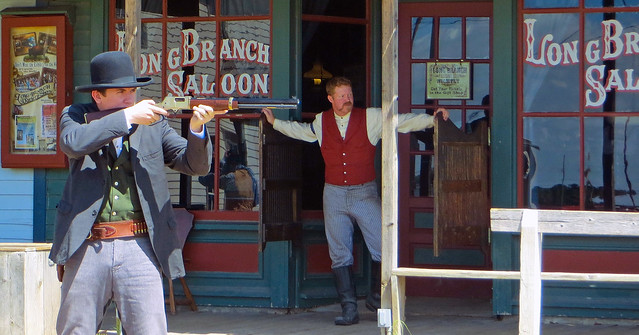
I took Wendy to the Boot Hill Museum, a recreation of Front Street from 1876 complete with its own version of the Long Branch Saloon, renowned from the tales of Wyatt Earp and television’s long-running Gunsmoke. The museum started in 1947 as project of the Dodge City Jaycees and has steadily improved, with a large collection of artifacts and displays.

Front Street

We walked through the line of buildings, with Wendy liking the saloon gal, piano player, and big-mustachioed bartender at the Long Branch. Years ago I ordered a sarsaparilla at their bar, and thankfully was not mocked, but this time we moseyed on through, browsing past the artifacts from Dodge City’s past. We liked the Hardesty House the best, a genuine 1878 Victorian cattleman’s home which transported one back to that era.

Gunfight

Then we waited out front for the noon gunfight, staged in front of the Long Branch Saloon with real guns loaded with blanks. Wendy and I enjoyed this all the more since we recently watched Tombstone, the mixed-accuracy portrayal of the famous gunfight in Arizona between outlaw Cowboys and the Earp brothers and Doc Holliday. That incident was in 1881, a few years after Wyatt Earp had been an assistant marshall in Dodge City; he would return to Dodge in 1883 for the bloodless Dodge City War. Wendy thought Kurt Russell’s appearance in the movie was a good match for the pictures of the real Wyatt Earp we saw in Dodge.

In reality, there was a gunfight inside the Long Branch Saloon on April 5, 1879 when Frank Loving killed fellow gambler Levi Richardson. In the mock version, a group of Cowboys, complete with red sashes, outside of the saloon, refused to obey orders to disarm from the marshall and his deputies, with violent results.

Trouble on Front Street

After the gunfight we walked over to Boot Hill and went through the People of the Plains exhibits in the original museum building, where Wendy liked the life-size stuffed longhorn and buffalo.

Homeward

Only in Dodge would a feedlot be a scenic stop

As we drove out of town we saw a nice sign with cowboy silhouettes, but were amazed that they actually have a feedlot scenic overlook, complete with fancy signage and yes, a quite authentic smell.

The wind can be your friend or your enemy out there, depending on if you are upwind or downwind of a feedlot. We saw many modern wind turbines, especially outside of Spearville, which boasts 67 GE Energy 1.5 MW wind turbines and is the third largest wind farm in the state.

We ate at a Jose Peppers in Wichita, with me having my usual beef fajitas while Wendy enjoyed “Poco Pollo” – three chicken burrito pillows covered in jalapeño cream cheese, melted Colby Jack, and pico de gallo. She loved it, along with their Spanish rice and masa.

A great partnership

It was good to finally reach Bartlesville, over 800 miles east of Mesa Verde. Wendy was a splendid partner on the trip, helping with logistics, photos, and the blog posts. And I’m thrilled to note that we did not turn on a television even once; our vacation was far too interesting for that vast wasteland. The West has much to offer and I am certain future summers will find us in fun cities like Santa Fe and Durango, as well as rural places far from the madding crowd.

Click here for a slideshow from this day

< Day 8 of July Escape 2013

Posted in photos, travel | Leave a comment

Day 8, July Escape 2013: Walsenburg

Trip Date: July 17, 2013

Mesa Verde was our last big tourism day; we’d spend the next two days in transit back home, with a pleasant stop in Walsenburg highlighting Day 8.

DAY 8: WALSENBURG

Day 8 Map (click map for slideshow)

Hot Air Balloons

Hot Air Balloons

My day began with another delicious lemon bar from Higher Grounds in Pagosa Springs, with Wendy enjoying her own treats on the ironing board table I rigged up in the hotel room. Happily the curtains were drawn aside, allowing us to unexpectedly witness the launch of two hot air balloons across the street.

It turns out that Rocky Mountain Balloon Adventures in Pagosa Springs offers rides for $135/person. Wendy and I enjoyed the free show of watching them inflate and take off in two balloons.

On our way out of town we took Princess the Camry through a car wash to remove remaining bits of Piedra Road and then ascended Wolf Creek Pass. Wendy noticed her bag of Doritos was swelling as we went up over 10,800 feet. Hours later she found it considerably more squeezable when we had descended from the San Juan Mountains over 6,000 feet to the broad flat plain of the San Luis Valley.

Air pressure demonstration

Just when the valley drive was really getting boring, we threaded our way up and over the Sangre de Cristo mountain range to arrive at the old coal mining town of Walsenburg for lunch.

The Urantia Book at La Plaza Inn’s Library Café

Thankfully TripAdvisor led us to the La Plaza Inn for lunch in their Library Café. Jeff and Karen Wilson opened this bed & breakfast in 2010, in a building which has been a hotel since 1907.  It turns out that Walsenburg was originally called La Plaza de los Leones, after the Leon family. But in 1870 Fred Walsen settled nearby and opened up a large mercantile, making the town an attractive location for German settlers. When it was incorporated, it bore his name. In 1876, Walsen also opened the area’s first coal mine, and the development of the town was influenced for a century by coal mining in the region. Reportedly an estimated 500 million tons of coal was mined until a combination of corporate mergers, environmental regulations, and enforcement of mine safety regulations led to the closure of virtually all mining in the area. But the little town of 3,100 is working hard to revitalize its downtown.

Great lunch in Walsenburg

Wendy knew I would love the Inn’s Library Café when she saw all of the books on the walls beside the tables. Once seated, I spotted and reached over to grab the hilariously wacky The Urantia Book, a huge cult tome I heard of some years back through the marvelous and much-missed Martin Gardner, who wrote about this weird book of religious revelations supposedly from numerous celestial beings. According to these supermortal beings, Earth is the 606th planet in Satania, which is in Norlatiadek, which is in Nebadon, which is in Orvonton, which revolves around Havona, all of which revolves around the center of infinity where some sort of god dwells. Gardner concluded the tome was originally the Bible of a separatist group of Adventists, based on the subconscious ramblings of Wilfred Kellogg and edited by William Sadler, a Chicago psychiatrist who got his start working for kooky Dr. John Harvey Kellogg, the Adventist surgeon, health and diet author, and brother of cornflake king William Keith Kellogg.

I showed Wendy some of the Urantia book’s craziness and then followed that up by grabbing Maximized Manhood off the shelf beside me.  That turned out to be a preacher’s take on pornography, adultery, television addiction, and immaturity.  I must say I enjoyed my food more than my taste of that book.  Barbara Long is the café cook, so I presume she prepared the wonderful French Dip along with my La Plaza custard pie, which was something like crème brûlée.  Wendy admired the caramelized crust of her peach cobbler.

On my trip to the restroom, I walked through the hotel’s romantic Bistro restaurant, where Chef Gordon Lucero prepares the evening meals. If only we had a café and restaurant like this back home!

Walsenburg Junk & Antique Stores

Walsenburg Emporium

Just up the street from the La Plaza Inn was April’s Attic, which advertised itself as a “Huge Shopping Emporium” of over 8,000 square feet. We found that irresistible. Wendy perused room after room of…things. It was rather eclectic. I purchased a couple of old science fiction paperbacks for 25¢ each, including Secret of the Sunless Worldthe story of “Gondal, most feared of all creatures in the universe”. Hmm…perhaps celestial beings were channeling layers of arcane knowledge through author Carroll M. Capps.  Or maybe not!

We looked through a couple more nearby stores, where there were some paintings which made me comment to Wendy, “That paint was worth more in the tube than on that canvas.”

American in Prairie

We now faced 280 miles, or almost five hours, of sheer boredom to make it to Dodge City, KS for the night. Wendy spotted “walking windmills” where the gentle slope of the land made their rotating blades look like appendages transporting them across the prairie. We sped through the stench of the occasional feedlot, with the journey lightened by a wonderful piano version of Gershwin’s American in Paris which she had on her iPod, as played on a modern Yamaha Disklavier player piano using piano rolls prepared by Gershwin himself. Paris inspired Gershwin to compose a wonderful tone poem, but I wonder what an American in Prairie would have sounded like. Instead of the rhythms of walking down a busy French boulevard, a galloping gait across an endless empty expanse? Instead of horns, moos? We shall never know.

American in Prairie

Dinner was at Applebee’s in Garden City, KS. The stench of a feedlot permeated the parking lot, but inside we found a cheerful waiter who sounded like he was from New Jersey and served us delicious Three Cheese Penne Pasta and Fiesta Lime Chicken. For some reason, we did not want to eat beef.

C’mon, Best Western!

Refreshed, it was only another hour’s drive to the fun cow-themed Best Western Plus Country Inn & Suites in Dodge. The décor of the lobby and rooms were indeed “Plus”, but Wendy was less than impressed by the “Complimentary Guest Towel”, a napkin-like piece of paper which directed us, “Take this towel with you on your travels and use it however you like.” Well, continuing with the books theme of this post, while The Hitchhiker’s Guide to the Galaxy highly recommends having a towel, I don’t think this is what they had in mind.

We were pooped in more ways than one from our travels through the feedlot-infested prairies, but ready to rise on the morrow for a gunfight in front of the Long Branch Saloon in good old Dodge City.

Click here for a slideshow from this day

Day 9 of July Escape 2013 >

< Day 7 of July Escape 2013

Posted in books, photos, travel, video | Leave a comment

Day 7, July Escape 2013: Mesa Verde

Trip Date: July 16, 2013

On the seventh day, instead of resting from the steam train ride the day before, Wendy and I drove to Mesa Verde for the fabulous views.

DAY 7: MESA VERDE

Day 7 Map (click map for slideshow)

We slept late after the exhausting but fun train ride the day before. Rain was forecast for the afternoon, so we eventually roused ourselves to drive west, under a low overcast sky, the 35 miles to the entrance of Mesa Verde National Park. I’d learned ahead of time that touring Cliff Palace and most other major sites now requires the on-site purchase of tickets, although a self-guided tour of Spruce Tree House is still possible. Given that we were still recovering from the long train ride, I doubted we would do much walking this day, mainly driving the loop roads past various overlooks. Back in 1991 my father and I toured the Cliff Palace and Balcony House ruins.

Mesa Verde Map

Anasazi

Anasazi

We stopped for a restroom break at the busy visitor center, which just opened this May and cost over $16 million. It is also a research center, with more than three million artifacts from 4,000 Ancestral Puebloans who lived in the area for 700 years, from about 600 to 1300 CE. We had limited time before afternoon showers were forecast, so we did not even go inside. But we did study the sculpture out front, Anasazi by Edward J. Fraughton. It wasn’t easy against the glare of the overcast sky to make out the laden Pueblo Indian figure climbing the spire until you got fairly close to interpret it. Modern-day Puebloan Peoples do not prefer the term Anasazi, which is Navajo and originally meant “enemy ancestors”, but the alternatives are more cumbersome.

Knowing we needed to beat the afternoon showers, we drove on to the park entry booth to pay the $15 entry fee for our vehicle and begin driving the 21 miles through the park to Cliff Palace, the largest and most famous of the cliffside ruins.

Heavy Skies

Beetles and fires have scourged the trees at the park, leaving hillsides littered with dead trunks. But you could peer between the trees for gorgeous views to the west from the mesa top. One stop had spiky Wyoming Paintbrush wildflowers. The heavy sky made it feel like you were at the top of the world. Wendy took advantage of a gap in the clouds for a very nice shot of the sun kissing the mesa rocks.

Overlook

Cliff Palace

We reached the Cliff Palace overlook, which was crowded with sightseers like us. I went back to grab my binoculars for better views of the tour going on below. Wendy and I both wondered about a group of disks on the floor of one kiva; maybe they are part of the ongoing reconstruction effort.

Cliff Palace

Cliff Palace once contained 150 rooms and 23 kivas, which were special rooms used for religious practices, and had a population of approximately 100 people. The first view of it by white cowboys was in 1888, and it was subjected to looting until the park was established in 1906 and Jesse Walter Fewkes of the Smithsonian Institution excavated and stabilized it in 1909. The rooms were constructed out of natural sandstone, wooden beams, and mortar made of soil, water, and ash. Tiny pieces of stone called chinking are also embedded in the mortar, to strengthen construction.

Ancestral Puebloans entered their cliff-dwelling apartments through wooden ladders, and the rooms were about six by eight feet. Families lived together, and historians say that two to three people probably shared a room. Many rooms were originally plastered in bright colors—usually pink, brown, red, yellow, or white. Smaller rooms near the back of the cliff were used for storing crops, such as beans, corn, and squash. Each clan or family had their own kiva in front of their dwelling for rituals and ceremonies.

After drinking in the view and climbing back up the hillside to the road, Wendy and I rested on a bench, unused to the altitude. We then drove the loop roads, stopping repeatedly to get out and walk over to the edge of the mesa for the views.

Navajo Canyon & Square Tower

We skipped Balcony House, since it is not visible from the road and we had no tour tickets, instead driving on over to the Mesa Top Loop for views of Navajo Canyon. Nestled up against one wall in a high alcove was Square Tower, which was being stabilized by two workers.

Square Tower House at Navajo Canyon

Stabilizing Square Tower

Square Tower House was occupied between 1205-1281 CE. It contains one of the latest construction projects at Mesa Verde, the Crow’s Nest. Square Tower House was built at the height of the region’s population, when their numbers were beginning to negatively impact the area’s resources. It is believed that many factors, including a 23-year drought, resource depletion, and social pressures led the people to gradually migrate south to the Rio Grande area, leaving the Mesa Verde region largely depopulated and abandoned.

Sun Point View

Sun Point View was our next stop and was our favorite, providing views of six sets of structures in Cliff and Fewkes Canyons. Half the population of Chapin Mesa was concentrated here between 1200 and 1300 CE.

Sun Point View

Fire Temple

Wendy and I enjoyed zooming in for views of each dwelling. Fire Temple is on the far left up Fewkes Canyon, and was recently re-opened to the public via a hiking trail. New Fire House is a two level structure adjacent to the temple. The lower level has seven rooms and three kivas, with thirteen rooms on the upper level. It may have been the dwelling for the people responsible for ceremonies in the temple, which resembles the floor of a great kiva, with two rectangular structures which may have been foot drums for dancing, and a central circular fire pit which had a large amount of ash when excavated by Fewkes.

Oak Tree House, also on the left up Fewkes Canyon, contains about 50 rooms and six kivas. Some of the structures rose four stories to the roof of the inner alcove. There are storage rooms on the upper ledge. It has a deep cave with roofless living rooms, grinding and cooking rooms, and some storage rooms. One of the more unusual walls found was made entirely of willow branches set in mud (rather than masonry), and some of the masonry walls were of the highest quality stonework present in cliff dwellings of Mesa Verde.

Oak Tree House

Both Fire Temple and Oak Tree House are situated in alcoves where occupants could enjoy sun in the winter and shade in the summer. Cliff Palace is up a canyon to the east, and is in the center of the view from Sun Point. From there one can easily spot the sightseers at the Cliff Palace overlook, where we had been earlier.

Sunset House is farther south along the main canyon and contains 33 rooms and four Kivas set on two ledges. Behind the prominent two-story structure were three dry-wall masonry turkey pens. Inhabitants carried water from a spring opposite Cliff Palace.

Sunset House

Sun Temple is a structure on the top of the mesa where Fewkes Canyon forks off the main canyon, and we would soon drive over to examine it.

Mummy House was constructed on a narrow ledge below the top of Chapin Mesa, directly below the Sun Temple. It once extended higher, with an upper penthouse in a niche being very well preserved; it may have been a granary. Only the wall stubs of ten rooms and two kivas remain on the ledge below. Fewkes found a well-preserved mummy there.

Sun Temple, Mummy House, and Cliff Palace

Sun Temple

Sun Temple Interior

We drove around to the Sun Temple, on top of the point where Fewkes Canyon splits off. It has a spectacular view of the canyon and Cliff Palace, and is a D-shaped structure with a thousand feet of double-coursed walls filled with a rubble core. Masons pecked the stones and, since no household goods nor roof beams were found here, the 30-room structure was probably never finished. A view down one of only two small windows in the structure showed how cramped some of those rooms were. Wendy captured me pontificating about the masonry, noting what I’d learned in the guide book.

Canyon Country

Far View

Approaching rain led us to the Far View Terrace for a restroom break and drinks. The Far View area of the park was one of the most densely populated parts of the mesa from 900 to 1300 CE. Nearly 50 villages have been identified within a half square mile area.

Panorama from Mesa Verde

We left the park, enjoying some final panoramic views. Raindrops sprinkled down as we fled back through a tunnel toward the park’s north entrance to return to Durango. While at the Far View Terrace, I’d placed a reservation at Ken and Sue’s. The grilled filet mignon with Gorgonzola butter, spinach, and potato lasagna they served me was superb. We then drove east back to Pagosa Springs for the night, ready to spend the next two days heading home, including stops in Walsenburg and Dodge City.

Click here for a slideshow from this day

Day 8 of July Escape 2013 >

< Day 6 of July Escape 2013

Posted in photos, travel | Leave a comment