When reading book reviews and blurbs, I bear in mind the disclaimer I often heard in 1970s car commercials: your mileage may vary. A few weeks ago I read Gary Shteyngart’s May 2024 article in The Atlantic: “Crying Myself to Sleep on the Biggest Cruise Ship Ever“. I enjoyed it, although it could not compete with David Foster Wallace’s “A Supposedly Fun Thing I’ll Never Do Again“, which originated in a 1996 article for Harper’s titled “Shipping Out”. Wallace set the standard for writers forced to suffer through a boat cruise.
Looking for a new Kindle read, I noticed that I had Shteyngart’s Super Sad True Love Story from 2010 marked as Read in my Kindle, although I had not logged it at LibraryThing or Goodreads. The character names seemed familiar, but the plot summary on Wikipedia did not, so maybe that was a Did Not Finish before I created such a list in Goodreads.
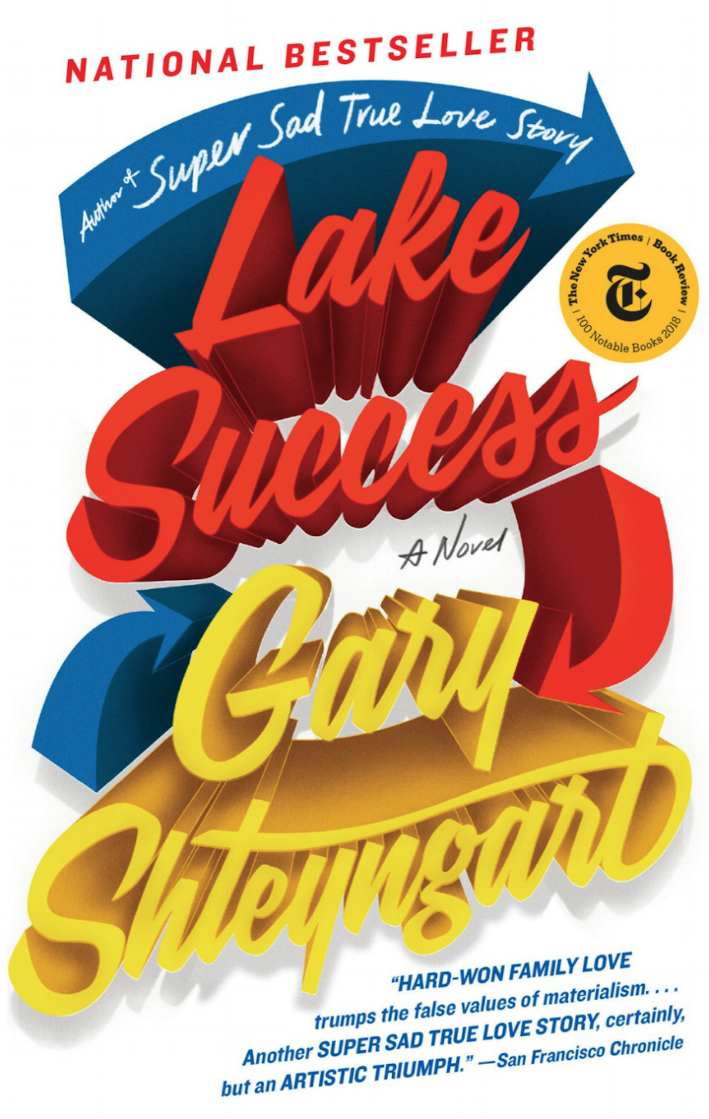
I decided to scout around for other Shteyngart novels and came upon Lake Success, which was a bestselling work with these incredibly abridged blurbs: “Spectacular.” -NPR, “Uproariously funny.” -The Boston Globe, “An artistic triumph.” -San Francisco Chronicle, “A novel in which comedy and pathos are exquisitely balanced.” -The Washington Post, “Shteyngart’s best book.” -The Seattle Times.
AND…it was named one of the best books of 2018 by Maureen Corrigan on NPR’s Fresh Air and The New York Times Book Review, NPR, The Washington Post, O: The Oprah Magazine, Mother Jones, Glamour, Library Journal, Kirkus Reviews, etc.
AND…it received a Salon Book Award, a Bollinger Everyman Wodehouse Prize, and was one of Amazon’s Best Books of the Month in August 2010. As for relative ranks, while composing this post I found it ranked as the 11,518th Greatest Book of All Time at The Greatest Books, with four of Shteyngart’s other novels ranked higher. Super Sad True Love Story was in the lead at 3,055th.
Well, okay, but Lake Success is about a multi-millionaire New York investment banker who goes on a road trip to escape a failing marriage and an approaching indictment. I knew that I, as an underpaid Oklahoma educator who is happily married and free of legal jeopardy, would not be likely to relate to the lead character, but the book was promoted as being funny, so…maybe?
I read the free Kindle sample and was gripped by the first part of the opening chapter, in which the unlikable banker struggles to get a ticket on a Greyhound bus out of New York as his odd way of fleeing the metropolis and his troubles. What I did not know was that in addition to his investment banking errors, he was fleeing from his wife and their young autistic son, nor that he would turn out to be a dim but successfully gregarious character who has some characteristics some might associate with autism.
Soon after I had purchased the book and read onward, the wife appeared in the story. She would pursue a relationship with a fake Latino writer who lived in the same garishly expensive Manhattan high rise, although he and his doctor wife’s third-floor apartment only cost $4.1 million in 2015, compared to the banker’s 4,000 square foot one up on the 21st floor which cost five times more. Let’s see…adjusting for inflation, that’s well over 100 Meador Manors.
What I soon noticed was that I did not like any of the main characters. They were all repulsive, engineered to empower various wry observations and parodic satires. I didn’t find anything “uproariously funny”, although before quitting the book 1/3 of the way in, I did highlight this paragraph about a Richmond restaurant:
The noisy restaurant the Hayeses had chosen looked like it had been tractor-trailered in from the part of Brooklyn where Seema’s funny Asian friend (Tina?) lived. There were gilded Victorian mirrors, drawings of horses, and a giant, pointless map of Latin America. Bearded bartenders were slinging tiki drinks, and the young clientele was in full possession of their looks.
The Did Not Finish killing blow was my going on a walk in a park on an unseasonably warm winter afternoon, listening to John Hodgman’s Vacationland. He essayed about a Maine summer home, repeatedly mentioning how a famous writer had once lived nearby:
That summer I thought about the famous writer in a new way. It won’t surprise you to know that he is white, and he wrote about the rhythms of his life in this white place. There is nothing wrong in this: all places and experiences deserve writing about. But what made the writer a greater hero to me in that moment was, unlike so many white men, he wasn’t braggy. He never suggested that his experience was heroic, or correct, or even unusual. In fact, it was profoundly usual, beautifully mundane, and merely his to offer. His offering was his insight into the small joys of his particular life, which by extension could help us recognize the small joys that exist everywhere, even outside of Maine. And he offered it humbly. You really should use your detective skills and find his work. He’s great.
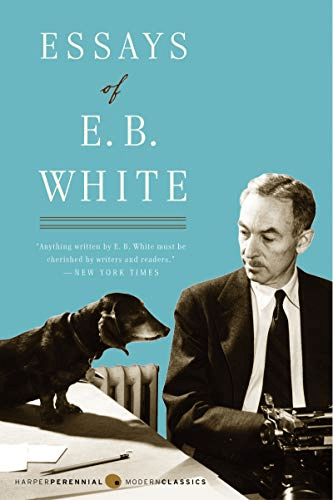
Well, I had already deduced that Hodgman was referring to the co-author of The Elements of Style and the sole author of Stuart Little and Charlotte’s Web: E. B. White. I’ve only read the story of the spider and “some pig”, and that was five decades ago in a school building that itself would perish thirty years later. Some day I’ll perish too, and might my limited time be better invested in some essays by E. B. White than in Shteyngart’s horrid characters?
I spent a whopping $2 on Essays of E. B. White, which he had compiled in 1977, sharing:
The arrangement of the book is by subject matter or by mood or by place, not by chronology. Some of the pieces in the book carry a dateline, some do not. Chronology enters into the scheme, but neither the book nor its sections are perfectly chronological. Sometimes the reader will find me in the city when he thinks I am in the country, and the other way round. This may cause a mild confusion; it is unavoidable and easily explained. I spent a large part of the first half of my life as a city dweller, a large part of the second half as a countryman. In between, there were periods when nobody, including myself, quite knew (or cared) where I was: I thrashed back and forth between Maine and New York for reasons that seemed compelling at the time. Money entered into it, affection for The New Yorker magazine entered in. And affection for the city.
I have finally come to rest.
That beckons to me, while I personally related to this part of his Foreward:
There are as many kinds of essays as there are human attitudes or poses, as many essay flavors as there are Howard Johnson ice creams. The essayist arises in the morning and, if he has work to do, selects his garb from an unusually extensive wardrobe: he can pull on any sort of shirt, be any sort of person, according to his mood or his subject matter—philosopher, scold, jester, raconteur, confidant, pundit, devil’s advocate, enthusiast. I like the essay, have always liked it, and even as a child was at work, attempting to inflict my young thoughts and experiences on others by putting them on paper. I early broke into print in the pages of St. Nicholas. I tend still to fall back on the essay form (or lack of form) when an idea strikes me, but I am not fooled about the place of the essay in twentieth-century American letters—it stands a short distance down the line. The essayist, unlike the novelist, the poet, and the playwright, must be content in his self-imposed role of second-class citizen. A writer who has his sights trained on the Nobel Prize or other earthly triumphs had best write a novel, a poem, or a play, and leave the essayist to ramble about, content with living a free life and enjoying the satisfactions of a somewhat undisciplined existence. (Dr. Johnson called the essay “an irregular, undigested piece”; this happy practitioner has no wish to quarrel with the good doctor’s characterization.)
Oh, what a blogger E. B. would have been. I laid aside the 11,518th Greatest Book of All Time in favor of the 976th. Even before reading a single essay in that book, I also ordered a rather thin used tome, from a Dallas bookstore, containing two of White’s other essays: “Farewell to Model T” and “From Sea to Shining Sea” about his 1922 trip, when he was just out of college and at loose ends, crossing America in a Ford Model T. Sorry, Shteyngart, there’s someone a short distance down the line I want to meet who has his own road stories to share.
For months I have been asked, “What are you going to do when you retire?” I usually answer flippantly, but an honest partial answer would be that I hope to whittle down my collection of unread books, including listening to audiobooks while doing more day hikes.
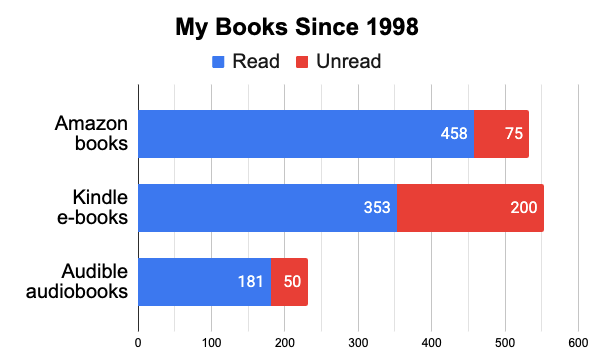
Since 1998, my book acquisition rate has been about one per week. Over the past 28 years, I purchased 533 physical books from Amazon and an indeterminate number from Barnes & Noble, eBay, and AbeBooks. I also acquired 553 Kindle e-books and 231 Audible audiobooks.
I had built up a library before I began using Amazon, and despite selling off 110 books back in 2010 and donating 700 to the public library in 2016, I still have about 350 physical books in my office, with maybe 75 of them waiting to be read. I also have a couple of hundred unread Kindle e-books and dozens of audiobooks I haven’t listened to. I track my reading on both LibraryThing and GoodReads, and I’ve been reading thirty-odd books a year while acquiring about fifty, and the imbalance has built up.
I already have plenty to read in retirement
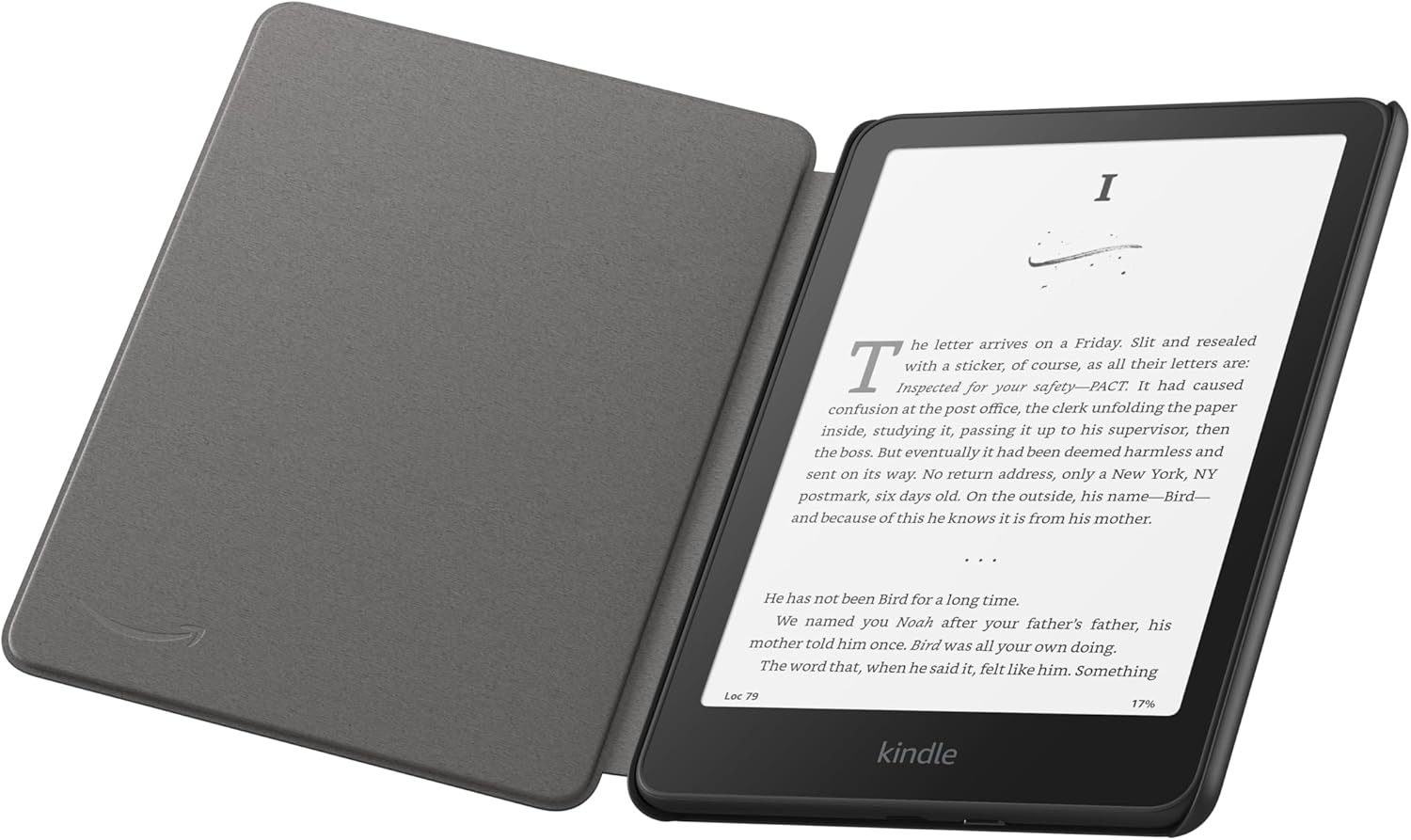
I bought the first version of the Kindle e-ink reader back in 2008, and I am now on my eighth model, a Kindle Paperwhite Signature Edition in a custom case. I have been reading on my Kindle about 18 days per month, and currently I’m on a 33-week usage streak. In 2025, almost 3/4 of the books I completed were e-books, but I didn’t get them all from Amazon, and several of them were free.
Public Domain Books
Most often I download a sample e-book from Amazon and then complete the purchase if it grabs me. However, for works in the public domain that have fallen out of copyright, I have other options.
I have usually relied on Project Gutenberg, which has over 75,000 titles, for free public domain e-books. However, Gutenberg’s formatting is often clumsy, and beware that some public domain translations of classic world literature, especially of Jules Verne, are just trash, requiring some research to avoid clinkers. Getting Gutenberg’s books into my Kindle collection is fairly easy: I just download an EPUB version from them and then use Send to Kindle.
Standard Ebooks produces higher-quality and better-formatted versions of public domain e-books than Gutenberg, but their selection was limited to 1,374 titles in early 2026, and getting them onto my Kindle is more involved. Amazon deliberately creates friction in getting third-party books onto its devices, and while you can download an AZW3 version for Kindles from Standard Ebooks, I had to download that to my Mac, get a special program from Amazon to allow my Mac to interact with my Kindle’s file system, connect the two with a USB cable, and then copy the AZW3 file into the documents folder on the Kindle and a separate cover image file into its system > thumbnails folder. The resulting e-book was nicely formatted, but it was trapped on that device and not available in the Kindle apps on my iPhone, iPad, or Mac. So my recommendation is to ignore their advice and just download the EPUB version of their books and use Send to Kindle. I haven’t noticed any problems with that far simpler method.
The friction with third-party books has manipulated me into sometimes paying a few bucks for a Kindle version directly from Amazon, particularly when I could cheaply get an author’s entire oeuvre in one enormous e-book. For example, I happily paid $1 for everything by Mark Twain and $3 for 36 translated Jules Verne books, after checking on the quality of a couple of the Verne translations. Oh dear, that means I technically have dozens more unread books…
Open Library
Some books, especially genre commercial titles from decades ago that are still under copyright, are not available as e-books. So on occasion, and particularly when doing research, I’ll try the Internet Archive’s Open Library. For a decade it provided free access to e-books, loaning them out to one user at a time, but during the pandemic it made a poor choice, lifting the cap on loaning e-books. That led to court battles which nearly bankrupted the Archive and resulted in over a half-million titles being stripped from its collection. The losses were mainly in-copyright commercial works, and thankfully the service still has over three million titles, although there are many near-duplicates of popular works in a multitude of different editions.
Public domain books in the Open Library tend to have downloadable PDF versions you can use in Apple’s Books app as well as EPUB files usable with Send to Kindle (which no longer supports the old MOBI file format), or you could try loading those books into the Cantook by Aldiko app. However, sometimes the text versions are lousy optical character recognition scans and you’re better off reading the actual scan of the physical book on Open Library in your web browser.
Other titles in the Open Library that are still under copyright are restricted to borrowing. Some reportedly can be borrowed for 14 days and might even be downloaded and read in the Cantook by Aldiko app, but lately the ones I have been interested in could only be borrowed for an hour at a time for reading in a web browser, although they could be borrowed again and again if they were not in demand.
When I can’t find an e-book, I am willing to pay for a used print version. I loved Keith Robertson’s Henry Reed books for children back when I was in elementary school, so during pandemic travel restrictions I sought out the six adult mysteries he authored under the pen name of Carlton Keith. At least half of them, Rich Uncle, The Crayfish Dinner, and Missing, Presumed Dead, are available at Open Library. However, I ordered physical copies of all six from used bookstores in Illinois, Ohio, New York, Tennessee, Texas, and even New Zealand via AbeBooks. I’ve read four of the six thus far, and my favorite was Rich Uncle, so I’m glad it is readily available for others to enjoy. I donated my copy of it to a Robertson collector.
Libby
It took multiple attempts to get access to Libby
An option I have far less experience with is Libby by OverDrive. It is available via many public libraries, including my Bartlesville Public Library account. However, it took a couple of attempts to get it working for me.
After childhood, I didn’t like the time pressure from two-week checkouts for books from the public library. So I’ve mostly used our local library for its extensive history room resources and its meeting spaces. Years ago, I would also stop in there or at one of the Tulsa libraries to read magazines, but such offerings gradually thinned and eventually disappeared.
Back in the early 21st century, I paid for access to the Tulsa public libraries
Fifteen years ago, I paid for an annual subscription to the Tulsa City-County Library system so that I could drive to the main library in downtown Tulsa and check out audiobooks on cassette tapes to listen to while driving on my dayhiking trips…audiobooks have always been quite pricey. Audible on my iPhone eventually made that unnecessary, so long as I was willing to pony up.
Late in 2025, I noticed that some of my Facebook friends who are avid readers utilize the Libby app, so I tried logging in. However, it said my Bartlesville Public Library card was invalid. A few weeks ago I was in the local library’s history room, using their microfilm reader to access a 90-year-old grade card in regards to a legal matter. On my way out, I stopped at the circulation desk and inquired about my account. They said it had been suspended for verification, due to lack of use, but they quickly re-activated it.
My old library card
However, a few weeks later I could not login with my account to the library website, could not reset my passcode, and the Libby service said my library card number was still invalid. I dropped in again at the library, and when I showed them my library account number, they immediately figured out the problem. When I added the number to my iPhone password manager years ago, three leading zeroes were dropped. Once I knew to add those back, I could reset my passcode and log in to the library’s online portal, and Libby also began recognizing my account. I should have taken the time to dig out my old library card, as the account number on the back included the leading zeroes!
The OK Virtual Library has 51,000 books and 18,000 audiobooks, including 41,000 Read With Kindle books. I tried a Kindle one out, and once I synchronized Libby with my Amazon account, it was a breeze to check out a book and then begin reading it on my Kindle…noticeably easier than loading public domain books from Gutenberg or Standard Ebooks, although Meador’s Law of the Conservation of Happiness holds true: Libby checkouts expire after two weeks.
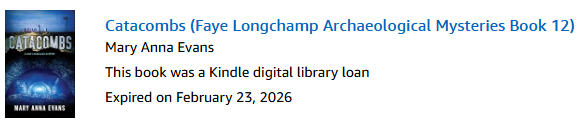
I checked this e-book out from Libby for my test, having noticed that the author used a fictionalized version of Oklahoma City’s Chinese Underground in it
Since I was just testing out the app, I didn’t want to keep the book checked out to me for two weeks in case someone else would want to use that license. I didn’t find a way to check it back in from my Kindle or my Kindle apps, but when I selected Books in my Amazon Digital Content library, the checkout was shown with an option to return the book early.
While the Libby service can offer magazines, your local library has to pay for such access. Bartlesville doesn’t, but I found I could get access to over 100 magazines from our library’s partnership with Hoopla. That provides up to eight audiobook, movie, music, comic, e-book, television, or BingePass titles each month, and there is a 7-day BingePass for Hoopla Magazines, although I was disappointed, albeit not at all surprised, to find that world titles like Sight and Sound and Cahiers du Cinéma are not on offer.
I’m very glad to see that our library and others have made progress in adding electronic checkouts to their panoply of services. By the way, if you like video documentaries, there is a Curiosity Stream BingePass.
Read!
I’m told you can also find free e-books at BookBub and Manybooks, although I haven’t tried them. I already have hundreds of purchased books awaiting my time and interest, but it is nice to have options, especially the free ones I’ve shared here.
Regular adult reading provides significant cognitive, emotional, and physical health benefits, including reduced stress, slowed cognitive decline, improved empathy, and increased longevity. If you prefer audiobooks, Libby has 18,000 and this week over 11,000 of those were instantly available to me for free thanks to my public library. There are also free public domain audiobooks at LibriVox, and while Audible charges for most of its wares, like any good drug dealer it does have some free audiobooks.
As for e-books, even if you are unwilling to try out the Kindle app on your mobile device or buy a dedicated e-ink reader, check out the above free options you can use on any web browser.
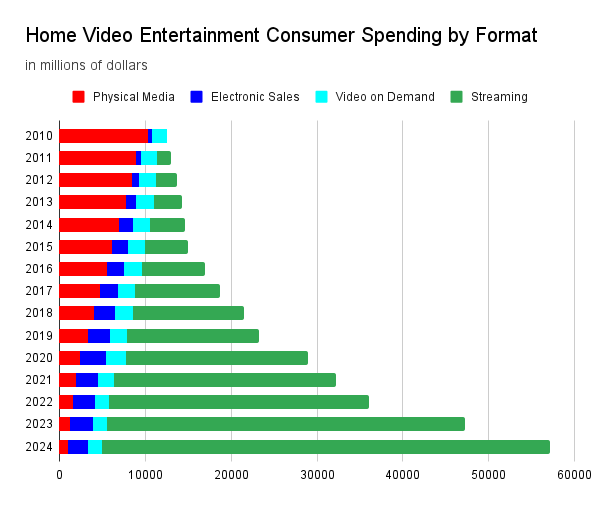
The streaming age has marginalized physical media. I have no regrets for ridding myself of my analog music recordings and almost all of my compact discs back in 2010. However, I was less dismissive of my pre-recorded videos, and I still have all of my various DVDs and Blu-rays. The only digital video format I completely abandoned was HD-DVD back in 2008.
Nevertheless, for over a decade Wendy and I have mostly rented streaming movies from Amazon or Apple. Physical media has become a tiny niche market for enthusiasts. I have several DVDs (1997-), Blu-rays (2006-), and 4K UHD Blu-rays (2016-) awaiting my attention post-retirement, but for me they have been a dubious investment.
Samsung stopped making Blu-ray players in 2019 and LG stopped in 2024. That same year, Best Buy stopped selling physical media, and Target phased out DVDs and Blu-rays except for a very limited rotating selection. Sony, which invented the Blu-ray format, stopped producing recordable Blu-ray discs in February 2025, although as of early 2026 it still produces read-only discs and players. The only other remaining major producer of players is Panasonic.
There are still some valid reasons for buying Blu-rays: quality, features, and guaranteed availability. Streaming video runs at 15 to 25 megabits per second, while UHD Blu-ray typically runs at 90 to 144 megabits per second, providing less compression, richer colors, and superior detail in dark and fast-moving scenes. However, I’m not all that discerning, having rented many a movie on VHS back in the day. Most streaming looks fine to me.
More persuasive for me are features such as making-of or historical documentaries and audio commentaries that come with many discs. The Extended Editions of Peter Jackson’s The Lord of the Rings movies are exemplars of the added value that discs can provide. You can find some commentaries online, but their functionality pales in comparison to the ease of using a commentary audio track on a pre-recorded movie on optical disc.
The most ardent collectors are driven by fear that licensing changes could remove a movie from any streaming service, even if you supposedly “buy” it, since all you are buying is unlimited rentals while they have rights to stream it. If I were worried about that, I could purchase movies from Apple and download and store them on a solid state drive at home, but I don’t rewatch movies enough to worry about that.
Spinning vs. Streaming Treks
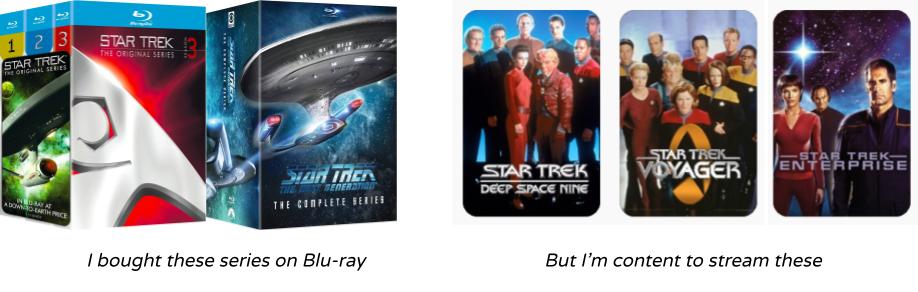
A review of my disc purchases over the past 15 years reveals that few of them were worthwhile to me. As a devoted old-school Trekkie, I enjoyed watching the high-definition broadcasts of the remastered original series of Star Trek from 2006-2009 using Meador Manor’s over-the-air reception antenna, and later I bought those remastered episodes on disc. However, I’ve watched very few of those discs.
The Next Generation series was remastered from 2012 to 2014, and I went ahead and bought the discs of those episodes in high-definition, but I’ve not bothered to watch them, despite my strong interest in and paid support for the reaction videos by Josh and Alex on the Target Audience YouTube channel, where they are watching all of the classic Trek series in broadcast order. As an avid Trekkie from 1972 to 2005, I was so familiar with the first three series (Star Trek: The Original Series, Star Trek: The Animated Series, and Star Trek: The Next Generation) that I could just watch the Target Audience reaction excerpts, feeling no need to revisit the episodes themselves.
However, once Target Audience reached Deep Space Nine, I had a decision to make. I hadn’t seen those episodes since their original broadcasts from 1993 to 1999, so I did want to rewatch each one before watching the corresponding Target Audience reaction highlights and discussion. However, I was not at all tempted to purchase that series on disc to watch on the big television. Both it and the later Voyager series are currently only available in standard definition, with remastering not proving economically viable as of yet. So I was perfectly content to just purchase unlimited streaming rights to the 176 episodes of Deep Space Nine from Apple TV for $80 and rewatch them on my iPad.
Now, with Target Audience about to start Voyager, I have purchased unlimited streaming of its 172 episodes on Apple TV for another $80. Should Apple eventually lose its license to those shows, I won’t be shattered since I paid less than 50 cents per episode.
And no, I don’t plan to watch the post-Berman Star Trek series, for reasons thoroughly explained by Darrel William Moore. I did endure the first nine of ten episodes of the first season of Picard, and I suppose that I might eventually finish that series, since I hear its third season is redemptive, but I’m satisfied that my trek concluded over twenty years ago.
Other Series on Disc
I have a few other television series on disc. Like the two Trek series I own, those have sat unwatched for many years. My other favorite science fiction TV show was the reimagined Battlestar Galactica, which was on cable TV from 2003-2009, and I bought it on Blu-ray when it concluded, but I’ve never rewatched the entire thing.
In 2010, I bought a box set of DVDs of The Six Million Dollar Man. That is the only series on disc I’ve systematically watched, but even after sixteen years, I’ve only finished two of the five seasons. However, I expect to eventually finish it, 50+ years after my childhood viewings. Currently, the only way to stream that old show would be to subscribe to Roku. I already pay for Amazon Prime, Apple One, and sponsor seven video creators on Patreon, so I have no interest in paying for more subscription services. I’m quite happy to have it on disc, especially given my fickle interest.
Only one of these box sets has been worthwhile to me thus far
A misfire was my purchase in 2015, before it was readily available on streaming, of the box set of the 1960s Batman television show on Blu-ray for $100. I have fond memories of enjoying reruns of it in the 1970s, but it has been over a decade since I bought those discs, and I’ve only watched the premiere episode. Nowadays you can get unlimited rentals of its three seasons on Apple TV for $70. I might watch some of the discs on some cold winter days after I retire…or I might not.
It should be no surprise, given my track record, that I haven’t bought any more television shows on disc in the past decade.
Spinning Up Some Movies
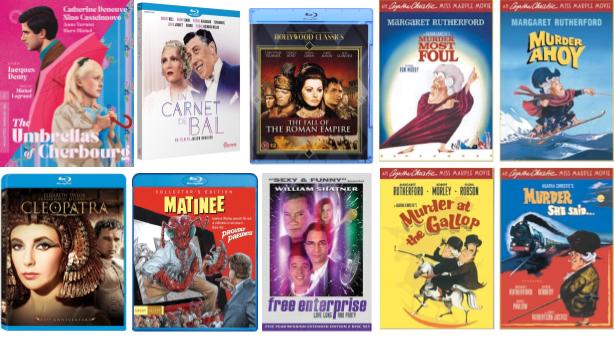
Over the past eight years, ten movies on disc have managed to build up at home, awaiting my retirement, including four old Miss Marple movies with Margaret Rutherford which I asked for Christmas one year.
Movies I have on disc that I plan to watch sometime after I retire
After I retire, in addition to catching up on my discs, I also expect to finally watch some major films that came out over the past few decades. However, I’d rather stream those, and search out commentaries and documentaries online, than acquire more discs for our living room shelves. We’ll see if the entertainment industry will oblige.
Linear television is dying, but with retirement approaching, I decided it was worthwhile to restore free over-the-air broadcasts to Meador Manor.
I bought our home in southeast Bartlesville in 1994. Built in 1981 near the end of an oil boom, it came with coaxial cable wired to two walls of the living room and to each bedroom, but I noticed that it lacked a television antenna. I had grown up with them in Oklahoma City, which did not have cable TV service until 1980, when I was 14 years old.
Analog Broadcasts
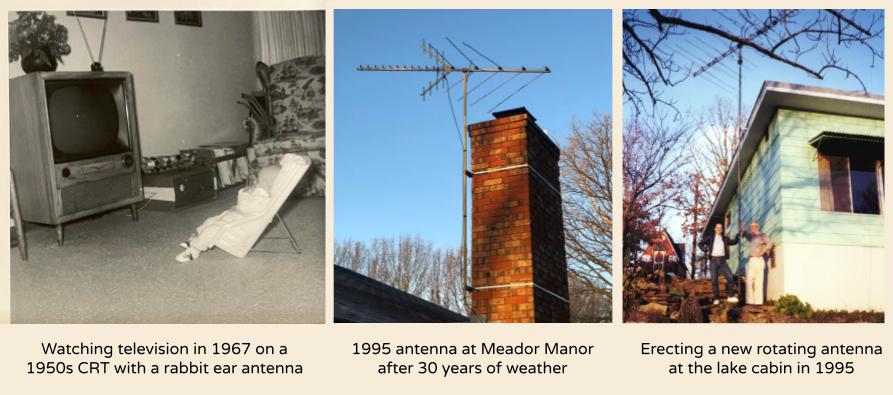
Back in my hometown there are huge broadcast aerials on Britton Road, less than three miles from my parents’ first house. So until I was in first grade, we just had “rabbit ear” antennas atop 1950s black-and-white televisions. We later moved to about 8-10 miles from the transmitters, and larger very-high-frequency (VHF) antennas hidden up in attics captured the analog signals for channels 4 (NBC), 5 (ABC), 9 (CBS), and 13 (PBS) for our color cathode-ray-tube television.
Some of the antennas I’ve used over the decades
Our vacation cabin in Missouri, however, was over sixty miles from the towers for Springfield’s stations, so it needed a huge antenna on a mast to pull in their signals. When I finally purchased my own home in Bartlesville in 1994, I didn’t need an antenna, since I subscribed to cable television.
Funly enough, I had first seen cable TV in the 1970s up in Bartlesville, when my parents and I visited some of their former co-workers here. They could watch a few dozen channels in little Bville while metro OKC at the time was still limited to just the four broadcast channels.
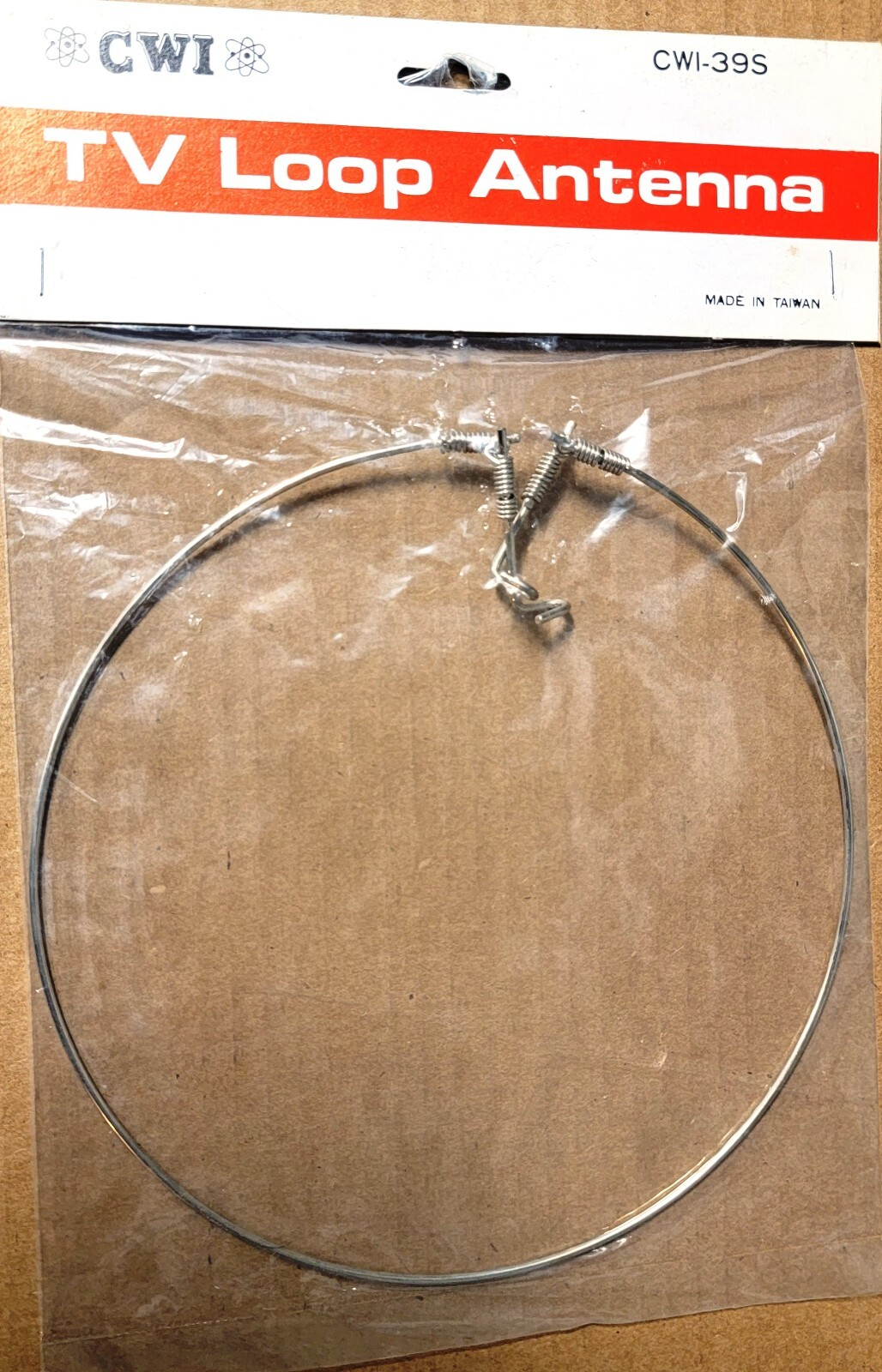
These little loops were used to pick up nearby UHF stations
Televisions once came with tuners for analog Very High Frequency (VHF) channels 2-13 and analog Ultra High Frequency (UHF) channels 14-83. Eventually a few UHF channels began broadcasting in OKC, but since our old attic antennas were not designed to pick up those frequencies, we attached little UHF antennas to the televisions’ UHF terminals. Those were loops instead of rabbit ears and worked fine since the UHF towers were not far away.
Then little microwave antennas started sprouting up on some neighborhood roofs to pick up pay television like Home Box Office, and finally coaxial cable service became available.
Cable TV
When Cox Cable first launched in OKC in May 1980, it carried 31 analog signals. The four VHF and two UHF broadcasters were represented, plus things like the USA Network, WGN-Chicago, WTBS-Atlanta, a weather channel, and the extra-cost channels of HBO and Showtime. The first full-time cable news channel, CNN, debuted that June, and Music Television (MTV) arrived over a year later.
When I was in high school in 1982, I would tune in TMC 43 on KAUT Channel 43 for music videos until I convinced my parents to subscribe to cable, which allowed me to watch MTV. That greatly broadened my awareness of popular music, although MTV later became symbolic of cable’s decline.
As Michael Girdley noted in his video about it, MTV long ago switched away from concentrating on music videos to reality programs and game shows that snagged higher ratings. Like me, he is a member of Generation X, and despite not seeing any of MTV for decades, it caught my attention that at the end of 2025 they finally shut down their remaining music channels, with just one hour of music videos airing each week in the USA on their main channel.
When I left for college, I had my own cable TV subscription and my parents cancelled theirs, reverted back to analog over-the-air broadcasts. A decade later, in January 1995, my recently-purchased home in Bartlesville was one of almost 60 million across America that had cable television. However, none of the available channels had elected to carry the premiere of the syndicated Star Trek: Voyager show on the fledgling United Paramount Network. As a Trekkie since 1972, I was pretty frustrated.
Meador Manor’s First Antenna
Voyager was airing on one of the over-the-air broadcast channels not carried on the local cable system, so I went to the Radio Shack in Eastland Center and bought an antenna, chimney mount, mast, grounding rod and wire, conduit, signal booster, and coaxial cables. My friend Carrie helped me get the antenna mounted to the chimney, and I was able to pull in the analog television signals from various transmitters.
Wouldn’t you know, a few days later, before the second episode of Voyager even aired, one of the cable channels belatedly started carrying the show. That meant I actually made no meaningful use of the antenna while paying for cable, although the hard-won experience prepared me for helping my father replace the larger antenna at the cabin in Missouri and, years later, I was ready to replace the antenna in my parents’ attic in OKC to improve their UHF reception.
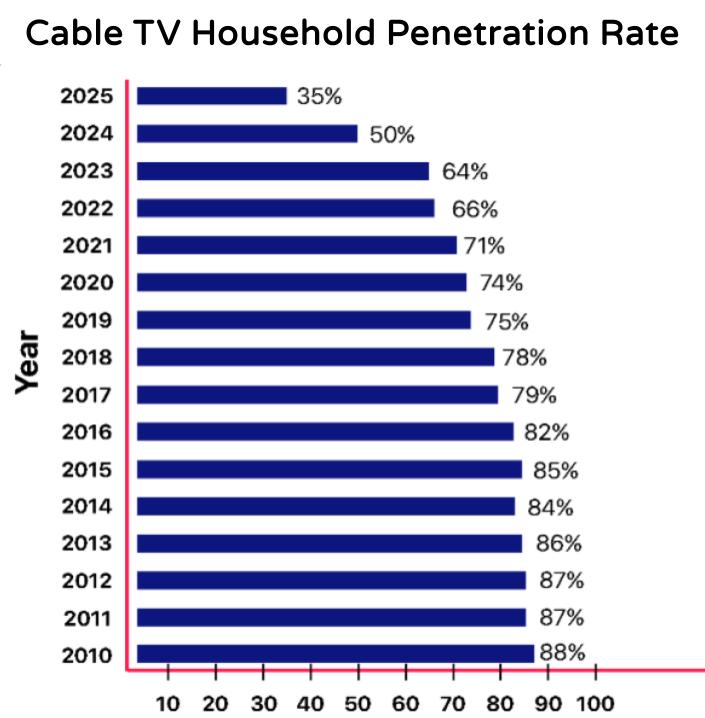
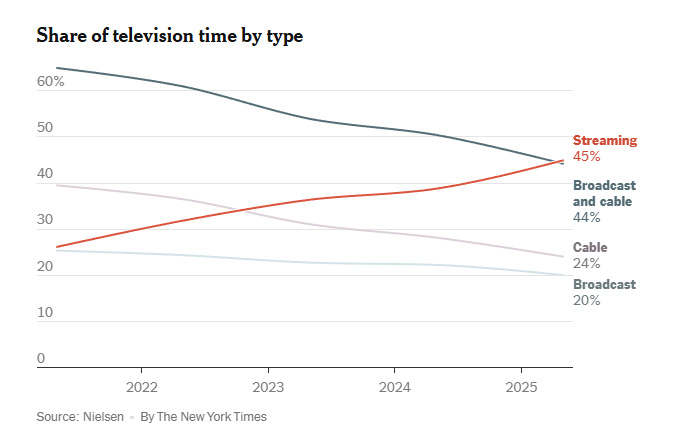
Cable television had expanded to 9 out of 10 households by 2008, the year I cancelled it. It took 17 years for the majority of the country to catch up, but by 2025 reportedly only about 1 in 3 households still had cable TV.
I cut off my basic cable TV service while retaining the cable system’s internet service. My reasoning was that the last of the Star Trek series, Enterprise, had been cancelled in 2005 and the last cable television channel I regularly watched was the SciFi channel, just to see the reimagined Battlestar Galactica and old reruns of Mystery Science Theater 3000. By 2008 I could get those fixes via the internet, so it no longer made sense for me to pay for oodles of basic cable channels I never watched. It shouldn’t surprise you to be told that I had no interest in satellite TV, either.
Analog to Digital Broadcasts
The switch from analog to digital broadcast television signals in the 2000s allowed broadcasters to send out both high-definition signals as well as multiple DVD-resolution subchannels. I could then pick up dozens of broadcast digital channels with my chimney-mounted antenna, although the only time I bothered with that was from 2006-2009 when the old Star Trek original episodes from the 1960s were remastered and broadcast in high definition, plus an occasional PBS program I would record for use in my high school classes.
Digital television was great for my parents back in OKC, although many broadcasters shifted away from using VHF channels 2-6 to broadcasting digital signals on higher frequencies. For example, old WKY, Oklahoma’s first television station in 1949 and the state’s first color station in 1954, which became KTVY in 1976 and then KFOR in 1990, stopped transmitting on channel 4 and instead that NBC affiliate began transmitting on UHF channel 27, masked as virtual channel 4. Similarly, the CBS affiliate shifted from analog signals on channel 9 to digital ones on channel 39 and then shifted again to channel 25 when the FCC reallocated more bandwidth away from television. Now most stations actually broadcast on channels 7-36, although there are a few in isolated locales which still broadcast on 2-6, with many virtual channels allowing broadcasters to pretend they are still using their old analog frequencies.
I helped my parents negotiate the analog-to-digital transition with converter boxes for their older bedroom televisions and a new high-definition 16:9 LCD television for their living room. Since their 1960s antenna up in the attic was only designed to pick up VHF signals, and many stations were now broadcasting on UHF, I also installed a new VHF/UHF antenna and booster in their attic, with coaxial cables snaking to three different rooms below. Tyler the Antenna Man has a video explaining the three types of television antennas.
The Decline of Linear Television
My father died in 2022 and my mother moved to an independent living facility in Bartlesville. It had local cable TV available at first, but then Sparklight reportedly stopped providing service to it. The elderly are the most engaged demographic for linear TV, so a new provider was promptly identified using alternate technologies.
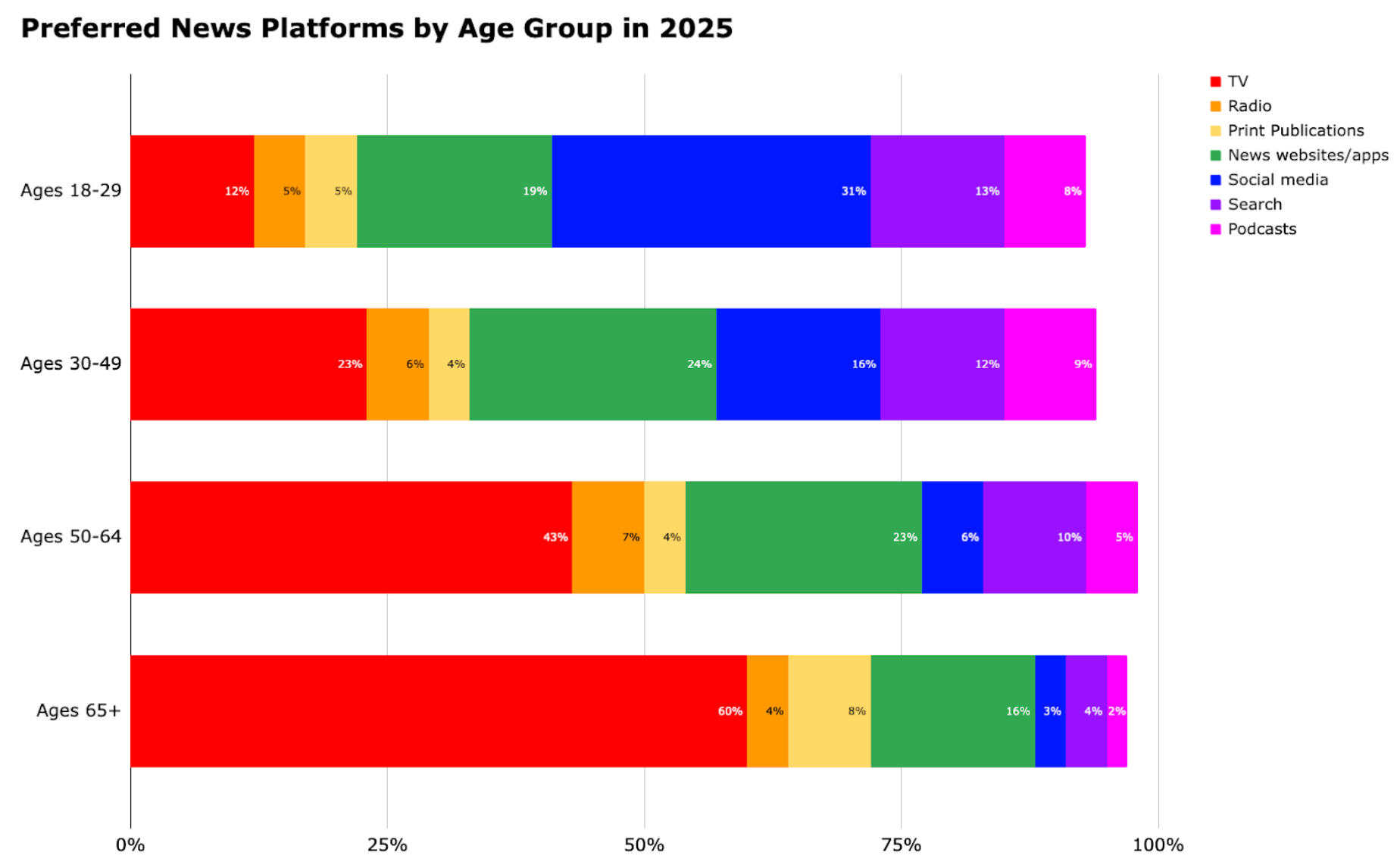
Another indicator of the contraction of linear television came in December 2023, when the Tulsa ABC network affiliate, KTUL, shuttered its local news production. KTUL is owned by the repugnant Sinclair Broadcast Group, which is now also influencing Tulsa’s Fox 23, with an allied company holding the broadcast license to dodge FCC restrictions. The percentage of US adults reporting they regularly watch local TV news declined from 46% in 2016 to 29% in 2022. By 2025, in the key advertising age demographics of 18-29 and 30-49, television news was only preferred by by 12-23% versus 19-24% for news websites and apps and 16-31% for social media, with print and radio their least preferred news platforms.
The inexorable decline of interest in linear television explains why there wasn’t more outcry about the Republicans’ cutting off federal funding for public broadcasting. The Corporation for Public Broadcasting is gone, with the surviving Public Broadcasting Service reliant on individual donations and various underwriters.
CBS will cancel The Late Show in May 2026, and while the urban left-wing politicization of the various late night talk shows’ monologues has presumably alienated at least 40% of their potential audience, the general decline of linear television also explains the monetary argument behind CBS terminating its offering, which was hosted by David Letterman from 1993 to 2015 and then by Stephen Colbert.
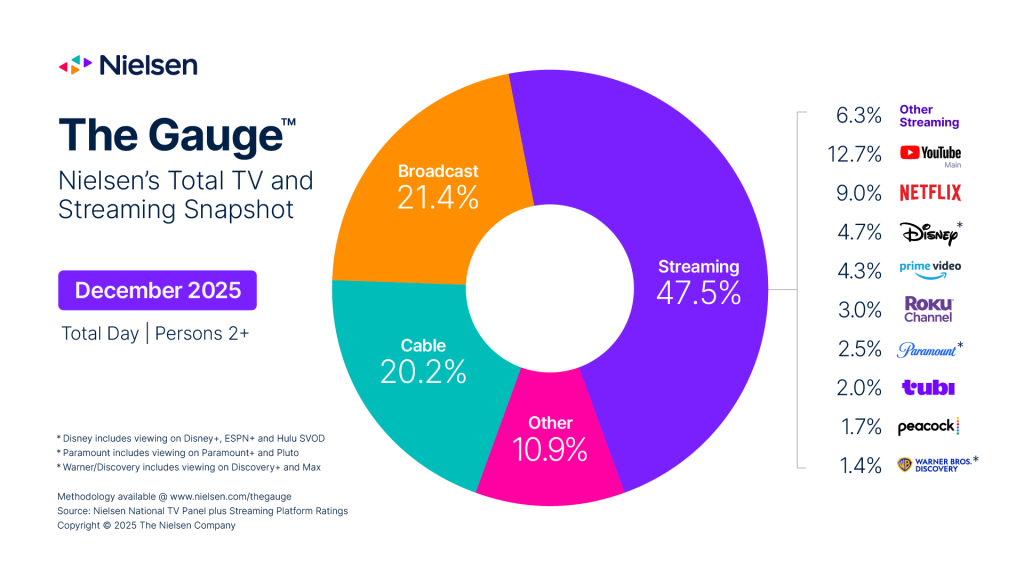
Nielsen’s nationwide summary showed that at the end of 2025, cable and broadcast TV were each only attracting about 1/5 of viewers.
While Wendy and I rely heavily on YouTube Premium to reduce advertisements in its on-demand offerings, we have no interest in paying for YouTube TV to get linear television via the internet. However, I’ll be retiring in June 2026, and I will have much more time for things like shows on the OETA educational station. Its high-definition broadcasts on channel 11-1 are much clearer than what it streams over the internet.
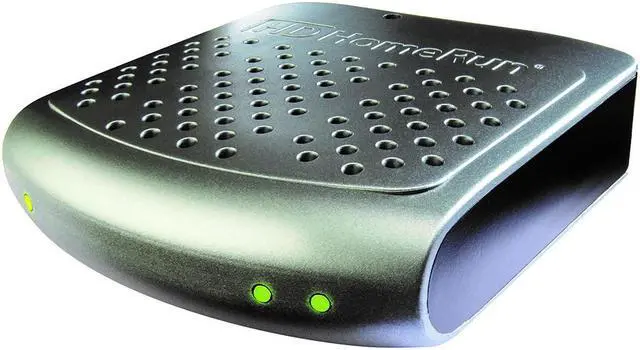
My HD Homerun from 2018
So I thought it would be nice to have that and other over-the-air broadcast channels available not only on the big TV in the living room but also on our iPads and my desktop computer. I also wanted the same digital video recording capability that I had once enjoyed with Tivo DVRs, allowing me to skip commercials and pause live transmissions.
Back in 2018 I had briefly experimented with an HD Homerun unit for that purpose. So I reinstalled that box, splitting the antenna booster’s output to it and the television’s own tuner and plugging the HD Homerun into the network router. I loaded the HD Homerun app on my iPhone, iPad, and Mac, and while I had to turn off my Virtual Private Network (VPN) for the Mac application to work, the iPhone app didn’t mind.
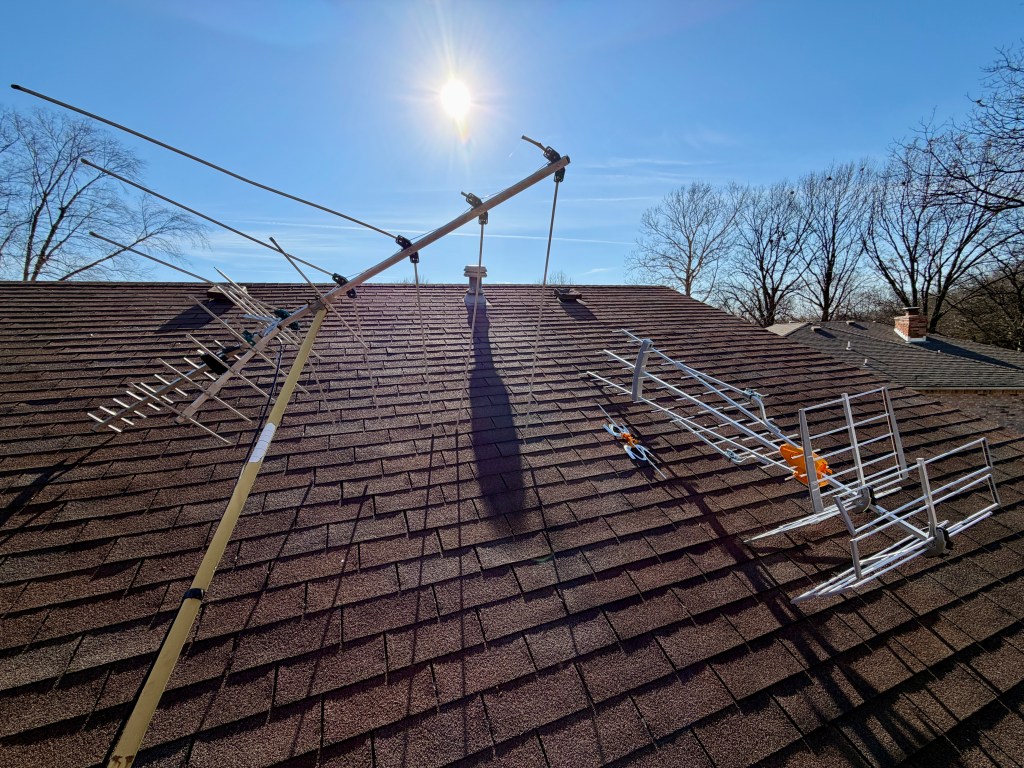
An ice storm damaged part of the VHF array on my 1995 antenna
The old antenna had lost its ability to pick up low VHF channels 2-6 many years ago when its longest log-periodic dipoles were snapped off in a storm. However, that didn’t matter after the digital transition when all of the regional channels shifted to broadcast on channels 8-36, as shown at rabbitears.info and antennasdirect.com. The shorter dipoles on my old antenna could still pick up VHF 8-13 and the Yagi-Uda end-fire array could still pick up UHF 14-36.
Well, at least it could a few months back, when in a test the television was pulling in 72 broadcast channels. Now the HD Homerun was only receiving Channel 2 and its seven subchannels, which actually broadcast on VHF channel 8. Did splitting the antenna signal across the TV and the HD Homerun weaken it that much? Or had a recent snowstorm dealt the antenna a near-death blow?
I disconnected the splitter, hooked the TV back up directly to the antenna, checked that the 1995 Radio Shack signal booster in the living room was on, and found that the TV was only receiving Channels 2 and 6 and their various subchannels, so it was only picking up high VHF channel 8 and UHF channel 26.
I wasn’t sure what was wrong. The old booster had a cranky connection in my recent test, so while waiting for decent weather to brave climbing up on the roof, I ordered a Winegard Boost XT pre-amplifier. By the time it arrived, the weather had improved from snow and a high of 46° F (8° C) to a sunny 65° F (18° C). I climbed up on the roof with the booster, tools, and coaxial accessories.
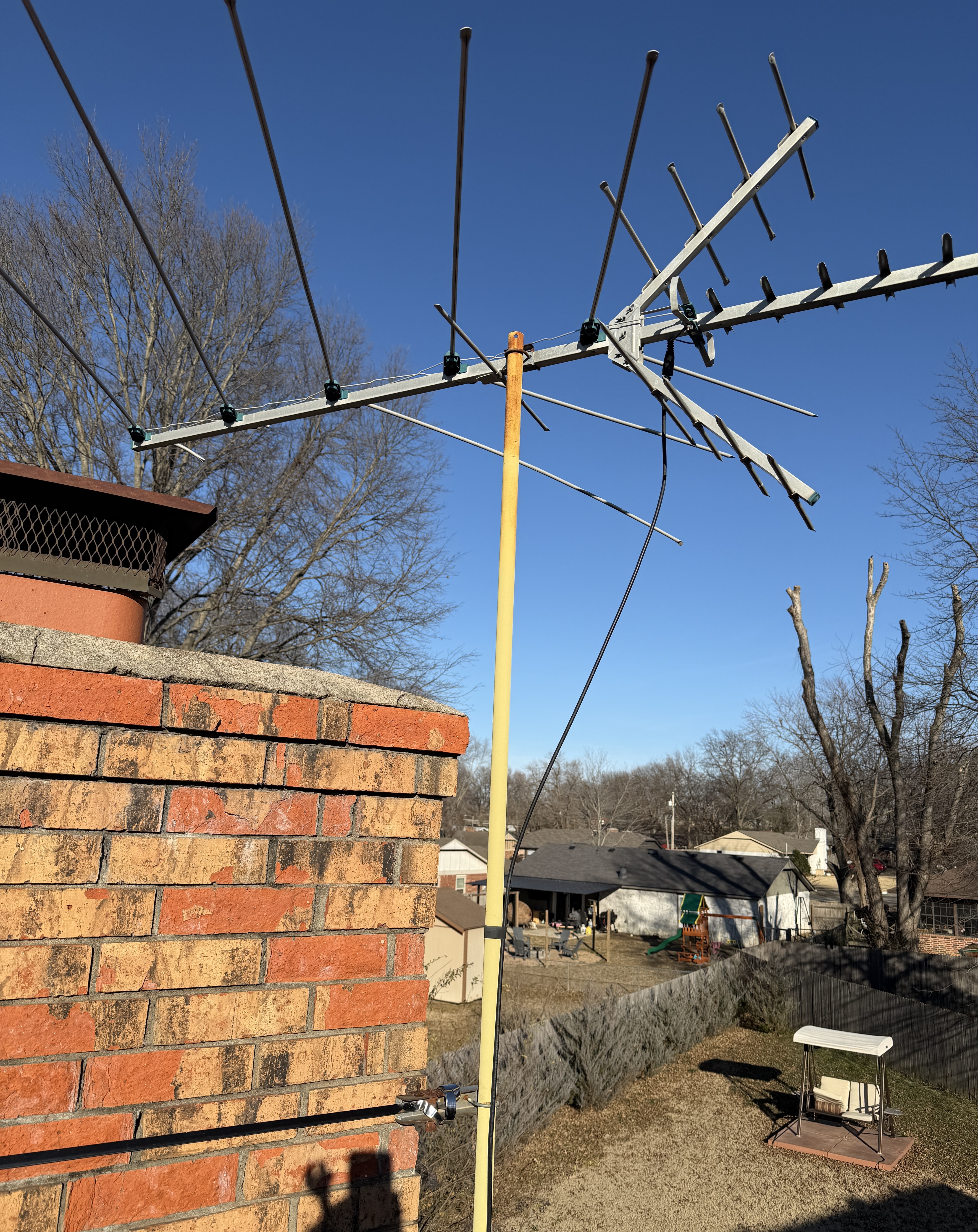
The shadows are of my crescent wrench and my iPhone (and yes, I know the chimney brick is shot)
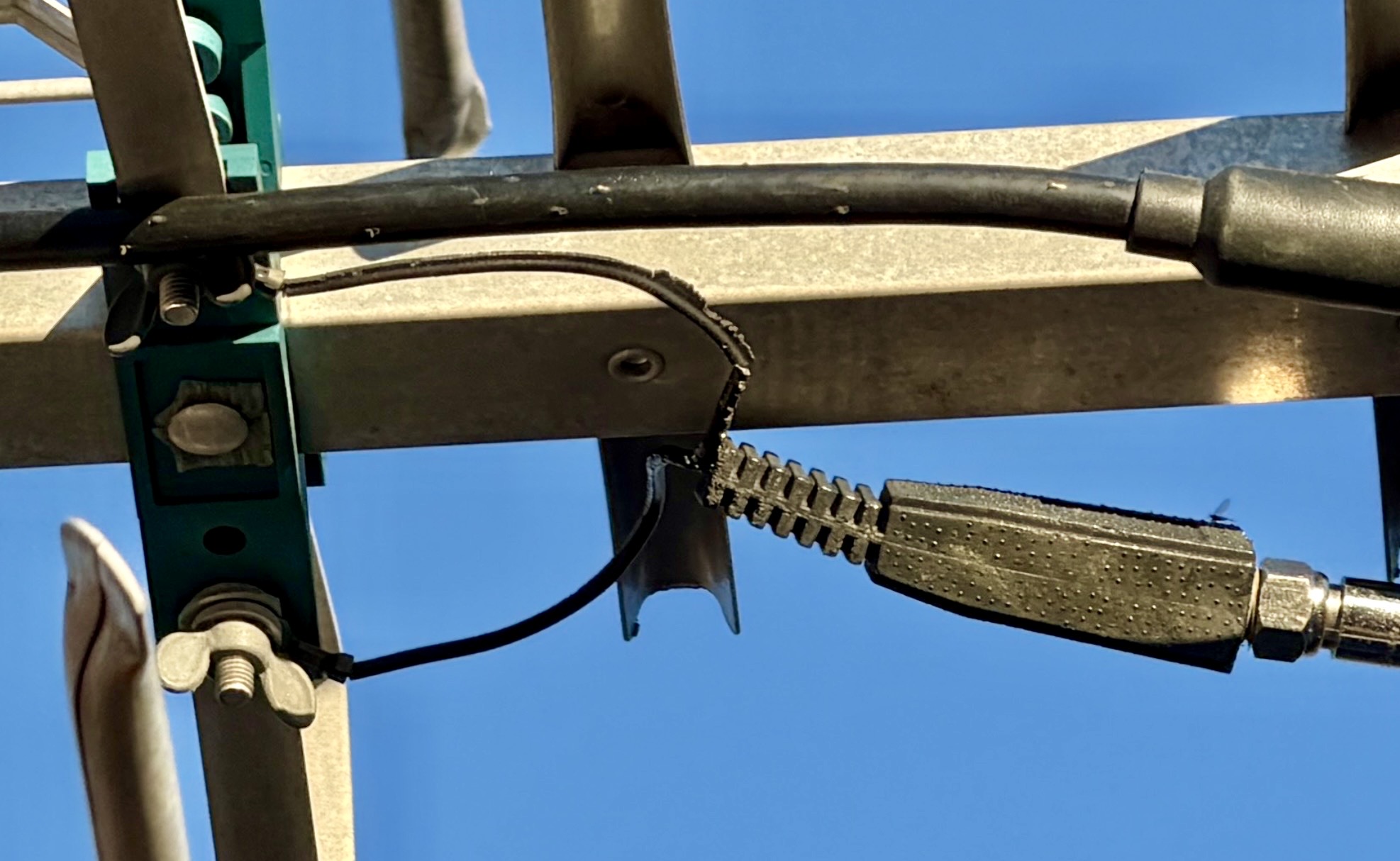
I discovered that the coaxial cable was screwed into a balun right up at the antenna, too high for me to reach. The mounting hardware was still in decent shape despite over 30 years of weathering, and even the electrical tape holding the coaxial cable to the mount was still okay. Ethel, one of our outdoor cats, and a couple of neighbor dogs thought I was a rooftop menace, while if my human neighbors spotted me, they were kind enough to leave me to my work.
I was able to slowly loosen the bolts on the clamps, remove the upper clamp completely, and then lift and tilt the mast out of the loosened lower clamp to lower the mast and antenna to the rooftop.
The insulation on the twin leads of the balun had degraded
Unfortunately, the insulation on the balun adapting the balanced 300-ohm twin leads on the antenna to the unbalanced 75-ohm RG-6 coaxial cable had degraded, and the leads felt quite flimsy. I had no replacement on hand, so I went ahead and wired the pre-amplifier onto the antenna and remounted everything. Back down in the living room, I hooked in a box to send power back up the coaxial cable to the booster and hooked up the television. However, now it wouldn’t pull in any stations at all. I figured the balun up top was shot, and it was time to reconsider my approach.
Amplification and Reception Limits
Pre-amplifiers can’t make up for an inadequate antenna; they are more about addressing signal attenuation through the downstream coaxial cable and any splitters. Practical and reliable reception can be expected for stations up to 70 miles away with a high-quality long-range antenna; while there are plenty of antennas advertised as having longer range, the curvature of the Earth makes such claims bogus.
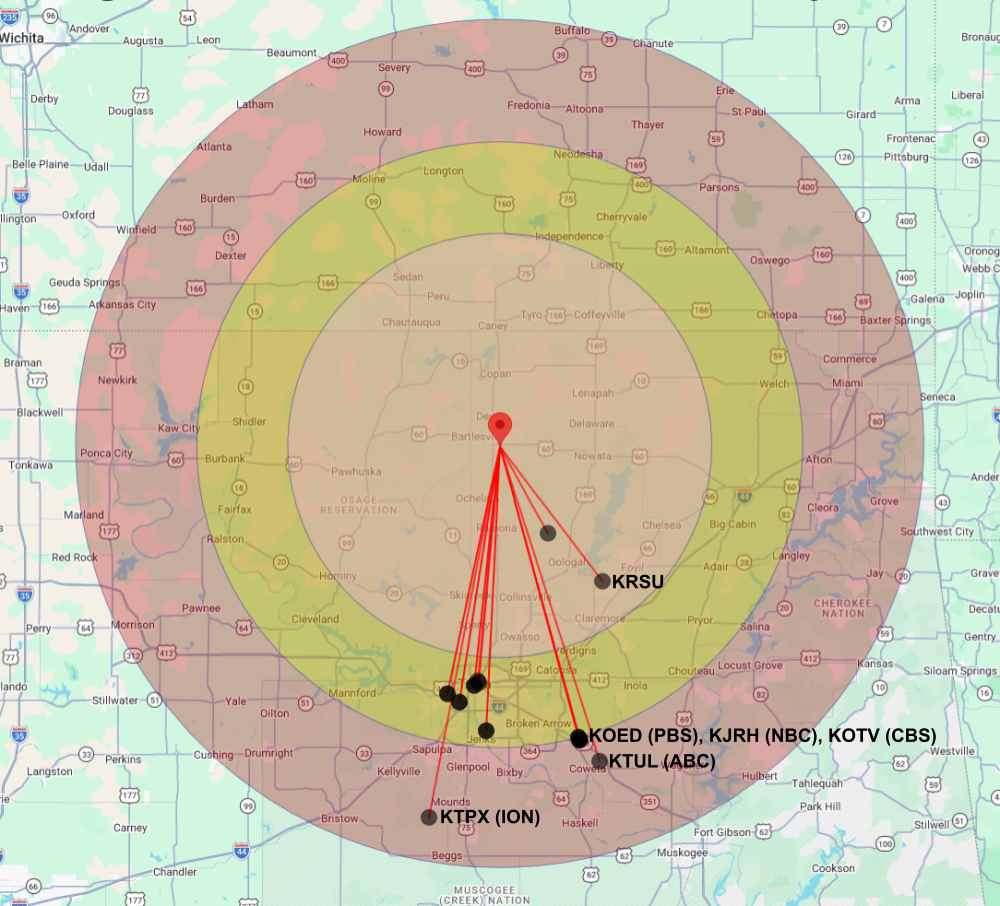
There are 20 transmitters within 70 miles of Meador Manor. The closest broadcast antenna, for a religious station, is 16 miles away, and the important antennas for the NBC, CBS, and PBS affiliates are 50 miles away, the ABC affiliate’s one is 55 miles away, and there is an Ion affiliate in Muskogee that broadcasts from 63 miles away. Thankfully they are all situated to the south, so I have no need for a rotating antenna.
The broadcast antenna locations in relation to Meador Manor [Source]
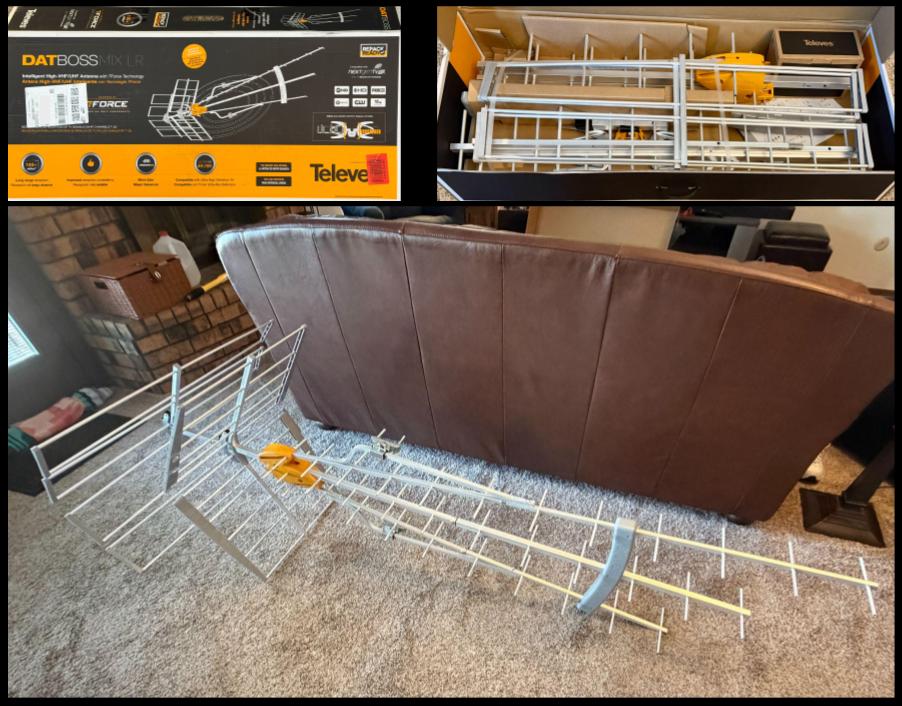
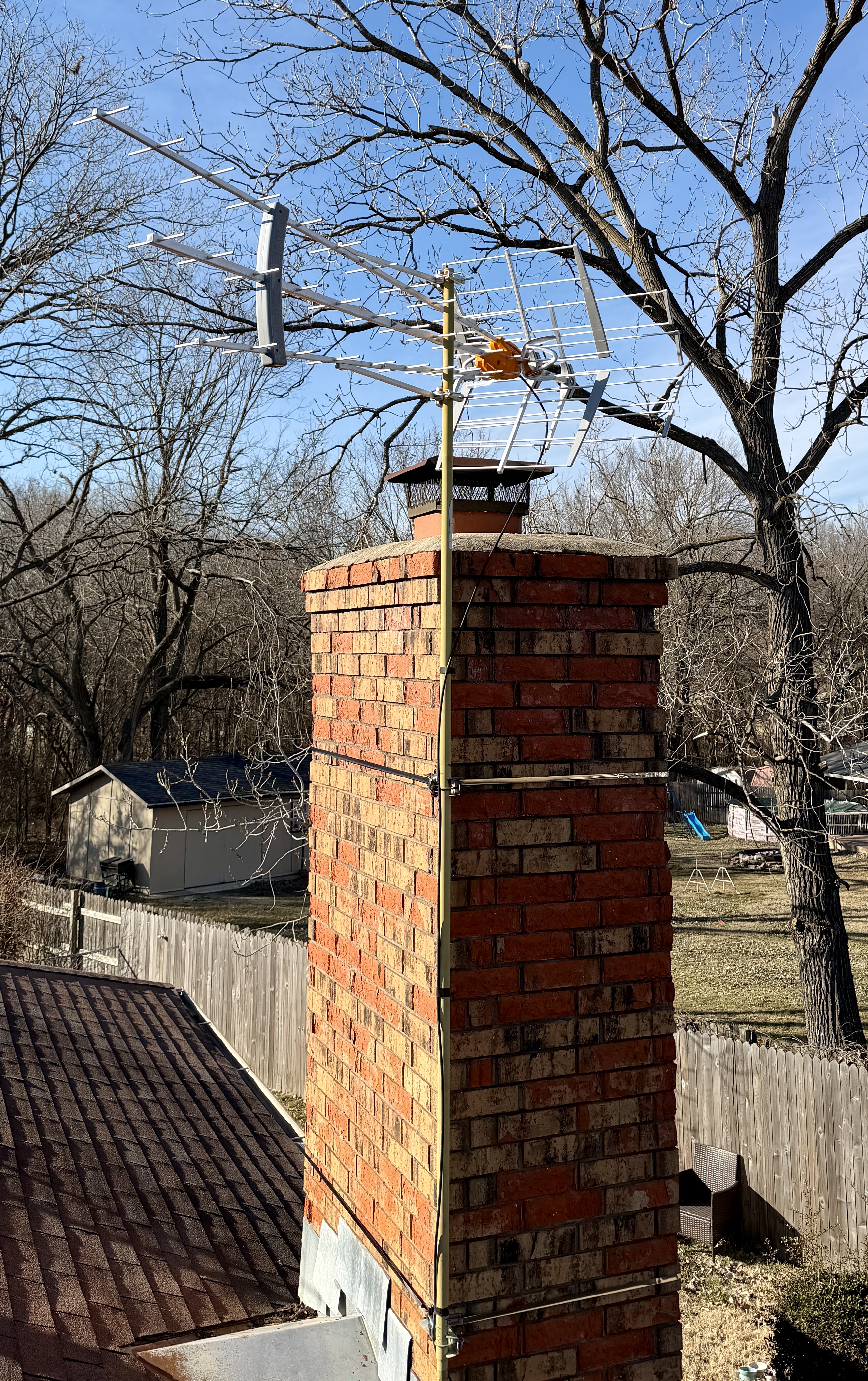
Since I was going to have to endure the cumbersome process of dismounting and remounting the antenna again, I decided to give up on the damaged 31-year-old antenna, which had been designed in the days when television was broadcast on a wider range of VHF and UHF frequencies. While I was still young enough to handle the task, I would erect a new long-range antenna with a built-in pre-amplifier that was designed to pick up channels 7-36 and reject 5G cellular signal interference.
The new antenna arrived in a few days, and I assembled it in the living room.
I took it up to the roof and lowered the mast and old antenna.
Out with the old, in with the new
The new antenna is 86 inches long while its rear UHF reflectors and VHF array make it 29 inches tall, and I was concerned if it would clear the chimney with the old chimney straps and mounting pole. Thankfully, it did.
I used the compass on my iPhone to guesstimate the orientation of the directional antenna, trying to point it at 165 degrees to aim for the PBS, NBC, ABC, and CBS affiliate transmitters between Broken Arrow and Coweta.
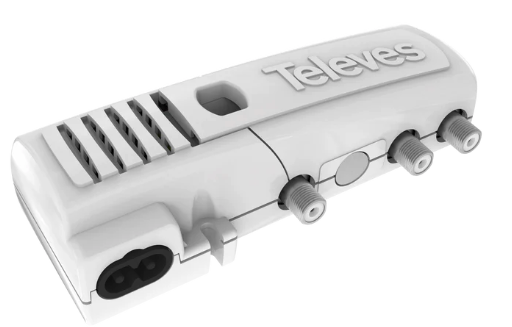
The inside power unit and splitter
I tossed the old antenna down and then crumpled it into a trash can. Down in our living room, I wired up the power unit that sends power back up the coaxial cable to the built-in booster within the antenna housing, and I hooked up coaxial cables to the television and the HD Homerun.
Huzzah! Both devices were picking up 73 channels, including the off-axis channel 44 broadcasting on UHF 28 from 63 miles away. Only seven of the 73 channels, from the low-power KUOC, a far-off-axis transmitter 42 miles away at Chandler Park in west Tulsa, were too weak to lock in reliably.
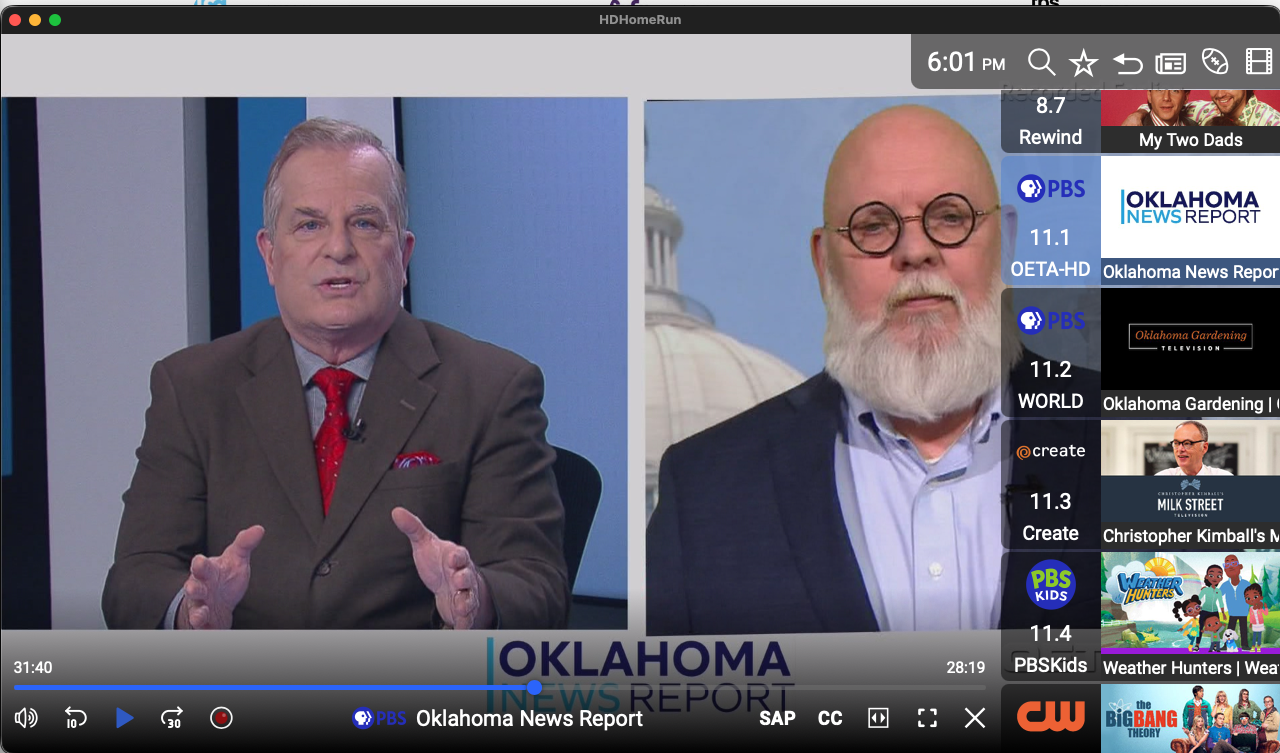
Watching OETA in high-definition on my Mac with the HD Homerun app
I deleted the seven weak channels along with twenty religious channels. (Can you tell we live in the Bible belt?) That left me with 46 channels, nine of those being high-definition. For those who love details: we get 1920 by 1080 interlaced signals for KJRH 2 (NBC), OETA 11 (PBS), KOTV 6 (CBS), KQCW 19 (CW), and KRSU 35 (RSU); 1280 by 720 progressive signals for KTUL 8 (ABC), KOKI 23 (FOX), KMYT 41 (MyN), and KTPX 44 (ION); and either 640 by 480 or 720 by 480 interlaced for the remaining 37 channels. Rabbit Ears has all the details.
Linear Limitations
All of those signals use the original ATSC broadcast standard for free over-the-air digital television. There is a newer ATSC 3 standard, but the Tulsa market doesn’t yet have any such transmissions. ATSC 3 is a mess since it includes digital rights management that could require an internet connection and even pay-to-view. The oligarchs running our corrupted federal government might eventually change the FCC rules and no longer require broadcasters to provide free over-the-air signals, but for now I can access more linear television options, with no subscription fees, than I had years ago with my first basic cable offering, and we can also stream them to our tablets, phones, and computers.
I paid the $35 annual subscription for the HD Homerun DVR feature, configuring it to record shows on my Mac Mini. I tested it by having it record an episode of the 1950s Adventures of Superman show broadcast on the MeTV network affiliate. That worked fine, but it also reminded me of its two major turnoffs for me: advertising and editing for time.
The episode I watched was only interrupted by advertising a couple of times, but they were long strings of commercials, much longer than what I experienced watching reruns in my youth a half-century ago. My DVR recording allowed me to skip past them, but their length led me to expect that some of the original episode would have been cut for time, something that also plagued the original Star Trek series when its reruns were syndicated in the 1970s.
This ending scene was cut from the MeTV transmission
The rather formulaic Adventures of Superman show typically had a closing scene in the offices of the Daily Planet, much like the original Star Trek series a decade later often featured a coda on the starship’s bridge. Those wrap-ups were used to tie up any lose plot threads and usually ended on a humorous note. The episode I watched on MeTV lacked such a coda and left a major plot thread hanging.
To confirm my suspicion, I bought that episode on Amazon Prime for $2. The print quality wasn’t great, but it did include the expected final scene. For research purposes, I also bought that episode for $3 from Apple TV. Same lousy print, but also the expected coda.
That sort of thing limits the value of linear television for me, although I don’t expect that to impact the high-definition versions of PBS programming. Linear TV will continue to contract as the Silent and Baby Boomer generations age out and as cable TV becomes increasingly expensive. I expect some cable companies will eventually discontinue their linear TV operations and just offer internet access. However, thanks to our new antenna, linear television lives again at Meador Manor.
APRIL 2026 UPDATE:
On April Fool’s Day, a lightning bolt struck so close to the house that it created a potential difference between the grounding rod for the antenna and the main ground for the home’s electrical system. That blew out the television. I considered going to the effort and expense of bonding the two grounds together, but since we had made virtually no use of the restored reception, I opted to just disconnect the antenna and the booster from the television. Bringing broadcast linear TV back to the Manor was a fun exercise, but in the end it was not worthwhile to us, given our lack of engagement.
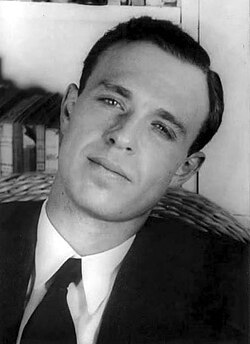
Adolfo Bioy Casares was an Argentine fiction writer, journalist, diarist, and translator. He authored ten novels and novellas, including the 126-page novella La invención de Morel or The Invention of Morel, which included an introduction by his countryman and prize-winning writer Jorge Luis Borges.
The novella won the First Municipal Prize for Literature of the City of Buenos Aires in 1941, and although it was his seventh work, Bioy Casares thought it launched his writing career.
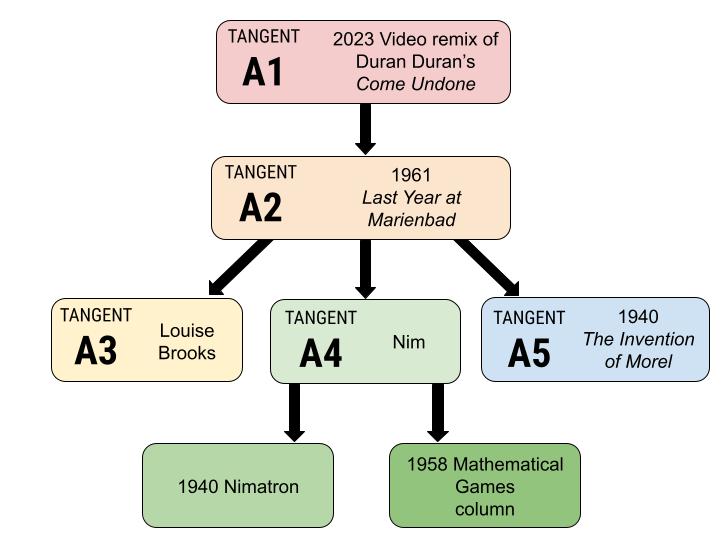
The writer of the 1961 French New Wave film Last Year at Marienbad, Alain Robbe-Grillet, wrote an admiring but mixed review of it in Critique magazine in 1953. The first drafts of the screenplay had Hispanic names, but it eventually evolved into characters named X, A, and M in the script but never named in the bewildering film. While Robbe-Grillet denied the connection, the connections are obvious, so I suspect he was trying to avoid copyright claims. As Kirby Ferguson would say, “Everything is a remix.“
The Invention of Morel was translated into English and published by the University of Texas Press in 1964, but went out of print until reissued as a paperback in 2003 by New York Review Books Classics. There is a Kindle edition, but it is reportedly a bad scan full of errors, so I bought the paperback, which interestingly has the silent film actress Louise Brooks on the cover with her distinctive bob.
That’s because Bioy Casares was fascinated by Brooks and disillusioned by the decline of her career. She had disappeared from the screens of Buenos Aires after three or four movies, and he modeled the character of Faustine in the novel after her. Hence the desire of the director of Last Year at Marienbad to have his lead actress resemble Brooks.
The novel not only served as inspiration for Last Year at Marienbad, but also influenced the science fiction television series Lost, which featured a mysterious island and was broadcast from 2004 to 2010. In season four, a lead character is seen reading Bioy Casares’ novel.
The novel begins, in translation, with, “Today, on this island, a miracle has happened: summer came ahead of time.”
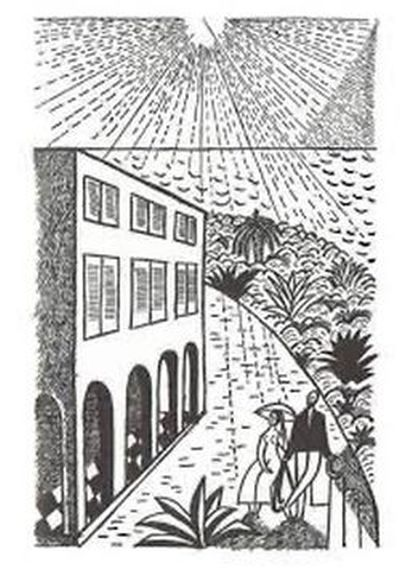
Illustration of tourists strolling past the “museum” in The Invention of Morel
Ann Manov summarized: “A group of elegant French tourists arrive in 1920s dress, like summer tourists at ‘Los Teques or Marienbad.’ Lounging around the hotel and the garden, they have the same banal conversations over and over again. One of them is an enigmatic, Gypsy-like woman sporting a bob and a headscarf. Her name is Faustine, and the fugitive follows her around the island, desperately in love. But she simply does not notice him.”
There are other mysteries, such as two suns or moons in the sky, and the tourists shivering under a hot sun, dancing in a storm, and swimming in a pool filled with rotting fish. Some of the weirdness reminded me of the children’s science fiction television series The Land of the Lost from 1974-1976.
The book explains these mysteries as effects from the titular recording and reproducing machine of Morel, who may be in love with Faustine.
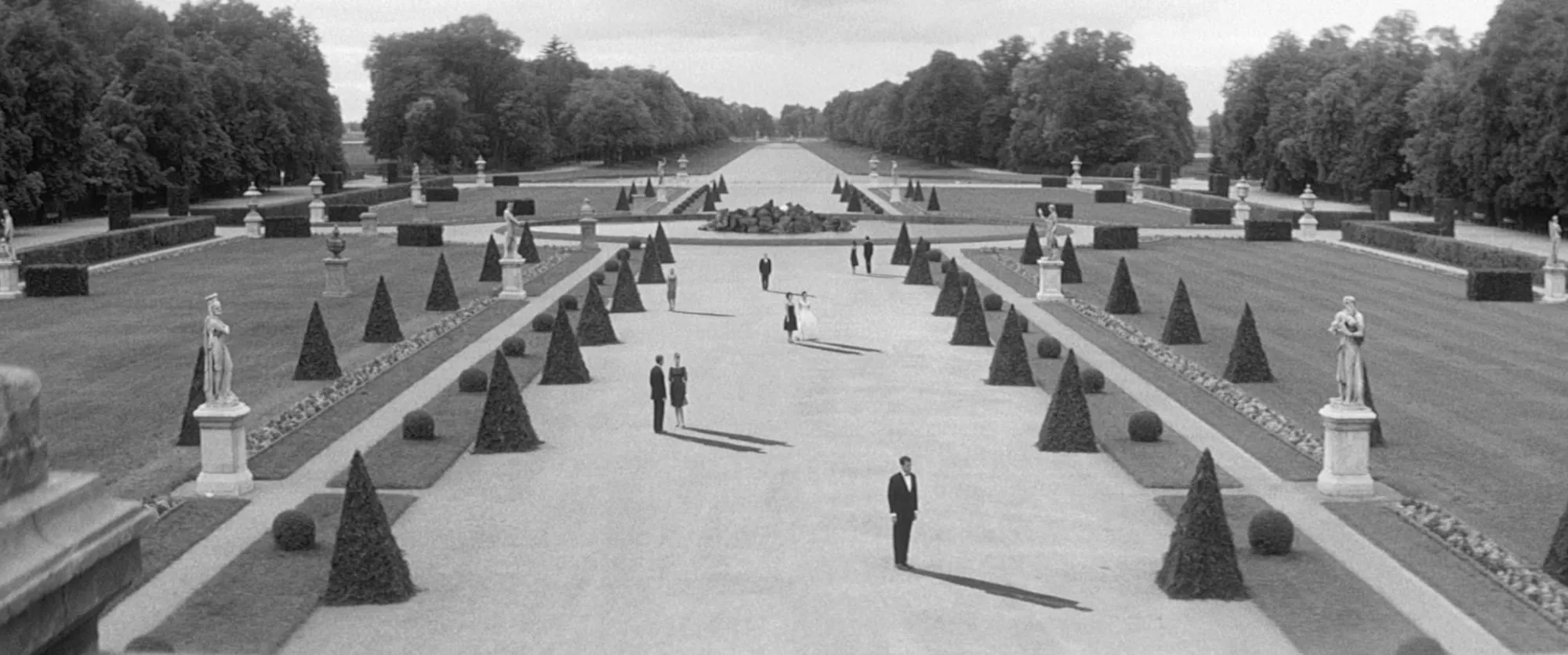
One of the most memorable images from Last Year at Marienbad features a different sort of disquieting wrongness in the environment. Tourists in the formal garden stand and cast shadows, but the statues and conical shrubbery do not. This was achieved by shooting the scene at high noon with false shadows painted onto the ground.
In other scenes, the garden decorations do cast obvious shadows, heightening the dissonance.
There are also repeated changes in a hotel bedroom through the film which reflect a man’s repeated remoldings of a woman’s memories/reality into preferred forms.
The book was interesting, although I would disagree with Jorge Luis Borges’ claim that it is perfect. I liked a throwaway line in which the narrator shared his plan to write a book to enshrine the memory of a man who had assisted him, declaring that the memory of men is the probable location of heaven. I liked that concept: after all, a fellow had just been “resurrected” in my mind 80 years onward, thanks to the novella.
And with that, I close out this first series of Tangents. A music video of an old English pop song to a French New Wave movie to an acerbic Kansan actress in German silent films to an ancient mathematical game to an 85-year-old Argentine novella. What am I going to do when I retire? You have a partial answer.



















 Meador Manor