August 3, 2012
July in Joklahoma, and August for that matter, are not conducive to happy hiking. So this isn’t a post about yet another day hike with photos. I’ve been spending my summer break in the air conditioning, reading classics on my Kindle. Or at least I was until I became immersed in promoting a vital new school bond issue, which has left me little time for a relaxing read.
Childhood Friends
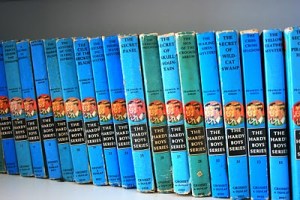
Childhood mysteries
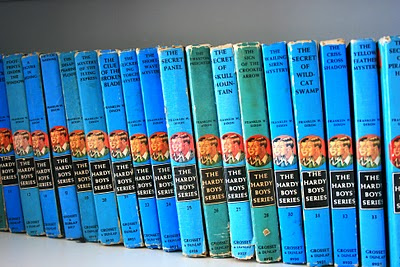
Over the course of a year, my reading rate these days is about a book a week, although with all of my hiking since the summer of 2009 much of that “reading” has been in form of listening to audiobooks on the road and on the trail. I’m too distracted in transit for anything deep, so I listen to mysteries or podcasts. As a child I read all of the mystery and adventure series I could find: I owned and read every one of the original 58 Hardy Boys books repeatedly and then about 35 of the Three Investigators books. Careful to only read them in private to avoid mockery, I also raided my aunt’s collection of Nancy Drew, Trixie Belden, and Dana Girls titles from the 1960s and earlier. The author of the Encylopedia Brown stories passed this summer, but I always found those stories far too short and trite.
Mystery and History for the Road
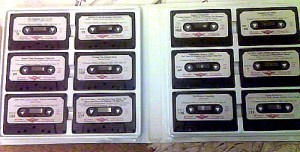
Old school audiobooks
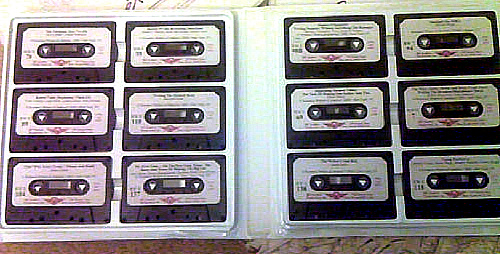
My good friend Carrie the Librarian, or Media Specialist in these times, kindly introduced me to the Ellis Peters mysteries years ago. I steadily worked my way through all of the Cadfael books, and a few others of Edith Pargeter‘s books which I could find in audiobook form, whenever I was driving on an extended trip. That was back in the audiocassette days and I was borrowing them from the Tulsa Public Library with a paid membership since I live outside that county. Since Ellis Peters’ audiobooks were filed at the library next to those of Elizabeth Peters, I eventually read through all of her Vicky Bliss and Jacqueline Kirby mysteries and her stand-alones, but the one book I read in her Amelia Peabody series was a turn-off.
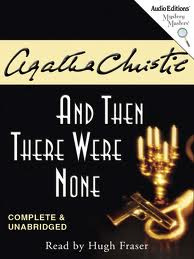
Christie audiobooks
Then I took on Agatha Christie, who was a far better writer than either of the Peters. Given my rapid burn rate on books when I began the regular day hikes, I was grateful Dame Agatha was so prolific. I bought from Audible, for use on my iPhone, all of the Hercule Poirot and Miss Marple novels and most of the stand-alones, and now have only a couple of Tommy and Tuppence novels left. There are still many Christie short stories I can listen to, but I find the novels more satisfying.
And for podcasts there is nothing I find more entertaining than listening to the incomparable OU historian and classicist J. Rufus Fears. His delightful lectures range from ancient history to great books to democracy. He’s a superb storyteller and listening to him is always a splendid treat.
Another favorite person for me to listen to is polymath author Simon Winchester. I must agree with Linda Hart that his “smooth-as-satin baritone English accent is sublime.” I was lucky enough to hear him in person at one of the University of Tulsa’s Presidential Lectures and he was quite charming.
But when I’m not in transit and can actually sit down by the window in my favorite recliner and read, I want something different than a typical mystery or lecture. I want science fiction or history or a great novel from another genre.
A Confederacy of Dunces
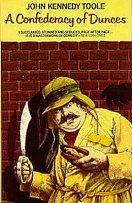
A Confederacy of Dunces
My summer reading began with the Pulitzer-prize winning A Confederacy of Dunces by John Kennedy Toole. The contrast between the hilarity to be found in its chapters and the tortuous journey of the book into print, along with the author’s tragic end, is quite poignant. David Foster Wallace also did himself in, but Toole is a far more entertaining companion than the too-clever Wallace, although Wallace’s essay A Supposedly Fun Thing I’ll Never Do Again is a classic.
Toole had a great ear for New Orleans patois and a true gift for great characters. The protagonist Ignatius J. Reilly is declared in the foreward to be a “slob extraordinary, a mad Oliver Hardy, a fat Don Quixote, a perverse Thomas Aquinas rolled into one.” Well, I tried to read the renowned Don Quixote awhile back, and gave up out of boredom about 1/6 of the way in, but Ignatius J. Reilly never bored me a bit. I was so amused at his reactions while he was watching the Doris Day flick That Touch of Mink at the cinema that I rented the movie on Netflix to see what he was blubbering on about.
Doris Day plays an out-of-work office worker who is lured by a wealthy businessman, played by Cary Grant, to Bermuda to embark on an affair. Ignatius, watching this in the cinema and to the consternation of fellow movie watchers, erupts:
“Filth!” Ignatius shouted, spewing wet popcorn over several rows. “How dare she pretend to be a virgin. Look at her degenerate face.” . . . “They’re photographing them through several thicknesses of cheesecloth,” he spluttered. “Oh, my God. Who can imagine how wrinkled and loathsome those two really are? I think I’m getting nauseated. Can’t someone in the projection booth turn off the electricity? Please!”
. . .
“Good grief. Is this smut supposed to be comedy?” Ignatius demanded in the darkness. “I have not laughed once. My eyes can hardly believe this highly discolored garbage. That woman must be lashed until she drops. She is undermining our civilization. She is a Chinese communist agent sent over to destroy us. Please! Someone with some decency get to the fuse box. Hundreds of people in this theater are being demoralized. If we’re all lucky, the Orpheum may have forgotten to pay its electrical bill.”
Ah, the days before VCRs, DVDs, and streaming movies.
Emma
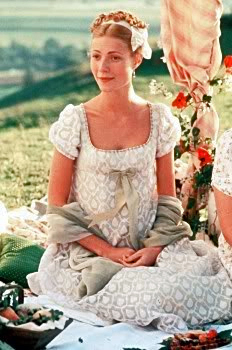
Paltrow was perfect as Emma
Last summer I examined several lists of great novels and took on Lolita and Under the Volcano. I’d thoroughly enjoyed the Pulitzer Prize winner I started off with this summer and felt brave enough to finally try some Jane Austen, emboldened by how often adaptations and mentions of her books crop up. I had really liked the movie version of Emma when I stumbled across it some years back, so I decided to try that novel. One nice thing: Aunt Jane is out of copyright, so her work is free for the asking.
These days, with my aging eyesight, I truly prefer to read my e-ink Kindle over a paper book, but I was reminded of one drawback of that format as I slowly made my way through Emma. I found myself wondering just how long the darn book was!
Granted, I was taking my time in the book. The prose reads as stilted to my modern ear, showing, or perhaps I should say shewing, its age since the book dates back to 1815. It is hard to imagine people talking as they do in Emma, especially after years of listening to Agatha Christie, who had a marvelous ear for dialogue, brought to life in the audiobooks. English has changed noticeably over that time, something I’ve thoroughly explored in fun lectures by John McWhorter, with an obvious example from Emma being how nice has changed its meaning over time. I was also pausing to read the SparkNotes after every three chapters, mostly to savor what I’d read since it was all pretty clear despite my lack of familiarity with the life of an aristocratic young woman in England in the early nineteenth century. Emma was a breeze compared to the embedded humor in Lolita or, lord have mercy, the complexities of Under the Volcano.
Anyhow, I really started to wonder how long this glacially paced story was going to be. Later at a Barnes & Noble bookstore I used the time-honored method of gauging the thickness of different Austen books which had similar formatting. Sure enough, Emma was much thicker than the rest. Online I find Emma is about 158,000 words, with only Mansfield Park coming in higher at 160,000. Sense and Sensibility has 119,000 while Pride and Prejudice is svelte at 83,000 words, and I suspect that its length assists the latters’ popularity.
I finally finished Emma and don’t regret that I read it, but I’m not inclined to sit and read through more of dear old Aunt Jane, although I might watch some of the recommended movie adaptations of her work.
Cleansing the Palate: Nora Ephron and SciFi
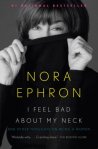
Nora and her neck
After the close and confined world of Emma, both geographically and culturally, I was ready for a change. Nora Ephron, the writer of one of my favorite movies, When Harry Met Sally, had just died. Obituaries mentioned one of her recent books, I Feel Bad About My Neck. I sampled it on my Kindle and enjoyed it enough to buy the thin volume, although who can really tell on an e-Reader? The essays were quick and funny, a relief after the slow pace of Emma.
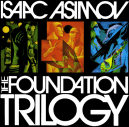
An Honored Classic
I decided to advance further in time by returning to Isaac Asimov’s crystal clear galactic prose. I’d re-read the original Foundation trilogy at the start of the summer, so now I re-read the two sequels. I remember being astonished to see Foundation’s Edge in the old Henry Higgins bookstore at the Windor Hills shopping center when I was in high school. After over 30 years, Asimov was taking up the Foundation saga again? Oh boy!
I still liked Foundation’s Edge, although it is weaker than the original trilogy, and the later Foundation & Earth was always too contrived for me and still annoys with its endless revisiting of the question over whether or not the choice of a Galactic Gaia over a Second Empire was the right one. After those books, I was not at all tempted to re-read the weak very late Asimov Foundation prequels nor those by Benford, Bear, and Brin.

Old-Fashioned Asimov
Instead, I chose to re-read, for the first time in decades, Asimov’s very early Empire novel The Stars, Like Dust. It was fun to see echoes of the pulpy bombast one finds in E.E. “Doc” Smith‘s now very dated tales popping up in that early Asimov work. And I will point out that even though I own all of the Asimov science fiction novels as paperback or hardback books, I downloaded and read them on the Kindle because I like its portability and font size control so much.
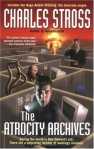
The book is NOT atrocious
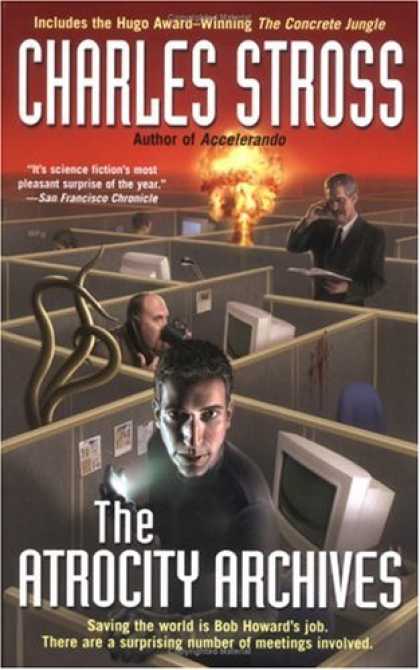
After soaking in old Asimov tales for awhile I was ready for something new. I saw reviewer praise for Charles Stross’s new The Apocalypse Codex, and I had loved Saturn’s Children, his tribute to Heinlein’s late career novel Friday, and also enjoyed his Eschaton novels. But Codex is the fourth novel in his Laundry Files series, so I started at the beginning with The Atrocity Archives, which is a novel and novella in one volume. That was a wild ride, one which I could enjoy the better since this year I’ve read for the first time many of H.P. Lovecraft’s tales. The Laundry Files books mix science fiction and horror, being set in a world where mathematics and the many-worlds model in quantum theory lead to phenomena commonly misinterpreted as witchcraft and demonology. I thoroughly enjoyed the first volume and will read the rest, but for me a little bit of horror goes a long way.
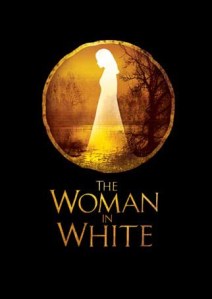
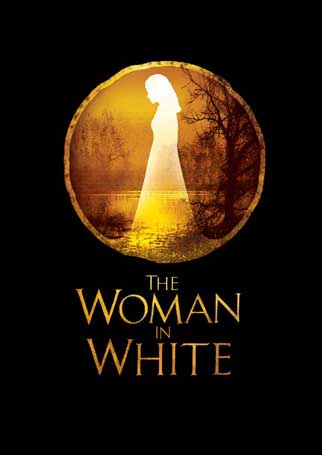
The Woman in White
This isn’t Dickens
I was ready to shift genres and read something old that would be new to me. I came across a couple of mentions of The Woman in White by Charles Dickens’ friend Wilkie Collins, as an example of an early fine mystery and “sensation novel”, so I downloaded and read it next; another freebie out of copyright!
I generally don’t like epistolary novels, but The Woman in White uses many different unreliable narrators, which made it far more interesting. The main villain is a memorable character, vividly brought to life, and there is a fairly strong female character who contrasts well to her milquetoast companions. I think the protagonist was foolish to not pursue her over her sister, but who can explain love?
I liked this passage:
So the ghostly figure which has haunted these pages, as it haunted my life, goes down into the impenetrable gloom. Like a shadow she first came to me in the loneliness of the night. Like a shadow she passes away in the loneliness of the dead.
Which brought to my mind the epitaph of the great astronomer and mathematician Johannes Kepler. We know what he wrote, although his grave was lost in war:
Mensus eram coelos, nunc terrae metior umbras: mens coelestis erat, corporis umbra jacet.
“I measured the skies, now I measure the shadows; sky-bound was the mind, earth-bound the body rests.”
I enjoyed the book enough that I’ll put Collins’s The Moonstone on my reading list, but I think I’ll head back to the future for my next read.










 Meador Manor