NW Passage Day 1: Marland and Midgley Manors

Marland's Grand Home (click image for slideshow)

I decided to spend the last part of my 2012 Spring Break at tourist sites I’d previously neglected in far northwestern Oklahoma, extending out to the very tip of the panhandle, or “No Man’s Land”. I spent many hours driving what signs proclaim as Oklahoma’s “Northwest Passage” during this three-day adventure.

I began with the exasperating drive west from Bartlesville to Ponca City along US 60. The route remains mostly a shoulderless two-lane road bobbing through the Osage Hills. I was delayed by the typical problems created by this inadequate road, stuck behind the slow wide load of a section of metal grain silo until the driver was able to pull over by the entrance to Osage Hills State Park and allow the accumulation of cars behind him to pass.

The weather was misty and overcast with frequent light rain all of the way to Ponca City, where the weather had the refinery producing immense clouds over the road as I turned north to visit Marland’s Grand Home.

E.W. Marland was a colorful oil man who became a self-made millionaire twice, married his adopted daughter, and became Oklahoma’s tenth governor. He made his first oil fortune back east and lost it in 1907, came west to the Ponca City area and by 1920 he was almost a billionaire in inflation-adjusted dollars. From 1914-1916 he had built for him and his first wife, Mary, a great home on Ponca’s Grand Avenue. He and Mary adopted her niece and nephew, Lydie and George, in 1916. After Mary died in 1926 E.W. had his adoption of Lydie annulled and married her in 1928. I’ve repeatedly visited the gorgeous Marland Mansion he built between 1925 and 1928, one mile from his Grand Avenue home. He only briefly enjoyed that grander estate with Lydie before his company was taken over by J.P. Morgan. Marland and Lydie vacated the mansion for its smaller artist studio and guest house by 1930.

Marland’s bad experiences with eastern banking interests made him an oddity among his fellow Oklahoma oil men: a New Deal Democrat who would be elected to congress for 1932-1934 and elected Oklahoma’s tenth governor from 1935-1939. He seemingly took his oath of honesty seriously, as he and Lydie were impoverished at the end of his term and moved into the former chauffeur’s quarters at the mansion in 1941, selling off the remaining mansion property, with E.W. Marland dying a few months later. Lydie lived in the chauffeur’s quarters until 1953, then roamed the country for 22 years working odd jobs. A childhood friend of hers financed her return to the chauffeur’s cottage in Ponca City in 1975, and Lydie lived there until her death in 1987.

I have thoroughly enjoyed each of my previous visits to the 1928 mansion and what remains of its grounds, but had never toured what is called “Marland’s Grand Home” – a fun play on words for the 22-room mansion he and Mary shared on Grand Avenue from 1916 to 1926. While the pink stucco home on Grand Avenue may pale in comparison to the magnificent mansion a mile to the northeast, the 16,500 square foot Italian Renaissance Revival home on Grand Avenue was a wonder for its day with its central vacuuming system, automatic dishwasher, attached three-car garage, and the first indoor swimming pool in Oklahoma.

The Grand Home once had extensive formal gardens stretching several blocks eastward as part of the 15 acre property, and despite later being sold for housing parcels you can see its traces to this day on the Ponca City street map, where 11th,12th, and 13th streets oddly do not connect Grand Avenue to Central Avenue one block south. The property had four hundred trees transplanted from the Arkansas River Valley as well as scores of magnolias from Avery Island, Louisiana.

While his later mansion was designed by architect John Duncan Forsyth, who would later design Bartlesville High School, the Grand Home was designed by Solomon Andrew Layton, whose firm designed many Oklahoma City landmarks including the State Capitol and Skirvin Hotel, and also designed such landmarks of the University of Oklahoma campus in Norman as the Evans administration building, Bizzell Memorial Library, and Oklahoma Memorial Stadium.

The entry foyer has a large hanging staircase with turned spindle balustrade, illuminated by a Waterford Crystal chandelier which is worth more than my annual take-home pay. To the right is the oak-paneled library, which features a large wall painting, commissioned by Mary and later retrieved from the mansion, of Marland and friends out on one of the silly fox hunts he set up out at Lake Ponca. A Marland Oil sign hangs nearby, its familiar form reminding us that his company became part of Conoco. Fireplaces and chandeliers are a focus of attention in the home, including the library.

To the left of the foyer is the living room, with a fireplace featuring marble from the palace of Maximilian and elegant accents. Farther east is my favorite room in any mansion, the sun room. This cheerful and more relaxed room has a floor of black and white marble squares and would have provided a view of the four city blocks of formal gardens. The adjoining dining room has dark walnut wainscoting with silver and mirror wall sconces, along with another Waterford Crystal chandelier. Artist George Stanley Lasarsky hand painted the walls above the wainscoting and later would do the same for Philbrook in Tulsa.

That was followed by the functional butler’s pantry and kitchen with the entire home reminding me greatly of the larger mansion nearby in style and comfort. Even the less showy areas of the home feature wonderful Art Deco light covers of varying styles.

The most unusual feature of the home is the indoor swimming pool under the east patio, reminding me of the former one at the White House, which is now the press briefing room. It originally was lit from above via glass squares in the patio deck. The remainder of the basement level has archeological displays and an extensive and fun collection of memorabilia from the Miller Brothers 101 Ranch and Wild West Show. Located seven miles south of Ponca City, the immense ranch was home to a touring show which thrived in the early twentieth century. The former three-car garage is home to some Daughters of the American Revolution memorabilia.

I took the grand staircase up to the second floor, which has a few Native American displays scattered about the former bedrooms. The stand out for me was a girl’s room with hand painted scenes of active teenage girls reminding me of the little vignettes decorating the interior covers of Grosset & Dunlap’s Nancy Drew books. I wonder if Lydie had any notion of what adventures awaited her?

I exited the home and admired the façade another pretty home on the northwest corner of 10th and Grand, and then drove a few blocks to the Spanish Colonial style City Hall built in 1917 and designed by Layton and Smith. I saved a tour of its interior for a future trip, but admired the statue of E.W. Marland, which was sculpted by Jo Davidson and moved from his estate when it was donated by Lydie to the city in 1941. There is a nice Cherokee Strip Land Run bronze out front, sculpted by Jo Saylors and funded by citizens to celebrate the centennial of the run. Ponca City is smaller than Bartlesville and has a similar oil industry history. It is interesting how Bartlesville retains a much larger corporate presence and a healthier economy, yet Ponca City has a grander public space.

It was time for a delicious lunch of fajitas with puffy chips at Enrique’s at the Ponca City airport. Then I drove 70 road miles southwest to Enid for my next stop: the bizarrely magnificent Midgley Museum.

Midgley Museum

I pulled up in front of a small rock house, and do I mean ROCK. Dan and Libby Midgley used their oil money to go a-hunting for animal trophies along with rocks, fossils, and petrified wood. They encrusted the entire house with 34 different kinds of stone, including immense petrified logs. The stones were collected in Oklahoma, Texas, New Mexico, and Arkansas, with most of the rocks and fossils found near Lake Texoma. I’m not sure all of the collection was acquired legally, since the kindly volunteer couple manning the museum for the local Masonic lodge mentioned that one load of petrified wood hauled in by Dan’s workers from Arizona turned out to be from the protected petrified forest and he was fined $40,000 for the transgression and then had to have it all hauled back home to Arizona.

Out front is an odd little Masonic display and a truly immense petrified stump. The Midgley home’s interior is a collection of both valuable and worthless bric-a-brac with more rock encrustations on both fireplaces. A big trophy room has mountings of many animals both Dan and Libby shot, although I preferred other oddities such as a large Pond Creek School stage fire curtain adorned with painted advertisements. Amongst the many impressive rock specimens lurked a space monkey image, which gives you a pretty good idea of the wackiness on display. It was a fun stop with friendly docents.

Then I headed out west on US 412 to intersect Highway 3, proclaimed repeatedly by highway signs as Governor George Nigh’s Northwest Passage. He spearheaded funding to improve that road leading northwest from Oklahoma City up into and along the Panhandle. I drove over 200 miles from Enid to Guymon, my resting place for the night before hiking Black Mesa the following day.

The heavy clouds were a pretty addition to a rather monotonous drive through farm fields and ranching pastures as low mesas began to dot the landscape. The sun was setting as I approached Guymon for a late pizza and a welcome hotel bed.

Click here for a slideshow from this adventure

NW Passage Day 2 ->

Posted in photos, travel | 1 Comment

Skyscrapers in the Mist

Driving past downtown Tulsa tonight I was lured into circling the skyscrapers by the First Place Tower blasting broadsides of light into the mist above the other buildings. Click here or the image below for a slideshow.

Skyscrapers (click image for slideshow)

(With apologies to Dian Fossey)

Posted in photos | Leave a comment

The Phillips 66 Speedway and Signs of Spring

Through June 2018 the Bartlesville Area History Museum has an exhibit on display all about Micro-Midget Racing in Bartlesville!

The Museum is open M-F from 10-4 on the top floor of the City Center at 401 S Johnstone


Speedway Remains (click image for slideshow)

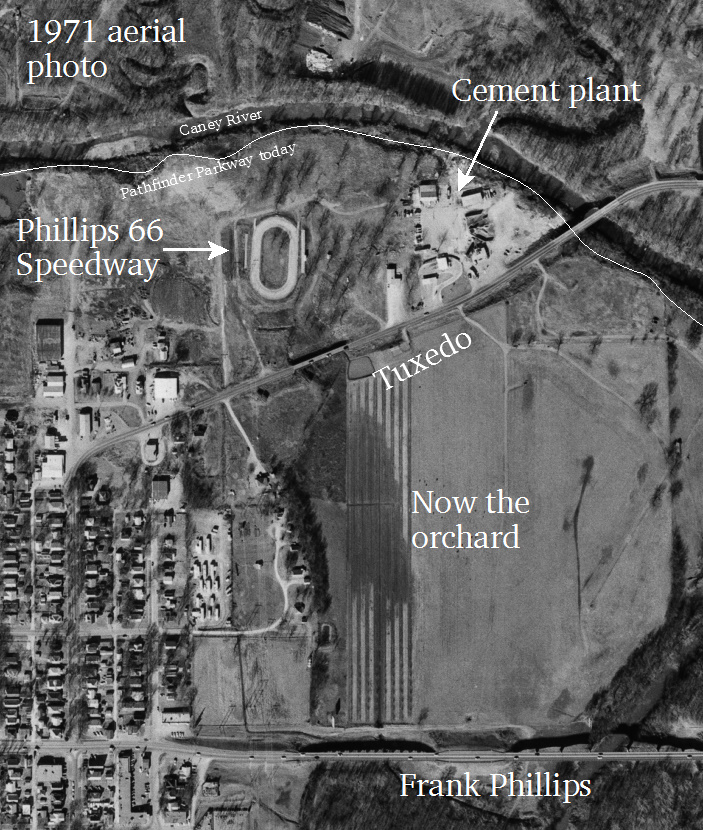
I walked the Pathfinder Parkway on a warm but overcast March afternoon on a quest to find the remains of The Phillips 66 Speedway, a Micro Midget racetrack which was tucked between Tuxedo Boulevard and the Caney River just east of Quapaw and Comanche. In a previous post I tracked down aerial views of the track and I wondered how much still remained in 2012.

The asphalt track disappeared long ago and the entire area is now heavily overgrown. Heavy growth and trees mark the center island of the speedway, with the remains of the east and west stands to either side, slowly succumbing to the relentless encroachment of nature.

The speedway is just south of my favorite bench on the Pathway, with horses grazing on the property immediately west of the former speedway. The area is along the power line route leading to and from the big PSO plant just south of Frank Phillips Blvd.

The area in question.

During my 4.75 mile walk from Atwoods to the location, I shot every little spring flower I encountered. I can never remember the names of plants, but I managed to identify wild blue phlox (both furled and unfurled), henbit, dog violet, the ubiquitous red buds, Bradford pear blossoms, and dandelions of different styles, and finally two examples of white flowers which I leave unidentified.

Click here for a slideshow from this walk

Posted in day hike, photos | 3 Comments

The 3rd generation iPad: resolution revolution?

Just how much does that improved resolution matter?

I loved my original iPad, which I paid for by selling off old media. A year ago I upgraded to the iPad 2, which wasn’t all that different from the original model. By downgrading from 64 GB to 16 GB of memory on the new unit and dropping the cellular 3G service for a WiFi-only model, I broke even on that upgrade. I used my iPhone 4’s hot spot to link the iPad 2 to the internet on the few occasions I took it on the road and didn’t miss the extra memory since I don’t sync my music collection to it. I hardly ever took photos with the lousy camera on the iPad 2, since I almost always use my dedicated superzoom camera for shots.

Why upgrade?

So when Apple announced the 3rd generation iPad, which it refuses to call the iPad 3, the only thing which lured me into another upgrade was the quadrupling of the screen pixels, jumping from 1024 x 768 to 2048 x 1536, a higher resolution than any screen I have ever seen. Apple also improved the camera, although it still isn’t as good as the one in the iPhone 4S, and added higher-speed cellular data options. I stuck with a WiFI-only iPad, but since the screen resolution would require more storage space for graphics and the better camera and nice photo apps might lure me into editing more photos on the unit, I went back up to a 64 GB model.

What about my iPad 2?

Last time I sold my old iPad to gazelle.com to pay for the new one, but this time I’m taking the old unit to school, where I will hook it up to the classroom projector for use in lessons. I have the requisite VGA connection kit, something I never used at home since AirPlay works so well with my 2nd generation Apple TV, allowing me to effortlessly and wirelessly send the iPad’s video and audio to my HDTV. Hopefully that repurposing of the iPad 2 will work out, and if not I can currently still get $250 for my old unit, which would help offset the $700 price tag for the new 64-GB WiFi iPad (3).

Comparing the iPad 2 to the 3rd generation model

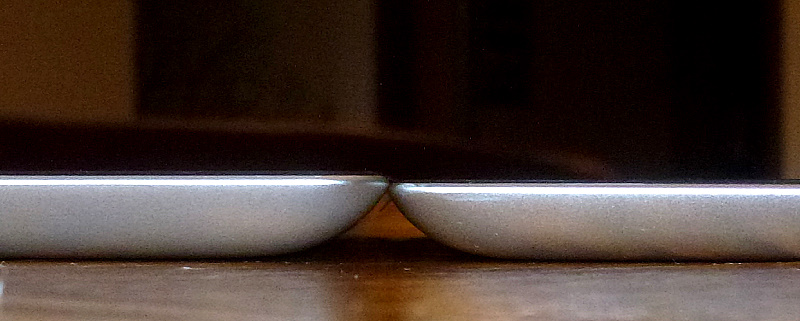
The new iPad is only about 1 mm thicker than the iPad 2

The new iPad is about one millimeter thicker and a tiny bit heavier than the iPad 2. This is to accommodate a battery with much higher capacity, keeping the battery life at about 10 hours despite the much higher resolution display, faster processor (needed for such high-res graphics – the units are equally “snappy” in use), and especially important to those using the energy-intensive LTE cellular service.

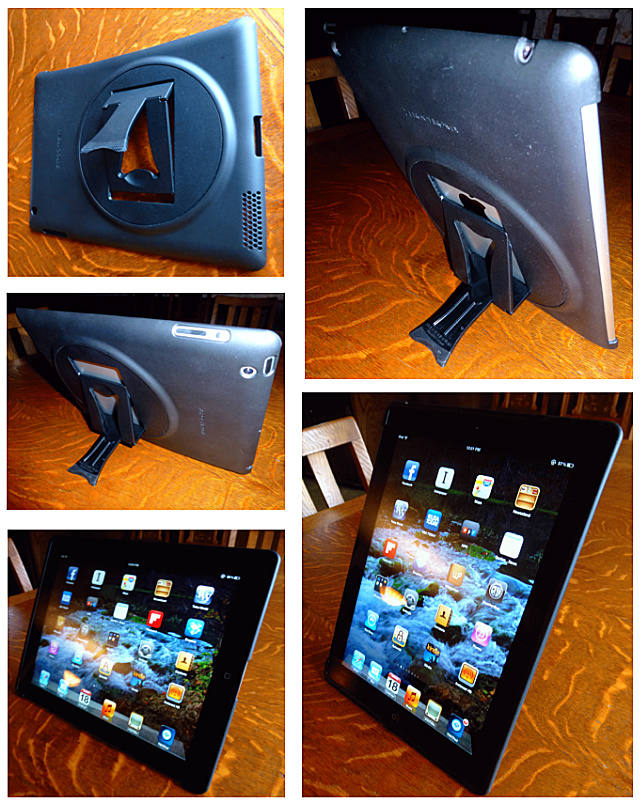
Neither the dimension nor the weight change is at all noticeable when using the unit, and new model still fits in my wonderful Zerochroma case and stand, which has made using the iPad around the house much easier.

I love my Zerochroma iPad case, which lets me instantly prop it up at many different angles in portrait or landscape orientation.

I like the case so much that, despite its $50 price tag (which a retailmenot.com coupon lowered slightly), that I ordered another for use with the iPad 2 when I take it to school.

When they are side-by-side there is no apparent difference between the iPad 2 and the new one, unless you look at the screen resolution.

The only apparent difference between the iPad 2 and 3rd generation model is the screen resolution.

And since this blog post is limited to about 640 pixels wide, you can’t readily perceive the difference here. You can click on the picture below for a higher-res shot. If you zoom in on it, you’ll be able to see the difference in the text. But while it is visible, it is not startling when you are using the unit in real life. (The new iPad is on the left in that shot; the iPad 2 is on the right.)

Click the image for a high-resolution shot of the two iPads. New iPad on the left; iPad 2 on the right.

The only time the resolution of my iPad 2 bothered me was when viewing a full-page article in the online Tulsa World, like the one above. The text would have occasional artifacts of letters in the same word being thicker and thinner. They were still readable, but it was annoying enough that I would often zoom in to get rid of it. The new unit eliminates that problem, but if I didn’t have a use for the old unit I might have regretted investing so much in the new one.

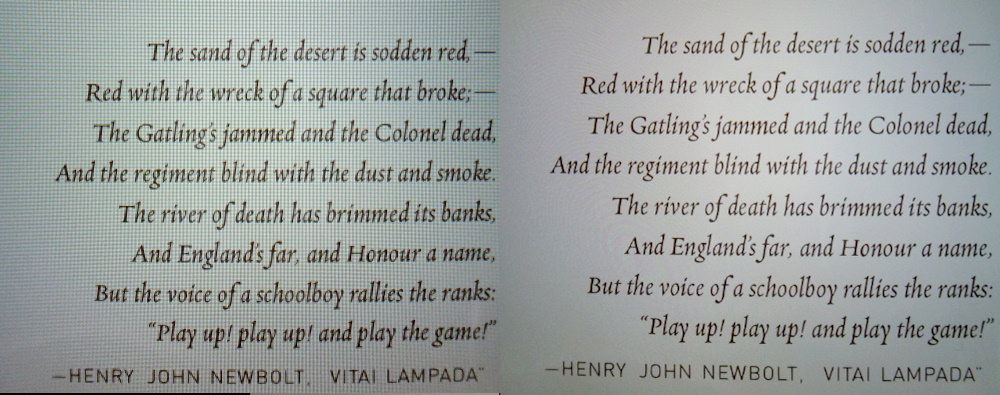
Reading in the Kindle app is also easier on the eyes thanks to the higher resolution. In the tight shot below you can see how the text is cleared up. But I tried reading a chapter in a book on my old Kindle 2 e-ink reader and the new iPad’s Kindle app, and still prefer the passive e-ink display even though the new iPad has 264 pixels per inch compared to 167 ppi on the Kindle. The lower-resolution passive display is still easier on my eyes than a higher-resolution backlit screen.

Here's a very tight shot of text in the Kindle app on the iPad 2 and the new unit.

Buying advice

If you’re buying an iPad for the first time, I’d recommend the new model over the iPad 2 since the lovely screen is nice if not necessary. You might be able to get by with a 16 GB model, but if you plan to take photos and edit them and sync music to the device then I’d suggest you bump up to 32 or 64 GB. If you have an iPhone 4 or 4S, forget about the cellular models and just use the hotspot function of your phone instead. But if you don’t have a cellular hot spot and plan to take the iPad on the road, get a unit with the cellular option since an iPad without internet service is of very limited value and I find WiFi coverage is still spotty and unreliable when travelling.

But if you have a limited budget, you probably won’t regret buying a $400 16 GB WiFi-only iPad 2. It has the same screen resolution as many laptops and works great if you don’t plan to load up lots of photos and music but mainly use the device for web browsing, email, and apps.

If you already have an iPad 2, I doubt you need to spend the money upgrading to the new model unless you are sensitive to the iPad 2’s text and graphics quality. Go try one out at an Apple store and see for yourself.

No Apple TV upgrade for me

While I have made the leap each time thus far with iPad upgrades and did upgrade from the first to the second generation of Apple TV box, I don’t plan to upgrade my 2nd generation Apple TV to the latest model. The only advantage of the model is a jump in HD resolution from 720p to 1080p, which wouldn’t make a huge difference on my home HDTV using streaming video services. The iPad mirroring over AirPlay is still limited to 720p even with a new iPad and the latest Apple TV; you only get 1080p resolution over AirPlay with some apps.

End result

I’m still delighted by the combination of an iPad and the Apple TV, and don’t regret spending money for the iPad upgrade since I have a use for the old one at school and could also sell it off for decent money. I don’t compose much text on the iPad, so I doubt I’ll use the new voice dictation option much since it isn’t a fancy personal assistant like the Siri service on the iPhone 4S. I’ll still use my Kindle for reading books, rely on my iPad for most web surfing and my morning newspaper, and use the iPad with the Apple TV for podcasts.

My next big Apple technology upgrade will be replacing my iPhone 4 to whatever model comes after the 4S, since my two-year contract expires this summer. I do look forward to trying out Siri when I get a new phone, since it seems like the USS Enterprise library computer come to life. But Apple will struggle to make significant improvements to future iPads and iPhones – they are pretty darn good already.

Posted in technology | Leave a comment

Spring Breaks in the Osage Hills

I celebrated the first day of my Spring Break 2012 by hiking five miles at Osage Hills State Park.

Spring Blossoms (click image for slideshow)

Video version

Click here for a slideshow from this day hike

Posted in day hike, photos, travel, video | 2 Comments