

On most recent Wednesday evenings I have shared on my Facebook profile some remembrance from the past. After dutifully applying the #grangerthings and #ThrowbackThursday hashtags, I decide whether a post should be public or instead restricted to my over 1,900 friends on that social media platform. That’s a Hobson’s choice, of course, since once you post anything anywhere on the internet, you should consider it public. Yet sometimes I apply the restriction as a sort of modesty panel which any of my Facebook friends can flip up with a screenshot.
Mining My Past
For months, I’ve been mining remembrances from the old photograph albums that came to me in April 2022 after my father died and my mother moved from Oklahoma City to an independent living facility here in Bartlesville. It wasn’t practical to plant a huge bookcase packed with photo albums, genealogy notebooks, and the like in her apartment, so it landed in my bedroom.
My parents married in 1961, and on a top shelf of the bookcase resides the Bolex 18-5 standard 8 mm film projector my father purchased, along with reels of silent home movies he shot into the mid-1970s on a 1961 Kodak Brownie Turret camera.
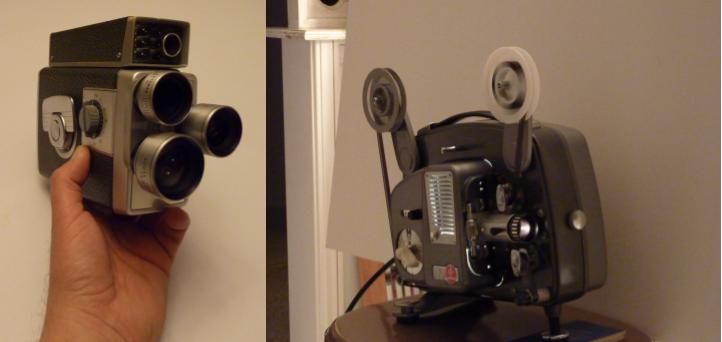

While scrounging for another photo that could prompt a little story from the past, I glanced up at the film reels on the top shelf and remembered something. I visited my folks in Oklahoma City over Christmas in 2009, and a big snow trapped me there for several days until I could dig out.
A few days after Christmas, we were looking for some entertainment. I set up my father’s old projector in their living room, aimed my digital camera at the screen, and we spent a few hours watching the old home movies he had shot.
I captured a few clips from that, and they were stashed somewhere in my digital archive. I located them and noticed one from when I attended preschool at the First Christian Church as a three-year-old. I added some music, and voila: Preschool in 1969.
I’m the towhead in the clip, decked out in my corrective shoes and black socks. But I was a bit at a loss for a story to go with the clip. I was too young to form any lasting memories of preschool. My mother had dutifully recorded in her Our Baby book that my teacher was Mrs. Carol Koop, and that my best friend at preschool was Robbie Deaton. I figure Robbie is the kid in the matching raincoat in the clip who is trying to blow bubbles.
So my thoughts turned to First Christian itself, which was billed as the Church of Tomorrow with its striking egg-shaped sanctuary dome made of thin-shell concrete, its louvered education building, and rocket-shaped bell tower. It was completed in 1956 and was the brainchild of preacher Bill Alexander and the young architects R. Duane Conner and Fred Pojezny. Sadly, the acoustics of the dome were atrocious, and Alexander and his wife were killed in a plane crash in 1960, but his ultramodern church was still thriving when I was at preschool there in 1969.

I found a photograph of one of the classrooms when the church was first opened.

Decline and Demolition
That’s where a typical #grangerthings post would end. But something rather dramatic happened at that location less than a year ago.

The Church of Tomorrow campus was demolished in 2022. What killed an iconic church that had made the National Register of Historic Places in 1984? The same thing that led to the recent closure of the First Christian Church in Bartlesville.
Now, we’re venturing into religion here, so allow me to reassure you that I’m approaching this dispassionately. I am interested in trends, their symptoms, and causes. I am not at all interested in sharing my personal religious views, how they have changed over my lifetime, nor in proselytizing for or against whatever views you hold.
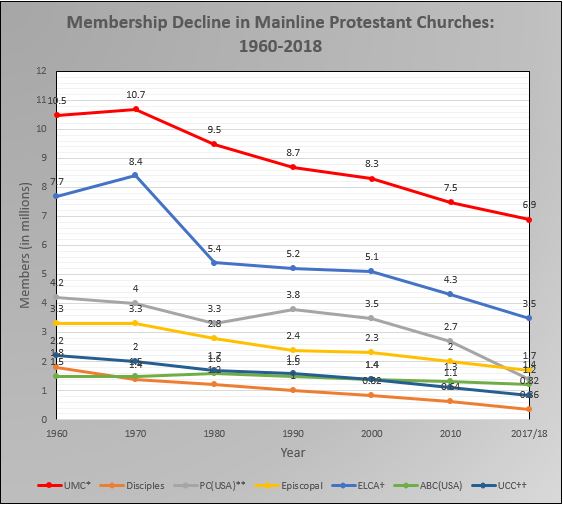
With that perspective in mind, I invite you to consider the membership timeline for the Disciples of Christ since my preschool days.

The Disciples of Christ is one of the “Seven Sisters” of what is called “mainline” protestant churches in the United States of America:
- American Baptist Churches USA
- Christian Church (Disciples of Christ)
- The Episcopal Church
- Evangelical Lutheran Church in America
- Presbyterian Church (USA)
- United Church of Christ
- United Methodist Church
They are called “mainline” because they once had churches on most of the main streets of American towns, and when I was in preschool, almost 1/3 of my fellow Americans were members of one of them. At the time, together they outnumbered the Catholics, while less than 1/5 of my fellow Americans were in Evangelical Protestant denominations.
The entire mainline is in steep decline.
So were folks switching to Evangelical churches? Well, the Evangelicals did experience a surge from 1983 to 2000, fueled in part by televangelists. Their share of the population jumped from 17% in 1972 to a high of 30% in 1993. However, they had dropped to 22% by 2018.

Another interesting development is the rise of non-denominational churches, which often get categorized as Evangelical.

I’ve witnessed this locally, with a growing number of non-denominational congregations even as mainline churches shrink and sometimes close. Ryan Burge is a PhD political scientist with many peer-reviewed publications and he is also a Baptist preacher. His analysis is that a shift from the mainline to non-denominational churches was once a primary factor, but now the non-denominational growth is more due to their attracting people who were raised as Catholics.
However, I must not give you the impression that we’re just seeing a shift from one form of Christianity to another. The total share of Protestants in the USA has shrunk markedly since the 1960s, dropping from around 70% to almost half that in the Gallup Polls, and there is no corresponding rise in Catholicism.

Instead, we have seen a significant rise in the religiously unaffiliated. Overall, the share of Christians in the USA has dropped from about 90% as late as 1992 to about 63% now, while the religiously unaffiliated have increased from 5% when I was a kid to almost 30% today.

The trendlines are pretty clear.

Soon there will be more non-religious Americans than Evangelicals or Catholics, and many more mainline churches will disappear. As for why, there are multiple causes. Burge’s analysis is that “secularization, politics, and the internet are the major causal factors” that have given rise to the No Religion surge. He covers this in detail in his book The Nones: Where They Came From, Who They Are, and Where They Are Going.
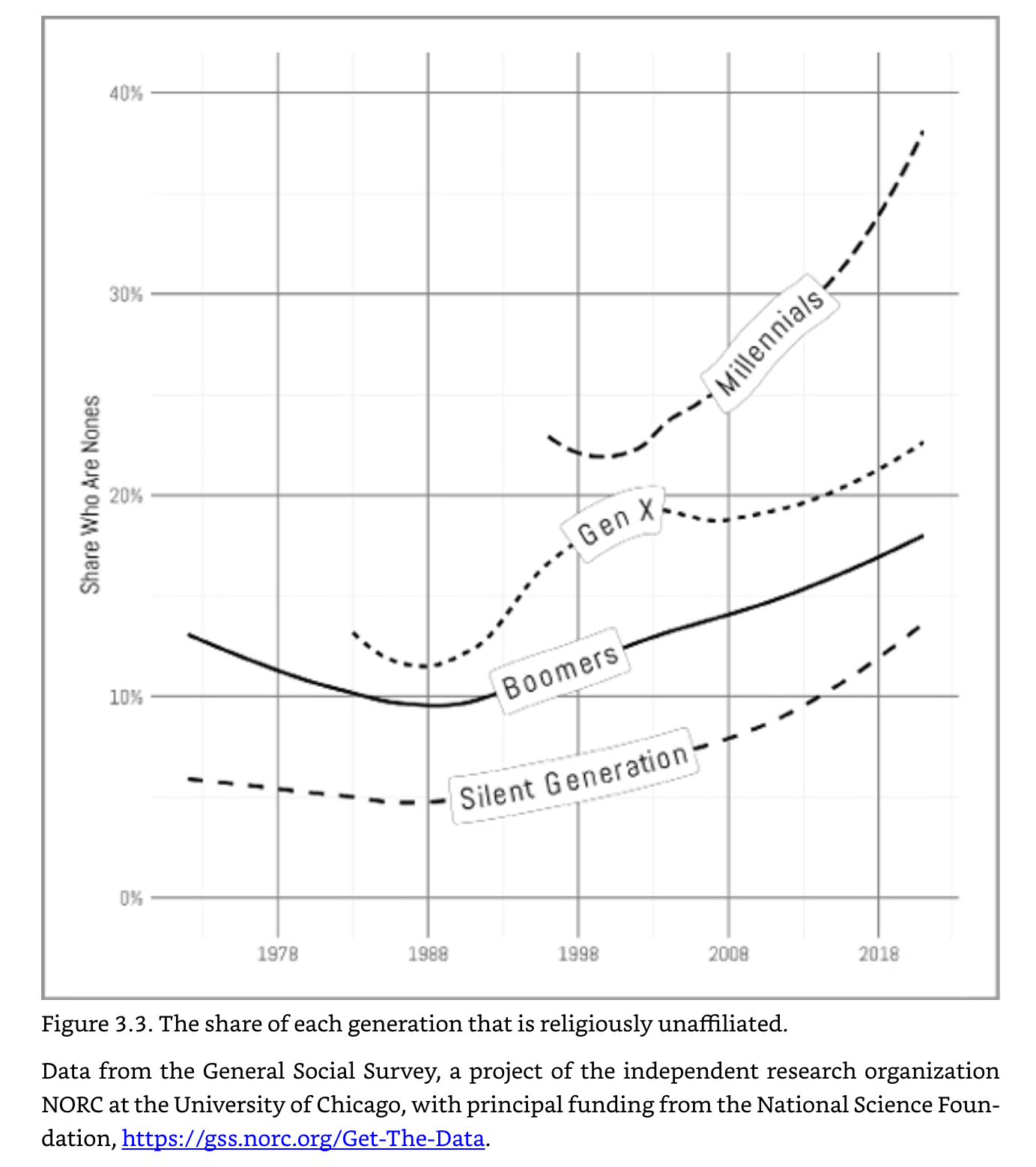
The shift away from organized religion is most apparent in the younger generations, but all of them show the same trend in the past 15 years.
It isn’t as though a third of Americans have become atheists, however. The Nones don’t engage in religious practices, but their beliefs are diverse. Consider the responses when Americans were asked to choose among six degrees of religious belief.

So as of 2021, only 7% of the population reported themselves as atheists and another 9% as agnostics. Half the population still claimed to be true believers and another one-third still reported some degree of belief in a higher power.
Time changes everything except something within us which is always surprised by change.
Thomas Hardy
I find these sweeping changes fascinating. When I was a kid, over 40% of US adults smoked. That has plummeted to less than 14%. I am similarly surprised by how support for same-sex marriage leaped from 27% in 1996 to over 70% today. Now the USA is steadily de-churching, something that happened in Western Europe decades ago. Having been surprised by earlier sea changes, I shan’t predict the change in religious affiliations during the time I have left.
Fifty-odd years after I left its preschool, the raw red soil of my hometown is again revealed where the Church of Tomorrow once stood.

Regardless of its causes, I instinctively view that red wound as another sinister signpost of my approaching old age. The elementary schools I attended in Warr Acres have also been razed. Time marches on, and I explore my nostalgia through my weekly remembrances, hopefully without wallowing in it.
When I captured that aerial view, I noticed that the bell tower remains at the northwest corner. So I used Google Street View to view that surviving emblem of what I once knew.

It is now just a tower for cellular antennas. How symbolic.
#grangerthings #ThrowbackThursday






 Meador Manor
Interesting, thanks,
My professor at SMU, Ted Campbell, has some interesting writings and videos on this subject of mainline churches! “The Sky Is Falling, the Church Is Dying, and Other False Alarms” is a short book about mainline Christianity and historically how the statistics were created if you’re interested!
I know 3 quality and experienced engineering companies that worked with this church on their acoustic issues. None were successful.