
June 4, 2024 | Photo Album

We got around early on our third morning of the vacation so that we could reach the Stout Grove of redwoods before it became crowded.
The Stout Memorial Grove is in the heart of Jedediah Smith Redwoods State Park in northern California. The 44-acre grove has many 300-foot tall trees. It was donated to the Save the Redwoods League in 1929 by Clara W. Stout, the widow of lumberman Frank D. Stout, in memory of her late husband.
I remembered from my visit in 2006 that to reach the grove from the east, before you reach Hiouchi you have to exit the Redwoods Highway onto the long, winding, narrow, and mostly unpaved Howland Hill Road. I remembered it had frequent turnouts, so I wasn’t too concerned about taking our large rented GMC Yukon Denali SUV on it so long as we beat the crowds.


Google Maps told me that visits to the trailhead pick up after 10 a.m. So we headed out at 6:15 a.m. from Rogue River and made it, after a few restroom stops, to the trailhead just before 9 a.m.
There were only a few vehicles at the trailhead when we pulled in, but by the time we left about an hour later, all of the parking spaces were taken with some vehicles parking in pullouts along the branch road off Howland Hill Road.
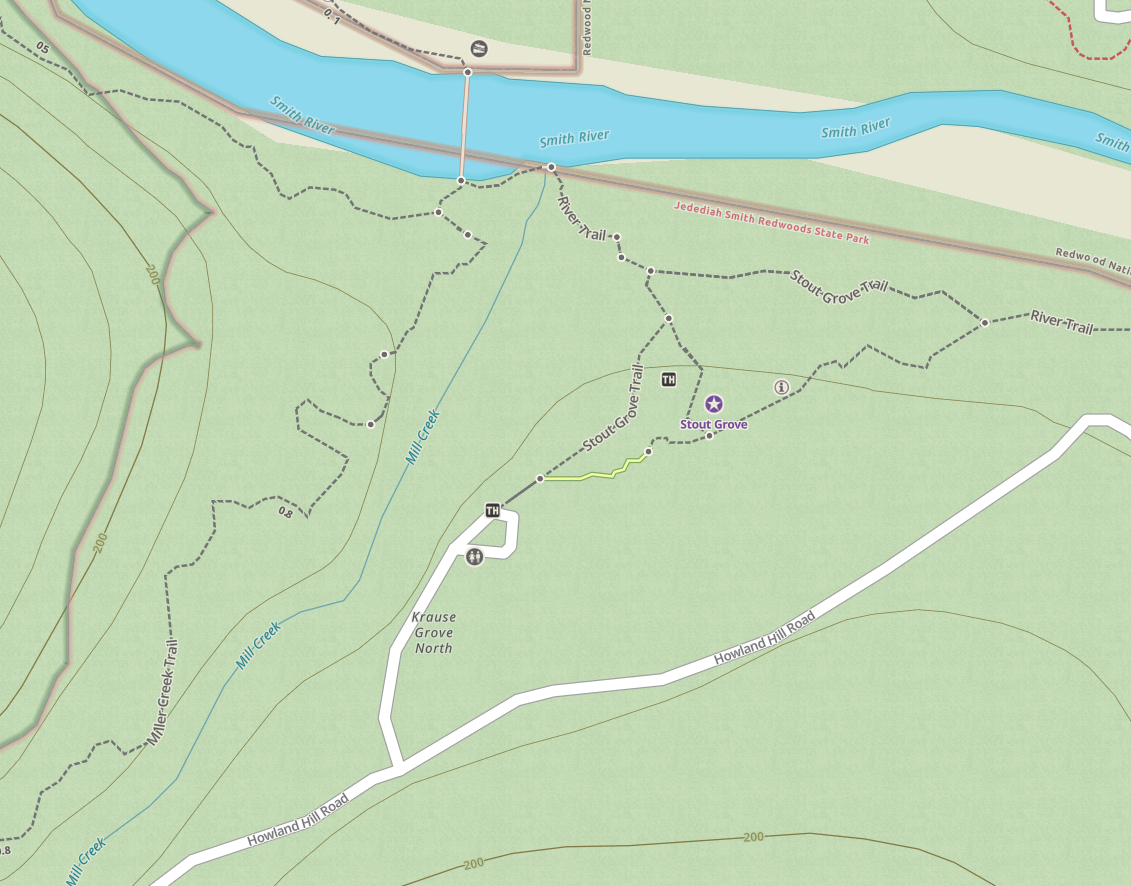
The weather was perfect, sunny but cool and comfortable, as we walked the loop.

Wendy was a bit surprised at seeing redwoods so early in our trip.

She told me it had been a 40-year-wait for her to get to see them.

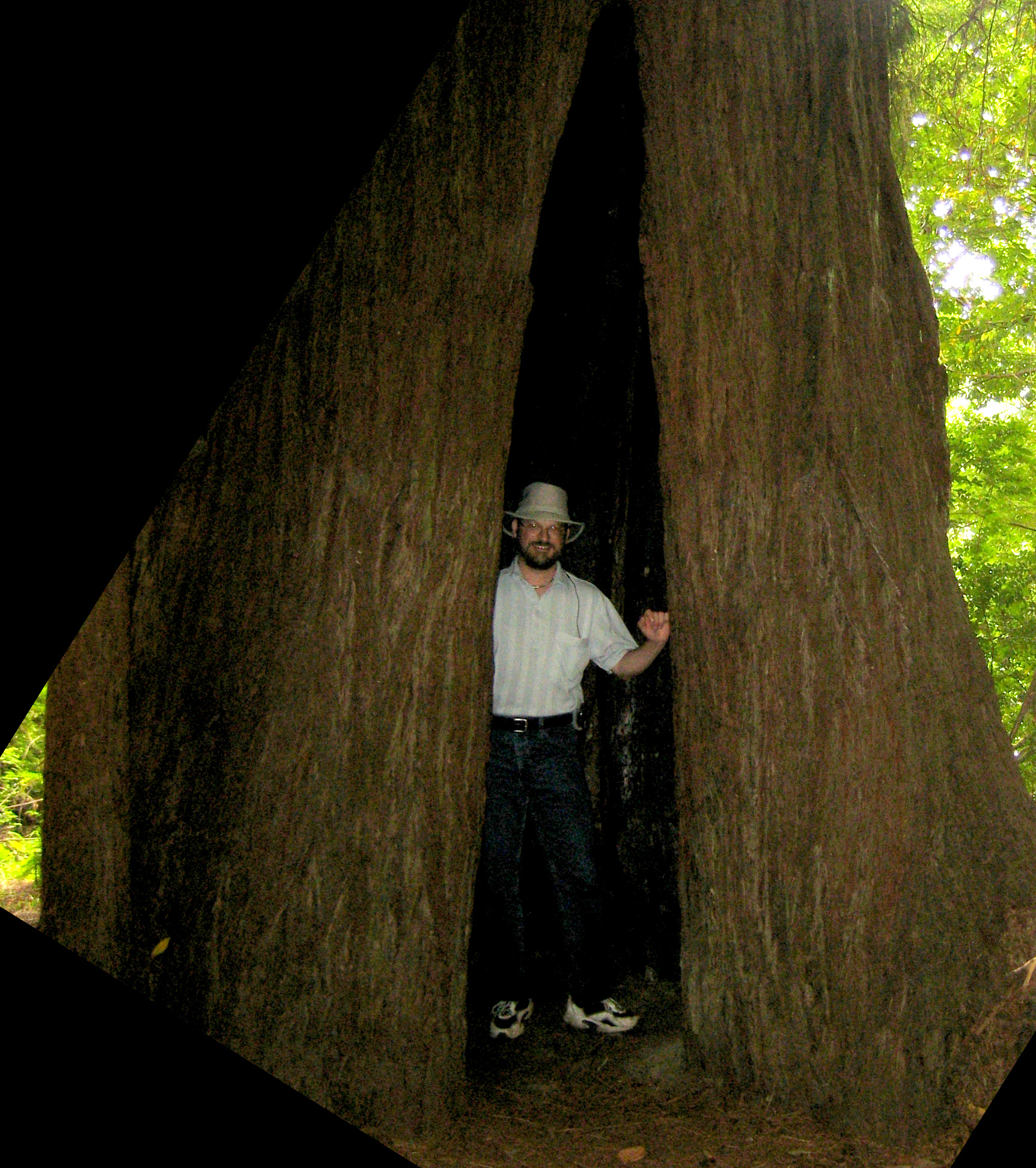
Wendy got a shot of me inside the same tree I had ducked into back in 2006. This time the camera wasn’t sitting on a nearby log, which had caused a severe list.

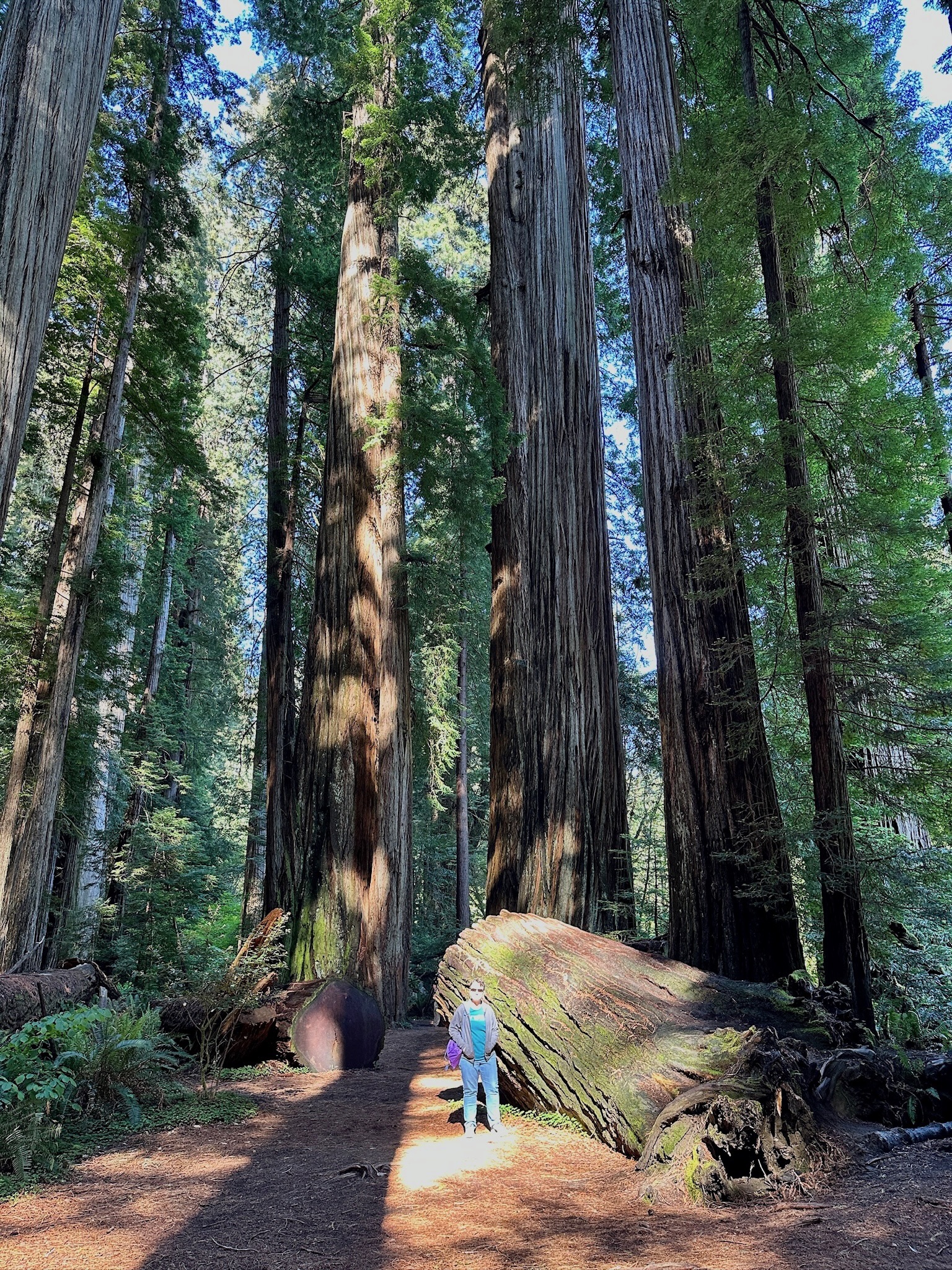
She had fun posing Barbie by one of the huge trees, and it took a video to provide scale.

We ourselves were dwarfed by the giants. Pictures of the redwoods can be tricky. If you don’t have a person in the shot, your sense of scale tends to be WAY off.

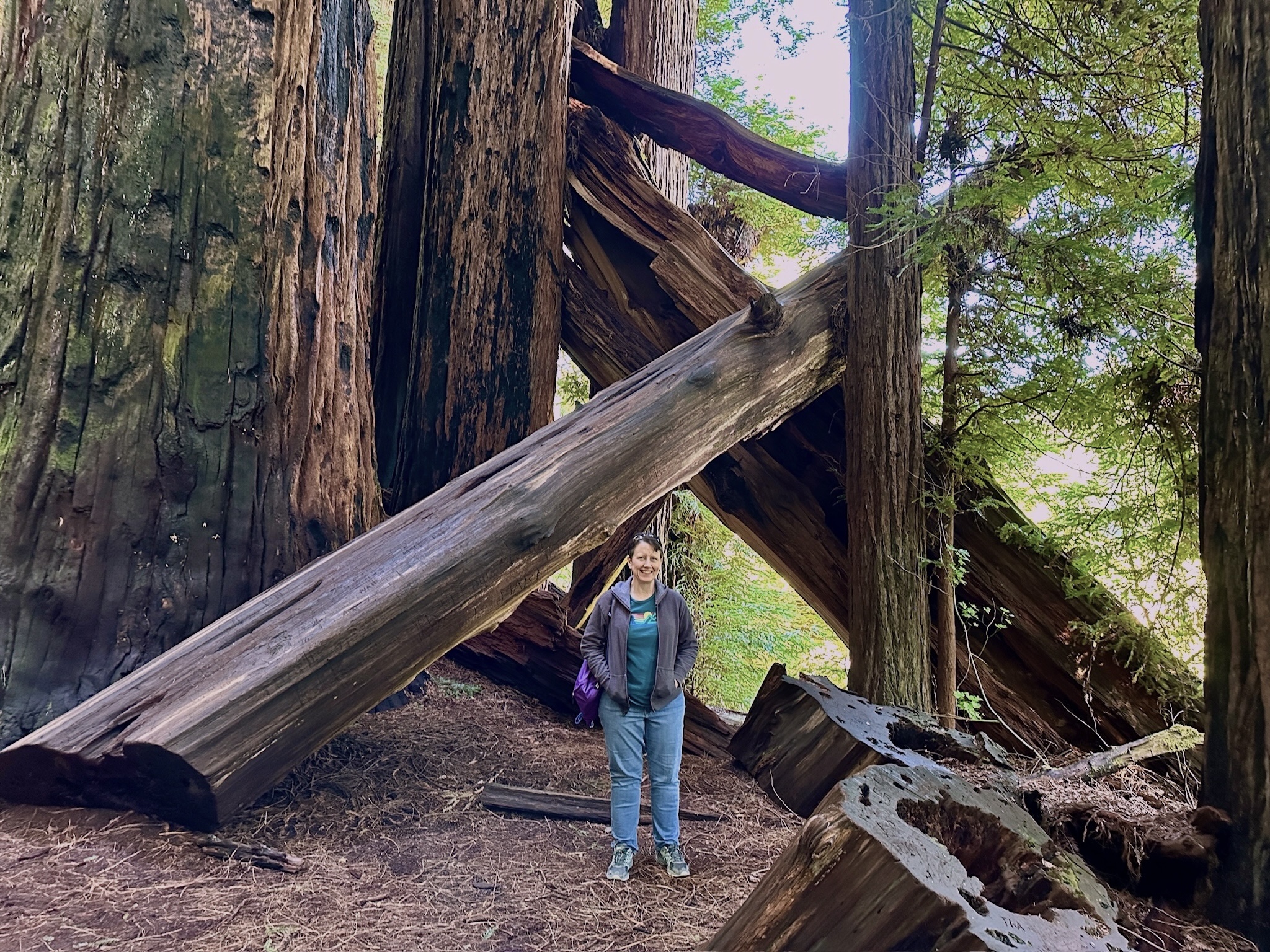
I remembered the diagonal fallen trees at one point along the loop, and this time was glad to have Wendy pose to provide scale that was lacking in my shot from 2006.

There were lots of photographers along the loop, shooting the trees in the morning light.

Wendy had me pose by one of the fallen giants.

A ranger was on hand to take photos, and shared with us how there were scorch marks on one of the big trees, yet there was no record of a fire in that area for over four hundred years, illustrating their immense age. The tallest tree in the grove is 342 feet high.

Since we had no problems navigating the first part of the six-mile Howland Hill Road, I opted to take it the rest of the way to Crescent City on the coast. It was once a stage coach road linking the Pacific Ocean harbor of Crescent City with mines in southern Oregon and weaves among the immense trees.

The road was surveyed by J.S. Howard in 1881 and in 1887 the Del Norte Board of Supervisors hired brothers Nels and Soren O. Christensen to build it. Redwood slabs or puncheon were added to the road in 1888 and 1892 during the “plank road” era.
Roads were often paved with redwood planks in segments in the redwood forests or where the soil was soft. Otherwise, wagon wheels dug beneath the surface of the powdery forest soil and became stuck. The road was graded and then the planks, called “puncheon,” were laid on top with dirt solidly packed between. The road was excellent as long as the packing remained in place. Winter rain, however, often washed dirt away, and water collected under the puncheon. As the vehicles drove over them, muddy water squirted up. In summer, dust on these roads was thick, with clouds trailing the stages through the woods. Vegetation along the sides was coated for months with a thick layer of road dust, and passengers often arrived at their destination coated in dust.

One stage coach made the roundtrip between Gasquet and Crescent City every day, while another carried mail. Wagons hauling equipment to mining areas often were pulled up Howland Hill with six-horse teams.

Sunset Telephone Company ran a line parallel to the road in 1897, and the first car drove over the road in 1904. Jack Williams, a resident of Grants Pass, purchased a “White Steamer” and took delivery of it in Crescent City where it was unloaded from a ship. He managed to get over Howland Hill Road, but the rest of the journey was too much for his car. The trip almost shook the car to pieces, and it had to be hauled home on a springless lumber wagon to be repaired at a blacksmith shop.
Even today, US 199 from Gasquet to Idlewild is quite narrow and winding, with me glad to have had lane guidance for the GMC Yukon Denali while traversing it. I was patient with a guy hauling a recreational travel trailer; negotiating that combination around the narrow curves would be nerve-wracking.

In 1916, the Board of Supervisors hired contractors to improve Howland Hill Road for cars and remove the puncheon from it. The road was in active use for about 40 years as a link between Crescent City to Gasquet on the Smith River.
The Redwood Highway, now US 199, opened in 1926, bypassing Howland Hill Road, so Howland Hill has seen only minimal improvement since then. Thus it is one of the few popular scenic roads that still retain the feeling and character of travel on a dirt road from the 1920s.
Stout Grove was the first one donated along Howland Hill Road in 1929. The last of the redwood groves along the route was purchased and donated to the State of California in 1949 with funds raised by the Garden Club of America, the Daughters of the American Revolution, and thousands of other donors for a memorial grove for fallen soldiers of World War II.
I enjoyed driving the rest of Howland Hill Road into Crescent City, where we would have time to enjoy the seashore before heading south to more redwoods.








 Meador Manor