On the first day of each new calendar year, for the rest of my life, thousands of copyrighted works from 95 years earlier will enter the US public domain. Here is a great article on what joined the public domain on January 1, 2026.
Books are the main attraction for me, although 1930 movies have also been liberated. Sound recordings have much more complicated terms, and the various releases into the public domain will become much more complicated in 2074, but it is highly unlikely I’ll live long enough to worry about that.
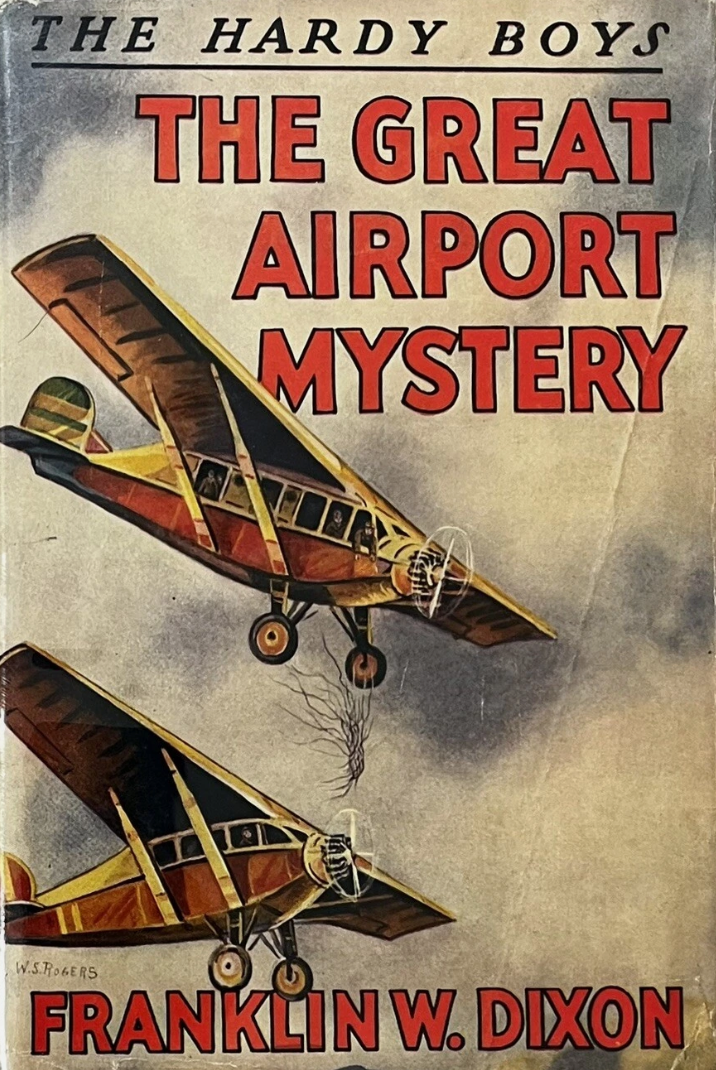
In recent years, the original editions of The Hardy Boys children’s books began their long slow march into the public domain. The first three were set free in 2023, three more in 2024, two in 2025, and The Great Airport Mystery is now fair game in 2026.
Mind you, only the older version written by Leslie McFarlane, involving pilot Giles Ducroy and an air mail robbery, has been freed. As I child in the 1970s, I read the more commonly available 1965 rewrite by Tom Mulvey, which is about pilot Clint Hill and stolen equipment. That revision will remain under copyright for 35 more years. Frankly, double pun intended, I always liked The Three Investigators better than the Hardy Boys, but those better-written children’s mysteries won’t start entering the public domain until 2060, and they too underwent revisions with a contemporary reboot that began this year.
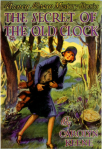
The Nancy Drew series began in 1930, so its first four entries have also now entered the public domain. The same caveat applies, with only the original versions ghostwritten by Mildred Wirt Benson losing their copyrights, with revised versions from 1959-1961 still being protected.
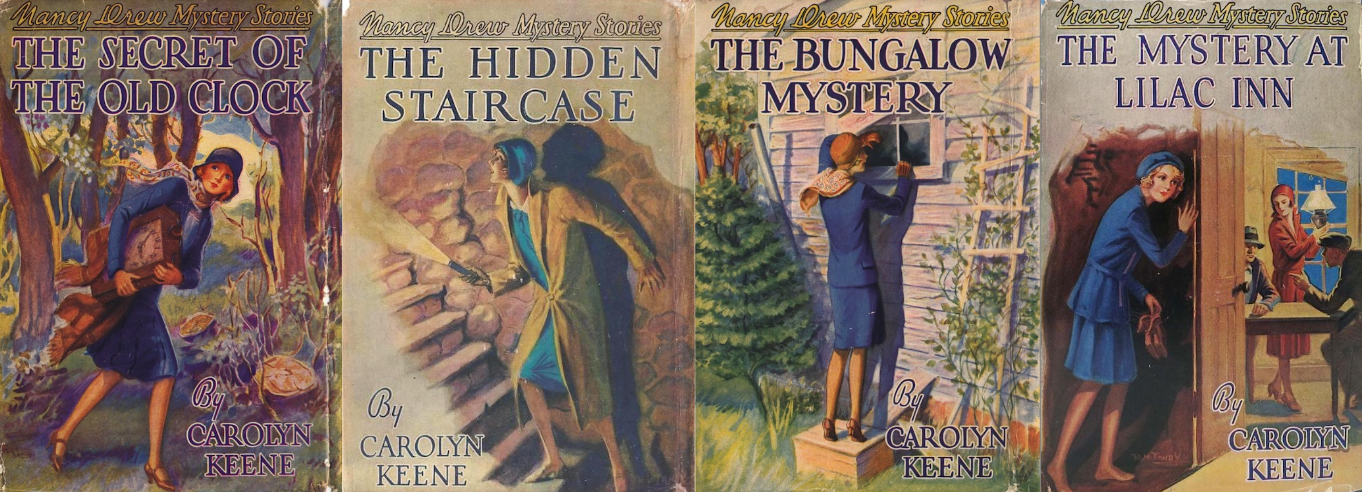
Breaking the legal bonds holding The Hardy Boys and Nancy Drew captive is not much to crow about, so here are more significant 1930 books:
- The Woman of Andros by Thornton Wilder
- Agatha Christie’s The Murder at the Vicarage, The Mysterious Mr. Quin, and Giant’s Bread
- The Maltese Falcon by Dashiell Hammett…the novel, not the 1941 Bogart film
- Last and First Men by science fiction author Olaf Stapledon
- As I Lay Dying by William Faulkner
- Cimarron by Edna Ferber
- Years of Grace by Margaret Ayer Barnes
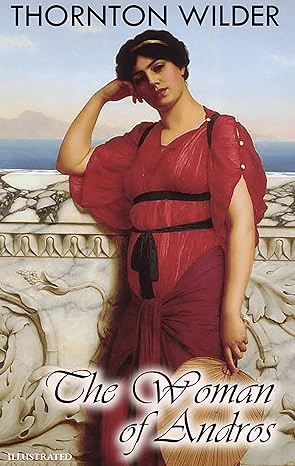
The Woman of Andros by Thornton Wilder
This one has a simply magnificent opening:
The earth sighed as it turned in its course; the shadow of night crept gradually along the Mediterranean, and Asia was left in darkness. The great cliff that was one day to be called Gibraltar held for a long time a gleam of red and orange, while across from it the mountains of Atlas showed deep blue pockets in their shining sides. The caves that surround the Neapolitan gulf fell into a profounder shade, each giving forth the darkness its chiming or its booming sound. Triumph had passed from Greece and wisdom from Egypt, but with the coming on of night they seemed to regain their lost honors, and the land that was soon to be called Holy prepared in the dark its wonderful burden. The sea was large enough to hold a varied weather: a storm played about Sicily and its smoking mountains, but at the mouth of the Nile the water lay like a wet pavement. A fair tripping breeze ruffled the Aegean and all the islands of Greece felt a new freshness at the close of day.
There are multiple copies of Wilder’s third novel at the Internet Archive, and I hope that a nice public domain electronic book edition gets uploaded to Project Gutenberg. I am puzzled that they don’t capitalize on the annual publicity about the topic.
I would enjoy comparing Wilder’s take on ancient Greece to the works of Mary Renault that I read forty years ago for an undergraduate honors seminar.
Agatha Christie…and Mary Westmacott
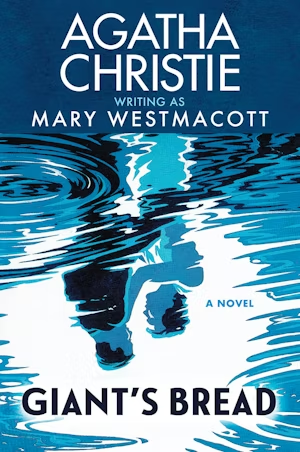
Years ago, I consumed all of Agatha Christie’s mysteries. The Murder at the Vicarage is the first of her Miss Marple series, while The Mysterious Mr. Quin is a collection of short stories featuring the mysterious and somewhat supernatural Harley Quin and his companion, Mr. Satterthwaite.
I have not read the non-mystery books that Christie published under pen names, including Giant’s Bread, the first of six she published as Mary Westmacott. It is about a young composer who reinvents his identity after being declared dead in World War I, and one reviewer recommended it, although she thought the ending rather farcical.
The Maltese Falcon Escapes the Copyright Cage

Dashiell Hammett was a former Pinkerton operative who wrote most of his hard-boiled detective fiction while living in San Francisco in the 1920s. The Maltese Falcon was his third novel and is considered his best work. His fifth and final novel, The Thin Man, was published in 1934, so it won’t be long until all of his work is freely available.
In text form, that is. You are more likely to be familiar with Bogey in a film version of The Maltese Falcon or possibly the six The Thin Man films with William Powell and Myrna Loy. The falcon’s film form won’t be freed until 2037.
Odd bits of trivia attach to the falcon props from the movie. One was given by studio chief Jack Warner to actor William Conrad…yes, the same actor who portrayed the overweight detectives in the Cannon and Jake and the Fat Man television series, who narrated Rocky and Bullwinkle and The Fugitive, and who portrayed Marshall Matt Dillon on the radio version of Gunsmoke. His prop was auctioned in 1994 for almost $400,000.
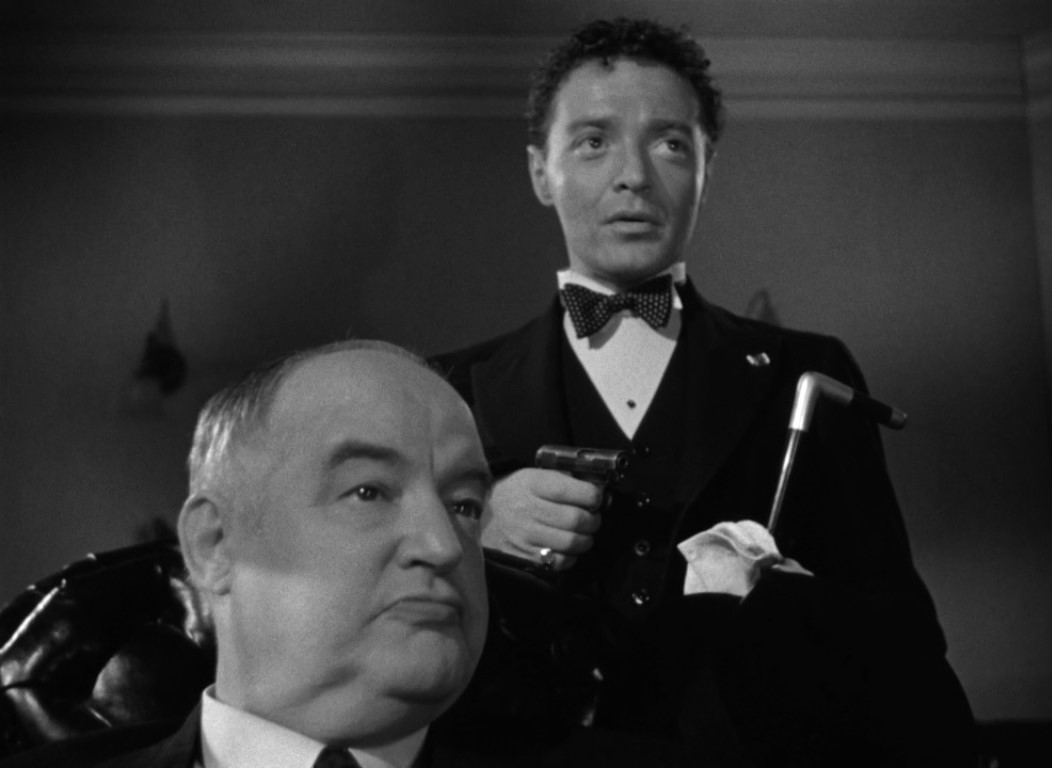
Not bad, but in the film, Sydney Greenstreet’s villain offered detective Sam Spade $50,000 for the statuette, which would be over a million 2025 dollars. Funly enough, a 45-pound metal version of the film prop was sold in 2013 for over $4 million.
The film was okay for me, with Sydney Greenstreet a standout, but I have no interest in reading the Hammett novel.
Olaf Stapledon’s Two Billion Years of Boredom
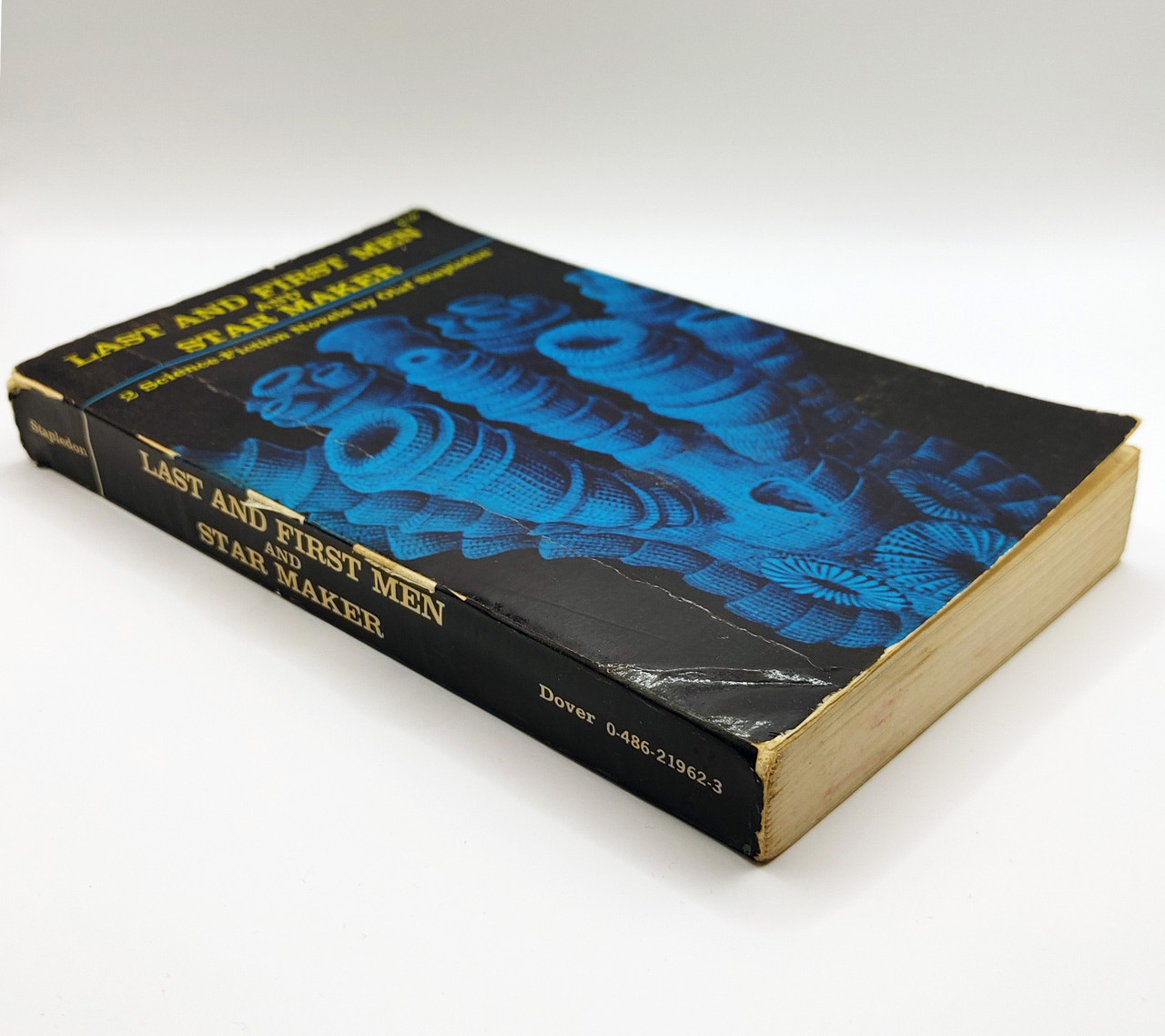
Stapledon’s Last and First Men: A Story of the Near and Far Future is a vast science fiction work reportedly summarizing two billion years of future development. I long had a 1968 paperback reprint of that 1930 work and his 1937 novel, Star Maker, but in my sampling of the former, I found it similar to J.R.R. Tolkien’s The Lord of the Rings appendices or The Silmarillion: quite soporific. I am in no manner tempted to read a summation of two billion years of fake history.
In 2017, Icelandic composer Jóhann Jóhannsson’s only film premiered, and it was based on the book. It isn’t encouraging to note that Jóhannsson died a year later from a deadly combination of flu medication and cocaine. His sparse film version only runs 70 minutes, which is about fifteen trillion times shorter than the span of time in the book…but I’m skeptical that the abridgment is worth your time.
However, decades ago I did enjoy Charles Sheffield’s 1997 science fiction novel Tomorrow and Tomorrow: A Love Story to the Edge of Time, which had an actual plot that managed to span billions of years, so successful novels with ridiculous time spans are feasible. However, Sheffield’s work won’t enter the public domain until…let’s see…it was published after 3/1/1989, so its copyright lasts for 70 years after the author’s death, and Sheffield died in 2002, so his book will be out of copyright in 2073.
Faulkner’s Streams
Decades ago I read, and actually appreciated, William Faulkner’s notorious The Sound and the Fury, which entered the public domain in 2025. It was ranked #6 on Modern Library’s 100 best novels of the 20th century.
The Sound and the Fury was told in stream-of-consciousness through the perspectives of three brothers, one of them being intellectually disabled, with a final chapter written in third-person narrative and focusing more on a black female household servant. I normally hate stream-of-consciousness, but it worked in that book, although I have no desire to repeat that experience.
As I Lay Dying is now in the public domain, but it is even more fragmented, with fifteen different narrators, and it also relies on stream-of-consciousness. Nevertheless, it was ranked #35 in the Modern Library’s list. Faulkner said that in writing it, he was spending the first eight hours of a twelve-hour shift at the University of Mississippi Power House shoveling coal or directing other works, spending the remaining four hours, from midnight to 4:00 a.m., in handwriting the manuscript on unlined onionskin paper. He said it took him six weeks to write the novel, and that he did not change one word.
Given my distaste for the stream-of-consciousness style of writing and disinterest in navigating fifteen different perspectives on a plot, I have no plans to read As I Lay Dying. I usually avoid Wikipedia plot summaries, but since I won’t be reading the work, I snuck a peek.
The Southern Gothic plot revolves about the transportation of a body in a coffin, and I liked a cover illustration on a 1980s paperback edition that was clearly in the style of Thomas Hart Benton. An internet search showed multiple Faulkner covers from that era that were designed by the late Carin Goldberg, with illustrator David Tamura imitating Benton.

If I had to read more Faulkner, I’m told that the seven short stories in his The Unvanquished don’t utilize stream-of-consciousness. However, I still have plenty of Southern Gothic stories by Flannery O’Connor awaiting my attention, and The Heart is a Lonely Hunter was so fascinatingly strange that I’m more likely to read more of Carson McCullers’ novels than to pursue reading Faulkner. I just finished a Mexican Gothic novel, The Hacienda, by Isabel Cañas, which was a treat. It was set in the 1820s, and I enjoyed that setting more than the uncomfortable Deep South of the USA.
Oklahoma in Cimarron
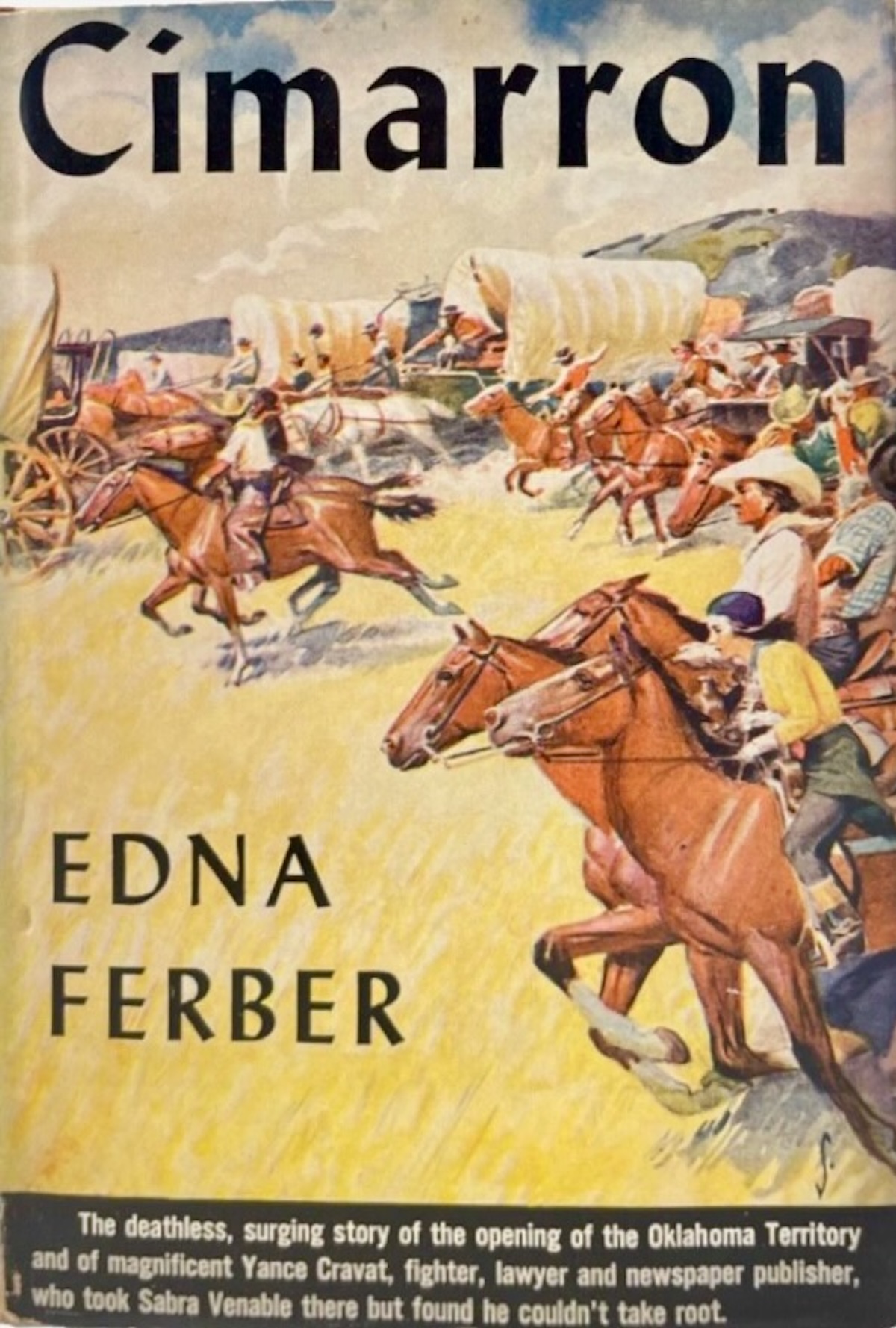
Two of the Oklahoma land runs, for the Unassigned Lands in 1889 and the Cherokee Strip in 1893, feature in Edna Ferber’s novel Cimarron. The first of those is how the land where I was born had been opened to white settlement 77 years earlier.
The novel takes its name from an old unofficial term for No Man’s Land, with the novel’s town of Osage likely based on Guthrie. Ferber intended it as a satirical criticism of American womanhood and sentimentality, and it was the best-selling novel of 1930. A 1931 film version was followed by one in 1960 featuring Glenn Ford and Maria Schell.
Jesse Schell described the novel as a story of “a bold southern lawyer who starts a newspaper in Indian territory”, with his wife being “a fish-out-of-water city-woman trying to raise her son and daughter on the frontier”. The book spans the period from 1889 to about 1925, and Schell liked this passage:
He licked and stamped the envelope, rose, and took from the table beside him his broad leather belt with its pair of holstered six-shooters, evidently temporarily laid aside for comfort while writing. This he now strapped quickly about his waist with the same unconcern that another man would use in slipping into his coat. He merely was donning conventional street attire for the well-dressed man of the locality. He picked up his sheaf of envelopes and stepped out. In three minutes he was back, and affably ready to talk terms with them. It was, perhaps, this simple and sinister act, more than anything she had hitherto witnessed, that impressed Sabra with the utter lawlessness of this new land to which her husband had brought her.
I’ve never read a Ferber book, although long ago I enjoyed watching Barbara Stanwyck and Bette Davis in the 1932 film adaptation of Ferber’s 1924 novel, So Big. Other Ferber titles in the fading cultural lexicon include Show Boat from 1926, which was adapted into a Kern and Hammerstein musical which had many Broadway revivals, and Giant from 1952, which led to a 1956 film with Liz Taylor, Rock Hudson, and James Dean.
The 1930 Pulitzer Novel
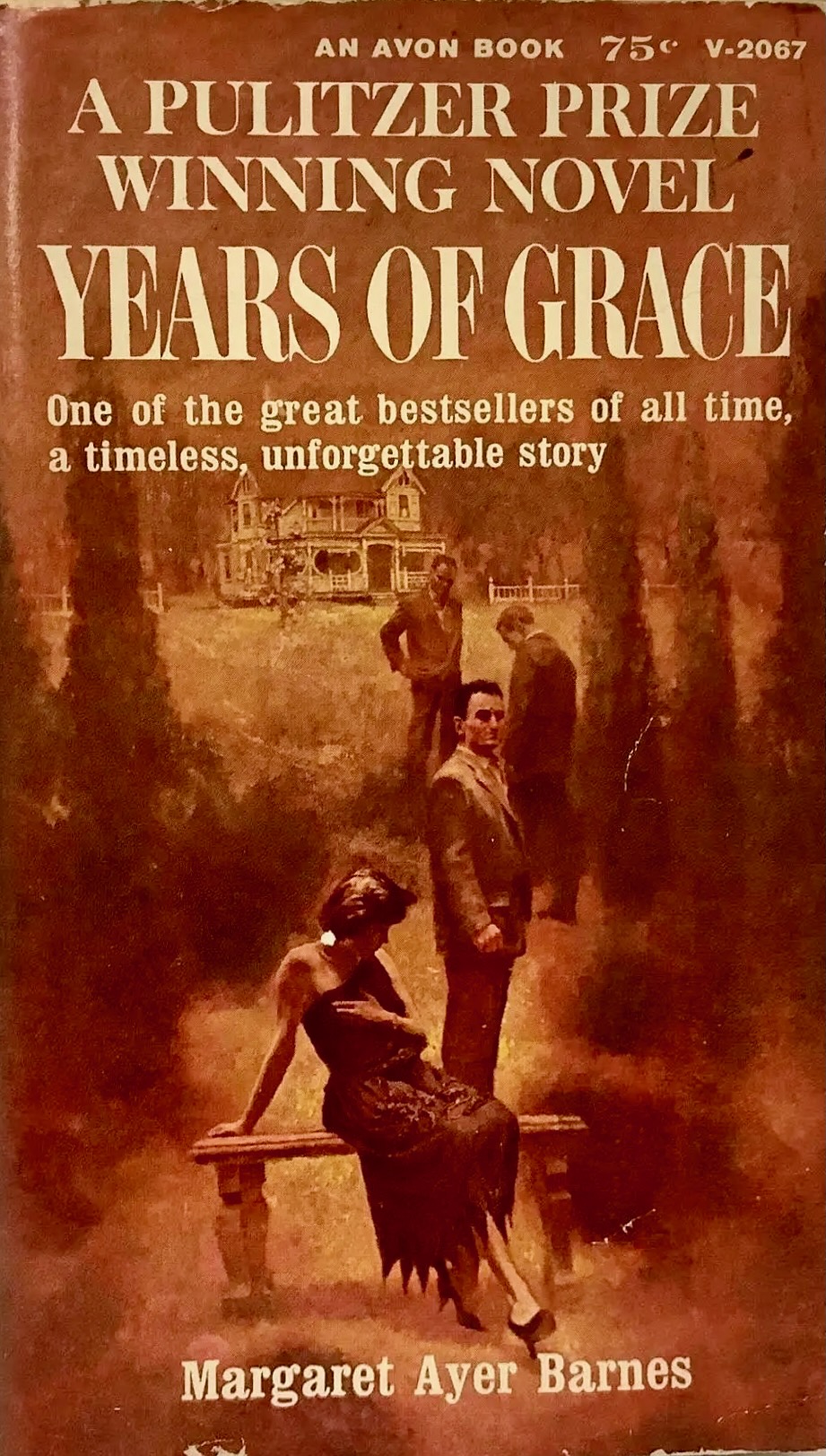
A 1930 work that has received less attention is Years of Grace by Margaret Ayer Barnes, which won the 1931 Pulitzer Prize for the Novel. Barnes earned at bachelor of arts from Bryn Mawr College in 1907, and she was the school’s alumnae director from 1920-1922. Barnes helped organize the Bryn Mawr Summer School for Woman Workers in Industry, which offered courses in progressive education, liberal arts, and economics mainly to young and single immigrant women with little to no academic background.
Barnes broke her back in a traffic accident in 1926, at age 40. Her friend Edward Sheldon was a playwright who encouraged her to take up writing. She wrote three short stories and three plays, with her first play, an adaptation of Edith Wharton’s 1920 novel The Age of Innocence, produced on Broadway with over 200 performances. Her best-known work is another play, Dishonored Lady, which she co-wrote with Sheldon.
In 1931, her first novel, Years of Grace, won the Pulitzer. It features Bryn Mawr College with a story, beginning in the 1890s and continuing into the 1930s, of a woman from her teens to age 54. The novel is said to follow many of the same themes as her other works, centering on the social manners of upper middle class society, with female protagonists who are often traditionalists struggling to uphold conventional morality in the face of changing social climates.
Great Books Guy John read the book in 2020 as part of reading through the early Pulitzer-Prize winners. He shared, “This is a delightful novel –it is surprisingly whimsical for a 600-page book– yet it is unfortunately wholly lacking in substance.”
John’s review shares that he enjoyed the book as a pleasant and simple work, but one populated with wooden characters with nothing much occurring. The prose provides carefully crafted glimpses into the life of a woman who goes from being a young romantic to a college feminist and finally a married woman who has a brief but intense affair with her best friend’s husband. John describes the book as conservative in tone, presenting the life of its character without judgment.
I’ll close with one of the sound recordings that has entered the public domain: