
When I consider the likely impacts on employment of advancements in artificial intelligence (AI), I am naturally reminded of how automation in manufacturing blossomed in the second half of the 20th century. I’m currently reading Kurt Vonnegut’s Player Piano, his dystopian first novel in 1952 “about people and machines, and machines frequently got the best of it, as machines will.”
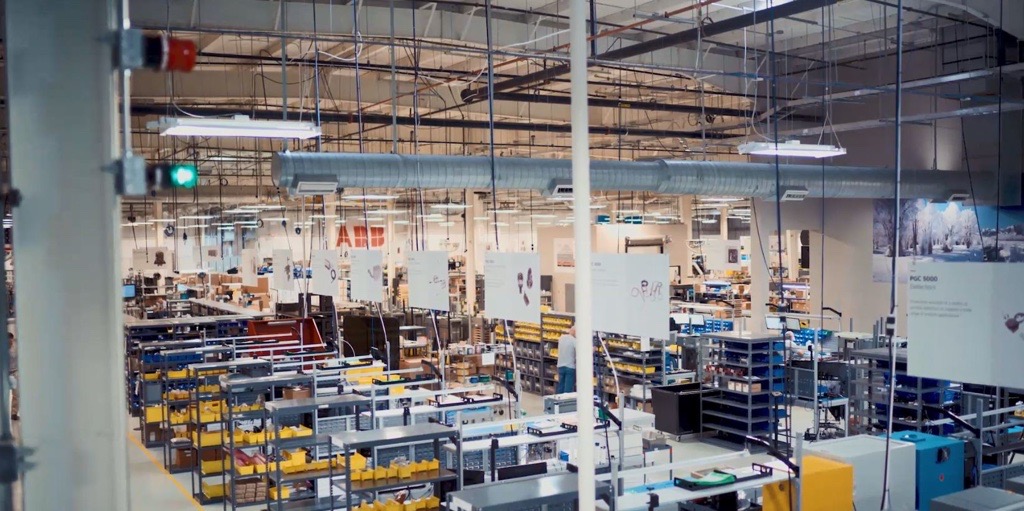
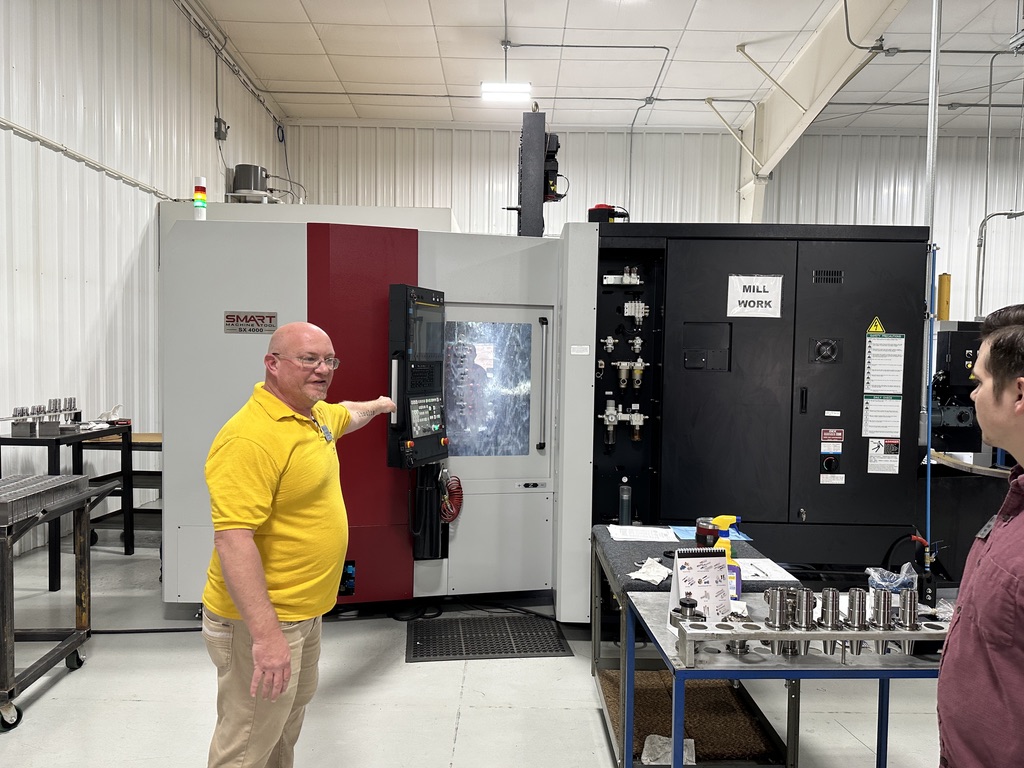
The changes in manufacturing have been driven home to me recently by tours of two plants in our local industrial park, which are radically different from the images I saw in my youth of factories and machine shops. The clean modern facilities included some sophisticated programmable machinery.
The Decline of Domestic Manufacturing
One might expect that automation led to a steady decline in manufacturing employment in the USA. However, there are significant complicating factors, including global trade and labor costs.
While it is true that over the 40 years between 1979 and 2019 manufacturing employment dropped from 22% to 9% of total nonfarm employment, that was not due to a steady erosion, but instead primarily due to three major drops during the economic recessions of the 1980s oil bust, the dot-com bust of the early 2000s, and the Great Recession of 2008 caused by a real estate bubble. The end result was that by 2019 we were back down to the domestic manufacturing employment levels of 70 years earlier, that of post-war 1949.

Let’s break down the 40-year decline from 1979 to 2019 into categories. First we’ll look at durable goods, which shed 35% of its jobs. Every sector saw significant drops, with the biggest drop in computer and electrical products, which declined by over 40%, while wood products and furniture dropped by 1/3, as did fabricated metals and machinery.

Now let’s turn our attention to nondurable goods, which shed over 1/3 of its jobs over those four decades. Worst hit were the USA’s apparel and textile industries, which lost an astonishing 80% of their jobs. That’s twice the painful loss of over 40% of the jobs in the paper and paper products industries. About 1/3 of petroleum jobs were lost in the oil crash of the 1980s and another 1/4 since then, while overall the jobs in chemicals are down about 20%. Printing and publishing rose until 2000 and then dropped, landing at about 10% below its levels of 40 years ago. Plastics and rubber also rose until 2000 and then dipped, landing about 5% down overall. The only area to show growth was food manufacturing.

So how did that change the employment mix? The chart below shows how the loss in manufacturing jobs was accompanied by a growth in services along with leisure and hospitality.
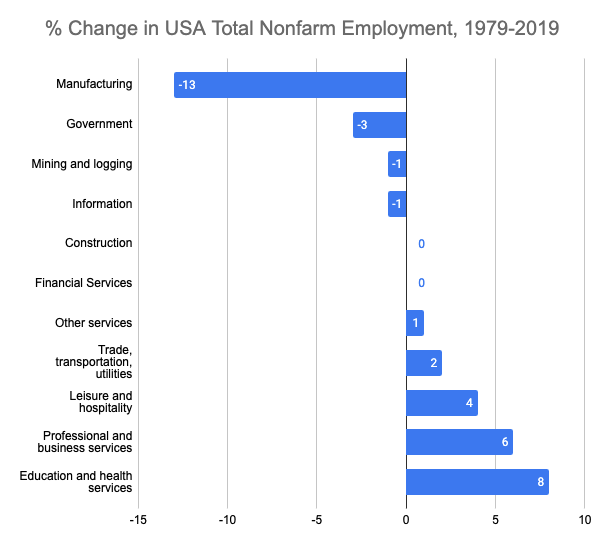
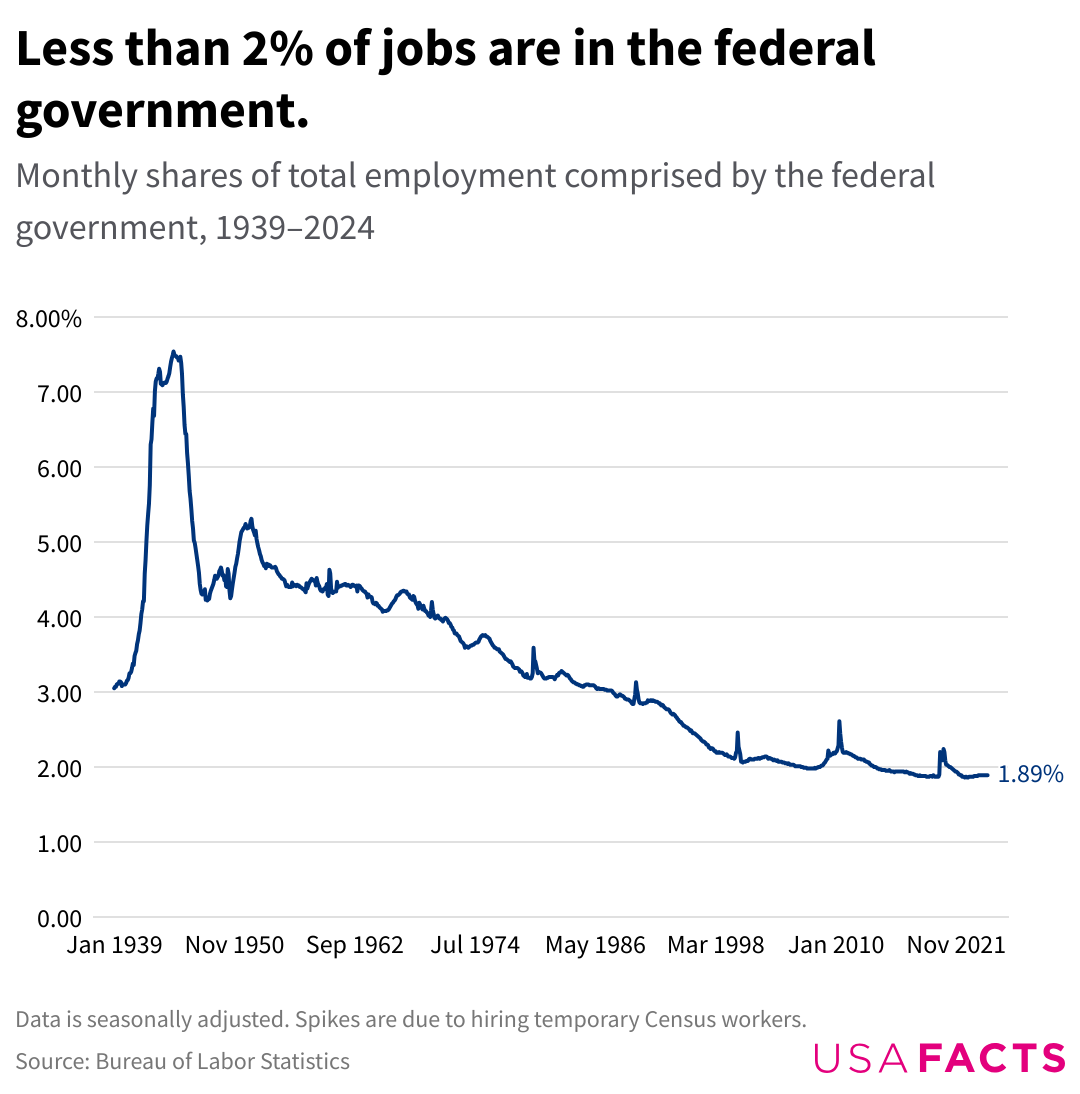
It is also interesting to note that despite the flogging of government as bloated and inefficient by the Reagan administration at the start of the period and the current decimation of government jobs at the start of the second Trump presidency, government actually declined from 1979 to 2019 in the percentage of total employment.
The loss of manufacturing jobs in the USA was not merely due to automation, but also increased global competition. Lower labor costs led companies to relocate production to other countries, and labor shortages that include the “great retirement” of the baby boomers have also had significant impacts. Trump promotes tariffs as a response to lower labor costs and lax regulations in other countries, while many economists warn that tariffs create market distortions that lead to long-term harm to domestic consumers and eventually retard industrial progress and efficiency.
The Progress of Artificial Intelligence
How much might AI impact employment in the various sectors? First, let’s confirm the impression that AI is making significant headway. General purpose AI models are now showing marked improvement on the most challenging tests of programming, abstract reasoning, and scientific reasoning.
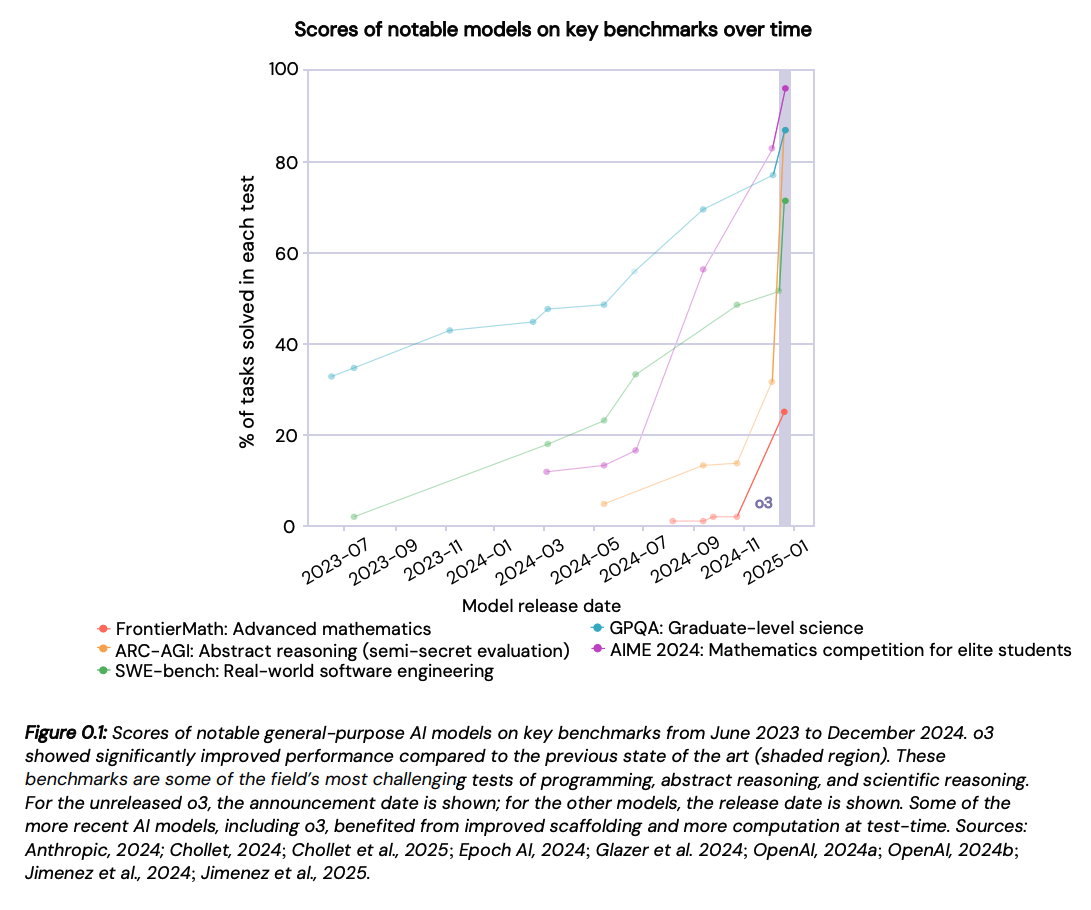
Over the last decade, general-purpose AI systems have achieved or exceeded human-level performance on benchmarks across a wide variety of domains, such as natural language processing, computer vision, speech recognition, and mathematics.
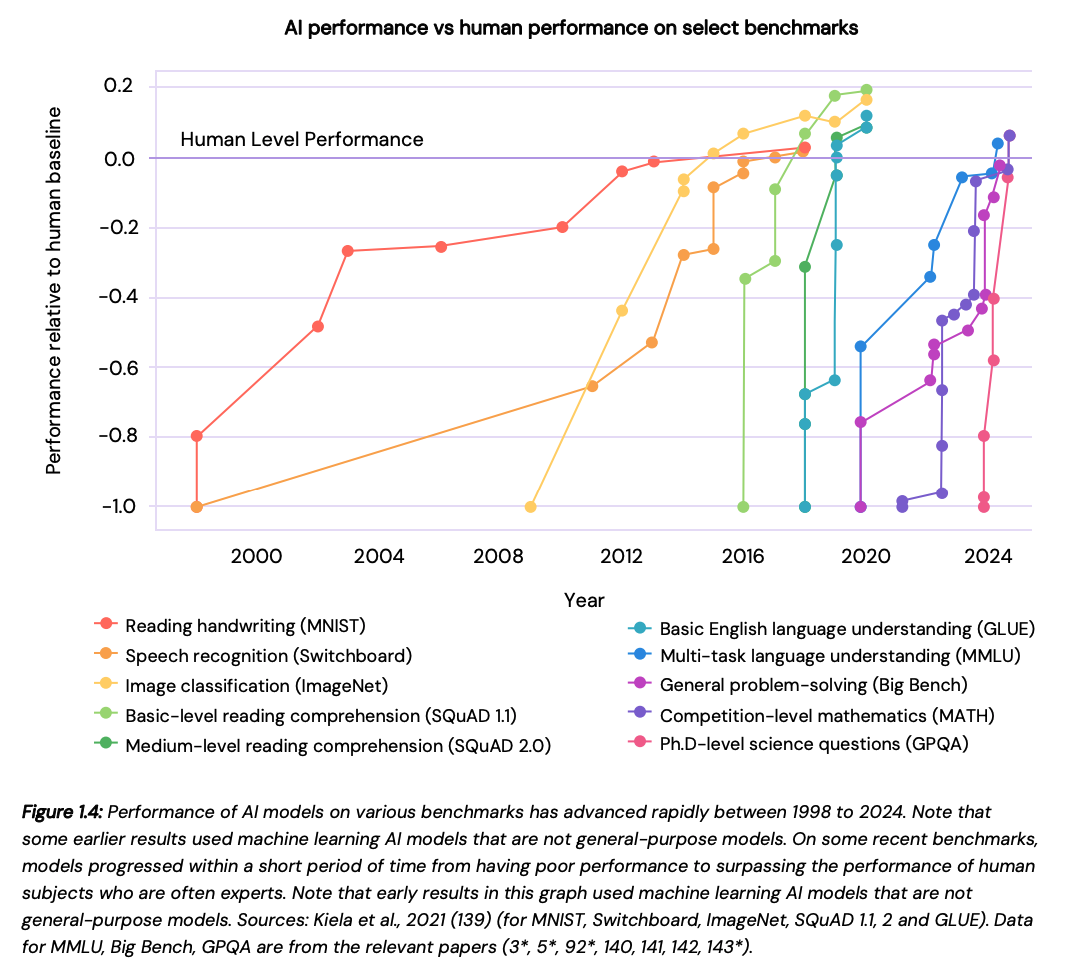
What is not clear is how impressive performance on benchmarks translates into performance in real-world tasks. According to the January 2025 International AI Safety Report, “current general-purpose AI systems often demonstrate uneven performance, excelling in some domains while struggling in others, which makes overly general comparisons less meaningful. While general-purpose AI now outperforms humans on some benchmarks, some scientists argue that it still lacks the deep conceptual understanding and abstract reasoning capabilities of humans.”
You are likely aware of how current large language model artificial intelligence can “hallucinate”, providing misleading and incorrect results. There are developing concerns about privacy, cost, and environmental impacts of AI systems.
AI Automation & Augmentation Both Bring Disruption
Nevertheless, according to the report, “General-purpose AI differs from previous technological changes due to its potential to automate complex cognitive tasks across many sectors of the economy. Unlike labour-saving innovations of past centuries that primarily automated physical tasks or routine computing tasks, general purpose AI can be applied to a wide range of complex cognitive tasks across multiple domains, ranging from mathematics to computer programming to professional writing.”
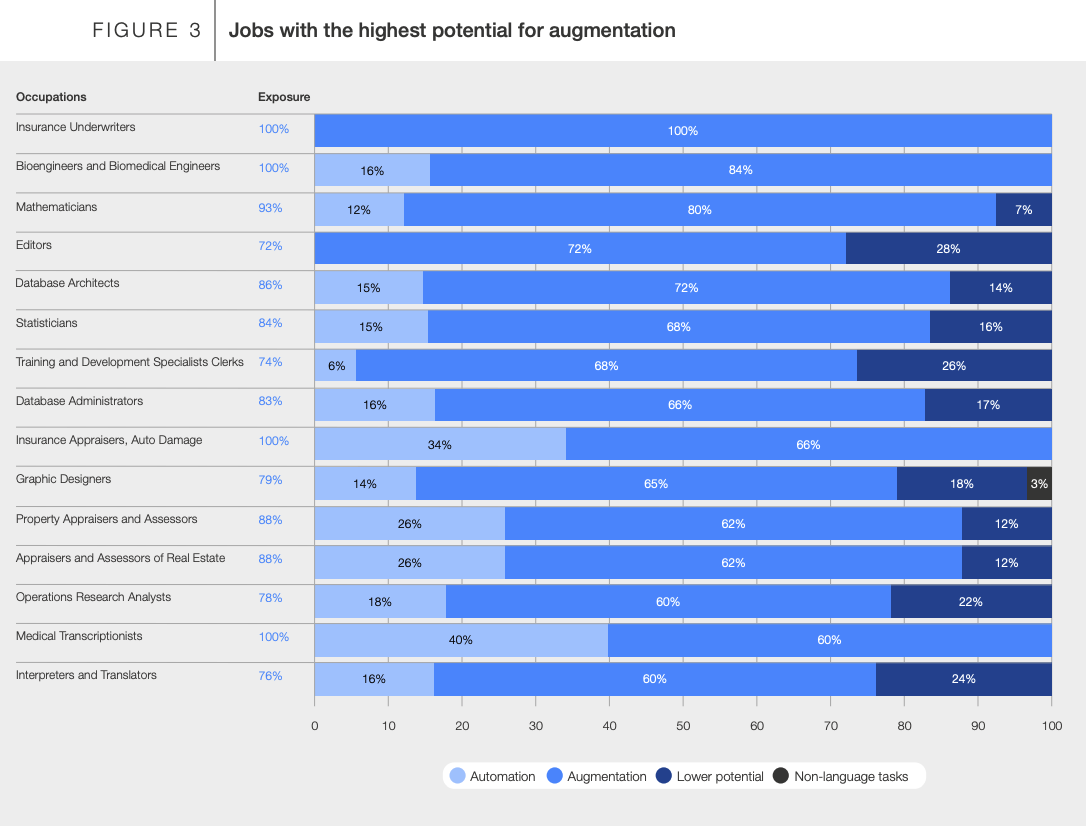
One study estimated that in advanced economies 60% of current jobs could be affected by today’s general-purpose AI systems. A 2023 white paper at the World Economic Forum identified occupations and sectors that are now vulnerable to AI automation.
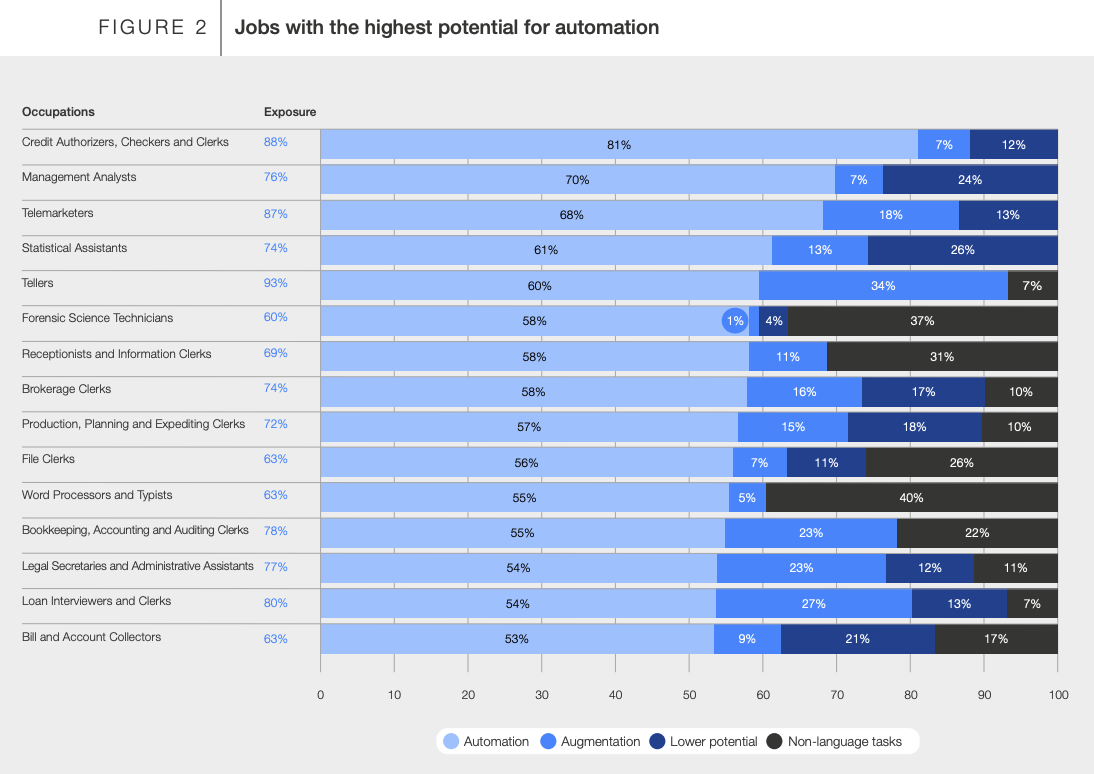
Those jobs are at high risk as AI develops, with machines, not humans, eventually performing many of their tasks.
Other jobs are exposed not through automation, but via augmentation. Humans will continue to perform these tasks, but AI will increase human productivity, which in turn can mean fewer job positions.
Jobs that require a high degree of personal interaction or physical movement are the least threatened by current AI trends.
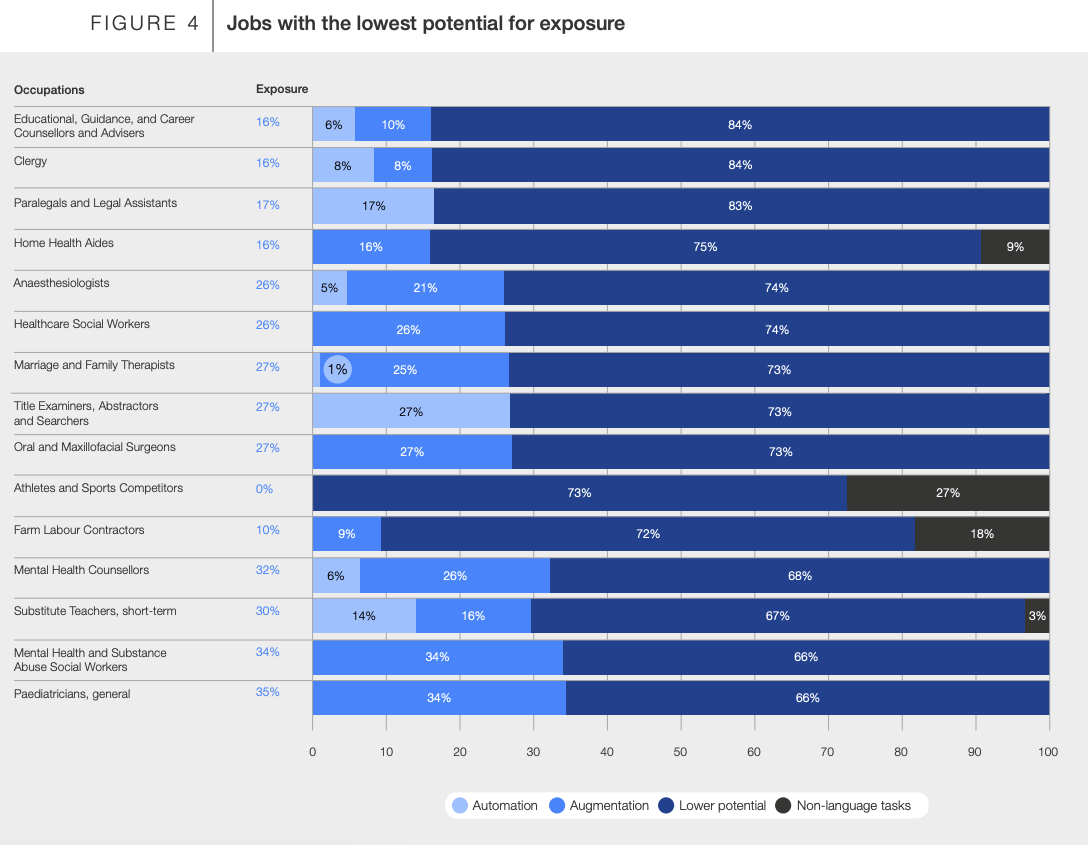
Jobs with little to no potential to be impacted by the adoption of large language models in the workplace include dishwashers, highway maintenance workers, meat cutters, rail-track laying and maintenance equipment operators, carpenters, slaughterers, oil and gas roustabouts, pressers, and fiberglass laminators and fabricators.
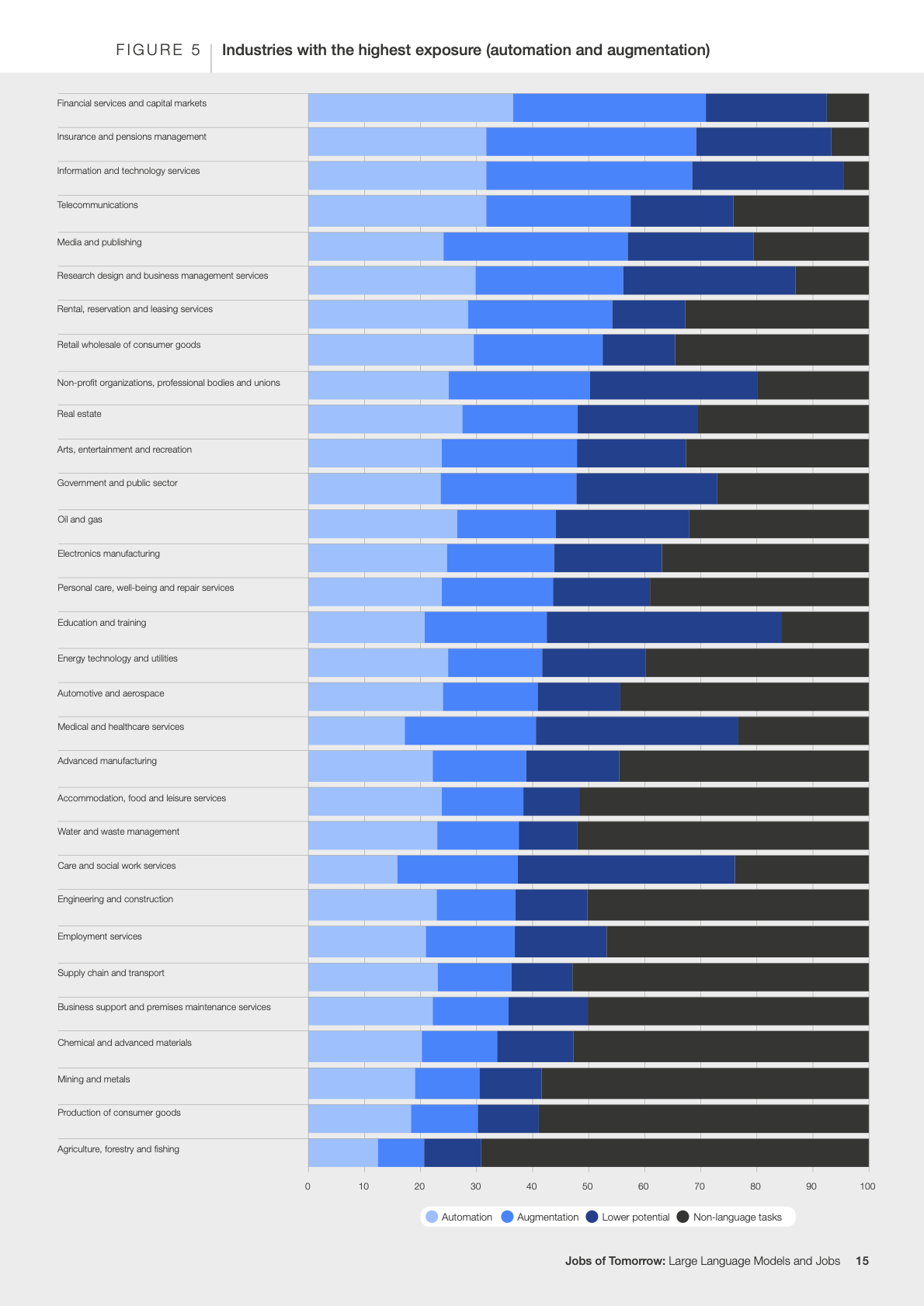
Switching from tasks to industries, below are the ones with the highest exposure to AI automation and augmentation.
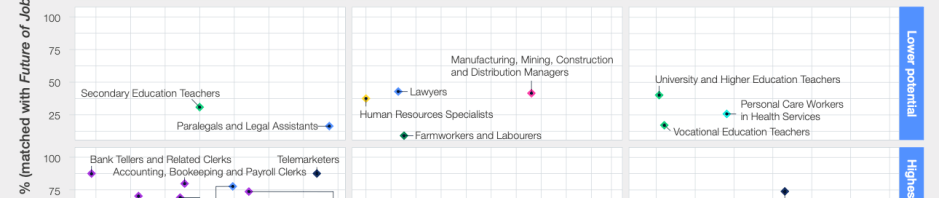
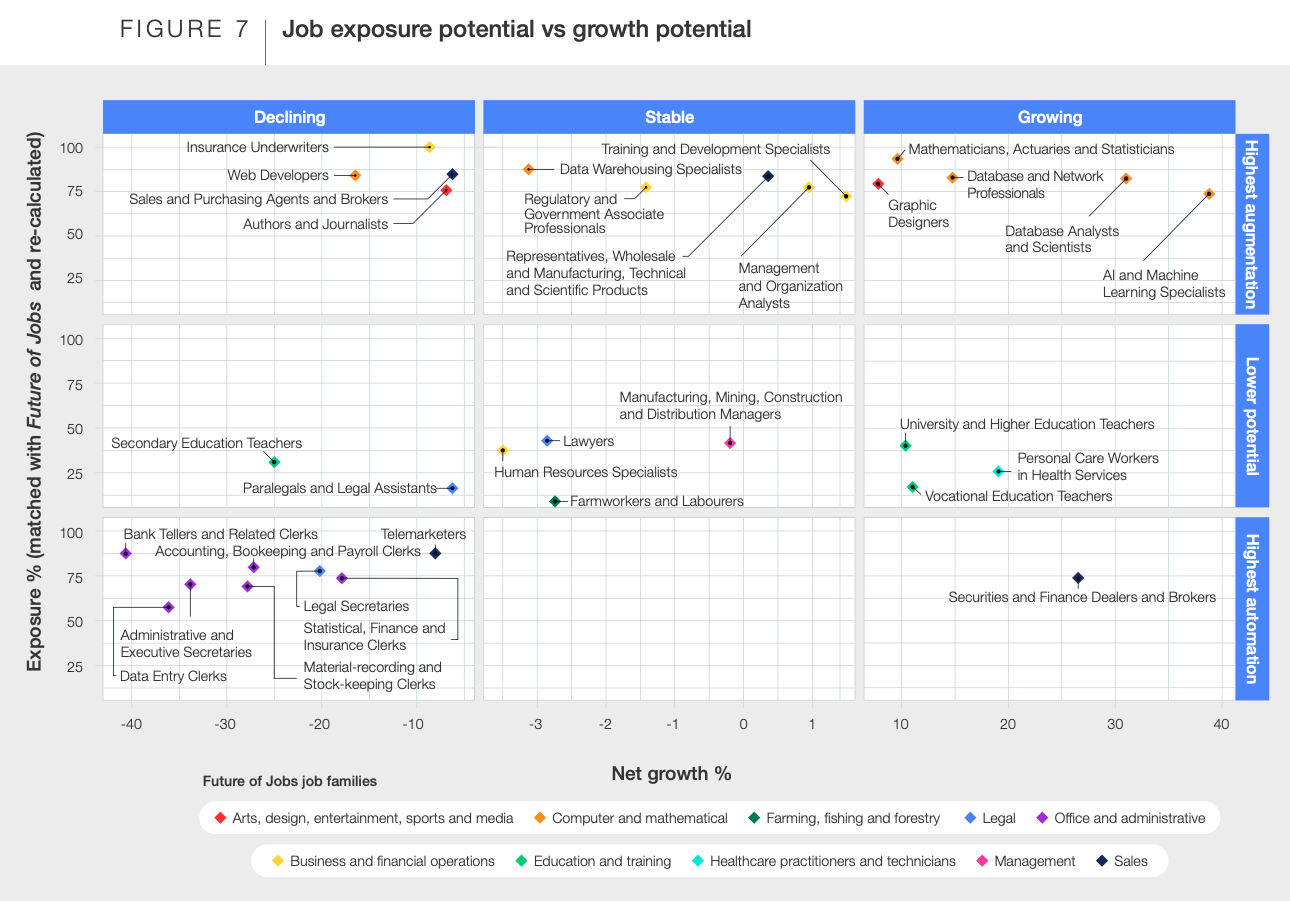
Another chart combines job exposure to AI with overall growth potential. Jobs on the left side of the chart are expected to decline, with the bottom left dramatically impacted by AI automation.
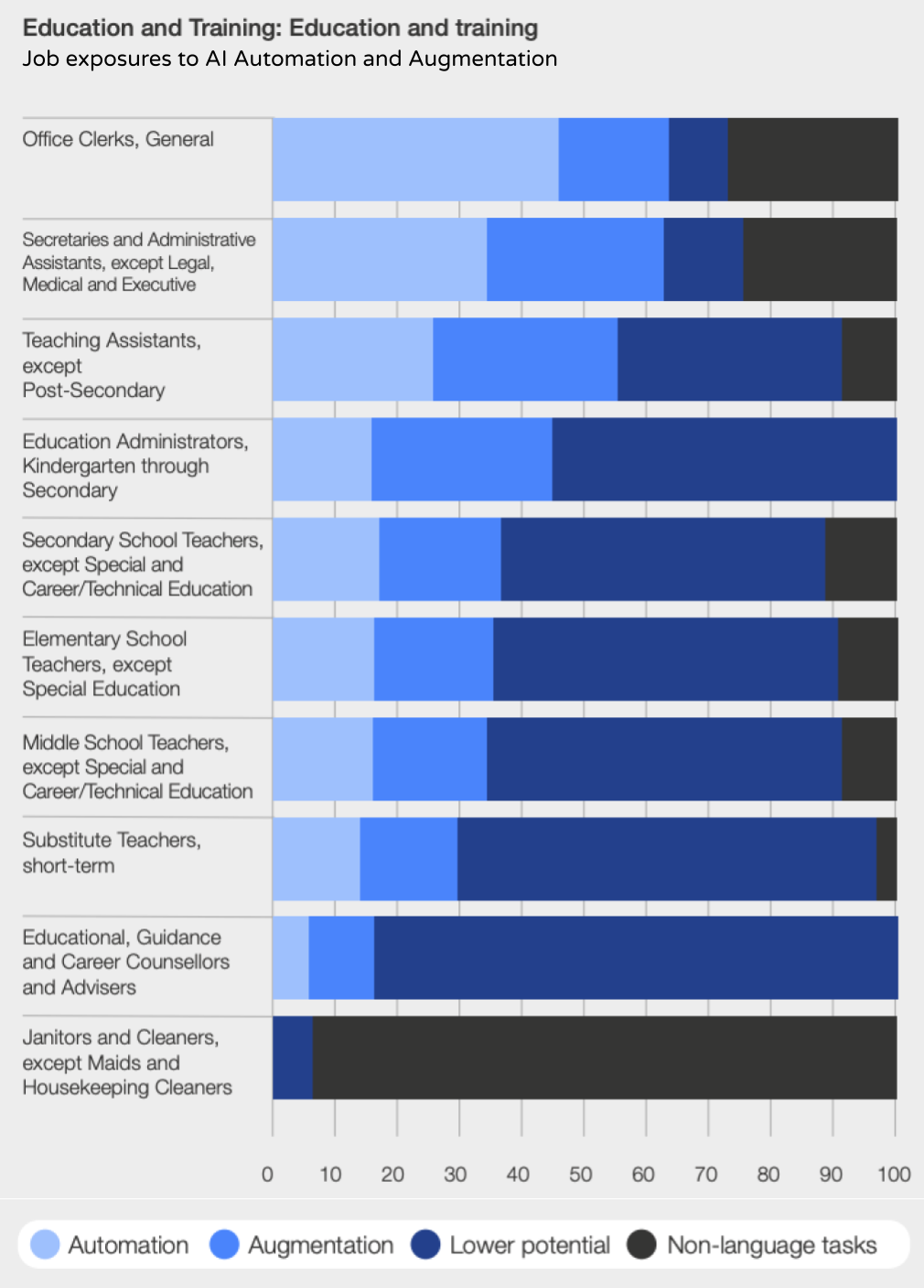
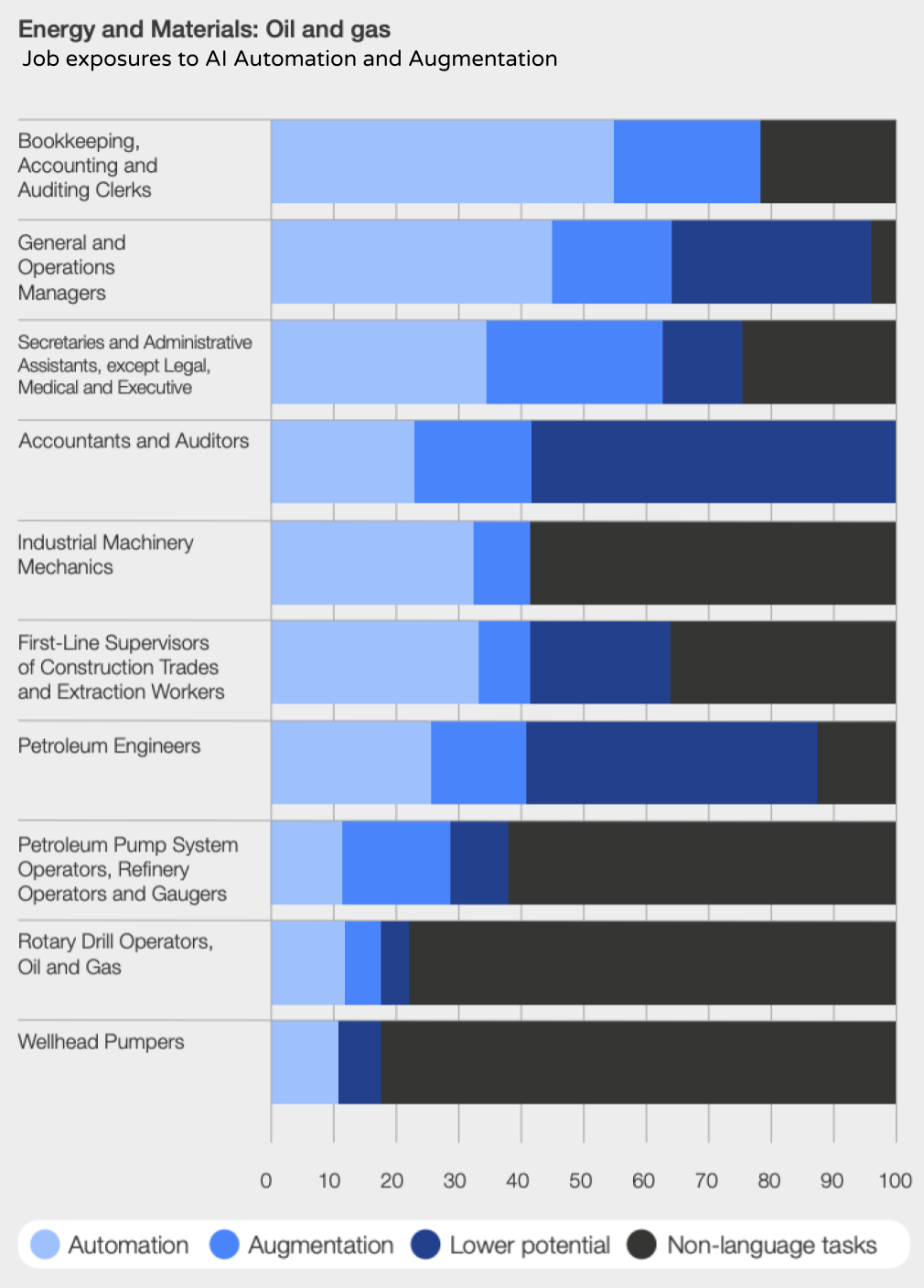
I will point out that the appendix on pages 20-29 of the report is particularly interesting, as it has charts of the job exposure to large language model AI within specific industries.
For example, here are the exposures in my own career field of education:
Bartlesville’s largest employers are still in oil and gas, and here are the AI exposures for that industry:
For some time, students have been encouraged to pursue careers in information technology, but those positions are now among the most exposed to AI disruptions:
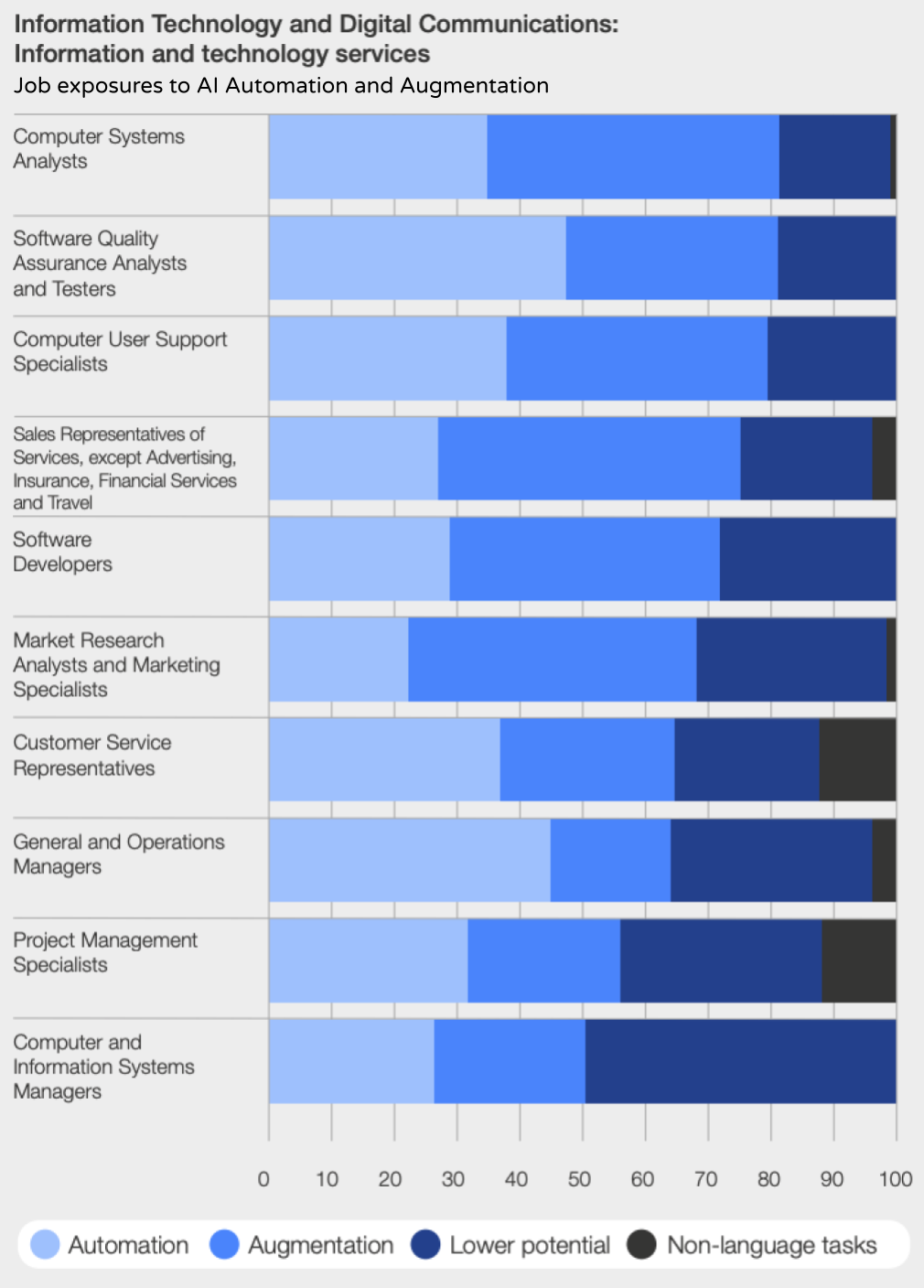

That final chart reminds me of the ouroboros, the snake eating its tail. Some perceive it as a symbol of the cycle of life, representing continuity and eternity. However, I have always perceived it as a symbol of self-destruction. Automation’s spread into new realms is certain to bring disruptions that will again shift employments.








 Meador Manor