
My least favorite months have always been July and August, as Joklahoma’s sweltering and oppressively muggy summers drive me off the trails and pathways, except for early morning walks on weekends.
One of my escapes is to read literature. In the summer of 2011, I read Lolita and Under the Volcano. Emma helped me through the summer of 2012. In 2018, I read Pride and Prejudice in the Utah desert. For 2025, I listened to Appointment in Samarra by John O’Hara.
O’Hara’s works were once popular and highly acclaimed. He wrote twelve novels, hundreds of short stories, along with essays, novellas, and plays. His prose was tough and sparse with crackling dialogue. He was explicit in his inclusion and treatment of sex in his stories, in an era when that was somewhat scandalous. His tales were elliptical, presenting slices of life without explicit explanations of what they meant. Respect for him was professional, but not personal.

Fran Lebowitz’s take on O’Hara: “Every single person I know who knew him, and there are quite a few, loathed him. He was probably such an unlikable person that nobody could judge him that way in his own era. My editor, for instance, knew him and we’re constantly battling, because he thinks I way overrate him and I say that’s because you knew him. So, he was a jerk. Except for pornographers, I think he’s the only writer who writes about sex in a way that it’s possible to read about it. I think John O’Hara’s the real Fitzgerald. O’Hara’s a cause to me. I have every single thing that he wrote.”
In 1966, John Updike’s take was, “He has more genius than talent. Very little censoring went on in his head, but his best stories have the flowing ease and surprisingness of poems.”
O’Hara’s reputation faded over the decades, but I was led to him several different ways. The first came when I recalled the movie title BUtterfield 8 when writing about telephone exchanges, only to discover it was based on O’Hara’s second novel. Then Another Bibliophile Reads mentioned one of his later, larger novels. Finally, while scanning the Modern Library’s list of 100 best novels of the 20th century, I noticed O’Hara’s Appointment in Samarra was ranked #22.


Some critics mocked Modern Library for including O’Hara’s debut novel in its list. As I wrote this post, The Greatest Books only ranked Appointment in Samarra as the 2,314th greatest book of all time. Not at all shabby, but he’s clearly fallen from grace.
For some reason, which I shall not overanalyze, I decided to first read a later O’Hara novel, Hope of Heaven. It was a slice of the life of a Hollywood screenwriter, a topic which brings to my mind Fitzgerald’s unfinished The Last Tycoon, Billy Wilder’s Sunset Boulevard, and David Fincher’s Mank.
Hope of Heaven was O’Hara’s third novel, and it only cost $2 to download to my Kindle. It was interesting for its frank treatment of sex among its characters and featured superb dialogue, but it was definitely elliptical. There was little lyrical prose, heavy symbolism, or explicit messaging. I wouldn’t have guessed it was published in 1938…it seemed more modern, and I was sufficiently intrigued to embark upon listening to Appointment in Samarra, which critics agree was both his first and best novel.
Given that both books are about the final days of wealthy men, in 1922 and 1930 respectively, comparisons are inevitable between my favorite novel, Fitzgerald’s The Great Gatsby of 1925 and Appointment in Samarra. Gatsby is in now in the public domain, while Samarra won’t become free to all until 2030.
The title of O’Hara’s 1934 book comes from an old story retold by W. Somerset Maugham in 1933:
There was a merchant in Baghdad who sent his servant to market to buy provisions and in a little while the servant came back, white and trembling, and said, “Master, just now when I was in the marketplace I was jostled by a woman in the crowd and when I turned I saw it was Death that had jostled me. She looked at me and made a threatening gesture; now, lend me your horse, and I will ride away from this city and avoid my fate. I will go to Samarra and there Death will not find me.”
The merchant lent him his horse, and the servant mounted it, and he dug his spurs in its flanks and as fast as the horse could gallop he went.
Then the merchant went down to the marketplace and he saw Death standing in the crowd and he came to Death and said, “Why did you make a threatening gesture to my servant when you saw him this morning?”
“That was not a threatening gesture,” Death said, “it was only a start of surprise. I was astonished to see him in Baghdad, for I had an appointment with him tonight in Samarra.”
You might think Julian English in Appointment in Samarra is an alternate take on Jay Gatsby in Fitzgerald’s greater novel. However, O’Hara biographer Frank MacShane noted, “Julian doesn’t belong to Fitzgerald’s Jazz Age; he is ten years younger and belongs to what came to be called the hangover generation, the young people who grew up accustomed to the good life without having to earn it. This is the generation that had so little to defend itself with when the depression came in 1929.”
While Fitzgerald’s prose is lyrical and his novel is pregnant with symbolism, O’Hara’s first novel is an adept work of realism. The Library of America noted that while both authors “dramatize the longings and dashed hopes of a lost generation, seduced and betrayed by the glittering temptations of the modern age”, “O’Hara remained always very much grounded in the real world, in ‘society,’ exposing its fine details and unspoken rules.”
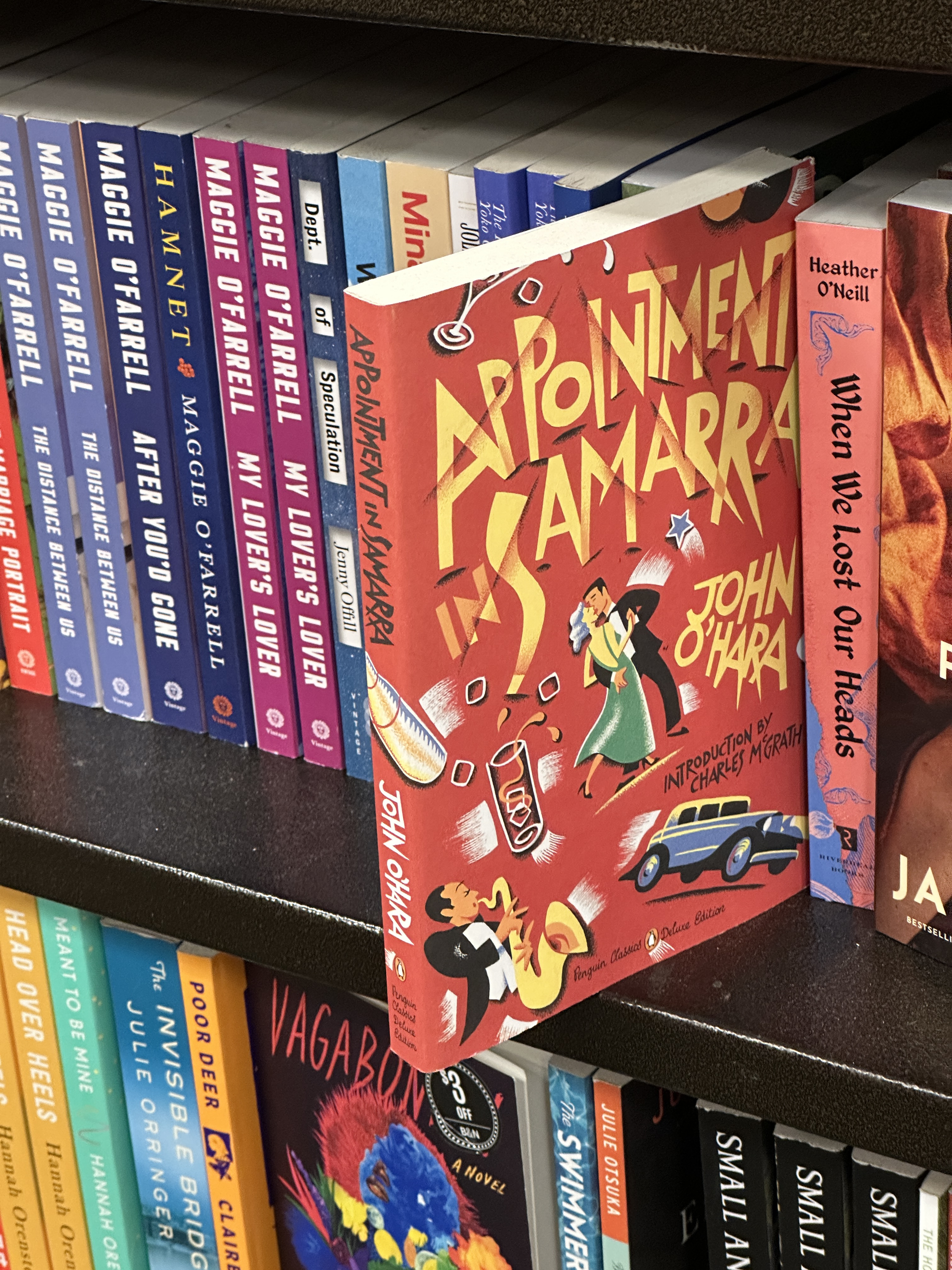
On successive days, Julian English performs several impulsive acts which are serious enough to damage his reputation, his business, and his relationship with his wife. O’Hara as the omniscient narrator never actually shows us the details of each incident, and I was fascinated with how the second event was related almost entirely through dialogue.
Given the power of his dialogue, I would recommend listening to O’Hara’s novel over reading the text, with the opposite advice for partaking of Fitzgerald.
Philip B. Eppard summarized the reader’s impression of Julian English: “drinking too much, charming with the opposite sex, constantly at odds with his parents, flouting conventional behavior in ways that lead him to be perceived by respectable society as something of a bad seed, and ultimately self-centered and insensitive to others.”
While The Great Gatsby is structured to have us perceive him through the narration of Nick Carraway, Appointment in Samarra is more direct. Julian English is less likable, but we have direct access to his thoughts. However, they remain somewhat shallow and superficial, like Julian’s life and those of most of his acquaintances.
One of the hallmarks of John O’Hara’s realism is that it faithfully reproduces the inconclusiveness of life itself, and this has sometimes been frustrating to critics, reviewers, and readers. The case of Julian English does not and never will have a neat explanation.

I enjoyed listening to this novel, much as I enjoy reading the New Journalism that Tom Wolfe and Joan Didion pioneered in the 1960s and 1970s. I was not at all surprised to find Didion referring to Julian English in one of her essays in Slouching Towards Bethlehem. Like O’Hara, she was a keen observer, and she embraced his elliptical style of describing without explaining. I deeply appreciate Didion’s early essays, but they often end abruptly, with no denouement. O’Hara can be similarly abrupt.
While I appreciate his skill, I don’t plan to read more of his novels. It is said that his short stories were his best work, and he sold hundreds of them to The New Yorker. I’ve bought a hardcover book, The Hat on the Bed, with a couple dozen of them that he wrote decades after his early novels. I’m told to expect character sketches and comments on the social fabric of early to mid-20th century America, with unexpected and dramatic conclusions.
Gibbsville awaits.







 Meador Manor