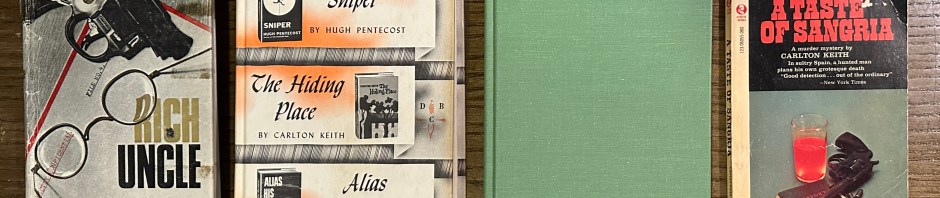

In the autumn of 2020, while our travels were restricted by the COVID-19 pandemic, I decided to read Keith Robertson’s crime novels. He was the author of the Henry Reed series which I enjoyed as a child, and he published six adult murder mysteries from 1961 to 1968. His children’s books were published from 1948 to 1986.

In a 1972 interview, he explained that the mysteries, for which he reversed his first and middle names to obtain the pseudonym Carlton Keith, were a “welcome relief” from writing children’s books. He said it took much less time to write an adult mystery than a children’s book, sharing that he entirely dictated his adult books. Recently I read the first three Perry Mason novels by Erle Stanley Gardner, and Gardner dictated his books and employed three secretaries to sustain the high output of what he termed his “fiction factory”.
I was interested that Robertson said that one problem with dictation was that he would use entirely too many words, and he would severely cut the word count in revision. He said that he didn’t struggle with plots, although I found some of his plotting overly complicated in the first two of his adult mysteries.

His adult mysteries are out of print and not available for my Kindle, so I purchased his first one as a pulp paperback on eBay. The Diamond-Studded Typerwriter, also published as A Gem of a Murder, had a wonderful pulp cover illustration by Harry Schaare. I have paid more attention to book illustrations since I started watching art director and designer J. Scott Phillips’ wonderful book and story reviews and some of the illustrator retrospectives by Pete Beard.
I enjoyed that first Carlton Keith novel enough to buy the rest of his adult mysteries, which were not available in the Kindle bookstore. So I ordered copies from used bookstores in Illinois, Ohio, New York, Tennessee, and New Zealand via Abebooks.
I read his second mystery in March 2021, and it was mediocre. So I took a long break from the little collection I had acquired. My interest was revived this summer, which has been exceptionally wet and humid. My distaste for sultry weather keeps me indoors, which encourages me to read.
Rather than continue with the Carlton Keith novels in chronological order, I examined the physical format of the four remaining works, deciding I would read whichever was most physically appealing.
So, let’s try judging a book by its cover. Which of these four interests you the most?

Surely you did not pick the green one. That is The Crayfish Dinner of 1966, which was also published as The Elusive Epicure. Here is its spine:

Three of the four were hardbacks, with only 1963’s Rich Uncle having an actual book jacket, although I’m sure The Crayfish Dinner once had one…let’s see what the internet shows.

Ugh; I agree with ditching that. I don’t care for the look of crayfish, and I remember dissecting one in high school Biology I. But it is evidently for dinner, and I have had some tasty Crawfish Étouffée in New Orleans.
I like the book jacket design of Rich Uncle, which is superior to the photograph on the cover of A Taste of Sangria. The latter was his last mystery, and it will probably be the last of the books I take up, as my copy is a cheap paperback with awful pulp paper printed in 1968. That eventual reading experience will be worsened by a tear across a dozen pages. I also don’t care for sangria, or any form of alcohol, for that matter.
In making my choice, I deliberately avoided reading any blurbs or summaries, and I also ignored their apparent lengths. Later, I did weigh the tomes. My Rich Uncle hardback weighed 9.3 ounces, the hardback with three novels, one of which was The Hiding Place, weighed over a pound at 19 ounces, The Crayfish Dinner hardback weighed 14 ounces, and the nasty little paperback was only 3 ounces.
I also didn’t crack open any of the books in making my choice, but here’s a look at the start of a chapter in each novel:

Now which one would you try?
Going only by the covers and the feel of each book in my hands, I selected the heaviest, an anthology of three 1965 “detective” novels: Sniper by Hugh Pentecost, The Hiding Place by Carlton Keith, and Alias His Wife by Stephen Ransome. Here’s a close-up:


My paternal grandparents kept several Reader’s Digest condensed books in the headboard bookcase of the guest bed my parents would use. As a child, I was fascinated how they might have six books in one, until I realized that “condensed” meant abridged. Feeling that I would be missing out, I generally avoided reading them, although I did enjoy examining their covers.
When I was in junior high, I checked out a translation of Jules Verne’s Twenty Thousand Leagues Under the Seas, having enjoyed the Disney film. Boy howdy, was I ever bored! Its passages on undersea life seemed interminable. I don’t know if I was reading the first English translation in 1872, by Reverend Lewis Page Mercier, but I suspect not since Mercier cut nearly a quarter of Verne’s French text (while committing hundreds of translating errors), and I couldn’t imagine the text being any longer. The full version is supposedly about 152,000 words, and at the time I would have loved to try a condensed version. I didn’t try reading another Verne novel for decades.
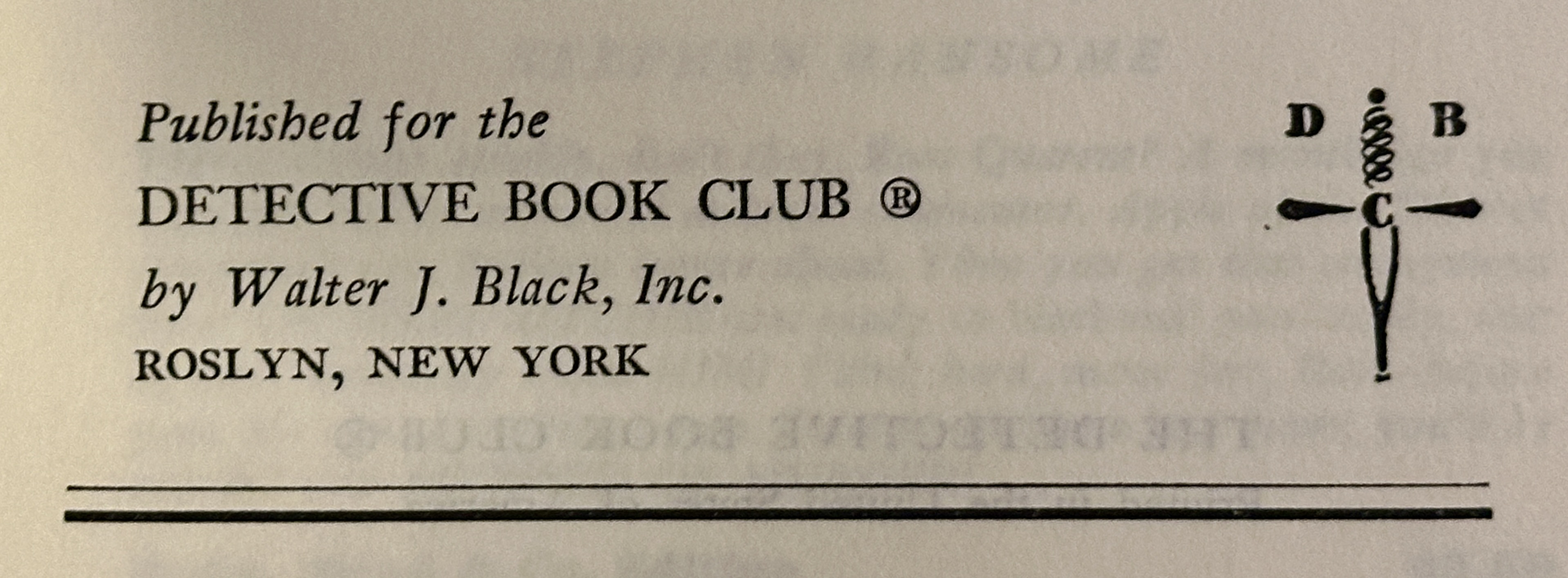
Seeing that The Hiding Place was in some sort of book club anthology, I was concerned that it might be abridged. The Detective Book Club anthologies were issued from 1942 through perhaps 2000. They were initially produced by Walter J. Black, who made a career in reprints, popularizing classics along with anthologies of Westerns and detective stories.
His son, Theodore M. Black, took over the business after Walter’s death in 1958, and he was a smart cookie. He graduated summa cum laude and Phi Beta Kappa from Princeton in 1941 and was that year’s valedictorian. After graduation, he was a captain in the army, serving in Europe in World War II, and he then served in the army reserves for 22 years, retiring as a reserve lieutenant colonel. As an educator, I’m mildly interested that he authored Straight Talk About American Education in 1982, but not enough to read it. Theodore died in 1994, and he was buried with his parents in Westbury, NY.
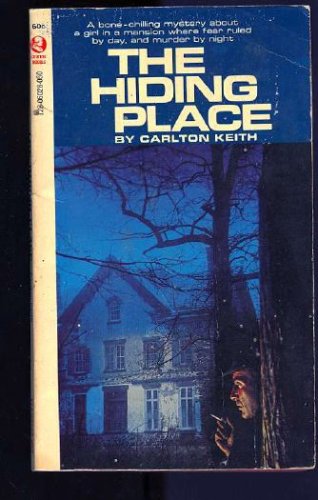
Some of the novels in the Detective Book Club anthologies were abridged, but an online image of a paperback edition of The Hiding Place shows what appears to be a thin tome. (If you search for this book online, you’ll be inundated with results for the Corrie ten Boom autobiography which I read in my youth. I had to use “-Boom” to filter my searches.)
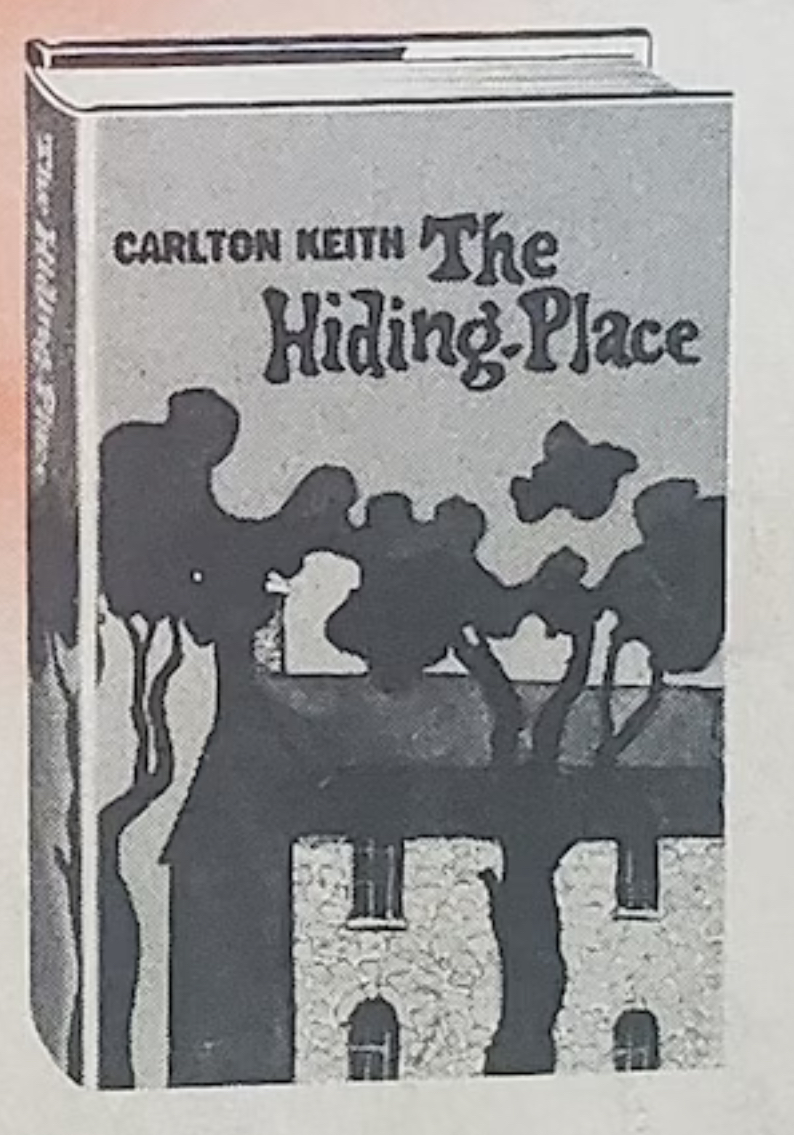
I searched for but couldn’t find a larger or color reproduction of the tiny book illustration used on the front and back covers of the Detective Book Club anthology for The Hiding Place. Whether it was intentional or not, I like how the artistic depiction of leaves on some trees, and what might be a cloud, are reminiscent of jigsaw puzzle pieces.
As for The Hiding Place, I was relieved to find it did not feature Jeff Smith, the handwriting expert protagonist of Robertson/Keith’s first two novels. The Jeff Smith characterization and some of his antics reminded me of Gardner’s early Perry Mason, and I’ll admit that I am a bit done with Perry Mason after the third book in that series. They were too hardboiled and plot-driven for my taste.
I was glad to find the protagonist of The Hiding Place was a completely different character, Alex Olszak. He was described as a big, hulking man with long, dangling arms and ham-like hands with a stolid face devoid of expression except when he smiled. Somewhat unexpectedly, his profession was industrial design, creating hubcaps, toasters, and other items, using modeling clay and plaster.
I appreciated how Robertson/Keith put some effort into characterization for Olszak, although almost all of the other characters were stereotypes. The story read like an adult version of one of the Stratemeyer Syndicate’s Hardy Boys or Nancy Drew mysteries, with hidden “treasure”, a secret room and tunnel, knockout blows to the head with no concussions, being tied up by crooks, and the like. It was simple and fun, and despite its utter lack of sophistication, I enjoyed it far more than the earlier Jeff Green mysteries.
Since it appeared in the Detective Book Club, I wondered if an actual detective would be a character or not. Indeed, a private detective did appear and played a role in the plot. I presume Robertson/Keith was trying out different forms of mysteries to see what might sell, or perhaps he was entertaining himself by writing in different styles within the genre.
Hugh Pentecost
I found that I thoroughly enjoyed reading the Detective Club Book in terms of its look and feel. It was comfortable to hold and read, with clear and well-laid-out text. In fact, I enjoyed it enough that after finishing The Hiding Place, I contemplated the one-page synopsis of its three novels on an opening page to see if I might read another of the tales.


The blurbs were poorly written, with far too many EXCLAMATIONS! However, the first one sounded like a cozy read in a familiar subgenre and was credited to Hugh Pentecost.
That pseudonym was used by author Judson Pentecost Philips, who wrote over 100 mystery and detective novels, along with many pulp sports novels back in the 1930s. It is said that his novels had strong characterization, fair play with the reader, and unstilted language. Sniper was the first of seven books in his John Jericho series. I suspect it being first in the anthology might indicate the publisher thought it was the best of the trio.

I confirmed online that the tiny book cover depiction on the anthology edition matched the book jacket on a hardcover edition of the novel, and I found a couple of other covers for it. I would not have even picked up this book based on its paperback cover, with its artwork of what appears to be a dangerous red-haired relative of Grizzly Adams, “Giant John Jericho”.
As a man with a smaller frame and no athleticism outside of fitness aerobics and day hiking, with a career based on science and technology, I don’t identify with big hulking male characters who are artistic. However, the book was in hand, and Philips/Pentecost had earned a Grand Master Award from the Mystery Writers of America, so what the heck.
John Jericho had some superficial similaries to Alex, the protagonist of The Hiding Place: another guy with a large frame, “hamlike” yet oddly dextrous hands used for artistic endeavors, and an appreciation for aesthetics more often stereotyped as a characteristic of homosexual males than straight he-men. Both gentlemen were also experienced in firearms.
The first chapter was a rough start, an introduction to the two lead characters which I found hard to believe: a woman was proposing intercourse with Jericho shortly after meeting him. He rejected that, and the story had no graphic scenes, but it immediately came across as distinct from Robertson/Keith’s contribution to the anthology, where a man and woman had some very conventional dates, a few kisses, and then agreed to marriage, with the reader only aware of them having reached first base.
Philips/Pentecost’s novel had more deft characterizations and a whodunit plot that offered up plenty of suspects with the inevitable twists and turns. He wasn’t Agatha Christie, but he was certainly more skilled than Robertson/Keith in the mystery genre.
I doubt I will seek them out, but I’d read another Hugh Pentecost book. Also, despite his evident inferiority in the genre, I’ve made it a project to read all of Robertson/Keith’s crime novels, and I suspect I will tackle Rich Uncle next…but that won’t be for awhile. Over the past four months, four of the eleven books I’ve read have been mysteries.

So I’ve started listening to director William Friedkin’s memoir on my walks, and I think I’ll pick up my Kindle, read the remaining essays in Slouching Toward Bethlehem, and then try reading another of Modern Library’s 100 Best Novels of the 20th Century: A House for Mr. Biswas by V.S. Naipaul. I’m grateful to have varied options to distract me during this sultry summer.








 Meador Manor
Granger, I’m so happy to have found your excellent review of Carlton Keith’s works. I’m involved with a small Keith Robertson fan group on Facebook and delight in finding new references to his work.
A few things:
> You may find an image of the hardcover “The Hiding-Place” (note the hyphen!) here: Sold at Auction: Carlton Keith Lot of (5) 1st’s in DJ’s. They’re not mine (I am still kicking myself for not finding the auction listing in time to bid) but the linked page includes nice-looking copies of five Carlton Keith titles, one with an incredible double inscription.
> I would really like to purchase or trade for your Robert Hale edition of RICH UNCLE if you’re willing to consider giving it up. It’s one of a couple Keith Robertson books missing from my collection.
> I hope you’ll explore more of Keith Robertson’s other books. I saw your post mentioning HENRY REED’S JOURNEY. Did you read others while growing up? So many great choices!
Scot,
Thanks for the link to the cover of The Hiding Place. Too bad it turns out those shapes are all just leaves, and the puzzle-piece look is not borne out in the full color version. Please send your mailing address to me privately at meador@meador.org and when I finish with Rich Uncle, I will be happy to send you my copy, gratis. I would like for a fan to have it.
Thanks, Granger. I sent an email.
I pondered that black-and-white image of THE HIDING-PLACE for years, wondering if it was made up just for the Detective Book Club omnibus, before finally finding a copy of the original book.
I also wanted to comment on your CRAYFISH DINNER. Your green cloth book is complete without a dust jacket! It is part of the 1983 Garland series “50 Classics of Crime Fiction, 1950-1975,” a collection chosen and introduced by Jacques Barzun and Wendell H. Taylor. As with the rest of the “50 Classics,” this book was issued without a dust jacket and desperately looks like it needs one. The dust jacketed book whose picture you found is the original 1966 Doubleday “Crime Club” imprint. The book was also published in the UK, retitled as THE ELUSIVE EPICURE.
Aha! Mystery solved. I started on Rich Uncle, so I could get it to you soon. That’s the one I had to order from New Zealand in 2020, paying $12.01 for the copy, which was once in the New Plymouth Library in NZ, plus $22 shipping. The seller was kind enough to say I could order more books from his shop down under with no increase in shipping, but I just got the one. I will say that thus far I’m enjoying it more than the two earlier Jeff Green books. The Hiding Place seems a regression, but perhaps Robertson/Keith was experimenting with a different level of book to see what would sell. You probably know more than I do about that!