
For over twenty years, researchers have collected data on how, where, and with whom our countrymen spend their time via over a quarter-million interviews. I find it interesting to compare my habits to the “average American”, especially since in less than a year mine shall change radically.

Until July 2026, I will remain among the almost half of people ages 15 years and older who work. As our population aged, the proportion of workers has shrunk a bit, from 54% in 2003 to 47% in 2024, with a fairly consistent 8 hours per day on average.

Almost 9 in 10 in the surveys spend an average of over 4.5 hours per day relaxing and doing leisure activities. About 3/4 spend an average of over 3.5 hours per day watching television, and while I have not watched traditional television in years, I’m right in sync by spending about 3.25 hours per day watching YouTube, and our television set does get used for a half hour each weekday morning for my aerobics exercise to the Everyday Workout episodes I recorded in the 1990s.

Over the past two decades, the proportion playing games has doubled from 8% to over 15%, and participants typically spend over two hours on that. As a child, I enjoyed board games, but the only card game I played was Kings in the Corner with my paternal grandmother. People often assumed via stereotyping that I played chess, but in fact I never cared to learn chess or even checkers. When video games came along, I played a few on my home computers, but I almost never played them in arcades and never developed a gaming habit.

About 1 in 5 participate in sports, exercise, and recreation on a given day, with those who do spending about 1.5 hours on it. I do my half-hour of aerobics on weekdays and walk on Bartlesville’s Pathfinder Parkway some weekend mornings. Walking has increased in popularity from about 1 in 20 on a typical day to 1 in 12, with the walkers spending an average of about 50 minutes on their perambulations.
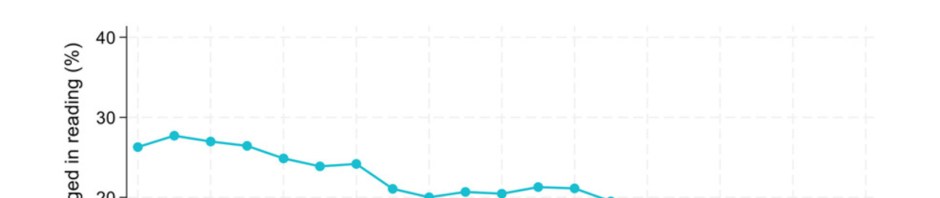
However, what prompted this post was a news article about the decline in reading. Over the past two decades, the share of readers has declined by 40%, from over 1 in 4 in 2003 to less than 1 in 6, with reading defined to include books, magazines, and newspapers in print, electronic, or audio form. As the number of readers has declined, the average time spent reading has increased from 84 to 104 minutes, although one suspects that shift is more statistical than showing an increased devotion to reading among the remainder.

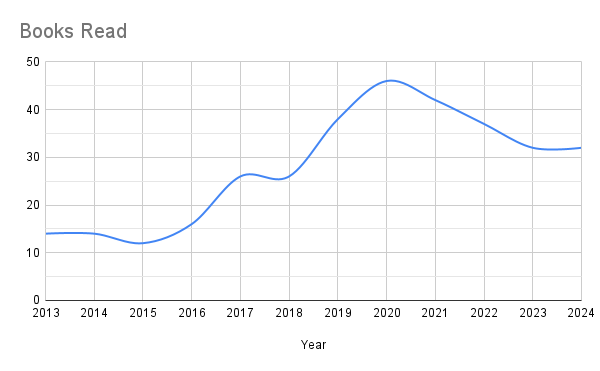
The researchers point out that the decline in reading correlates with an increase in the use of other digital media, including social media, and I already mentioned a rise in gaming. I only read 12 books in 2015, but that rose fairly steadily to peak at 46 amidst the COVID-19 pandemic in 2020, declining back to 32 for the last couple of years. The median number of books read per year in the USA is about five, with an average of a dozen, the latter statistically inflated by a small number of voracious readers.
In about 300 days, I’ll have eight hours each weekday freed up from work. It will be interesting to see how that impacts my reading, walking, and viewing habits. Retirees enjoy almost seven hours of leisure time each day, which they often spend on reading, games, creative ventures, and spending time outdoors. They savor their meals more and spend more time on home repairs and gardening.
I’ve a list of things I’m interested in after retirement, including Tulsa Town Hall lectures, Osher Lifelong Learning Institute classes, completing my downtown history project, and spending more time at Woolaroc, Philbrook, and the Gilcrease once it reopens. It will be fun to connect more with friends and acquaintances, and I will no doubt do more dayhikes, updating my map of the trails at Osage Hills and revisiting trails I haven’t walked in a decade or more. I’ve also accumulated a pile of books and several optical video discs of movies and old television shows that await my attention.
But, Mousie, thou art no thy lane,
In proving foresight may be vain;
The best-laid schemes o’ mice an’ men
Gang aft agley,
An’ lea’e us nought but grief an’ pain,
For promis’d joy!
Still thou art blest, compar’d wi’ me
The present only toucheth thee:
But, Och! I backward cast my e’e.
On prospects drear!
An’ forward, tho’ I canna see,
I guess an’ fear!







 Meador Manor