
A lightning strike prompted me to simplify our home theater. The bolt early one morning struck quite close to our house, disrupting our next door neighbor’s telephone landline wiring and one of its attached telephones. I had to reboot both our cable modem and its eero router to get the internet back up in Meador Manor, and later that day our television was making clicking noises while in standby mode.
Unplugging the television for awhile solved the clicking issue, but a few days later, when Wendy wanted to watch a DVD with me, I couldn’t get our Sony Blu-Ray Ultra HD player to work. I tried a different HDMI cable, a different disc, and powering everything down and back up to no avail. I presumed that a power surge might have damaged the player, despite it being plugged into a surge protection power strip, since that power strip had been in use for years and thus its protective metal oxide varistors could have worn out.
So I ordered a Panasonic Blu-Ray Ultra HD player, but when I plugged it in, it was still no go. Oh dear…what had I missed? Our complex home theater system, which I had rebuilt in 2017, had always been too complex for Wendy’s comfort and now its crankiness was exasperating me as well.
The Receiver
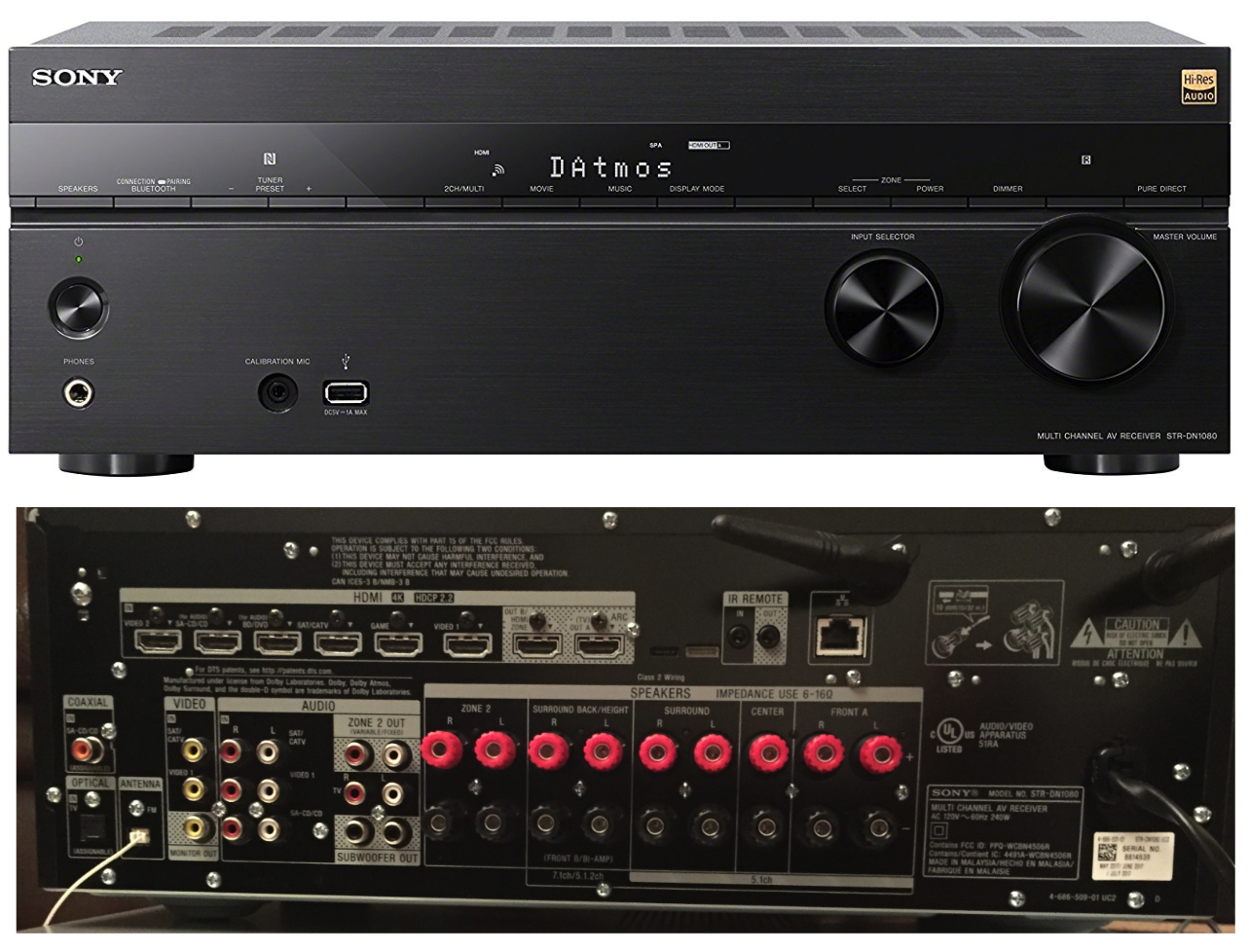
Back in 2003, I had bought a Panasonic SA-HE100S receiver for $300 along with a $300 Onkyo SKS-HT500 home theater speaker system. Fourteen years later, when I bought an LG OLED television, my old receiver didn’t have any HDMI capabilities to help everything link up, and I wanted to keep using the surround sound speakers. Wendy and I were newlyweds, and I hoped to build a system with push-button ease of use.
So at that time I invested $598 in a Sony STR-DN 1080 receiver, which became an HDMI hub for our television, Apple TV, and disc player while powering the five old surround sound speakers and powered subwoofer. I also upgraded my old Logitech Harmony universal remote to a Harmony Companion.
With considerable effort, I got everything to work, but Wendy was never comfortable with the system. In recent years, more often than not I would activate a function on the Harmony universal remote and have something go haywire, requiring me to tweak various settings and break out dedicated remote controls to get a video to play correctly in surround sound.
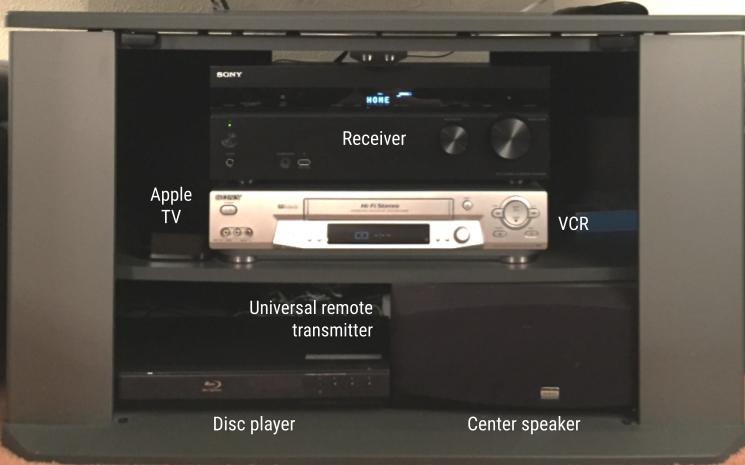
Earlier this year I stopped using my 2001 VCR to watch my 1990s workout videos, since I now have digital copies of the shows on my Mac Mini home computer which I can stream to the television using my iPad. I decided it was time to radically simplify, with a goal of clearing out everything in the TV cabinet except for the Apple TV and the disc player and having a system Wendy and I could operate much more easily and reliably.
Simplification
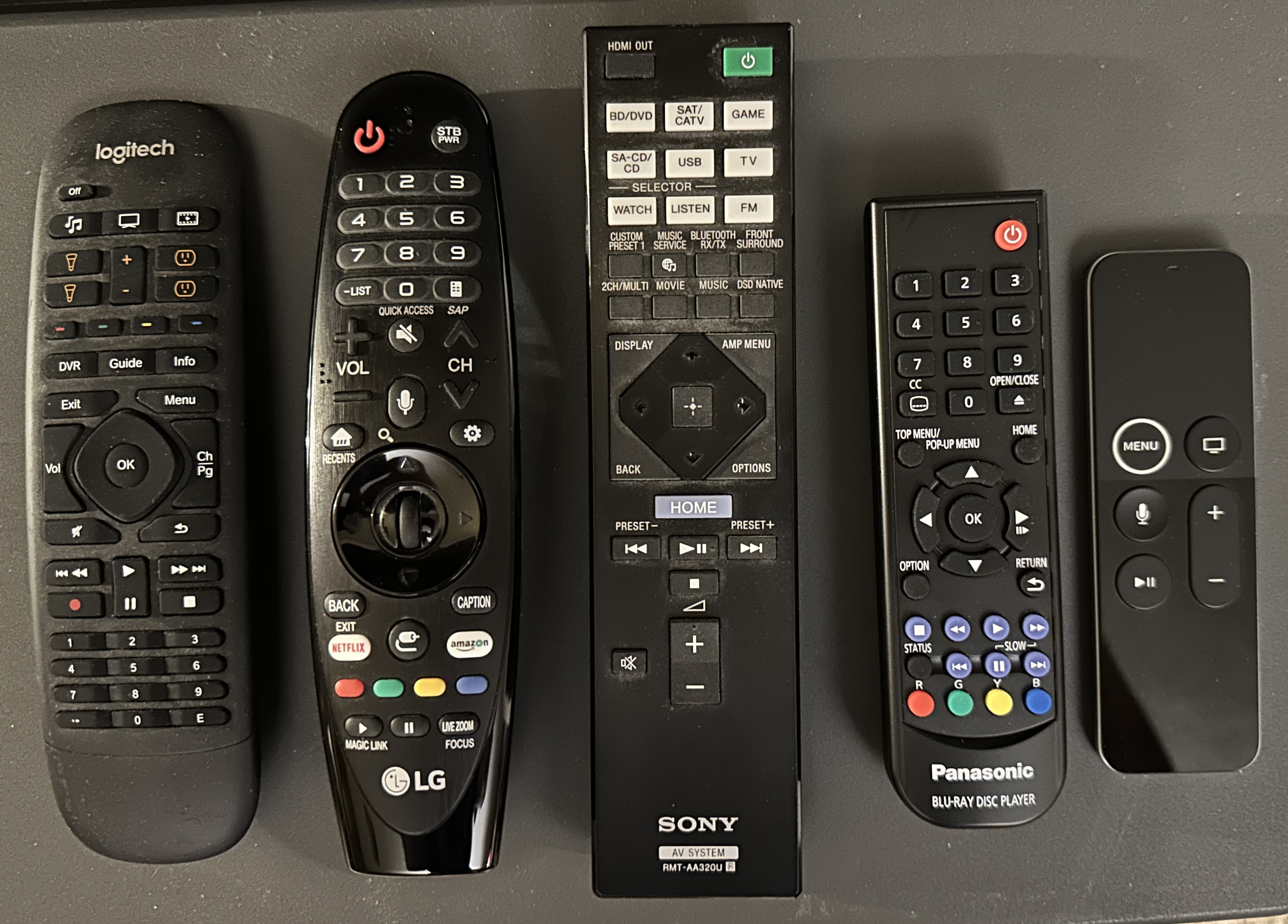
I abandoned the Logitech Companion universal remote along with using the receiver as an HDMI hub. Instead, I plugged the 2025 disc player, the 2017 Apple TV, and a 2018 Chromecast Ultra directly into the television. We will now rely on the LG television’s “Magic Remote”, which I managed to program to control the basic functions of the new Panasonic disc player and I had previously programmed to adequately control the Apple TV.
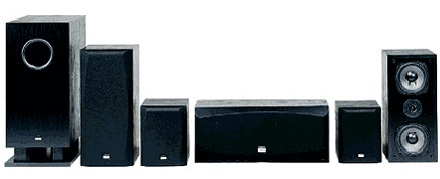
Eliminating the complexity of the receiver also meant abandoning the Onkyo surround sound speakers I had purchased in 2003. After I retire in 2026, Wendy plans to continue to work for a few years. So I expect to be making more use of our home theater, and I opted to invest in a new sound system that doesn’t need a receiver/amplifier and supports Dolby Atmos for a three-dimensional soundscape.
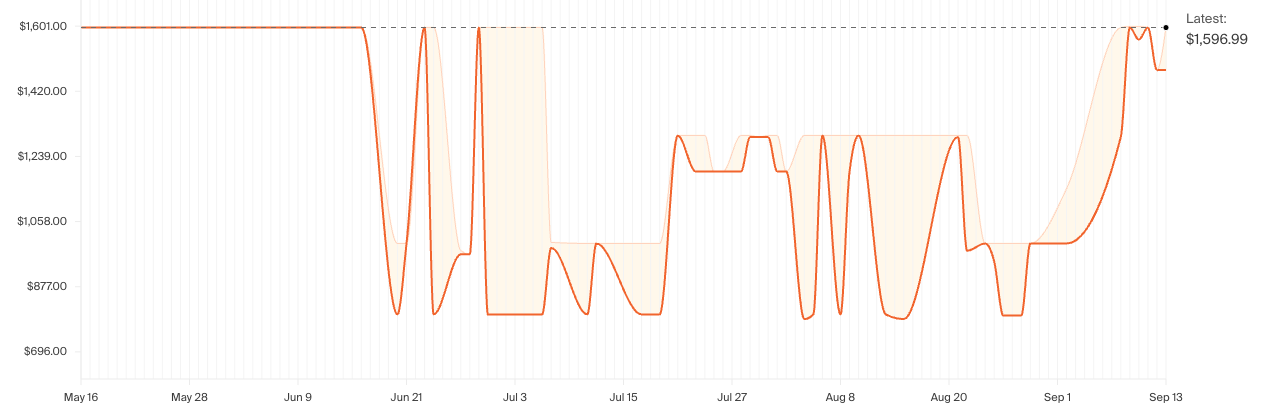
I spent $1,000 on an LG S95TR 9.1.5 channel soundbar with two wireless remote surround speakers and a subwoofer; it was LG’s flagship model last year, and Amazon was willing to let me spread payments across several months. I noticed that its price has fluctuated between $800 and $1,600 over the past months, so don’t pay list.
My old system was termed a 5.1 because it had five obvious full-range speakers — front left, front right, center, left surround, and right surround — and one subwoofer for deep bass. But what did the new system’s 9.1.5 designation mean, given that physically it is one long soundbar, two satellite speakers, and a subwoofer?
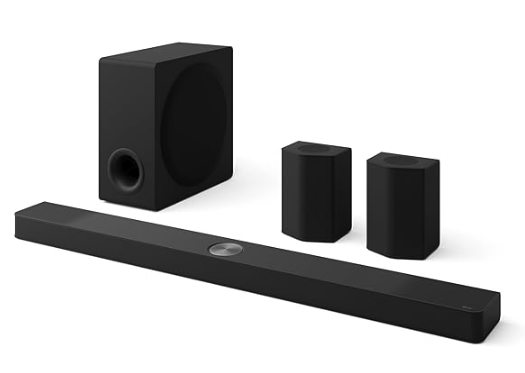
Well, it has 9 regular channel speakers, 1 subwoofer, and 5 up-firing speakers. Those last speakers are used for Dolby Atmos. The soundbar actually has ten speakers in it, three of them firing upward.
The subwoofer went on the floor near the television. The two satellite speakers replaced the two in our old Onkyo system. One of those old speakers had always sat up high on a fireplace mantle on one side of our couch, while its companion sat on the floor on the other side. The older units did not need power cords but had long speaker wires leading back to the Sony receiver under the television, and because of the speaker wires they were never really behind us, just beside us.
The new system’s satellite speakers just have power cords since they receive the sound signals wirelessly from the soundbar. In addition to front-firing drivers, they each have one firing upward. I put those about nine feet behind the couch along walls near power outlets.
Back when I set up the Sony receiver, it came with a little calibration microphone to tune my old 5.1 system speakers. The new system had me use the LG ThinQ app — the same app that controls our LG washing machine — to calibrate the speakers. (I wondered why they call the app “thin Q” and the internet told me to think about it. 🙄)
I just sat with my iPhone on the couch, triggered the test, and each speaker sequentially made loud noises that were picked up by the iPhone to adjust the settings in about a minute. Wendy has better hearing than I do, and I then used the app to reduce the volume of the subwoofer since she doesn’t like so much bass.
My LG television is too old to support LG’s WOW interface, so it can’t properly integrate its own internal speakers into the sound mix, but I have the soundbar plugged into the HDMI port on the television that supports audio return channel and consumer electronics control, so I can use the television’s remote control for the surround sound volume, and the soundbar powers on if I set the television’s audio out to the HDMI port.
Comparison
After setting up and calibrating the new sound system, and before dismantling the old receiver and Onkyo speakers, I did a comparison. Our Apple TV 4K supports Dolby Atmos, so rather than scour our collection of physical media for a suitable Blu Ray or trying something in the television’s Amazon Prime app, which I presume also supports Dolby Atmos, I checked to see what the internet suggested as movie scenes with noticeable Dolby Atmos effects that I could rent or buy on the Apple TV. One was the seawall segment of Blade Runner 2049.
Wendy and I watched the scene, with me switching between the television’s optical output, which fed the old 5. 1 speakers, and the HDMI output driving the new 9.1.5 system. I didn’t really notice Dolby Atmos, and the sound was fine with either system. I’m glad my motivation to invest in a new sound system wasn’t a lack of Atmos or other limitations with the older speaker system, but rather just me needing to simplify operations.
My impression was that dialog was a bit clearer with the new system, which would be welcome. We both noticed a lag between the video and the sound, and I tried adjusting the audio delay in the television’s sound settings, but the solution was to activate the “bypass” function. That sends the audio information out directly, without any delay from the television’s video processing. On some systems, that can create its own lag since the television might be slow in processing video, but bypass seemed to work fine for our test.
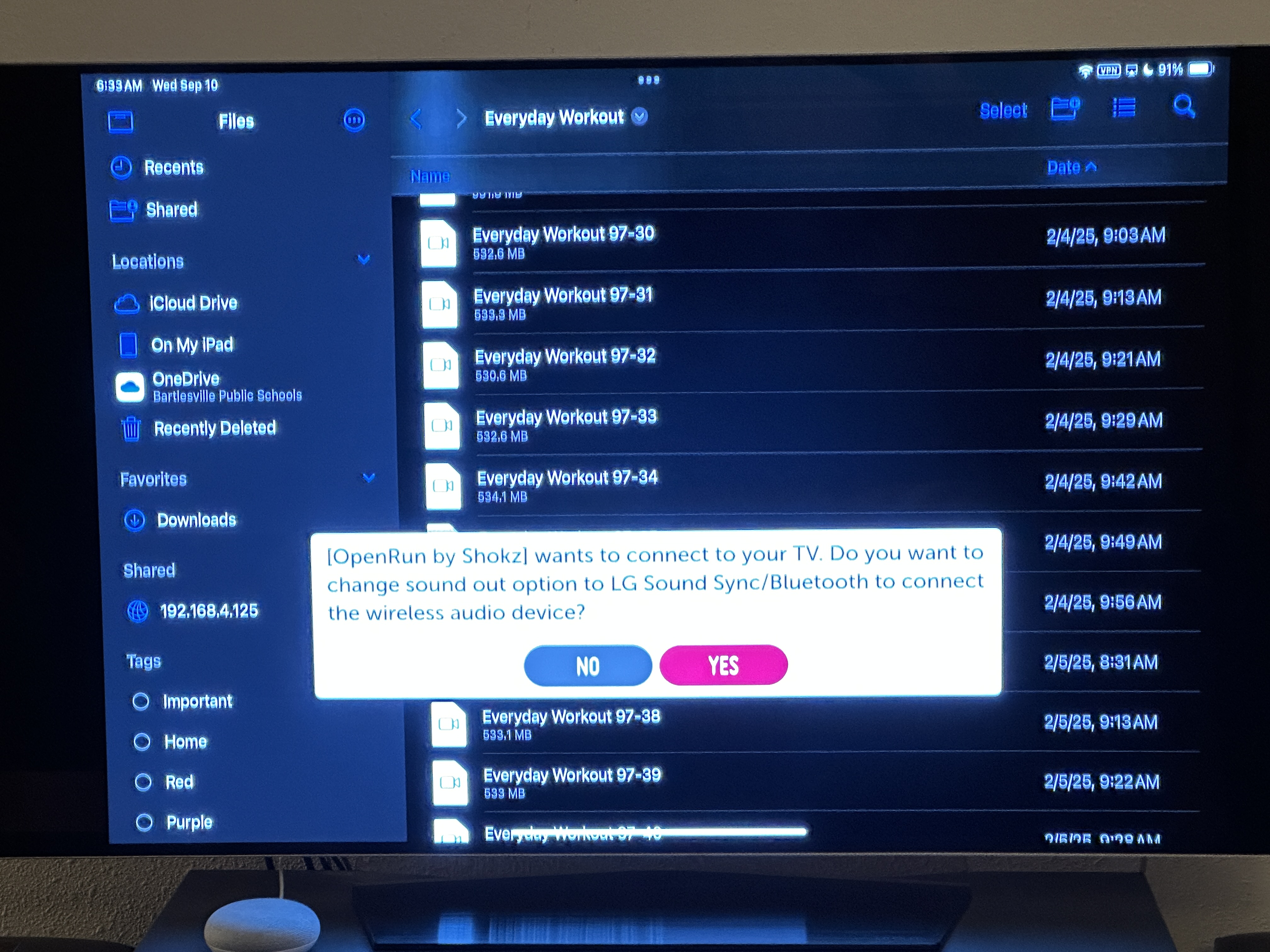
I use Bluetooth bone conduction headphones when mirroring my aerobics videos from my Mac through my iPad to the television each weekday morning. When I turn on the headphones, the television asks me if I want to use them.
That all worked normally after the upgrade except that when the soundbar is on, the Bluetooth reception has interference. I couldn’t find a way to turn off the soundbar but keep the television on with the Magic Remote, so I have to manually power down the soundbar each morning, either with its own dedicated remote, the LG ThinQ app, or the power button on top of the soundbar.
When I turn on the system at other times, it either defaults to the television’s internal speakers or to the HDMI audio output for the surround sound. That setting is fairly easy to adjust, although I’d like to have a shortcut key for that on the “Magic Remote”.
My only real complaint about the new soundbar is that when I adjust the volume, neither the television or the soundbar show a meter or number indicating the sound level. The television displays a level number when using its internal speakers, and the old receiver showed its own number on its display. It could be that the ThinQ app shows a volume meter, but using a smartphone app to control the system does not appeal to me.
The living room setup is now cleaner without the left and right speakers that once sat on the floor and a center speaker that was tucked in the television cabinet.
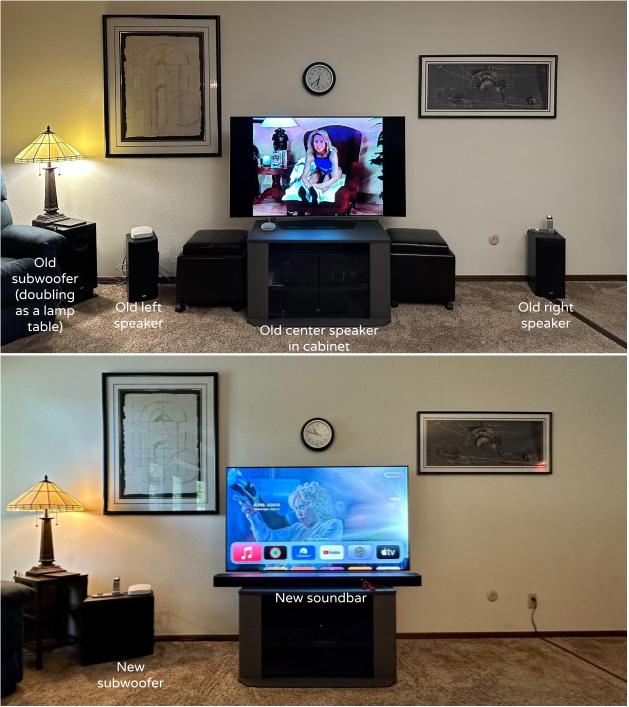
That cabinet now seems almost empty with only the disc player, Apple TV, and not-so-magic remote controls in it. I re-installed its tinted glass doors, which I had removed decades ago since the old system’s center speaker resided in the cabinet. I also replaced the surge protection power strip behind the cabinet with a new one to ensure our equipment is protected by fresh varistors.
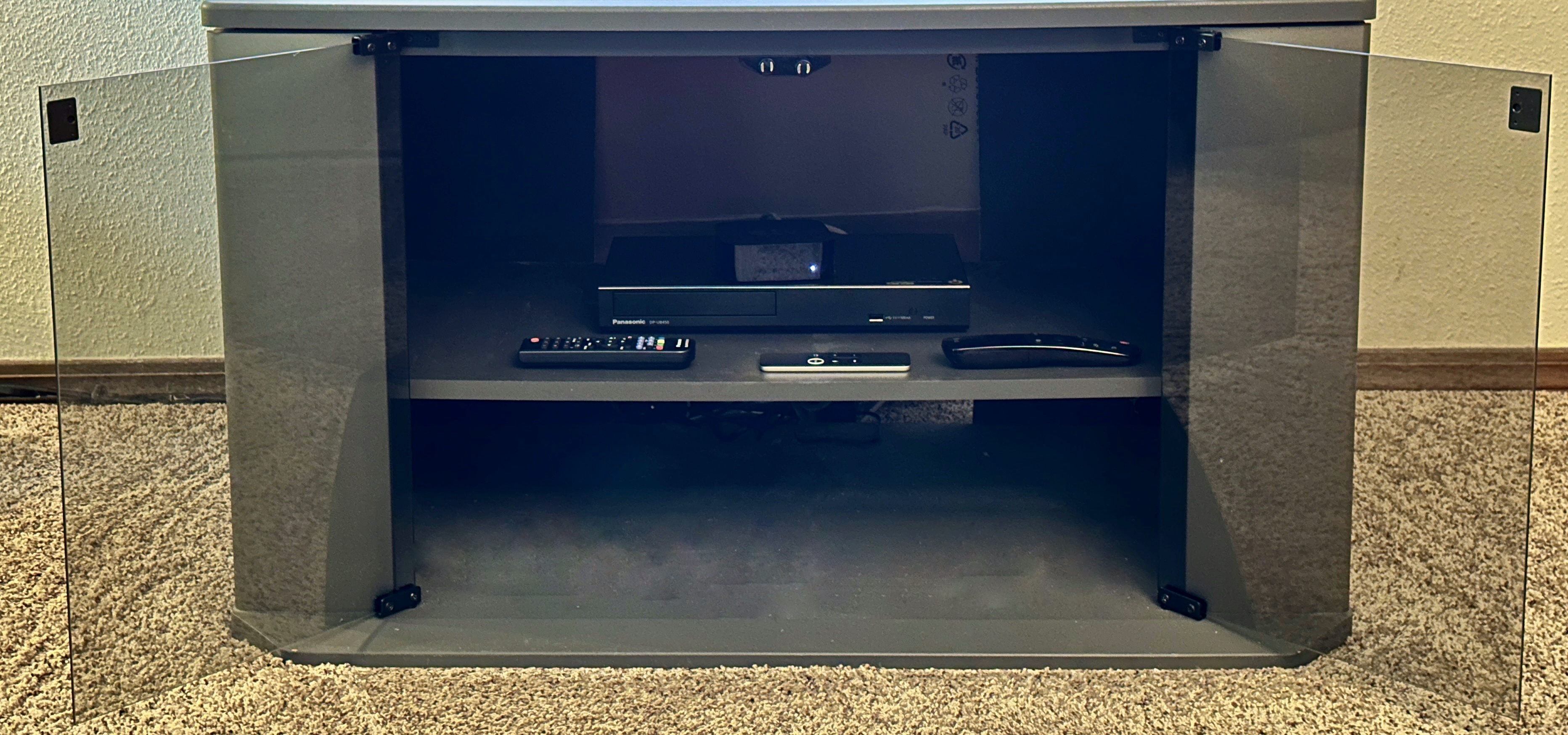
The upgrade was a success: the system is now much simpler to use. But there was a bit more tweaking to do, as another request Wendy had made was that it be easy to watch broadcast television.
Broadcast Television

Broadcast television is helpful should the internet go down yet electrical power remain operative. Our chimney sports the VHS/UHF antenna that I mounted on it thirty years ago, but part of its VHF log-periodic dipoles snapped off in a storm years ago, leaving only its Yagi-Uda end-fire array for UHF channels fully intact. I had presumed that was why for the last few years when I would test the system it could not pull in KJRH, the Tulsa NBC affiliate, which still identifies as Channel 2 although it actually broadcasts on digital channel 8.
You might be wondering if the antenna took the bolt. It is connected to a grounding stake I also bought and drove many feet into the earth back in the day, so it is effectively a lightning rod that provides a low-impedence path when a lightning circuit is formed. But I have seen no indications that the recent strike involved our antenna; my guess is that a nearby tree became part of the circuit. The brief issues with our system were more likely just due to the electromagnetic pulse from the nearby bolt.
Anyway, when I tested the antenna this week, the television could also no longer show digital channel 11, which is KOED, the Tulsa PBS affiliate. I checked the antenna’s gamut, and it was only able to pull in 28 channels, which was unusually low.
When I installed the antenna and accessories from Radio Shack back in 1995, I had included a powered signal booster. I wondered if it might have lost some of its mojo over the past 30 years. I still had a second booster I had tried three decades ago and rejected, but not returned, so I wondered if it might now work better. I had the television displaying the signal strength for Channel 11 while I began to unscrew the coaxial cable from the old booster. Suddenly the low signal strength surged to 100% and the high-definition broadcast came through. My guess is that the booster connection had some oxidation.
Lo and behold, that also fixed Channel 2, and the aerial is back to picking up 72 broadcast television channels from towers that are up to 63 miles away. Many of those are multiplexed sub-channels with 480-line interlaced broadcasts of vintage content, but we do receive high-definition 1080-line interlaced broadcasts from the local CBS, NBC, and PBS affiliates and 720-line progressive ones from ABC and FOX. I’m frankly surprised that there are still so many broadcast channels, given that broadcast television’s share of viewership is now less than 20%.
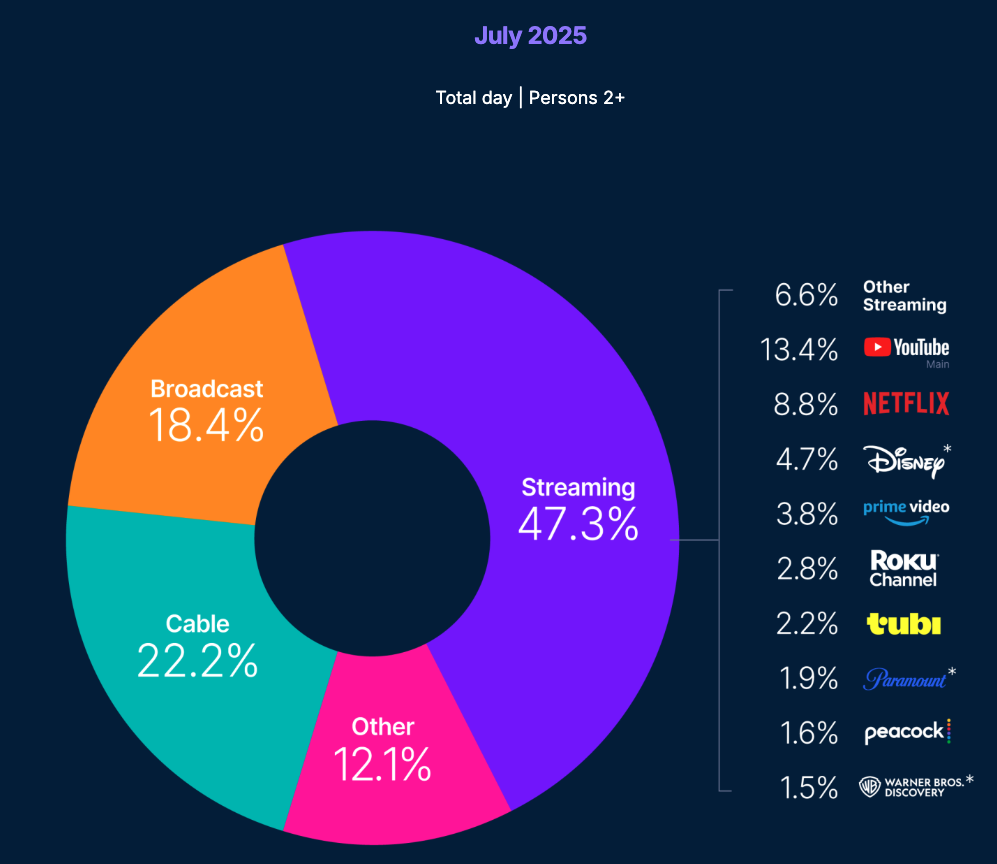
The LG television carries a mind-boggling 1,000 internet channels, including many dedicated to reruns of particular shows. I’ve no idea what their viewership is like, but we’ve come a long way since Bruce Springsteen released 57 Channels (And Nothin’ On) in 1992, let alone when I was a youngster in OKC and we received only four television channels on our black-and-white television’s rabbit ears antenna.
The Future
I have a bunch of optical discs awaiting my attention when the weather isn’t cooperative and I’m not otherwise engaged. I have a few seasons left of The Six Million Dollar Man to rewatch fifty years later, plus all of the Bright Knight Batman shows available for sampling. As for movies, I have restorations of The Umbrellas of Cherbourg from 1964, Danger:Diabolik from 1968, Cleopatra from 1963, and 1937’s Un Carnet de Bal stacked up, along with all four of Margaret Rutherford’s Miss Marple films. Perusing the media shelves also reminded me of a slew of unwatched Great Courses videos that I purchased over a dozen years ago.
So much to watch, and so little free time…for about nine more months.







 Meador Manor