

Hippocrates promulgated the first known personality model over 2,400 years ago, which led Galen to name four temperaments: sanguine, choleric, melancholic, and phlegmatic, which were associated with proportions of four bodily fluids. Thankfully little of that nonsense survives outside of adjectives authors employ for their characters. We modern enlightened folk (yes, that is intentional sarcasm) instead rely upon a mix of pseudoscientific and psychospiritual humbug, some useful behavior patterns, and a handful of traits measured on a continuous scale.
Myers-Briggs
The pseudoscientific Myers-Briggs Type Indicator is probably the best-known of the personality tests. It uses answers to 93 questions to assign people one of 16 personality types based on four sets of opposing qualities: Extraverted/Introverted, Sensing/iNtuiting, Thinking/Feeling and Perceiving/Judging. Its publisher makes millions per year on the test and related products.
The test is based on Carl Jung’s interesting but empirically unsupported theories on how the human brain works. Jung’s made-up principles were adapted by Katherine Briggs and her daught Isabel Briggs Myers, who had no formal training in psychology.
Myers-Briggs uses false, limited binaries for its categorizations although human traits are generally spread across a spectrum. For example, people are not true extraverts or introverts, but have a mix of extraverted and introverted qualities. The test is also inconsistent, with up to half of people arriving at a different result if they take it over a month later. It uses flattering, vague descriptions and thus benefits from the Forer-Barnum effect, a technique used in astrology, fortune-telling, and pseudoscience.


However, so long as you recognize its severe limitations, the test is still fun for most people. Its four traits also correlate roughly to four of the five personality factors that do have some scientific support, although the five factors exist on continuous scales. I’ll delve into that later.
When I first encountered some version of Myers-Briggs decades ago, I was classified as INTJ. Nowadays that type is often given the flattering labels of The Architect or The Mastermind.
Who wouldn’t want to be a quick, imaginative, strategic, self-confident, independent, decisive, hard-working, determined, open-minded, jack-of-all-trades? As for the weaknesses attributed to INTJ people, I certainly can be arrogant, clueless in romance, and judgmental, but surely those weaknesses are fairly common across a range of personalities, not merely the tiny fraction who are categorized as INTJ.
For the first time in many years, I took one of the free tests based on Myers-Briggs (refusing to pay for the real thing), and it categorized me as ISTJ, The Logistician. Did I really shift from iNtuiting to Sensing over the years? Maybe, but I wasn’t taking the actual for-profit Myers-Briggs test and the various classifications are a false binaries…our traits map out across spectra.
I think of Myers-Briggs as a fun exercise in narcissism or, if you want to put a nice spin on it, as a tool for introspection. Most of us enjoy being categorized, especially when various positive traits are then attributed to us, although I’ve also noticed a trend of people embracing being labeled as neurodivergent, which can be a fraught topic.
Enneagram
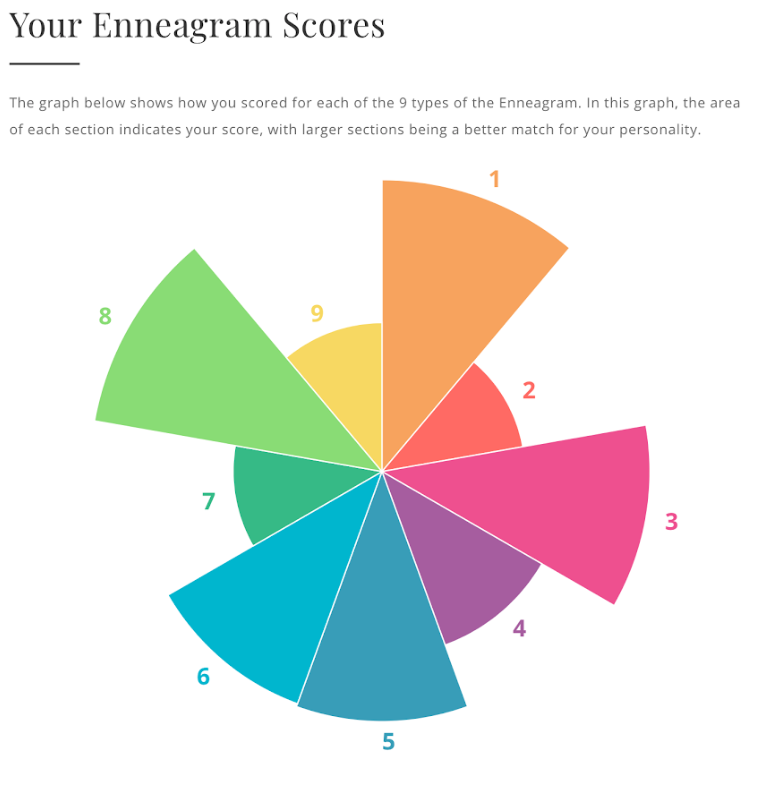
Another pseudoscientific personality test is the Enneagram of Personality, which has been popularized by Truity Psychometrics, not to be confused with our local Truity Credit Union. Its typology traces back to the Bolivian psycho-spiritual teacher Oscar Ichazo and the Chilean psychiatrist Claudio Naranjo, but it doesn’t originate from a validated scientific theory.
I took the test five years ago and retook it for this post. My results were quite stable, which is an improvement over Myers-Briggs, although I found the Enneagram less interesting. My Enneagram score categorizes me as a Type 1 Moral Perfectionist, Reformer, or Improver. But golly, I also scored high in Type 8, the Protective Challenger, and what did my high scores for Types 3, 5, and 6 mean? Not much, at least to me.
BEST Communication Styles
The personality pattern instrument I have found the most useful in my professional life measures the BEST Communication Styles. Dr. James Brewer adapted and expanded work by William Marston and Ned Herrmann on measuring dominant behavior patterns; Marston was quite a character and invented both the polygraph and Wonder Woman. Brewer developed a basic description of four personality types: Bold, Expressive, Sympathetic, and Technical.


My clear preferences were for Technical and Bold, with minimal scores in the Sympathetic and Expressive styles. Interestingly, my wife has very similar scores.
What I appreciated about the BEST system was learning the scores for some of my fellow administrators and using that to tailor my interactions with them, in hopes of communicating more clearly and effectively. It also helped me understand better where other leaders were coming from. It is also simple enough that I can make some use of it, while some corporate-style trainings I’ve endured had so many complex steps, acronyms, categorizations, and procedures that I couldn’t be bothered to try to apply them in real life.
The Five Factor Model
In psychometrics, the five-factor model is the most common these days, and at least it was based on empirical research. It measures five factors on a continuous scale: extraversion, neuroticism/emotional stability, amicability/agreeableness, conscientiousness, and openness/intellect & imagination.
A problem with the five-factor model is the naming of the five factors. As you can see, at least three of them have alternate names. This in part reflects how some terms carry positive or negative connotations. Many people might dislike being found less agreeable or conscientious or more neurotic. So alternate terminology is often employed at the cost of confusion.
I took the Open-Source Psychometrics Project’s Big Five Personality Test. Its names for the five factors are shown in the results, including misspelling extraversion, which comes from the Latin extra vertere or “to turn outside”, as “extroversion”. That arose from folks who do not know Latin and thus misspell extraversion to match the spelling of introversion.
My insistence on using extraversion reflects my personality: relatively low in agreeableness and high in conscientiousness.

While Myers-Briggs-style tests always classify me as introverted, I actually scored as more extraverted than 2/3 of those taking the test. People often confuse introversion with shyness or depression, neither of which I suffer from, but I definitely prefer less stimulation and more time alone than those I consider extraverts, and I have to recharge after social interactions.
Emotional stability is an inverse measure of neuroticism. My result says I have an above-average tolerance for stress and change, which I suppose is a function of brain chemistry and also might reflect a happy childhood with few adverse experiences. It might also be influenced by my embrace of Stoicism in adulthood. This factor has no parallel in Myers-Briggs.
Almost 4 out of 5 test-takers scored higher than I did on agreeableness/amicability. My result is thus associated with a lower motivation to maintain social harmony and being more likely to express my opinions forcefully. I’m useful to have on a committee if you don’t want a yes-man. It is also associated with lower levels of compassion, cooperation, and empathy along with enhanced critical thinking, independence, and self-sufficiency. The Thinking/Feeling binary in Myers-Briggs corresponds to this factor. Thinking is associated with low agreeableness while Feeling is associated with high agreeableness.
Independent empirical measures such as my career-long low absenteeism, job stability, and exercise routine correlate with my high score in conscientiousness. I’m a planner with strong impulse control and self-discipline, but that also means that I am quite stubborn and am irritated by those who are impulsive or disorganized. The Judging/Perceiving binary in Myers-Briggs corresponds to this factor. Judging is associated with high conscientiousness while Perceiving goes with low conscientiousness.
My most extreme score was for intellect/imagination, which is most commonly known in the literature as Openness to Experience and is associated with a general appreciation for art, emotion, adventure, unusual ideas, imagination, curiosity, and variety of experience. Folks like me are said to be more likely to hold unconventional beliefs. The Sensing/iNtuiting binary in Myers-Briggs corresponds to this factor. Sensing is associated with low openness while iNtuiting goes with high openness.
My results illustrate some of the problems with personality tests. I have many of the characteristics of introversion, but was rated as more extraverted than 2/3 of the test-takers. I also had a very high score in Openness in the more scientific test, which matches up with the N in my early INTJ label on Myers-Briggs, but I’ve also had tests offer the contradictory label of ISTJ.

Note that these traits are not fixed; most people shed some of their neuroticism and thus gain emotional stability as they age, and we tend to become more conscientious over time. I do like the continuum of the traits in the Big Five test, which reminds me of how the Kinsey Reports broke ground in the mid-20th century by classifying sexual orientation on a continuum rather than strict binaries. The limitations of heterosexuality and homosexuality spectra then led to initialism in the form of LGBTQ, then LGBTQIA2S+, etc. Golly, but people do love to label and identify themselves and each other.
The utility of most personality tests is dubious, but I do find them interesting. I wouldn’t recommend spending any money on versions of Myers-Briggs or Enneagrams, which I regard as more suitable for entertainment. However, I have found the BEST Communication Styles useful in working with team members, and the Open-Source Psychometrics Project’s Big Five Personality Test is completely free and the five-factor model does enjoy some scientific support.






 Meador Manor