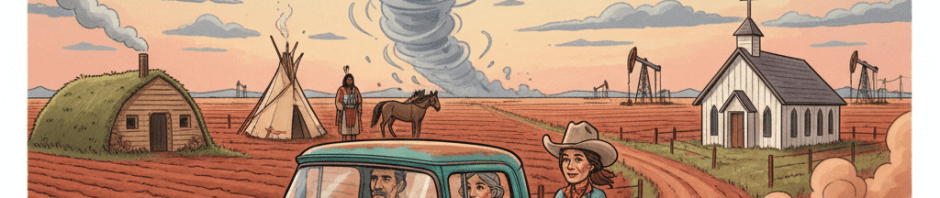

A memorable encounter with Okie stereotyping came in 1984, right after I graduated from high school. One boy and one girl had been selected from each state for an academic recognition in Washington, DC. I was flown out, on my first-ever ride in an airplane, and checked into a dormitory at Georgetown. The dorm’s reception hall was filling up, like a weird variant of Noah’s ark, with the guy and the gal from each state. I was greeted and instructed to state my first name and my state.

“Howdy! I’m Granger from Oklahoma.” I could hear my accent from the first syllable, and I flushed at the smirks and sideways looks that appeared around the room. While my accent is not what you’ll hear down in Little Dixie, I remained acutely aware of my South Midland accent all that week. It would have been cuter if I’d been wearing a cowboy hat and boots with my jeans, but I didn’t own such items.
Various exchanges at our first mixer:
How often do you get dust storms? The Dust Bowl was mostly out west in the panhandle area, and farming practices have improved since the 1930s, so we see few dust storms.
How many tornadoes have you been in? Well, we have tornado watches and warnings a few times each year, but I’ve never seen a twister myself. [I wouldn’t see one until a few years later as an undergraduate in Norman.]
Do you live in one of those, uh…sod houses? No, our home is like the third little pig’s, with a brick exterior.
Do you have an outhouse? No, we have indoor plumbing…and central heat-and-air to boot.
Do you have trouble with Indian raids? Are you kidding? No, we don’t circle the wagons and fend off Indian attacks.
So you get along okay with the Indians? Well, I’m dating a half-blood Cherokee, if that tells you anything.
And so on…from some of the best-educated kids across the nation. Mind you, I was pretty ignorant as well. My roommate was from Connecticut, and one night he suggested we go out and get some “Häagen-Dazs”. I had no idea what that was, but it sounded similar to Heineken, and we were years away from being of legal drinking age. So I asked, “Is that legal?”
Hopefully over the past 40 years the internet has improved things somewhat, but I noted some Oklahoma stereotypes that Heather Koontz once identified and decided to explore them both statistically and personally.
Everyone drives a truck and wears boots
Welp, less than 20% of Okie vehicles are trucks, and trucks are more popular in 22 of the 50 states. While I have ridden in and driven pick-ups, I have never owned one. My parents drove sedans, station wagons, and Volkswagen campers, while I’ve only owned sedans and coupes, and my wife owns a minivan which we use for our driving vacations.

However, cowboy boots are indeed the most popular footwear in Oklahoma, a status only shared with Alabama, Arkansas, Mississippi, and Tennessee. (The most popular footwear in Texas is, funnily enough, open-toed slip-on slides. Shameful.) I had a pair of boots when I was eleven, and I bought one pair as an adult which I wear on rare occasions, but I like sneakers.

Everyone lives on a farm
Farms are now often large corporate entities, so even in South Dakota, which has the greatest proportion of farmers among its population, they peak at 5.6%. You have to travel down through North Dakota, Iowa, Nebraska, Montana, Wyoming, and Kansas before you’ll encounter Oklahoma at 8th place with 3.1% of its people being farmers. However, my first name does come from farming, and my mother grew up on an Oklahoma farm until age 13.
Tornadoes happen every day
Oklahoma is in tornado alley where warm, moist air from the Gulf of Mexico meets cool, dry air from the northern plains.

However, the region of higher tornadic frequency has been shifting eastward.

From 1991 to 2010, Oklahoma was tied for 7th place in the number of tornadoes per square mile.
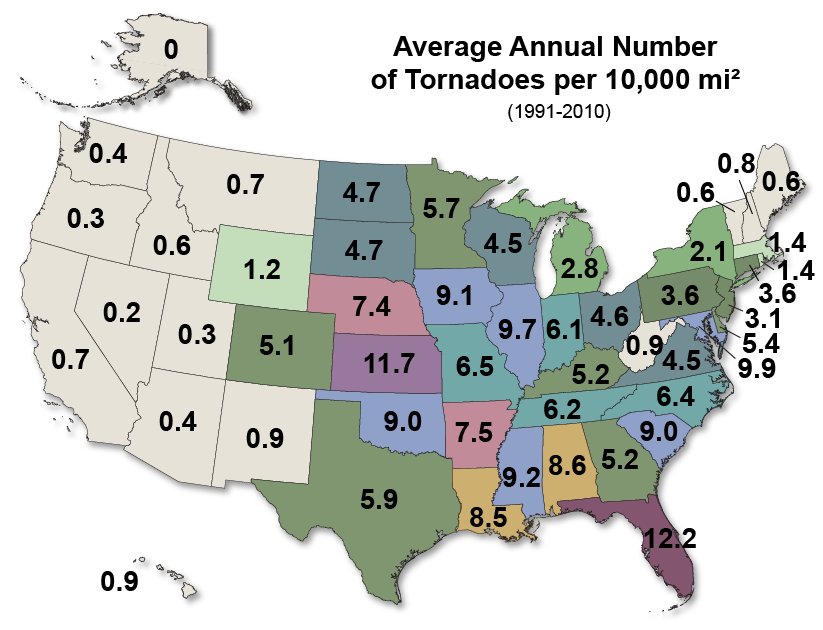
I’ve heard a few twisters while taking shelter, and we had some tornado damage in Bartlesville in 2024, but I’ve only seen one, from a mile or two away, back in the late 1980s in Norman. Oklahoma averaged 59 tornadoes per year from 1950 to 2024.
It’s just red dirt
Steinbeck’s The Grapes of Wrath about the Dust Bowl has long influenced popular perceptions of the Sooner State. However, the Dust Bowl primarily affected the remote panhandle region, not the cross timbers of central Oklahoma where I grew up, let alone Green Country in northeastern Oklahoma where I have lived my adult life.


The western half of Oklahoma is indeed mostly prairie grass, and “red dirt” music gets its name from the Port Silt Loam soil found in 33 of the state’s 77 counties.
However, the east central area is dominated by the Cross Timbers mix of prairie, savanna, and woodland of post oak and blackjack oaks. I live at the boundary between the Cross Timbers and the bluestem prairie mosaic, with oak-hickory forests to the southeast, while the southeast corner of Oklahoma has oak-hickory-pine forests spread across the Kiamichi and Ouachita Mountains.

Oklahoma also has over 200 man-made lakes, while there are 62 natural oxbow lakes that are 10 acres or more in surface area. Oxbows are old U-shaped bends of rivers cut off from the main channel.
Football is life

Football is indeed a major cultural phenomenon in Oklahoma, although the professional basketball team in Oklahoma City is the state’s only major league sports franchise. The rivalry between the University of Oklahoma and Oklahoma State University football teams is intense. I earned my undergraduate degree from OU and did hours of graduate work at OSU, so I don’t favor either one, especially since sports in general don’t interest me.
It’s full of cowboys & Indians
Oklahoma certainly features cowboys. Between 1866 and 1890, a number of cattle trails crossed what later became Oklahoma, transporting livestock to railheads.


At the beginning of this century, over five million cattle were still to be found on farms, feedlots, and ranches of Oklahoma, which in 2022 was ranked fifth among the beef-producing states. There are indeed some cattle ranches around Bartlesville.
Oklahoma is also very much a state of First Peoples, being once divided into the Oklahoma and Indian Territories. Many of its 39 tribes were forcibly removed to this region between 1830 and 1862, with more pressured onto reservations here between 1867 and 1892.

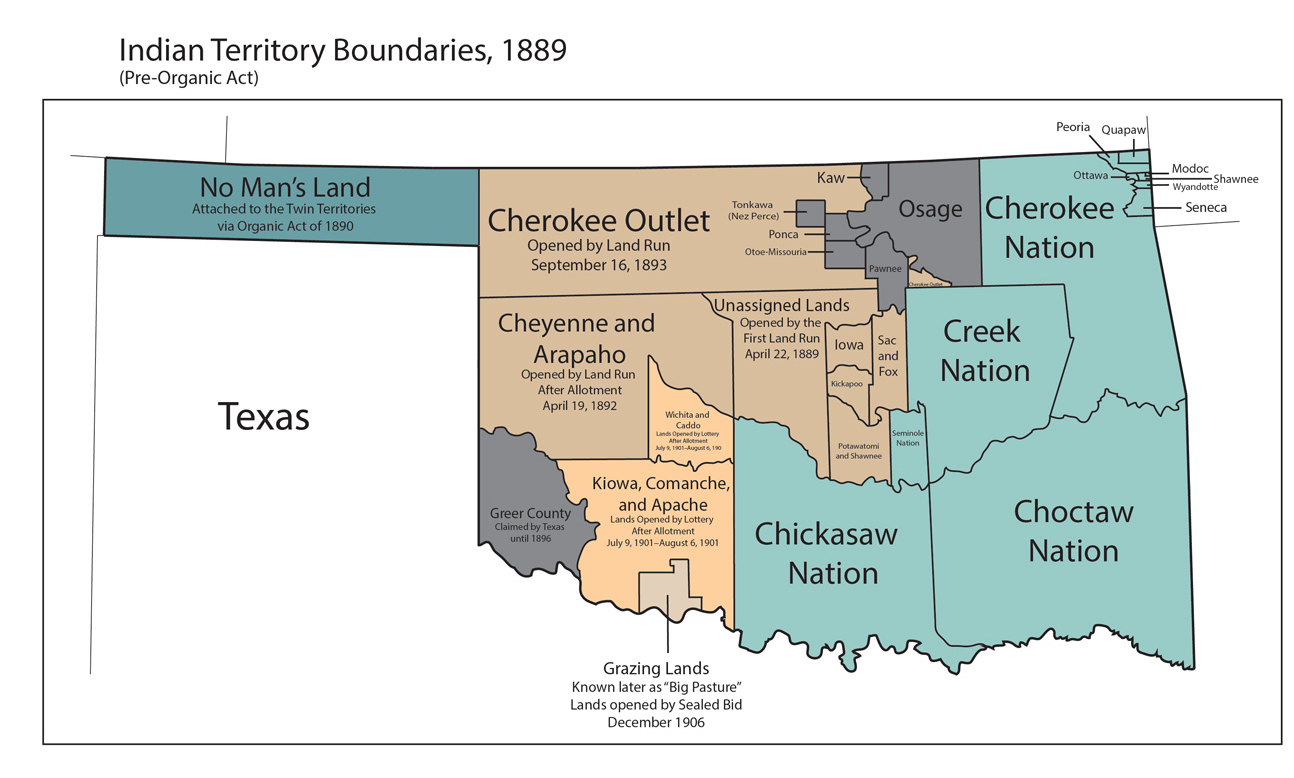

In 2023, Oklahoma had 555,598 First People forming 13.5% of its population, mostly in the eastern half of the state which was once Indian Territory. The only state with a higher percentage of First Peoples was Alaska. While only 1.2% of the total U.S. population lives in Oklahoma, it is home to 7.6% of the nation’s First Peoples.
Oklahoma had strong ties to western movies featuring Tom Mix, Gene Autry, Will Rogers, Dale Robertson, et al. as well as institutions such as the 110,000-acre 101 Ranch and characters like Pawnee Bill. The Rodgers & Hammerstein musical Oklahoma! also established a popular image of farmers and cowmen.
The “cowboy and Indian” stereotype dates back to later half of the 19th century, with the “Wild West” only lasting from 1865-1895, ending over a decade before Oklahoma’s 1907 statehood. The classic cowboy era began to decline in the winter of 1886-1887 when thousands of cattle died during an extreme cold spell. The open ranges being fenced off with barbed wire, plus extensions of the railroads, eventually made cattle drives obsolete. Cowboys transitioned from being nomadic drovers to working for private ranch owners.
The American Indian Wars concluded a century ago, and the 1924 Indian Citizenship Act finally granted citizenship to all First Peoples. Today the most prominent tribes in Oklahoma are the “five civilized tribes” of the Cherokee, Choctaw, Chickasaw, Muscogee (Creek), and Seminole. Bartlesville is in the Cherokee Nation, just east of the Osage Nation, and the town is home to one of the three federally recognized tribes of Lenape or Delaware Indians, with the others based in Anadarko, Oklahoma and Shawano County in Wisconsin.
On the personal front, I have little to no Native American ancestry, with my DNA categorized as 60% British, 16% French & German, and 15% general northwestern European. I’ve never ridden a horse, so my cowboy hat, boots, and duster are just costume wear.
Tipis are everywhere
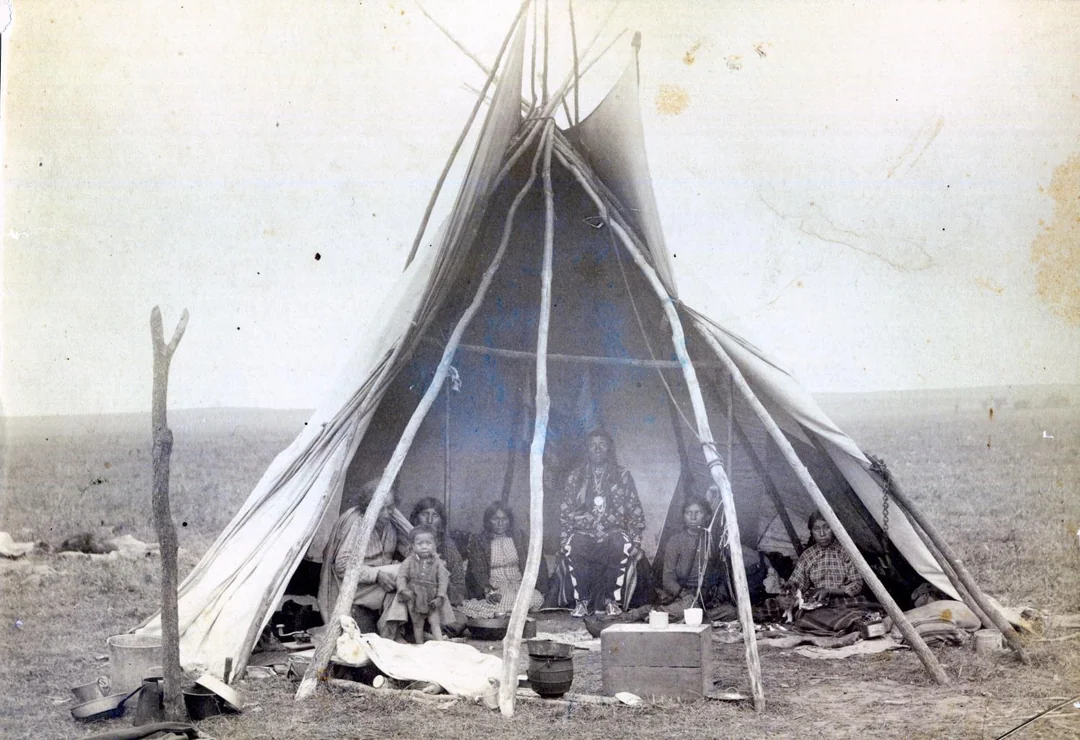
Several Plains tribes used tipis, with the Osage using them during hunts but also using longhouses made of wood and animal hides for their permanent villages.
The Oklahoma Historical Society does have a Lakota tipi made from buffalo hide around 1852 and a 1916 Kiowa tipi that was featured in the 1920 film The Daughter of Dawn which was filmed in Oklahoma’s Wichita Mountains. When I was a kid, a large tipi was displayed on an upper floor of the old historical society building at the capitol complex.
However, I’ve only seen a few tipis in tourist or historical contexts. Oklahoma tribes employed diverse styles of traditional housing in the historic and early reservation periods.
It is covered in oil wells
These days, Texas, New Mexico, North Dakota, Colorado, and Alaska produce more oil than Oklahoma.


[Source]
However, Oklahoma was the largest producer at statehood in 1907 and remained in the top three with the much larger California and Texas until the end of World War II, and then remained in the top five for the rest of the 20th century.
Tulsa was billed as “the Oil Capital of the World” until the late 1960s and 1970s when Houston assumed prominence, and the Oklahoma petroleum industry led to some beautiful art deco buildings, Ponca City’s Marland Mansion, Woolaroc near Bartlesville, and much more.
The state’s long history of petroleum production has left most of it dotted with over 450,000 oil and gas wells, with about 30,000 being active in the 2020s. Unfortunately, the state has over 260,000 unplugged wells. Bartlesville still has some stripper wells, and it was the location of the state’s first commercial oil well and was once the headquarters for both Phillips Petroleum and Cities Service.

My father was a petroleum engineer for Cities Service Gas Company, and my mother did some office work at Cities Service and Oklahoma Natural Gas before her career at a savings and loan. I was drawn to Bartlesville by the opportunity to teach high school physics all day, something that was possible for a few decades thanks to the socioeconomic impact of Phillips Petroleum and its successors.
It’s all conservative evangelicals
Change “all” to “mostly” and it works. 70% of Oklahomans are Christians, and 2/3 of its Christians are Evangelical Protestants; only Arkansas has a greater percentage of evangelicals. Oklahoma is a top-10 state in overall religiousness, religious attendance, and prayer frequency, positioned at the northwestern end of the Bible Belt.
In 2022, 51% of Oklahomans described themselves as politically conservative, with only 26% claiming to be moderates and 23% as liberals. Oklahoma was solidly Democratic back in the Jim Crow era, shifting in the late 20th century to be completely dominated by Republicans. Donald Trump won every county in 2016, 2020, and 2024, and Republicans hold veto-proof supermajorities in both chambers of Oklahoma’s legislature.

The dominance of religious conservatives was long evident in Oklahoma’s vice laws, although that has changed significantly over my lifetime:
Alcohol: The state officially prohibited liquor from 1907 to 1959, with predictable inconsistent enforcement. Beer with only 3.2% alcohol was allowed after national prohibition ended in 1933, but Oklahoma didn’t allow sale of individual alcoholic beverages for on-premise consumption, “liquor by the drink”, until 1984, and grocery stores were not allowed to sell wine and beer until 2018. For decades, liquor stores weren’t allowed refrigeration nor Sunday sales.
Drugs: In 2018, voters, not the ultra-conservative legislature, approved a state question legalizing marijuana for medical use. A 2023 study estimated that almost half of Oklahomans use cannabis.
Gambling: This was largely prohibited until 1988, when tribes were allowed to operate certain types of gaming on sovereign land. In 2004, voters authorized tribal gambling, including slot machines and table games, and now there are over 100 tribal casinos dotting the state. A statewide lottery began in 2005, and sports betting was legalized in 2020.
Sex: The state once banned oral and anal sex along with interracial marriage and cohabitation, and homosexual acts were illegal until the 2003 U.S. Supreme Court decision in Lawrence v. Texas. Sex education is still rare, and abortion is a felony with almost no exceptions, so it is no surprise that the state’s teen birth rate is in the top five.
As for me, my politics is Outsider Left, and while I abstain from alcohol, drugs, and casinos, that isn’t attributable to religious beliefs.
It’s a land of poor, backward people
Oklahoma is among the bottom 10 states in median income. One source lists it as the sixth-poorest state, with many jobs falling short of living wages. U.S. News & World Report ranked Oklahoma #42 overall, with dismal rankings in education and health care, and it ranks #47 in the Opportunity Index. The state was similarly ranked 47th in health and well-being by the United Health Foundation. WalletHub likewise ranked Oklahoma as the 8th worst state to live in, although it did fare better than neighboring Arkansas and New Mexico. Oklahoma ranks 42nd in its overall state tax burden, but that translates into underfunded schools, roads, and various other services.
On the plus side:
- 49th in cost of living, with extremely affordable housing, low taxes, and affordable utilities
- Business-friendly with a strong job market in the energy, agriculture, and healthcare sectors
- Surprising geographic diversity with varied landscapes including plains, forests, and mountains that are accessible via over 200 parks, wildlife refuges, and national forests
- Welcoming and friendly residents who have a strong sense of community
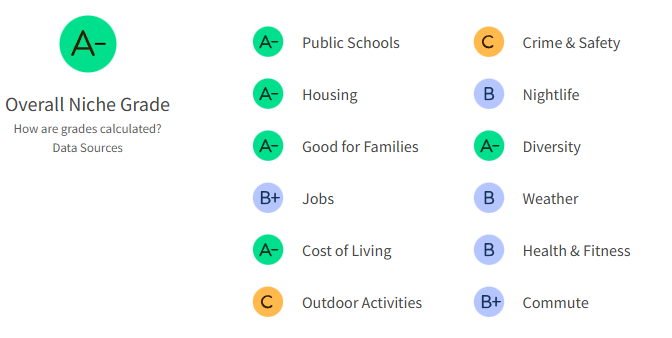
Bartlesville was ranked the 11th best place to retire in Oklahoma by Niche magazine in 2025, and I would rank us higher than they did in outdoor activities given my appreciation of the Pathfinder Parkway, but we understandably lost points for lack of access to beaches and snow skiing.
Stereotypes
I’d say that several of the above Okie stereotypes ring true, even though few of them apply to me on a personal level. Every state has its quirks!
Stereotypes fall in the face of humanity. We human beings are best understood one at a time.
Anna Quindlen







 Meador Manor
