
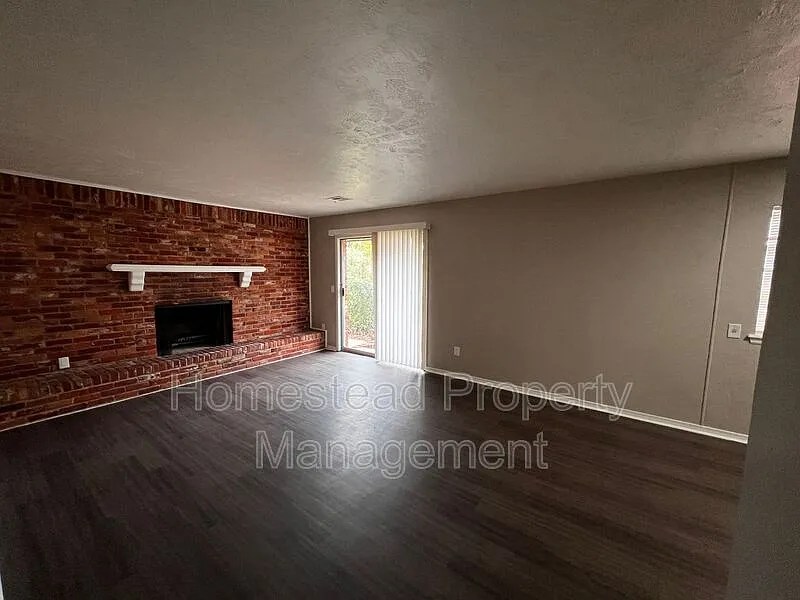
Real estate websites have a secondary function as time machines since when properties are marketed for resale we may catch glimpses into houses we left long ago. The home my parents built in 1962 was “flipped” in 2022. I lived there from 1966-1972, with us moving once I completed kindergarten. Seeing it transformed by millennial gray prompted me to revisit the few ghostly fragments that escaped infantile amnesia.
The Village
My Greatest Generation father and Silent Generation mother were newlyweds when they built the house in 1962, four years before I came along as an early member of Generation X. My father had previously been living in a home he had purchased for his first family in 1957 in The Village, then a north central suburb of Oklahoma City. Dad worked for Cities Service Gas, which had both its executive and operational offices in Bartlesville until 1943 as part of the sprawling Cities Service empire. During World War II, the natural gas company’s executive offices were shifted to Oklahoma City and its operational ones to Wichita, while the oil company remained in Bartlesville until the late 1960s.
In 1957 the operational offices in Wichita, where my father was a gas measurement engineer, were consolidated with the executive ones in Oklahoma City. So Dad moved his first family to The Village, a suburb that had originated in 1949 when developer Clarence E. Duffner, Sr. purchased 40 acres of land near the old railroad town of Britton, itself located seven miles north of Oklahoma City’s core.
Over the years, OKC would grow to encapsulate multiple towns, including The Village, Nichols Hills, Warr Acres, Bethany, Woodlawn Park, Mustang, Spencer, Forest Park, and Lake Aluma while annexing Britton, Belle Isle, Forest Park, Deer Creek, and many square miles of unincorporated land.

Oklahoma City annexed Britton in 1950, prompting Duffner and fellow developers Floyd and Joe Bob Harrison and Sylvanus Felix to incorporate The Village to avoid a similar fate for their additions. There were only seven residents at the time, with six voting in favor and none against!
The community started with 160 acres but annexed additional housing developments to grow to encompass 2.5 square miles which are bordered by Oklahoma City on all sides except for rich Nichols Hills to the south.
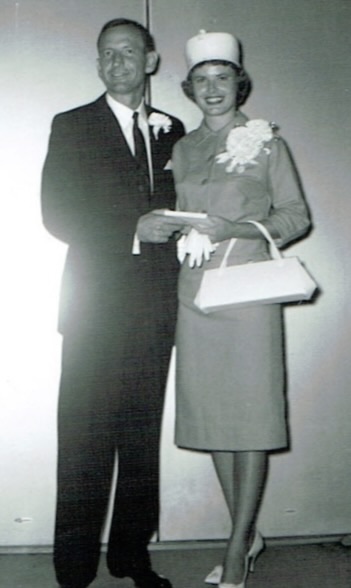
My father’s first marriage ended in divorce in 1960. Dad spotted my mother at a Cities Service Gas Company Christmas party that year, their first date was in March 1961, and they were married five months later. Mom had come to OKC in late 1957 and had lived in a couple of apartments with other girls. She was 11 years younger than my father, so I am much younger than most of my paternal cousins.
Western Village Addition
Dad put the house in The Village up for sale by owner, and he and his new bride lived in a nearby rental home while a new house was constructed for them in the Western Village addition of Oklahoma City. You might be surprised that “Western Village” is situated on the east side of The Village, but the name came from it being bordered by Western Avenue on the east and The Village on the west.

In January 1962, Ferguson Investment Company began constructing over 500 new homes in that quarter-mile section.

My parents’ home was the first to be constructed on its block, with them visiting the site when it was nothing but a dirt field with completed homes lined up along a street to the south. They made almost daily checks as the house went up: a three-bedroom wood frame home with red used-brick veneer and white trim, a wood-burning fireplace, and a patio in the back.


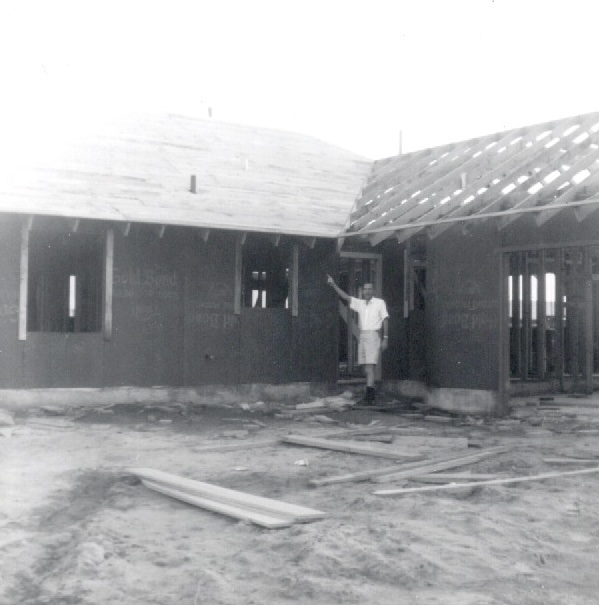


The homes were marketed as featuring heavy “floating” concrete slab floors with windbraced wood framing anchored every four feet with steel bolts. The roof trusses were marketed as “tornado-resisting” and the homes were said to be “100% insulated — floors, walls, and ceilings.”

The exterior of the home changed very little over its first 60 years, with the 2022 flip repainting its trim in a dark bluish-gray that toned down the fake shutters but made the white garage doors even more prominent; thank goodness they are perpendicular to the street.


The 1962 marketing for the homes reflected the gender norms of the era: “The cheerful kitchens, a trade-mark of Ferguson homes, truly are a woman’s dream — built-in wall-oven and tabletop range, disposal unit and exhaust-hood. Beautiful mill-built cabinets, with counter space provided next to range and refrigerator.”

My parents reported only having one minor issue with the builder, and that involved the kitchen built-ins. They were indeed made in a cabinet shop and were delivered to the home site to be stored in the garage until installation. My mother had specified the corner built-in was to have standard shelving rather than a Lazy Susan option that was being offered. They were delivered with a Lazy Susan already installed. She advised the builder of the error, and they had quite a contest of wills before my mother made her point and regular shelving was put in the place of the Lazy Susan.
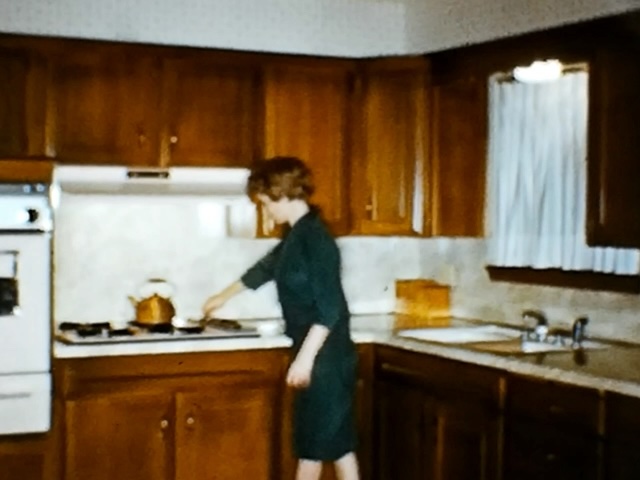

The color image of my mother in the kitchen is from a silent 8mm film my father shot in their new home around Christmas in 1962, and the other shot of me in my high chair is from 1968. That kitchen changed very little for decades after we moved away. Below is its appearance sometime before 2022. The appliances, sink and cabinet hardware had been updated, but the cabinets were still varnished instead of painted and it still had its formica countertops and backsplash and a vinyl floor.
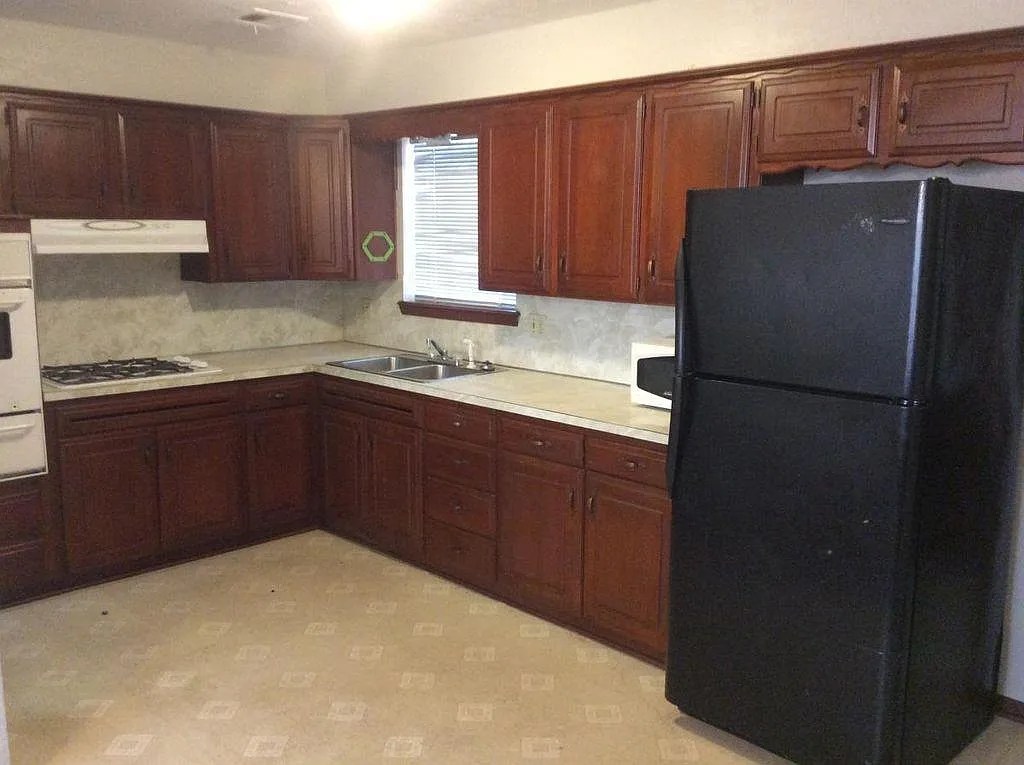
Flippers like to paint wood cabinets and replace any wall-to-wall carpet or vinyl flooring with engineered wood floors. A variety of materials may be used to replace formica countertops and backsplashes.
As for colors, my memories of the late 1960s are fragmentary, but I know the appliances were light pink. Later, while growing up in the 1970s, I was surrounded by lots of earth tones — harvest gold, oranges, and terracottas — coupled with plenty of wood paneling and avocado green appliances. Those would all appear in my parents’ next home to the southwest in the town of Bethany. Eventually beige would sweep through homes as a more neutral color, and by the early 2010s grays began to dominate. The aesthetic adopted by the flippers was the later stereotype.


I don’t like wood wall paneling, but I do like wood tones in cabinetry and wainscoting, so we have left those intact in our 1981 home in Bartlesville. I am grateful that our home’s contractor cabinetry was stained dark and not the honey gold that became popular later that decade and endured into the 1990s. I do have to break out the Old English scratch remover, however, to touch up our dark woodwork.
The flippers extended the engineered flooring through the entire Western Village house. They also painted the mantle, but thankfully resisted painting the back brick wall.


The eleven homes and apartments where I have resided had mostly wall-to-wall padded carpet, allowing me to walk around in comfort in socks or barefoot without fear of tripping. I developed an aversion to bare hard floors at the house we moved to after leaving Western Village. It had a den paved in red quarry tile, the same kind later used in QuikTrips. A large rug softened the area around the sofas, but there was a big cold zone I had to traverse to reach the long green shag carpet of the living room and bedrooms.

Shag was an example of carpeting at its worst, with one of my household chores being to rake it. My parents invested in a massive self-propelled Kirby vacuum cleaner, and I remember the constant pings when my mother swept the living room shag. The previous homeowners had kept a caged bird in there, and I figure she swept up many pounds of birdseed. My father finally reacted by replacing the shag with commercial short-loop pile carpet that Cities Service surplussed from its downtown offices.
In 2018, Wendy and I replaced the 37-year-old saxony carpet in our home in Bartlesville. We still wanted wall-to-wall carpet, and we had Sooner Carpet install a frieze carpet that looks and feels great, doesn’t track like saxony, and thank goodness doesn’t require raking. However, I understand the appeal of having robot vacuums sweep hard floors and rugs and that owners of indoor pets want ways to address stains, smells, and allergens. I’m also sure that the popularity of open-plan spaces also contributed to the return of rugs, which can create functional zoning.


Back at Western Village, the bathrooms were also refinished. Gray again dominated, covering the walls and woodwork, with another gray mix countertop. I suppose they expected millennials to love its neutrality, versatility, and practicality. However, it all seems so bland to me. I also read that millennial gray is “oversaturated” in the cultural sense and losing favor, and “beige ‘n sage is the new greige.” Well…er…time marches on.
The Western Village development at the end of the Baby Boom continued into the early years of the Baby Bust, with the last lots filled by 1970. Pied Piper Park was just to the south and in 1963 Western Village Elementary School was built on the western side, just inside the borders of The Village.

So I lived just an 8-minute walk from the park and a 12-minute walk to the school. I do recall the walk to and from kindergarten, as I had a hernia that made the trek painful when I was in a hurry. Getting that fixed when I was five years old was my only significant surgery. Below is a clip from early 1971, months before I would start walking to kindergarten.
One clear memory of kindergarten was the day I was selected to be the “wake up fairy” for our naptime. I was given a yardstick and was supposed to gently tap each student to signal them to get up and go to recess. One of my friends had made me angry earlier, so when I came to him I stabbed the yardstick down hard on his back. That indiscretion led Mrs. Brewer to revoke my privileges to play with the wooden stove in the little kitchen area, one of my favorite things in the classroom, for what seemed like an eternity. Lesson learned!

In 1972, the court-ordered and rather complicated Finger Plan of forced busing began to desegregate the Oklahoma City school system. Oklahoma City’s long history of racism and redlining meant that many schoolchildren across the sprawling city would be bused across town to address de facto segregation that had endured for almost two decades after Brown v. Board of Education.
To avoid a plan that by fifth grade would bus me to a school many miles away, my parents joined the consequent “white flight” and sold their home of ten years. We moved to the Nazarene suburb of Bethany in far west OKC where I would be in the Putnam City school district. Oklahoma City had 71,000 students in its school district in 1971, and within a decade over 30,000 white students had left. White flight and the Baby Bust meant that the district dropped to about 35,000 students. Forced busing ended in the elementary schools in 1985, by which time the district had about 20,000 white students and 15,000 black students. The U.S. Supreme Court lifted the desegregation order in 1991. By 2011, the OKC school district had rebuilt to 43,000 students, with over half of them being Hispanic.
Western Village Elementary struggled with declining enrollment and poor outcomes. It was facing closure in 1998 when INTEGRIS Health started an after-school program there, and it officially transformed the facility into Oklahoma’s first public elementary charter school in 2000. It was renamed Stanley Hupfeld Academy at Western Village in 2010.
That concludes my look back at my first home. I already did a series of three posts on the Windsor Hills neighborhood where I lived during junior high and high school:
- Windsor Hills Pre-History and Development
- Windsor Hills Layout and Shopping Center
- Windsor Hills Homes, Schools, and the Windsor District
One of these days the house in Bethany, where I lived while attending the first through sixth grades, will be resold. If I’m lucky, photos of it will make it into a real estate time machine, allowing me to revisit that home as well, which had a more complex history and layout than the contractor home my parents purchased in Western Village.
I don’t really miss my first neighborhood, as my memories are so fragmentary. However, earlier this year Wendy and I stopped in Oklahoma City on our way to Santa Fe, NM. We had lunch at Johnnie’s Charcoal Broiler on Britton Road, and I deliberately exited the Broadway Extension to drive west on Britton Road through the old downtown, half a mile south of Western Village. The sense of déjà vu was rather eerie, even after over a half-century.






 Meador Manor