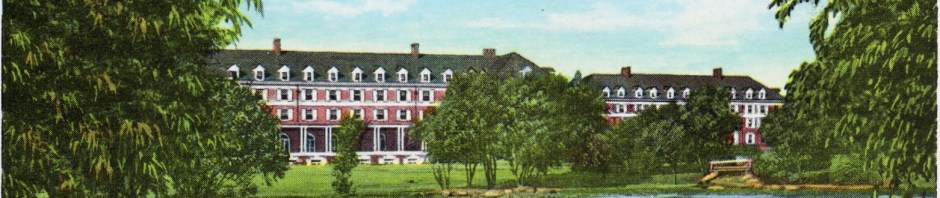
Today’s postcard from a 1940 Oklahoma souvenir pack is of Murray Hall at the Agricultural and Mechanical College in Stillwater. Two of those three titles have since changed. Murray Hall was stripped of that name in 2020, and it is now the Social Sciences and Humanities building and its north addition is now the Psychology building. The Oklahoma Agricultural and Mechanical College was renamed the Oklahoma State University of Agricultural and Applied Sciences in 1957, and that was truncated to just Oklahoma State University (OSU) in 1980.
The Stillwater name remains, unchanged since 1884 when a caravan of Boomers settled in dugouts and tents beside a stream just inside the future Oklahoma Territory. They called the stream the Still Water and their settlement Stillwater. Surrounded by the U.S. Cavalry and cut off from supplies, the Boomers returned to Kansas, and Stillwater was not permanently settled until the 1889 land run. The territorial legislature approved it as the land-grant college site in December 1890.
Back in the 1990s, I earned 12 hours of graduate credits from OSU, although my master’s degree was earned elsewhere. None of my OSU classes were conducted at its main campus in Stillwater, instead being transmitted to Bartlesville High School via compressed video.
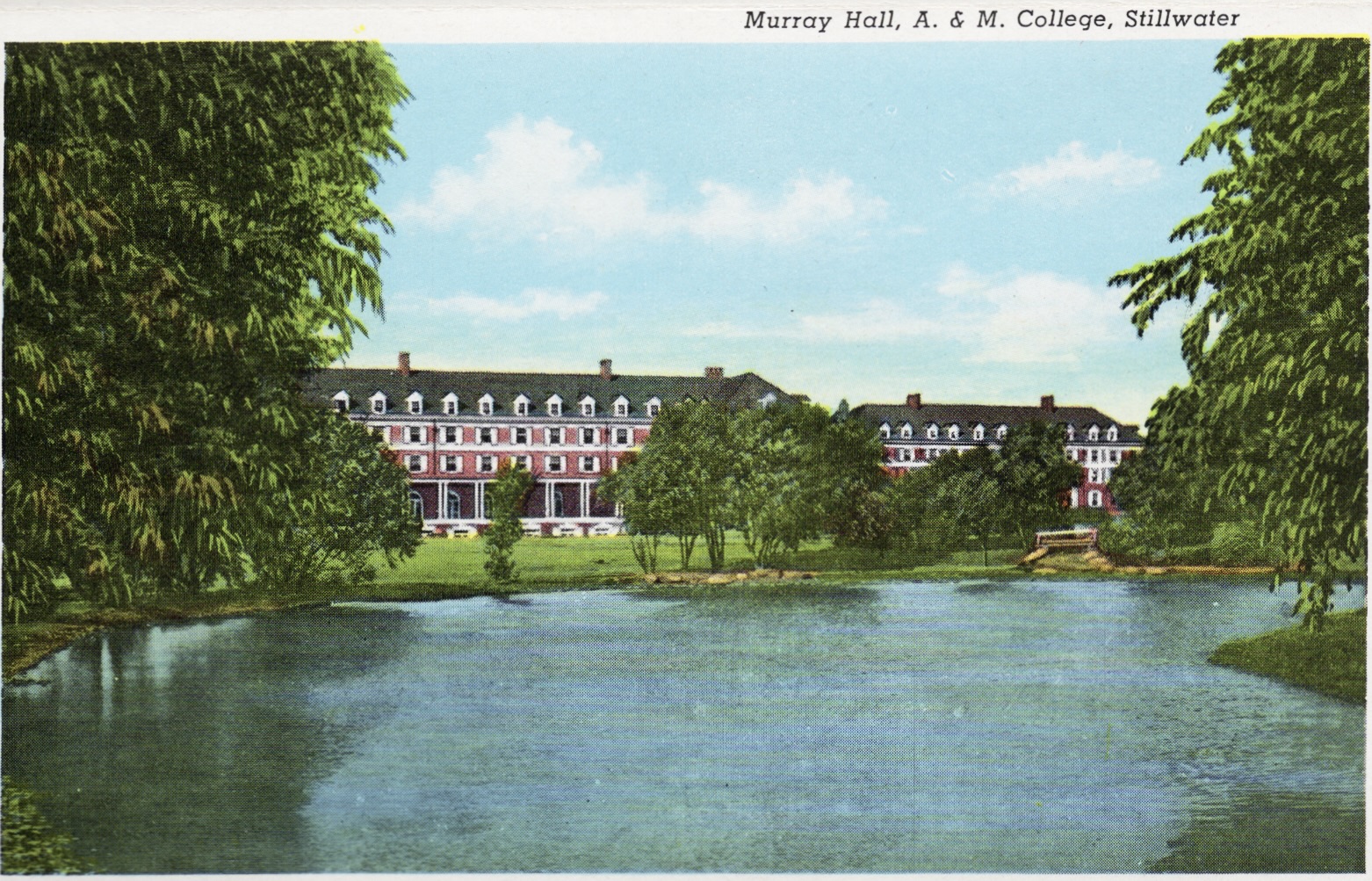
However, I was on the OSU campus a few times back in the 1990s. I was a sponsor for Bartlesville High School at the annual Interscholastic Meet held on the Stillwater campus. A drafting teacher from the Mid-High and I would corral a group of smart students onto a yellow school bus early on a Saturday morning for the two-hour drive to the Student Union, which is northeast of Theta Pond, the body of water in the postcard view.
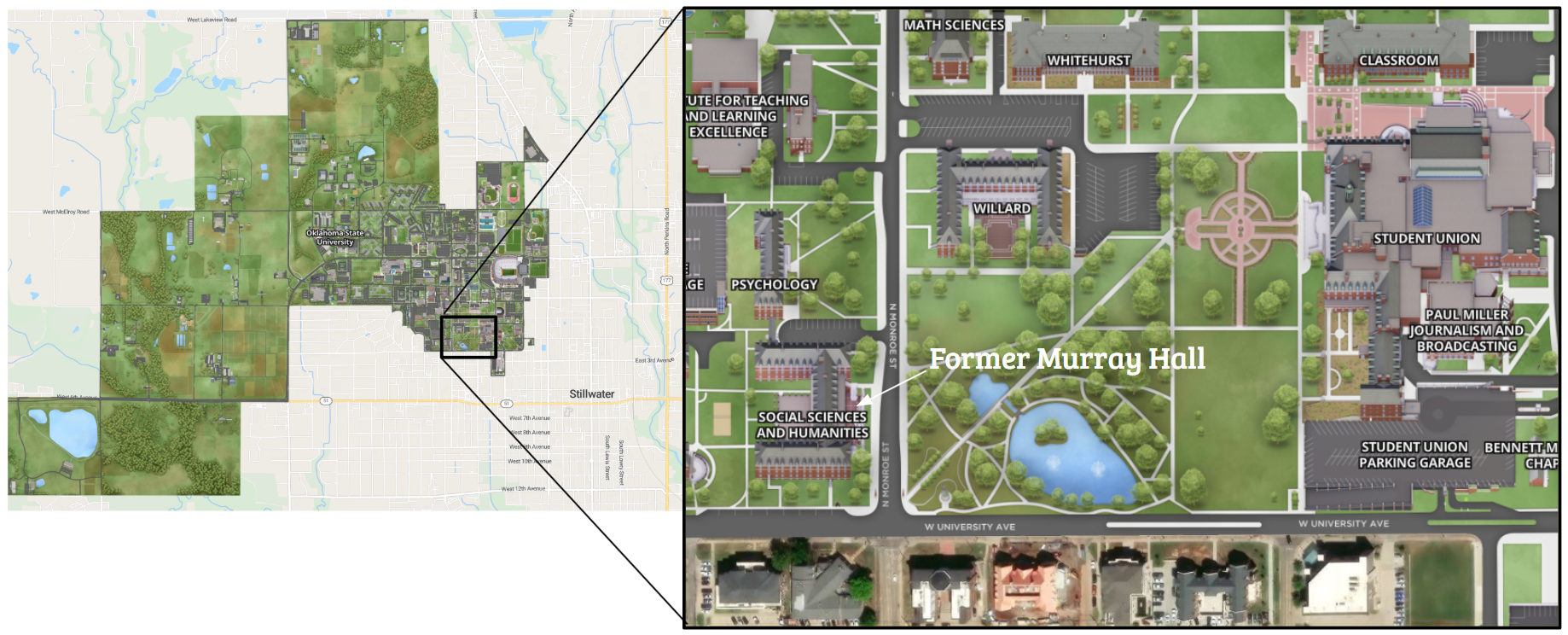
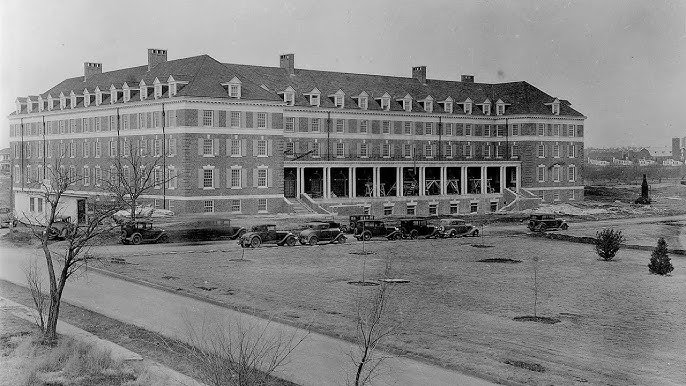
As for Murray Hall, that five-story U-shaped building opened in 1935 as a dormitory for over 400 female students. It was the second largest state owned building in Oklahoma at that time, and it was named for the infamous Alfalfa Bill Murray. He was President of the state’s Constitutional Convention, Oklahoma’s first Speaker of the House, one of its congressmen, and its ninth governor.
Murray was also a virulent and vocal racist who pushed for segregation and Jim Crow laws. So in 2020 OSU finally removed his name from its buildings. At least for now, we still have Lake Murray in south central Oklahoma, and it will appear in one of our later postcards. So Alfalfa Bill will appear again in this series.
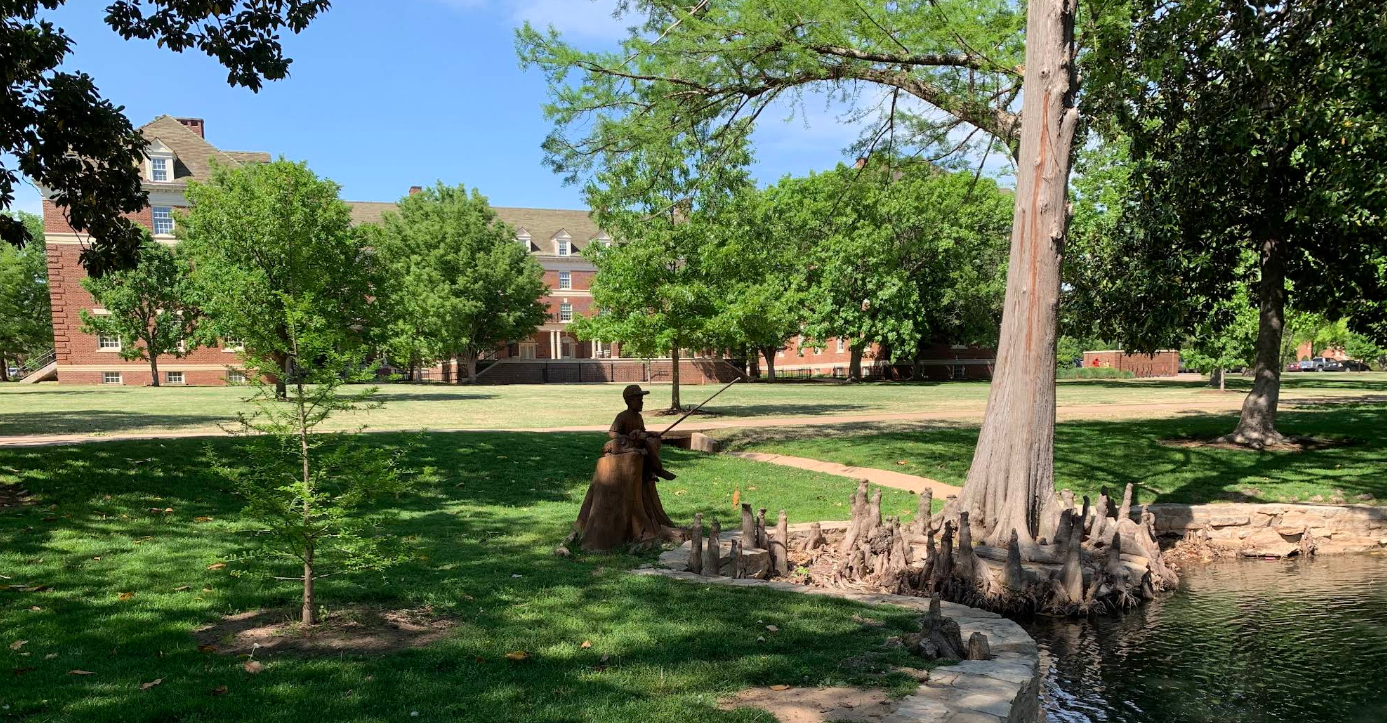
Theta Pond was built in 1895. Once known as College Pond and Horse Pond, being near a horse barn, water was once pumped by windmill into the pond and then distributed across the campus. In the 1920s it became Theta Pond after the nearby Kappa Alpha Theta sorority house. Over the decades, trees have grown up and obscured the view of the former Murray Hall, which was closed to residency in 1971 and has served various academic departments over the years.
You can take a virtual tour of the campus.
A Bartlesville Connection
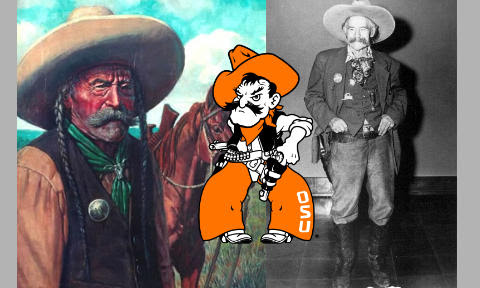
Frank Boardman “Pistol Pete” Eaton was eight years old when his father, an abolitionist, was shot in cold blood by six former Confederates. Eaton grew up to be an expert shooter and reportedly hunted down and slew all of his father’s murderers.
He lived and worked in future Bartlesville during his youth in the late 1870s, having a residence just south of the mound on Jessie Creek, and later moved in with Jasper Exendine’s family. Exendine became a famous athlete in football and baseball, and he and Pistol Pete visited each other in Bartlesville many times and made appearances at the once famous Dewey Roundup rodeo.
After the 1889 land rush, Eaton settled and lived as a sheriff and blacksmith in Perkins, ten miles south of Stillwater. After seeing Eaton riding a horse in a 1923 Armistice Day parade in Stillwater, a group of Oklahoma A&M students decided that Pistol Pete would be a suitable school mascot, replacing a tiger one they disliked. The school’s teams began being called the Cowboys as well as the Aggies, and they officially became the Cowboys in 1957, with Eaton’s likeness adopted as the official school mascot the next year when he passed away at age 97.
Stillwater is 65 miles northeast of Oklahoma City and 64 miles west of Tulsa. The town grew from 3,444 in 1910 to 16,007 in 1940 when the postcard was printed. Now it is over 48,000, while the home of its chief rival, Norman, has grown to over 130,000. The next postcard will take us there.