

I flit across familiar genres of fiction, occasionally dive into a literary work, and maintain an interest in a variety of nonfiction. Recently I had a bit of mystery, a light adventure, an old science fiction novella, and a depressing yet engrossing literary visit to Winesburg, Ohio.
Needing a break from fiction, I embarked upon listening to 14 hours of erudition from the always-reliable Simon Winchester with The Breath of the Gods: The History and Future of Wind. Normally I would balance that by reading fiction on my Kindle or as a physical book.
However, in researching a previous post about a novella by Lester del Rey, I enjoyed an insightful article by Dan Sinykin. I liked it so much that I purchased and read the first chapters of Sinykin’s Big Fiction: How Conglomeration Changed the Publishing Industry and American Literature which dealt with mass market paperback. He lost me when he went on to write about trade paperbacks, as I haven’t read most of the famous authors of the 1960s onward that he droned on about.
I abandoned that book and considered what fiction I might pick up next. That drew me back to the Modern Library’s self-serving 100 Best Novels of the 20th Century, and I began running down its unread entries, cross-referencing them with the meta-analysis of The Greatest Books of All Time. I noticed a pattern in them.
One of Sinykin’s premises is that in the era of publishing conglomerates, book awards like the Booker and Pulitzer have heavily favored historical fiction. I see a similar focus on the past, with a decidedly downbeat tone, in many of the entries on Modern Library’s 20th century list. Here’s just a handful of the highest-ranked unread entries:
- Catch-22: 1961 critique of military bureaucracy, set in World War II
- Sons and Lovers: 1913 novel of emotional conflicts and suffocating relationships from 1885-1911
- The Way of All Flesh: 1903 posthumous publication of a multi-generational tale, written in the 1880s and satirizing Victorian hypocrisy, spanning 1765 to 1863
- An American Tragedy: 1925 critique of the American Dream, covering 1897-1908
- Native Son: 1940 story of a black youth living in poverty in the 1930s
I wasn’t attracted to that laundry list of depressing critiques of society set a century or more in the past. I thought of the Saturday Night Live fake commercial from 1976, and how I needed a Puppy Upper instead of all of those Doggie Downers.
So I asked Gemini, “What are the most joyful and optimistic books in the Modern Library’s 100 Best Novels of the 20th Century?”
It replied, in part, “When the Modern Library compiled its famous list of the 100 Best Novels of the 20th Century, the editorial board clearly leaned into the era’s signature literary moods: existential angst, dystopian dread, psychological disintegration, and tragic disillusionment. Finding a book on this list that leaves you genuinely uplifted and smiling requires some careful planning…”
It then identified A Room with a View and The Bridge of San Luis Rey, which I’ve already read, and I wouldn’t call Wilder’s novel a happy one. It also recommended The Adventures of Augie March, which I had previously rejected as yet another bildungsroman. That was followed by Kim, but the imperialism of Rudyard Kipling is hardly to my taste.
Thankfully, it then spat out four works I was unfamiliar with: Scoop by Evelyn Waugh, The Wapshot Chronicle by John Cheever, Loving by Henry Green, and Under the Net by Iris Murdoch. Knowing AI’s tendency to hallucinate, I first verified those were actually on the Modern Library’s list, and then I put them into an online spinner, flicked the virtual dial, and…my next read was Scoop, which has been described as “Waugh’s exuberant comedy of mistaken identity and brilliantly irreverent satire of the hectic pursuit of hot news.”
However, Seth Meyers wrote, “Its timelessness is both hilarious and depressing.” Depressing? Oh, dear, let’s hope not.
It is #75 on the Modern Library list, #84 in BBC’s 2015 ranking of 100 Greatest British Novels, #60 in the Guardian’s 2015 ranking of the Best 100 Novels in English, and was ranked the 433rd Greatest Book of All Time in that meta-analysis in late May 2026. It was published in 1938, so it won’t enter the public domain in the U.S. until 2034. The Kindle version cost me $9 after I redeemed $3 in “points” I had somehow earned, although I could have scored a paperback copy for $7.
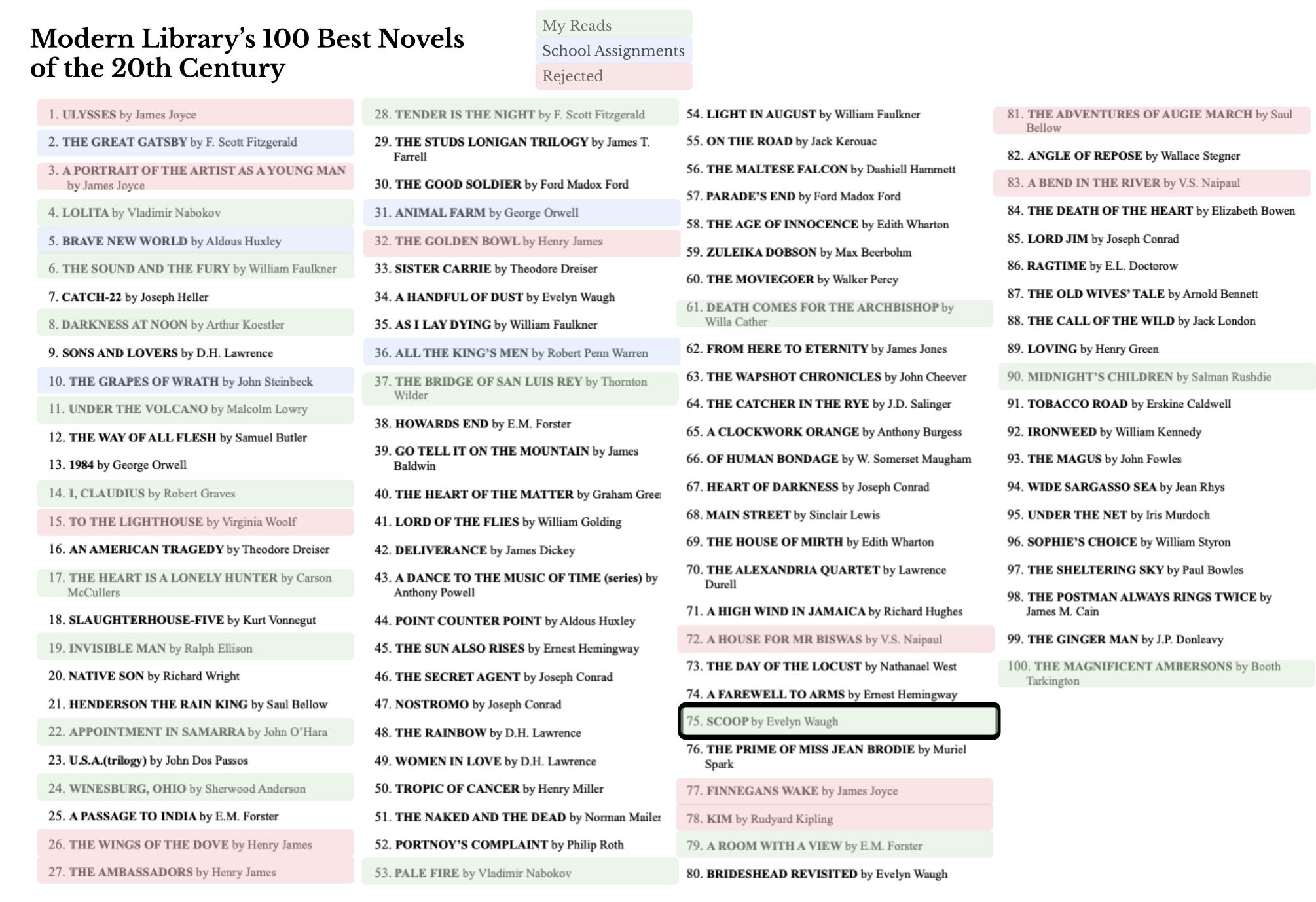
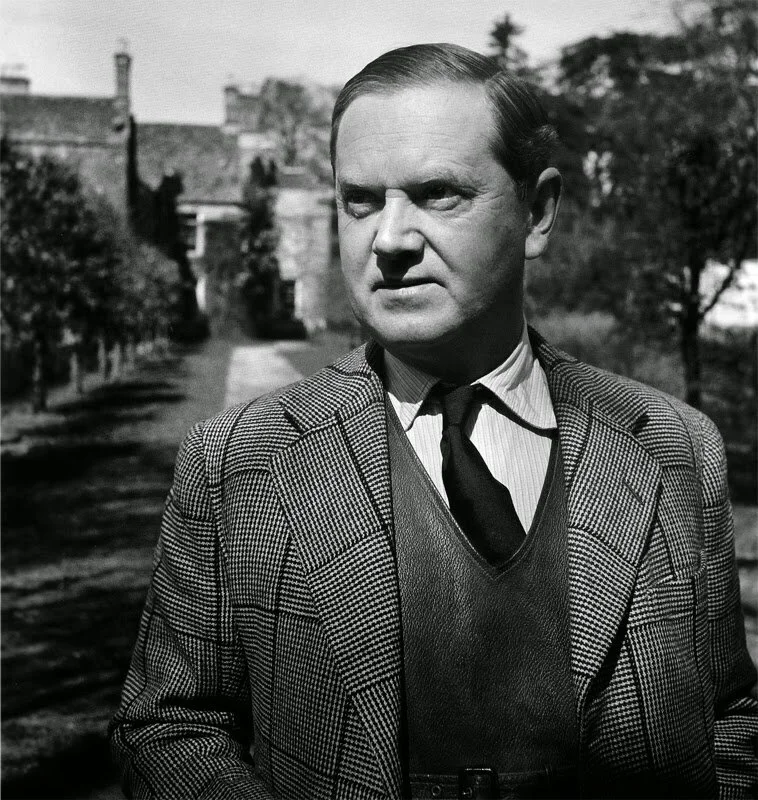
I knew little about Waugh, save that he was from an era when men were named Evelyn and that he had written Brideshead Revisited, although I hadn’t a clue what that novel was about. I see Brideshead ranked the 141st greatest book versus 433rd for Scoop, but on Modern Library’s list Brideshead was #80 versus Scoop as #75, and it has A Handful of Dust as #34.
Waugh was known for satirical novels and “considered one of the great prose stylists of the previous century”. However, I found his Wikipedia biography rather repulsive. I could only hope that the unpleasant person’s book was more appealing than he was, but I am not altogether surprised when a satirist is an unhappy human being. One biographical detail I enjoyed was that his first wife was also named Evelyn. Unsurprisingly, he-Evelyn and she-Evelyn did not stay together for long. He-Evelyn later converted to Catholicism, thus securing for himself, in keeping with the stereotypes, a second wife (after the convenient annulment) who was unlikely to divorce him as well as a considerable number of offspring.
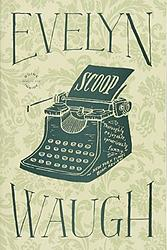
I found the book a quick and fairly painless read. There were some brief funny sketches, such as:
The widowed Lady Trilby was William’s Great-Aunt Anne, his father’s elder sister; she owned the motor-car, a vehicle adapted to her own requirements; it had a horn which could be worked from the back seat; her weekly journey to church resounded through the village like the Coming of the Lord.
I particularly enjoyed Waugh’s description of a milch-goat that made a few appearances:
The Pension Dressler stood in a side street and had, at first glance, the air rather of a farm than of an hotel. Frau Dressler’s pig, tethered by the hind trotter to the jamb of the front door, roamed the yard and disputed the kitchen scraps with the poultry. He was a prodigious beast. Frau Dressler’s guests prodded him appreciatively on their way to the dining-room, speculating on how soon he would be ripe for killing. The milch-goat was allowed a narrower radius; those who kept strictly to the causeway were safe, but she never reconciled herself to this limitation and, day in, day out, essayed a series of meteoric onslaughts on the passers-by, ending, at the end of her rope, with a jerk which would have been death to an animal of any other species. One day the rope would break; she knew it and so did Frau Dressler’s guests.
I also enjoyed how the pompous newspaper executive Lord Copper thought of his banquets:
Lord Copper quite often gave banquets; it would be an understatement to say that no one enjoyed them more than the host for no one else enjoyed them at all, while Lord Copper positively exulted in every minute.
The humor was clearly influenced by P.G. Wodehouse, Waugh being a fan and modeling his Lord Copper after Wodehouse’s more hilarious Lord Tilbury, with Waugh acknowledging the debt with a mention of a “Bertie Wodehouse-Bonner”. The daft Boot family in the novel are a variation on the Blandings of Wodehouse, and so forth, but we don’t spend enough time with the various characters for their charms to become more than set dressing.

The novel was fun, but its humor was Wodehouse-Lite, and its satire quite colonial and imperial. Waugh targeted everyone, but I never understood his deus ex machina character of Mr. Baldwin. I see that Herbert Lom played the character in a 1987 television adaptation, and that strikes me as good casting based on the description of the character in the book.
I think I would have enjoyed the novel far more if I had not already listened to over a dozen Wodehouse novels. The final section, after the long middle spent in Africa, felt too contrived, and the novel left me not unhappy yet underwhelmed. I certainly wouldn’t rate it as highly as several of the novels by Wodehouse.
I had not given up on something light from the Modern Library’s list, but I was tired of reading about Great Britain, so I passed up Under the Net and Loving for now. Instead, my next read was The Wapshot Chronicle by Cheever.








 Meador Manor