
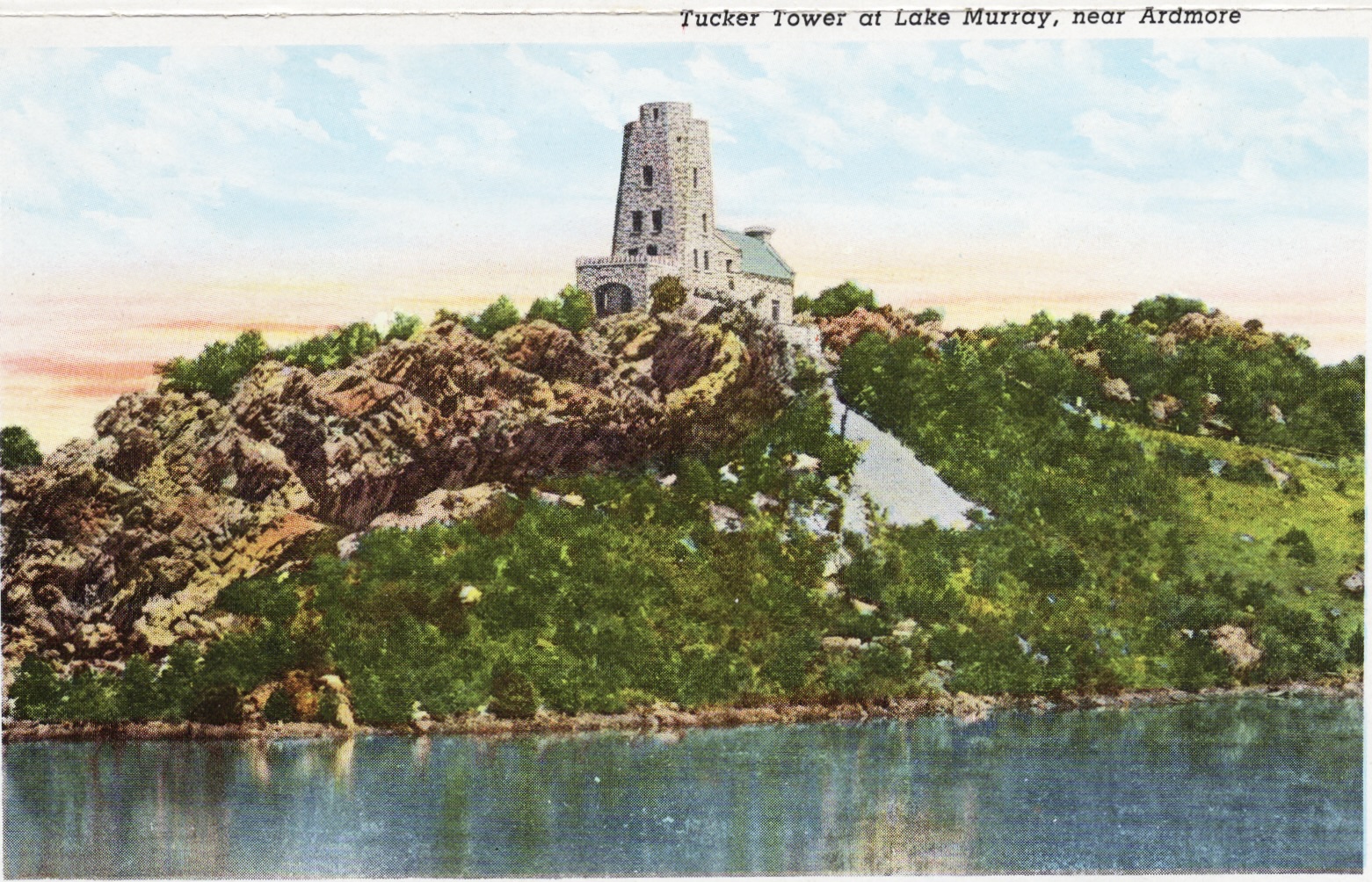
Today’s postcard from a 1940 Oklahoma souvenir pack is of Tucker Tower at Lake Murray. That is east of I-35 way down south of Ardmore, only thirteen miles from the Texas border. It was a boondoggle rising 65 feet above a bluff that was in turn 65 feet above the surface of the lake. Construction began in the 1930s on a visually impressive but impractical building.
Lake Murray was built by the National Park Service and various New Deal agencies of the Great Depression, including the Works Progress Administration (WPA). Two main group camps were created, plus a separate “Negro” camp. Lake Murray State Park became the only state park built by the National Park Service to provide permanent camping facilities for African American youth, which I suppose was progressive in some sense but also reflected the virulent racism of Governor Alfalfa Bill Murray and the Oklahomans who elected him.
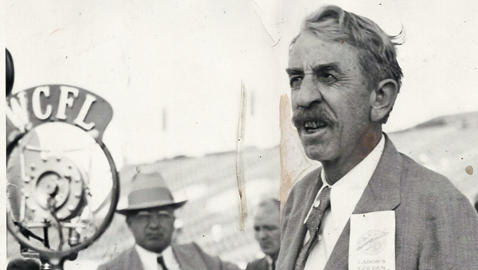
The Lake and park were, of course, named for that notorious governor, who was also the namesake for the former Murray Hall in Stillwater from an earlier postcard. He was a former farmhand from Toadsuck, Texas (I’m not kidding) who grew alfalfa and could rhapsodize about the crop at length. He became a self-educated lawyer in Tishomingo, the capital of the Chickasaw nation. Years before his governorship, he presided over the writing of the Oklahoma Constitution, the longest governing document in the U.S. when it was ratified in 1907. Murray strongly supported white supremacist and segregationist clauses in its draft which President Teddy Roosevelt thankfully had stricken before ratification. However, Murray became the first Speaker of the House in Oklahoma and made sure the first law passed by the new state was a Jim Crow one, the infamous Oklahoma Senate Bill One.
During the Great Depression, Murray was elected governor with a campaign slogan that is shockingly offensive today: he railed against “The Three C’s – Corporations, Carpetbaggers, and Coons.” Murray used the National Guard on 47 occasions and declared martial law over 30 times in four years, for everything from policing ticket sales at university football games to patrolling oil fields. One wonders if Oklahoma will eventually decide to strip his name off the lake, the state park, a state college, and Murray County. I don’t hold out much hope, but it could do so while letting the more ambiguously named Alfalfa County remain.
The tower was named for Fred Tucker, a state senator, who was instrumental in obtaining funding for the dam and lake. Tucker said they had trouble getting Governor Murray to go along with the lake idea, and Murray only agreed to support it if they would name the lake after him. Given what is happening at the federal level these days, some things never change.
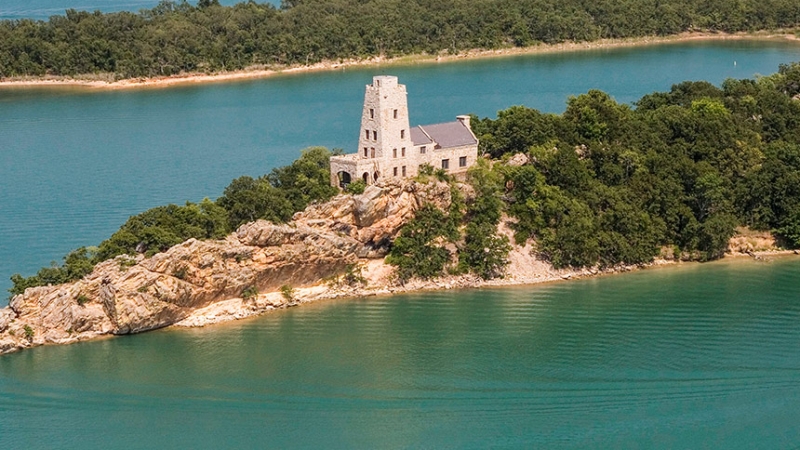
The tower was based on photographs of a European castle that Fred Tucker had taken in World War I. Limestone was quarried on site to build the five-story tower with observation deck, including a two-story section intended as a living area. It seems that the tower might have been intended as a summer vacation home for governors, but work progressed slowly, and its exterior was completed by 1940.
However, its rocky peninsula projecting out into the lake made sewage disposal problematic, as pipes would need to extend to cesspools far enough from the lake to avoid pollution. The unfinished and unplumbed structure was used in the early 1940s for some University of Oklahoma (OU) summer geology camps.
The tower’s interior wasn’t completed until the 1950s, when the paleontologist Dr. John Willis Stovall of OU worked with the state parks and recreation division to convert it into a geology and natural history museum, which opened in 1954.
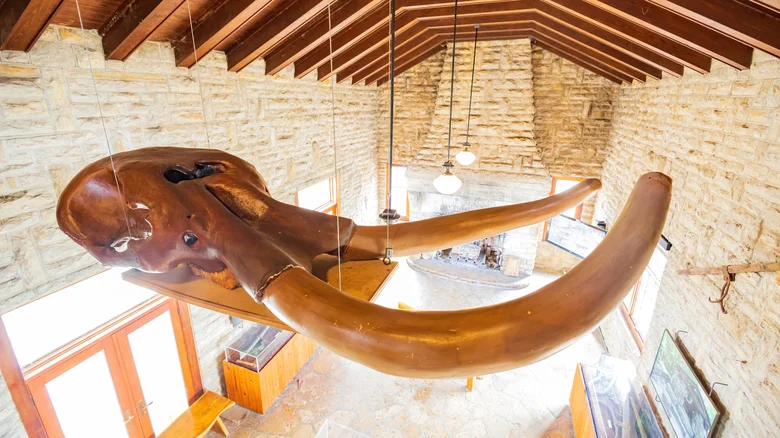
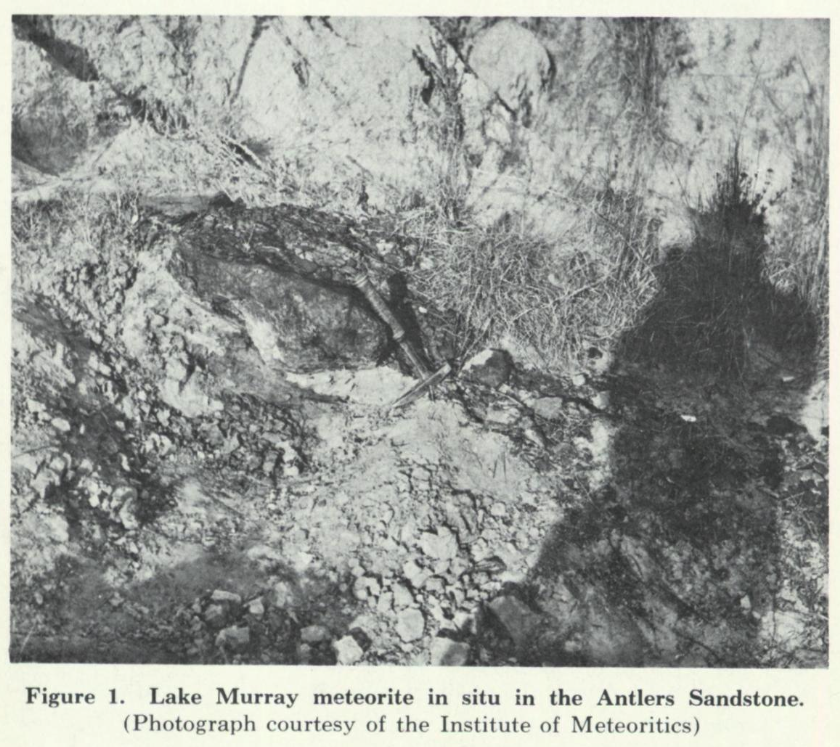
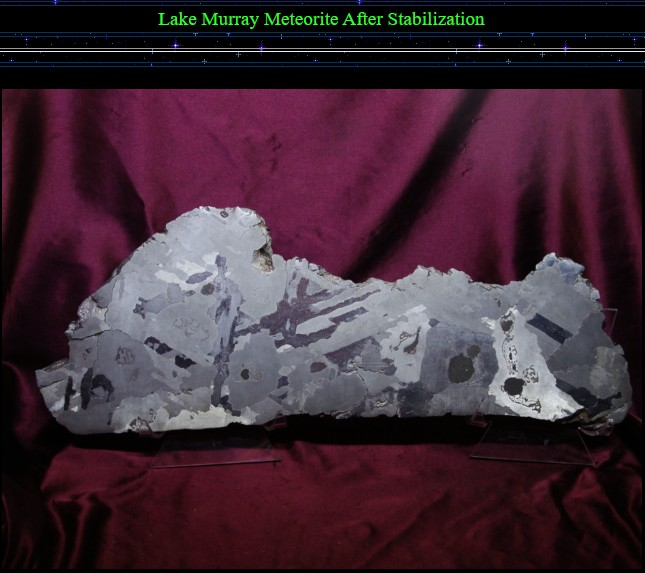
That seemed fitting since in 1933, on a farm that was sold to the state for the park, a huge meteorite was discovered. It weighed 560 pounds, and it was later cut up for analysis, with one of the pieces displayed at Tucker Tower.
By 1987, rotting floors inside the building led the park naturalist, Mark Teders, to close off the tower end of the second floor. The iron window frames were so rusted that new panes of glass just fell back out, and there was still no sewage system, with visitors having to use a portable restroom in the parking lot. Despite its shortcomings, the tower drew 36,000 visitors that year.
In 2011-2013, a $3 million 4,000-square-foot Nature Center was added, with the old tower receiving a $500,000 makeover. The funding was raised by the state park’s oil and gas trust fund, and Mark Teders was still the naturalist. He noted that the tower had 25,000 visitors between that March and September.
I hoped to tour the tower with Wendy back in 2019 during a stay in Sulphur, but I underestimated to time it took to get there on back roads while diverting through the tiny town of Gene Autry. So Tucker Tower remains an unfinished piece of business for us.
Tomorrow’s postcard will take us to a spot I have enjoyed on multiple occasions: the Quanah Parker Dam.






 Meador Manor