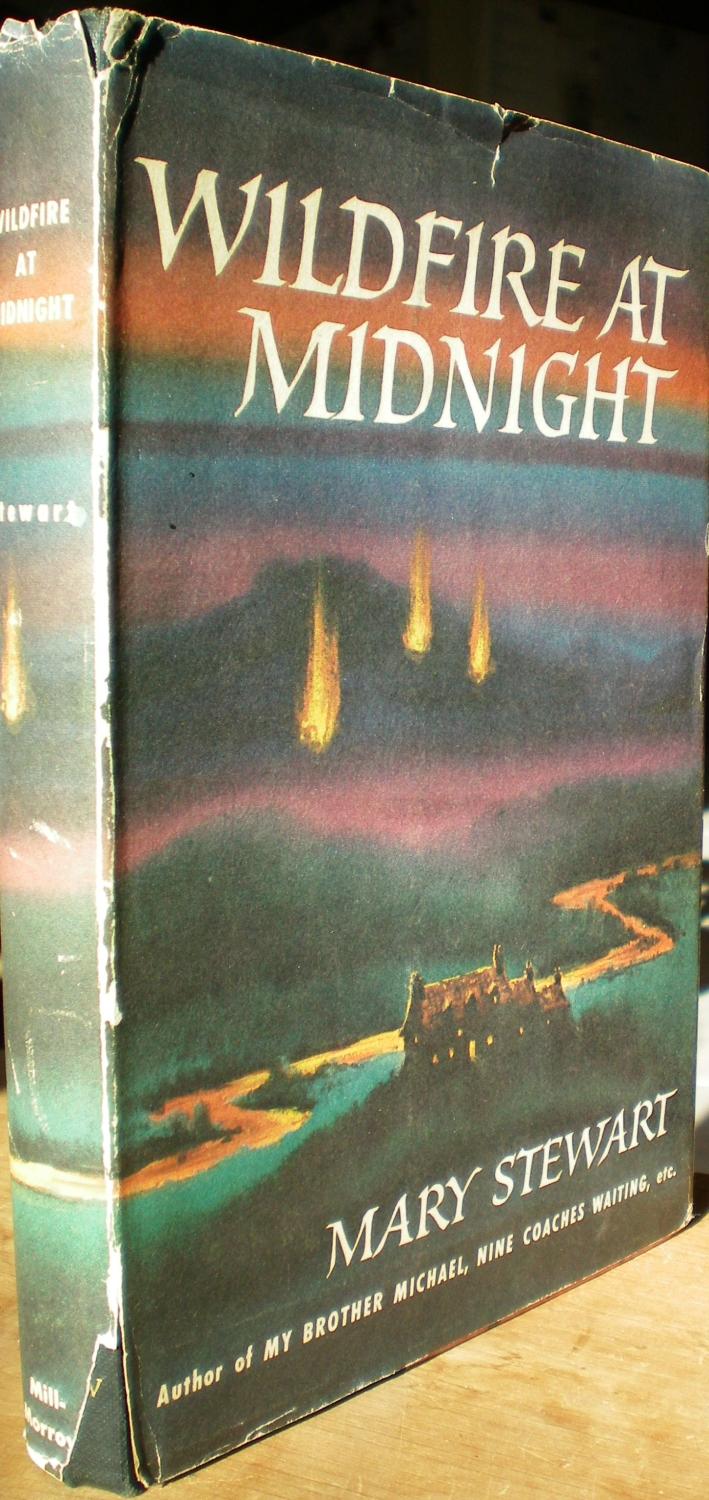
Mary Stewart’s second novel, Wildfire at Midnight, is set on the coast of the Isle of Skye off the northwest coast of Scotland.
The first of her suspense romances I had read was her seventh, The Moon-Spinners of 1962, which was set on sunny and dry Crete. Liking it, I then backtracked to her first, Madam, Will You Talk? of 1955, which was set in the south of France.
In this outing, Stewart again displayed her splendid ability to transport you to a particular location, quickly establishing a mood evoked through its physical geography.
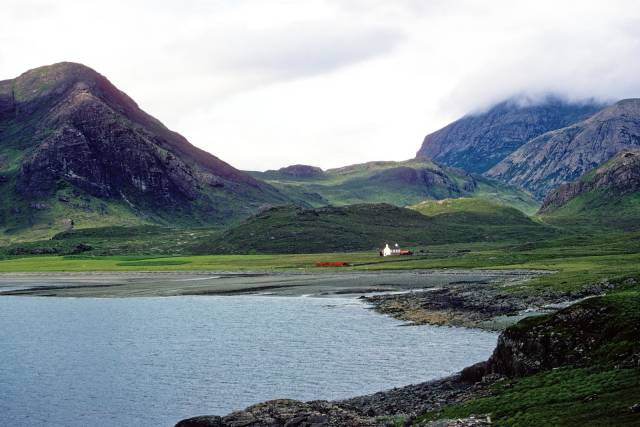
And, locked in the great arms of the mountains, the water lay quiet as a burnished shield, reflecting in deeper blue and deeper gold the pageantry of hill and sky. One thin gleaming line, bright as a rapier, quivered between the world of reality and the water-world below. Our boat edged its way, with drowsily purring engine, along the near shore of the loch. Water lipped softly under the bows and whispered along her sides. The tide was at half-ebb, its gentle washes dwindling, one after one, among the sea-tangle at its edge. The sea-weeds, black and rose-red and olive-green, rocked as the salt swell took them, and the smell of the sea drifted up, sharp and exciting. The shore slid past; scree and heather, overhung with summer clouds of birch, flowed by us, and our wake arrowed the silk-smooth water into ripples of copper and indigo.
And now ahead of us, in the centre of the mountain-crescent, I could see the dip of a bay, where a green valley cut through the hills to the sea’s edge. Higher up this valley, as I knew, was a loch, where the hills crowded in and cradled the water into a deep and narrow basin. Out of this the river flowed; I could see the gleam of it, and just discernible at that distance, a white building set among a mist of birch trees where the glittering shallows fanned out to meet the sea. The boat throbbed steadily closer. Now I could see the smoke from the hotel chimneys, a faint pencilling against the darker blue of the hills. Then the glitter of water vanished as the sun slipped lower, and the enormous shadow of the Cuillin strode across the little valley. One arrogant wing of rock, thrusting itself across the sun, flung a diagonal of shadow over half the bay.
However, this book is an outlier in some ways, as she experimented with a whodunit set in an isolated hotel with various suspects. A prior grisly murder was merely described as a past event, but Stewart did in a couple more folks and threatened others in this fast-paced adventure.
The blogger Danielle once shared: “In the article ‘Teller of Tales’ (The Writer, Volume 83, No. 5, May 1970), Mary Stewart said, ‘Wildfire at Midnight was an attempt at something different [from her previous writings], the classic closed-room detective story with restricted action, a biggish cast, and a closely circular plot. It taught me technically a great deal, but mainly that the detective story, with its emphasis on plot rather than people, is not for me. What mattered to me was not the mystery, but the choice the heroine faces between personal and larger loyalties.'”
Danielle went on to write: “One can always rely on Mary Stewart’s descriptive genius to create a setting so breathtakingly real that it seems to be a memory of one’s own rather than an imagined place. This is perhaps particularly the case with northern England and Scotland; born in Durham and educated there and in Yorkshire, Stewart later settled in Scotland. Wildfire At Midnight also borrows specialist knowledge from her husband, noted Scottish geologist Sir Frederick Stewart, and draws upon the couple’s travels: ‘[…] the one background I owe entirely to him is the Scottish one for Wildfire At Midnight. We travelled every inch of Scotland together.’ (Interview in Counterpoint, edited by Roy Newquist, published by Rand McNally & Company, 1964, page 564.) The rain-lashed island setting with its suddenly descending fogs, perilous mountains, treacherous bogs, and toasty peat fires by which to warm oneself with a glass of sherry, is a character in its own right. It is neither filler nor a device to create suspenseful moodiness (although suspenseful and moody are the resulting atmosphere), but is actually even more integral to the plot than usual with Stewart, who always takes care to match her stories believably to the chosen location.”

This was the third book to have a significant chase, so that appears to be standard in Stewart’s suspense romances. This one came late in the book shrouded in a dense mist, but I was gratified when she chose to have it abruptly end with a literal ascent into sunshine, only to place the heroine in even greater danger. When Stewart uses what are now cliches, she at least does so effectively.
Her prose can elevate the work above mere genre writing. Consider her opening in Chapter 5:
At half-past nine on a summer’s evening in the Hebrides, the twilight has scarcely begun. There is, perhaps, with the slackening of the day’s brilliance, a sombre note overlying the clear colours of sand and grass and rock, but this is no more than the drawing of the first thin blue veil. Indeed, night itself is only a faint dusting-over of the day, a wash of silver through the still-warm gold of the afternoon.
Her deftness extends to the characters as well. When the heroine unexpectedly runs into her ex-husband, there is a quick verbal exchange, and then Stewart wrote, “It was over, the awkward moment, the dreaded moment, sliding past in a ripple of commonplaces, the easy mechanical politenesses that are so much more than empty convention; they are the greaves and cuirasses that arm the naked nerve.”
The book maintained Stewart’s reputation for a quick pace, although its sensibilities are now quite dated. I was not impressed with the heroine’s paramour, but at least Stewart threaded explanations throughout the story for her choices. I will certainly read more of Stewart’s suspense romances, with Thunder on the Right from 1957 promising a return to France. But it would be a mistake to binge on her works; instead, I use her confections as splendid palate cleansers in between longer courses in other genres.