Granite Hills Grandeur

The Bewitching Wichitas (click image for slideshow)

Over Thanksgiving I’d hoped to hike the Granite Hills trails at Great Plains State Park in the Wichita Mountains of southwest Oklahoma, but was stymied by weather. The beautiful Wichitas are too far a drive for a day hike out of Bartlesville, but Winter Break offered another opportunity.

So the day after Christmas, which I’d spent as usual with my folks in Oklahoma City, I ignored the gray overcast skies and drizzle which extended from the city down the H.E. Bailey turnpike to Lawton and points west. The forecast said the clouds would part a bit in the afternoon with highs in the 40s and that was good enough for me.

As I pulled into Lawton around 11 a.m. I was wondering if I’d get to hike at all, since a steady drizzle continued unabated. I took shelter at Central Mall and grabbed lunch, then headed west past the Wichita Mountains Wildlife Refuge, where I’d be hiking and exploring the following day, toward Tom Steed Reservoir near Snyder.

As I passed the Quanah Parker monument on the Cache highway, I was thrilled to see the clouds part on cue and the sun break through for a bit, although it was mostly shielded as I drove into the state park toward the granite hills. At the Granite Hills trailhead several vees of birds passed overhead. The trailhead sign had a better trail map than the one they’ve posted online. Why these things happen remains a mystery.

The namesake mounds of granite were heaped ahead of me and I tried to follow the yellow trail but got confused by some junctions and wound up looping back on myself. When I tried to backtrack and correct it, I was stymied so I just bushwhacked my way along a watercourse until I caught a glimpse of the reservoir and could shoot a panorama.

I eventually found the white trail and followed it down to the lakeside camping areas. The white trail led back uphill to cedars which celebrated Christmas in reddish orange and green. I reached a tiny grove of saplings, unusual in this setting, and then shot a white bouquet of dead flowers amidst the ubiquitous prickly pear cacti.

I finally reached the far trailhead at the old low Lake Snyder dam, directly south of the big Tom Steed Reservoir Dam upstream on Glen Creek. The rock walls of the Lake Snyder spillway contrasted to the big concrete arch of the bigger dam. While atop the bluff above Lake Snyder, I startled a big heron, only capturing a blurry image of it winging past below me.

Moving north up the road past the big dam, I could see up the narrow creek channel leading out into the larger body of the lake. I rejoined the trail system, always taking the right fork so I could take the higher yellow trail for the return. The boulder strewn trail led up to an overlook and the clouds obligingly parted for a sunny shot. I turned around to shoot a panorama of the granite hills.

I climbed to the summit, where a tree growing in a crack looked like it was splitting a huge boulder. I then shot a very long panorama linking the views. As the sun lit up the distant hills I descended to shoot one last granite mound and then followed the yellow trail until I reached the point I’d been at hours earlier. Here I turned off trail, bushwhacking over to a pond shown on my map.

The drought had drained it and as I negotiated the muddy shore I slid down, smearing mud across my hindquarters. Oh dear! I don’t mind scratches and cuts but I do detest muddy clothes. Chagrined, I used bottled water to wash my hands and cautiously made my way over to the park road and followed it to another small pond, where I bushwhacked across dry mudless granite until I stumbled across the yellow trail again.

I followed it through a grove of trees back to the trailhead. Laying a blanket across the car seat, I drove over to a park restroom where I changed my pants and rid myself of the muddy reminder of that pitiful pond. Then I headed back onto the highway as it wound north and west around the reservoir.

Fittingly the golden hour of sunset arrived as I reached the hill adorned with the distinctive remains of the Gold Bells Mine and Mill. The round cooling tower atop the hill resembled a giant kiva in the warm sunlight. The mine never managed to produce gold, so the owners resorted to blasting gold dust into the mine walls to salt it and cheat new investors to recoup their investment, including $17,000 invested in the big useless mill.

The lake glimmered below the dusky sunset sky and then the blue briefly returned above the old cyanide mill. I drove on into Roosevelt, where I was startled by a disturbing tire man who was dancing beside the abandoned high school. West of town a low cloud pressed down over the flat fields and the colors deepened. Granite hills transformed into purple mountains beneath the moon as Trixie the GPS directed me along a shortcut of lonely flat roads towards Quartz Mountain.

I had fond memories of my stay a year before at the best state-owned lodge and had made the wise decision to forgo a hotel room in Lawton for the comforts of the lodge. The low off-season room rate readily compensated for the 35 mile drive over to the park and I knew a fine meal and pleasing accommodations awaited me.

A star illumined the small carnival outside the park as I wound my way over to the resort. Their online booking system had not registered my reservation, but that was hardly a problem in the off-season. I crossed the moonlit courtyard to my room and then walked beneath the lunar sliver to the Sundance Cafe. The old Indian greeted me at the entrance and I was led to the same fireside spot where I dined a year ago.

Candles gleamed as I feasted on hot rolls, a salad, and seared salmon with citrus sauce and grilled vegetables. This is the life! After dinner I strolled through the corridors where other guests were also walking about, admiring black and white photographs from the summer arts institute. I preferred the sculpture Another Dream by Fritz Scholder, which portrayed a woman emerging from the rock for a kiss.

In the lobby was As Long As The Waters Flow by Allan Houser. The fan the woman was holding looked like a paddle to me – she was prompting me to get to my room and start blogging. I learned last year there is no WiFi in the rooms, so this time I came armed with an ethernet adapter for my Macbook Air. So I’m thankfully composing this post from the comfort of my room, and my photos uploaded in record time via the high speed wired connection.

Tomorrow I head back east to the Wichita Mountains Wildlife Refuge to hike a few short trails and see other sights mentioned in Edward Ellenbrook’s guide book which I’ve not encountered on my previous visits. More granite grandeur to come…

Click here for a slideshow from this day hike

Posted in day hike, photos, travel | Leave a comment

Flagpole Mountain and Clayton Lake Falls

Clayton Lake Falls (click image for slideshow)

The first day of winter 2011-2012 was also the first day of my school’s winter break. I celebrated by heading south to Oklahoma’s Kiamichi Country. That’s tourism talk; we Okies really call it Little Dixie because of the strong southern accents there. Many southerners moved into the area after the Civil War, seeking cheap land.

I wanted to day hike in the Kiamichi and San Bois Mountains, both of which are subsets of the Ouachita Range, which I’ve explored on several day hikes. There are still bridle trails I can explore at Robbers Cave, but I wanted something fresh and the state parks website showed a Clayton Lake State Park about an hour south of there. I recognized Sardis Lake to the north, but had never heard of Clayton and Wikipedia reported there was a surviving fire tower nearby on Flagpole Mountain. That clinched it.

I arrived in Clayton a bit after 10 a.m. and found it to be economically depressed, which was no great surprise for Kiamichi Country. 39% of its inhabitants are below the poverty line, compared to 13% of the folks in oil-rich Bartlesville and our little city’s per capita income of $35,800 dwarfs Clayton’s $13,500. But while we have only the foothills of the Osage, Clayton is nestled between mountains which jut up 1,000 feet above the town. I was headed for Flagpole Road, which promised to wrap around Flagpole Mountain’s northeastern rim south of Sardis Lake and west of Clayton.

The road was dirt and water had rutted it badly in places. Slabs of sandstone often protruded from the road surface as I cautiously bounced my way upward, glad I’d put new struts on Princess (my 2001 Camry) a few weeks ago. Finally I could see my target, along with some other towers, on a nearby ridge.

I’d wondered why this Pushmataha County tower had survived, unlike its brethren. That mystery was solved when I found it festooned with antennas pointing this way and that. It was the typical Aermotor design, with a 7 foot square cab up top accessed by a trapdoor. The Forest Service put up about 250 of these towers across the nation between 1933 and 1942, and I’ve climbed ones at Sugar Camp, Hercules Glades, Piney Creek, and Flat Rock in Missouri. Sugar Camp is the one I know from childhood and its lower steps have been stripped away as the cab windows are all gone and the floor is decrepit and unsafe. I figured this tower was in better shape.

Sure enough, all of the steps were intact and I climbed for a nice view of my car far below and Sardis Lake in the background. Thankfully the trap door was unlocked and not only were the windows intact but even sported an I Red heart Smokey sticker. Even the table for the Osborne Fire Finder was still in place, painted forest green. The panoramas of the north and west were quite nice, and Flagpole Road led on south along the mountain ridge.

I opened the trapdoor and descended both the tower and the mountain, pausing along the empty road for a shot of the dam at Sardis Lake. The state defaulted on payments for this water reservoir, prompting a court case it lost. Then Oklahoma City purchased the rights and the Choctaw and Chickasaw Nations recently filed suit to block the water being piped 130 miles to the metropolis. Water fights will become more common as our lakes silt up even as demand increases.

My next stop was tiny Clayton Lake State Park. There was mention of a hiking trail, but the sketchy reports led me to speculate it would be very short or abandoned, and the maps showed a park boundary hugging the lake shore. I would indeed find only remnants of a trail, but that was compensated by some beautiful waterfalls at the spillway.

Pine trees surrounded the tiny lake as I explored, stymied in my rare decision to ask at the park office about a trail by a sign in the window saying the ranger was out in the park somewhere. I walked north toward the dam and spotted an eagle zipping past the trees along the western shore, but my photos of its flight were blurry and useless. The broad spillway was eroded and water was cascading into Peal Creek. Clambering all over this area snapping photos and videos of the falls was the highlight of my day.

I grabbed shots of the spillway edge and farther below, getting right up against the cascade. I would later struggle completely across the waterway, winding my way on jutting rocks and debris to make it to the far side of the spillway to shoot one of the waterfalls nestled among the rocks. Quite a treat!

I then returned to my car to grab my lunch pack and walked over to the park’s south end, where I found some reflections and a berm leading out into the water. I found the feeder stream and a big tilted ledge there made a nice lunch spot with a good view both upstream and downstream.

After my repast I clambered upstream, looking back at the lake now and again, until my trip was arrested by the property line, with a large private cabin butting up against the boundary. I had no choice but to shift uphill, discovering abandoned mossy picnic tables here and there. Here on a dirt road I was surprised to find blue tree blazes. The trail! But it led straight down a road blocked by barbed wire and private property notices. Something went wrong for this trail after it was built and blazed. How sad, both for it and for me.

So I wandered up another feeder stream, undoubtedly wandering a bit past an unmarked boundary this time. But then the trail I was following turned to ford the wide stream and clearly entered private land. Stymied again, I backtracked, having exhausted the park’s clearly accessible regions. But the afternoon sun was out and I decided to return to the spillway for some hopefully improved photos.

There I found an Asplundh truck with a fellow clearing logs from upper edge of the spillway. He was working alone but I then spotted three more Asplundh workers, bedecked in hunter orange tuques, who were exploring the other side of the spillway. They’d found a way across, so why not me?

That is when I struggled all of the way over, finding carved channels in the tilted bedding planes of the rocks and getting very close to the falls. I climbed up the dam and walked to the far shore, where I unexpectedly found another blue trail blaze. I hadn’t brought my iPhone or pack with me for this return to the spillway area, so I opted not to bushwhack the abandoned trail and instead reversed course. On my way down the dam by an alternate route I scrambled to a halt, gasping in surprise at a large snake sunning itself on a rock below me. Neither of us was pleased at the encounter and I returned to my car by a different route. I’d only hiked four miles and there were a few hours of light left, so my next stop would be Robbers Cave.

Since September 2009 I’d hiked several times at Robbers Cave and exhausted almost all of the pedestrian trails. While I want to explore part of the multi-use trail and bridle trails east of the highway, I’d need a full day outside of hunting season for that. So I opted to circumnavigate Lake Wayne Wallace using a bridle trail I’d only partially walked previously, rather than using the Mountain Trail shown on the park map.

I parked at Frank Glenn Bridge on Ash Creek Road and first walked northeast up Fourche Maline Creek to snap some distant small falls. Then I walked over to and across the long earthen dam, looking at empty tent camping sites along the eastern shore. I was following the yellow bridle trail as it wrapped up and around the high bluffs, emerging out on top for a sweeping view of the dam and the Frank Glenn Bridge below.

Checking the time I decided I could circumnavigate the lake before dusk, taking the Big John II portion of the yellow bridle trail. I zipped along the high trail and reached an unfamiliar section with a stern warning to follow the switchbacks and not erode the hillside. I dutifully wound my way downhill, startling a flock of geese as I reached the lake shore. Once again my camera failed to focus on them in flight. Steve Austin never had this kind of trouble with his bionic eye, but it cost over a million dollars back in 1974, so I shouldn’t complain.

The trail linked to the mountain trail and I followed it around the northwest end of the lake. I then followed the bridle trail along an abandoned road with a collapsed bridge back to Ash Creek Road and traipsed back to my car. I’d hiked another 3.5 miles, bringing my total for the day to 7.5 miles. Less than 4 miles to go to reach my 300 mile goal for the year!

I drove home and it was only fitting that on the first day of winter a light snow began as I headed north on US 75. The flakes were melting upon impact, but they did make the big vertical shaft light at the Ramona casino look like a snowblower. Next week I plan to trade the Ouachitas for the Wichitas.

Click here for a slideshow from these day hikes

Posted in day hike, photos, travel, video | 2 Comments

Fountainhead Folly

Lake Eufaula (click image for slideshow)

A building has integrity, just like a man, and just as seldom.

So says Ayn Rand in The Fountainhead and I was reminded of that quotation today when I made a brief return to Oklahoma’s Fountainhead. The former state park and lodge on Lake Eufaula, that is. Over 25 years ago a friend and I visited Fountainhead and Arrowhead, back when they were both operational. I’d hoped to see striking architecture at what were once the state’s premiere lodge resorts, but only found fading façades.

Eventually the state defaulted on the debt and both lodges were sold off. Arrowhead sadly became one of the Scientology cult’s Narcanon drug rehab centers while the Muscogee (Creek) Nation bought out the Fountainhead golf course and resort. The tribe is operating the golf course, but their plans to redevelop the resort have been stymied because a major building is situated on Corps of Engineers land and our dysfunctional Congress has yet to resolve the situation.

My friend Carrie and I had a long but memorably unattractive hike at Arrowhead a year ago. The trails there were rough, rocky, uninteresting, and littered with dozens upon dozens of beer cans. So I had faint hope for what I’d find 17 miles north at Fountainhead, now renamed Lake Eufaula State Park. The park map showed only two longer trails, one of which appeared to be a handicapped accessible hard surface loop. I appreciate the need for that sort of trail, but it has limited appeal to me. But I wanted to hike on a pretty December day, had an evening Christmas party to attend, and we’re in the midst of deer hunting season. So I was seeking a state park with a trail new to me and the former Fountainhead was my choice.

I dropped my car off for a tire rotation while I walked 1/3 mile up US 75 to grab breakfast. After that I had the oil changed and made the two-hour run south to Lake Eufaula. I chose not to turn off and see the decrepit lodge but drove past the park sign to the visitor center. It was naturally much like the one at Arrowhead, with a silly steep aluminum roof with a gold or copper anodized coating which has almost completely worn away. If you back far enough away and get some of the roadside pines they’ve planted in the shot, it looks a bit better. As at the other park the restrooms were in a separate building and bizarrely built with extremely narrow doors and vestibules. They’re anything but ADA compliant.

Across the road I found the trailhead for the Chinkapin Trail. It was a mowed and cleared strip, a bit soggy from recent rains. It would no doubt be more appealing at other times of the year, but probably not much more interesting. It crossed a couple of tiny almost-dry creekbeds which once had piped crossings but those had washed out. The old concrete pipes were discarded to the side, an unattractive reminder of an investment no one cares to renew. I then began hearing the shots.

Hunters were busy, not in the state park, but across the lake. Since the park is on a peninsula the sounds of various shots boomed across the water, hardly conducive to a relaxing hike. I wanted to see the lake from the shore, but knowing a shot can carry a long ways I donned my orange vest and decided to wrap up this trip. I reached a leafstrewn gully/road and it led past what appeared to a pond built right into the lake’s shore. Trees and, sadly, some jetsam jutted from the rim of Eufaula Pond…or should I say from the edge of Lake Eufaula?

The trail led on to the closed Longhorn Loop camping area, which had a truly nasty shelter that typifies what goes wrong with cheap modernism which is not properly maintained. I walked down to the lake shore and then fled along the asphalt loop road to return to my car. Along the way I spotted a side trail and followed it to an old neglected cemetery. The Logans had the biggest tombstone, while the most touching was for the Fox’s dead baby.

I returned to the road and was ambling through a clearing when a buck and doe bounded past me. I didn’t bother with the camera but just grinned and admired their strides. Knowing another deer might well be nearby, I followed a clear cut they had emerged from and eventually found another buck eyeing me from a distance. I shot him at full zoom, but my shots were far less deadly than my fellow hunters’.

Returning up the highway to the visitor’s center I noticed they planted the pines too close to the power lines, resulting in ugly cutbacks. Poor planning, but it did provide a nice screen from the road for a bit. I also discovered why this area was called Longhorn Loop. A herd of the namesake cows was in a field beside the road. A giant roadside fish told me I’d reached the end of my 4.15 mile hike.

With distant gunshots still echoing across the lake, I opted to forgo the tiny nature trails in the other camping areas and the Hummingbird Beach trail just north of the airstrip and headed home. I shan’t return to Lake Eufaula, as it has disappointed me too often. Hopefully I’ll have better luck hiking in southwestern Oklahoma during winter break.

Click here for a slideshow from this day hike

Posted in day hike, photos, travel | 2 Comments

Titillating Titles

When I was an undergraduate at OU in the 1980s I sought out the campus film series so I could see some of the greatest films ever made. This was before DVDs, and VCRs were still expensive and the selection of VHS tapes at the local video stores was sketchy. Even when I found a good tape, I’d be watching it on my 19″ CRT television at an effective resolution of 333×480. So watching a pristine 16mm or 35mm print on a huge screen in one of the big lecture halls was a real treat.

It was in that setting that I saw for the first time what critics laud as two of the greatest films ever made: Welles’ Citizen Kane and Hitchcock’s Vertigo. Both feature music by Bernard Herrmann and Vertigo has a Saul Bass title sequence to die for. Be sure to watch it in full screen at the highest resolution available.

You really can’t grasp the power of this any more. Even the Blu-Ray version on a big HD television won’t give you the sensation I had watching that for the first time on a wall-sized screen in a huge auditorium. That sucker swallowed scores of people around me. We drowned in its depths.

Bass had seen Lissajous figures in a math book years before and he realized that putting those spirals into motion could symbolize the vertigo of the protagonist and the abyss awaiting him. I’d seen such figures animated before, not on a movie screen, but on an oscilloscope. Back in 1958 John Whitney devised a sine wave pendulum to etch such figures into glass and collaborated with Bass to produce the mechanical animations for Vertigo. After seeing the movie I went home and began programming trig functions in BASIC, eager to try to produce similar animations on my Tandy 2000 home computer.

Saul Bass is probably the most famous title designer of all, having worked repeatedly for some of the best directors, such as Hitchock, Preminger, and Scorsese. Here’s a neat quick look at many of his efforts. Be sure you click the options for HD and fullscreen.

And here’s a neat student animation project about Bass with Kraftwerk’s great early song “Ruckzuck” from the album they refuse to acknowledge these days.

When you think of memorable title sequences, I’m sure you think of James Bond films, most of them the work of Maurice Binder. It is hard to pick out my favorite, and some of them look rather dated, such as the neon make-up and laser images in A View to a Kill. But when I was a prepubescent boy I found those sequences terribly provocative. My eyes opened wide…and then hurriedly scanned the room to make sure my parents didn’t know what I was watching.

A movie many people disliked but which I found enjoyably disturbing was Frankenheimer’s 1996 version of The Island of Dr. Moreau with Marlon Brando at his most weird. I remember being drawn in by Thomas Cobb’s powerful title sequence. Again, you really need to see this on a big screen in full res.

Yes, that’s the same guy who did the scary titles for Se7en.

Title sequences can go awry, of course. I remember Mr. Jennings, my 7th grade math teacher, complaining to my class about the very long title sequence in 1978’s Superman with the big swooping letters. Well, at least you have John Williams’ score pounding away to relieve some of the monotony.

I had fun browsing through this list of great title sequences. As I peruse the list, I’d say their last pick is one of my first: the huge lips and great geeky song by Richard O’Brien from The Rocky Horror Picture Show.

It’s simple, cheap, and memorable, focusing your attention on the song…once you get over the fear of being bitten!

Posted in movie, video | Leave a comment

Generation Gaps

I was interested to read a new study from the Pew Research Center about U.S. generations and their political views. Here are the generational groupings the study used:

Generation Birth Years
Millenials 1981-1993
Generation X 1965-1980
Baby Boomer 1946-1964
Silent 1928-1945
And here are my own extensions:
G.I. (I don’t care for Brokaw’s ‘Greatest’ appellation) 1901-1927
Lost 1883-1900
And who is now sitting in my classes?
Internet 1995-present

My father is from the G.I. generation, my mother from the Silent, most of my closest friends at work are Baby Boomers, and I’m from Generation X. Over the course of my career I’ve taught students from Generation X, then Millenials, and now I’m teaching what I term the Internet Generation.

Here are some fascinating comparisons of the generations I found in the report:

Greater Diversity and Later, Fewer Marriages

Look at how much views on gay marriage have changed

Interracial Dating

More Religiously Unaffiliated

Fewer viewing religion as a key to nation's success

Trust in government declines and anger rises sharply

More conservatives than liberals

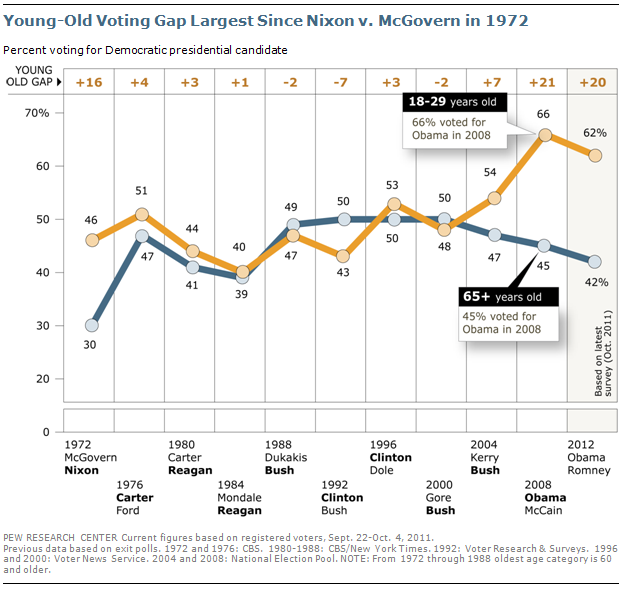
Huge age gap in recent presidential elections

Democratic party viewed as more concerned, less extreme

Declining patriotism and less exceptionalism

Young folks are still optimistic

Many old folks just don't get the internet

Gen-Xers like me are not confident about their retirement

We Gen-Xers are the gloomiest about the major social programs

There's a reason Occupy Wall Street exists...

Social issues roundup

Reefer madness

Most realize the earth is warming, but many don't want to accept responsibility

There is lots more in the report if you care to read it or you can zip through all of the charts.

Posted in politics, random | 1 Comment