Morning in the Osage Hills (click image for slideshow)
I’ve just completed the first work week of the new school year and it had been almost a month since my last real day hike. So I broke with tradition and took an August hike. Minding the forecast high in the mid-90s I got up before dawn, hoping to take an early morning hike on the Bugle Trail at Osage Hills.
I breakfasted at Eggbert’s and then drove the 20 miles to the park, only to be thwarted since the gate would not open until 8 a.m. So I drove back to town, stopping along the way to admire the sky and the high view of town looking east along US 60. I made a pit stop at my home and then zipped back out to the now-open park.
The sun had climbed the sky and the temperature had reached the upper 70s when I reached the trailhead, greeted by a deer. When I startled it two more deer hidden in the brush bounded off too. I headed for the Sand Creek Bluffs, startling the big blue heron at the pool near the trail and, as usual, failing to capture a photo of it. When standing aside for a park truck coming along the trail, one of the employees thanked me for coming out to visit. In all of my visits to the park I’ve been true to my usual loner hiking personality and not interacted much with the staff, but they’ve always been unfailingly polite and welcoming.
The water was unusually still in Sand Creek, and later I’d find the explanation in that it had completely stopped flowing across the waterfall ledges downstream. I took the opportunity to cross the ledge to the far side of the creek, but the brush was too high for much exploring: I was in shorts with my legs and arms thoroughly doused in Cutter, which kept most insects at bay but didn’t stop mosquitos from stabbing me in the back through my wicking shirt.
I recrossed the creek and bushwhacked past the big fallen tree around the bend of Sand Creek, struck by its unusually low appearance. Signs on the high bluffs to the east warned me off from intruding onto their heights so I made my way back up the west bank to the trail. I wandered over to the shelter in the picnic area, which I usually don’t visit because it so often is in use. This morning there were the remains of a wedding strewn about, from flowers and candles to cups and Diet Coke. Hopefully the couple got off to a less messy start than it appeared!
The back side of the shelter was pretty in the morning sun and I followed the Bugle Trail on north to Lake Lookout, where I saw the rowboat actually in use for once, carrying a family about the little lake. I circled around past the CCC camp and observation tower back to my car.
I went about four miles in two hours, sauntering about with no pack or poles. The temperature had reached the upper 80s so I was glad to pay for a Coke Zero at the restroom building. Then I drove back to town to wash up for a well-deserved lunch, glad that I’d broken the August spell and managed to work in a short hike somewhere other than the Pathfinder Parkway.
I did not grasp at first glance the joke in today’s Sunday Bizarro comic in the Tulsa World.
There's an optical mistake here...
Then I realized the driver’s windshield was a giant lens. But there is an optical mistake in the comic, one which we might kindly assert was made by the driver: he is truly bizarre and should be cited for using the wrong corrective lens in his windshield.
Presbyopia (click to enlarge)
The last thing the driver would want is an enlarging lens. Yes, elderly people often are seen using lenses which make their eyes look larger than normal, but that is due to presbyopia, the hardening of the crystalline lens in the human eye. The focusing muscles can no longer flex the lens enough to focus on near objects, allowing the focal point to fall behind the retina, causing a blurry image. A converging lens is used to shift the focal point onto the retina for a sharp image.
Near and farsightedness (click to enlarge)
The same is true for people who are farsighted before their lenses become inflexible. The images of nearby objects form behind the retina because their eyeballs are simply too short to match their cornea and lens effects. So again a converging lens is used to help them out.
The side effect of using a converging lens in spectacles, which sit some distance in front of the cornea, is that the reduced field of view creates enlarged images. So the concavoconvex lenses create a similar effect one sees with the classic double convex “magnifying lens”: it makes nearby objects appear enlarged and, since light is reversible, makes your eye look larger from the viewpoint of whatever nearby object you are sighting.
Below are the six basic lens shapes.
Lens types
The three lenses on the left are converging lenses. Notice how they are all thicker in the middle than at the edges. Spectacles and contact lenses for farsighted people and those suffering from presbyopia use the positive meniscus or concavoconvex shape. The three lenses on the right are diverging lenses, thicker at the edges than in the middle. Spectacles and contact lenses for nearsighted people use the negative meniscus or convexoconcave shape.
Converging lenses enlarge nearby objects
Notice how the girl’s eye in the photo is enlarged. She is holding up a double convex converging lens, so anything nearby she looks at will appear enlarged and, since light is reversible, to us her eye looks enlarged, like the effect seen in the windshield in the comic.
But when you look through a windshield you are always sighting distant objects. Presbyopia and farsightedness are not problematic in that case. If the driver, like me, needs vision correction to drive then it is to focus on distant objects. That means he is near-sighted because his eyeball is too deep. The cornea and lens of the eye converge the rays too much, so that the focal point occurs in the aqueous humour in front of, rather than on, the retina.
So near-sighted deep-eyeball folks wear diverging lenses which spread the light rays out so that they focus farther back: on the retina. A diverging lens widens the field of view, so it makes more of your face visible through your spectacles than normal and decreases the apparent size of your eyes, making things look smaller than normal. So if I look beady-eyed I can blame the convexoconcave lenses I must wear.
Diverging lenses reduce images
The fellow in the photo is holding a diverging lens up, and you can see how his eye looks smaller than normal. The wide field of view gives us a double image of his nose and other eye as well.
I’m old enough to also suffer from presbyopia, so I wear bifocals. The upper part of each lens is convexoconcave to diverge the light rays from distant objects to focus deeper in my eyeball on my retina, while the lower part of each lens is concavoconvex to converge the light rays from near objects to focus closer in rather than behind my retina. I chose progressive lenses to make the transition between the shapes less optically noticeable – to hide the “line” one sees with traditional bifocals. The resulting complex lens shapes makes grinding such lenses much more difficult and expensive, but I’m vain enough to pay for it.
Notice how the driver in the Bizarro comic is squinting. This is an adaptation we nearsighted people learn. Squinting reduces the aperture size and, like a pinhole camera, improves focus. So the squinting of the driver is confirmation of his nearsightedness and that he should definitely not be using a concavoconvex windshield. He needs to get a convexoconcave one. Reverse the meniscus!
This is not the first time I’ve noticed optical errors in pop culture. Back in 1994 the third single from Meat Loaf’s Bat Out of Hell II: Back Into Hell album, penned as usual by Jim Steinman, was Objects in the Rear View Mirror May Appear Closer Than They Are. Clearly Steinman was thinking of the safety warning on passenger-side automobile mirrors that, “Objects in the mirror are closer than they appear.” The warning reminds you that the mirror is designed to reduce the driver’s blind spot by diverging the reflected light to widen the field of view. But diverging mirrors, like diverging lenses, reduce the image size. Since we judge the distance to an object in part by its apparent size, the reduction in image size can fool you into thinking a car is farther back than it really is.
But notice that Steinman’s lyrics are the opposite of how car mirror optics actually work. The song says objects may appear closer than they are, but in fact the mirrors we use on cars make objects appear farther than they are. Steinman got the grammar wrong – again, perhaps it was deliberate, but I doubt it.
I won’t suggest requiring physics and grammar for all songwriters and visual artists: we’ll grant them the artistic license to do as they wish to make us laugh…or cry.
Back in mid-1990s my physics teaching colleague Lynne Shaw and I wanted to take our students on a tour of an electrical power plant. But arranging a field trip proved impossible with our budget and time constraints. So we decided the two of us would take a tour, snapping photos and taking notes, and turn it into a slideshow for use in our classes.
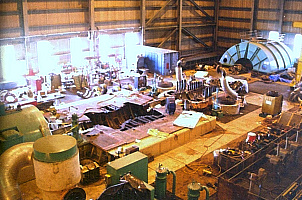
It all worked like a charm, although it was a lot more work to create the show back in 1995 than it would be today. We waited a few months for the tour time set by the local utility, Public Service Company of Oklahoma. It turned out the plant manager, Gary Briggs, had timed our visit so we could see into one of the turbine-generator systems while it was dismantled for maintenance.
A peek into the turbine
Throughout the tour Lynne and I snapped photos with our respective 35mm film cameras and took extensive notes about what we learned from the very informative and welcoming Mr. Briggs. Back when I was an undergraduate majoring in Science Education, for a media class I’d created a little slideshow about the way electrical power is distributed in a city, showing substations, transformers, and meters. Lynne and I did the same thing on our return to Bartlesville.
We developed our film into slides and picked out about 30 of them. On my Gateway 2000 computer, which sported a 66 MHz 80486DX microprocessor (compared to the four-core 2.66 GHz i7-920 in my current desktop!), I created a tiny title slide and miniature schematic of the plant’s operating parts and printed those onto transparency film to insert into film frames to add to our slideshow. Lynne and I wrote out a narrative to go with the slides and took turns recording it onto my computer using the Windows Sound Recorder. I picked out a number of free MIDI music clips that came bundled with the computer’s SoundBlaster audio card and mixed the music in with our narration and many sound effects, then added little beeps to indicate when each slide should be advanced. I then recorded the completed soundtrack onto cassette tape.
Before PowerPoint there was the Carousel
We then had a 35 mm slideshow with audio narration we could show our classes each year. It had been a lot of work, but we had great fun doing it. We later gave a workshop on electricity at the Green Country Science Teachers Workshop and Phillips Petroleum paid to replicate the slides and cassette so we could distribute the show to the participants.
Eventually PowerPoint evolved to where it could replace the analog show. So I scanned our slides to convert them into bitmap images I could load into PowerPoint. I linked them to the original digital WAV audio files we had recorded, omitting the beeps from the mix this time, and added some animations and titles. I timed out each slide to advance automatically at the right moment, and had a fully automated PowerPoint.
Lynne retired in 2000, but the show carried on. Now I could burn it onto a CD as an automated PowerPoint, and I continued to distribute it at the Green Country Science Teachers Workshop until the workshop folded in 2002.
In 2008 I further refined the show with improved scans of the slides and updated graphics. I then tried to find a way to convert the revised PowerPoint into a video, because the show was automated and perfect for a video. Also, PowerPoint back then did a terrible job of properly linking to the separate audio files, making transferring the show to another machine always problematic if you didn’t use the CD. But I couldn’t find a way to make the conversion. I did create a silent version of the show with the narration text overlaid on each slide, and posted that online in both PowerPoint and Adobe PDF formats.
Today Lynne called because she was on a camping trip where she had met an electrical utility executive. She asked me to send her a link to the show. I sent her the links for the silent versions and wondered again if there was some way to convert the show into a video.
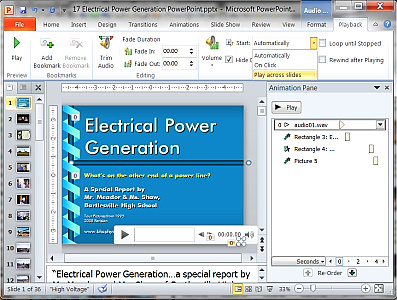
Editing in PowerPoint 2010
It turned out PowerPoint 2010 could do it, but it did not like the way the old WAV audio files were linked into the show. I had to convert the show into the latest PPTX file format, then delete each audio link and re-insert the audio clips so they would be embedded into the show itself, tweaking their playback settings each time. But once I’d done that I could then just click “Save As” in PowerPoint and select to output it as a Windows WMV video.
I then uploaded that to YouTube and now our little show, 16 years after we took the tour and spent so much time crafting it into a narrative,is online for the world to enjoy. You can even watch it in HD, complete with cheesy free music from the early 1990s. And yes, back then I had more hair on top of my head than on my chin.
Every so often those of us who grew up in the analog era are struck by our new era of instant gratification thanks to digital technology and the internet. It is mind-boggling how much information, of good quality, is at our fingertips day and night.
Zettabyte
IDC reports that in 2010 the digital universe exceeded a zettabyte, or 1021 bytes (sorry, but a bug has my WordPress site converting the superscript into a subscript). That’s approaching the prefix limits of the metric system and is equivalent to one trillion gigabytes. For perspective, the first floppy drive my parents bought for me in the early 1980s used pitiful 160 kilobyte disks, and it would take over seven quadrillion of those discs to hold that much information.
Even more important than the vast quantity of digital information is its accessibility. I don’t have to sort through seven quadrillion disks to find what I want. I just type a phrase into Google or Wikipedia or YouTube and almost instantly I have the data, and in readily consumable form to boot. Cisco predicts that in a few years internet traffic will reach a zettabyte per year. Egad!
Petabytes per month of internet traffic
Note how a huge chunk of that data stream will be internet video, and I’m certainly doing my part. I’ve been a Netflix member since 2004, my plan fluctuating over the years anywhere from 1 up to 5 discs-at-a-time. But improvements in streaming offerings and my living room’s internet connection have left my discs gathering dust while I watch video podcasts, stream old TV shows and movies via Netflix, and watch clips of darn-near-anything on YouTube. And if there is a song I want to hear, but don’t yet have in my digital collection of over 11,000 songs, someone has almost always posted it as a YouTube video clip.
In the early days of video streaming I was disappointed by delays, lags, and video artifacts. But those have mostly disappeared, in part because I replaced my first-generation Apple TV with the newer model, switched from WiFi to hardwired ethernet from my office router to a switch in the living room, and upgraded from 5 Mbps to 10 Mbps internet service. (My local cable service now offers a 50 Mbps plan, but all of the video streaming I’m doing would incur extra charges from its 50 GB monthly usage cap, so I have stuck with my 10 Mbps plan which has a daily cap of 5 GB.)
The living room ethernet switch serves my Apple TV, Tivo HD, and Sony Bravia HDTV. I can also stream video via 802.11n WiFi to my iPad 2 and either watch it on the pad or send it on over to the Apple TV to watch the video on my big-screen HDTV. So most days I’m pulling up my favorite video podcasts from the TWiT network using my iPad’s TWiT app and watching them on my HDTV via the Apple TV. And I’ve been gorging myself rewatching episodes of Star Trek: Enterprisefrom 2001-2005, finding them better than I had remembered the first time around.
So while it is true that I watch almost no live television (I no longer have cable TV and, for example, never turned on a single TV during my entire 11-day vacation to New Mexico and Colorado last month), I do watch video at home. But it isn’t broadcast or cable TV…it is podcasts and old shows and movies and random fluff.
I can indulge childhood nostalgia by pulling up clips from almost any TV series I ever watched. Yesterday I was thinking back to a show I watched when I five years old: Josie and the Pussycats. Yeah, there was some movie version about a decade ago, but I never paid any attention to that. I remembered Josie as being like Scooby-Doo but with better music during the long chase scenes. And the old clips confirm that impression.
But I do have a soft spot for some of its silliness, such as Stop, Look, and Listen, which I actually prefer to its obvious musical source, the Jackson 5’s ABC. (Jump to 37 seconds into the clip for the song.)
Listening to the singing of Kathleen Dougherty (Cathy Dougher) as Josie, Cherie Moore (actress Cheryl Ladd) as Melody, and Patrice Holloway as Valerie at that impressionable age left me with a fondness for girl groups that would make me a fan of The Bangles when I was in high school and college. And no, I had no idea Cheryl Ladd, who to me was simply Farrah Fawcett-Major‘s replacement on the original Charlie’s Angels, was a singer on the Josie and the Pussycats songs.
It was the vast and accessible internet data archive that not only revealed that interesting tidbit but also revealed that Valerie became the first regularly appearing female black character in a Saturday morning cartoon show thanks to the insistence of music producer Danny Janssen. He had cast the performers for the singing group when Hanna-Barbera tried to change the show into an all-white trio. Janssen refused to recast Patrice Holloway and Hanna-Barbera eventually caved after several weeks of standoff. Interestingly, many notable soul session players in L.A. offered their services to the group at minimal fees out of gratitude for his stance.
I own an instrumental-only track of that theme and just love to crank it. And I wouldn’t have a clue about Hoyt Curtin, probably best remembered for his Flintstones theme, if it weren’t for the internet.
Woody the Birthday Pony on Foreman Scotty
Continuing the stream-of-consciousness the internet enables, I was exposed to old-style television as a small child by being taken to a few of the studio recordings of the Foreman Scotty TV kiddie show in Oklahoma City. I even got to mount Woody the Birthday Pony.
I was too young for that honor to register in long-term memory. In fact, my only clear memory of Foreman Scotty was one visit to the Channel 4 studios for the show where I saw a monitor which was playing a Flintstones cartoon out of sync with the rest of the show. I was completely puzzled about how the cartoon could be playing “on TV” before they officially started the same cartoon in the live show. I had no idea they could do that! To my little brain it was about as surprising as hearing modern rock songs pounding out of an old-time radio – I thought antique radios should produce antique music!
There are limits to the internet archive: I could not find any Foreman Scotty video clips online, just several stills, although I readily located some video of HoHo the Clown, who I watched for years on Channel 5. Old Ed Birchall was a very sweet man, but frankly he rarely made me HoHo with laughter.
There is no compelling reason to put any extant film or tapes of Foreman Scotty up on the internet, although I presume eventually a few clips will appear. And similarly the catalog of television shows and movies available for streaming will expand. For I’m not the only one with discs gathering dust by the television. The cloud keeps building and building, promising to eventually shower us with almost any information we desire…instantly.
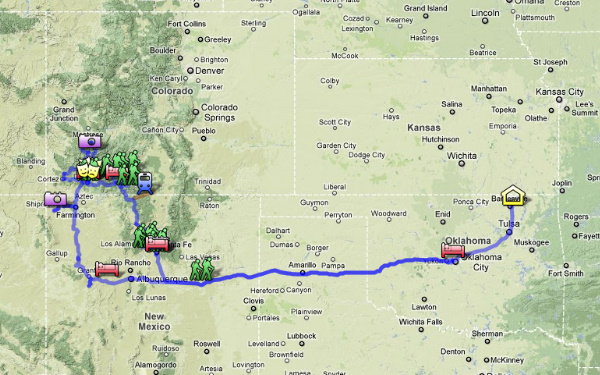
Here’s the roundup from my recent escape from the heat of the Oklahoma summer, fleeing to northwestern New Mexico and southwestern Colorado for July Jinks 2011:











 Meador Manor