James Joyce supposedly said, “Life is too short to read a bad book.” I like to think that is true, since I generally have no patience for stream of consciousness writing, and thus I will never read his Ulysses or Finnegans Wake.
Wendy shared this on Facebook a few years ago:
This is my husband in a nutshell.
Wendy: So whatcha been reading?
Granger: I’ve been reading about the lost pianos of Siberia.
Wendy: Hehehe no really.
Granger: That’s really what I’ve been reading about.
He proceeds to tell me about the book...
Wendy: Why would you ever read a book like that?
Granger: I just felt sorry for the book, like maybe nobody would ever read it.
However, when I stumble into a work that I find repulsive, I do stop reading it, adding it to my Abandoned/DNF list on Goodreads to ensure I don’t accidentally try reading it again later.
I’ve abandoned seven books in the last couple of years, almost 1 out of every 10 that I started. The latest rejection was for A House for Mr. Biswas, one of the entries on Modern Library’s list of the 100 Best Novels of the 20th Century.
A House for Mr. Biswas became the fifth book on the Modern Library’s list that I rejected
I did give it the ole college try, however. My Kindle reported I read 20% of it, which would be over 41,600 words. Heck, my favorite novel, The Great Gatsby, is only about 47,000 words.
The 1961 novel by V.S. Naipaul offered a glimpse of the harsh life for poor Hindus in the first part of the 20th century on the island of Trinidad in the Caribbean Sea off the coast of Venezuela. I didn’t sympathize with any of the characters, particularly the protagonist, who grows up to become petulant, rude, and abrasive. I enjoyed the start about his childhood, and I recognize why some find the book an amusing satire, but for me it grew tiresome and irritating once he became an adult.
In his positive review of the book, Peter Berard wrote, “The thing with living under various kinds of oppression, Naipaul reminds us, is that it doesn’t make us into saints or superheroes. It more often makes you and those around you a mess.”
The more I read of the book, the more oppressed I felt, so I reluctantly abandoned it. Wanting to cleanse my palate, I decided to pick up a book of John O’Hara’s short stories that I had purchased in May via AbeBooks: The Hat on the Bed.
I had ordered it after reading his novel Hope of Heaven and before I read Appointment in Samarra, which is on the Modern Library list of great novels. I’m told O’Hara was a master of the short story, but I was leery given that his style appears to be that of a keen observer who describes, but does not explain, and offers little in the way of symbolism.
The first story in the collection, “Agatha”, served as confirmation. It was a sharply delineated portrait of a silly society woman, but it had virtually no plot or punch, earning the book a rejection.
Deflated, I decided to go with something short and bound to entertain. I like a plot, but I’m not interested in ones that are overly complicated. Locked-room mysteries like Rim of the Pit by Hake Talbot or intricate whodunits like John Dickson Carr’s Hag’s Nook are a bit much. I prefer something with a bit less plot and seek out splendid dialogue, such as almost anything by Agatha Christie or the characters that populate the Thursday Murder Club series by Richard Osman.
Recently I was reminded of my need for plot when I tried and failed to read To the Lighthouse by Virginia Woolf. Who’s afraid of Virginia Woolf? Me!
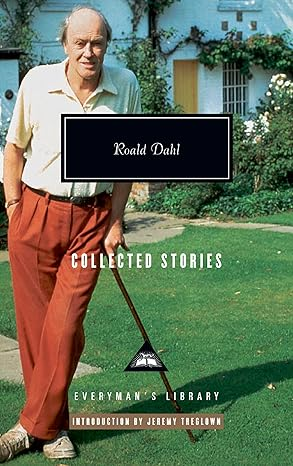
If you’re only familiar with Dahl via something like Charlie and the Chocolate Factory, the adult tales share his taste for meting out consequences. The children’s book addresses gluttony, greed, pride, and sloth, while the adult tales take on deception, cruelty, infidelity, and yes, greed, often via table-turnings and twists of fate.
The 21st story was just what I needed, and I plan to read a few more before embarking on another novel. Dahl has a sense of humor, but it is more wicked than satirical. In 2023, I tried to read Patrick Dennis’s Auntie Mame: An Irreverent Escapade, but it was not to my liking. I’m reminded of my reading, and actually finishing, A Confederacy of Dunces by John Kennedy Toole back in 2020, which also really wasn’t my cup of tea. If you want to make me chortle, give me books like A Walk in the Woods or In a Sunburned Country by Bill Bryson or have me listen to David Sedaris’s Santaland Diaries.
Meanwhile, when the weather cooperates enough for me to walk on the Pathfinder Parkway, I’ve been listening to The Friedkin Connection: A Memoirby William Friedkin, who directed The French Connection, The Exorcist, The Boys in the Band, and other gritty films.
I’d listened to some interviews with Friedkin and his commentary on Citizen Kane, so I knew I wanted to listen to him reading his memoir. It has been excellent thus far, providing a fascinating glimpse of his tough childhood and how he stumbled his way into live television and documentaries.
Friedkin’s formal education ended after high school, but thankfully in the WGN mailroom he was discovered by Francis Coughlin, a radio and television writer, producer, and panelist. Friedkin recalled, “On my bookshelves I still see the books he gave me fifty years ago, all of which I read and we discussed: the bound works of Dickens, Ruskin, The Autobiography of Lincoln Steffens, Sandburg’s Lincoln, Churchill’s History of the English Speaking Peoples and History of the Second World War, the collected essays of Rebecca West, the writings of H. L. Mencken, and Shirer’s Rise and Fall of the Third Reich.”
Fran helped Friedkin invest in improving himself, and I encourage you to do the same. Find something you like, and don’t be afraid to abandon something that doesn’t suit.
You may have tangible wealth untold; caskets of jewels and coffers of gold. Richer than I you can never be. I had a mother who read to me.
I am intrigued by societal shifts. Economics is usually one of the largest drivers of change, and the internet and then smartphones and social media and the COVID-19 pandemic have also had significant impacts. Data shows increasing contrasts between my own Generation X (those born from 1965 to 1980), Millennials (1981-1996), and Generation Z (1997-2012).
Alcohol
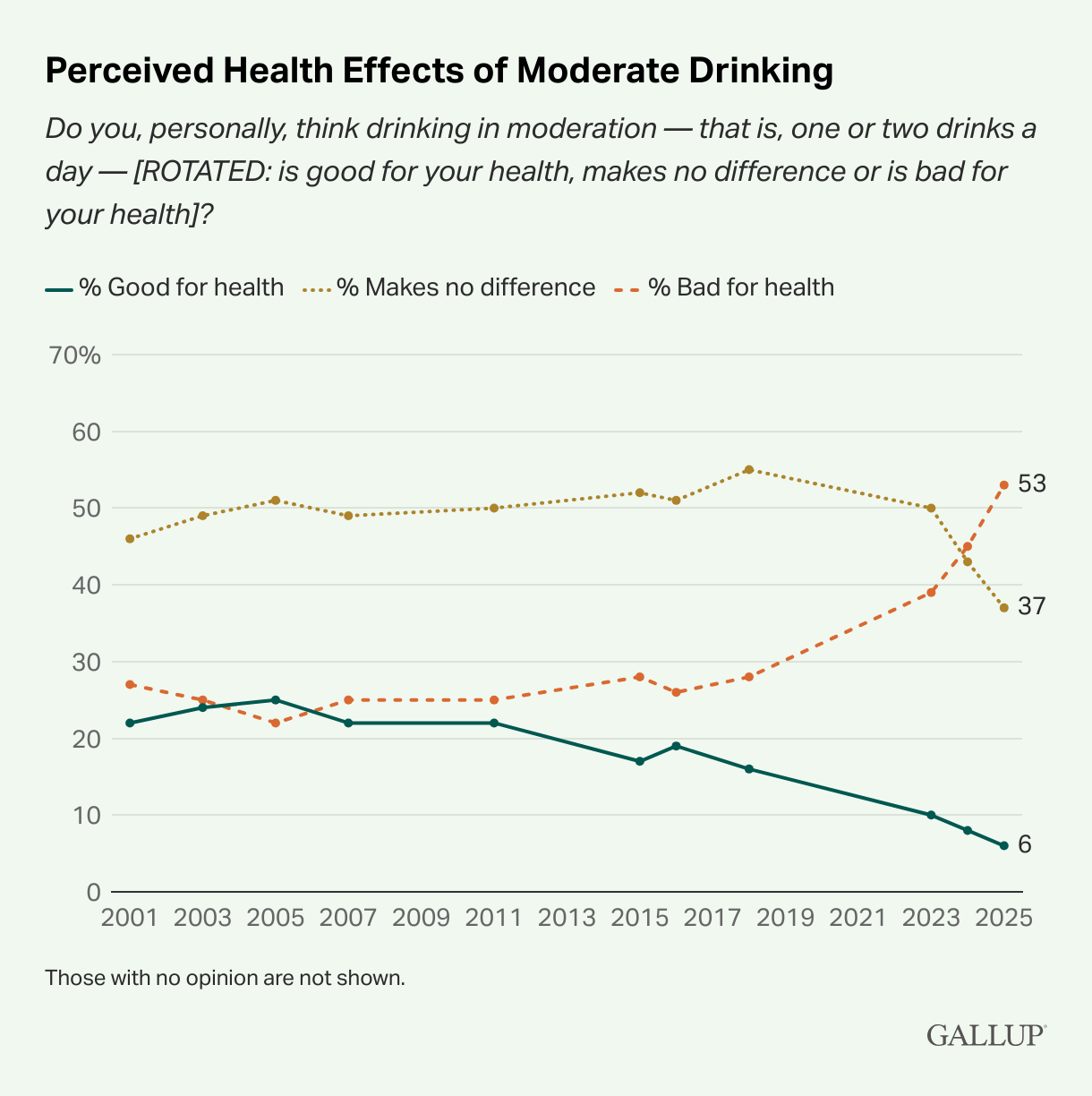
Gallup has tracked Americans’ drinking behavior since 1939, and this week it released results from its annual Consumption Habits survey. The percentage of U.S. adults who say they consume alcohol is now the lowest they’ve recorded, at 54%.
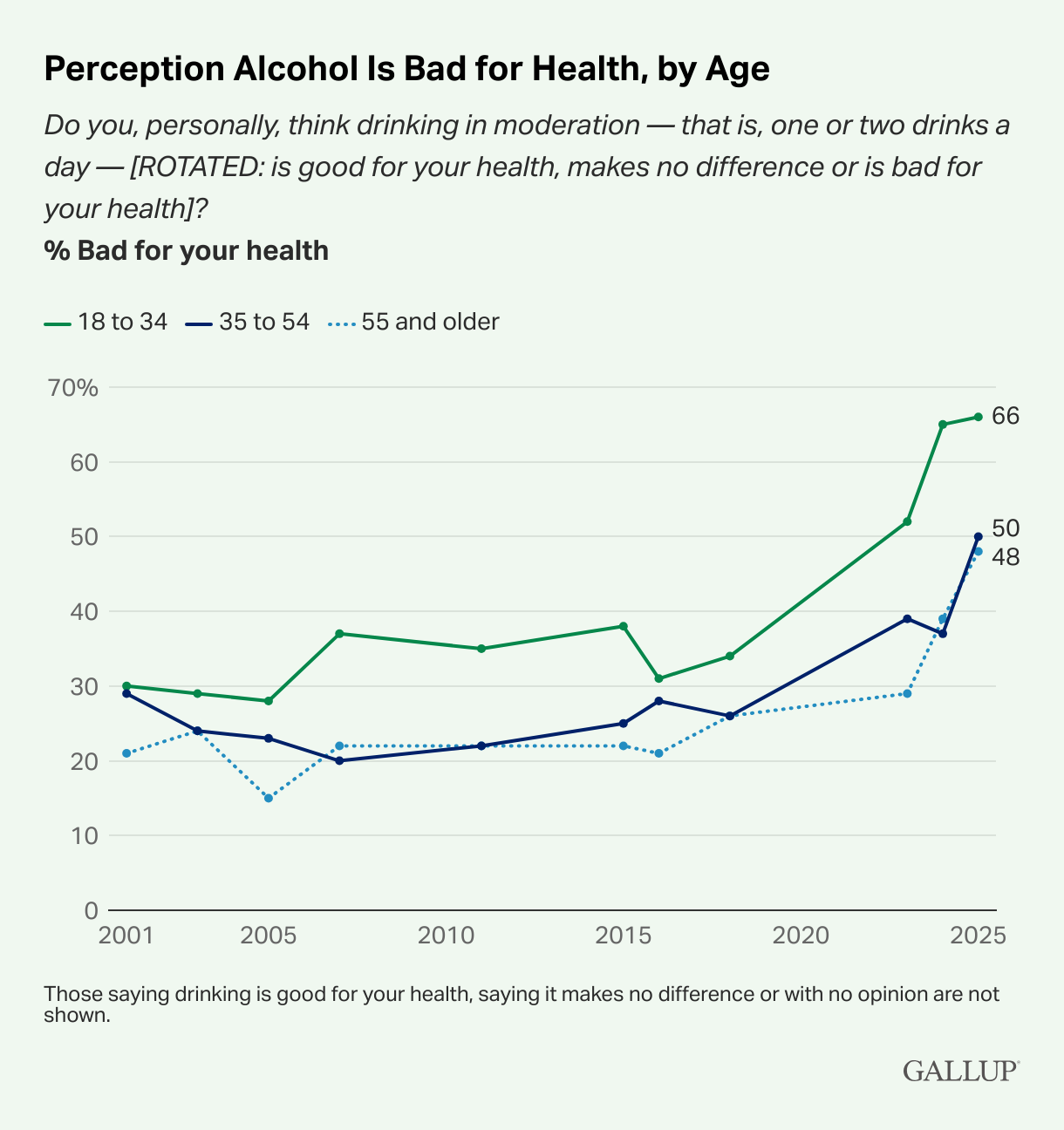
The shift in perception has occurred across all age ranges, but I find it startling that 2/3 of young adults now think drinking in moderation is bad for your health.
Gallup’s full report shows that the percentage of self-reported teetotalers from 1939 to 2025 has ranged from a low of 29% in the late 1970s to a high of 45% in in 1958, nearly matched at 44% in 1989 and 2025. Such self-reporting is a mix of actual behavior and social perceptions.
Marijuana
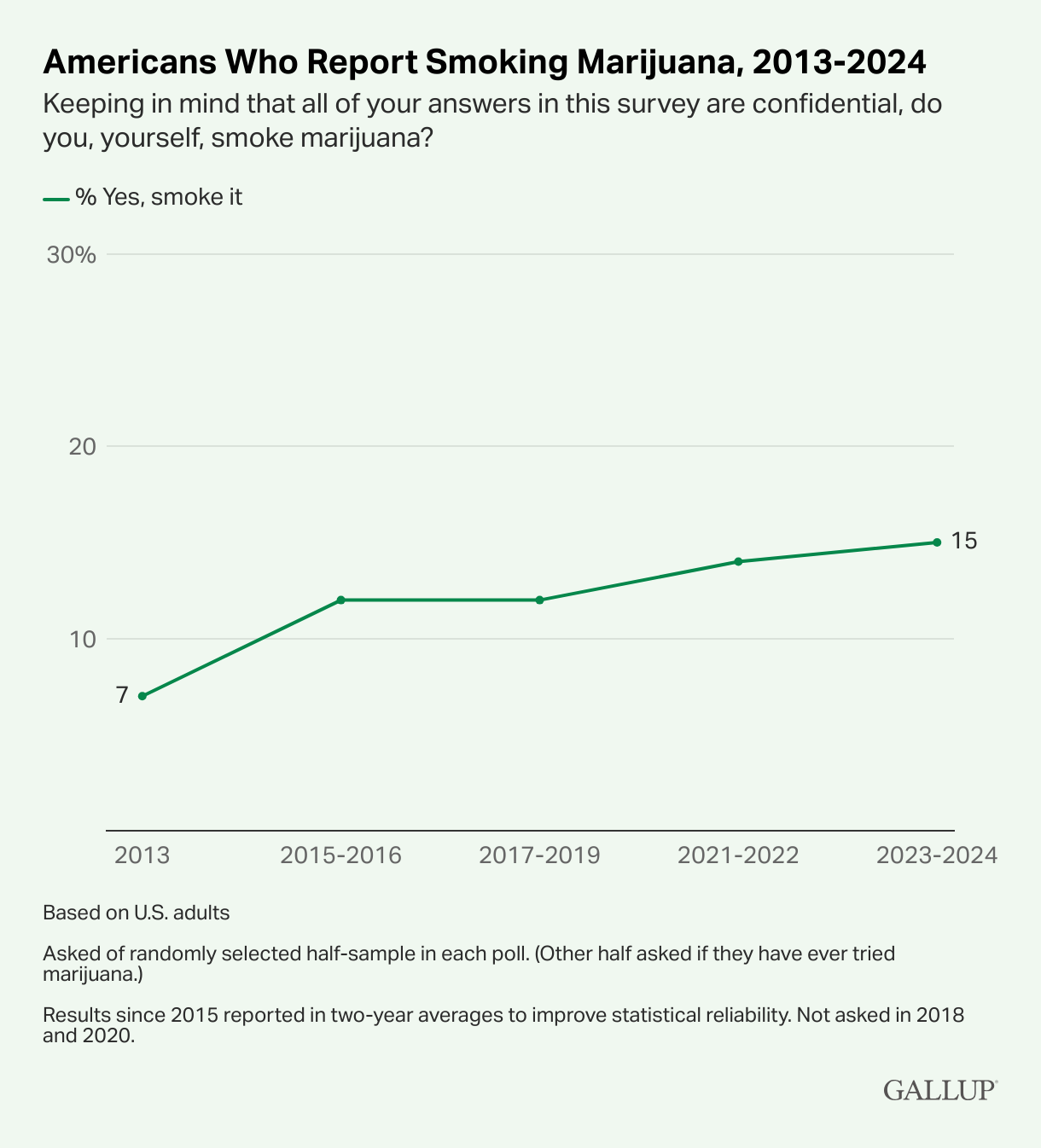
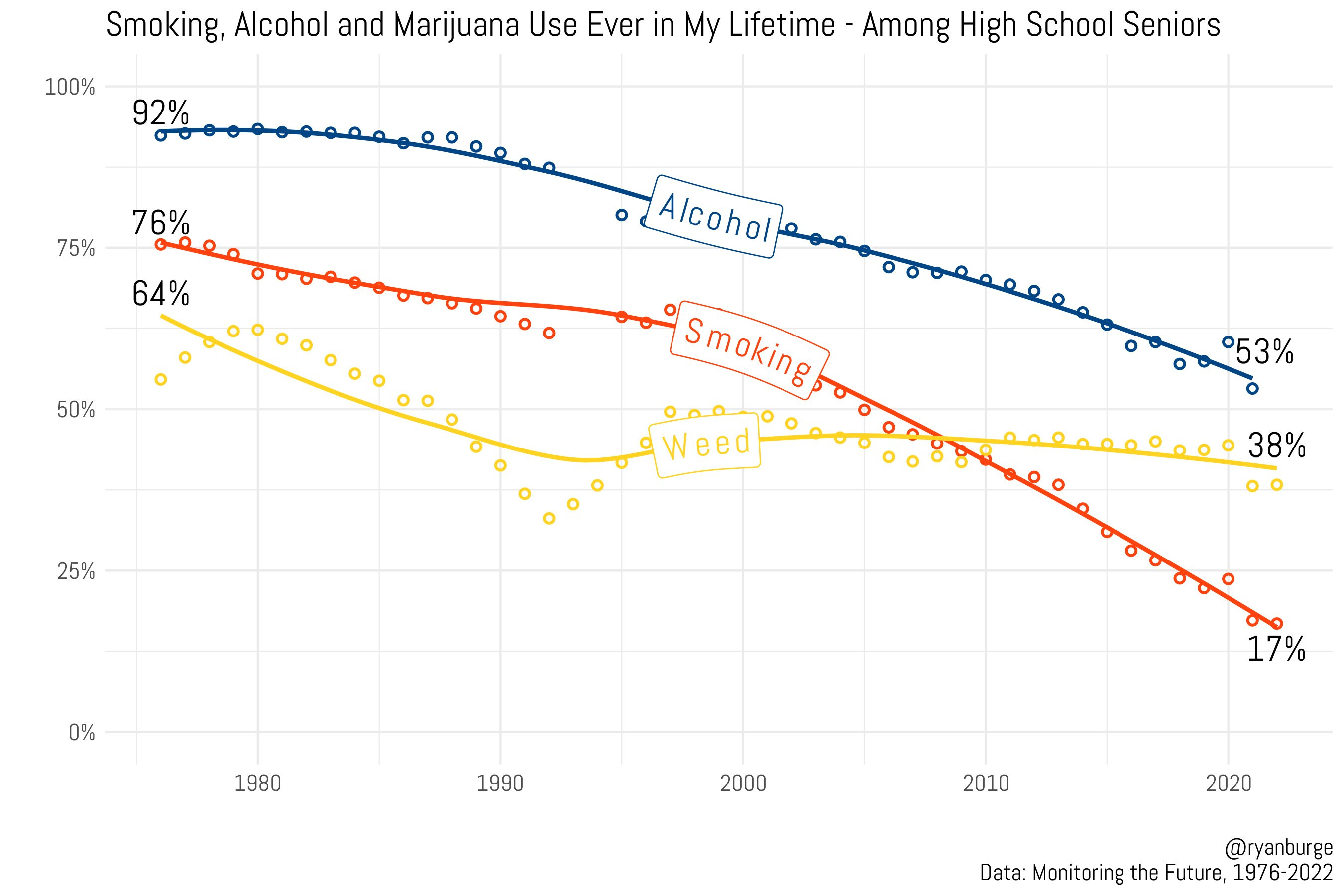
We have cannabis shops all over town, so I’ve wondered how the increasing legalization of marijuana might be impacting alcohol consumption. Nationwide, the percentage of adults who reported trying marijuana has jumped from about 1/3 to almost 1/2:
Those declines have been accompanied by shifts in mobility and socialization.
Driving
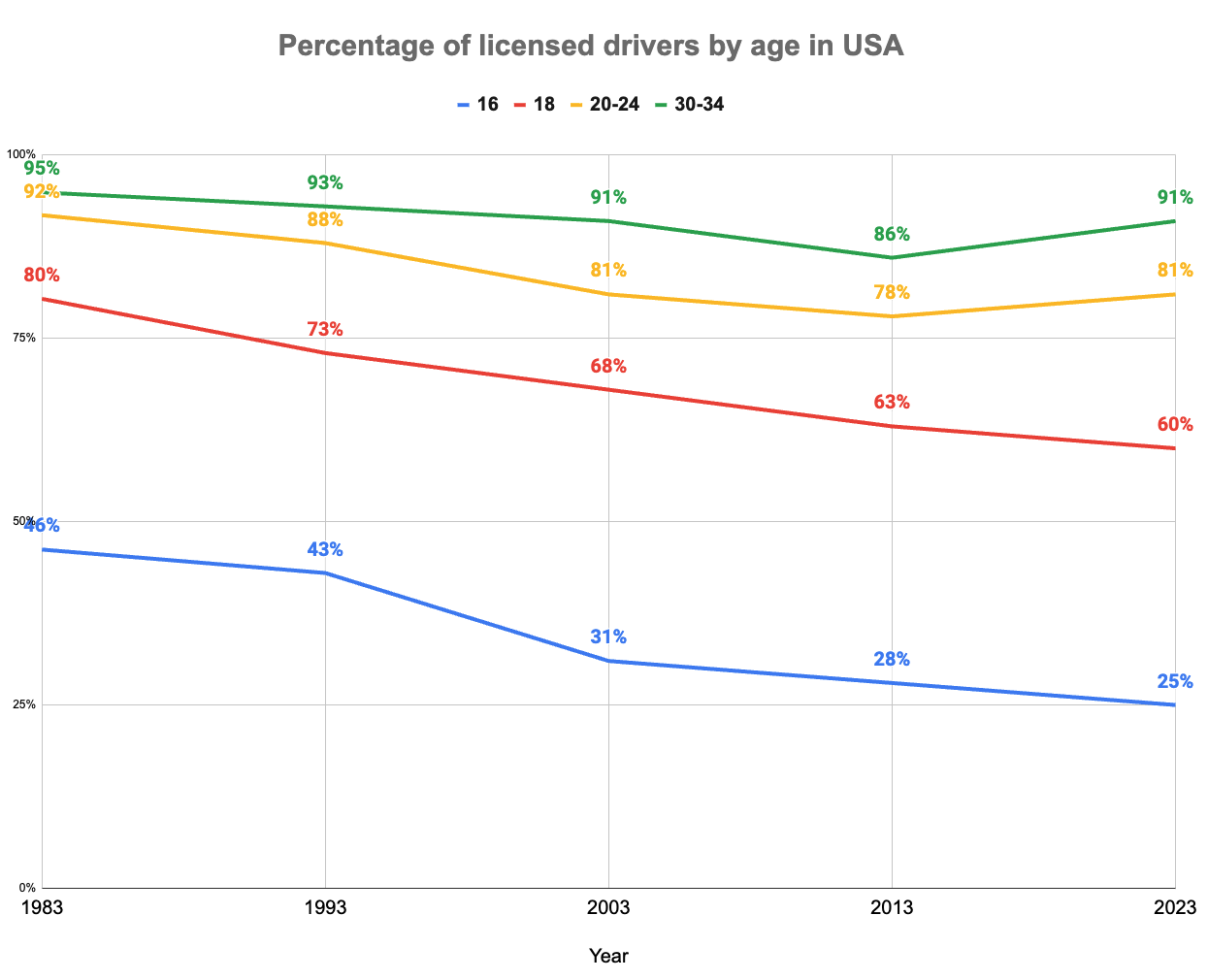
I’ve always lived in places where driving was nearly a necessity, and in the early 1980s my peers and I were eager to take Driver’s Education and get our licenses. I had acquaintances who were into fixing up old muscle cars to go cruising on Route 66 in Oklahoma City, and in high school I drove a Toyota Corolla, shifting to a Chevrolet Monte Carlo and then a Toyota Celica Supra during college, amidst oodles of fellow students driving the Datsun 280ZX, Chevrolet Camaro, and the like. My, how things have changed:
Now only 1/4 of 16-year-olds have a driver’s license, versus almost 1/2 in my youth, and licensing similarly dropped from 4/5 of 18-year-olds in 1983 to 3/5 of them in 2023. The decline is attributed to rising expense, increased availability of ride-sharing services, and teens connecting more with friends online than in-person at shopping malls, cinemas, and the like.
Socialization
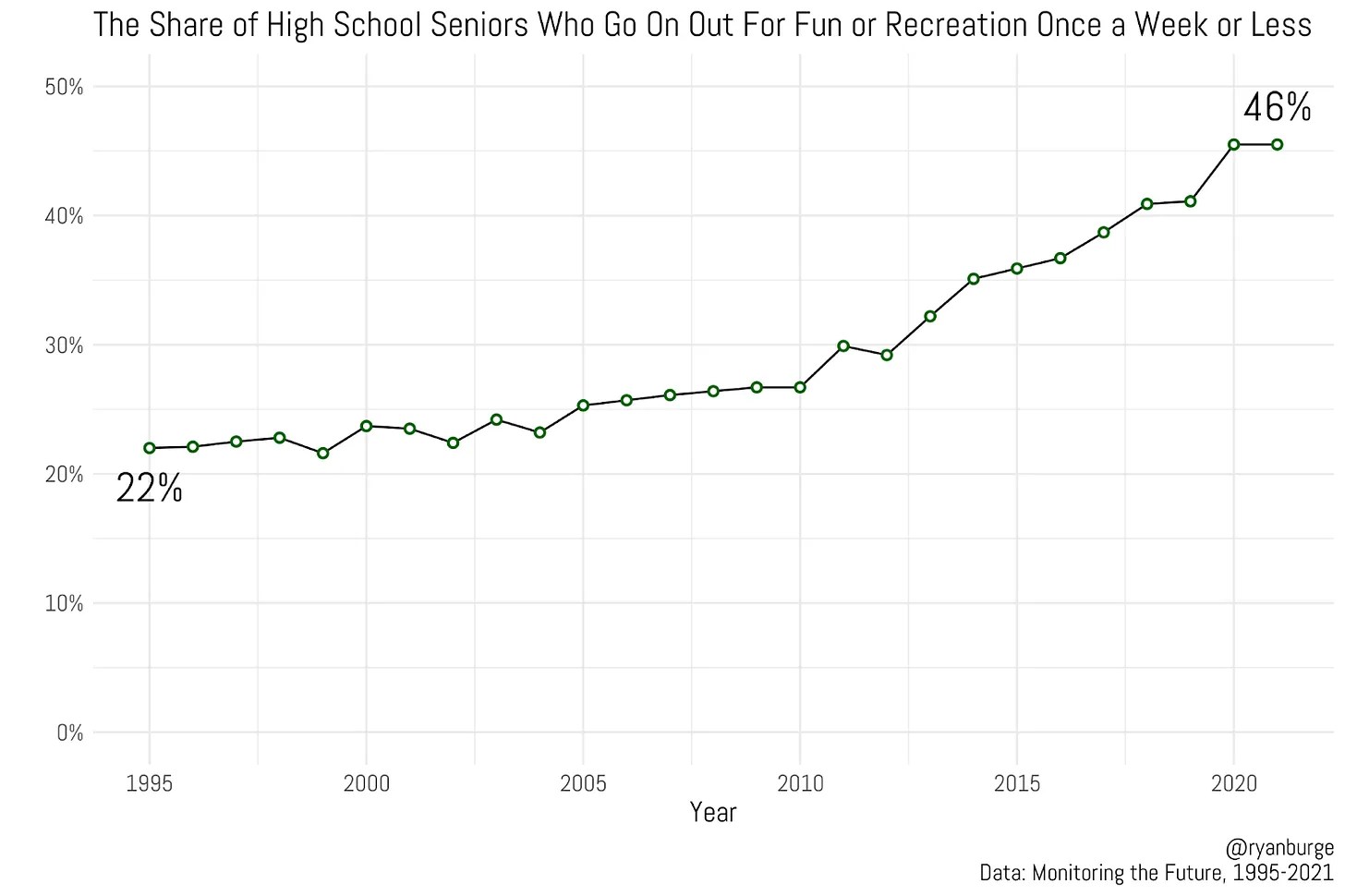
These trends are accompanied by significant changes in socialization among youngsters. Over the past 30 years, the share of high school seniors who only go on a date once a month or less has more than doubled to 71%:
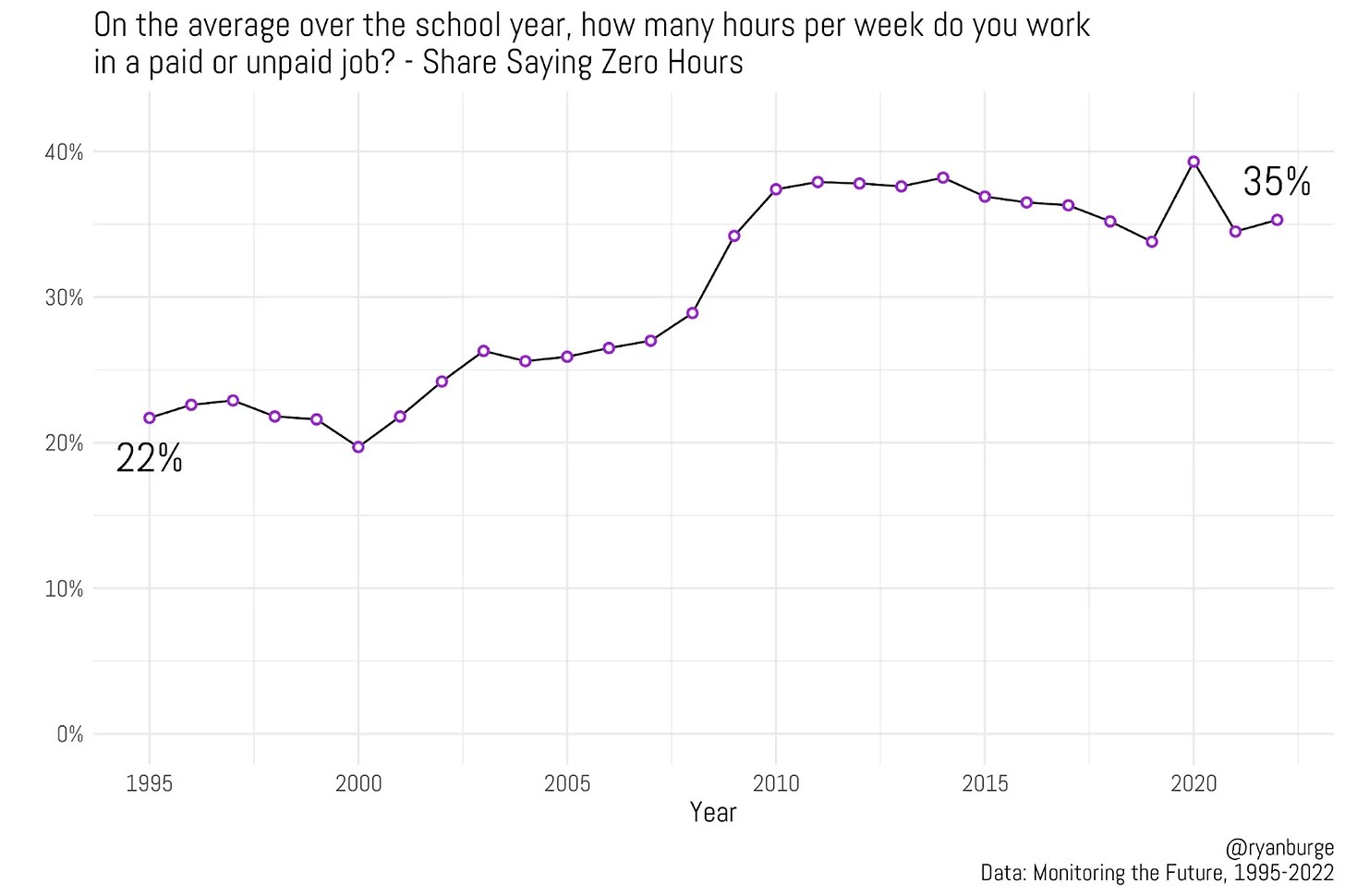
When I was a high school senior, 87% of my peers were employed, but that eroded to 78% over the following decade and is now about 2/3, with the Great Recession of 2008 being a major inflection point reducing the number of working high school seniors.
Combining those factors, almost 1 in 6 high school seniors rarely date, socialize, or work:
Thinking back over 40 years to when I was a high school senior, I was going on a date at least once every week and going out for fun and recreation a couple of times per week, but I did not go to work until after my freshman year of college.
Religion
Religious services and programs are another way to socialize. Religious attendance among high school seniors has decreased dramatically. When I was in high school, about 1 in 3 attended weekly with only 1 in 7 never attending, but now only 1 in 6 attend weekly and over 1/3 never attend.
Below is a chart documenting the erosion in religious behavior, identity, and belief among American adults. It shows the percentages who never attend religious services, who profess to no religion, and those who either profess they don’t believe in God or don’t know if there is a God while not believing there is any way to find out.
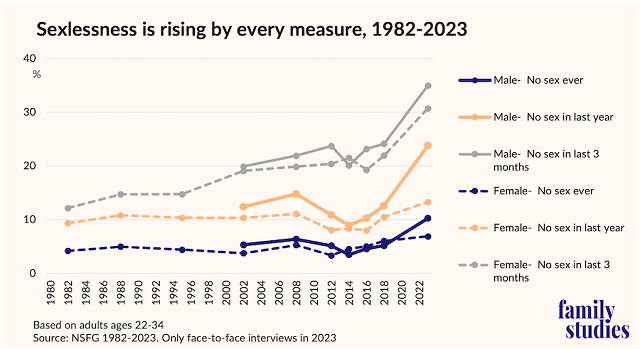
Let’s see…less alcohol, driving, socialization, and religion, and more marijuana. Care to guess the changes in sexual behavior? Here’s the percentage of sexlessness among young adults over the years:
By 2022-2023, about 1 in 10 adult males ages 22-34 and about 1 in 14 young adult females were virgins, and about 1/3 of the young adult males and almost as many of the females had not had sex in the previous three months.
Here’s a look at the percentages of high school students who have had sexual intercourse over time:
The CDC reports that overall 54% of US high school students had had sex in 1991, but that had declined to 30% by 2021. In Oklahoma, the decline was from 50% in 2003 to 33% in 2021.
Over the past 30 years, the percentages of people having sex at least once per month have declined across all ages:
There are many contributing factors to that, including ready access to online pornography. One site estimated that about 2/3 of men and 2/5 of women view it each year, with 57% of young adults using it at least monthly.
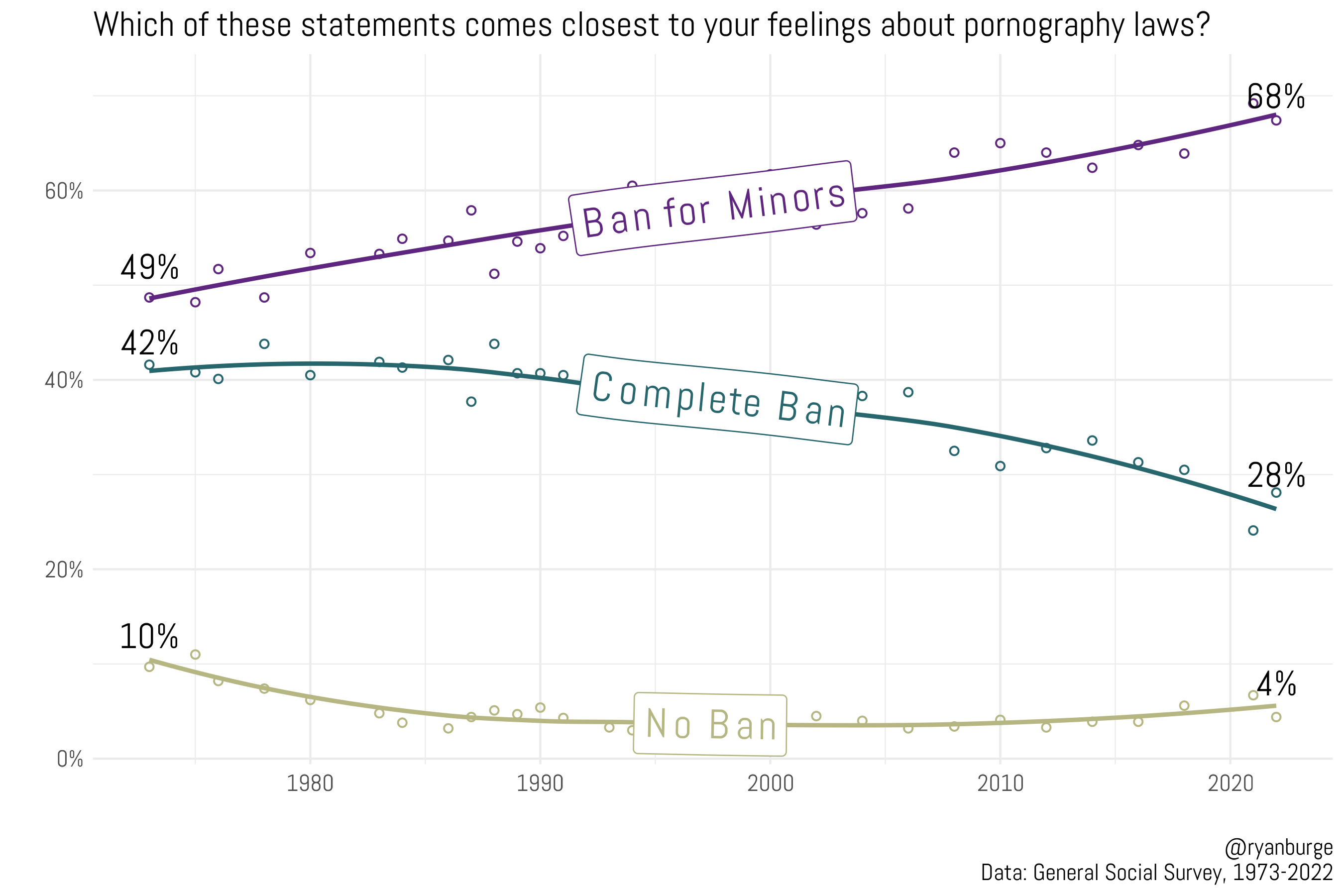
Support for banning pornography access to minors rose from about 50% when I was a kid to almost 68% in 2022, while support for complete bans on porn fell from about 40% to 28%.
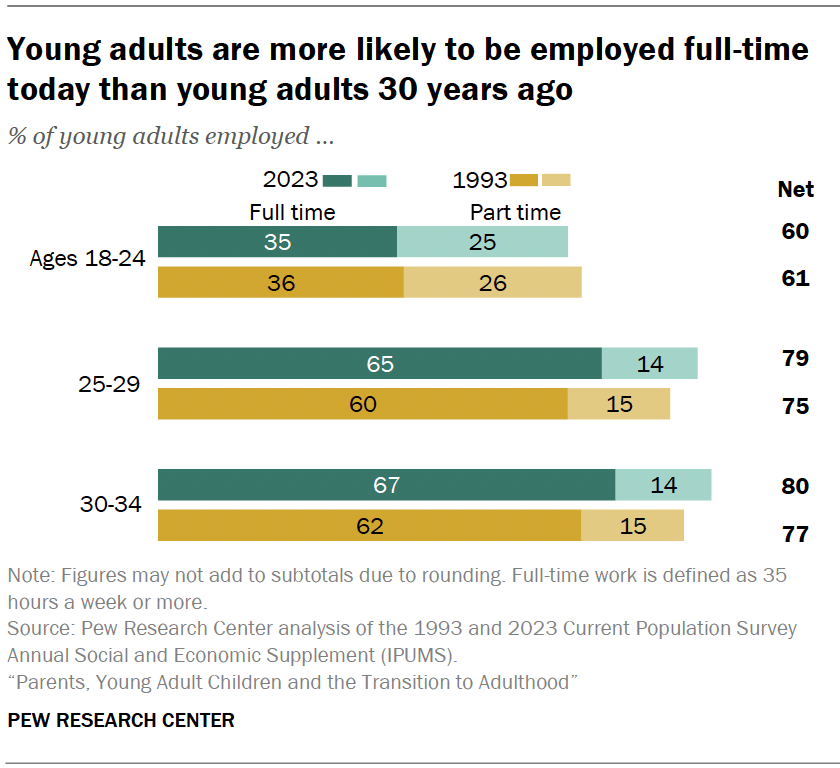
Today’s young adults are less likely to be married or have kids, especially those in their late 20s, and there have been less dramatic increases in the share of young adults living in a parent’s home:
Living with one’s parents understandably usually helps with finances and parental relationships, but can hamper one’s sense of independence and social life:
All of this highlights for me how many young people live differently than my peers and I did back in the day. Having no children or grandchildren of my own, with my interactions with youngsters dramatically curtailed when I left high school teaching nine years ago, I enjoy these glimpses into changing preferences and lifestyles.
I found on my Kindle a sample I had downloaded long ago of Joan Didion’s first essay collection, Slouching Toward Bethlehem. The first essay in the collection, Some Dreamers of the Golden Dream, was fantastic. Here’s the opening paragraph:
THIS IS A STORY about love and death in the golden land, and begins with the country. The San Bernardino Valley lies only an hour east of Los Angeles by the San Bernardino Freeway but is in certain ways an alien place: not the coastal California of the subtropical twilights and the soft westerlies off the Pacific but a harsher California, haunted by the Mojave just beyond the mountains, devastated by the hot dry Santa Ana wind that comes down through the passes at 100 miles an hour and whines through the eucalyptus windbreaks and works on the nerves. October is the bad month for the wind, the month when breathing is difficult and the hills blaze up spontaneously. There has been no rain since April. Every voice seems a scream. It is the season of suicide and divorce and prickly dread, wherever the wind blows.
Joan Didion
I also loved this part of the next paragraph:
This is the California where it is easy to Dial-A-Devotion, but hard to buy a book. This is the country in which a belief in the literal interpretation of Genesis has slipped imperceptibly into a belief in the literal interpretation of Double Indemnity, the country of the teased hair and the Capris and the girls for whom all life’s promise comes down to a waltz-length white wedding dress and the birth of a Kimberly or a Sherry or a Debbi and a Tijuana divorce and a return to hairdressers’ school.
It wasn’t long before I was purchasing the entire book. The title is from William Butler Yeats’ 1919 poem The Second Coming, which you might recognize:
Turning and turning in the widening gyre The falcon cannot hear the falconer; Things fall apart; the centre cannot hold; Mere anarchy is loosed upon the world, The blood-dimmed tide is loosed, and everywhere The ceremony of innocence is drowned; The best lack all conviction, while the worst Are full of passionate intensity.
Surely some revelation is at hand; Surely the Second Coming is at hand. The Second Coming! Hardly are those words out When a vast image out of Spiritus Mundi Troubles my sight: somewhere in sands of the desert A shape with lion body and the head of a man, A gaze blank and pitiless as the sun, Is moving its slow thighs, while all about it Reel shadows of the indignant desert birds. The darkness drops again; but now I know That twenty centuries of stony sleep Were vexed to nightmare by a rocking cradle, And what rough beast, its hour come round at last, Slouches towards Bethlehem to be born?
I was pleased to “get it” when Didion made a reference to “Julian English” in one of the essays in her book, as he was the protagonist of Appointment in Samarra, which I had been listening to on my Audible app. What a happy coincidence…although my use of that expression is questionable given Julian’s inevitable fate. Her reference to O’Hara’s novel isn’t that much of a surprise, given that he was as resistant to explicit meaning as she was in his fictional, and her creatively factual, slices of life.
From The Lively Art of Writing
Didion, like Tom Wolfe, was part of the New Journalism movement. Her writing was egocentric, sharply detailed, and stringent. Like O’Hara in his early novels, she avoided being too explicit in what meanings or conclusions the reader might draw from her work. However, that elliptical approach included abrupt endings to most of her essays in Slouching Toward Bethlehem. Their lack of conclusions thus violates the structural principles of The Lively Art of Writing which I learned in high school.
New Journalism, which usually found a home in magazines instead of newspapers, is said to have died by the early 1980s. Of course, these days all forms of journalism are struggling economically. Newspapers, magazines, and television news programs have been dying out for years. Some have survived in digital form.
The implosion of television and radio news audiences is one of several reasons why the Republicans finally succeeded in their decades-long quest to defund the Corporation for Public Broadcasting, which helped support public television and radio stations.
I haven’t watched any television, including public television, in many years. However, I have long listened to NPR news when commuting to and from work, and listening to its three-minute hourly news segment is a bedtime ritual. I’ve donated to KWGS, the National Public Radio affiliate in Tulsa, for years, and my response to the GOP’s gutting of its federal funding was to double my monthly donation to $25 per month.
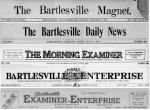
Currently I’m spending almost $150 per month for news. Here are my subscriptions and donations, ranked by monthly cost:
After I retire, I’ll re-assess my various subscriptions. I could cancel the E-E and still access it with my subscription with The Oklahoman since they are both now owned by Gannett, I could cancel the New York Times and still access it via Apple News, and I figure the Tulsa World would offer me a better deal if I called their circulation department and threatened to cancel, a gambit I’ve used for years to keep the New York Times down to $1/week. However, I like investing in journalism, and even now I’m spending less than $5/day for news, and to me that’s quite a bargain.
Another post-retirement project might be to read more of Didion. I’d like to have more of my own writing display the scalpel-like precision of her slices while invoking a distinct mood and atmosphere. Her journalism is far from New anymore, but it, like the many news sources I continue to invest in, has value.
Planned obsolescence dates back a century to when lightbulb manufacturers in much of North America and Europe formed the Phoebus Cartel in Geneva to deliberately reduce the lifespan of their lightbulbs from 2500 hours to 1000 hours while increasing prices. That rigged market lasted until 1940, when World War II made coordination among the members impossible.
In 1924, General Motors executive Alfred P. Sloan Jr. suggested annual model-year design changes to goose car owners into buying replacements, a concept he borrowed from the bicycle industry. The concept spread throughout the consumer economy, sometimes using fashion and trends to drive replacements, but other times via contrived durability, from light bulb filaments that broke faster to small brittle plastic gears that reduced the lifespan of toys.
Some of my clothes are anything but fast fashion
We continue to see this in smartphones which are designed to make battery replacement difficult, have cheap internal screen cables, and inhibit or prevent repairs. There is also “fast fashion” clothing and footwear that is inexpensive, seasonal, trendy, and frequently thrown out as trends change.
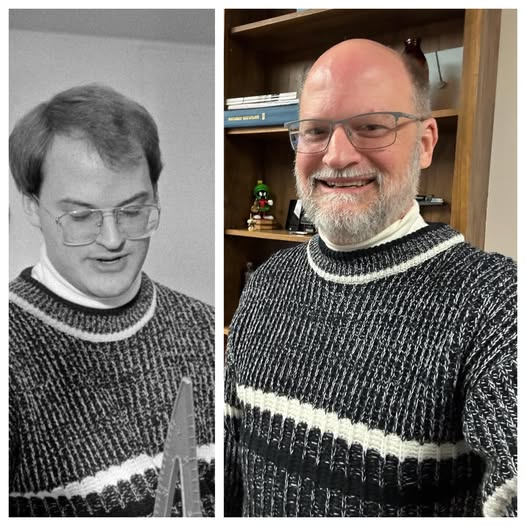
I have no experience with fast fashion. This winter, when the heat wasn’t working properly at work, I was wearing turtlenecks and sweaters I purchased over 35 years earlier. However, I have decades of experience with its cousin, turbo tech.
Planned obsolescence in technology
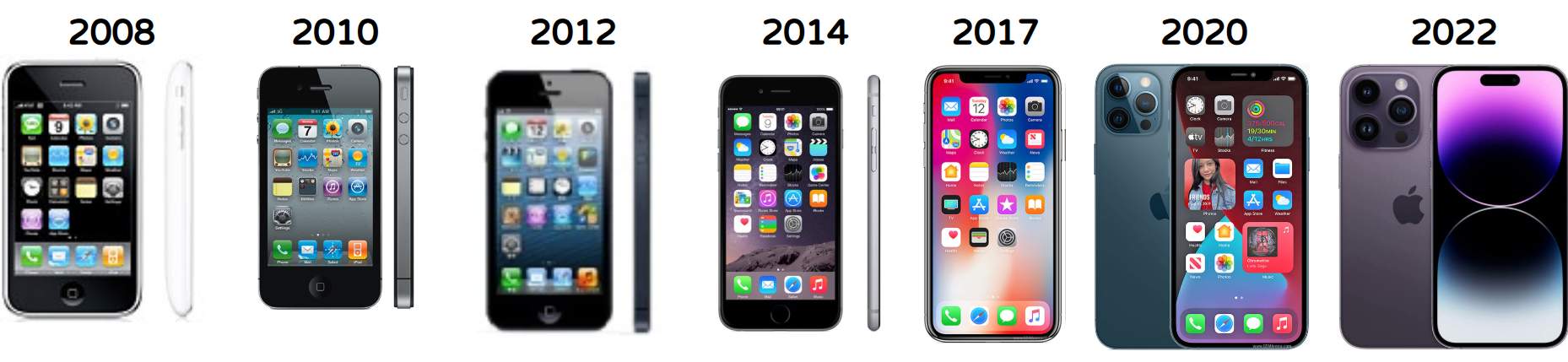
I replace my iPhone every two or three years. Given the wear and tear of daily use, plus hardware improvements, I’m still comfortable purchasing a new iPhone when its battery capacity is noticeably diminished. I’ve had my current iPhone 14 Pro for over 1,000 days and its battery’s capacity has declined to 81%, so Apple will be expecting me to upgrade it in September 2025 after three years of use…and I probably will.
I purchase a new iPhone every 2 or 3 years
Desktop and laptop computers also have limited lifespans. In the early days, that was because hardware was advancing so rapidly, but now it is primarily an issue of deliberate software-driven obsolescence. Microsoft released Windows 10 in 2015 and will be retiring it in October 2025. My 2017 Dell XPS 8910 desktop computer still has plenty of oomph to run Windows 11, but Microsoft opted not to support it and millions of other older machines. They claim that is because they want particular hardware security features, but their primary motivation is to goose the market.
I responded by opting to abandon my use of Windows at home, and I’ll seldom use it at all after I retire in June 2026, forty years after first using Windows 1.03 in 1986. I replaced my home Windows desktop computer with a Mac, although I expect my wife will purchase a new Windows desktop computer for herself.
For years I have been shifting away from Microsoft services to rely on Google and Apple
My mother’s Windows 10 computer will also be unsafe to use after October 2025, and I thought about just installing ChromeOS Flex on it. However, I figure its power supply is getting long in the tooth, so I just bought an inexpensive Chromebox for her to use with her existing monitor, keyboard, and printer.
That shift will not spare us from eventual planned obsolescence. The new Chromebox will no longer receive updates in seven years, and Apple usually ends support for a given model of Mac 7-10 years after its release date.
Early smart home devices are aging out
However, I’m not used to what I view as household appliances losing features or becoming unusable because a vendor stopped supporting them. The smart home with its internet-of-things has expanded my exposure to planned obsolescence. Meador Manor now has a smart thermostat, doorbell with camera, a patio camera, multiple home hubs and mini speakers, a weather station, and various smart plugs that all need internet-based services to be fully functional. What is the lifespan of such devices? The answer is often somewhere between five years after a model is introduced and ten years after that model is no longer being sold.
First and second-generation Nest thermostats will become obsolete in October 2025
I bought an ecobee thermostat in 2018, and they showed their obsolescence plan in 2024 when they ended support for their original model, which they had stopped selling back in 2013.
A related example is Nest Learning Thermostats, which were all the rage back in 2011. Google acquired the firm in 2014 and started selling the 3rd generation models in 2015. In October 2025, which is coincidentally when Windows 10 support ends, Google will end support for the first and second generations of Nest Learning Thermostats. The various obsolete smart thermostats will still have basic controls, but they will no longer be remotely accessible via apps or the web.
Google already abandoned Nest’s early Dropcam cameras in 2024, and those devices were last sold in 2015. They are useless without the online service, as they can no longer connect to the app, stream, or record video. That means some cameras were not even useful for a decade, and there is little recourse, since Google Nest devices are only guaranteed to receive automatic security updates for 5 years from the date a model becomes available.
I decided to inventory our major smart home devices and when they might lose support:
Smart Device
Year Bought
First Year Sold
Last Year Sold
Possible End of Life
Google Home Minis
2017-2019
2017
2021
Anytime from 2022 to 2031
Google Home Hubs
2018-2019
2018
2021
Anytime from 2023 to 2031
ecobee3 Lite Smart Thermostat
2018
2016
2025
Maybe 2035
Google Nest Protect Smoke & CO Alarm, 2nd Gen.
2020
2013
2025
Definitely 2030 when CO sensor expires
Google Nest Cam Indoor/Outdoor
2022
2021
still for sale
Anytime from 2026 to 2035+
Google Nest Doorbell, 2nd Gen.
2023
2022
still for sale
Anytime from 2027 to 2035+
I don’t look forward to replacing, reprogramming, and in two cases rewiring those devices as they age out. However, Wendy and I use most of our smart home devices on a daily basis, and we certainly miss them when our internet service goes down.
I started out with Amazon Echo devices in 2016, eventually owning six of them, before abandoning them in favor of Google’s offerings. A primary reason for that switch was how often Alexa misunderstood a request or couldn’t offer a good answer. Google Home is far from perfect, but it did a better job for us. As for Apple’s Siri, well, bless her heart.
Our Wemo Mini Smart Plugs only lasted 6-7 years
We also use various smart plugs: I purchased four from Kasa and one from Gosund in 2020, and a couple of Wemo Mini Smart Plugs date back to 2019. They are linked into our Google Home app along with everything else. I could also link them into the Apple Home apps on our iOS devices, but since most of our devices are from Google, it is easier to use the Google Home app.
Something that caught me by surprise was having “smart” plugs become obsolete. Those are quite simple devices which need minimal support, but this month Belkin notified me that it would no longer support my Wemo smart plugs after January 2026, so those ended up only being usable for about 6.5 to 7 years.
Belkin is exiting the smart home market and Google is no longer making Nest Protect smoke and carbon monoxide detectors, pushing customers to First Alert’s hardware. That is a sign of how the various vendors have struggled to find long-term profits in smart home devices and services. I hope that Google, Apple, and Amazon stay committed to the market, as competition is important, but Google is notorious for creating services that it then neglects and abandons, Apple is greedy and tends to have a few major hits and multiple misses on its devices and services, and Amazon is a predator that I already rely on too heavily.
Another smart home issue that has arisen is Matter. That’s an open source interoperability standard that was released in 2022 and promises to make setting up smart home devices easier with ready interoperability with Amazon, Apple, and Google voice assistants. Since most of my devices predate 2022, they are probably not fully compatible with that new standard. I noticed that Kasa offers a Matter-compatible smart plug, but it costs over 50% more than the non-Matter version. Why am I not surprised?
Failed Experiments
I burned out on Hue bulbs
There are some Smart Home products that I experimented with but later abandoned. I bought several Philips Hue smart LED bulbs in 2016 and a Hue Bridge in 2017, but I never found their adjustable dimming, color, and brightness useful. Eventually, I just had one of the Hue bulbs on my bedside nightstand. One day the controls stopped working, and I quickly gave up on diagnosing the issue and just yanked the Hue Bridge out of the system and put the bedside lamp on a Kasa Smart Plug. Smart bulbs are not for me.
The dryer vibration sensor was a bust
I actually like how our new LG washer sends a notification to my watch whenever it finishes a cycle. I invested in an Aqara hub and vibration sensor in an attempt to get notified whenever our older LG dryer ended a cycle, but that was a pain to program and didn’t prove reliable. As with the Hue Bridge, I ended up unplugging the Aquara hub. Whenever the dryer finally dies, I will buy one that includes wireless notifications. But all I really want are cycle-end notifications…I don’t need monthly reports, remote control, let alone unsolicited tips. I haven’t seen any compelling reasons to invest in a smart refrigerator.
By the 2030s, I expect planned obsolescence will have claimed most of our original smart home devices. Maybe Matter will make programming their replacements easier, something I may welcome since I’ll be well into my own retirement.
In the autumn of 2020, while our travels were restricted by the COVID-19 pandemic, I decided to read Keith Robertson’s crime novels. He was the author of the Henry Reed series which I enjoyed as a child, and he published six adult murder mysteries from 1961 to 1968. His children’s books were published from 1948 to 1986.
Keith Robertson in the 1950s
In a 1972 interview, he explained that the mysteries, for which he reversed his first and middle names to obtain the pseudonym Carlton Keith, were a “welcome relief” from writing children’s books. He said it took much less time to write an adult mystery than a children’s book, sharing that he entirely dictated his adult books. Recently I read the first three Perry Mason novels by Erle Stanley Gardner, and Gardner dictated his books and employed three secretaries to sustain the high output of what he termed his “fiction factory”.
I was interested that Robertson said that one problem with dictation was that he would use entirely too many words, and he would severely cut the word count in revision. He said that he didn’t struggle with plots, although I found some of his plotting overly complicated in the first two of his adult mysteries.
Not a children’s book
His adult mysteries are out of print and not available for my Kindle, so I purchased his first one as a pulp paperback on eBay. The Diamond-Studded Typerwriter, also published as A Gem of a Murder, had a wonderful pulp cover illustration by Harry Schaare. I have paid more attention to book illustrations since I started watching art director and designer J. Scott Phillips’ wonderful book and story reviews and some of the illustrator retrospectives by Pete Beard.
I enjoyed that first Carlton Keith novel enough to buy the rest of his adult mysteries, which were not available in the Kindle bookstore. So I ordered copies from used bookstores in Illinois, Ohio, New York, Tennessee, and New Zealand via Abebooks.
I read his second mystery in March 2021, and it was mediocre. So I took a long break from the little collection I had acquired. My interest was revived this summer, which has been exceptionally wet and humid. My distaste for sultry weather keeps me indoors, which encourages me to read.
Rather than continue with the Carlton Keith novels in chronological order, I examined the physical format of the four remaining works, deciding I would read whichever was most physically appealing.
So, let’s try judging a book by its cover. Which of these four interests you the most?
My four remaining Carlton Keith mysteries
Surely you did not pick the green one. That is The Crayfish Dinner of 1966, which was also published as The Elusive Epicure. Here is its spine:
Three of the four were hardbacks, with only 1963’s Rich Uncle having an actual book jacket, although I’m sure The Crayfish Dinner once had one…let’s see what the internet shows.
Ugh; I agree with ditching that. I don’t care for the look of crayfish, and I remember dissecting one in high school Biology I. But it is evidently for dinner, and I have had some tasty Crawfish Étouffée in New Orleans.
I like the book jacket design of Rich Uncle, which is superior to the photograph on the cover of A Taste of Sangria. The latter was his last mystery, and it will probably be the last of the books I take up, as my copy is a cheap paperback with awful pulp paper printed in 1968. That eventual reading experience will be worsened by a tear across a dozen pages. I also don’t care for sangria, or any form of alcohol, for that matter.
In making my choice, I deliberately avoided reading any blurbs or summaries, and I also ignored their apparent lengths. Later, I did weigh the tomes. My Rich Uncle hardback weighed 9.3 ounces, the hardback with three novels, one of which was The Hiding Place, weighed over a pound at 19 ounces, The Crayfish Dinner hardback weighed 14 ounces, and the nasty little paperback was only 3 ounces.
I also didn’t crack open any of the books in making my choice, but here’s a look at the start of a chapter in each novel:
Now which one would you try?
Going only by the covers and the feel of each book in my hands, I selected the heaviest, an anthology of three 1965 “detective” novels: Sniper by Hugh Pentecost, The Hiding Place by Carlton Keith, and Alias His Wife by Stephen Ransome. Here’s a close-up:
My paternal grandparents kept several Reader’s Digest condensed books in the headboard bookcase of the guest bed my parents would use. As a child, I was fascinated how they might have six books in one, until I realized that “condensed” meant abridged. Feeling that I would be missing out, I generally avoided reading them, although I did enjoy examining their covers.
When I was in junior high, I checked out a translation of Jules Verne’s Twenty Thousand Leagues Under the Seas, having enjoyed the Disney film. Boy howdy, was I ever bored! Its passages on undersea life seemed interminable. I don’t know if I was reading the first English translation in 1872, by Reverend Lewis Page Mercier, but I suspect not since Mercier cut nearly a quarter of Verne’s French text (while committing hundreds of translating errors), and I couldn’t imagine the text being any longer. The full version is supposedly about 152,000 words, and at the time I would have loved to try a condensed version. I didn’t try reading another Verne novel for decades.
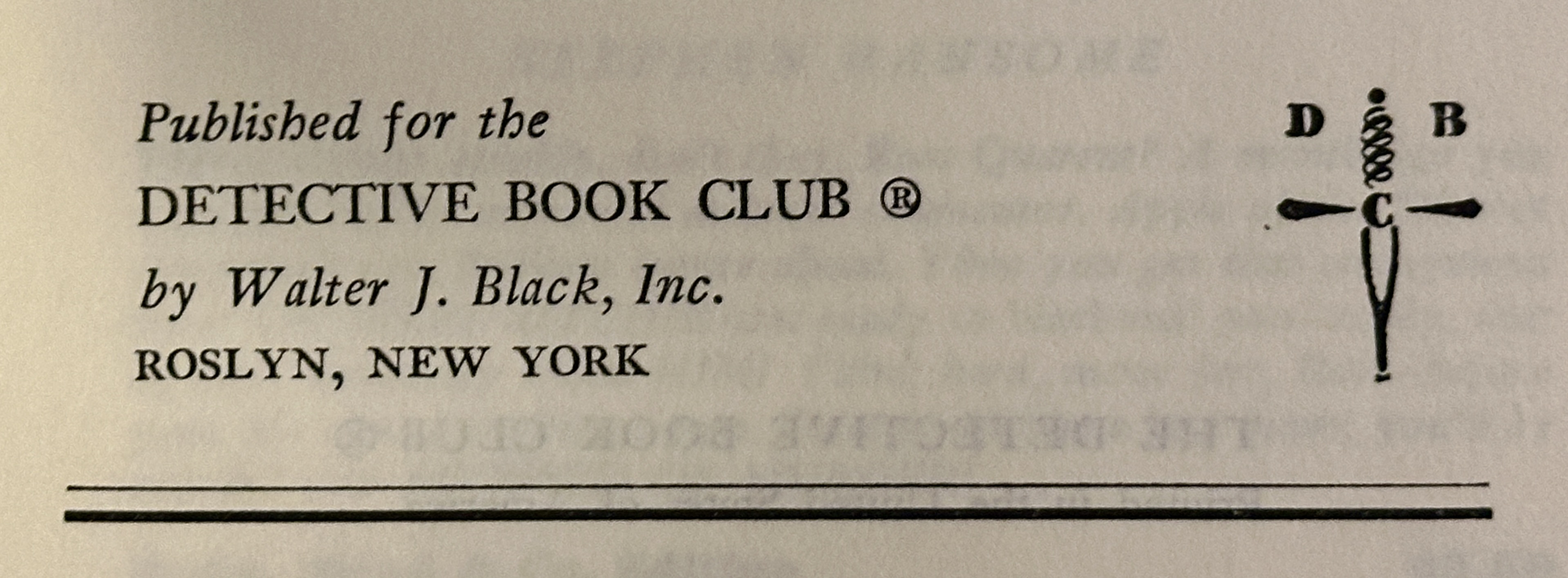
Seeing that The Hiding Place was in some sort of book club anthology, I was concerned that it might be abridged. The Detective Book Club anthologies were issued from 1942 through perhaps 2000. They were initially produced by Walter J. Black, who made a career in reprints, popularizing classics along with anthologies of Westerns and detective stories.
His son, Theodore M. Black, took over the business after Walter’s death in 1958, and he was a smart cookie. He graduated summa cum laude and Phi Beta Kappa from Princeton in 1941 and was that year’s valedictorian. After graduation, he was a captain in the army, serving in Europe in World War II, and he then served in the army reserves for 22 years, retiring as a reserve lieutenant colonel. As an educator, I’m mildly interested that he authored Straight Talk About American Education in 1982, but not enough to read it. Theodore died in 1994, and he was buried with his parents in Westbury, NY.
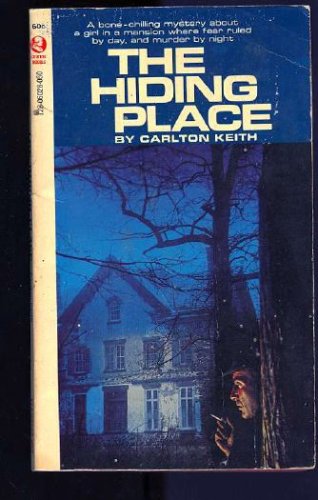
Some of the novels in the Detective Book Club anthologies were abridged, but an online image of a paperback edition of The Hiding Place shows what appears to be a thin tome. (If you search for this book online, you’ll be inundated with results for the Corrie ten Boom autobiography which I read in my youth. I had to use “-Boom” to filter my searches.)
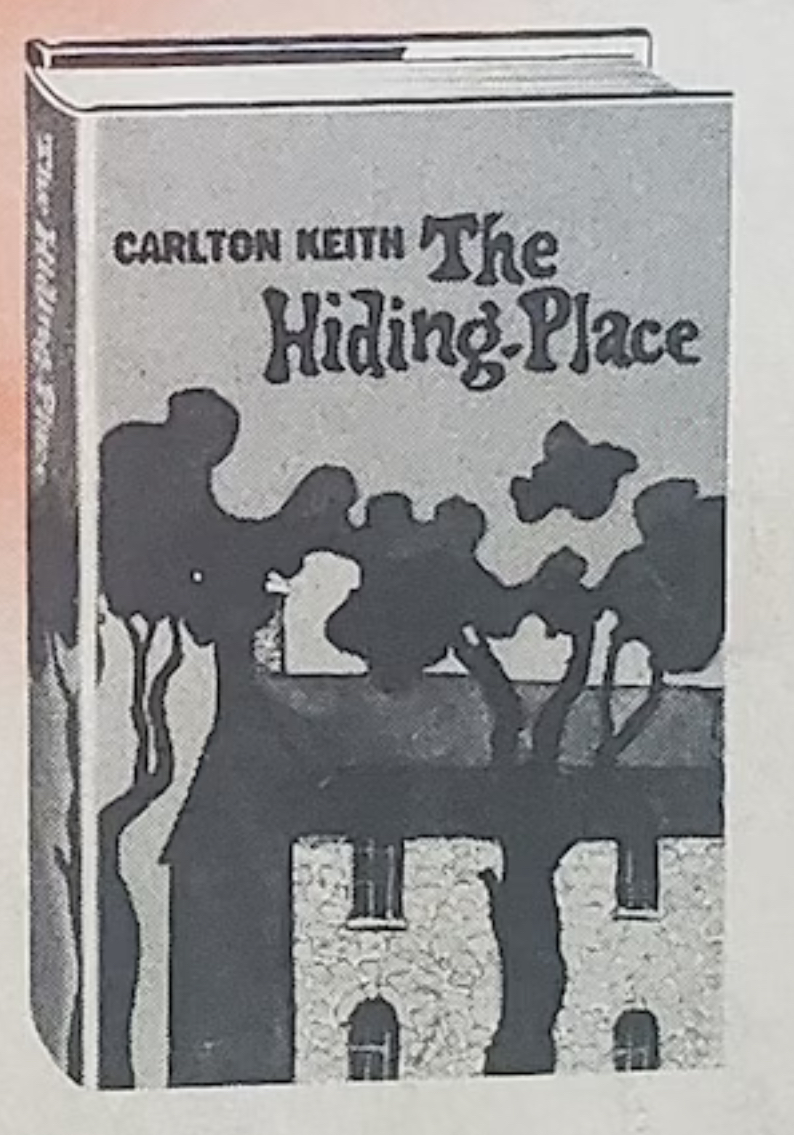
I searched for but couldn’t find a larger or color reproduction of the tiny book illustration used on the front and back covers of the Detective Book Club anthology for The Hiding Place. Whether it was intentional or not, I like how the artistic depiction of leaves on some trees, and what might be a cloud, are reminiscent of jigsaw puzzle pieces.
As for The Hiding Place, I was relieved to find it did not feature Jeff Smith, the handwriting expert protagonist of Robertson/Keith’s first two novels. The Jeff Smith characterization and some of his antics reminded me of Gardner’s early Perry Mason, and I’ll admit that I am a bit done with Perry Mason after the third book in that series. They were too hardboiled and plot-driven for my taste.
I was glad to find the protagonist of The Hiding Place was a completely different character, Alex Olszak. He was described as a big, hulking man with long, dangling arms and ham-like hands with a stolid face devoid of expression except when he smiled. Somewhat unexpectedly, his profession was industrial design, creating hubcaps, toasters, and other items, using modeling clay and plaster.
I appreciated how Robertson/Keith put some effort into characterization for Olszak, although almost all of the other characters were stereotypes. The story read like an adult version of one of the Stratemeyer Syndicate’s Hardy Boys or Nancy Drew mysteries, with hidden “treasure”, a secret room and tunnel, knockout blows to the head with no concussions, being tied up by crooks, and the like. It was simple and fun, and despite its utter lack of sophistication, I enjoyed it far more than the earlier Jeff Green mysteries.
Since it appeared in the Detective Book Club, I wondered if an actual detective would be a character or not. Indeed, a private detective did appear and played a role in the plot. I presume Robertson/Keith was trying out different forms of mysteries to see what might sell, or perhaps he was entertaining himself by writing in different styles within the genre.
Hugh Pentecost
I found that I thoroughly enjoyed reading the Detective Club Book in terms of its look and feel. It was comfortable to hold and read, with clear and well-laid-out text. In fact, I enjoyed it enough that after finishing The Hiding Place, I contemplated the one-page synopsis of its three novels on an opening page to see if I might read another of the tales.
Judson Philips
The blurbs were poorly written, with far too many EXCLAMATIONS! However, the first one sounded like a cozy read in a familiar subgenre and was credited to Hugh Pentecost.
That pseudonym was used by author Judson Pentecost Philips, who wrote over 100 mystery and detective novels, along with many pulp sports novels back in the 1930s. It is said that his novels had strong characterization, fair play with the reader, and unstilted language. Sniper was the first of seven books in his John Jericho series. I suspect it being first in the anthology might indicate the publisher thought it was the best of the trio.
I confirmed online that the tiny book cover depiction on the anthology edition matched the book jacket on a hardcover edition of the novel, and I found a couple of other covers for it. I would not have even picked up this book based on its paperback cover, with its artwork of what appears to be a dangerous red-haired relative of Grizzly Adams, “Giant John Jericho”.
As a man with a smaller frame and no athleticism outside of fitness aerobics and day hiking, with a career based on science and technology, I don’t identify with big hulking male characters who are artistic. However, the book was in hand, and Philips/Pentecost had earned a Grand Master Award from the Mystery Writers of America, so what the heck.
John Jericho had some superficial similaries to Alex, the protagonist of The Hiding Place: another guy with a large frame, “hamlike” yet oddly dextrous hands used for artistic endeavors, and an appreciation for aesthetics more often stereotyped as a characteristic of homosexual males than straight he-men. Both gentlemen were also experienced in firearms.
The first chapter was a rough start, an introduction to the two lead characters which I found hard to believe: a woman was proposing intercourse with Jericho shortly after meeting him. He rejected that, and the story had no graphic scenes, but it immediately came across as distinct from Robertson/Keith’s contribution to the anthology, where a man and woman had some very conventional dates, a few kisses, and then agreed to marriage, with the reader only aware of them having reached first base.
Philips/Pentecost’s novel had more deft characterizations and a whodunit plot that offered up plenty of suspects with the inevitable twists and turns. He wasn’t Agatha Christie, but he was certainly more skilled than Robertson/Keith in the mystery genre.
I doubt I will seek them out, but I’d read another Hugh Pentecost book. Also, despite his evident inferiority in the genre, I’ve made it a project to read all of Robertson/Keith’s crime novels, and I suspect I will tackle Rich Uncle next…but that won’t be for awhile. Over the past four months, four of the eleven books I’ve read have been mysteries.
So I’ve started listening to director William Friedkin’s memoir on my walks, and I think I’ll pick up my Kindle, read the remaining essays in Slouching Toward Bethlehem, and then try reading another of Modern Library’s 100 Best Novels of the 20th Century: A House for Mr. Biswas by V.S. Naipaul. I’m grateful to have varied options to distract me during this sultry summer.



























 Meador Manor