Surviving the culture wars

Culture wars and identity politics, initially amplified by broadcast media and now metastasized by social media, corrode our quality of life.

Recently Judith Martin and her children Nicholas and Jacobina, writing in their Miss Manners column, shared this take:

Demagogues harness culture wars and identity politics to propel themselves into high elective offices. Sadly, it is no longer surprising for autocratic federal and state elected and appointed officials to routinely demonize people they should instead be serving and to portray segments of society as threats to the community rather than members of it.

In broadcast and social media, people are freely labeled as racists, bigots, misogynists, homophobes, xenophobes, fascists, socialists, communists, ad nauseam. Labels lack nuance and often mischaracterize the complex and contradictory behavior inherent in human nature. Even when they accurately reflect past or current behavior, they imply permanence. However, we all know that people often change and evolve.

Malcolm X and George Wallace famously renounced their prior racist views. Bill Clinton went from signing the Defense of Marriage Act to being an outspoken supporter of marriage equality. Charlie Kirk shifted from supporting the separation of church and state to views associated with Christian nationalism. Ronald Reagan went from being a committed liberal and admirer of Franklin D. Roosevelt to become the leader of a conservative political movement.

If we don’t believe people can change, then what is the point of argument, debate, or other attempts at persuasion? Moderation, mutual respect, and compromise are key tools in creating strong communities, but increasingly those have receded behind extreme public partisanship, intransigence, and hateful words and actions.

Stereotypes have developed about right-wing violence and left-wing cancel culture, but violence and cancel culture are now utilized by extremists on both ends of the political spectrum to the detriment of everyone. People of widely polarized political and cultural beliefs invoke supposed rights of free speech without understanding its legal limits, and sometimes suffer doxing, employer discipline, loss of employment, and worse.

Kate Harner has written about how digital and broadcast media promote anger-provoking content to increase engagement, create detachment that promotes cruelty to others and a lack of empathy, and feed an attention economy that exploits extreme emotions for profit. She wrote:

If you stay true to your principles, they will offend somebody and you will get ‘canceled’. With a large enough audience that is a guaranteed outcome. Someone would wake up in a bad mood and forget to take their pills, and your principles would become a convenient target for their rage. . . . So for self-preservation, people stay silent – and who can blame them? In America you may not face imprisonment if someone does not like your views, but be prepared to lose your job.

Increasingly, we see government being weaponized in the culture wars. Partisans may temporarily rejoice as political norms are violated and authoritarian tactics promote their views while suppressing others, but power will eventually shift with victors transformed into victims.

Identity politics

Progressives often promote the rights of interest groups, particularly people who have historically suffered discrimination and persecution. However, when progressive politics is perceived as mostly about promoting disfavored groups, autocrats can portray progressive policies as favoring the disfavored few at the expense of the majority. Human rights are portrayed as a zero-sum game with winners and losers, as if someone else gaining equality somehow robs you of it. Autocrats use that mindset to divide and conquer.

Examples of how much people can change are Americans’ views on sexual orientation. Gay marriage had spread across 36 states before the Supreme Court nationalized it in 2015 with Obergefell v. Hodges. While only 27% of U.S. adults supported it thirty years ago, now over 2/3 do, albeit it with the usual partisan divide.

[Source]

As for employment discrimination, back in 1978, Oklahoma passed a law allowing schools to fire teachers for public homosexual conduct. That law was struck down by the Court of Appeals and its stance then affirmed by a divided Supreme Court. Nevertheless, a “don’t ask, don’t tell” mindset prevailed for decades in Oklahoma schools. That also became official U.S. policy on military service from 1994 to 2011. However, in 2020, employment discrimination on the basis of sexual orientation and gender identity was prohibited nationwide under Bostock v. Clayton County.

Over time, views on homosexual relations had shifted, and the courts were following that trend. Whereas only 40% of Americans held that homosexual relations were morally acceptable back in 2001, that has risen to 64%.

However, condemnation of minority sexual orientations and unusual gender identities is still quite common in Oklahoma, where 47% of adults are Evangelical Protestants and 42% say homosexuality should be discouraged, compared to only 30% nationwide who feel that way. Bartlesville has ongoing efforts to censor library books, ban drag shows, and so forth.

Transgender politics is especially fraught. Less than 1% of the U.S. adult population, and only 0.7% of Oklahoma adults, identify as transgender, but in recent years they have been treated as cannon fodder in the culture wars.

Equality v. equity

Things get particularly dicey when people seek to use the law in pursuit of equity rather than equality.

A commonplace illustration of equality versus equity

At first glance, we’re glad that equity means everyone can reach an apple. But what if the apple is employment or certification and the taller boxes represent identity-based scholarships, admittance requirements, or test score adjustments? How one achieves equity can drastically reduce support for interventions. For example, if we want more racial, economic, or religious diversity in certain professions, are we willing to enact quotas? Would we support scholarships and programs targeted at underprivileged groups? What about lower standards for groups that have suffered historic discrimination?

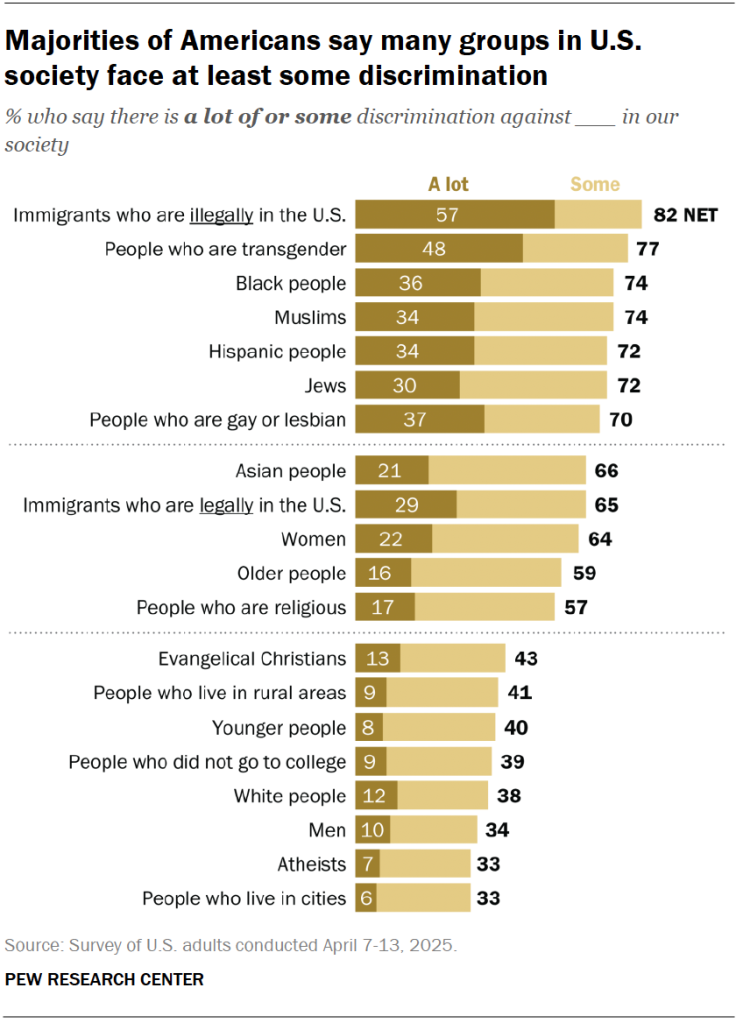
Majorities of Americans say many groups do face some discrimination, but equality before the law is embraced far more broadly than are attempts at creating equity.
[Source]

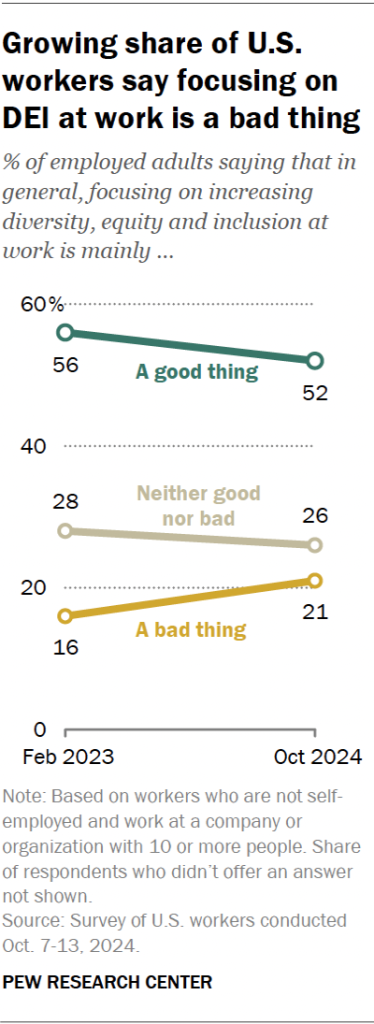
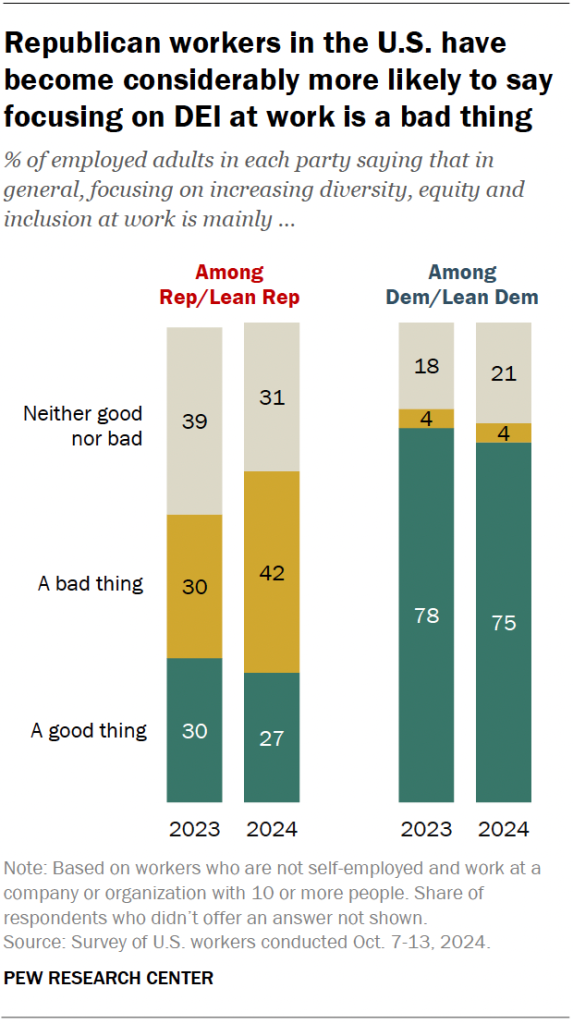
Recently many Republican politicians have pushed to ban diversity, equity, and inclusion (DEI) efforts in the government, workplace, and education. Support for DEI in the workplace has been slipping as it has become an extremely partisan issue.
Evangelicals

The aspects of the culture war that I am most frequently exposed to as an Oklahoman are promoted by Christian evangelicals, with a strong uptick this month after Charlie Kirk’s assassination.

Evangelicals often think of themselves as one of the most marginalized groups in American society. Data from the American National Election Study does show that feelings toward Christian fundamentalists have steadily deteriorated over the past 20 years, with the average feeling toward them now being far colder than toward Muslims, Jews, or Christians in general.

When interpreting that chart, please bear in mind that while all fundamentalists are evangelicals, not all evangelicals are fundamentalists.

I would attribute some of the negativity toward evangelicals as arising from the very nature of evangelizing, the active preaching of their beliefs in hopes of conversions. Backlash becomes inevitable whenever that strays into harnessing secular power to impose their values and beliefs on others. Such bullying behavior is particularly noticeable in Oklahoma, with elected state officials who repeatedly violate the separation of church and state, capitalizing on how Christians still compose 70% of the state’s adult population.

Oklahoma’s demagogues are well aware that evangelicals are anything but marginalized in this state, with only Arkansas having a larger share of its population identifying as evangelical Protestants.

Evangelicals who are particularly strident in seeking to impose their beliefs on others have little fear of being ‘canceled’ in Oklahoma since they now outnumber even Mainline Protestants by over four to one.

[Source]

However, the state’s 70% share of Christians is down from 85% in 2007, with drops from 2007 to 2024 in the overall share of Oklahomans in the Evangelical Protestant, Mainline Protestant, and Catholic divisions of Christianity. The share of Oklahomans who are religiously unaffiliated has more than doubled over that same timespan, with over 1 out of 4 now identifying as atheists, agnostics, or professing nothing in particular.

[Source]

Modern society provides access to different worldviews through the internet, offering moral guidance outside of religion and reduced social pressure to conform to religious norms. Some evangelicals view the rise of the religiously unaffiliated as both a challenge and an opportunity, but the strong alignment of many evangelical groups with conservative political ideologies is a “push factor” driving some people away from religion; the religiously unaffiliated tend to be more politically liberal.

The religiously unaffiliated nevertheless have diverse beliefs. Only about 5% of people, both nationwide and in Oklahoma, identify as atheists. That’s up from 2% nationwide and less than 1% among Oklahomans back in 2007. As one would expect, atheists and evangelicals often take a dim view of each other.

[Source]

Here are how U.S. adults as a whole viewed various groups in 2022:

[Source]

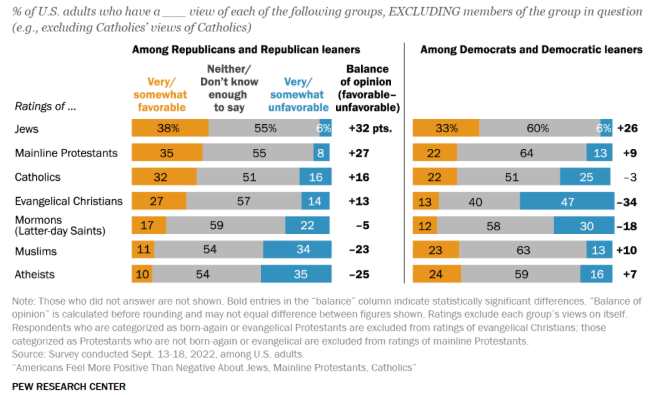
Consider how partisan groups viewed the various categories.
[Source]

Survival strategies

I take a dim view of both culture wars and identity politics. My decade of directing my school district’s communications efforts has led me to avoid “feeding the beast”. Some state officials make outrageous proclamations and demands, which usually lack legal force. My approach is to avoid actively responding to those provocations, which are really about “ginning up the base” and fanning the flames of the culture war or distracting from the latest scandal arising from incompetency and corruption.

The reality is that both broadcast media and most social media warriors of both liberal and conservative bents have an extremely short attention span. Rapid scrolling and constant notifications foster a need for immediate emotional gratification, regardless of whether that is positive or negative. The warriors typically move on within days, and sometimes hours, minutes, or seconds, to their next outrage, with little if any follow-up.

My advice is to minimize your engagement with such posts and avoid broadcasting to entire groups about issues that likely only interest the fringes. When you do respond to direct inquiries, stick to the facts as much as possible using neutral language and tone. If the warrior you are directly communicating with is an acquaintance, you may be able to disarm them with some mild humor so long as it is not aimed at them or their concerns. Model mutual respect and, if it is not returned and you are disrespected, bear in mind this advice Marcus Aurelius gave to himself:

Keep this thought handy when you feel a fit of rage coming on—it isn’t manly to be enraged. Rather, gentleness and civility are more human, and therefore manlier. A real man doesn’t give way to anger and discontent, and such a person has strength, courage, and endurance—unlike the angry and complaining. The nearer a man comes to a calm mind, the closer he is to strength.

If you need help in letting go of anger, here is some detailed advice from another Stoic, Seneca.

In regards to your own posts on social media, I don’t believe they can change most people’s minds. I’ve seldom seen anything approaching a reasoned or productive debate in the comments. Rather, social media reinforces existing beliefs through personalized algorithms and echo chambers.

Furthermore, research published in Nature showed that decreased exposure to like-minded views made little difference. Over 23,000 Facebook users had their exposure to content from like-minded sources reduced by about 1/3 during the 2020 U.S. presidential election. That increased their exposure to content from cross-cutting sources and decreased their exposure to uncivil language, but it had no measurable effects on ideological extremity, candidate evaluations, belief in false claims, or affective polarization, a term I define below.

There are significant psychological barriers which make social media users resistant to contrary arguments:

  • Confirmation bias: people seek out and favor information that aligns with their existing beliefs and dismiss contradictory information
  • Motivated reasoning: when confronted with counter-arguments, people are more critical of information that contradicts their views and more lenient toward information that confirms them
  • Cognitive dissonance: confronting a contrary argument creates mental discomfort, motivating people to reject new information to avoid the discomfort and protect their ego and public image
  • Affective polarization: social media intensifies dislike and distrust of the opposing side, making purely factual arguments less effective than those rooted in identity

So my advice is to save your fingers. Avoid engaging in online “debates” and arguments with strangers. Avoid reacting to every little outrage. Avoid insults, both created by you and directed at you. Focus on the genuine positive aspects of social media: keeping in touch with real-world friends and acquaintances; enjoying positive posts of beauty, nature, and fun events; providing positive support, information, and advice for those who seek it out.

Each of us shall continue to make mistakes, but we can embrace a growth mindset. As Maya Angelou’s advice to Oprah Winfrey has been paraphrased:

Posted in politics, religion | 1 Comment

Simplifying Our Home Theater

A lightning strike prompted me to simplify our home theater. The bolt early one morning struck quite close to our house, disrupting our next door neighbor’s telephone landline wiring and one of its attached telephones. I had to reboot both our cable modem and its eero router to get the internet back up in Meador Manor, and later that day our television was making clicking noises while in standby mode.

Unplugging the television for awhile solved the clicking issue, but a few days later, when Wendy wanted to watch a DVD with me, I couldn’t get our Sony Blu-Ray Ultra HD player to work. I tried a different HDMI cable, a different disc, and powering everything down and back up to no avail. I presumed that a power surge might have damaged the player, despite it being plugged into a surge protection power strip, since that power strip had been in use for years and thus its protective metal oxide varistors could have worn out.

So I ordered a Panasonic Blu-Ray Ultra HD player, but when I plugged it in, it was still no go. Oh dear…what had I missed? Our complex home theater system, which I had rebuilt in 2017, had always been too complex for Wendy’s comfort and now its crankiness was exasperating me as well.

The Receiver

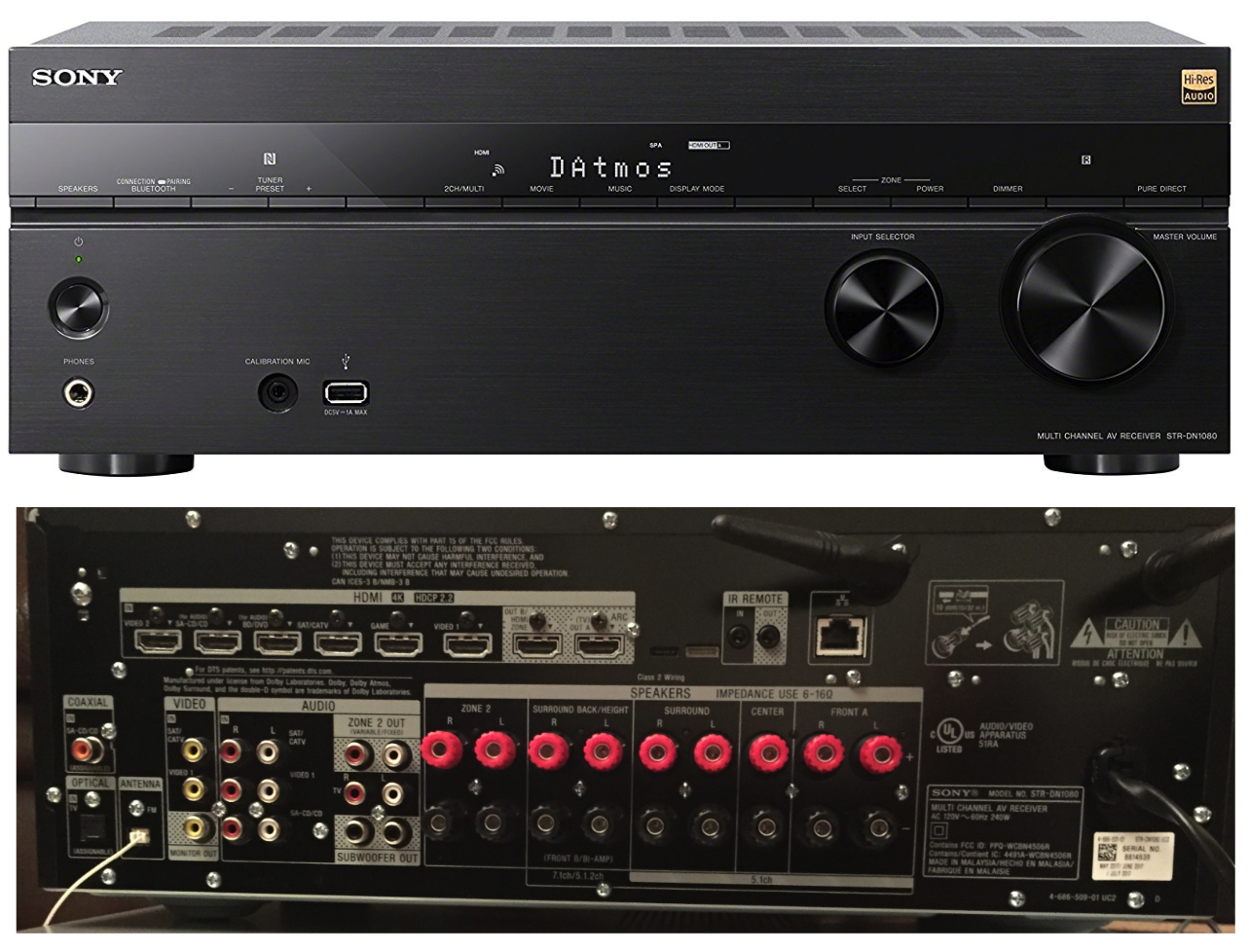
The Sony AV receiver I purchased in 2017

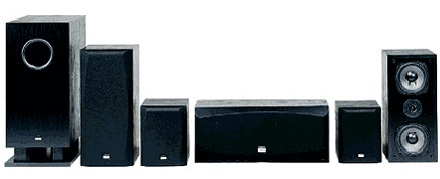
Back in 2003, I had bought a Panasonic SA-HE100S receiver for $300 along with a $300 Onkyo SKS-HT500 home theater speaker system. Fourteen years later, when I bought an LG OLED television, my old receiver didn’t have any HDMI capabilities to help everything link up, and I wanted to keep using the surround sound speakers. Wendy and I were newlyweds, and I hoped to build a system with push-button ease of use.

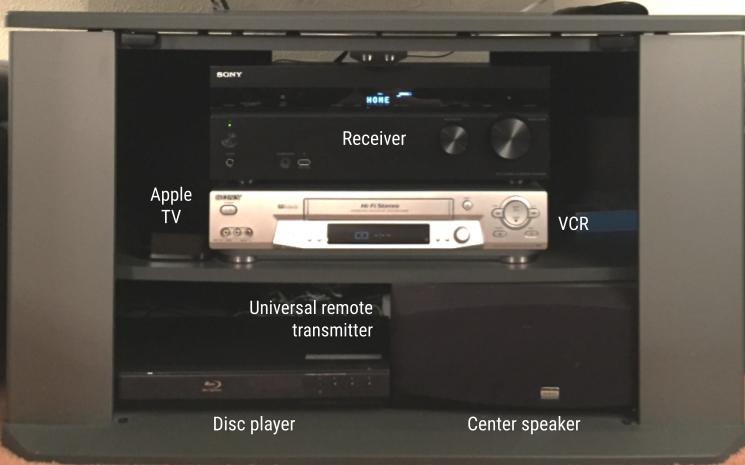
So at that time I invested $598 in a Sony STR-DN 1080 receiver, which became an HDMI hub for our television, Apple TV, and disc player while powering the five old surround sound speakers and powered subwoofer. I also upgraded my old Logitech Harmony universal remote to a Harmony Companion.

With considerable effort, I got everything to work, but Wendy was never comfortable with the system. In recent years, more often than not I would activate a function on the Harmony universal remote and have something go haywire, requiring me to tweak various settings and break out dedicated remote controls to get a video to play correctly in surround sound.

Earlier this year I stopped using my 2001 VCR to watch my 1990s workout videos, since I now have digital copies of the shows on my Mac Mini home computer which I can stream to the television using my iPad. I decided it was time to radically simplify, with a goal of clearing out everything in the TV cabinet except for the Apple TV and the disc player and having a system Wendy and I could operate much more easily and reliably.

The equipment in our TV cabinet from 2017-2025

Simplification

I abandoned the Logitech Companion universal remote along with using the receiver as an HDMI hub. Instead, I plugged the 2025 disc player, the 2017 Apple TV, and a 2018 Chromecast Ultra directly into the television. We will now rely on the LG television’s “Magic Remote”, which I managed to program to control the basic functions of the new Panasonic disc player and I had previously programmed to adequately control the Apple TV.

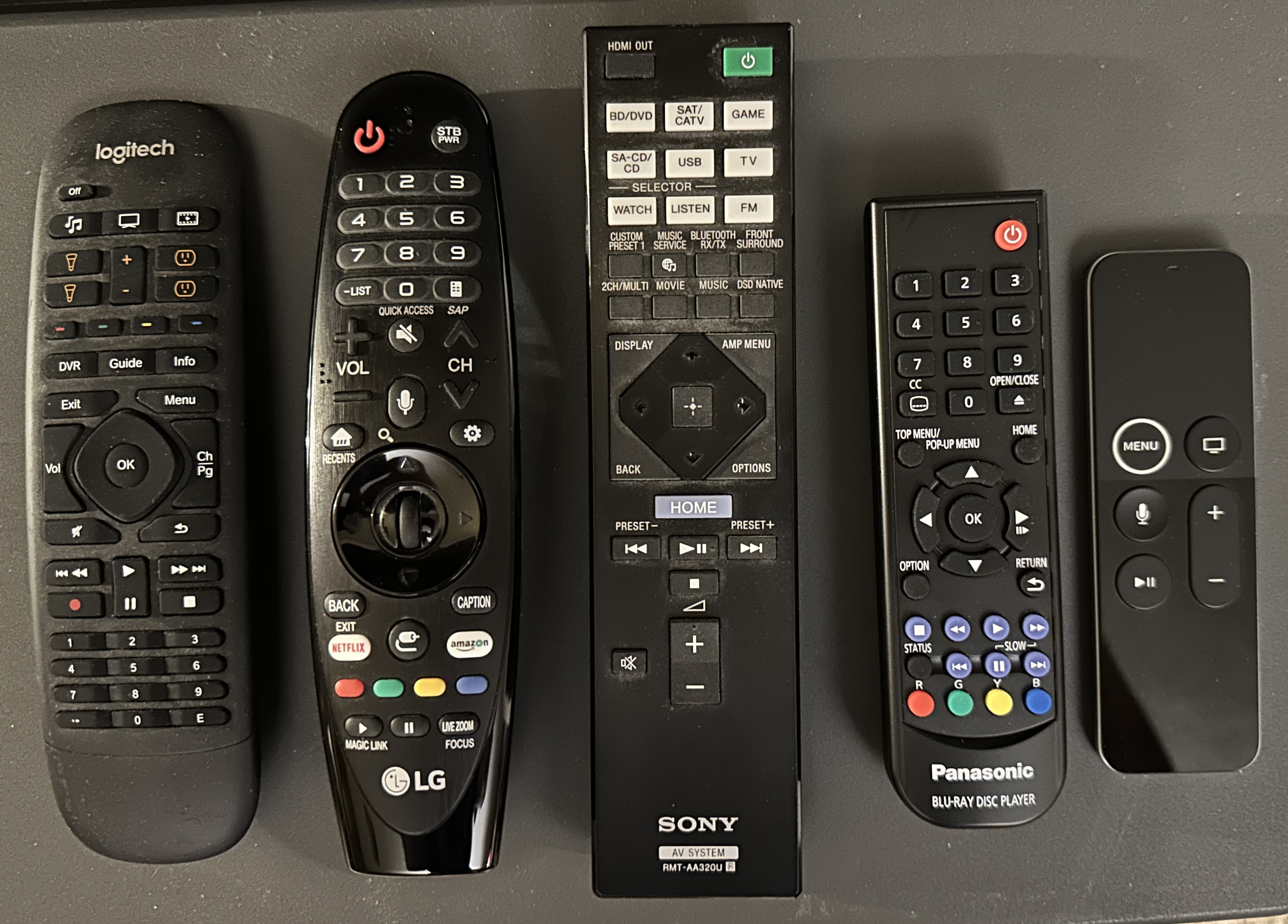
Our remote controls included the Logitech Companion, the LG television’s “Magic Remote”, another for the Sony receiver, and little-used ones for the Panasonic disc player and the Apple TV
My 2003 5.1 surround sound speakers

Eliminating the complexity of the receiver also meant abandoning the Onkyo surround sound speakers I had purchased in 2003. After I retire in 2026, Wendy plans to continue to work for a few years. So I expect to be making more use of our home theater, and I opted to invest in a new sound system that doesn’t need a receiver/amplifier and supports Dolby Atmos for a three-dimensional soundscape.

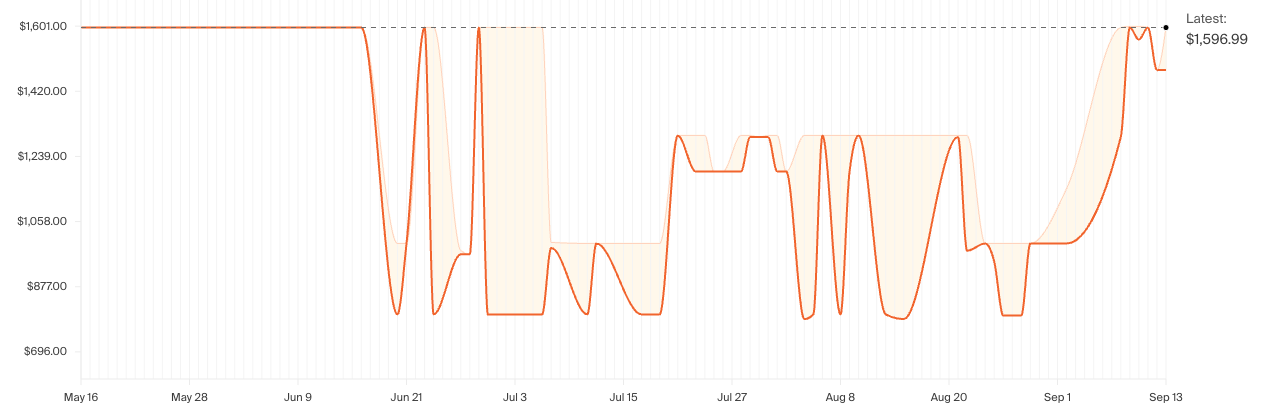
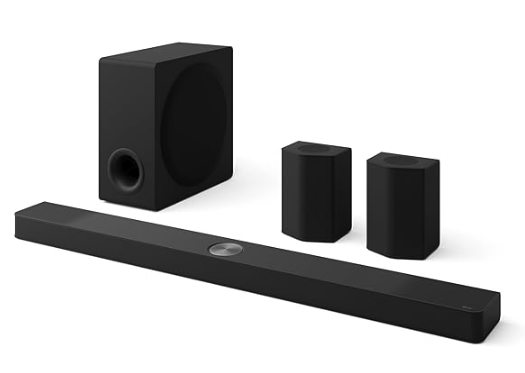
I spent $1,000 on an LG S95TR 9.1.5 channel soundbar with two wireless remote surround speakers and a subwoofer; it was LG’s flagship model last year, and Amazon was willing to let me spread payments across several months. I noticed that its price has fluctuated between $800 and $1,600 over the past months, so don’t pay list.

How the new soundbar system’s price has fluctuated at Amazon over the past four months

My old system was termed a 5.1 because it had five obvious full-range speakers — front left, front right, center, left surround, and right surround — and one subwoofer for deep bass. But what did the new system’s 9.1.5 designation mean, given that physically it is one long soundbar, two satellite speakers, and a subwoofer?

The new LG S95TR 9.1.5 surround sound system

Well, it has 9 regular channel speakers, 1 subwoofer, and 5 up-firing speakers. Those last speakers are used for Dolby Atmos. The soundbar actually has ten speakers in it, three of them firing upward.

The subwoofer went on the floor near the television. The two satellite speakers replaced the two in our old Onkyo system. One of those old speakers had always sat up high on a fireplace mantle on one side of our couch, while its companion sat on the floor on the other side. The older units did not need power cords but had long speaker wires leading back to the Sony receiver under the television, and because of the speaker wires they were never really behind us, just beside us.

The new system’s satellite speakers just have power cords since they receive the sound signals wirelessly from the soundbar. In addition to front-firing drivers, they each have one firing upward. I put those about nine feet behind the couch along walls near power outlets.

Back when I set up the Sony receiver, it came with a little calibration microphone to tune my old 5.1 system speakers. The new system had me use the LG ThinQ app — the same app that controls our LG washing machine — to calibrate the speakers. (I wondered why they call the app “thin Q” and the internet told me to think about it. 🙄)

I just sat with my iPhone on the couch, triggered the test, and each speaker sequentially made loud noises that were picked up by the iPhone to adjust the settings in about a minute. Wendy has better hearing than I do, and I then used the app to reduce the volume of the subwoofer since she doesn’t like so much bass.

My LG television is too old to support LG’s WOW interface, so it can’t properly integrate its own internal speakers into the sound mix, but I have the soundbar plugged into the HDMI port on the television that supports audio return channel and consumer electronics control, so I can use the television’s remote control for the surround sound volume, and the soundbar powers on if I set the television’s audio out to the HDMI port.

Comparison

After setting up and calibrating the new sound system, and before dismantling the old receiver and Onkyo speakers, I did a comparison. Our Apple TV 4K supports Dolby Atmos, so rather than scour our collection of physical media for a suitable Blu Ray or trying something in the television’s Amazon Prime app, which I presume also supports Dolby Atmos, I checked to see what the internet suggested as movie scenes with noticeable Dolby Atmos effects that I could rent or buy on the Apple TV. One was the seawall segment of Blade Runner 2049.

Wendy and I watched the scene, with me switching between the television’s optical output, which fed the old 5. 1 speakers, and the HDMI output driving the new 9.1.5 system. I didn’t really notice Dolby Atmos, and the sound was fine with either system. I’m glad my motivation to invest in a new sound system wasn’t a lack of Atmos or other limitations with the older speaker system, but rather just me needing to simplify operations.

My impression was that dialog was a bit clearer with the new system, which would be welcome. We both noticed a lag between the video and the sound, and I tried adjusting the audio delay in the television’s sound settings, but the solution was to activate the “bypass” function. That sends the audio information out directly, without any delay from the television’s video processing. On some systems, that can create its own lag since the television might be slow in processing video, but bypass seemed to work fine for our test.

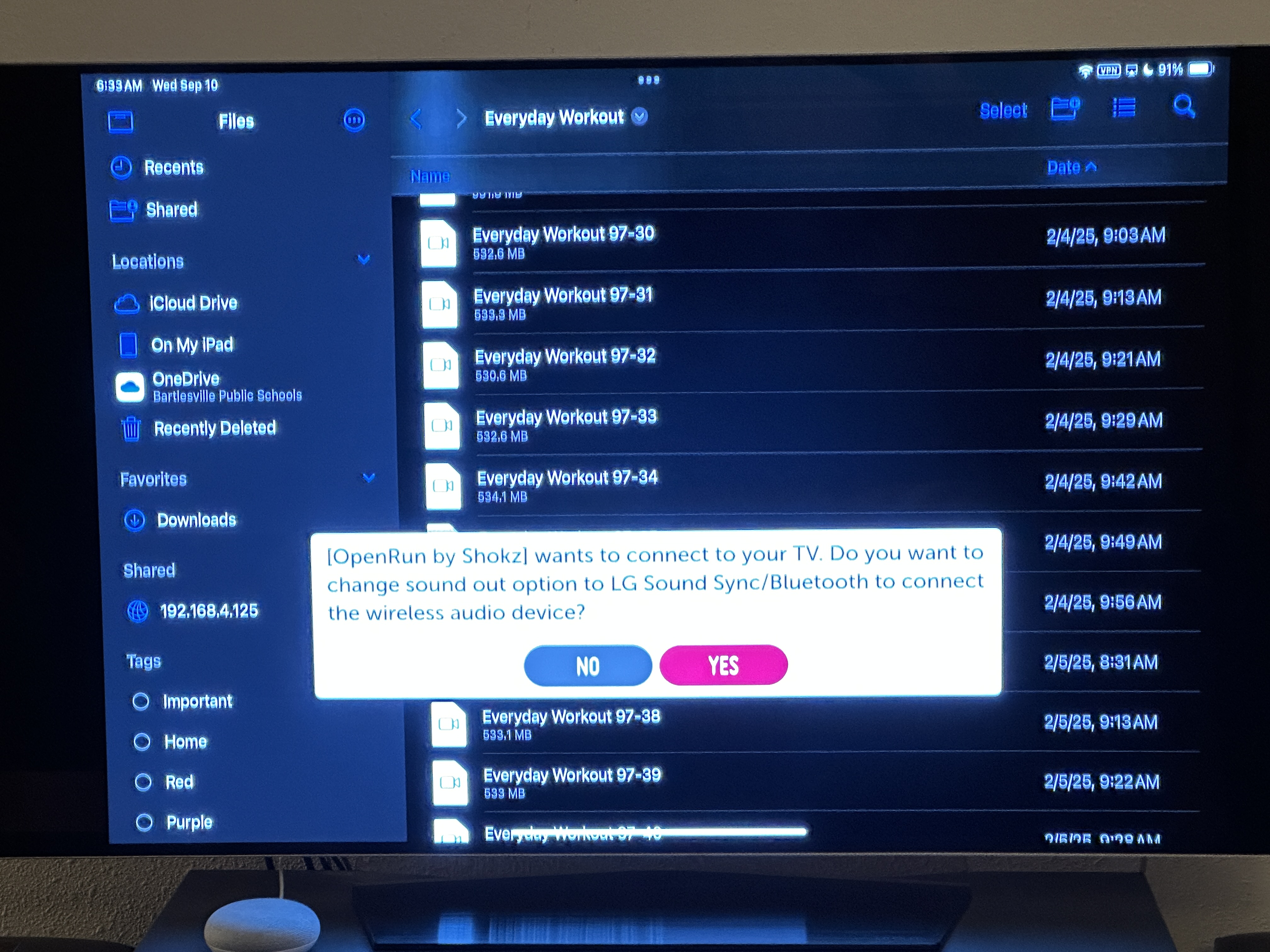
The prompt I see each weekday morning

I use Bluetooth bone conduction headphones when mirroring my aerobics videos from my Mac through my iPad to the television each weekday morning. When I turn on the headphones, the television asks me if I want to use them.

That all worked normally after the upgrade except that when the soundbar is on, the Bluetooth reception has interference. I couldn’t find a way to turn off the soundbar but keep the television on with the Magic Remote, so I have to manually power down the soundbar each morning, either with its own dedicated remote, the LG ThinQ app, or the power button on top of the soundbar.

When I turn on the system at other times, it either defaults to the television’s internal speakers or to the HDMI audio output for the surround sound. That setting is fairly easy to adjust, although I’d like to have a shortcut key for that on the “Magic Remote”.

My only real complaint about the new soundbar is that when I adjust the volume, neither the television or the soundbar show a meter or number indicating the sound level. The television displays a level number when using its internal speakers, and the old receiver showed its own number on its display. It could be that the ThinQ app shows a volume meter, but using a smartphone app to control the system does not appeal to me.

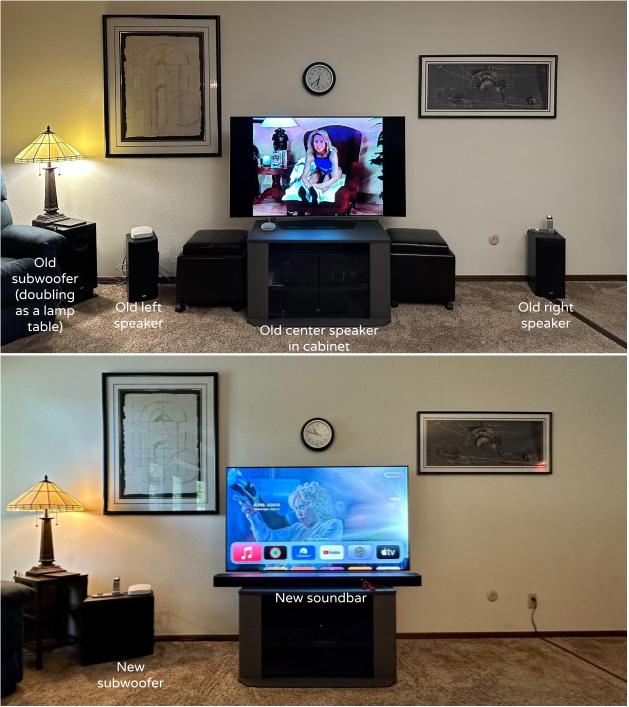
The living room setup is now cleaner without the left and right speakers that once sat on the floor and a center speaker that was tucked in the television cabinet.

Before and after (those things on each side of the television stand in the before photograph are our ottomans we roll over to the couch when we watch a show)

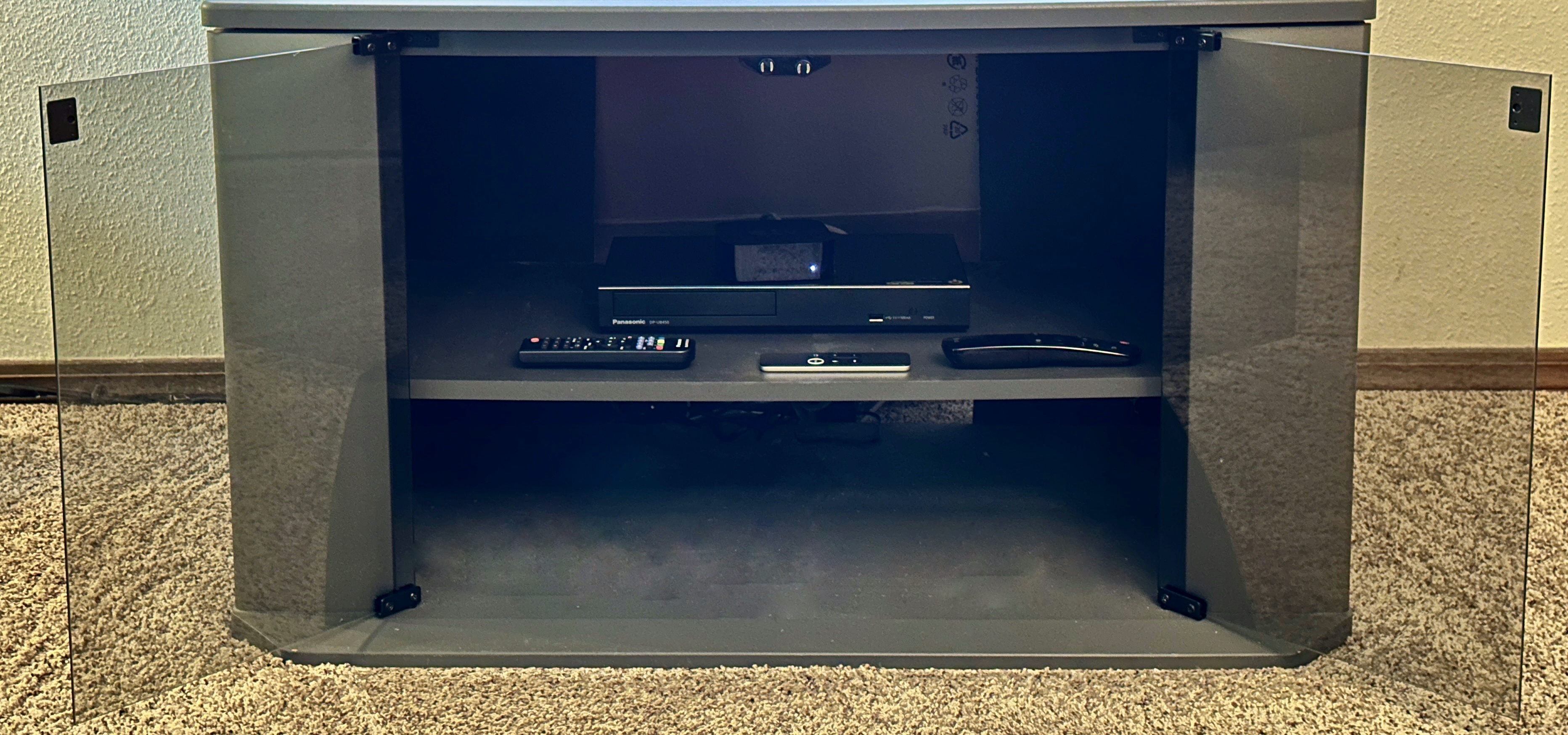
That cabinet now seems almost empty with only the disc player, Apple TV, and not-so-magic remote controls in it. I re-installed its tinted glass doors, which I had removed decades ago since the old system’s center speaker resided in the cabinet. I also replaced the surge protection power strip behind the cabinet with a new one to ensure our equipment is protected by fresh varistors.

The TV cabinet is no longer stuffed with equipment

The upgrade was a success: the system is now much simpler to use. But there was a bit more tweaking to do, as another request Wendy had made was that it be easy to watch broadcast television.

Broadcast Television

The Manor’s 1995 antenna is damaged, but that wasn’t why we had lost some channels

Broadcast television is helpful should the internet go down yet electrical power remain operative. Our chimney sports the VHS/UHF antenna that I mounted on it thirty years ago, but part of its VHF log-periodic dipoles snapped off in a storm years ago, leaving only its Yagi-Uda end-fire array for UHF channels fully intact. I had presumed that was why for the last few years when I would test the system it could not pull in KJRH, the Tulsa NBC affiliate, which still identifies as Channel 2 although it actually broadcasts on digital channel 8.

You might be wondering if the antenna took the bolt. It is connected to a grounding stake I also bought and drove many feet into the earth back in the day, so it is effectively a lightning rod that provides a low-impedence path when a lightning circuit is formed. But I have seen no indications that the recent strike involved our antenna; my guess is that a nearby tree became part of the circuit. The brief issues with our system were more likely just due to the electromagnetic pulse from the nearby bolt.

Anyway, when I tested the antenna this week, the television could also no longer show digital channel 11, which is KOED, the Tulsa PBS affiliate. I checked the antenna’s gamut, and it was only able to pull in 28 channels, which was unusually low.

When I installed the antenna and accessories from Radio Shack back in 1995, I had included a powered signal booster. I wondered if it might have lost some of its mojo over the past 30 years. I still had a second booster I had tried three decades ago and rejected, but not returned, so I wondered if it might now work better. I had the television displaying the signal strength for Channel 11 while I began to unscrew the coaxial cable from the old booster. Suddenly the low signal strength surged to 100% and the high-definition broadcast came through. My guess is that the booster connection had some oxidation.

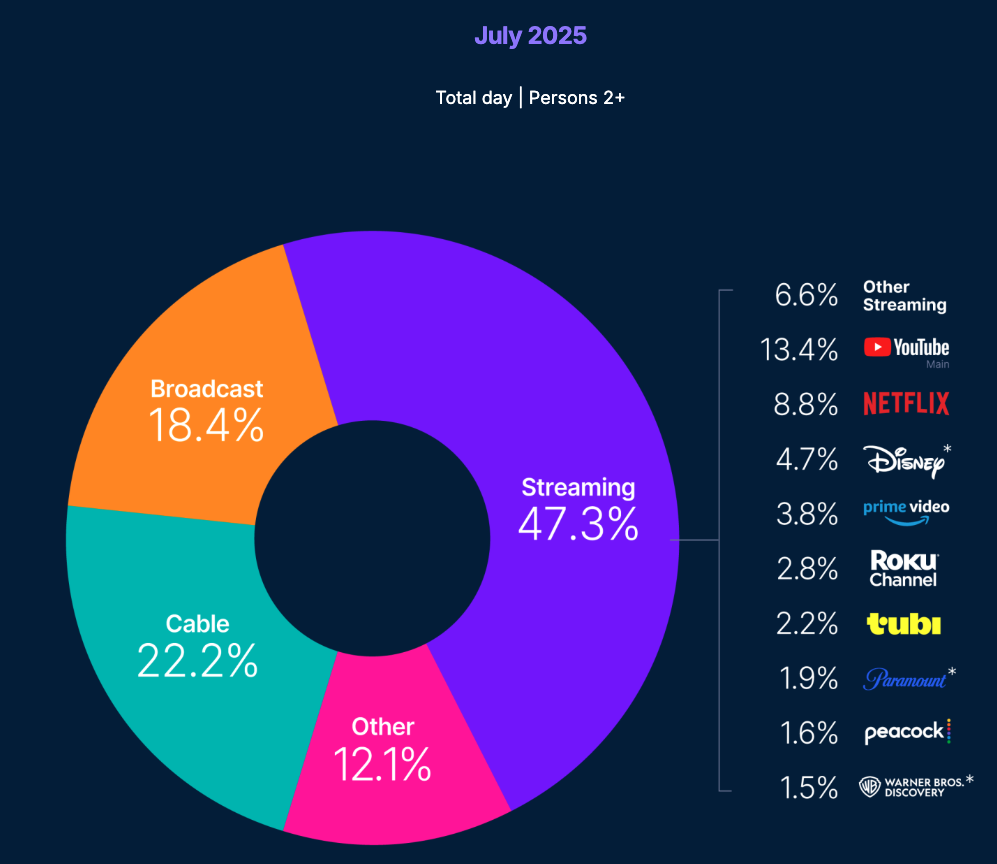
Lo and behold, that also fixed Channel 2, and the aerial is back to picking up 72 broadcast television channels from towers that are up to 63 miles away. Many of those are multiplexed sub-channels with 480-line interlaced broadcasts of vintage content, but we do receive high-definition 1080-line interlaced broadcasts from the local CBS, NBC, and PBS affiliates and 720-line progressive ones from ABC and FOX. I’m frankly surprised that there are still so many broadcast channels, given that broadcast television’s share of viewership is now less than 20%.

Television viewership [Source]

The LG television carries a mind-boggling 1,000 internet channels, including many dedicated to reruns of particular shows. I’ve no idea what their viewership is like, but we’ve come a long way since Bruce Springsteen released 57 Channels (And Nothin’ On) in 1992, let alone when I was a youngster in OKC and we received only four television channels on our black-and-white television’s rabbit ears antenna.

The Future

I have a bunch of optical discs awaiting my attention when the weather isn’t cooperative and I’m not otherwise engaged. I have a few seasons left of The Six Million Dollar Man to rewatch fifty years later, plus all of the Bright Knight Batman shows available for sampling. As for movies, I have restorations of The Umbrellas of Cherbourg from 1964, Danger:Diabolik from 1968, Cleopatra from 1963, and 1937’s Un Carnet de Bal stacked up, along with all four of Margaret Rutherford’s Miss Marple films. Perusing the media shelves also reminded me of a slew of unwatched Great Courses videos that I purchased over a dozen years ago.

So much to watch, and so little free time…for about nine more months.

Posted in HDTV, movie, technology | Leave a comment

A Loss of Trust

Cynicism has been building among my fellow Americans throughout my lifetime. This post charts the erosion of trust in the government, political parties, news and information sources, science, educational institutions, and almost all professions.

There is politics in this personal post, so I reiterate that nothing in this post reflects the views of my employer…and yes, I do look forward to retiring from public service in about 300 days.

Trust in the federal government

In 1964, at the start of Lyndon Johnson’s Presidential administration, over 3/4 of Americans trusted the government to do what is right just about always or most of the time. By my birth just a couple of years later, that had eroded to 2/3 of Americans. The Vietnam War, Civil Rights era, Watergate, Arab oil embargo, and Iran hostage crisis each contributed to its continued slide, with less than 1/3 still trusting in the government by the end of the Carter administration.

Source

Trust in the government rebounded somewhat under Reagan but it then fell again to a new record low. It was rebuilt during the Clinton administration, but after the 2001 terrorist attacks it again steadily eroded and has remained quite low ever since, with only about 1/5 of Americans trusting the federal government to do what is right.

Separating the views for the executive, legislative, and judicial branches, a majority now distrusts all three.

Source

I see little point in focusing on the presidency, which is dominated by partisanship, but the judicial branch is traditionally less partisan and thus often had the highest trust. It is notable how that has plummeted over the past few years. If we focus in on the U.S. Supreme Court, its approval has flipped from strongly positive to notably negative.

Source

The court’s legitimacy was undermined in the 21st century by the controversial Bush v. Gore, Citizens United v. Federal Election Commission, Obergefell v. Hodges, Dobbs v. Jackson Women’s Health Organization, and Trump v. United States decisions, the machinations of Mitch McConnell to change the political balance of the court, the ethical lapses of justices Thomas and Alito, and the turbulent confirmation of Kavanaugh.

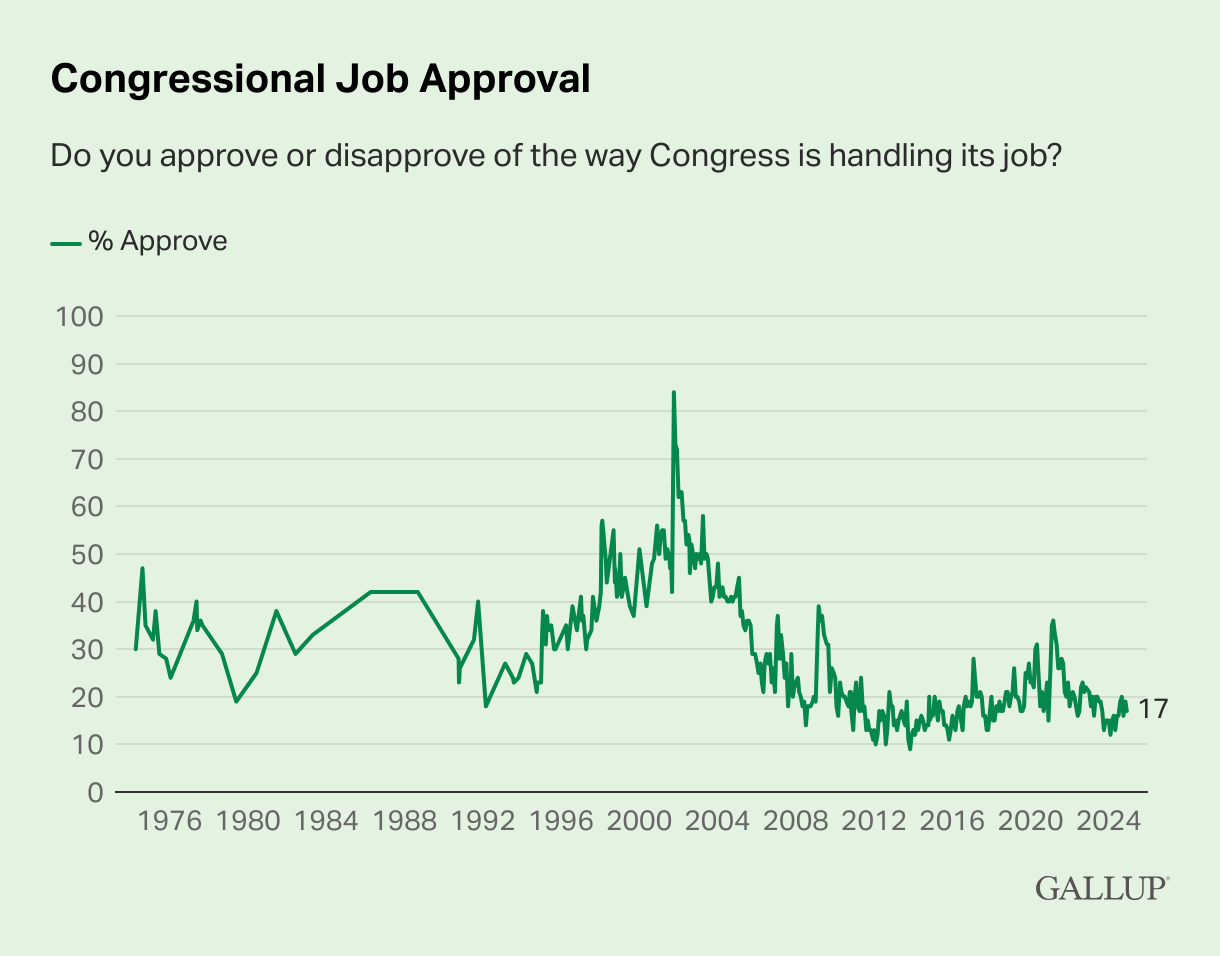
Overall Congressional job approval has traditionally been low, with telling remarks dating back to Will Rogers, Mark Twain, and much earlier. In general, people tend to favor their members of Congress far more than the institution. Its approval briefly spiked above 50% in the late 1990s and again after the 2001 terrorist attacks, but it has been quite low for most of the past two decades.

Source

Trust in political parties

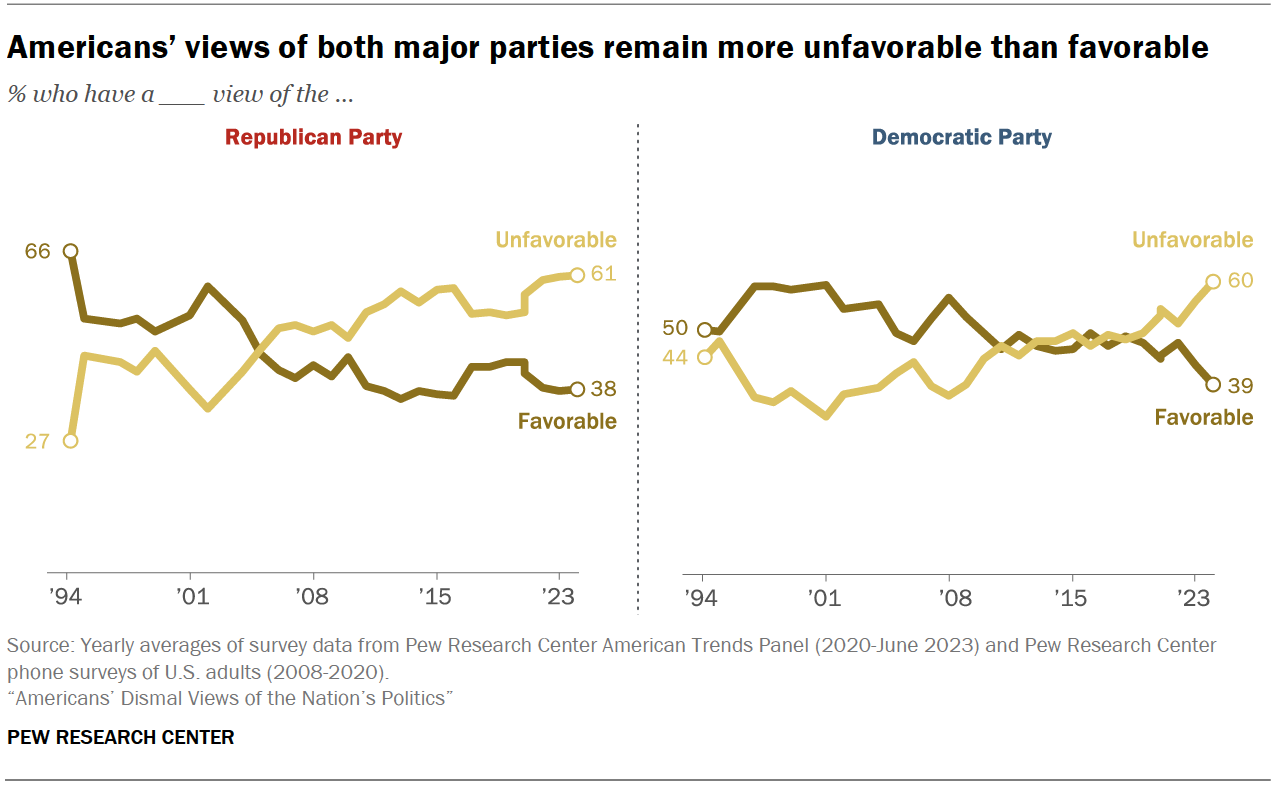
When asked about them separately, about 60% of Americans view each of the major political parties unfavorably.

Source

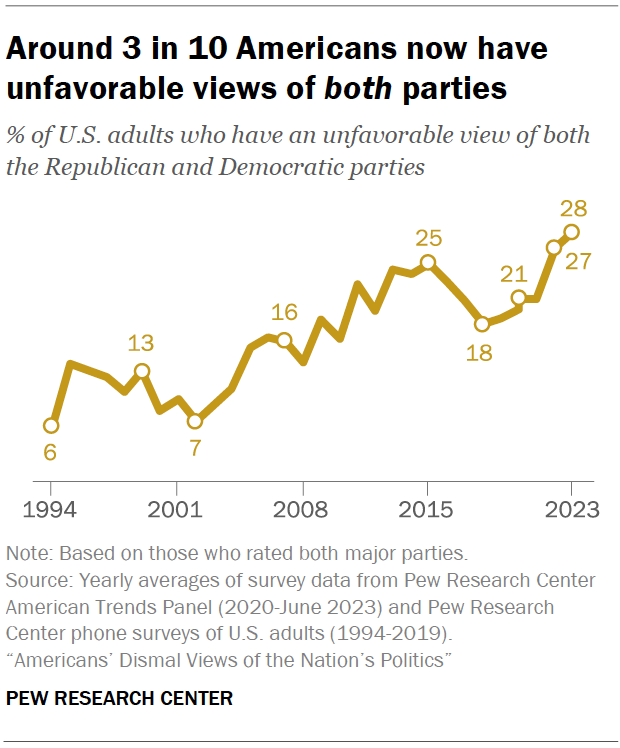
Those figures naturally reflect ever-increasing partisanship, but note how a few decades ago they both held net favorable ratings. The flip was driven by those who dislike both of the parties, which has increased from about 1 in 20 adults to now more than 1 in 4.

The winner-take-all single-member district system in the United States promotes a stable two-party system and makes it very difficult for third parties to emerge.

Increasing partisanship, with fewer Republican or Democratic moderates being elected, creates problems for states in which one side of the political spectrum has overwhelming dominance.

Oklahoma’s Political Parties

[Source]

I was born and bred an Oklahoman, and I have devoted my life to serving its citizens. However, I am clear-eyed about its dark history and benighted politics. There are some truly dedicated public servants from both political parties serving in Oklahoma, but their good works are often overshadowed by the antics of crooks, cranks, and crackpots.

Oklahoma has long been dominated by conservatives. The increasing association of Democrats with liberalism and Republicans with conservatism, which some younger folks may take as a given but older folks like myself know has evolved over time, means that currently most races in Oklahoma have no viable Democratic candidates outside of a few gerrymandered urban districts.

The combination of gerrymandering with Oklahoma’s semi-closed primary races and single-party control since 2011 has resulted in increasing far-right extremism. Many races are decided in closed Republican primaries, in which a lack of moderates and liberals empowers the far right and Christian nationalists.

Registering as an independent or as a Democrat in Oklahoma prevents one from voting in the Republican primary, which is now the deciding event for almost all of the elections. State Question 836 is an attempt to address this by establishing open primaries, but its future is far from certain.

Another consequence of Oklahoma’s dominance by conservatives and Republicans is extreme voter apathy. In the 2020 and 2024 general elections, Oklahoma’s voter turnout was the lowest of any state. Unfortunately, in recent years the lack of moderates and liberals in closed Republican primaries and their failure to vote in the general elections has led to the election of corrupt and incompetent demagogues to statewide offices.

Oklahoma has been completely controlled by Republicans since 2011 [Source]

Alongside its strong populist streak, the state has a long history of state-sanctioned racism and oppression, which shouldn’t be a surprise given how it was used as a dumping ground for forcibly relocated First Peoples, with several of the tribes themselves being racist slaveholders until the federal government intervened after the Civil War.

Republicans were once the party of Lincoln, abolition, and reconstruction, with southern Democrats endorsing slavery and then racial segregation and voter suppression. Oklahoma’s widespread racism was part and parcel of its near total control by the Democrats throughout most of the 20th century.

However, in the 1960s President Johnson led the Democratic party to support integration and Civil Rights, which gradually led to the Republicans dominating the southern states. In Oklahoma, which has always been an oddity in southern politics due to its location and history, Republicans began to win federal offices and governorships, but it wasn’t until the 21st century that the Republicans took control of the legislature. By then, the shift in Oklahoma was based less on race politics and more to do with many conservatives leaving the Democratic party and many liberals leaving the Republican party amidst decades of relentless and depressing culture wars.

Control of the Oklahoma legislature flipped in the 21st century [Source]

Trust in news and information sources

We are witnessing the slow but inexorable decline of newspaper, radio, and television journalism. Their business models have been disrupted by the internet and social media, along with an increasing reliance on platforms that are highly biased and sometimes actively promote misinformation and falsehoods.

It is interesting to note that the erosion in trust of local and national news organizations is largely driven by Republicans, while trust in social media is similar for members of both political parties, although understandably low.

Source

Younger people have less trust in national and local news, with a corresponding increase in their trust of social media sites.

Source

However, trust in national news outlets does not vary by age among Republicans.

Source

Trust in science

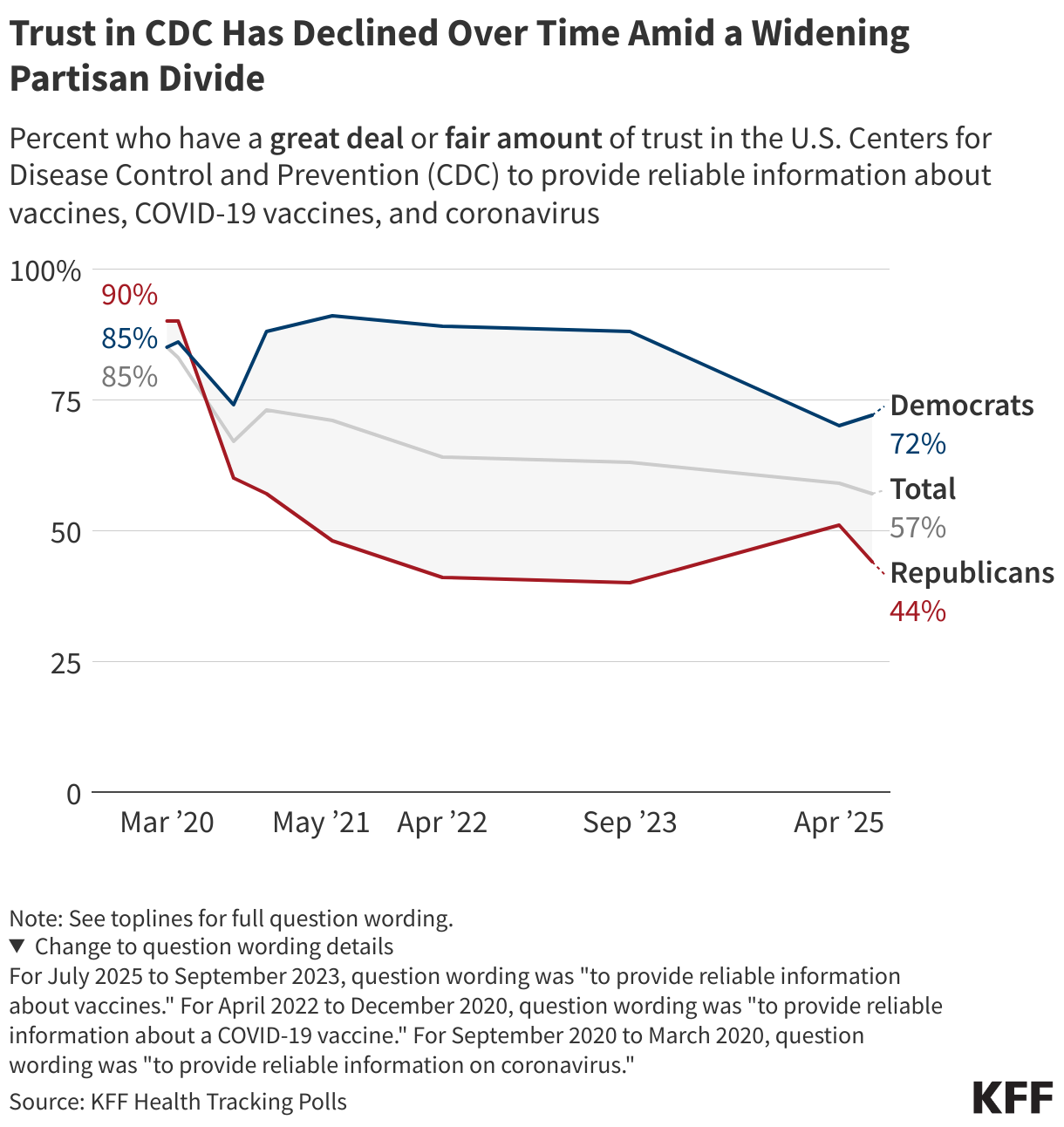
Trust in the scientific establishment took a hit during the COVID-19 pandemic. In April 2020, 87% of Americans had confidence in scientists to act in the public’s best interests, but that declined to 73% by the fall of 2023, driven by a steep loss of confidence among Republicans.

Source

That partisan divide is especially evident for the Centers for Disease Control, which is now coming apart at the seams thanks to the appointment of the crackpot Robert F. Kennedy Jr. as the Secretary of Health and Human Services. Public health in the United States is rapidly deteriorating, and Oklahoma was already one of the worst states in health care.

Source

Trust in educational institutions

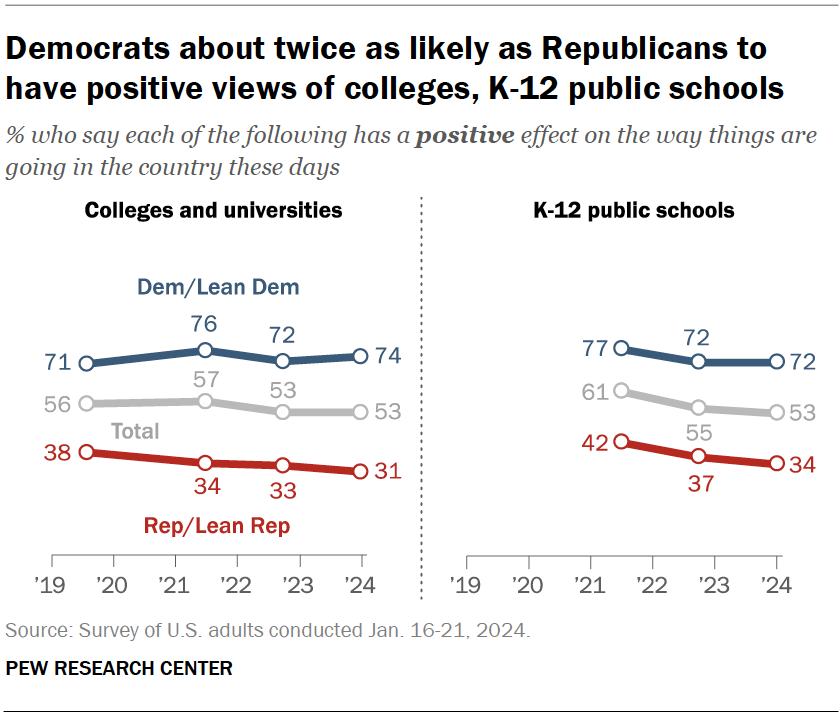
The past decade has seen a widening partisan divide in trust of educational institutions. Having worked in Oklahoma public schools since 1988, I am disheartened that only 1/3 of Republicans say they have a positive effect on the way things are going in the country. Culture wars and demagoguery have exacted a heavy toll. As with health care, Oklahoma’s public school rankings are extremely low, with consequent impacts on the quality of life.

Source

Trust in the professions

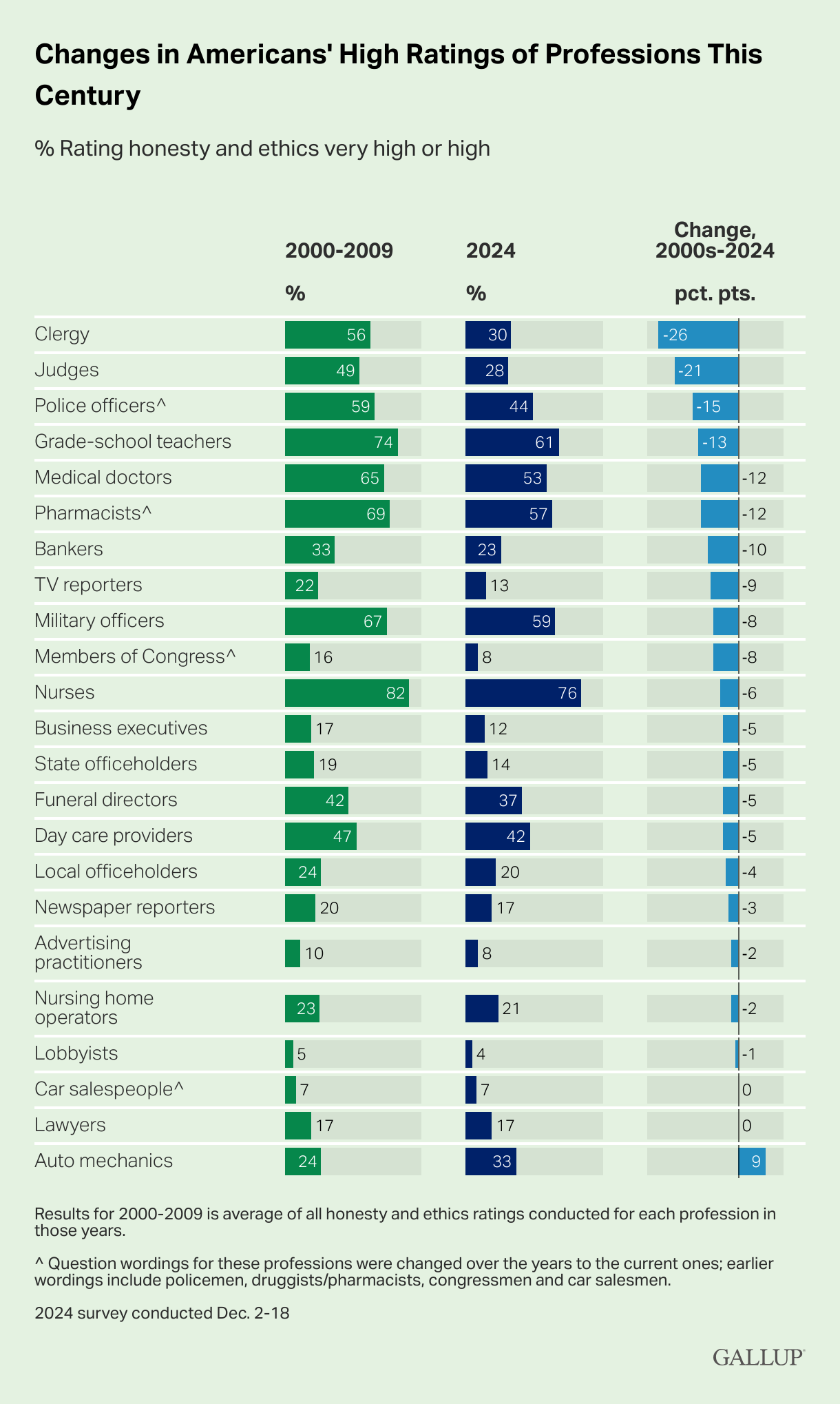
Perhaps the most depressing news is that ratings of the honesty and ethical standards of people in many different professions have fallen.

Source

Note the immense loss of trust in clergy, judges, and police officers. Grade school teachers have also taken a big hit, but thankfully trust in them remains relatively high, with only nurses rated higher. Sadly, Oklahoma’s current state superintendent is striving mightily to further erode the trust in our state’s teachers.

The age of anxiety has given way to one of cynicism. While I do value cynics — H.L. Mencken is a favorite — one should not confuse cynicism with intelligence. To borrow from Robert Frost, too much cynicism can leave you with “nothing to look backward to with pride, and nothing to look forward to with hope”.

While it has also been said that cynicism is critical thinking without hope, Dr. Alexander Katrompas argues that to a Stoic, “hope is the first defense of a weak and undisciplined mind, and the last refuge of a coward.” He advises us to rather engage in critical thinking with a sense of optimism born from resilience and discipline. I plan to remain an optimistic cynic.

I do not hope for things to be easier; I prepare to meet them with strength.

-Alexander Katrompas
Posted in politics | Comments Off on A Loss of Trust

Leisure Time

For over twenty years, researchers have collected data on how, where, and with whom our countrymen spend their time via over a quarter-million interviews. I find it interesting to compare my habits to the “average American”, especially since in less than a year mine shall change radically.

Until July 2026, I will remain among the almost half of people ages 15 years and older who work. As our population aged, the proportion of workers has shrunk a bit, from 54% in 2003 to 47% in 2024, with a fairly consistent 8 hours per day on average.

Almost 9 in 10 in the surveys spend an average of over 4.5 hours per day relaxing and doing leisure activities. About 3/4 spend an average of over 3.5 hours per day watching television, and while I have not watched traditional television in years, I’m right in sync by spending about 3.25 hours per day watching YouTube, and our television set does get used for a half hour each weekday morning for my aerobics exercise to the Everyday Workout episodes I recorded in the 1990s.

Over the past two decades, the proportion playing games has doubled from 8% to over 15%, and participants typically spend over two hours on that. As a child, I enjoyed board games, but the only card game I played was Kings in the Corner with my paternal grandmother. People often assumed via stereotyping that I played chess, but in fact I never cared to learn chess or even checkers. When video games came along, I played a few on my home computers, but I almost never played them in arcades and never developed a gaming habit.

About 1 in 5 participate in sports, exercise, and recreation on a given day, with those who do spending about 1.5 hours on it. I do my half-hour of aerobics on weekdays and walk on Bartlesville’s Pathfinder Parkway some weekend mornings. Walking has increased in popularity from about 1 in 20 on a typical day to 1 in 12, with the walkers spending an average of about 50 minutes on their perambulations.

However, what prompted this post was a news article about the decline in reading. Over the past two decades, the share of readers has declined by 40%, from over 1 in 4 in 2003 to less than 1 in 6, with reading defined to include books, magazines, and newspapers in print, electronic, or audio form. As the number of readers has declined, the average time spent reading has increased from 84 to 104 minutes, although one suspects that shift is more statistical than showing an increased devotion to reading among the remainder.

[Source]

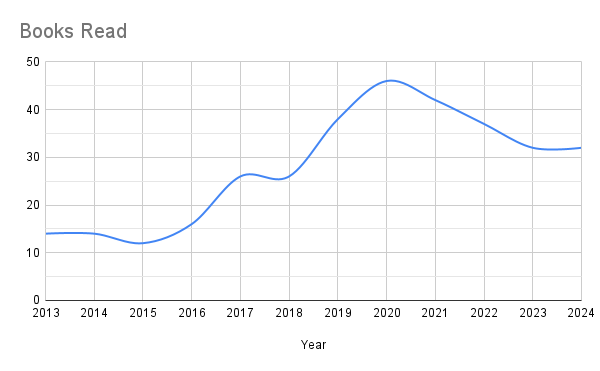
The researchers point out that the decline in reading correlates with an increase in the use of other digital media, including social media, and I already mentioned a rise in gaming. I only read 12 books in 2015, but that rose fairly steadily to peak at 46 amidst the COVID-19 pandemic in 2020, declining back to 32 for the last couple of years. The median number of books read per year in the USA is about five, with an average of a dozen, the latter statistically inflated by a small number of voracious readers.

In about 300 days, I’ll have eight hours each weekday freed up from work. It will be interesting to see how that impacts my reading, walking, and viewing habits. Retirees enjoy almost seven hours of leisure time each day, which they often spend on reading, games, creative ventures, and spending time outdoors. They savor their meals more and spend more time on home repairs and gardening.

I’ve a list of things I’m interested in after retirement, including Tulsa Town Hall lectures, Osher Lifelong Learning Institute classes, completing my downtown history project, and spending more time at Woolaroc, Philbrook, and the Gilcrease once it reopens. It will be fun to connect more with friends and acquaintances, and I will no doubt do more dayhikes, updating my map of the trails at Osage Hills and revisiting trails I haven’t walked in a decade or more. I’ve also accumulated a pile of books and several optical video discs of movies and old television shows that await my attention.

Robert Burns

Posted in books, random, technology, video | Leave a comment

Wilder’s Bridge of Love

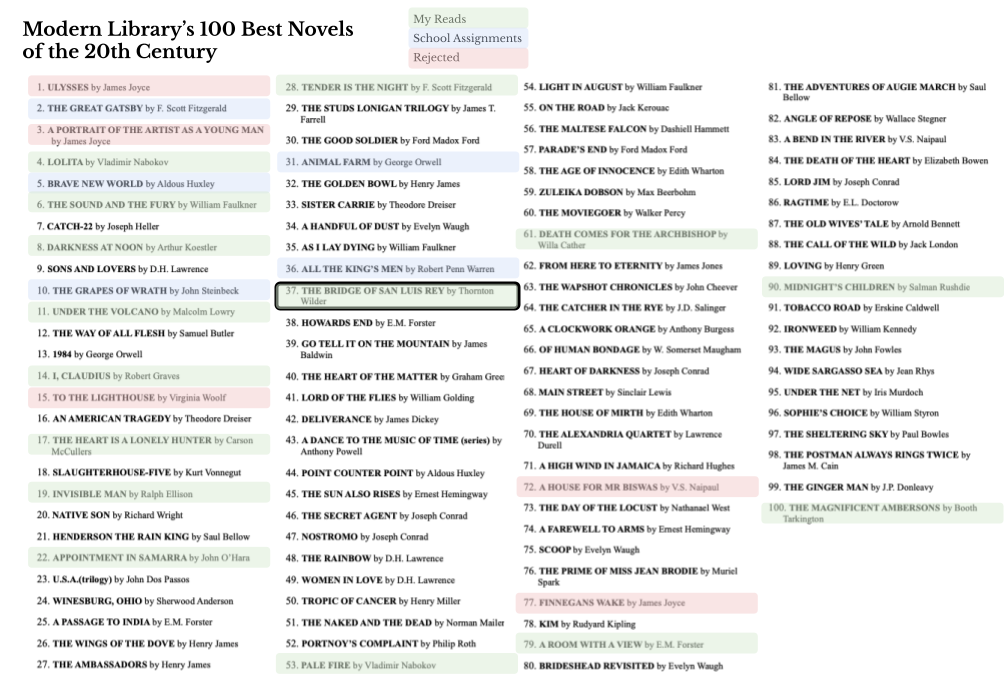
Thanks to Thornton Wilder, I have now read 1/5 of the 100 novels that Modern Library proclaimed to be the best of the 20th century. Before picking it from the list, I questioned whether or not I had ever heard of The Bridge of San Luis Rey, although I immediately recognized Wilder as the playwright of Our Town.

I rather suspect that Wilder’s novel only sounded familiar because of its similar title to The Bridge Over the River Kwai by Pierre Boulle, who also authored Planet of the Apes, although I’ve not read either of them, having merely seen the corresponding movie adaptations of 1957 and 1968. Kwai doesn’t even merit a ranking in The Greatest Books meta-analysis, while Apes ranks 13,716th. San Luis Rey is far more highly regarded, currrently ranked 622nd in the meta-analysis and #37 on Modern Library’s century list.

I’ve seen Our Town performed multiple times by high school students over the years. It was the most popular play for high schools in the 1950s, 1960s, and 1990s, and it was still in the top 6 in the 2010s. Its minimal sets, large number of roles, and prominent roles for females were key features bolstering its popularity.

[Source]

I was always struck by its use of a stage manager character as narrator. That meta-narrative and its memorable third act feel strangely modern despite the play being written in 1938 and depicting the fictional American town of Grover’s Corners between 1901 and 1913.

After finishing Wilder’s novel, I invoked the incredible power of the internet to revisit the 1977 television production of Our Town. It featured the wonder that was Hal Holbrook, joined by Ned Beatty, Barbara Bel Geddes, Sada Thompson, and Ronny Cox. I highly recommend it, even with the distracting video effects they used in the wedding scene.

I watched the play, rather than reading it, since I lack an internal monologue and never enjoy reading plays…for me, they must be performed.

Our Town leans hard into the “typical American town” vibe, and I’ve always enjoyed it, even though I don’t share its characters’ religious beliefs and disagree with some of its philosophy.

The Bridge of San Luis Rey was written a decade earlier than Our Town and is similarly philosophical, but its setting is radically different: Lima, Peru circa 1714. It tells the story of five people who died in the collapse of an Incan rope bridge and the events that led up to their being on the bridge at the fateful moment.

A friar who witnessed the collapse inquired into the lives of the victims, seeking a spiritual answer to the question of why they were killed, an inquiry that ends in fire.

The novel won the 1928 Pulitzer Prize and can be read or downloaded for free at Project Gutenberg. Wilder would go on to win Pulitzers for Our Town in 1938 and his play The Skin of Our Teeth in 1943, as well as the 1968 National Book award for his novel The Eighth Day. He was no slouch.

The novel was far removed in many ways from my own experience, but it was touching in its search for meaning. The final lines are thus:

But soon we shall die and all memory of those five will have left the earth, and we ourselves shall be loved for a while and forgotten. But the love will have been enough; all those impulses of love return to the love that made them. Even memory is not necessary for love. There is a land of the living and a land of the dead and the bridge is love, the only survival, the only meaning.

Reading those lines brought a song into mind, one that inevitably brings the sting of tears. Mark Knopfler wrote it after reading Only Love and Then Oblivion four days after September 11, 2001.

Wilder would share similar sentiments in a much later letter to Montgomery Clift, as recalled by Clift’s onetime romantic partner, Jack Larson, best remembered for his portrayal of Jimmy Olsen in the 1950s Adventures of Superman television series:

In the novel, Wilder was tackling the great conundrums of religious faith: Why do some people die and others don’t? and Why do bad things happen to good people (and vice versa)?

My answers to those questions are not Wilder’s, but despite our philosophical differences I greatly appreciate Our Town and The Bridge of San Luis Rey, mostly for when they challenge orthodoxy and portray — and thus subtly critique — the banality, hypocrisy, cruelty, and irrationality that pervade human affairs.

I highlighted this description of the abbess of a convent who connects each of the doomed:

She was one of those persons who have allowed their lives to be gnawed away because they have fallen in love with an idea several centuries before its appointed appearance in the history of civilization. She hurled herself against the obstinacy of her time in her desire to attach a little dignity to women.

It is apparent to me that Wilder chose a land distant in location and time so as to undermine readers’ preconceptions. Had he written his book a few decades later, I wonder if he might have chosen a distant planet in the far future, crafting a work of science fiction.

So what’s next? Well, I’m going to try for a trilogy of sorts. I’ve purchased Wilder’s The Eighth Day, which he wrote in 1962 and 1963, when he was around retirement age and spent twenty months in hibernation, away from family and friends, in the Mexican border town of Douglas, Arizona. It will be interesting to see how a lifetime of experience affected his work.

Posted in books, music, religion | Leave a comment