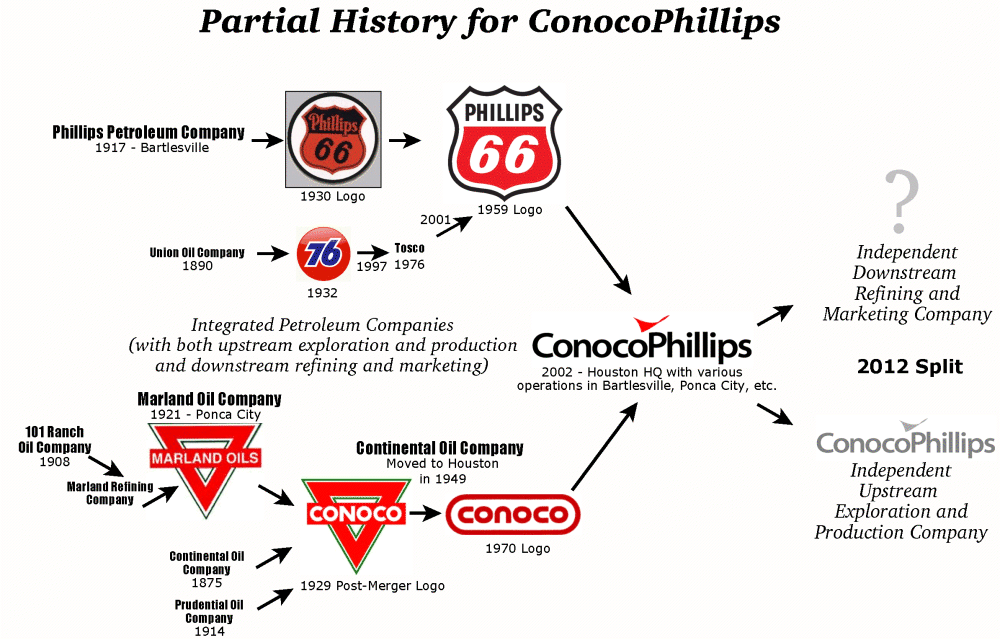
Some fellow Bartlesville teachers and I were on a summer lark, touring the Marland Mansion in Ponca City, when we heard the big news: ConocoPhillips is breaking up. It seems fitting that we heard the news at the mansion, since Marland Oil blended with Continental Oil Company in 1929 to become the well-known Conoco brand until it merged with Bartlesville’s own Phillips Petroleum in 2002. It will be interesting when, a decade after the merger, we see two separate and non-integrated companies emerge.
Click the image below for a history of some of the larger mergers and branding that formed what we know as ConocoPhillips today.
ConocoPhillips History (click image to enlarge)
Any changes in ConocoPhillips are big news for us since Bartlesville, where I’ve lived and taught for 23 years, is still dominated by the company. Bartlesville was the world headquarters for Phillips Petroleum for 85 years from 1917 until 2002, with the company employing over 9,000 Bartians in 1981 although that number had dropped to about 2,400 by 2001.
In 2002 Phillips merged with Conoco and the Phillips refining, wholesale marketing, and exploration and production divisions left Bartlesville for Houston. But local employment levels remained fairly stable and then grew somewhat to reach about 3,000 today. Bartlesville became a global support center for the company, handling accounting, information technology, human resources, and finance operations. The company’s research and development center remained in Bartlesville, which is also home to Chevron Phillips Chemical Co. research and development operations. The fate of Chevron Phillips and other joint ventures is not yet determined. Meanwhile, Ponca City endured heavy job losses as the company’s operations there contracted to concentrate on the local refinery.
Phillips and Conoco were integrated petroleum companies for many years, but recently ConocoPhillips has been shedding some of its refining operations and now it will separate into two companies. One will be upstream exploration and the production and the other will be downstream refining and marketing.
One radio report claimed the upstream company would be called Conoco and the downstream company would be called Phillips, but in his remarks to investors Mr. Mulva referred to the new upstream company as ConocoPhillips with the downstream company unnamed at the time. So even if we did see a revival of Phillips Petroleum, it would not be the sort of integrated petroleum company it was prior to 2002.
UPDATE:
They eventually decided to name the downstream company Phillips 66, so here’s an updated graphic:
Phillips Petroleum/ConocoPhillips History (click to enlarge)
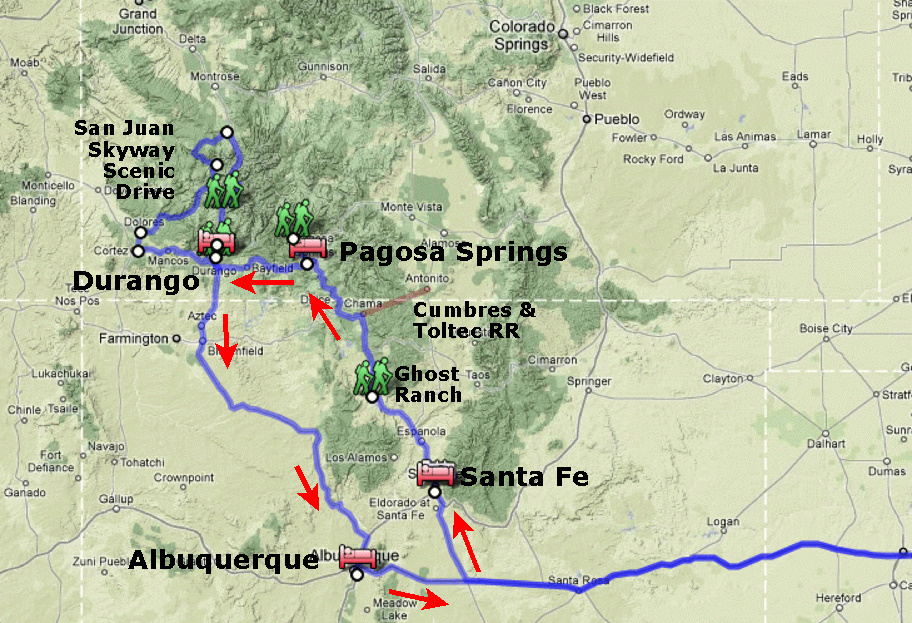
Soon I embark on my annual escape from Joklahoma’s miserable July weather. This trip will be similar to the one I took last year, with me heading out west to visit Santa Fe, New Mexico as well as Pagosa Springs and Durango, Colorado. However, this time I am sticking to I-40 for the trip out and back, avoiding the slower (and, thanks to feedlots, smellier) northern route through Dodge City.
July Jinks 2011
Unfortunately, much of the hiking I had planned has been cancelled because the area forests have Stage III fire closures. I had originally planned to hike in the forest east of Santa Fe and then spend several days in Los Alamos to hike in Bandelier National Monument. But on June 26 a tree fell on a power line and ignited the massive Las Conchas fire. It has spread to 150,000 acres and is still not contained. Los Alamos was saved, but Bandelier is closed indefinitely as is the Santa Fe forest both east and west of town and the Carson Forest to the north. Sandia Peak an hour southwest at Albuquerque is also now closed to hiking.
So I’ll have to content myself with Santa Fe museums and the Plaza one day, and will hike the loop trail at the Audobon Center and Nambé Falls, which are still open. Then I’ll head north toward Pagosa Springs, stopping to hike at Ghost Ranch if any of its trails remain outside Carson Forest and thus still open.
I then head north to Pagosa Springs. Thankfully the San Juan Forest is still open with only Stage I fire restrictions, versus the Stage III closures in New Mexico. So I can hopefully get in a couple of days of hiking in that area. Last year I stayed on the east side of town. This year I’ve booked a room west of town at a hotel which should have better WiFi for uploading my pictures and blog posts.
Although the New Mexico forests are closed, they are still allowing the Cumbres & Toltec Scenic Railroad to operate between Chama, New Mexico and Antonito, Colorado. So I’ll ride the train from Chama to Antonito and then ride a bus for the return trip. The rails are another section of the same narrow-gauge line serving the famous Durango & Silverton train which I rode in 1991 and 2010.
Then I head west to Durango, where I’ll see a road production of Greater Tuna and probably spend a day taking the San Juan Skyway Scenic Drive. I may hike at Purgatory as well. The trip will then end when I drop down to Albuquerque to tour a bit before the long drive east back to Oklahoma.
Despite the forest closures, it should be a good trip; projected highs will be in the mid-80s compared to the continuing string of 100s in Oklahoma. And I’ll be getting away from town where I’ve spent many days on school activities, including some committee meetings, filling an open science position at our school, organizing the work of seven district teachers who are writing science curricula, and bargaining a new contract for Bartlesville’s teachers.
Before The Star Spangled Banner was declared the national anthem by Congress and Hoover in 1931, the country used Hail Columbia, which was composed in 1789 for George Washington’s inauguration. It is now used to announce the Vice-President. And it’s pretty terrible.
When I was a kid in grade school we always sang the alternate version of the British national anthem, God Save the Queen, which we learned as My Country, ‘Tis of Thee. That’s a much better song, but we can’t use the same song as the British, now, can we?
I do love that back in 1939 Marian Anderson, who had been denied permission to perform at Constitution Hall by the Daughters of the American Revolution because of her color, was invited by Harold Ickes, at the urging of Eleanor Roosevelt, to perform it at the Lincoln Memorial.
Yankee Doodle Dandy also comes to mind, but let’s get serious. Recognizing its emblematic status, in 1931 Congress and President Hoover declared The Star Spangled Banner as our national anthem. And regretfully it is a terribly difficult song to sing well. It is based on an old British drinking song and most of us probably have to be inebriated to think we can carry it off.
Joseph Byrd argues, “It actually makes a very good drinking song, with its dramatic caesura followed by the tipsy high tenor note on the last phrase. The middle part, which strains the vocal range of ordinary mortals, was intended to be amusing. Where we sing ‘And the rockets’ red glare,’ the original song had the Athenian poet Anacreon calling down from heaven in an effete falsetto, ‘Voice, fiddle, and flute, no longer be mute, I’ll lend ye my name, and inspire ye, t’boot!'”
We’re so put off by the difficulty in singing our anthem that too often we stand silently and allow those with greater vocal talents to attempt it on our behalf. I’d frankly prefer that we just butcher it in unison and not treat its performance like a talent show!
Many have suggested alternate songs for our anthem, such as Irving Berlin’s God Bless America.
Others suggest America The Beautifulwhich, like The Star Spangled Banner, started out as a poem. Katharine Lee Bates had been inspired by Pikes Peak and Samuel A. Ward’s hymn, Materna, was fitted to the words later on. Many like Ray Charles’ take on it.
And then there’s the Black National Anthem, Lift Every Voice and Sing, which also started out as a poem back in 1900 and, like We Shall Overcome, was literally an instrumental part of the civil rights movement.
I’d suggest This Land Is Your Landfor our anthem, but I realize it isn’t regal enough, and some folks would no doubt object to Woody Guthrie’s politics.
In the end, we all recognize our nation’s anthem as The Star Spangled Banner. At least the Mormon Tabernacle Choir can do it justice.
That’s only the first and fourth verses. In fairness I should offer up a defense of our anthem, so here’s famed writer Isaac Asimov, and a review of ALL of its verses:
In 1812, the United States went to war with Great Britain, primarily over freedom of the seas. We were in the right. For two years, we held off the British, even though we were still a rather weak country. Great Britain was in a life and death struggle with Napoleon. In fact, just as the United States declared war, Napoleon marched off to invade Russia. If he won, as everyone expected, he would control Europe, and Great Britain would be isolated. It was no time for her to be involved in an American war.
At first, our seamen proved better than the British. After we won a battle on Lake Erie in 1813, the American commander, Oliver Hazard Perry, sent the message “We have met the enemy and they are ours.” However, the weight of the British navy beat down our ships eventually. New England, hard-hit by a tightening blockade, threatened secession.
Meanwhile, Napoleon was beaten in Russia and in 1814 was forced to abdicate. Great Britain now turned its attention to the United States, launching a three-pronged attack. The northern prong was to come down Lake Champlain toward New York and seize parts of New England. The southern prong was to go up the Mississippi, take New Orleans and paralyze the west. The central prong was to head for the mid-Atlantic states and then attack Baltimore, the greatest port south of New York. If Baltimore was taken, the nation, which still hugged the Atlantic coast, could be split in two. The fate of the United States, then, rested to a large extent on the success or failure of the central prong.
The British reached the American coast, and on August 24, 1814, took Washington, D. C. Then they moved up the Chesapeake Bay toward Baltimore. On September 12, they arrived and found 1000 men in Fort McHenry, whose guns controlled the harbor. If the British wished to take Baltimore, they would have to take the fort.
On one of the British ships was an aged physician, William Beanes, who had been arrested in Maryland and brought along as a prisoner. Francis Scott Key, a lawyer and friend of the physician, had come to the ship to negotiate his release. The British captain was willing, but the two Americans would have to wait. It was now the night of September 13, and the bombardment of Fort McHenry was about to start.
As twilight deepened, Key and Beanes saw the American flag flying over Fort McHenry. Through the night, they heard bombs bursting and saw the red glare of rockets. They knew the fort was resisting and the American flag was still flying. But toward morning the bombardment ceased, and a dread silence fell. Either Fort McHenry had surrendered and the British flag flew above it, or the bombardment had failed and the American flag still flew.
As dawn began to brighten the eastern sky, Key and Beanes stared out at the fort, trying to see which flag flew over it. He and the physician must have asked each other over and over, “Can you see the flag?”
After it was all finished, Key wrote a four stanza poem telling the events of the night. Called “The Defence of Fort M’Henry,” it was published in newspapers and swept the nation. Someone noted that the words fit an old English tune called “To Anacreon in Heaven” –a difficult melody with an uncomfortably large vocal range. For obvious reasons, Key’s work became known as “The Star Spangled Banner,” and in 1931 Congress declared it the official anthem of the United States.
Now that you know the story, here are the words. Presumably, the old doctor is speaking. This is what he asks Key:
Oh! say, can you see, by the dawn’s early light,
What so proudly we hailed at the twilight’s last gleaming?
Whose broad stripes and bright stars, through the perilous fight,
O’er the ramparts we watched were so gallantly streaming?
And the rocket’s red glare, the bombs bursting in air,
Gave proof thro’ the night that our flag was still there.
Oh! say, does that star-spangled banner yet wave,
O’er the land of the free and the home of the brave?
“Ramparts,” in case you don’t know, are the protective walls or other elevations that surround a fort. The first stanza asks a question. The second gives an answer:
On the shore, dimly seen thro’ the mist of the deep,
Where the foe’s haughty host in dread silence reposes,
What is that which the breeze, o’er the towering steep.
As it fitfully blows, half conceals, half discloses?
Now it catches the gleam of the morning’s first beam,
In full glory reflected, now shines on the stream
‘Tis the star-spangled banner. Oh! long may it wave
O’er the land of the free and the home of the brave!
“The towering steep” is again, the ramparts. The bombardment has failed, and the British can do nothing more but sail away, their mission a failure.
In the third stanza, I feel Key allows himself to gloat over the American triumph. In the aftermath of the bombardment, Key probably was in no mood to act otherwise.
During World War II, when the British were our staunchest allies, this third stanza was not sung. However, I know it, so here it is:
And where is that band who so vauntingly swore
That the havoc of war and the battle’s confusion
A home and a country should leave us no more?
Their blood has washed out their foul footstep’s pollution.
No refuge could save the hireling and slave
From the terror of flight, or the gloom of the grave,
And the star-spangled banner in triumph doth wave
O’er the land of the free and the home of the brave.
The fourth stanza, a pious hope for the future, should be sung more slowly than the other three and with even deeper feeling:
Oh! thus be it ever, when freemen shall stand
Between their loved homes and the war’s desolation,
Blest with vict’ry and peace, may the Heav’n – rescued land
Praise the Pow’r that hath made and preserved us a nation.
Then conquer we must, when our cause it is just,
And this be our motto–“In God is our trust.”
And the star-spangled banner in triumph doth wave
O’er the land of the free and the home of the brave.
I hope you will look at the national anthem with new eyes. Listen to it, the next time you have a chance, with new ears.
Yesterday I finally discovered the songs of Michael Bublé. Of course once you finally notice some outstanding performer you’ve previously been ignorant of, you immediately start to notice him or her everywhere. Yesterday and today I listened to a bunch of his song samples on iTunes, cherrypicked my favorites for purchase, and set up a playlist for a drive to Tulsa. After lunch there I was browsing at a bookstore and promptly ran across an unkind photo of him in a gossip rag – they’re just jealous of his marvelous voice, I suppose.
You can hear my Bublé playlist via YouTube; below are details and links for each of my 11 selections, including other famous versions of the songs.
Save the Last Dance for Me
1. Save the Last Dance for Me
This is the song which introduced me to Michael’s music, overheard as I strolled down the toothpaste aisle. It was composed by Doc Pumus and Mort Shuman and was a #1 hit in 1960 for The Drifters. I own the version by The Drifters but am most fond of the sadder version by Emmylou Harris, a top ten Country hit for her in 1979.
Michael is joined by Sharon Jones and Dap-Kings on this 1960 song composed by Clyde Otis, Murray Stein, and Brook Benton. Dinah Washington and Brook Benton had a top-five hit with it.
This 1963 number has great credentials with music by Henry Mancini, Italian lyrics by Franco Migliacci, and English lyrics by Johnny Mercer. It appeared in the original Pink Panther film, performed by Fran Jeffries. Michael performs an adaptation of an arrangement of it for Lena Horne. “Meglio stasera” translates as “Better tonight” and “Fa’ subito” as “Do it right away” – the urgent message is basically, “Let’s make love tonight, because who knows what will happen tomorrow.”
I’ve loved this song since I first hear Anita Kelsey overdub Jennifer Connelly’s performance of it in the theatrical release of Dark City. It was composed in 1953 as ¿Quién será? by Mexican composer and bandleader Pablo Beltrán Ruiz and the best known version was in 1954 by Dean Martin.
This was a number composed by Anthony Newley and Leslie Bricusse for the 1965 musical The Roar of the Greasepaint – The Smell of the Crowd with Cy Grant singing. My favorite version is by Nina Simone, but Michael does a fine job.
I’m no dancer, my attempts consisting primarily of shifting my weight from foot to foot as I wriggle my hips and shoulders, accompanied by flailing forearms. The first time I recall dancing in public, if we discount my escapades as a toddler, was to gyrate to Devo’s Whip It at the Mayfield Junior High 9th Grade Banquet. That prompted legislation restricting me to the occasional bout of spelling out YMCA, in the style invented on American Bandstand, when chaperoning the prom.
But faithful readers know that despite my personal awkwardness I do admire splendid dance numbers, from Stormy Weather to Mary Poppins. Today I was shopping at Walgreens and found myself having to resist tapping my toes, snapping my fingers, and twirling to, of all things, Save the Last Dance for Me.
Counterintuitively, while I love the lyrics, I’ve never thought of that song as much of a dance number. Although I purchased the classic 1960 version by The Drifters as part of my audio collection years ago, it doesn’t get my body moving beyond a side shuffle and head bob. And my favorite version of the song is the somber 1979 one by Emmylou Harris, which seems only suitable for a slow dance.
But today along the toothpaste aisle in Walgreens I heard a take on the song I’d never heard before, which my iPhone’s SoundHound app told me was released by Michael Bublé in 2005. I promptly bought the song, added it to my playlist, and in composing this post foundthe wonderfully cute video.
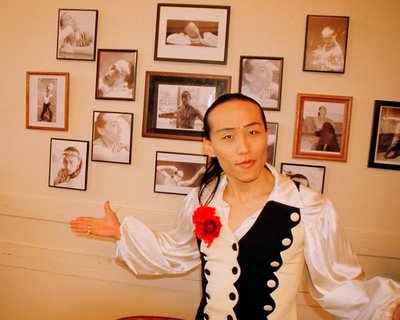
Raymondo Chan
Isn’t the dance instructor Raymondo Chan wonderful in that video? As an Asian Canadian who teaches salsa dancing, he’s just as much of a remix as Bublé’s cover of the song!











 Meador Manor