July Jinks Day 4: Opals and Sulfur

Opal Lake (click image for slideshow)

I had a rough third night in Santa Fe but still managed to grab a continental breakfast at the hotel and hit the road by eight o’clock. I drove north towards Pagosa Springs, originally intending to stop at Heron Lake and see if the Rio Chama trail from there to El Vado Lake was open.

I passed the gorgeous bluffs near Ghost Ranch, regretting that its trails are closed under the fire threat. And then only 1.5 miles from the turnoff for the lakes, I was stopped by a flag man and had to wait 10 minutes for a pilot truck to guide me and the long line of cars built up behind me through several miles of resurfacing. By then I’d lost my appetite for an uncertain hike and wanted a cooler hike at a higher altitude in an open forest, one which was guaranteed to pay off.

So I drove on, noting the noticeable shift in the forest as I entered Colorado. My route led me to Chama and I scoped out the depot where I’ll board the Cumbres and Toltec train on Thursday morning. What a contrast to Durango! The downtrodden burg had nothing to offer, so I drove on into beautiful Pagosa Springs for lunch and to check that this stretch of highway wasn’t under construction. It wasn’t, and at the restaurant I researched trails on my iPad and recalled that last summer I had considered a hike above 9,000 feet of altitude that involved Opal Lake.

Afternoon is no time to be solo hiking at higher elevations because the mountains invoke thunderstorms. But I found I could just hike a mile in to Opal Lake and then back out, elevating from about 8,750 feet of altitude at the trailhead to about 9,250 feet at the lake. So I retraced my drive south eight miles and turned eastward into the San Juan Forest, taking gravel roads 13.5 miles in and up to the trailhead.

I saw what I’ll call a prairie chicken along the road, and the sky still looked bright and sunny, with pretty aspens alongside the road. There were several vehicles, including a horse trailer, at the trailhead. I signed in at the register and noted past visitors had carved many a tree. The trail began climbing steadily and I was grateful for my trekking poles. It had been a month since I’d done a serious hike and the altitude was taking its toll. I soon met two ladies riding their horses back to the trailhead.

The trail was heavily forested, only passing one large rock outcropping near the first of several fords of White Creek. (Why isn’t it called Rito Blanco? That sounds better.) The trail had not been very pretty, but then I hit a large grove of aspens. Oh yes, that’s nicer, and I could tell some others had loved it 15 years ago.

The trail would feature oodles of wildflowers from here on to the lake. I did not bring my wildflower ID guide with me and I’m tired, so I’ll give them Latin names based on their color – Linneaus be crucified. There was an Opalus canarius and some wilting Opalus xanthinus near a fallen log.

The sky was darkening, with the trail headed toward Storm Mountain. Okay, it’s really one of the 11,700 foot peaks in the Chalk Mountains, and I’m the only one who has the imagination to call it Storm Mountain. But to heck with the clouds, the lake couldn’t be much farther. I hit a junction with Fish Creek Trail, which I would unexpectedly return on awhile later.

The sides of the trail were lined with the same tall plants I’d seen in bloom at Williams Creek last year – let’s call them Florealbo, although a lot of searching online leads me to believe it is Veratrum californicum, variously known as the corn lily, false hellebore, and “skunk cabbage.”

Dark clouds were building over nearby Flattop Mountain, which peaks out at 11,400 feet. Here and there a gap between the Florealbo (okay, corn lilies) I caught colorful glimpses of what I think of as foxglove, but is really Penstemon hallii, and that name I did not make up. I have swcoloradowildflowers.com to thank for that identification. I forded the creek again and soon was told Opal Lake was only 0.1 mile away on a side trail. I’d make it before the weather turned on me!

The trail was lined with wildflowers with busy bees. The only time the insect life bothered me was when I stopped to take a photograph. So yes, they were driving me crazy. Why I hadn’t sprayed down with Cutter is a mystery to me too.

The trail opened out on a large meadow and I caught a glimpse of the lake. Flowers were strewn before Flattop Mountain to appease it. And then I was on the shore of Opal Lake, with Flattop and its taller friend in the background. At one side a stream was pouring down into the lake, and I shot a video of its flow.

Some fishermen came up behind me, so I fled down a perimeter trail, startling a family of ducks into motion. The lake looked pretty good from the new angle, and it nicely reflected the building clouds. Oh – I’d better get moving.

But I still stopped for a red burst flower, er, Cheiri. Then the perimeter trail I’d been following hit another creek area and petered out. I bushwhacked quite a bit, trying to complete the loop on animal trails which left me with tiny cuts on my legs and several bites (from insects, not the trail blazers, and I saw three snakes slithering, but not biting, together). The animal trails got too tight, so I had to backtrack. I then found a narrow grassy trail which headed back toward the trailhead, parallel to the Opal Lake Trail. That would do, and I was reassured by tree graffiti that this trail really led somewhere. It eventually popped out at the junction I’d seen earlier – I’d been on a less travelled portion of the Fish Creek Trail.

By now faint distant thunder was getting louder and I saw a flash of lightning. Time to scramble! I caught up with another couple who were high-tailing it toward their car. We laughed as we scrambled along, the man asking if my trekking poles had shock absorbers as we bounced down the rough trail. With my poles giving me two more legs, I felt like an enraged bull heading down a hillside toward his bouncing red shirt.

A fine rain began falling, just enough to cool us off without soaking us. We ran into a group of hikers headed uphill toward the lake, but they were all outfitted with ponchos. If I were them, I’d want a lightning rod to boot, although I’d only seen that one flash. We were soon back at our cars, celebrating our timing since just then the rain started to pick up.

As I descended on the gravel roads, the rain slackened and disappeared, as I’ve noticed before: Pagosa Springs can be bright and sunny while it rains in the mountains a few miles away. As I crossed a bridge, I spotted a deer crossing the Rio Blanco.

I drove back into town and checked into my hotel. I’m staying up on the flat land west of town this time, in a hotel with good room WiFi. And the view from the window is pretty good even though it looks out on the highway. After a shower and change of clothes I headed to JJ’s Riverwalk Restaurant & Pub to again enjoy a tremendous prime rib while tourists fished or floated by on their tubes in the shallow river. A cute black cat walked up along the riverwalk and tried to beg scraps from the diners, clearly on the lookout for wait staff who’d kick her out.

Thoroughly stuffed, I walked along the riverwalk and discovered a momma cat and her kittens hiding in the shore brush. There was still some daylight left, so I decided to go see the springs area, which I’d only given a cursory look last summer. I drove downtown and located the public spring by the road feeding down into the San Juan River. The water comes out too hot for bathing, but the hotels mix it to get different pools for soaking. You can’t enjoy heaven without hell, so it was fitting that the attractive springs area had frequent whiffs of sulphurous fumes from the mineral springs.

I had fun watching folks try to navigate the river in their tubes and shot a video of their exploits.

I also liked the lawn chess set at one hotel. Having circumnavigated the springs area, I crossed the San Juan, took a last look at the springs area, and drove to my hotel beneath the sheltering sky.

It is raining as I wrap up this post. Tomorrow I plan to rise early and drive north out to the Williams Creek canyon off the Piedra River to go farther along a hike I had to abandon early last year due to storms. And yes, there’s a 40 percent chance of afternoon thunderstorms tomorrow, so I’ve got to get around, drive 40 minutes out to the trail, and do as much of it as I can in the morning.

Click here for a slideshow of this day hike

Day 4 of July Jinks 2011 ->

<- Day 3 of July Jinks 2011

Posted in day hike, photos, travel, video | Leave a comment

July Jinks Day 3: Anasazi and Atomic City

In the footsteps of the Anasazi at Bandelier (click image for slideshow)

Long post today, because I took lots of pictures on my day hikes at Bandelier National Monument and my visit to Los Alamos. I culled 186 shots down to 80, just for you, gentle viewer.

My day began with breakfast in the back room at the Pantry, a favorite area restaurant operating since 1948. By the time I left there was a line at the door stretching outside, but that’s not because I’m a slow eater. I then drove north towards Los Alamos, a wonderfully scenic drive once one turns west off US 285 onto NM 502. It dives down to cross the Rio Grande and then wiggles westward until you turn off on NM 4 towards White Rock and Bandelier National Monument.

There were signs of the nearby nuclear science lab, especially a large receiving dish off the road which is clearly in use since in the afternoon I would see it again, pointed directly upward to the sky. I passed eroded bluffs, clear inspirations for the Anasazi (ancestral pueblo peoples) to dig into the talus to expand their cliffside dwellings. The ashy rock was produced by the Jemez Volcano over a million years ago, which had two eruptions each estimated at 600 times as powerful as the recent Mt. St. Helens eruption, covering a 400-square-mile area in ash up to 1,000 feet thick. The 12-mile diameter Valles Caldera is a remnant of one eruption. Jeepers! I remember at the Mt. St. Helens Visitor Center a display showing how many eruptions dwarfed it, but the statistics are staggering.

Soon I reached the entrance to Bandelier, which was named after a Swiss naturalist and that explains the difference in spelling from the term for a shoulder-strap ammunition belt. The monument has been closed for several weeks by the Los Conchas fire. The fire burned over 233 square miles of the Jemez Mountains and only a few of the over 70 miles of hiking trails have re-opened, with park staff busily sandbagging around the historic CCC structures in the park to prepare for flash floods and debris they know will come. Burned desert ground repels water, and the park reports that following the La Mesa Fire of 1977 Frijoles Creek flowed at thirty-two times its usual rate and destroyed about two dozen trail bridges, altered the stream bed, forced evacuations, and deposited three feet of silt behind the administrative buildings. So good luck to their efforts to prepare for what is to come when New Mexico’s afternoon monsoons of late July arrive.

They waived the usual $12 entry fee and allowed me to go to the Juniper campground to hike two miles on the Tyuonyi Overlook Trail. The beginning looked unpromising, with a number of fallen and burned trees from old fires (this area was not burned in the Los Conchas fire). But in the distance rose beautiful mountains, perhaps helping inspire the Anasazi to build a circular shrine up here on the mesa.

As the trail made a beeline along a ridge projecting on the edge of Frijoles Canyon, a distant highway looked like an absurd trail extension and improvement project. At the overlook there was a sign which told of how Tyuonyi Pueblo peaked in the late 1400s at about 400 rooms with up to three stories in parts of the circular structure. A brochure told me Tyuonyi translates as “meeting place” and is pronounced QU-weh-nee.

The overlook provided a tremendous panoramic view of Frijoles Canyon, formed by El Rito de los Frijoles or “The Little River of Beans” – and I have no idea why the Spanish called the creek by that name. All around I could see closed trails begging to be hiked – darn that forest fire!

I met a family from Maine by taking their group photo for them, and when they mentioned their disappointed desire to see more ruins, I told them that the Tsankawi area back north near White Rock was open and had some sort of ruins. They would follow that tip, for I ran across them there later and we had a happy conversation as we traversed portions of the trail there.

But first I returned to my car and drove west, intending to hike the open Burnt Mesa Trail. But the parking area was closed for remediation and clearly the first few miles of the trail had been burned over, making the name most appropriate. So I drove onward to take NM 501 north into Los Alamos and zipped back east to the open Tsankawi Ruins, and that one has the more obvious pronunciation of SAN-kuh-wee.

The ancestral pueblo people who settled in this area, the Pajarito Plateau, from roughly 1100 to 1500, were divided into different language groups which shifted in different directions when a drying climate and likely overpopulation and resource depletion led them to shift to pueblos along the Rio Grande. Those living in Frijoles Canyon spoke Keres and oral traditions say they moved to Cochiti Pueblo. But those living in the separate Tsankawi area spoke Tewa and moved to San Ildefonso.

The trail ascended the pretty pink and white volcanic cliffs via a ladder. Up top I could see a creek heading eastward toward the gash of the Rio Grande and soon I encountered the ancient furrow in the tuff carved by millions of footfalls over the past millenium, which would guide me the rest of the way. The white trail led upward and then I found a spot making me wonder if they had their own version of Bigfoot, but of course they just wore out different paths over time.

The view south was fantastic, and I stood aside from the channel for two hikers coming toward me. They laughed, saying they had done the trail backward because of a big group in front of them before they hit a fork. I certainly understood, and a few minutes latter spotted the big group trailing down the lower part of the loop like a trail of ants. I wondered why most of them had worn dark shirts for this hot sunny hike – my self-portrait along a particularly deep section of the trail furrow reveals my choice of attire: a white wicking shirt and a new Tilley hat, hurriedly purchased and rushed to me last week when I left my old misshapen one behind at a movie theater in Jenks.

I reached a funny fork where those horizontally challenged among us might choose to deviate to avoid a narrow cleft of steps. I took the slim path up, despite my high-edge-of-normal BMI (perhaps I’m just dense) and was rewarded with a great panoramic view of a nearby mesa and a lovely view to the north as well. My, but the views from this mesa were memorable, with only the sweep of the highway to disrupt the north view, striped by huge cloud shadows.

A sign warned me I was approaching the unexcavated ruins atop the mesa, which to my untrained eye looked like scattered stones and brushy depressions. I posed by a large cactus which belied the translation of Tsankawi as “village between two canyons at the clump of sharp round cacti.”

A squirrel dashed in front of me to stretch out under a bush, hoping to blend in. I waited until he got to work again, but as soon as I moved he flattened right out again. I reached the cliff edge and there met up with the folks from Maine whom I’d met earlier. Another ladder took us down to several runs of hand-carved caves in the tuff.

I took shelter in one, grateful to get out of the sun for a bit. The talus trail was like an Anasazi hallway, with rooms on one side and a big canyon on the other. Some caves had petroglyphs and blackened ceilings – the Anasazi did this to make the ceiling less friable. I liked the niche in one cave.

Some folks from Pennsylvania had me play peekaboo from behind a rock – a welcome breeze made me use my hat strap. I turned back at one point to capture a woman lost in contemplation. I came across a bluff face with petroglyphs, then another with many small pockmarks in it, presumably to provide Anasazi with a quick scramble to the top, but it would only appeal to a rock climber. The trail began to descend, offering a choice between a deep groove and a shallower set of steps. The Anasazi used axes to fell large Ponderosa pine trees whose straight, thick trunks made excellent vigas: the beams used to support the roof. Many viga holes of multiple levels are visible in Frijoles Canyon, but there was one spot at Tsunkawi with them as well, although the vigas here were small.

The trail wrapped up along a ledge and I bid farewell to the folks from Maine, who were heading on to points westward, including Yosemite, which I simply must visit someday.

From this long description it probably seems like the hikes took all day, but it was actually only lunchtime, so I drove into Los Alamos for what proved to be a mediocre lunch. But the restaurant was only a block from the Bradbury Museum, which my father and I had visited at a different site 20 years before. I decided to see how much it had changed, recalling that it is named after a longtime director of the lab, not science fiction author Ray Bradbury. The man who wrote There Will Come Soft Rains wouldn’t be a big fan of a nuclear weapons lab.

The new rented digs downtown are much nicer than the lab building we visited in 1991, but the highlights were still the mockups of Little Boy and Fat Man, the bombs dropped on Hiroshima and Nagasaki. A kindergarten teacher and her husband took a new shot of me next to Fat Man since my students would only laugh at the one my father took of me by it when I was in my mid-twenties and still had some hair up top. Now they can laugh at the caption to the photo: Fat Man. Whether that means the bomb or their teacher is up to them!

I took a shot of an instrument package used for underground nuclear weapons testing, something my students are unfamiliar with since our nation last conducted such a test in 1996. I took another shot for my class, of an Eniac circuit board, since we discuss that early vacuum tube computer when we deal with projectiles – Eniac was designed to compute artillery firing tables. After we work through deriving one simple range equation and contemplate the complicating factors we ignored, my students grasp why Eniac was so useful. Speaking of projectiles, the museum had a couple of missiles and mockups of their nuclear warheads on hand too.

On my way out of town I halted when I spotted an imposing log building with extensions sticking out here and there. The intriguing center was Fuller Lodge, built in 1928 from 771 massive pine logs selected by architect John Gaw Meem. He was quite influential, and his Santa Fe-style home on Museum Hill is now home to the Museum of Spanish Colonial Art. When I toured that museum yesterday, I was frankly more interested in the house than its contents.

Fuller Lodge was the dining hall for the Ranch School, a private school for boys which was purchased in World War II for use as a hotel and gathering place during the Manhattan Project. It was known as bathhouse row since they were the only rooms in town with bathtubs at the time. It is now a community center and home to a public art gallery. I wandered into the lodge and shot its main hall and a stairway, then captured one of its chimneys and other façade while outside.

Driving back along NM 4, I stopped at a switchback to shoot a panorama and then drove into White Rock. Its residential streets were lined with houses which were an odd mix of faux-dobe and conventional appearance. The yards were similarly inconsistent, some with quite nice xeriscaping and careful use of cedars interspersed with yards afflicted with tiny, ugly, and unkempt lawns struggling in the desert. My purpose in visiting was not to pick the best yard, however, but to view from an overlook the immense White Rock Canyon, where the Rio Grande has carved 1,000 feet down into the volcanic rocks. Not a bad way to wrap up a long photogenic day.

Upon my return to Santa Fe I showered and had tasty beef and chicken Tacos al Carbon with pork and beans at Los Patrillos. Tomorrow I journey north to Pagosa Springs, hoping to get in a hike along the way.

Click here for a slideshow from this day hike

Day 4 of July Jinks 2011 ->

<- Day 2 of July Jinks 2011

Posted in day hike, photos, travel | Leave a comment

July Jinks Day 2: Strolling Around Santa Fe

Santa Fe (click for slideshow)

I awoke in Santa Fe, had an uninspiring continental breakfast in the cramped lobby of the hotel complex, and set out for the hills to the northeast, hoping to hike part of the Dale Ball trail system. But alas, the entire system is closed, like the adjacent forest, because of the fire danger. I do wish the city’s webpage on the trail system would bother to mention that.

So I drove around the hilly residential area and finally settled on Hillside Park as a destination. I circled the park, but could not find a parking area – it turns out the one up top has been blocked off for unknown reasons. But I managed to find Thomas Silvestri Macione Park near the base of Hillside Park, and it had plenty of parking.

The tiny triangular plot of land is dedicated to Mr. Macione, or “El Diferente”, who was evidently a beloved eccentric who started out as a barber in Boston but moved to Santa Fe in 1952 to paint. A sculpture of El Diferente by Mac Vaughan, complete with easel, palette, and nearby dog, adorns the park.

I found the lower entrance to Hillside Park, which is a plaque-adorned series of ramps leading up the hillside. Ascending the walkway afforded a nice view of downtown and the Plaza a few blocks away, and a rabbit entertained me for a bit.

Up top the trail led to a monument with the figure of Justice on one side. It turns out the upper area was L. Bradford Prince Park, commemorating a territorial governor who was instrumental in early policies; the whole area was once part of Fort Marcy. Tiny lizards skittered by here and there. The city had started some trails across the park, but they were abandoned and incomplete. I wandered the area, reaching a nice home adjacent to the park at far end, and retraced my steps, catching sight of the Romanesque towers of the Cathedral Basilica of St. Francis of Assisi above the trees. I toured the Cathedral last year, but I would see it from the Plaza today as well.

Driving to the Plaza area, I searched for a street parking spot but finally gave up and grabbed one in a parking garage. I toured the New Mexico Museum of History and the Palace of the Governors, which is an ancient, long, and narrow adobe building dating back to 1610 and said to be the oldest continuously occupied public building in the U.S. Its current Pueblo Revival Style appearance dates back to a 1913 renovation and that look became mandatory for buildings throughout Santa Fe. It gives the city a unified distinctive appearance, even though it is mostly faux-dobe. Few buildings here have four-foot-thick walls build of mud bricks like the Palace.

Today the building, like the Spanish Governor’s Palace in San Antonio, is anything but what we think of as palatial. It seems like a fairly miserable place to be stuck in to me, spoiled as I have been by 20th and 21st century architecture and resources. I was struck by the small size of the chain mail on display used by Spaniards back in the day – even I would be heavier and taller than them thanks to modern nutrition. Photos were banned in the complex, but I did shoot the courtyard between the buildings. The white low structure on the right is the Palace. I also strolled out into the plaza and shot the front veranda, lined as always with Native Americans selling wares.

I’d hoped to eat at the famous Plaza Cafe, but it was closed pending clean-up from a kitchen fire. The receptionist at the museum suggested Tia Sophia’s, but it was closed too. So I strolled over to the La Fonda hotel, which was built in 1922 and was one of Fred Harvey’s famous hotels from 1925 until 1969. I’m not surprised that the impressive interior reflects the design work of Mary Colter, who helped create so many splendid buildings at the Grand Canyon and established a style now used throughout our national parks. I enjoyed a drink up in its bell tower last year.

In the 1970s the hotel’s interior fountain patio was enclosed and turned into the La Plazuela restaurant. It was fully renovated in 2009 when local architect Barbara Felix painstakingly reworked it. I was impressed by her attention to detail, even visiting the closed mine to get samples of the original flagstone material for a better match. I honored her work by dining at La Plazuela today, waiting until 11:30 for lunch to begin.

I was not disappointed. The beef fajitas I had tie with those at La Rosa in Bend, Oregon as the best I’ve ever had. While the grilled squash and other vegetables were what made La Rosa memorable, in this case the excellent slices of meat were served with delicious corn, pinto beans, and exquisitely cooked sweet onions and peppers. Nothing very unusual, outside of the corn, but these were prepared to perfection. And topping it off was a thick hot sopapilla and honey. I had enjoyed a similar meal at Enrique’s in Ponca City last week, but La Plazuela showed just how wondrous fajitas can be when skillfully prepared.

I waddled about the hotel for awhile, admiring the light fixtures, alcove paintings, and fireplaces. Back outside, I strolled down to the Cathedral, drawn by its bells striking 12:45 p.m. and its statuary, and was struck by a multi-figure statue in the park with both animals and people. An art show was going on, but I still got shots of the four major figures and a cathedral tower in the background, and the tower viewed amidst the park’s trees. The museum across the street from the cathedral, in the renovated Federal Building, is a nice example of Santa Fe style.

I wandered over to another art show, this one by the Santa Fe Society of Artists. I went in not expecting to buy a thing, but the penultimate booth was that of Franz Amadeus Leitner, and his landscape photographs were most striking. I especially liked a shot of Shiprock, a formation in northwestern New Mexico I have not visited but plan to see for myself next week. I liked it enough to splurge and buy the mounted print for my home. Mr. Leitner was charming and I enjoyed how he plugged a tiny swiper into his iPhone for my credit card.

On my way to my car with my bubble-wrapped treasure, I was stopped by three ladies who were looking for a yogurt shop. My own iPhone was used this time to give them walking directions, and as soon as they went on their merry way I was asking it for help too, since I’d told it to remember where my car was parked.

The next stop was Museum Hill, which I visited last year during the International Folk Art Festival. It was far quieter today, and the empty plaza highlighted the large Apache Mountain Spirit Dancer sculpture by Craig Dan Goseyun. I love how he captured the movement of the dancer’s costume. Nearby was Morning Prayer  by Allan Houser, who also sculpted Sacred Rain Arrow at the Gilcrease Museum in Tulsa.

I made a sandwich of the area, with boring slices of the Museum of Indian Art & Culture and the Museum of Spanish Colonial Art around the meat of the Museum of International Folk Art. Lucky for you, only the meaty museum allowed photography. A docent took me and an elderly couple from New York to highlights of the extensive collection of folk art. My favorite was the Girard collection, a sampling of about 10% of the 100,000 pieces Alexander Girard collected and donated, setting up clever displays and tableaus. I liked the Polish cathedrals decorated with silver foil from candy wrappers, a South American cathedral, a Mexican courtyard tableau, and loved the addition of some camera-laden elderly tourists in the huge pueblo tableau. I also admired the costumes in another wing from a Bolivian Carnival and Peruvian Masquerade.

It was too late in the day to visit the fourth and final museum on the hill, the Wheelwright, so I drove over to the Cristo Rey Church, which is the largest adobe church in the world. Making my way over to the Monsignor Patrick Smith Park, I spotted a bell just like the one my father has on a pole in his backyard. This one was handsomely mounted above a gate in an adobe arch.

Folks were lounging under the few trees around the edges of the park, some with children and some getting randy enough that they’ll have children in no time. My final shot of the day was of a home perched on a distant hillside.

I returned to my hotel to map out, literally, my strategy for the next couple of days and then had spaghetti and meatballs at the Olive Garden. Tomorrow I’m going to Bandelier National Monument, which had been completely closed for a few weeks due to the Los Conchas Fire. Frijoles Canyon is still closed indefinitely, with fears of flash flood damage in the coming rains. But last Friday they opened up three trails around the north edges of the park and I’ll take anything at this point since all of the forests and city trails are shut down. I had fun in town today, but I’m ready to head out to the countryside for a day hike.

Click here for a slideshow from today’s hijinks

Day 3 of July Jinks 2011 ->

<- Day 1 of July Jinks 2011

Posted in day hike, photos, travel | 1 Comment

July Jinks Day 1: Across the High Plains

Santa Rosa Lake Lizard (click image for slideshow)

The first day of July Jinks 2011 was a long drive from Oklahoma City to La Villa Real de la Santa Fé de San Francisco de Asís, but let’s just call it Santa Fe, New Mexico.

I drove straight west on I-40 into Texas, stopping at the Calico Cafe in Amarillo for lunch. I saw one dust devil near Amarillo and was pleased when filling up the car to note my 2001 Camry had managed to get 35 miles per gallon on the easy highway drive with temperatures in the 90s.

After entering New Mexico I skipped Tucumcari, which did not impress me last year, for a later stop along Highway 66: Santa Rosa. The lure was Santa Rosa Lake, which in the current drought is at dangerously low levels. The temperature was 99, but that did not dissuade me from taking a 3/4 mile trail to see the channel below the dam. The humidity was very low and I did not get terribly hot along the trail, while back home in Bartlesville I would have been drenched. I saw a pretty lizard along the way and a cactus which had turned pink. I took another short trail nearby, which looped around layered rock.

After that nice break from the drive, I headed back into Santa Rosa for a dipped cone at the Dairy Queen and headed back along I-40 to make the turn up the nearly deserted two-lane US 285 and then I-25 to Santa Fe.

I finished my penultimate Hercule Poirot audiobook along the way. The only Poirot novel that remains for me to enjoy is Curtain, the one Agatha Christie wrote in the early years of World War II and locked away in a bank vault for over thirty years. She saved it for posthumous publication, wanting her parting shot with Poirot to be a book written when she was at the height of her powers. That’s long-term thinking! I will savor it on this trip, unless the History of the Bible lectures I’m now listening to keep me too captivated. Having exhausted the Poirot series, save for short story collections, I’ll then listen to some more of her stand-alones and other short series. No doubt eventually I’ll work my way through the Miss Marples, but I don’t care for her as much and am putting those off having listened to two or three of them thus far.

I am staying at an apartment complex on the southeast edge of town which was converted into a hotel. It is cheap and quite adequate. I had to wait awhile for my dinner at Pizzeria Espiritu in a strip mall less than two miles away, but Yelp was right – it was superb! My pizza had mozzarella cheese and fresh basil, topped with a creamy sauce (rather than tomato sauce) and a mix of Portobello, Shiitake, and Italian mushrooms.

Last year the city seemed larger to me because of the route I took to and from my hotel. Now it seems smaller, especially since I know its population is only a bit more than twice that of Bartlesville. But it is far more upscale, of course, with its focus on art and tourism. Tomorrow I will visit Museum Hill and the Plaza.

Click here for a slideshow from today’s hijinks

Day 2 of the July Jinks ->

Posted in day hike, photos, travel | 1 Comment

The Return of Phillips Petroleum?

July 15, 2011

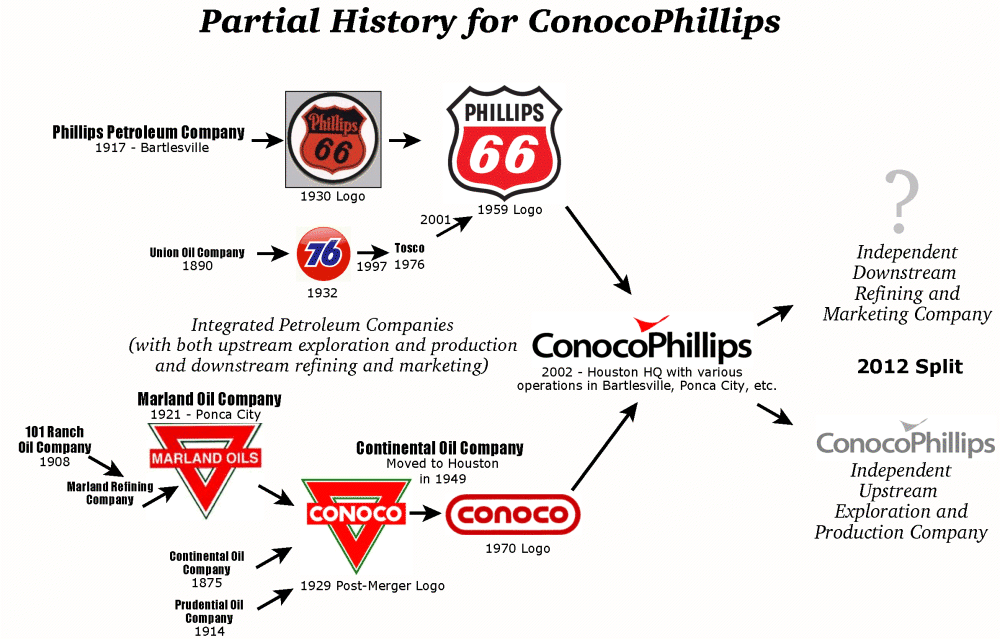
Some fellow Bartlesville teachers and I were on a summer lark, touring the Marland Mansion in Ponca City, when we heard the big news: ConocoPhillips is breaking up. It seems fitting that we heard the news at the mansion, since Marland Oil blended with Continental Oil Company in 1929 to become the well-known Conoco brand until it merged with Bartlesville’s own Phillips Petroleum in 2002. It will be interesting when, a decade after the merger, we see two separate and non-integrated companies emerge.

Click the image below for a history of some of the larger mergers and branding that formed what we know as ConocoPhillips today.

ConocoPhillips History (click image to enlarge)

Any changes in ConocoPhillips are big news for us since Bartlesville, where I’ve lived and taught for 23 years, is still dominated by the company. Bartlesville was the world headquarters for Phillips Petroleum for 85 years from 1917 until 2002, with the company employing over 9,000 Bartians in 1981 although that number had dropped to about 2,400 by 2001.

In 2002 Phillips merged with Conoco and the Phillips refining, wholesale marketing, and exploration and production divisions left Bartlesville for Houston. But local employment levels remained fairly stable and then grew somewhat to reach about 3,000 today. Bartlesville became a global support center for the company, handling accounting, information technology, human resources, and finance operations. The company’s research and development center remained in Bartlesville, which is also home to Chevron Phillips Chemical Co. research and development operations. The fate of Chevron Phillips and other joint ventures is not yet determined. Meanwhile, Ponca City endured heavy job losses as the company’s operations there contracted to concentrate on the local refinery.

Phillips and Conoco were integrated petroleum companies for many years, but recently ConocoPhillips has been shedding some of its refining operations and now it will separate into two companies. One will be upstream exploration and the production and the other will be downstream refining and marketing.

ConocoPhillips CEO Jim Mulva, who lived and worked in Bartlesville during the early part of my career here, said both of the new upstream and downstream companies would have their support services in Bartlesville, at least for now. We’ll see how this plays out.

One radio report claimed the upstream company would be called Conoco and the downstream company would be called Phillips, but in his remarks to investors Mr. Mulva referred to the new upstream company as ConocoPhillips with the downstream company unnamed at the time. So even if we did see a revival of Phillips Petroleum, it would not be the sort of integrated petroleum company it was prior to 2002.

UPDATE:

They eventually decided to name the downstream company Phillips 66, so here’s an updated graphic:

Phillips Petroleum/ConocoPhillips History (click to enlarge)

Posted in random | Leave a comment