Arkansas Traveller

A Return to Petit Jean (click image for slideshow)

I spent the middle part of Spring Break travelling in Arkansas, prompting a colleague at work to send me this clip of The Happy Wanderer and I’ll add The Arkansas Traveller to the mix, since I revisited scenic spots near Russellville which I’d visited in March and June of 2010.

The first day I visited Pedestal Rocks and King’s Bluff, which had been rainy hikes last June, but were dry and defoliated this time. Along the way I stopped at Haw Creek Falls to enjoy the pretty scene. On this visit to Pedestal Rocks the dry conditions allowed me to capture self-portraits both atop and at the base of the fascinating pedestal-in-the-making, providing some scale to the formation, with a separated pedestal near by. On the adjoining King’s Bluff trail I saw another small pedestal and enjoyed the falls. Fallen trees sported some interesting fungi.

The next day I drove up to Petit Jean Mountain to enjoy the Palisades Overlook and walked about the Bear Cave area with its rocks and trees and carved overhangs. A year ago I enjoyed the Cedar Creek Trail with its side streams, iron bluff, pedestrian bridges, and falls. On the Rock House Cave trail I posed by the big boulders and visited the cave, the turtle rocks, and passed several wet bluffs.

I also returned to the Cedar Falls Overlook, which was as impressive as ever, and laid my hand on the carpet rocks for scale. Driving over to Red Bluff Drive, I visited the CCC Overlook and posed on its towering cliff. The day ended with me down at the Slush Puppy stand near the CCC monuments, shooting the gorgeous reflection of Davies Bridge, and then I drove over to Stout’s Point to view the Arkansas River and the glow of the setting sun on the chimney at the former YMCA building.

On the final day I drove up Mount Nebo to hike the Summit Park trail and the prettier half of the Rim Trail, culminating at Sunrise Point and yet another self-portrait on top of the world. I decided to spend the late afternoon hiking down to Cedar Falls back at Petit Jean, with flowers alongside the trail and the immense bowl of the falls at its terminus. The golden hour found me again at Roosevelt Lake and its sentinel trees, and I revisited the Palisades for a lovely sunset.

Much of the hiking was vertical on this trip, with only 15 miles or so of horizontal travel over the three days. It was nice to revisit these familiar spots, but I look forward to novel experiences in the coming months. Before Spring Break is out I need to go shopping, since I’ve worn out my hiking boots and trekking poles. Thank goodness I’m more resilient.

Click here for a slideshow from these day hikes

Posted in day hike, photos, travel | 4 Comments

Apple: The Next Generation

This weekend I replaced both my original Apple TV and original Apple iPad with the second generation of both products. The next generation’s focus is on streaming content while being smaller and lighter.

Four years ago I bought the Apple TV as part of my “cutting the cable” strategy of giving up cable television and relying instead on over-the-air digital high-definition broadcasts, a Tivo box, and the Apple TV as a way to conveniently watch and listen to free podcasts as well as purchase downloadable movies and television shows. The 40 GB unit cost $300 back in March 2007 and I’ve used it almost daily. I’ve bought several movies on it and entire seasons of a few television shows. All of that worked well since the large files were downloaded onto the hard drive, avoiding the stuttering and pausing I sometimes get watching streaming Netflix movies with my Tivo. I also used the Apple TV on numerous occasions to watch YouTube videos with a friend.

But I primarily used my Apple TV to download and watch podcasts. For a long while I had my desktop computer download the various audio and video podcasts and told iTunes to sync them to the Apple TV. But I had no control over when my desktop and Apple TV would decide to sync, so I often found myself manually initiating a sync on the desktop so I could watch a podcast on the Apple TV. In recent months I found it more convenient to just manually download a podcast directly on the Apple TV. I could also stream them, but again I ran into stuttering playback problems despite my installing a switch in the living room for a hardwired ethernet connection back to the cable modem in my office. I also bought the Fire Core hack for the Apple TV so that I could install Boxee and browse the internet on it, but I found both options slow and clumsy and seldom used them. So while I was vaguely interested in the newer model of Apple TV, I had no compelling reason to upgrade.

I bought my original iPad in April 2010. I knew I would use it to surf the internet, but I also bought the more expensive 64 GB version with both WiFi and 3G. I thought I might need extra memory for videos and music, and wanted 3G so I could use the iPad on the road. But I found I seldom used the iPad for those things, relying instead on my Apple TV for video and iPhone for audio and only occasionally taking the iPad on the road.

When the next generation of iPad was announced this month, I hurriedly sold the original iPad to gazelle.com, receiving enough money from that sale to fully pay for a new 16 GB WiFi-only unit. I dropped having 3G on the new iPad since I could use the new Personal HotSpot service on my iPhone 4 to tether it to the iPad or a laptop computer for cellular data. And I dropped down to the lowest memory size since I hardly ever used the songs or movies stored on the original iPad.

The new AirPlay feature for iPhones and iPad also gave me a reason to invest in a new Apple TV. The new model is less than 1/4 the size of the old one, dropping the hard drive and instead relying entirely on streaming content. It cost $99 and, like the latest operating system upgrades to the iPad 2 and iPhone 4, the new Apple TV supports AirPlay and Home Sharing. This allows me to access audio and video files on my desktop computer on any of the devices over the wired and WiFi network in my home. I can also send audio from the iPhone, iPad, or desktop computer to the Apple TV and send some videos as well.

I’ve been testing the new toys and have been pleased with the results. The new Apple TV does a much better job of streaming and fast-forwarding podcasts, which I usually manually stream on the Apple TV rather than relying on its connection to my desktop iTunes library. Its Netflix app is superior to the ones on my Tivo and my Sony HDTV, having the ability to add movies to the Watch Instantly queue. I love having my full desktop iTunes library available at home on the iPhone, iPad, or Apple TV. So Home Sharing is a great addition for an Apple-centric household.

After registering for Home Sharing on each device, I tried out AirPlay. At first I could only send audio from the iPad to the Apple TV, but online tipsters recommended rebooting both devices and that straightened things out. Now I can sit on the couch with my iPad and stream YouTube videos, music from my Home Sharing library, and some website videos to the Apple TV. That is far more convenient than navigating the Apple TV’s YouTube menus with a remote control and gives me the kind of large-screen internet video access I need when sharing online content with a friend.

My new iPad is a bit thinner, lighter, and snappier, but not enough to make a huge difference. I’m not terribly interested in its cameras since none of my family or friends have iPhones or iPads for FaceTime and the rear camera’s still image quality is poor. I’ll continue to use my Panasonic superzoom camera for stills and video. The new Smart Cover, which magnetically attaches to the iPad, props it up and automagically wakes the iPad when opened and puts it to sleep when closed. It is a definite improvement on Apple’s case for the original iPad.

While on the road this weekend I turned on my iPhone 4’s Personal HotSpot and used it to get internet access on my iPad. The change in service will be less costly than I had imagined. Up to now I was paying an extra $15/month for 200 MB of data for my iPhone 4 and another $15/month for up to 200 MB of data whenever I used the iPad’s 3G service. Sometimes I’d go over that limit on either device and be charged another $15 for another 200 MB of data. Now I’m on the $45/month DataPro SmartPhone Tethering plan, which lifted my data cap from 400 MB total to 2 GB and I can use my iPhone’s 3G service with both my iPad and my laptop. That’s a deal I can live with.

When I bought my 11” MacBook Air back in November, I was delighted by its diminutive size and weight and how it still felt like a “real” laptop, unlike my Asus netbook. It has been a boon for editing photos and blogging while on the road, and I wondered if I really needed an iPad when I had the Air. Well, this past week showed me how much I still want an iPad. There was a 9-day gap between shipping the old iPad off to gazelle and picking up the new one at the local Wal-Mart. I found the MacBook Air’s clamshell design and touchpad interface were far clumsier and less satisfying for couch surfing than the touch interface and slab design of the iPad.

So what’s my verdict on The Next Generation? Picard was smarter but less exciting than Kirk…er, excuse me. My verdict on Apple’s next generation is that the new Apple TV was worthwhile since its streaming works well and AirPlay and Home Sharing integrate it so readily with an iPad, iPhone, laptop, and desktop. As for the iPad 2, while I certainly don’t mind its improvements, I’m glad I broke even in selling the old one and buying the new model. I haven’t seen any changes in the new model I needed to pay extra money for. And I’m looking forward to using the Personal HotSpot service with my iPad and my MacBook Air in future travels.

Posted in technology | 3 Comments

Natural Tunnel in Bennett Spring Hollow

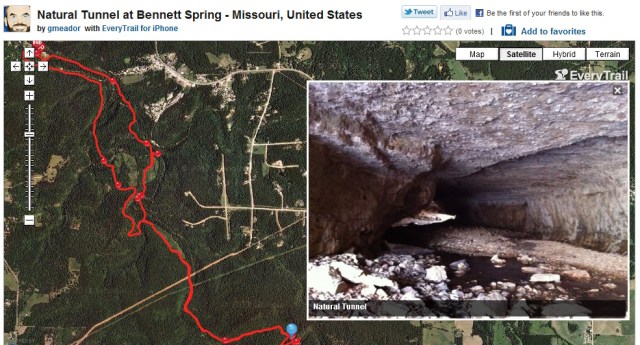
Natural Tunnel at Bennett Spring (click image for slideshow)

On the first day of Spring Break 2011 I headed east to one of the oldest and largest state parks in Missouri, Bennett Spring. A larger and less photogenic sibling to Roaring River State Park, this one also features a natural spring, brown and rainbow trout fish hatchery, lots of anglers, CCC improvements, and hiking trails. Bennett Spring has five times the flow of the one at Roaring River.

The day started with a breakfast biscuit at McDonald’s and then the familiar drive east on miserable US 60 to Vinita, then angling northeast on I-44 toward Lebanon, Missouri. I turned off onto the new south bypass of Springfield, which continues to expand on its southeast side. I had lunch at Romano’s Macaroni Grill and then headed back on I-44 to Bennett Spring State Park.

In 1837 the Brice family moved into the area and James Brice built the first grist mill. Peter Bennett built a mill shortly thereafter and married Brice’s daughter. The Bennett mill was the most successful in the area, which by 1900 was a popular fishing spot. 40,000 mountain trout were introduced into the spring and Brice Inn was opened. The last mill at Bennett Springs operated from 1900 to 1944, used as a saw mill, electricity generator, flour mill, and later as a fish food grinder until it was destroyed by fire. Its raceway was the first trout-rearing pool. The state bought the spring, community of Brice, and surrounding area to form one of its first state parks. The CCC developed most of the park between 1934 and 1937 by renovating and enlarging the hatchery, building cabins, roads, hiking trails, water fountains, shelter houses, a dining lodge, and an arch bridge that crosses the spring branch. The similarity to Roaring River is striking and continues to this day, with a newer park store built in the same style as the new one at Roaring River.

My primary target was the longest trail in the park. I drove past the spring creek which had folks fishing all along the shores and out in the water. Parking at the trailhead at the southern end of the road, I set out on the 7.5 mile Natural Tunnel trail which runs southeast to a 300-foot-long natural tunnel carved by a creek through the dolomite.

It was warm and sunny as I hiked through bare trees alongside and across rocky creek beds. Descending a narrow ridge of dolomite, I could see a bit of rocky bluff projecting from the forest ahead. At the base a stream had carved its way along a bluff and then finally broken through at a weak spot. I ventured down a rocky creek bed to see the eroded bluff. Later I reached a section of a creek where I could see more dramatic dolomite erosion and a tiny cave above the water. The sides of the spring hollow were covered in trees, except for the stripes made by a couple of natural gas pipelines, reminding me of the stripes across Osage Hills State Park near home.

Approaching the natural tunnel, there was a narrow cave in the hillside. Then I saw the wide entrance of the tunnel. A stream had encountered a ridge of dolomite and wrapped around it long ago. Swirling water at the turn had slowly eroded the ridge until it broke through to form an S-Shaped tunnel 296 feet long, 16 feet high, and 50 feet wide. Dolomite is calcium magnesium carbonate and slightly water soluble. (Not to be confused with Dolemite!) Along the bluffside approach to the tunnel, I was disappointed to see that previous visitors had stuck some water bottles into small holes in the face of the rock. I wished I had a carry bag so I could extract them and walk them to the nearest trash can over three miles away.

I had brought along a flashlight upon the urging of a guide book, but I found it was not needed. Stepping into the first curve of the tunnel I could see the light streaming from the exit. After posing for a self-portrait, I used rough-and-tumble stepping stones someone had kindly placed in the waters of the creek to make my way to the far end. There I was puzzled to see huge broken slabs of reinforced concrete across the tunnel mouth. What foolishness was this? It turns out that in 1964 the park decided to cap the tunnel and form an upland lake. But after a heavy rain the water broke through and the stream resumed its natural course. I wish they’d bothered to haul away their mess. From atop the failed seal I shot a panorama of the tunnel’s mouth and then another panorama inside the tunnel.

Backtracking to where the trail looped, I followed the other side past the Jenkins family cemetery, which dates back to 1840. Crossing a wide creek bed, I admired a large stone. EveryTrail said I had ventured 8.7 miles in four hours. I have a gift for extending trails – this time I’d added 1.2 miles to the nominal trail length.

EveryTrail Record

There were still a couple of hours of daylight left, so I drove past the CCC gauge station to the Nature Center and hiked another 1.5 miles along the Bridge Trail to the Bluff Trail, although the upper section of the latter was poorly marked and difficult to discern. The picturesque CCC bridge with the water streaming over the dam lured me over to admire the arches and watch the fishermen. Back at the car I was washing up and putting on a clean shirt and shoes when the park siren wailed, signaling the end of the fishing day.

I drove into Lebanon for a tasty dinner at La Tolteca before returning home, looking forward to a few more days of hiking later in the break.

Click here for a slideshow from this hike

Posted in day hike, photos, travel | 2 Comments

99.44 Percent

Since 1882 the slogans for Ivory soap have been “It floats” and that it is “99 44/100% pure.” Regarding the latter, Harley Proctor had the soap sent out to college chemistry professors and laboratories for comparison to the popular Castile soaps of the day. One chemist’s analysis was in tabular form with the ingredients listed by percentage and Harley added up the ingredients which fell into the category of pure soap, leading to the slogan which has become so associated with the product it is now registered with the trademark office.

I thought of this the other day when someone asked me that annoying question I’ve heard all too often in my nerdy existence: “How smart are you?” There is of course no reasonable answer to the inquiry, although I’m tempted to snap back with, “Smarter than you.” Thankfully I’m too polite to do that. But I find the question both annoying and embarrassing. Perhaps I should answer, “99 44/100%” since that was my percentile ranking on the Wechsler test I took in college as part of a paid psychology experiment, as well as on the simplistic IQ tests I took in grade school. My IQ score may be higher than 99.44% of the population, but while I approach three standard deviations above the mean IQ score, I’d hardly call myself a genius, and I’m not about to join Mensa!

The question, “How smart are you?” is annoying because it is absurdly simplistic to quantify intelligence as a numerical value. The eminent Stephen Jay Gould despised IQ scores, criticizing in The Mismeasure of Man their development and use, charging they reflect two major fallacies: reification, or, “our tendency to convert abstract concepts into entities” and ranking, our “propensity for ordering complex variation as a gradual ascending scale.” And most school teachers have suffered through trainings about Howard Gardner’s theory of multiple intelligences, the gist of which is that traditional IQ tests measure mostly logical and linguistic intelligence, overlooking many other types. The specifics bore me, but the theory is popular, although its specifics debatable.

I’m very good at school work and always had top grades, and the correlation between IQ scores and grades is about 0.50. But that leaves a lot of room for other factors. My good grades also reflected my persistence and motivation. Since I teach physics, people naturally assume I’m a math whiz. But while I loved geometry, I hated algebra and had to work hard at it throughout junior high and high school. I was on my high school’s math bowl team, yet I barely earned my A in high school calculus, and while I followed the math sequence in college all of the way through calculus and ordinary and partial differential equations, earning A’s all the way along, it never came naturally to me. But now I use plenty of algebra successfully every working day.

So am I “smart” in math? It depends on what you mean. I’d say I’m much “smarter” at language arts than mathematics, yet I still commit punctuation and grammatical errors. An example of the kind of things which worry me: I ended my opening sentence for this post with “pure.” to follow American English, but greatly prefer “pure”. as per British practice. I’m an Anglophile with regard to British mathematical notation and some spellings and the like. But I digress…

Sometimes people conflate the remembrance and retrieval of trivial knowledge with intelligence. Many are fascinated that IBM’s Watson defeated the human champions on Jeopardy, and students often infer I must be great at that game. But I know so little about so much that it asks about, e.g. sports, opera, and alcoholic drinks…er, potent potables, that I doubt I’d do all that well. And what does it mean to be “book smart” when IQ exerts a causal influence on future academic achievement, whereas academic achievement does not substantially influence future IQ scores?

Finally, I find being asked for my IQ score or ACT or SAT scores to be embarrassing. They were all good enough – good enough to get me into the gifted and talented program in elementary school and good enough to make me a National Merit Scholar and receive other scholarships for college. But if the roughly 1000 people at my school are normally distributed, there are a handful with higher IQs, and I can tell I’ve taught students whose IQ, SAT, and ACT scores beat mine. I’m confident every student in my classroom is better than I am in some important way. Some of them are certainly “better people” than I if you go by empathy, personality, physical attractiveness, athletic ability, or a zillion other things.

So I’d say my 99.44% rank is little more than a marketing slogan. And while I can float, I have to work at it.

Posted in random | Leave a comment

Bushwhacking in Charon’s Garden

Elk Mountain & Charon's Garden (click image for slideshow)

The forecast for Saturday, February 26 was irresistible: low 70s and partly cloudy in southwestern Oklahoma. After the heavy snowstorms of January and February, I’d managed to start mapping trail lengths in Osage Hills, but I wanted to go on a sunny hike which would really make me sweat. So I set my sights on two large trails in the Wichita Mountains Wildlife Refuge I had yet to complete: Elk Mountain and the northern half of Charon’s Garden.

I left Bartlesville Friday night for Oklahoma City for an evening with my parents, spent doing the usual technical support on their computer equipment. The next morning Dad treated me to breakfast at Jim’s on the west end of Bethany along old route 66, and then I headed southwest down the H.E. Bailey turnpike. Turning off at Medicine Park, I drove past Mount Scott, which was still enshrouded in fog. The morning had been overcast, but just after I passed Mount Scott the sun broke through the cloud deck for the first time, promising a better day to come. I drove west across the refuge to the Sunset Area, site of two different CCC camps back in the 1930s.

The parking lots were already filling up with eager hikers and fewer family picnickers. I took a bridge across Sunset Pool along Headquarters Creek to first take the Elk Mountain Trail, which arcs around southeast to climb the northeast side of the mountain with plenty of side “social” trails and stone steps.

Just a short ways up the mountain the view was already quite charming with the skies rapidly clearing. The granite shoulders of the mountain were popping out through its covering of blackjack oaks and cedars. The CCC boys had laid broad granite steps leading up through the brush and winding about its northeast flank, devolving into a jumble of large tilted stones.

The summit was crisscrossed with trails and a broad range of hikers, from teenagers to pensioners, milled about, including a soldier from nearby Ft. Sill. I walked westward along the southern edge of the summit, looking across the chasm of Post Oak Creek far below over to Twin Rocks Mountain to the west. Granite outcroppings rose amongst cedars, including a prominent stone resembling a conning tower. I clambered over atop some long folds of granite for a view back eastward, then returned to the peak of the summit, as designated by a survey marker, for a panoramic view eastward over French Lake towards Mount Scott.

Using my camera’s 12x zoom I could see the dam at French Lake and the first of the fish lakes downstream, beside which I had hiked in late December. I glanced north and then descended the mountain, deviating onto a narrow “social” trail which wound its way down to the western end of the Sunset picnic area, where I inadvertently startled a couple who were chatting in what must have seemed an isolated spot until I emerged from the brush.

Here’s my photo track up and down Elk Mountain at EveryTrail.
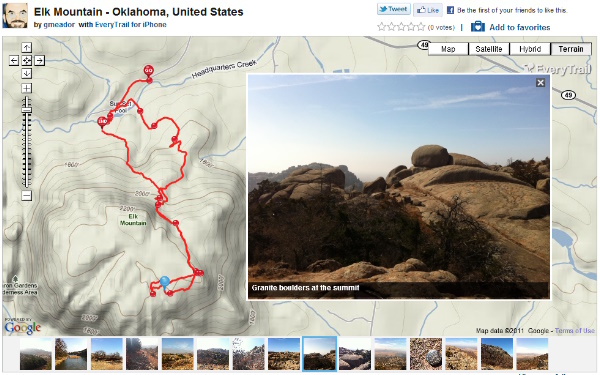
Today I would deviate significantly from the main trails, since they are unmarked. When you compare my actual path (in yellow) up and down Elk Mountain to the schematic map at that trailhead, you can see how I managed to turn a 2 mile round trip into a 3.1 mile excursion. Next came Charon’s Garden Wilderness, which Quincy Amen and I hiked partway up from the south back in November. This time I’d make it all of the way, although my deviations (in red) turned the 4 mile round trip through into a 6.2 mile trek.

I soon reached the north trailhead for the Charon’s Garden Wildnerness. The dirt trail shot westward, paralleling Headquarters Creek for quite a ways until it reached sandy Post Oak Creek. I had forgotten to bring along my trail guide from Oklahoma Day Hikes and also failed to read it in advance, so instead of turning south along the creek, I ventured on west down an obvious dirt trail.

The trail eventually turned southwest toward Twin Rocks Mountain, although I shot the landmarks without knowing they were eponymous. I paused to eat a turkey sandwich for a late lunch, surrounded by granite peaks.

Setting off again, my trail began rapidly diminishing into a buffalo track and there were frequent echoing gunshots from Charon’s Garden Mountain to the southwest. When the track turned westward again, I knew I was way off track – later I’d discover I was 0.7 miles west of the proper path.

So I retraced my steps and then headed southeast toward what I presumed, correctly, was the ravine of Post Oak Creek. Eventually I reached a nice overlook of Post Oak Creek, with Elk Mountain and its landmark Apple and Pear stones to the east. Below I spied several young men noisily traversing the main trail, but reaching them was no easy task. I followed animal trails, but the animals who forged them kept shrinking until I was ducking and scrambling through tree limbs and brush – a true bushwhack. I finally emerged onto the main trail with several long scratches along my hands and forearms.

The party I’d spotted turned out to be a major leading an ROTC troop. As they clambered up a hillside, I overheard them remarking about a strong odor. I doubted my tortuous bushwhack had made my that smelly, but years of bloody noses in my youth left it so scarred my sense of smell is quite weak. So I shrugged and march onward. The mystery was solved when I passed this spot on my northward return journey and spotted a rotting carcass in the creek. Downwind the smell was intense enough even I could smell it.

Soon I recognized I was back on the creekside trail Quincy and I had traversed in November. A couple of ladies were also struggling southward along the confusing trails with me. So I stopped at a pool and, when they came along, offered them directions about how to proceed south to Treasure Lake. I passed the markers at the south trailhead and ventured over to the shore of Post Oak Lake for a snack.

I decided to take a high trail to the west to begin my return journey. From up high there was a nice view of Elk Mountain’s south slope and Treasure Lake. Soon I spotted the ROTC troop exiting a cleft to the east, where a small waterfall was visible. I walked back down to and crossed the creek, making my way up into the cleft to the waterfall.

A tree grew beside a pool created by the waterfall’s flow through a rock cleft. Scrambling up a rocky slope, I was able to get a close-up shot, and look back out of the cleft toward Post Oak Creek. I followed a trail along the east side of the creek toward Elk Mountain. The sky was quite beautiful as the afternoon waned, and up ahead giant boulders stood across my path with the Apple and Pear looming overhead, although they did not resemble fruit from this angle.

Soon I reached this field of massive boulders, the south edge marked by an enormous stone looming above me. Scrambling around and then atop the boulders, I paused for a breather and snapped a self-portrait with the Apple and Pear behind me. Leaving those landmarks behind, the rough trail then led across a massive boulder pile and I cautiously slid my way across. A solo hiker fell in between two of these giants and perished in 1992, so I knew I had to proceed cautiously. After crossing, I took a shot of the treacherous path I had followed.

Eventually I reached the sandy headwater of Post Oak Creek, where I’d mistakenly headed westward a few hours earlier. I returned to the Sunset Area down in the bed of Headquarters Creek and soon reached the end of Sunset Pool. I’d completed 9.4 miles and headed back to Oklahoma City for a much-needed shower and some Chinese take-out with the folks.

Here’s my loop about the Charon’s Garden Wilderness at EveryTrail.

Click here for a slideshow of this day hike
Posted in day hike, photos, travel | 1 Comment