Straying at Sequoyah

Sequoyah State Park (click image for slideshow)

For my last day of Thanksgiving Break I decided to find some new trails to hike.  I’d spent the prior day on housework, mulching leaves and doing laundry.  The weather was warm for November, if blustery.  I scanned the map for trails I had not visited, with the constraints of them not being more than a two-hour drive away and being free of any hunters.  My eyes alighted on Sequoyah State Park at Fort Gibson Lake near Wagoner, home to one of the state’s remaining lodges, the oddly named Western Hills Guest Ranch.

I’d briefly visited with some friends staying at the park some months back and they’d mentioned there were hiking trails.  The state’s online map showed a variety of hiking and biking trails, although my own explorations would later show it to be out of date, which, when combined with very poor park signage, led me astray several times.  Thankfully freezes had killed off the underbrush and made the consequent bushwhacking tolerable.

I crossed the Highway 51 bridge over Fort Gibson Lake and arrived at the park around 10:15 a.m.  I turned west off the main road down past the Paradise Cove Marina, noticing that one of the trailheads shown on the map was not marked.  I drove to the adjoining picnic area to the south, where the map showed another trailhead for the small Eagle Roost loop trail.  I parked in a sandy lot at the trailhead near some of the planted pines which line many of the park roads.

Here there was a trailhead sign, although what I presume was once a registry box was a cobwebbed shambles.  The trail had been mowed and looped about a small hill, with occasional green signposts providing direction at junctions.  Other numbered signposts were presumably explained by some nature trail map I did not have.  I find it most irritating that many state parks do not post all of their trail maps and guides online, forcing one to either inquire at a park office or do without.  And Oklahoma’s travelok.com website was redesigned a year or so ago, for the worse, and now provides only sketchy information on most of the parks.

The only notable aspect of the trail was the Cockrum Cemetery, a burial plot of about a dozen graves which had a picket fence and reconstructed tomb which were put up a decade ago.  The cemetery began with the burial of Ka-tee Cockrum in 1884 in a tomb of native stone.  By the 1920s the area was so neglected that the stones were reused for a grain silo and the headstone moved to the family homestead.  It returned to this site in 2000 when the cemetery was restored.  The sign explaining this mentioned a North Ray cemetery – later I would realize that the peninsula the park occupies was once home to a ghost town called Ray.  A church, the Ray Mission, is nearby with another, larger cemetery.

When the trail returned to the lake, I followed a mountain bike trail not shown on my map around a small and muddy cove with abandoned picnic tables and debris scattered about.  It was depressing until some waterfowl appeared to lift my spirits.  Returning to my car, I’d hiked about 1.25 miles and was hungry, so I drove down to the tip of the peninsula and had a tasty lunch at the lodge restaurant.  I was the only customer for some time, although eventually three elderly couples appeared.  Some crabbed about breakfast no longer being served (at 11:15!) and another old fellow was being very picky about ordering his side salad just so.  Overhearing these other customers, I wondered if the restaurant not having Coke or Pepsi on hand, which had forced me to settle for a Dr. Pepper, might be symbolic: prune juice cola seemed fitting for the lodge’s clientele.  (Of course I know it is an old wives’ tale that Dr. Pepper has prune juice in it.)

After lunch I drove over to the nature center and found a modern trail sign for the Three Forks Nature Trail, indicating part of it headed off north along a paved pathway.  I shouldn’t have trusted the sign – the paved path was a mountain bike trail and, as far I could tell with later exploration, there is no Three Forks Nature Trail segment heading north from the Nature Center anymore.  A north loop for the trail is shown on the park maps, but the area is overgrown and only a few sections of the former trail, discernible by field stone curbing, remain and are cut through by barbed wire fencing.

I don’t like hiking on asphalt trails in my boots, but I persevered and headed north for over a mile, passing the riding stables, until the paved trail petered out at the road to the closed Cherokee area.  I could see it had been planned to extend the trail north from there, but that work had not been completed.  My map indicated another section of bike trail to the west, and I found it was there and was happily unpaved but cleared.  So I followed it and noticed that it branched off to the north to join with the Eagle Roost Trail – I’d seen red tree blazes for that section of bike trail earlier, although it was not shown on the online maps.

My section of bike trail turned south and then, frustratingly, ended at the road to the Seminole area.  The silly map acted like it just crossed the road, but that wasn’t true.  I turned east along the access road, arriving at the Ray Mission church and graveyard, close to the main road.   No trail signs, but I did see a cleared path to the south.  I followed it and it lead to a sewer lagoon, again with no signage.  I took another southern trail, which popped out on the Creek area access road, with no further trail to the south in evidence.  Maybe I was on the wrong path entirely or hadn’t stuck to the perimeter of the sewer lagoon for long enough.  Oh bother.

I wandered through a mowed field looking for a path south, but no dice.  So I returned to the access road and guessed the promised trail might lie to the west.  After passing another large mowed field, I found the bike trail again and followed it south to a creek close to the lake shore before it turned southeast to finally pass another sewer lagoon and terminate at the Chickasaw area access road by the golf course.  I walked back east along the road and found a large sign for the bike trails which showed the supposed path of several different sections.  It was only approximate for the bike trails and, like the online map, showed a north loop for the Three Forks Nature Trail which I would later find had been abandoned.  One hopes they have more accurate maps available at the park office or nature center, but given the shoddy park signage, I wouldn’t count on it.

Returning to the nature center area, I scouted around and confirmed that the west part of the north trail loop was non-existent.  So I walked south along the road to where I’d earlier spotted a sign for the Fossil Nature Trail, or Fossil Trails, as the sign put it.  This trail (or trails?) did exist, and was the most scenic in the park.  It made its way along the rugged and rocky eastern shoreline of the peninsula, allowing me a chance to scramble down to the water and along the rocky bluff.  When the shoreline bluff became impassable I backtracked and found an unmarked and crumbling cemented stone pathway back up to the main southbound trail.

This last bit of southbound trail had some abandoned and crumbling picnic tables, reminding me of the neglected cove I’d seen at the start of the day.  A big driftwood tree was interesting and the trail ended at a dock to the east of the lodge, where I could see Fort Gibson dam in the distance.  I retraced my path northward, following an abandoned unpaved roadbed for part of the way.  Soon I was heading north on the remaining part of the Three Forks Nature Trail, which then reached an unmarked fork.  The path to the left appeared to head back toward the nature center, while that to the right headed downhill toward the lake and was presumably part of the north loop toward the Choctaw area.

I took the right fork.  The trail could only be discerned by native curb stones lining its sides, which stuck up through the plentiful leaves.  A short side trail led down to abandoned equipment where what I take to be the park’s water pipes run down into the lake.  Eventually the trail popped out at the Choctaw RV area.  A dilapidated sign pointed westward, but I couldn’t easily spot a trail and wasn’t in the mood to ask the camp host, the only trailer in the area, for directions.  So I bushwhacked my way westward along a barbed wire fence and eventually came across a north-south section of what was once the Three Forks Nature Trail’s north loop.  The trail petered out to the north, and to the south it ran into new barbed wire fencing, forcing me to bushwhack westward to a road and return to the nature center.

I’d hiked 8.5 miles and was ready to call it a day.  While I’d enjoyed the walk, the inaccurate and outdated trail maps and pitiful signage, along with several derelict picnic areas, left me unimpressed.  I’m glad the Osage Hills State Park near me is kept in better shape, although it too could use better trail maps and signs.  Sadly I can’t expect any improvement for some time, given ongoing severe cuts in the state budget.  Much of the stimulus money is going to highway projects.  That way I can save time getting to our neglected state parks.  <sigh>

Click here for a slideshow of today’s day hike

Posted in day hike, photos, travel | 1 Comment

Black Friday at Platt

November 27, 2010

Platt’s Lincoln Bridge (click image for slideshow)

That which we call a rose by any other name would smell as sweet.
Shakespeare’s Romeo and Juliet

The bard’s maxim is put to the test by what was once Sulphur Springs Reservation, then Platt National Park, and is now the Chickasaw National Recreation Area.  In 1902 that tribe sold the land around Travertine and Rock Creeks to the government and the popular summer resort grew up with the adjacent community of Sulphur.  It was a major CCC project during the Depression and eventually Lake Arbuckle was built to the south.  When I was a child my parents took me there several times for camping, hiking, and biking and since then I’ve returned a few times with friends.  I was ten when its awkward new name was applied, but many of us still call it Platt out of both nostalgia and convenience.

Thanksgiving 2010 was cold, but it warmed on Black Friday and I found myself in Oklahoma City ready for a day hike.  My proximity to south central Oklahoma made it a tempting target, but I wanted to stick with a popular and well-developed park since we are now in gun hunting season for deer.  My Oklahoma Hiking Trails book mentioned the Rock Creek Trails at Platt, just south of the campground I recalled from my youth.  Those might be dicey with hunters about, but I knew there were also some trails along Travertine Creek where no hunters would dare stray.

So I drove south to Sulphur and into the park for a day hike which would extend to 5.75 miles.  The most picturesque area I could recall was the Little Niagra falls to the east, so I drove to them first through an almost empty park.  The combination of freezing rain on Thanksgiving and Black Friday shopping had cleared the park, but it was now in the 40s and the trees were rapidly shedding their icicles.  For the first time in my life, I had the falls all to myself.

The CCC constructed the beautiful twin falls, which cascade on Travertine Creek.  The upper falls are nice, but the lower falls are far more fun, having a series of stepping stones across the top.  I shot a short video of Little Niagra and then trekked eastward past the Nature Center toward two of the springs which feed the creek.  The trail, as I vaguely remembered, was long and linear as it both followed and traversed Travertine Creek amidst the glistening trees.  I ignored the three side loops to the south, concentrating on the two springs.  The wide circular pool at Buffalo Springs was strewn with leaves.

Above me one tall tree gave a final burst of autumn color and I crossed another slab bridge over a small waterfall in good flow and fed entirely by Antelope Springs.  They flow from the base of a pile of boulders formed of conglomerate rock.  I returned to my car, having hiked a bit under two miles along the creek.

Driving to the west part of the park, I stopped at Lincoln Bridge, which was built in 1909 on the centennial of Abraham Lincoln’s birth.  Although lacking the usual flock of children scampering about its little flagpole turrets, the bridge had its usual charm as it spanned Travertine Creek.

I drove past Bromide Hill through the Rock Creek campground on the northwest corner of the park, past the many narrow numbered turn-ins.  I recalled riding my bike past these as a child wondering when I’d finally reach our slot in what seemed like an endless series.  The deeper portions of the campground were gated off since there were only about three campsites in use in the entire park.  I was disappointed to find that the entire Veterans Lake area was closed, denying me access to the Rock Creek multi-use trail, parts of which I remember scrambling across decades ago.  I later discovered that the Lake was closed in July for a nine-month project to rehabilitate the dam to modern standards and replace the road across it with a new mile-long North Shore trail connecting to Rock Creek campground.

Not knowing what was afoot at the time, I decided to check out the other entrances to Veterans Lake but found them all blocked.  Thinking I might try the southern trailhead to the Rock Creek trail system, I drove seven miles south to the Buckhorn Area on the southeast shore of Lake of the Arbuckles.  But there were orange-vested utility workers all about and signs indicated the area was open to hunting, so I opted for safety and returned to the historic part of the park to hike around Bromide Hill.

This long mound of conglomerate rock rises 140 feet above Sulphur and the park.  For millennia rivers washed rocks down from the Arbuckle Mountains and lime in the water cemented them into what is today’s Bromide Hill, which is tall enough to transition from oak, ash, and elm trees into short grass and prickly pear cacti.   An overlook provides a great view of Sulphur to the south and is called Robbers Roost since local legend says outlaws once used the location.  These days it serves tourists and, evidently, beer-swilling polluting partiers who leave aluminum cans scattered in the crevices.

Parking in the Bromide Pavilion area, I took the east bridge across the creek, which I remember being constructed in the 1970s, and climbed the east trail up the hill, happily finding that the trail to the top was still open even though the road at the top was closed and fenced off due to the work at Veterans Lake.  At Robbers Roost I enjoyed the view while dining on a hefty turkey sandwich I’d picked up down in town.  That reminded me of cold campsite mornings when my father would drive a few blocks to pick up delicious warm square donuts in the city, which we feasted on back in camp.  As a child the fact that a full-fledged city was only a few blocks to the north struck me a singularly odd, and from above it is striking to see the park only extend a few blocks northward to the walls separating it from the city.

Extended westward along and then down the peak was a narrow overgrown trail.  I vaguely recalled taking it in the past, but was not clear on its destination.  As it descended into the trees I startled a large buck who, like me, was hiding from hunters.  Soon I managed to stir up a doe as well.  Eventually the trail ended at the western edge of the hill, providing an overlook of the fork in the road where you either turn into Rock Creek campground or towards Veterans Lake.  Ah yes, I remembered being here before in my younger days.

Backtracking and bushwhacking, I descended from the roost to a well-remembered spot where the main trail crosses a rockfall of massive boulders.  I was tempted to climb on up to the crevices, but decided it was too treacherous for a solo expedition.  I then trod eastward to circumnavigate the fenced Bison Pasture.  Although I never spotted any of the buffalo, descendants of a small group brought over from the Wichita Mountain Wildlife Refuge decades ago, I did see another doe and a buck, barely managing to capture a shot of one of them through the trees before they bolted.

I passed a large hollow tree stump and followed my shadow around to the Ranger Station, built in 1894 as a family home by Graves Leeper and put to use in 1904 as the superintendent’s office.  It was expanded in the CCC area.  It is adjacent to Hillside Spring, which flows at about 80 gallons per minute with a heavy sulphur content.  The arsenic in the water is why it was once used to help lighten the skin.  Today the bacteria content makes the water undrinkable.

Nearby is the former center of the park, an old buffalo wallow which became Pavilion Springs and brought together the flow of seven springs.  One is grateful for the open sides to the pavilion, as the sulphurous stench is quite strong.  You can safely cross Highway 177 to the pavilion via an underpass with the spring water flowing in a small side channel.  The sulphurous smell through the short underpass is quite powerful, and I remember being both fascinated and repulsed by it as a youngster.

The first part of the trail back westward toward Bromide Pavilion along Travertine Creek was scenic, but became less interesting as it curved south through the woods.  The sun was streaming into the south side of the beautiful old pavilion, where until the 1980s the big fountains allowed you to compare bromide and medicine spring waters to the city’s tap water.  The building had tanks to store up low-flow spring water for peak usage, but the springs eventually dried up completely.

I wrapped up my trip with a trek back up Bromide Hill, this time using the west trail with its memorable high walls and switchbacks.  The hill’s long shadow was eating away at the park below as I descended to my car for a drive to Tulsa for dinner with friends.  I look forward to returning to Platt, er, the Chickasaw National Recreation Area, after the Veterans Lake projects are finished.  I want to refresh my memory of the lake and the Rock Creek trails and partake of the new trail they are a-building.

Click here for a slideshow of today’s day hike

Posted in day hike, photos, travel, video | 1 Comment

Stay Loose with Belle & Sebastian

Recently I’ve been playing two Belle & Sebastian albums a lot: Dear Catastrophe Waitress and The Life Pursuit.

Stay Loose is from the earlier album and is an example of how their lyrics are anything but mindless. While it lacks the brilliant couplets that Martin Fry of ABC puts in his songs, I do like this song a great deal. And this song, like the best songs of ABC, was produced by the wonderful Trevor Horn, formerly of The Buggles, Yes, and The Art of Noise.


Video of Stay Loose

I was choking on a cornflake
You said, “Have some toast instead”
I was sleeping maybe three hours
You said, “You should get to bed”
I was waiting at the church door
For the minister to show
I was looking at the new year
You said, “Walk before you crawl”

I was feeling like a loser
You said, “Hey, you’ve still got me”
I was feeling pretty lonely
You said, “You wanted to be free”
I was looking for a good time
You said, “Let the good times start”
With a quiver of your eyelid
You took on someone else’s part

But what about me
I don’t really see
How things will improve
All you want is to stay…

Maybe I’m a little greedy
You said, “Think before you speak”
Sometimes I’m a little seedy
You said, “Everyone is weak”
Now I feel a little better
Is there something I can do?
But I never heard the answer
I never had a clue

But what about me
I don’t really see
How things will improve
All you want is to stay…
The lights are out in the house tonight
And I creep around
And I creep into your head
All you want is to stay loose

There’s a little echo calling
Like a miner trapped inside
If I tell her of this moment
She will in me doubt confide
And she’s on me like a blanket
Like a stalk of wilting grass
I’m not sure about her motive
I’m not sure about her past

But my faith is like a bullet
My belief is like a bolt
The only thing that lets me sleep at night
A little carriage of the soul
If it starts a little bleaker
Then the year may yet be gold
Happiness is not for keeping
Happiness is not my goal

So what about me
I don’t really see
How things will improve
All you want is to stay loose
Oh what about them
You play mother hen
To a gaggle of gangling youth
All you want is to stay…
The lights are out in the house tonight
And I creep around
And I creep into your head
All you want is to stay…

I was living through the seconds
My composure was a mess
I was miles from tenderness
It was dark outside, the day it was broken in pieces
Everything is flat and dreary
I couldn’t care what’s in the news
Television is the blues
Television is hysterical laughter of people

And I know it could be me
I’m always asking for more, more, more, more
I keep running round in circles
I keep looking for a doorway
I’m going to need two lives
To follow the paths I’ve been taking.

Posted in music | Leave a comment

Visiting the Devil’s Den

Yellow Rock at Devil's Den State Park (click image for slideshow)

Several friends who read my day hike posts recommended a trip to Devil’s Den in the Boston Mountains of northwestern Arkansas. Unfortunately this year its famous caves were closed to help protect its bats from the white-nose syndrome which has killed millions of bats in the northeast.  But the hikes are still great, so on a warm November weekend, with autumn’s colors fading fast, I headed out on a three-hour drive to the park.  I wanted to get started before it got too crowded, as the park is quite popular and I knew I’d see fellow hikers all day even though the spectacular fall foliage was on the wane.

I had a Silver Dollar breakfast at Eggberts and dawn was breaking as I drove down US 75 to Tulsa, then heading due east on 412 to Fayetteville to catch the I-540 bypass south to the park.  Arriving at the visitor center before 10 a.m., I picked up a trail map, but it had no more detail than what I’d already found online.  I planned to hike four trails in the park, making several loops for a total of six or seven miles.  I first hit the nearby Devil’s Den Nature Trail which sports several geological formations.  Fellow hikers, including some of the fairer sex in colorful regalia, were in evidence.  But I often had areas of the trail to myself, including the Devil’s Den area with its eroded sandstone bluffs with their many layers, some lichen, and sealed caves.  The area was very rocky and treacherous both due to slipping rocks and the many leaves covering them – I made heavy use of both trekking poles and still managed to tumble once onto my rear.

Returning to the main trail, I ascended to another sealed cave where a series of wide crevices have opened up.  I decided to go off the main trail to see more of them, ascending to the top of the mountain into a wilderness area where I found crevices with crisscrossed trees, crevices with mossy walls, and a crevice topped by a felled tree trunk.  I then bushwhacked in a large circle to return to the main trail, which had a crevice running alongside it and a right-angle crevice which is near one entrance to the Devil’s Ice Box, a now-sealed cave which pours out a stream of cool air blown through it from above.

The trail then wound past bluffs with heavy bowl erosion patterns.  The many large stone steps were clearly the blessed work of the good old CCC.  Eventually I reached the Twin Falls area, although it was too dry to see much.  The large upper falls area did have some drips.  One of the most fascinating parts of this trail was the building-sized hunk of eroded sandstone which reminded me of the Casa Milà in Barcelona by Spanish architect Antoni Gaudí.  Bowl erosion had formed various portholes and tunnels through the stone.  The trail eventually wound back down the Lee Creek, which created the valley the park occupies.  There I found a few ruins at the location of the old Donald homestead.

Having completed my first trail I decided to set off south down the west side of the creek along the Lake Trail.  The CCC built a dam to create the eight acre Lake Devil along here and there was a low-lying building near the north edge of the lake which was quite picturesque.  The big rock dam was interesting and climbable.  Some boys were fishing from one end and I enjoyed scrambling over to the spillway to get a close look at it.  A statue of a CCC worker had been erected nearby.

Then I was off along the shore of Lee Creek.  The Lake Trail became the Woody Plant Nature Trail as it wound by a campground.  A large bluff drew me down to the creek and nearby I saw a fellow traversing the creek via a suspended line, cheered on by onlookers.  Farther on I found a spot where a huge slab had fallen beside the creek and took advantage of a convenient rock as a lunch spot, dining on a turkey sandwich I had bought on the road.  I took the time to snap a self-portrait and then, rather than retrace the lake trail back to the other trailhead I wanted, wound my way uphill along Highway 170 up to a CCC overlook.

Far below I could see the bridge in the heart of the park which I’d crossed earlier to reach the west side of Lee Creek.  The Yellow Rock Trail ran from the shelter northeast along and down the mountainside.  There were some nice eroded bluffs and I was delighted to see my shadow as the sun finally broke through the overcast which had lingered all day.  Perfect!  I scampered down sunlit steps, knowing I’d have good light when I reached the famous Yellow Rock Overlook.  I’d saved it for the end of the hike so the sun would have more time to break through.

The overlook was larger than I’d expected and I faced north to shoot the famous Yellow Rock itself with both my regular camera and my iPhone, as well as in a panorama.  The side of the mountain was dotted with trees bearing the final remains of autumn.  I had plenty of company at the overlook, including a fellow who lay down facing the edge.  But not wanting to interfere with other shutterbugs, I waited until all the other hikers had vacated the area to venture out on the rock for a self-portrait, although my timer didn’t last long enough to get a side shot.  The view was tremendous, and the view south was spectacular as well.   Farther along the ridge I saw a twisted cedar and bluff crevices.  The remainder of the Yellow Rock Trail back to Lee Creek was also scenic, with bluffs viewed from overhead and some nice overhangs above the trail.  One section of bluff had Halloween rocks of black and orange.

I’d hiked about 6.75 miles by then and was ready to call it a day.  So I drove back to Tulsa for dinner and just managed to beat the evening crowds at Zio’s and get a table without waiting.  I then drifted through a Borders for book ideas – bless them, Amazon is eating their lunch and I’m not helping, using the Tulsa bookstores to browse but then purchasing books on my Kindle.

Thanksgiving Break approaches, but I don’t know yet if my schedule will allow for more day hiking then or not.

Click here for a slideshow of today’s day hike

Posted in day hike, photos, travel | 4 Comments

The Shrinking Portable Computer

November 19, 2010

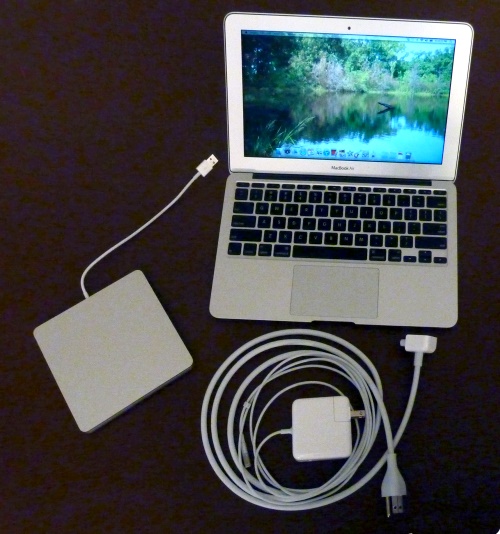
My new MacBook Air

As noted in the summary of my personal computers, I bought my first laptop computer back in 1997.  I’ve bought three laptops since then, including a new MacBook Air which arrived yesterday.  I brought them together for a side-by-side comparison.

The Averatec had a full-size keyboard and sluggish trackpad, the Asus had a slightly-reduced keyboard and small but responsive trackpad, while the MacBook Air has a full-size keyboard and big glass trackpad which is very responsive and supports multi-touch gestures.  But I miss the dedicated right-click buttons of Windows machines and am not at all used to the current application’s menu bar being at the top of the screen instead of the top of its own window.

I accessorized the MacBook Air with an external SuperDrive DVD +/- burner and VGA-to-Display Port adapter.  A carrying bag is on order from WaterField Designs as well as a Full Install DVD for Windows 7 Home Premium so I can run my Windows applications on it along with native OS X apps.

2005Averatec 3270 EE-1(PADD) 2008Asus Eee PC 1000H (PADDe) 2010MacBook Air 11” (Droxine)
Native Operating
System
Windows XP Home,
Service Pack 3
Windows XP Home, upgraded to Windows 7 Home Premium Mac OS 10.6.5 (Snow Leopard)
Microprocessor 1.6 GHzMobile Athlon Sempron 2800+ 1.6 GHzIntel Atom n270 1.6 GHzIntel Core 2 Duo
Random-Access Memory 480 MB 2 GB 4 GB
Disks 60 GB hard drive,
DVD +/- burner
160 GB hard drive 128 GB flash drive, separate DVD +/- burner
Weight Without Accessories 4.5 pounds 3.2 pounds 2.3 pounds
Screen 12.1 inch,  1024×768 10.2 inch,  1024×600 11.6 inch,  1366×768
Battery Life about 1.5 hours 3-4 hours about 5 hours
Connectivity 3 USB, PCMCIA II, SD card, microphone, headphone, ethernet, modem, VGA, 802.11 b/g (built-in speakers) 3 USB, SD card, microphone, headphone, ethernet, VGA, 802.11 b/g/n (built-in speakers and 1.3 megapixel camera) 2 USB, headphone, Mini DisplayPort, 802.11 b/g/n, Bluetooth 2.1+EDR (built-in microphone, speakers, and camera)
My Cost Without Accessories / Today’s Resale Value at gazelle.com $890 / none $464 / $85 $1350 / $700

It is interesting how the microprocessor speed has maxed out, making additional computing cores, on-board cache memory, and better disk speed vital to improved performance.  Over time the weight has dropped significantly and the screen and battery life have improved, but my new Mac’s improved specs carry a hefty price premium.

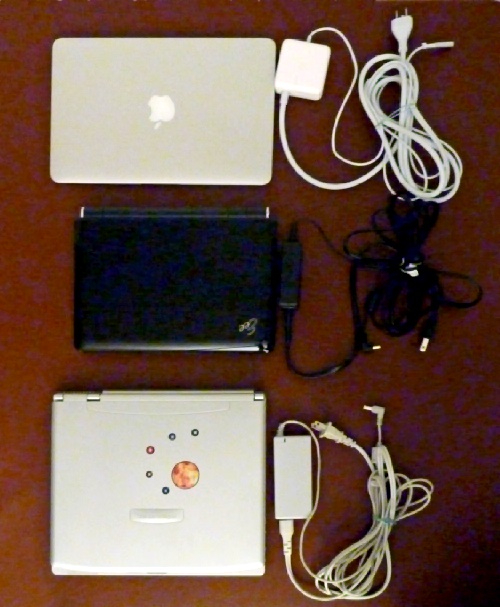
My three laptop computers

Below is what they look like when closed alongside their power adapters.  The silver Averatec’s at the bottom extends 12 feet while the black Asus’ extends 11 feet.  I like how the MacBook Air’s power adapter has a retractable two-prong plug that goes directly to the wall for a reach of 6 feet, or you can swap that two-prong plug for a three-prong extension cord for a total reach of 12 feet.  The other adapters have detachable cords, but no direct plug-in option.

My laptop computers

Below you see how thick they are, and why I find the slimness of the new MacBook Air quite stunning.

Thickness of my laptop computers

As for approximate boot times, below is how they stack up with their existing operating systems.  Soon I’ll update this with times for the Mac when booting into Windows 7 Home Premium.

2005Averatec 3270 EE-1(PADD) 2008Asus Eee PC 1000H (PADDe) 2010MacBook Air 11” (Droxine)
Time from boot to login screen 80 s 46 s 13 s
Time from boot to  responsive desktop screen 102 s 65 s 17 s
Time to boot from hibernation to responsive desktop screen 58 s 26 s 1.5 s

The solid state flash drive in the MacBook Air really makes it boot up quickly, while the sluggish hard drive in the old Averatec is a huge performance bottleneck at all times.

I’ve never owned an Apple Macintosh computer before, so I’ll have more to report on the MacBook Air as I learn more about its operating system, experiment with native software, and get Windows 7 on it via Boot Camp and/or a virtual machine.

Here’s a shot of my current portable devices side-by-side: the Apple iPhone 4, Amazon Kindle 3, Apple iPad, and Apple MacBook Air.

My portable technology devices

For my parting shot I set the iPad and iPhone atop the MacBook Air to show how that laptop is the same width as the iPad and the same length as the iPad alongside the iPhone 4.

My portable Apple devices

Posted in technology | 4 Comments