Steady as she goes

When there is an economic recession, we hear about major losses in stock valuations, job losses, and the impact on retirement savings. Economists worry that Trump’s trade wars could trigger another one, with a market correction and a bear market in the Nasdaq developing in the early spring of 2025. In the past two days, my 403(b), an educator’s version of a 401(k), lost 8% of its value, and I will be retiring in less than 15 months.

However, I’m not panicking. I’ve lived through eight recessions, with half of those coming over the past 35 years of my working life, and my approach for over 30 years has been to employ dollar cost averaging and stay the course, investing a fixed amount of money at regular intervals, regardless of the current market conditions. That reduces the impact of market volatility over time.

I was too young to remember the Nixon recession of 1970, and I have only scattered impressions from the 1973 oil crisis that triggered a recession. However, I was in high school during the twin energy crisis recessions of 1980 and 1981-1982, and those certainly impacted my family, since my father was a petroleum engineer.

The periods of growth in our country’s gross domestic product, interrupted by recessions [Source]

Dad was the manager of Gas Measurement for Cities Service, and he survived a takeover attempt by Mesa, a failed merger with Gulf, a merger with Occidental, and then Cities Service Gas being sold off to Northwest Energy and then Williams to pay down the debt from the Occidental merger. He was finally forced out in the Williams acquisition, ending his 35-year career in the petroleum industry at age 58.

My mother continued working at a savings and loan, but those institutions experienced a first wave of failures in that recession. Hers survived until 1991, but it then succumbed, ending her working life at age 54. That was right after the end of the Gulf War recession, the first recession during my own working life.

When I began teaching in 1989, my parents ensured that I had an individual retirement account that was added to annually, as they knew how important that would be for me decades later. I’ve always deposited the most I could in my IRA each year throughout my career, but the volatility of the market is better illustrated by my 403(b), in which I have invested about 10% of my gross salary each month since 1992.

I thought it might be instructive to see how it fared through three different recessions, but bear in mind that I am anything but a financial expert. I’m just sharing a fractional view of my own experience, and you should consult a professional financial advisor about your own investments, such as a Certified Financial Planner or Chartered Financial Analyst.

A majority of my 403(b) was invested in the stock market, and by the end of the long expansion of the 1990s I had invested about $24,000 while the account’s value had reached about $36,000. That computed to be a fantastic rate of return, but of course it couldn’t last.
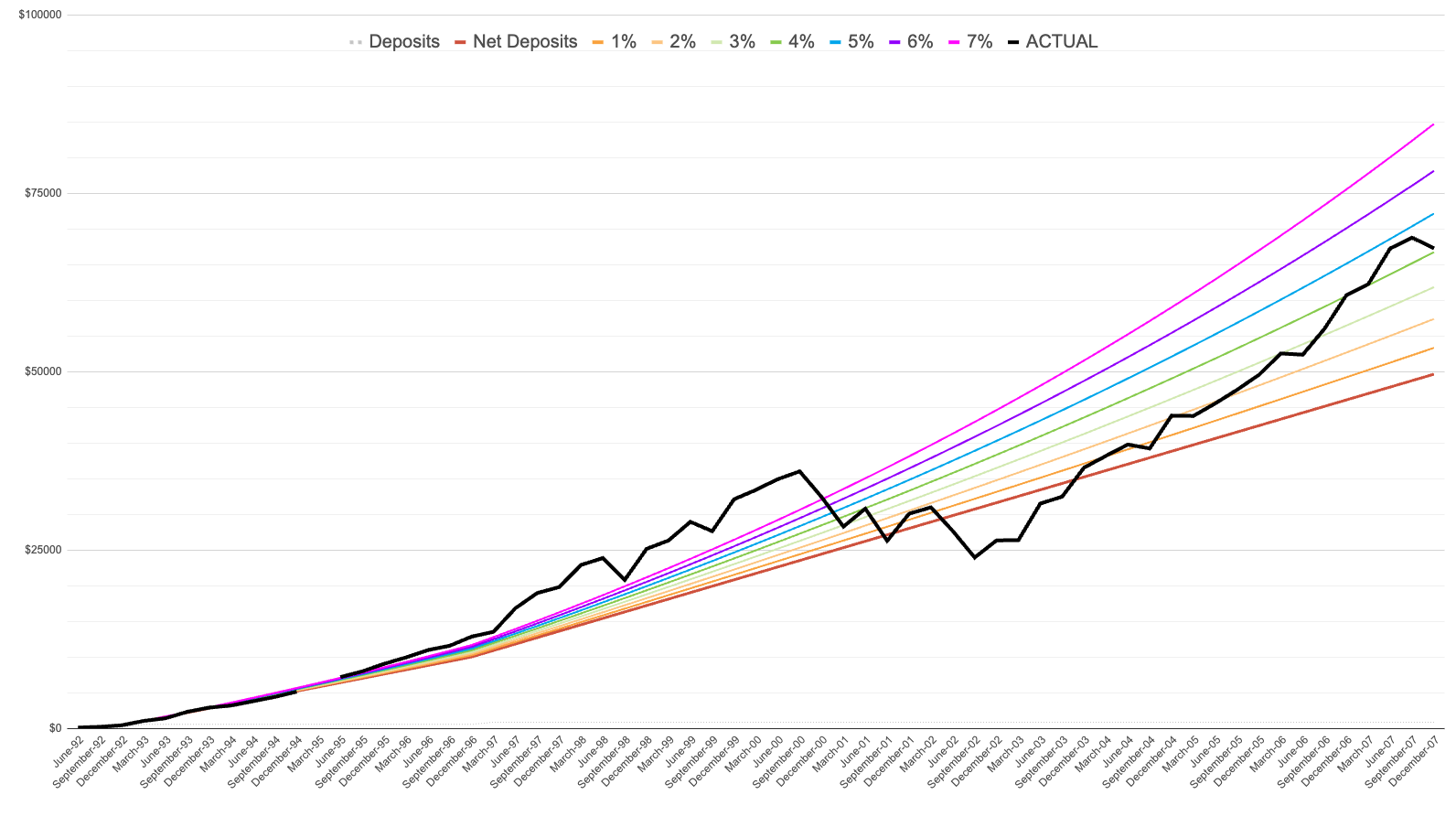
The first 15 years of my 403(b); the recession of 2000-2002 was painful

When the Dot Com recession in 2001 struck, I trusted in the power of dollar cost averaging. So I made no adjustments in my investment mix nor the amount of my paycheck that was diverted each month into my ever-dwindling 403(b). By late 2002, I had invested about $31,000 in it, but its value was only $24,000! The recession had wiped out a decade of gains and then some, putting my account well underwater.

However, I knew that my monthly investment was then buying more shares at their reduced prices, and whenever the market finally recovered, my gains would reappear. I wasn’t back above water until the end of 2003, three years after my 403(b) began to tumble, and it never again reached the immense percentage gains of the 1990s. By the end of 2007, I had invested a total of $50,000 over the previous 15 years and the account was valued at $67,000. I calculated my overall rate of return somewhere between 4% and 5%. Nothing to brag about, but I had no financial advisor at the time, and my strategy was building what will eventually become one of my primary income sources in retirement.

Then the Great Recession hit, the longest economic downturn since World War II. My 403(b) again steadily declined, again going underwater.

My 403(b) during the Great Recession of 2008 and its slow recovery

By March 2009, I had invested over $54,000 in it since 1992 but the account was valued at less than $40,000. Again, I stayed the course, continuing to invest. The economy and the market recovered, and my account finally recovered to an overall return above 4% in late 2013, six years after the Great Recession began, and again beating overall inflation.

We then had some downturns and corrections, but there wasn’t another recession until COVID-19 triggered one in early 2020. By then I had invested over $112,000 and my account was valued at over $240,000, and I calculated my overall rate of return at around 6%.

I didn’t just keep dollar cost averaging, as I also needed to periodically assess the mix of assets, primarily how much was invested in higher-risk equities and how much in lower-risk fixed-income assets. On rare occasions, when the market was healthy, I have reallocated funds when my exposure to equities was too high for my comfort. However, I never made such adjustments when the market was down, as I wanted to lock in gains, not losses.

To keep my own amateur adjustments to a minimum, for some years I have kept most of the account in a Lifecycle Index 2035 fund, which gradually becomes more conservative in its investment mix over time. It currently has about 2/3 of its assets in equities and 1/3 in fixed-income assets. That will reach an even split in 2035 and by 2065 will be 20% equity and 80% fixed-income, although it seems unlikely I’ll still be around to witness that.

Most of my 403(b) is in a fund that gradually becomes more conservative over time to reduce risk in my old age

The COVID-19 recession didn’t impact my account nearly as much as the earlier Dot Com and Great recessions. My overall rate of return at first dipped to less than 5%, recovered over the next two years to reach almost 7%, but then dipped again in 2022.

Since then it gradually rebuilt to above 6%, and this week it dove to about 5.5%. I realize it could dip much lower before I retire in June 2026, when my deposits will stop. However, I don’t expect that impact on one of the legs of my retirement stool to delay my retirement nor reduce my withdrawal plans. My parents left the workforce at ages 54 and 58, right after recessions, yet they enjoyed long and comfortable retirements. It certainly helps that in addition to individual retirement accounts and 401(k)/403(b) plans, both my father and I were able to pay into defined-benefit pension plans that were shielded from market volatility, although their fixed payouts don’t offer protection from inflation.

I will keep my money invested, trusting that no matter how low the markets get, they will eventually rebound and my retirement assets will be rebuilt. My own experience is that could take a half decade or more after a big recession, but hopefully I have plenty of time. My father lived to age 97, my mother is enjoying independent living in Bartlesville at age 88, and I have a 50% chance of lasting another 30 years..and I fully intend to be retired for almost all of them.
Posted in random | Leave a comment

The Lonely Washing Machine Repairman

Throughout my childhood, from 1967 to 1988, actor Jesse White portrayed “Ol’ Lonely”, the Maytag repairman who never had enough to do. Eventually other actors, including Gordon Jump of WKRP in Cincinnati fame, played the role. The campaign rang true with our family, since our Maytag washers and dryers lasted for decades.

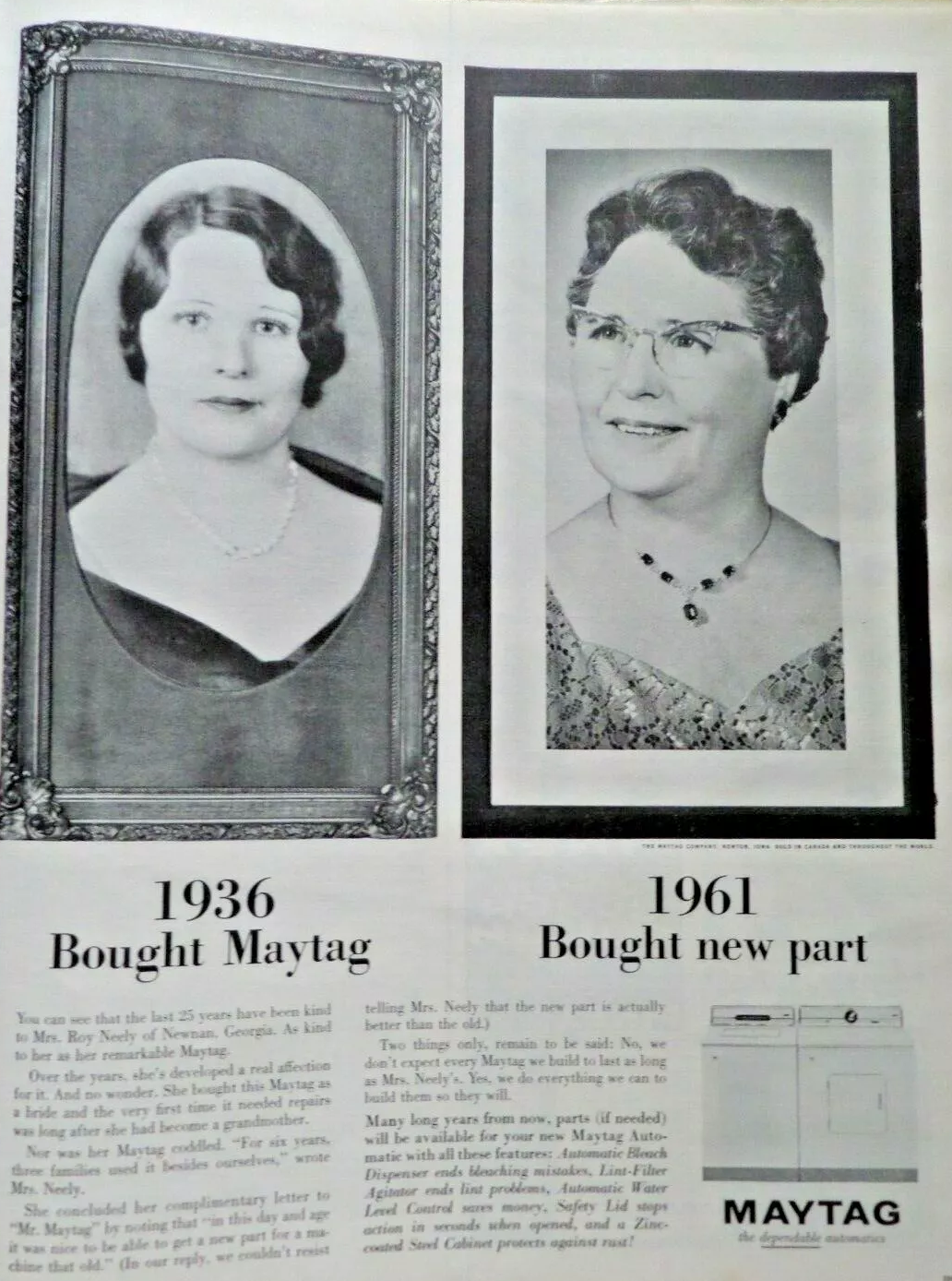
1962 Maytag ad about a Georgia woman whose Maytag finally needed a new part after a quarter century of heavy use

Before the iconic television ads, Maytag advertised its reliability in print with ads such as one about a Georgia woman whose 1936 Maytag washer was used by four families and finally needed a part replaced after 25 years.

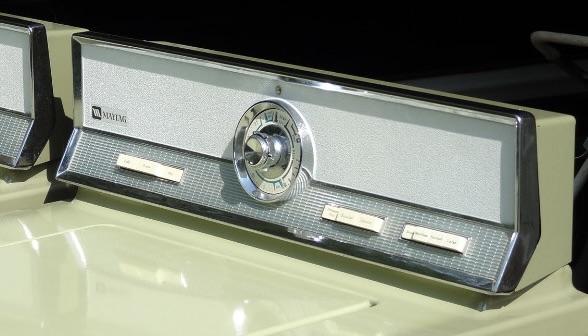
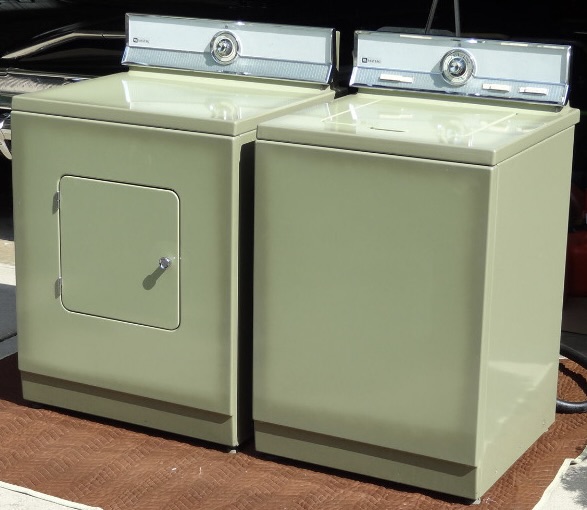
In the early 1970s, my parents bought a Maytag washer, in the trendy avocado green of the day. In 1978, they purchased a matching Maytag dryer.

As a kid, when unsupervised I liked to dial up the spin cycle on the washer, prop open the lid, and jam its switch so it would keep running. I would toss in a washcloth and marvel at how it seemed to disappear due to the high spin rate and the limitations of my vision.

In 1989, when I moved into my own apartment in Bartlesville, I had a small washer and 120-volt electric dryer, of a brand I don’t recall. They were barely adequate, with the dryer taking an extraordinary amount of time to dry towels due to its low voltage. The next year I moved into a rent house and was delighted when my parents gave me their Maytag washer and gas dryer, even if the washer was about 18 years old and the dryer age 11. Those were far superior to what I had been using.

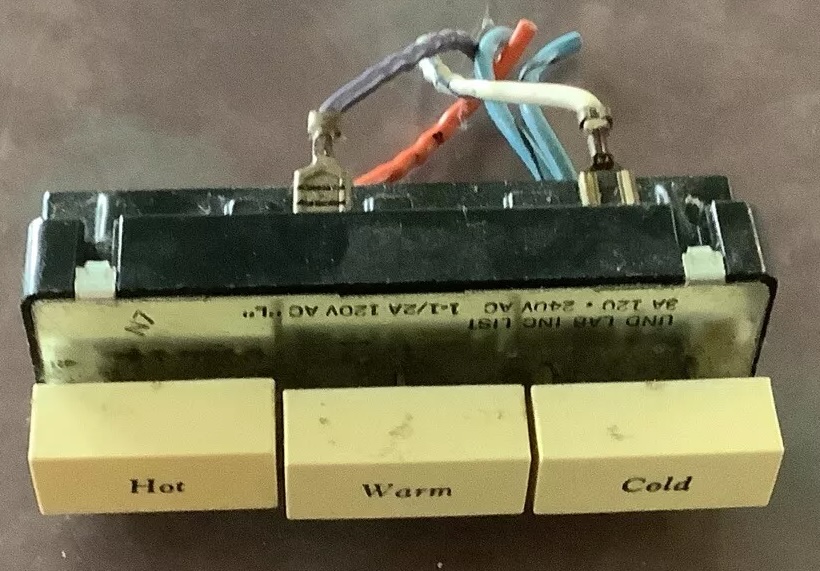
The washer finally did need a repair, as the water temperature selector switch stopped engaging. I unscrewed the top panel and was able to easily disconnect and remove the faulty switch, buy a new one from a local supplier, and be back in business. I could see my repair for years, since the new switch buttons were bright white, while the old buttons for cycle type and load size had yellowed with age.

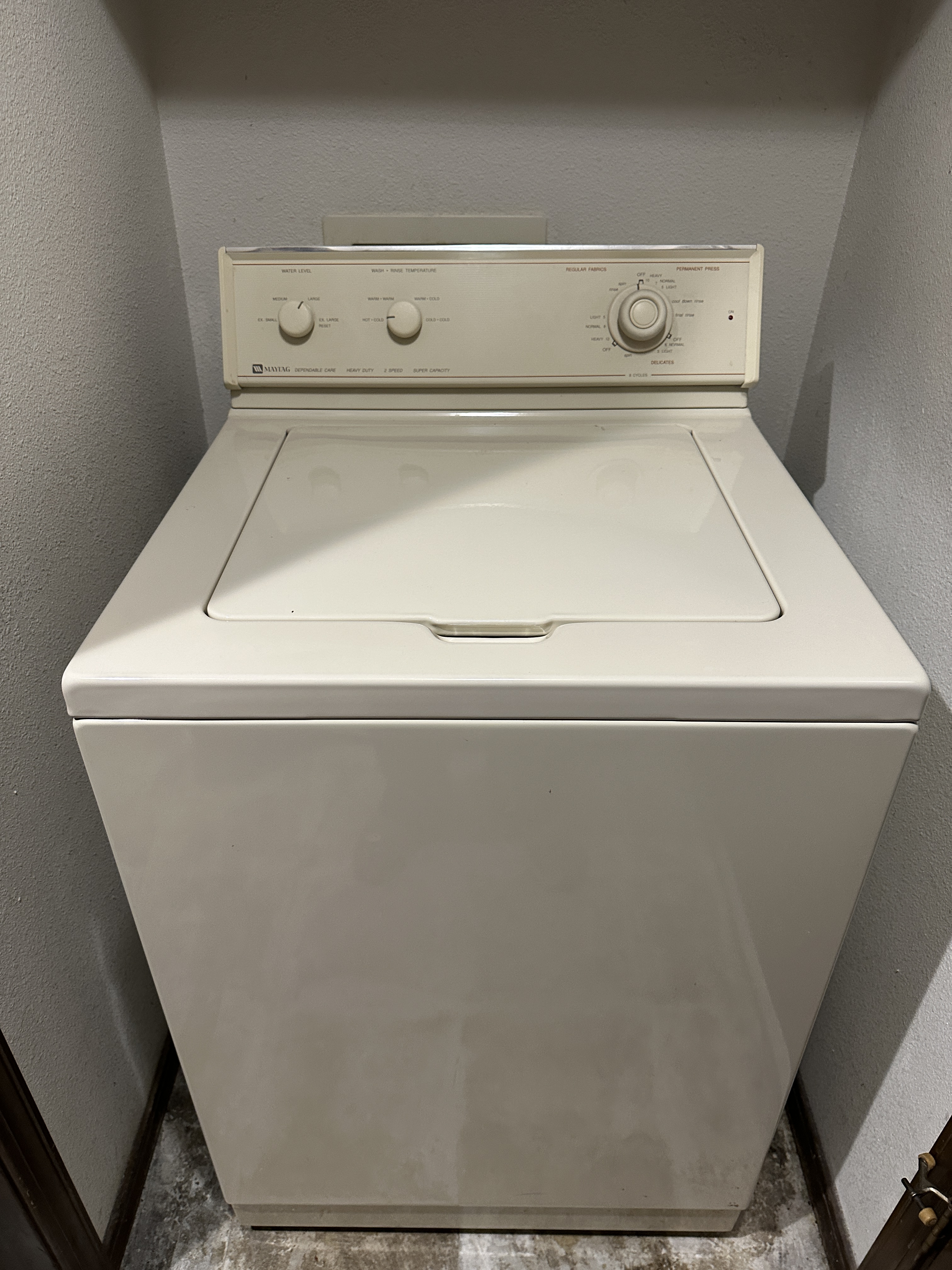
My 1996 Maytag only needed one repair over its 29 years of use

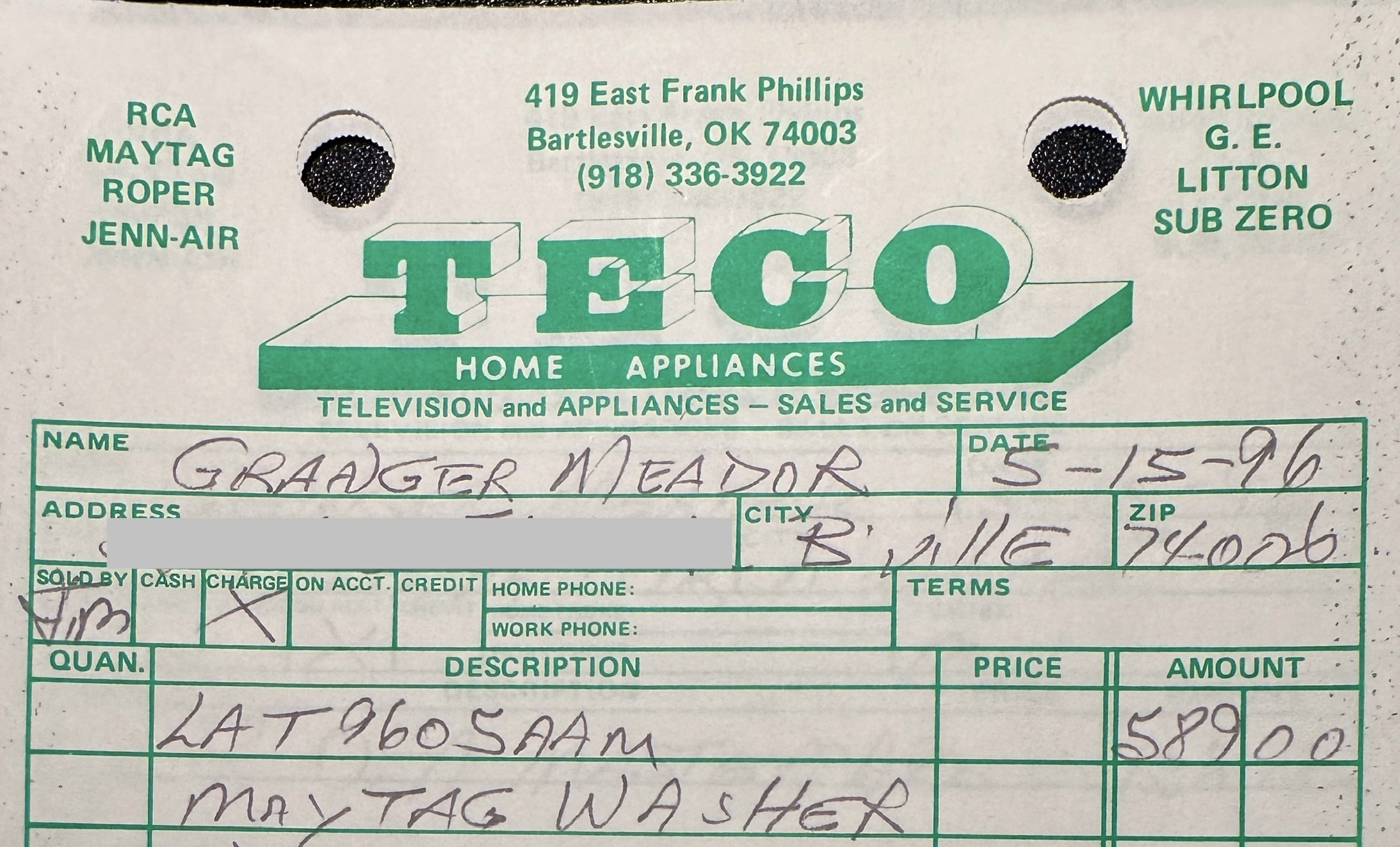
In 1996, the washer broke again, and this time it would have required a more significant repair that would have strained my finances as an underpaid schoolteacher in Oklahoma. However, I had just received the local Kurt Schmoldt Teacher Appreciation award, a cash prize that would cover virtually all of the cost of a new washer. So rather than try to have a 25-year-old unit repaired, I went to the local TECO appliance store, which Ted Schwermer founded in 1969; his son Gary ran the shop from 1985 to 2016.

A timer I found on eBay brought my washing machine back to life

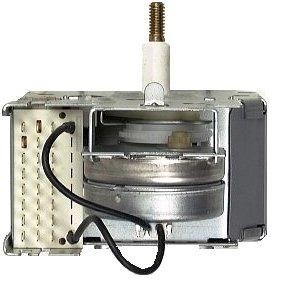
I told them that I wanted another Maytag, and they fixed me up with one for $589 that ended up lasting 29 years. I did have one repair on that washer over the decades. In 2008, after perhaps 2,500 loads, the washer began running the motor at the wrong speed and sometimes stopped in the middle of a cycle. I had a repairman out, who said it was a bad timer and since the model was no longer manufactured, he could not replace it.

Rather than buy a new washer, I paid the repairman for his diagnosis and his time, and then I went on eBay to buy a new electromechanical timer for $88. I installed it and was back in business for almost 3,500 more loads of laundry. My total capital and repair costs ran to less than 13 cents per load over three decades.

However, a few weeks ago I was doing the laundry and my socks got wet…the ones I was wearing, that is. The washer had leaked water across the tiny utility room and a bit into the adjacent kitchen. I dried things out and checked the hoses and drain, but I couldn’t locate where the water leaked from. Later loads that day were fine, so I hoped it was just a fluke…but I knew better.

Sure enough, a couple of weeks later another load leaked a bit, and since the leak was something intermittently amiss inside a washer approaching 30 years of age, rather than crack it open to try to diagnose and repair it, I decided it was time for a replacement. It struck me as better to enter my retirement in July 2026 with one-year-old washer rather than one with 30-year-old parts. But this time, despite the great reliability of the Maytags of the 20th century, I knew that I wouldn’t be buying that brand.

A Very Brief Maytag History

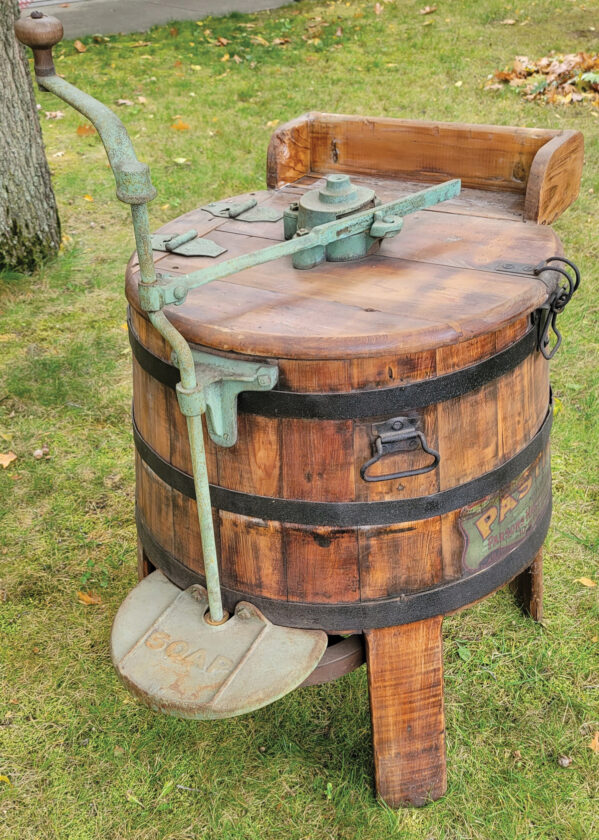
One of Maytag’s first washing machines [Source]

Frederick Maytag, his two brothers-in-law, and George W. Parsons started a new farm implement company in Newton, Iowa in 1893, producing threshing machines, band cutters, and self-feeder attachments. It became the Maytag Company in 1909 after it began manufacturing washing machines to fill in the seasonal gaps in the farm equipment business.

The first Maytag washer, the “Pastime,” was a wooden tub model with a hand crank that had a retail price of $11 to $15, the equivalent of about $450 in 2025. 

By 1927, the Maytag Company was producing more than twice as many washers as any other competitor. They didn’t start producing clothes dryers until 1953, and the Maytag family sold their appliance business in 1962. Its reputation for durability and dependability would endure until the 21st century.

Maytag was acquired by the Chicago Pacific Corporation, the remains of the Chicago, Rock Island & Pacific Railroad, in 1988, which also owned the US and UK divisions of Hoover. In 2004, it was still producing 88% of its products in older US-based factories, but the company hurt its reputation by selling low-end Amana models produced in Searcy, Arkansas as Maytag-branded ‘Legacy Series’ machines.

Front-load washing machines that used less water and energy were promoted by the government in the early 2000s, but Maytag’s Neptune line of front-load washers were called Stinkomatics by dissatisfied customers when the washers developed mold that was not easily cleaned. By 2005, the company’s market share had declined to all-time lows, sales were flat, and it was ranked low in customer satisfaction. Whirlpool completed its acquisition of Maytag in 2006.

Switching Brands

When I purchased my new Maytag washer in 1996, I kept using the 1978 avocado green gas dryer. Its burner finally failed in 2003. Consumer Reports had warned me that Maytag was no longer a reliable brand, so I purchased a KitchenAid gas dryer that worked fine until 2020. While the Maytag dryer had lasted 25 years with one igniter replacement during its run, the KitchenAid only lasted 17. By then, Wendy and I were married, and she isn’t a fan of natural gas dryers. Our 1981 home was built to support either type of dryer, so we switched to electric.

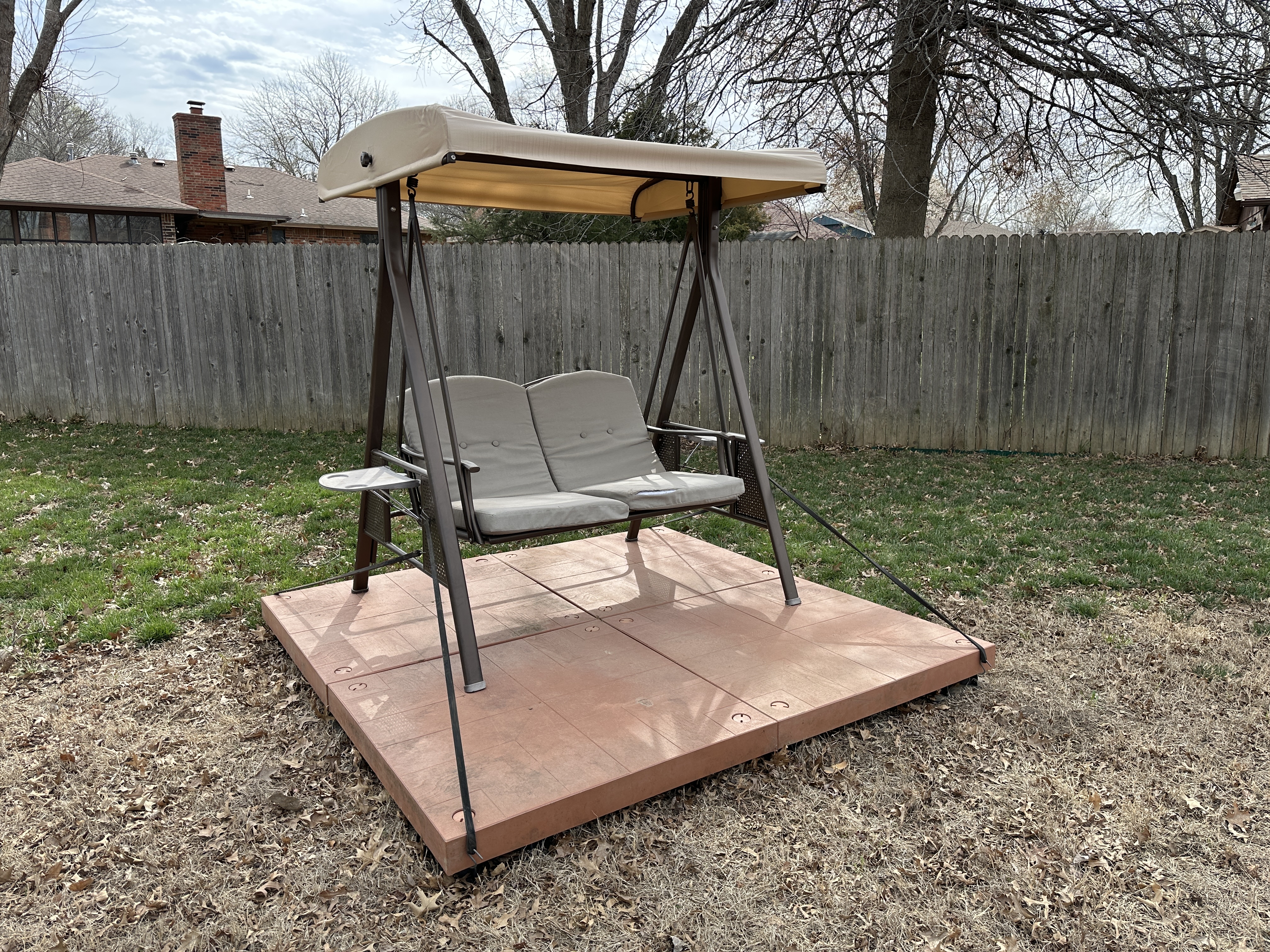
One of my backyard swings where I like to read my Kindle or listen to Audible; I wish my phone could tell me when a dryer load is done

I checked Consumer Reports, for which I’ve had a digital subscription for decades, and they recommended an electric dryer from LG. We had enjoyed using an LG washer and dryer in a rental cabin, so that sealed the deal.

The dryer is fine, although being a 240-volt electric unit, its cycle time is longer than the natural gas dryers I was used to, yet still far superior to the 120-volt electric dryer I used in 1989-1990. We like the tune it plays when a load is done, although it is one of the few appliances that I wish had a WiFi connection so that I could be out on my swing in the backyard and get an alert when it is done. I have compensated by setting timers on my Apple Watch that help somewhat, but I have a ordered a vibration sensor to see if I can program it to alert me. [See my update at the end of this post.]

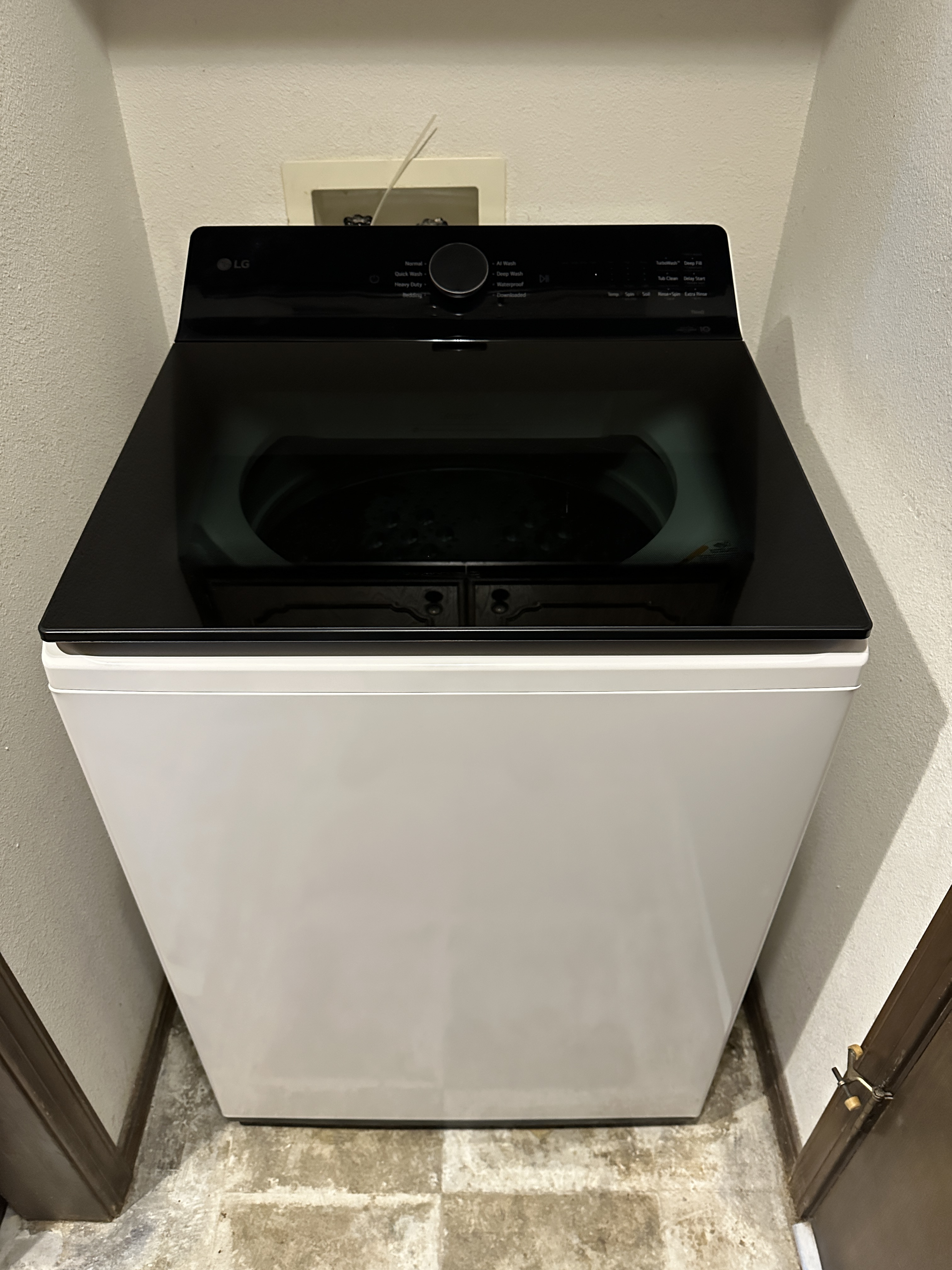
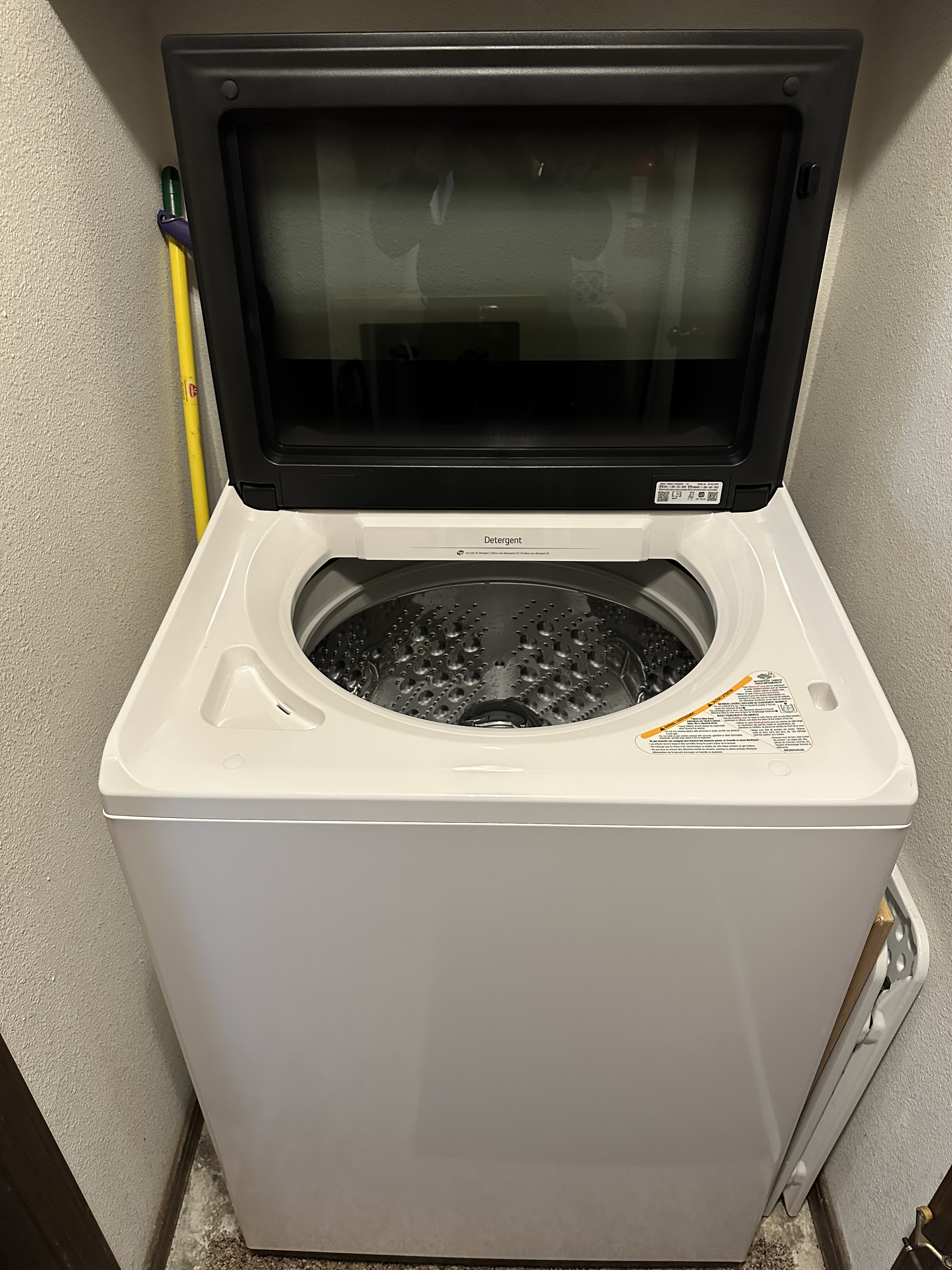
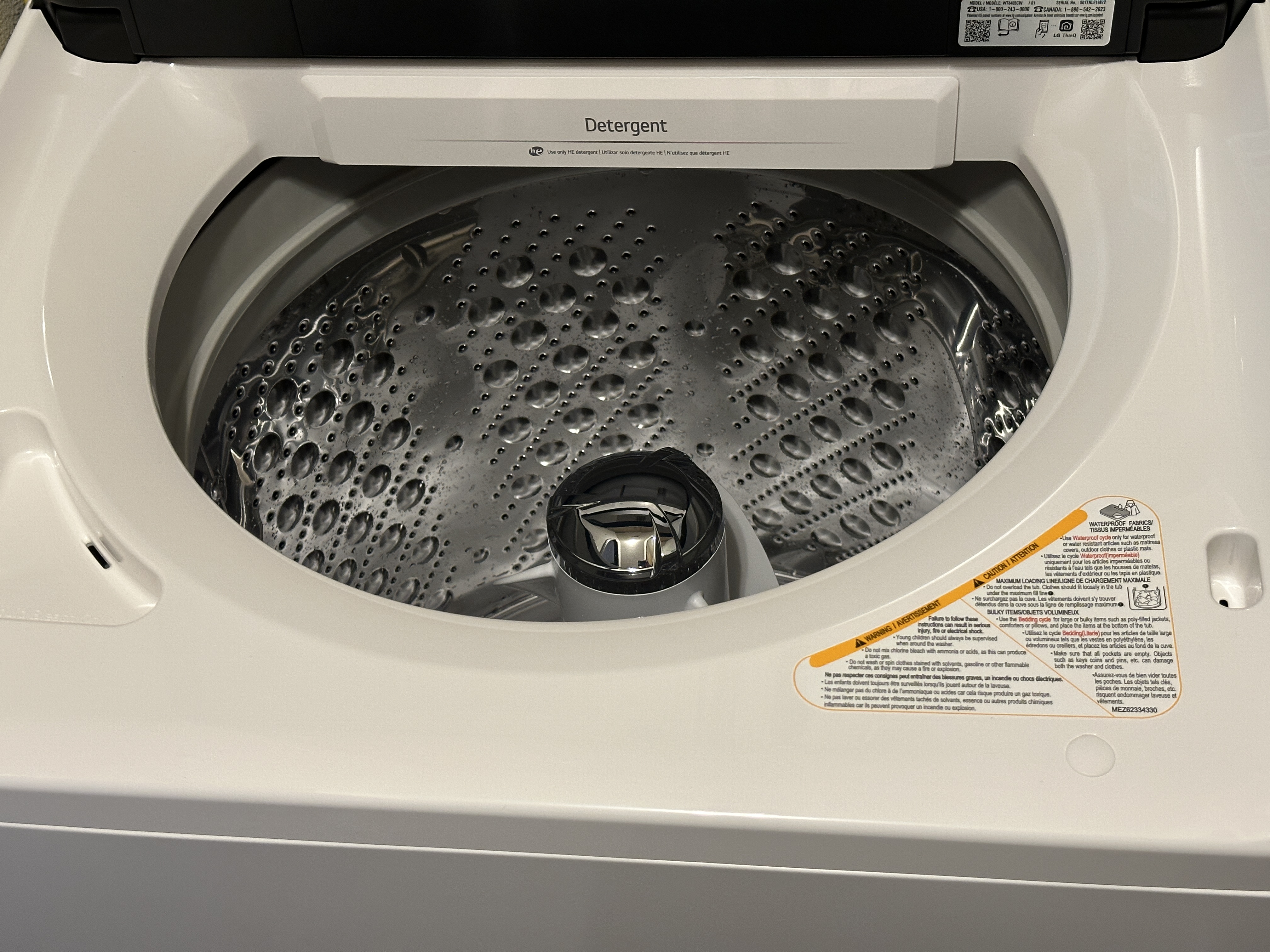
Our new washer does have WiFi, although I doubt I will need remote notifications that a load of washing is completed. I had always used top-load washers with agitators, but I read about the pros and cons of front-loaders, agitators versus wash plates in top-loaders, and how Speed Queens are very reliable but have smaller tubs. I decided to go with the highest-rated top-load agitator washer, as I didn’t want to deal with the extra cleaning to properly maintain a front-loader. That turned out to be another LG unit.

I purchased Consumer Report’s highest-rated top-load agitator washer

A Very Brief LG History

LG was once Lucky-GoldStar. It was founded in South Korea in 1947 as Lak Hui Chemical Industrial Corporation; Lak Hui is pronounced “Lucky” in English. It established GoldStar in 1958 as it expanded its plastics business, and the company manufactures electronics, chemicals, appliances, and telecommunication devices. Four generations of the Koo family have managed the company.

In recent years, LG models have consistently ranked high in Consumer Reports, and I have enjoyed the 55″ LG OLED television I purchased in 2017. However, I grin when I remember that LG stands for Lucky-Goldstar, since there was a time decades ago when they were known for cheap bargain-basement electronics.

My 1996 Maytag washer completed the largest load in about 25 minutes; modern-day washers typically take much more time, although they use less water and energy. Our new LG washer would take 90 minutes to complete its most aggressive normal cycle with Consumer Report’s eight pound test load. They report wash times from 65 to 120 minutes for front-loaders and 40 to 100 minutes for top-loaders with agitators.

Our dryer typically takes 60 to 90 minutes to dry a load, and I’m not used to a washer taking that long or more. So I suspect I’ll be taking advantage of the washer’s faster “TurboWash” mode, which still won’t be as brisk as my old Maytag.

The new washer was $848 plus $38 for new connectors, $50 to haul off the old Maytag, $79 tax, and $29 delivery for $1,044 total. That’s actually cheaper than my Maytag, which cost $686 with tax back in 1996, which would be about $1,400 in 2025 when adjusted for inflation. Even better, my old Maytag used 923 kilowatt-hours per year in the government’s tests, while the new LG uses only 210 kilowatt-hours per year.

However, can the LG washer last 29 years with only one fairly simple repair? Is there an LG repairman, and is he lonely? Time will tell.


Posted in history, home repair | Leave a comment

AI’s Potential Impacts on Employment

When I consider the likely impacts on employment of advancements in artificial intelligence (AI), I am naturally reminded of how automation in manufacturing blossomed in the second half of the 20th century. I’m currently reading Kurt Vonnegut’s Player Piano, his dystopian first novel in 1952 “about people and machines, and machines frequently got the best of it, as machines will.”

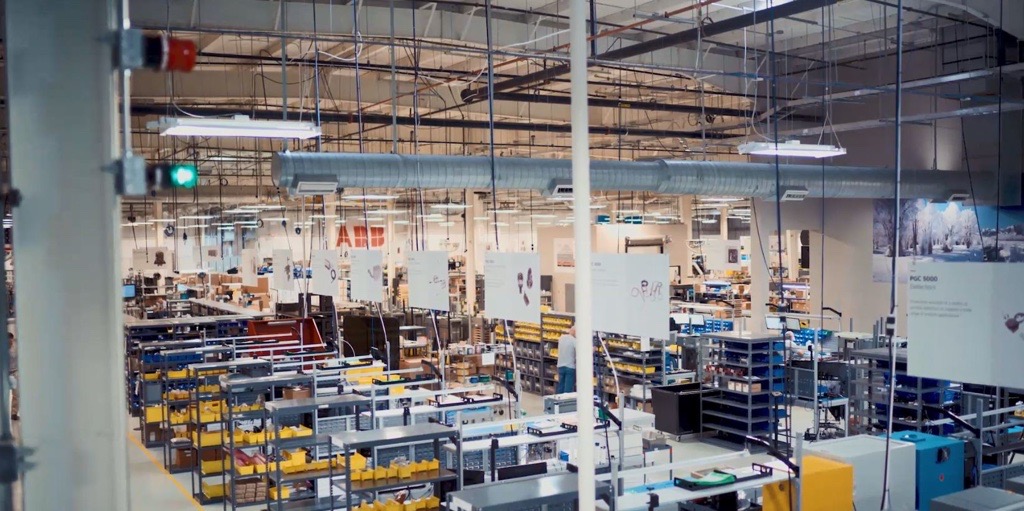
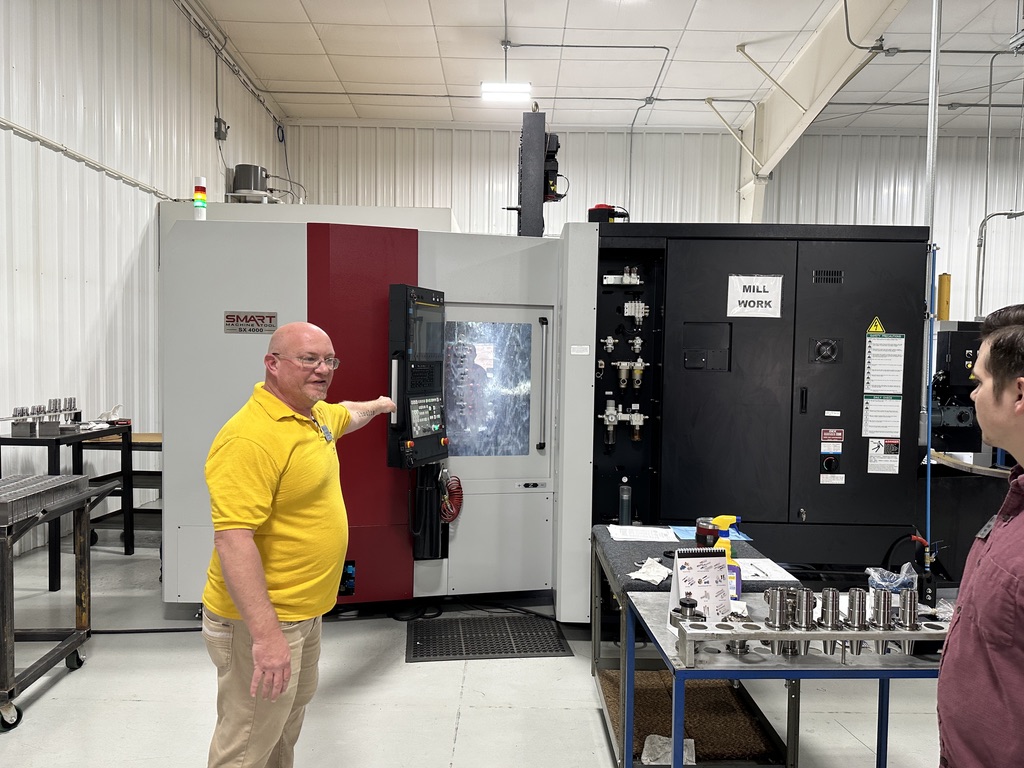
The changes in manufacturing have been driven home to me recently by tours of two plants in our local industrial park, which are radically different from the images I saw in my youth of factories and machine shops. The clean modern facilities included some sophisticated programmable machinery.

The Decline of Domestic Manufacturing

One might expect that automation led to a steady decline in manufacturing employment in the USA. However, there are significant complicating factors, including global trade and labor costs.

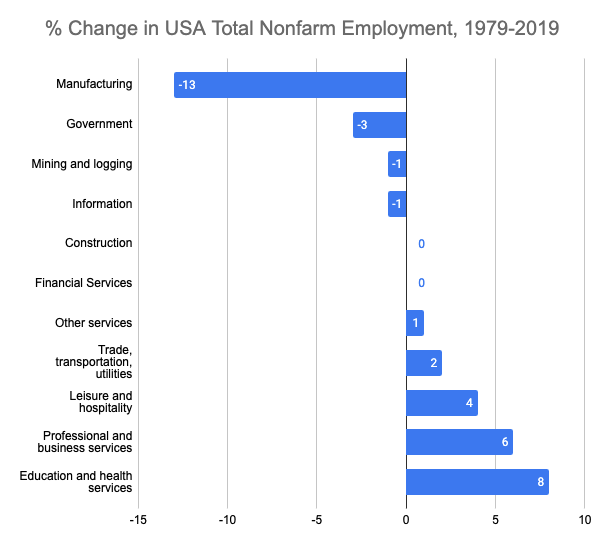
While it is true that over the 40 years between 1979 and 2019 manufacturing employment dropped from 22% to 9% of total nonfarm employment, that was not due to a steady erosion, but instead primarily due to three major drops during the economic recessions of the 1980s oil bust, the dot-com bust of the early 2000s, and the Great Recession of 2008 caused by a real estate bubble. The end result was that by 2019 we were back down to the domestic manufacturing employment levels of 70 years earlier, that of post-war 1949.

There were three major drops in manufacturing employment in the early 1980s, early 2000s, and the Great Recession of 2008 [Source]

Let’s break down the 40-year decline from 1979 to 2019 into categories. First we’ll look at durable goods, which shed 35% of its jobs. Every sector saw significant drops, with the biggest drop in computer and electrical products, which declined by over 40%, while wood products and furniture dropped by 1/3, as did fabricated metals and machinery.

[Source]

Now let’s turn our attention to nondurable goods, which shed over 1/3 of its jobs over those four decades. Worst hit were the USA’s apparel and textile industries, which lost an astonishing 80% of their jobs. That’s twice the painful loss of over 40% of the jobs in the paper and paper products industries. About 1/3 of petroleum jobs were lost in the oil crash of the 1980s and another 1/4 since then, while overall the jobs in chemicals are down about 20%. Printing and publishing rose until 2000 and then dropped, landing at about 10% below its levels of 40 years ago. Plastics and rubber also rose until 2000 and then dipped, landing about 5% down overall. The only area to show growth was food manufacturing.

[Source]

So how did that change the employment mix? The chart below shows how the loss in manufacturing jobs was accompanied by a growth in services along with leisure and hospitality.

[Data Source]
[Source]

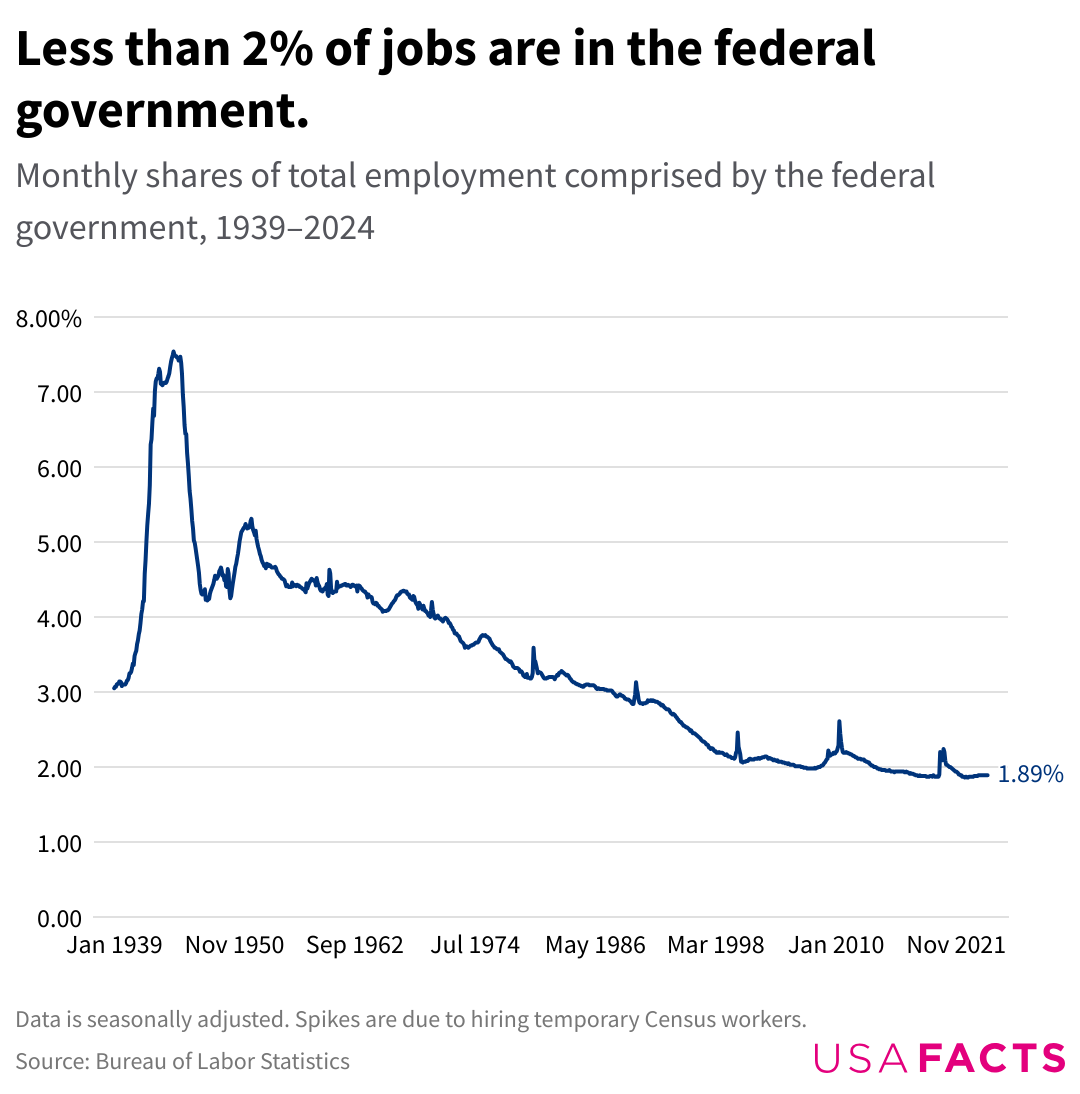
It is also interesting to note that despite the flogging of government as bloated and inefficient by the Reagan administration at the start of the period and the current decimation of government jobs at the start of the second Trump presidency, government actually declined from 1979 to 2019 in the percentage of total employment.

The loss of manufacturing jobs in the USA was not merely due to automation, but also increased global competition. Lower labor costs led companies to relocate production to other countries, and labor shortages that include the “great retirement” of the baby boomers have also had significant impacts. Trump promotes tariffs as a response to lower labor costs and lax regulations in other countries, while many economists warn that tariffs create market distortions that lead to long-term harm to domestic consumers and eventually retard industrial progress and efficiency.

The Progress of Artificial Intelligence

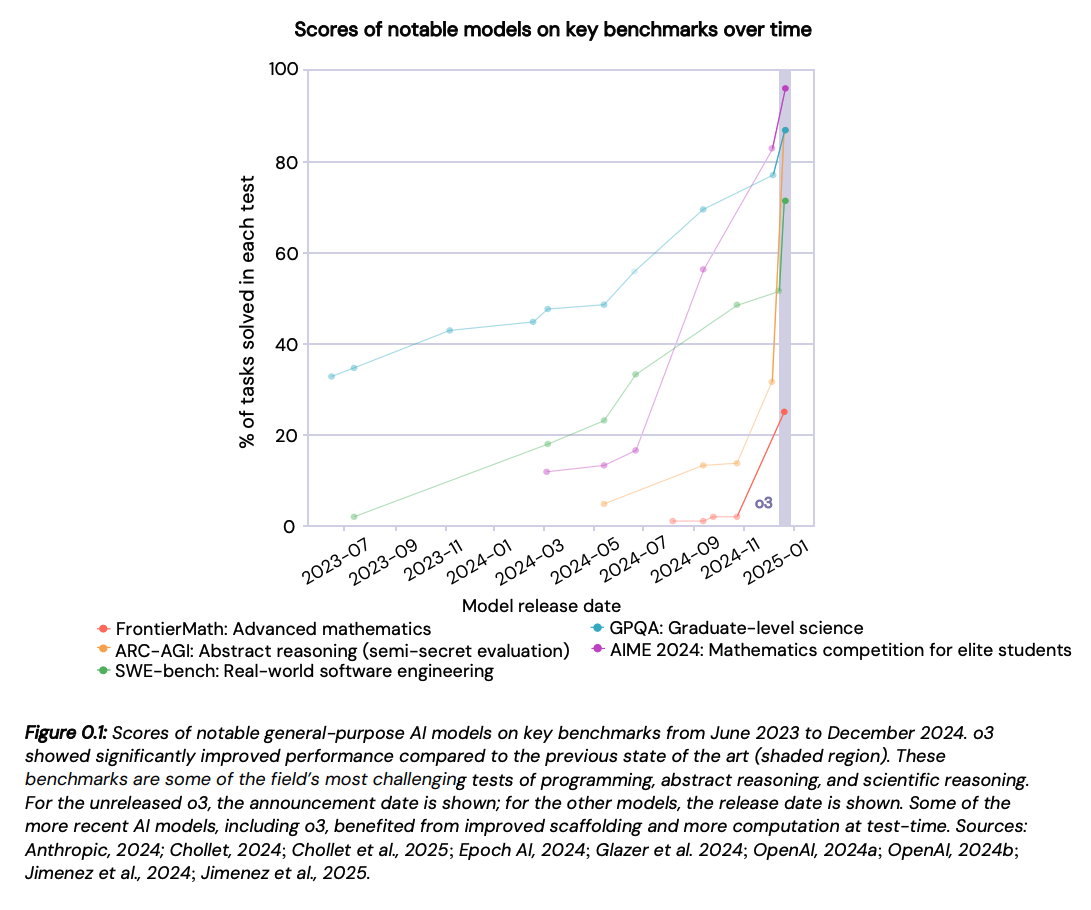
How much might AI impact employment in the various sectors? First, let’s confirm the impression that AI is making significant headway. General purpose AI models are now showing marked improvement on the most challenging tests of programming, abstract reasoning, and scientific reasoning.

General purpose AI model performance on the most challenging tests of programming, abstract reasoning, and scientific reasoning [Source]

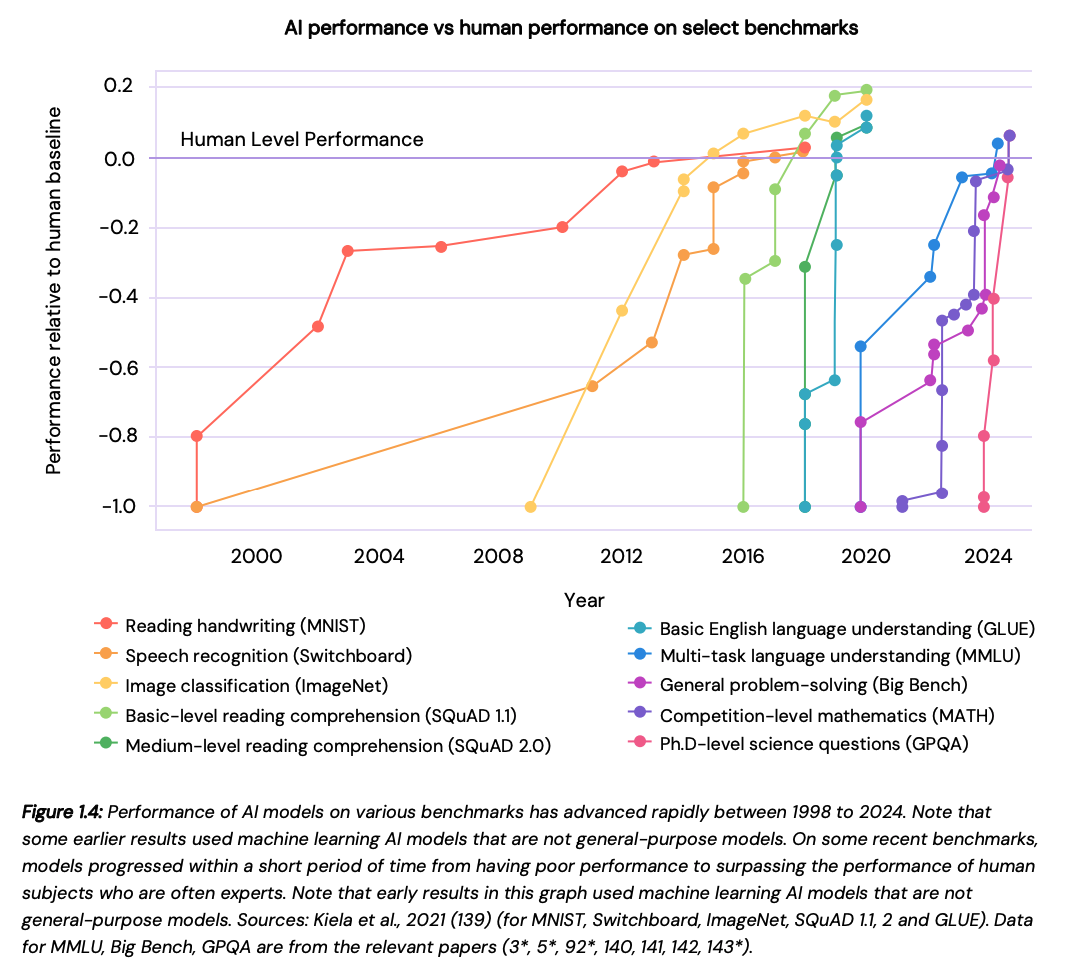
Over the last decade, general-purpose AI systems have achieved or exceeded human-level performance on benchmarks across a wide variety of domains, such as natural language processing, computer vision, speech recognition, and mathematics.

[Source]

What is not clear is how impressive performance on benchmarks translates into performance in real-world tasks. According to the January 2025 International AI Safety Report, “current general-purpose AI systems often demonstrate uneven performance, excelling in some domains while struggling in others, which makes overly general comparisons less meaningful. While general-purpose AI now outperforms humans on some benchmarks, some scientists argue that it still lacks the deep conceptual understanding and abstract reasoning capabilities of humans.”

You are likely aware of how current large language model artificial intelligence can “hallucinate”, providing misleading and incorrect results. There are developing concerns about privacy, cost, and environmental impacts of AI systems.

AI Automation & Augmentation Both Bring Disruption

Nevertheless, according to the report, “General-purpose AI differs from previous technological changes due to its potential to automate complex cognitive tasks across many sectors of the economy. Unlike labour-saving innovations of past centuries that primarily automated physical tasks or routine computing tasks, general purpose AI can be applied to a wide range of complex cognitive tasks across multiple domains, ranging from mathematics to computer programming to professional writing.”

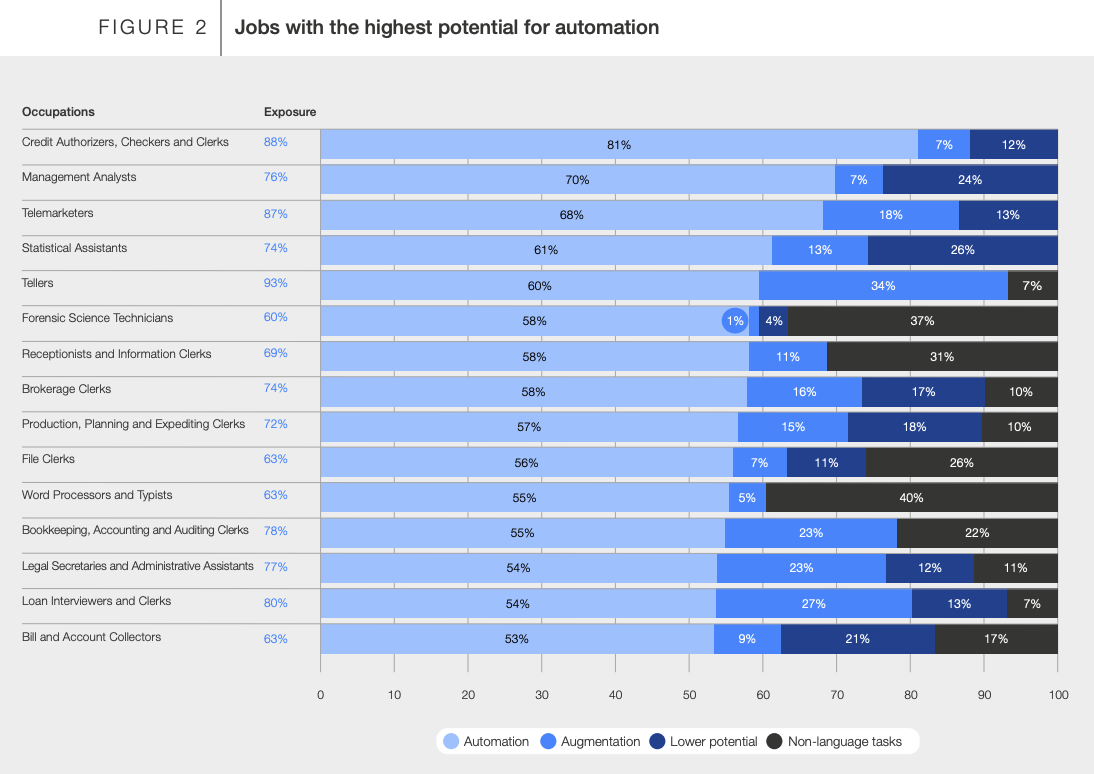
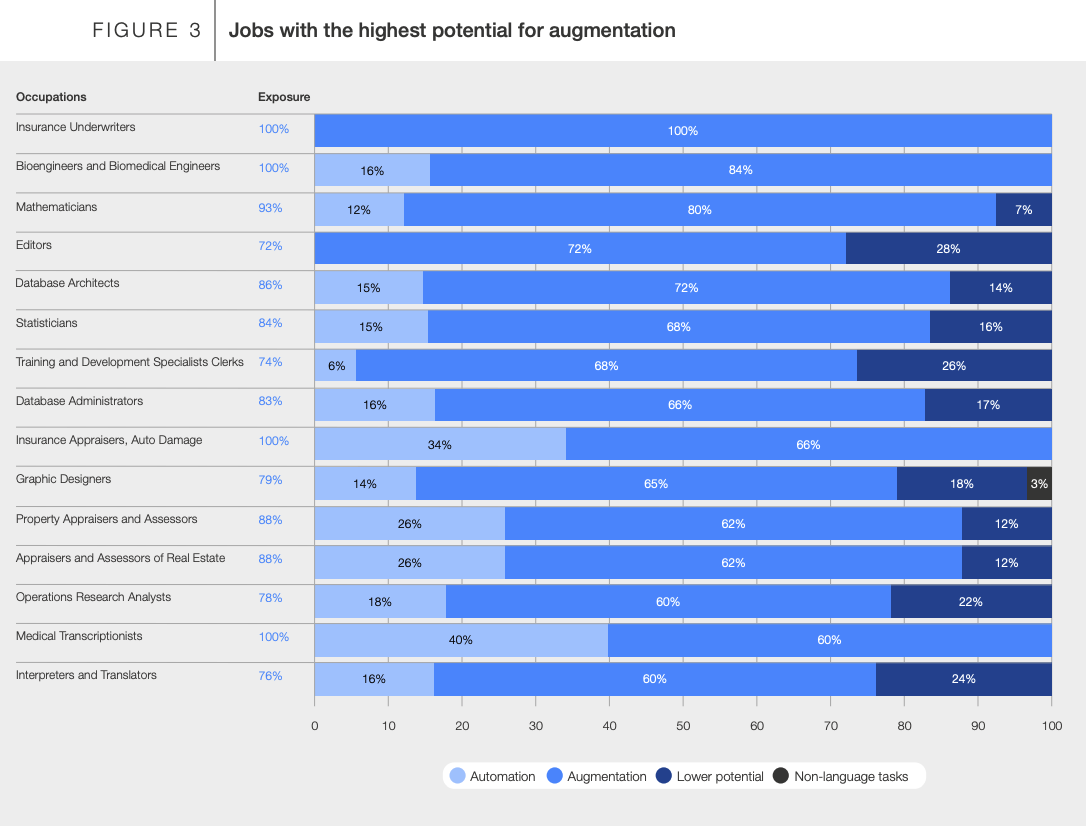
One study estimated that in advanced economies 60% of current jobs could be affected by today’s general-purpose AI systems. A 2023 white paper at the World Economic Forum identified occupations and sectors that are now vulnerable to AI automation.

[Source]

Those jobs are at high risk as AI develops, with machines, not humans, eventually performing many of their tasks.

Other jobs are exposed not through automation, but via augmentation. Humans will continue to perform these tasks, but AI will increase human productivity, which in turn can mean fewer job positions.

[Source]

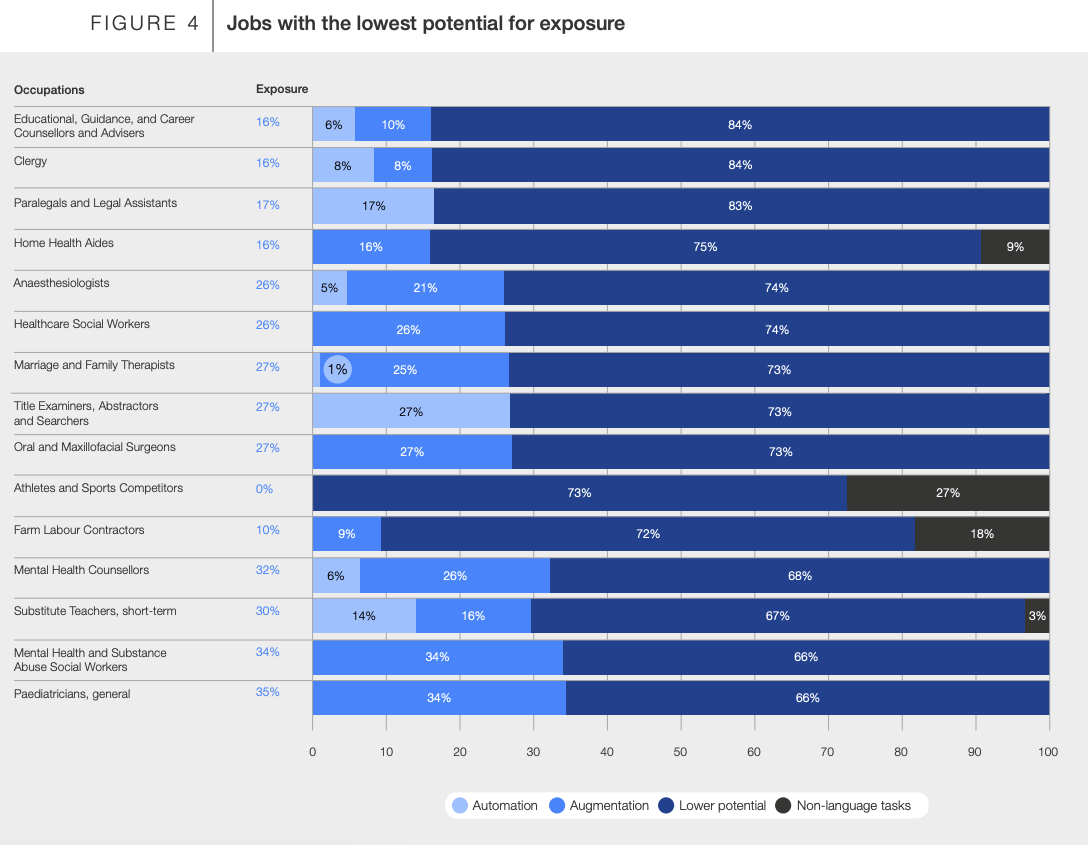
Jobs that require a high degree of personal interaction or physical movement are the least threatened by current AI trends.

[Source]

Jobs with little to no potential to be impacted by the adoption of large language models in the workplace include dishwashers, highway maintenance workers, meat cutters, rail-track laying and maintenance equipment operators, carpenters, slaughterers, oil and gas roustabouts, pressers, and fiberglass laminators and fabricators.

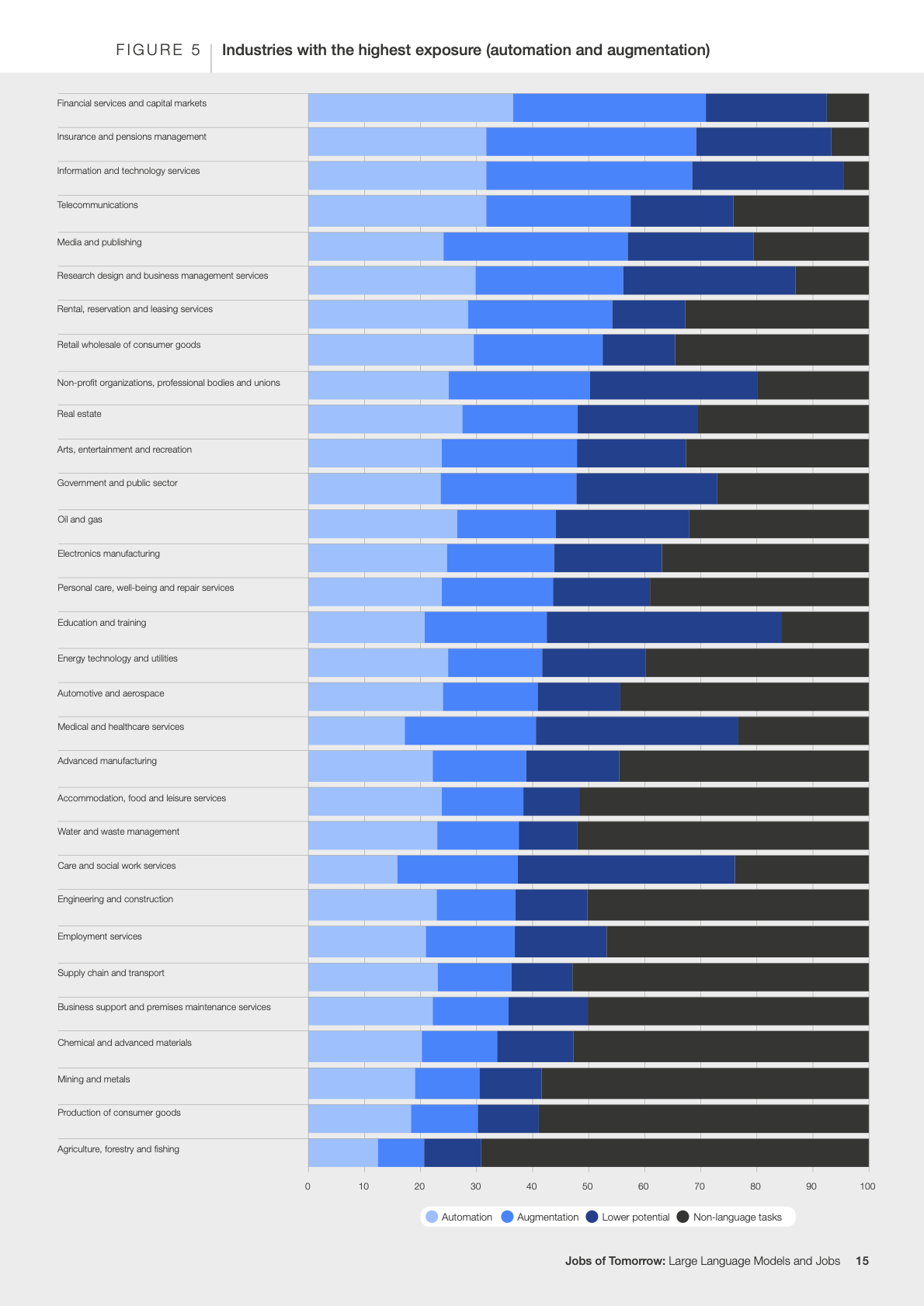
Switching from tasks to industries, below are the ones with the highest exposure to AI automation and augmentation.

[Source]

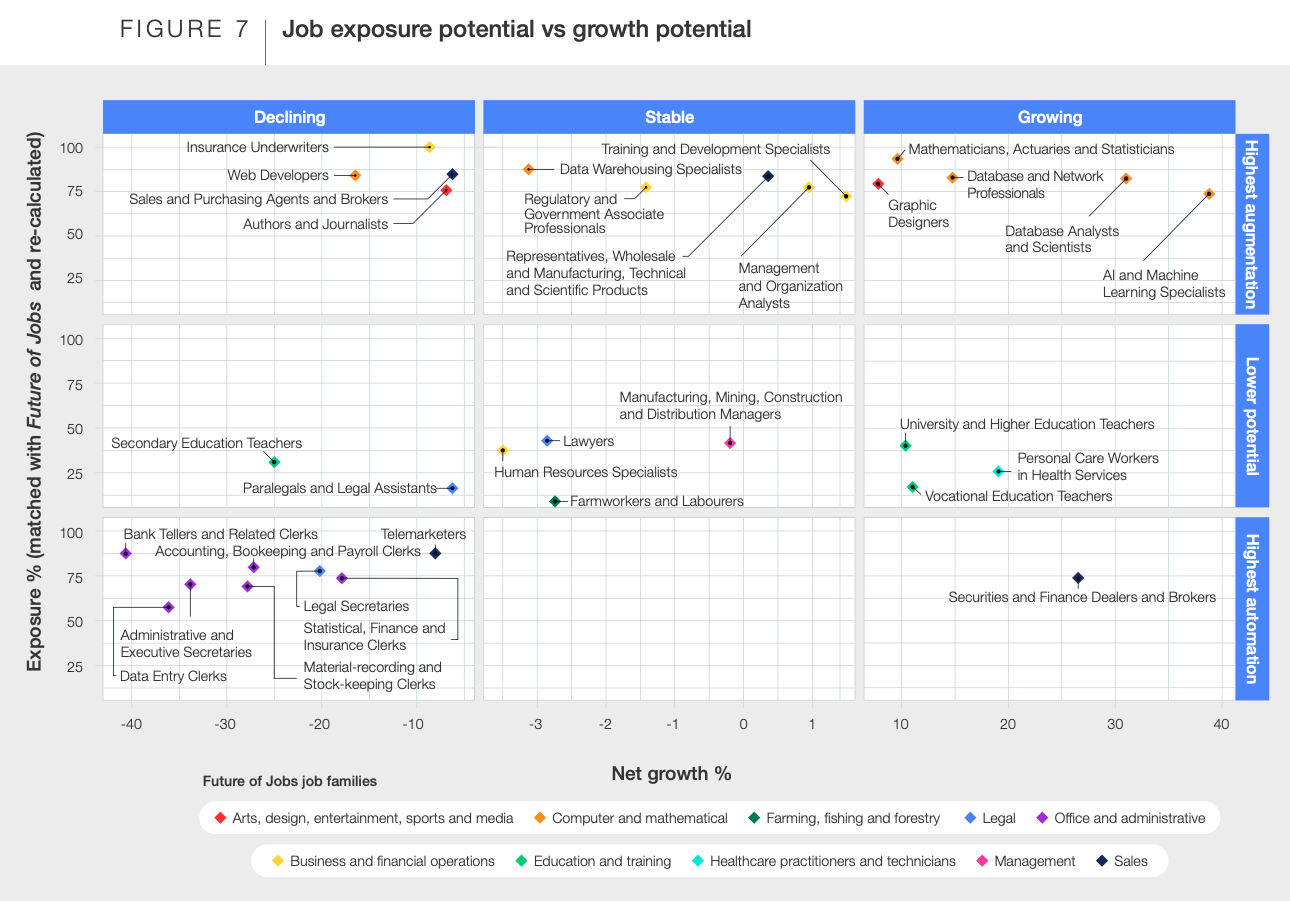
Another chart combines job exposure to AI with overall growth potential. Jobs on the left side of the chart are expected to decline, with the bottom left dramatically impacted by AI automation.

[Source]

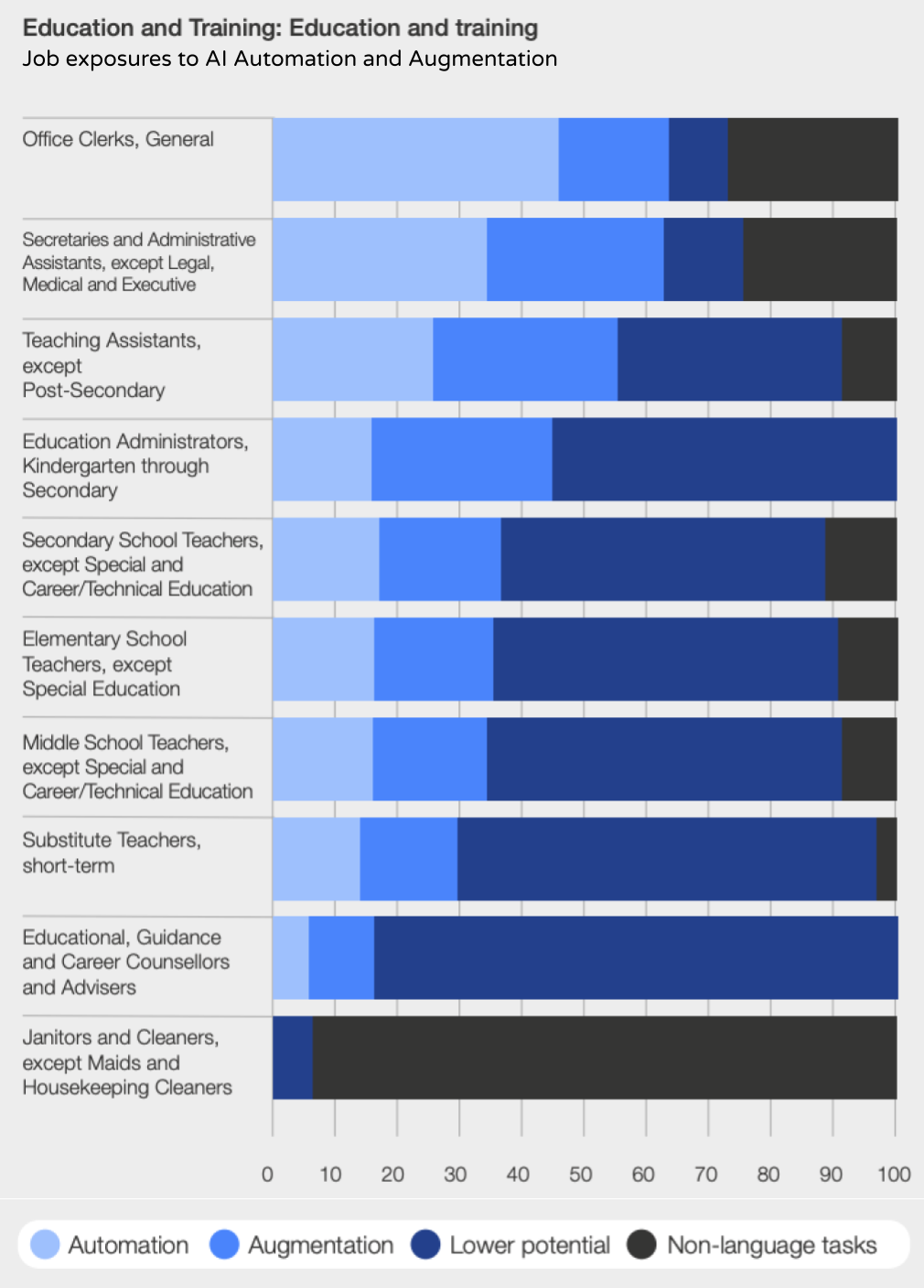
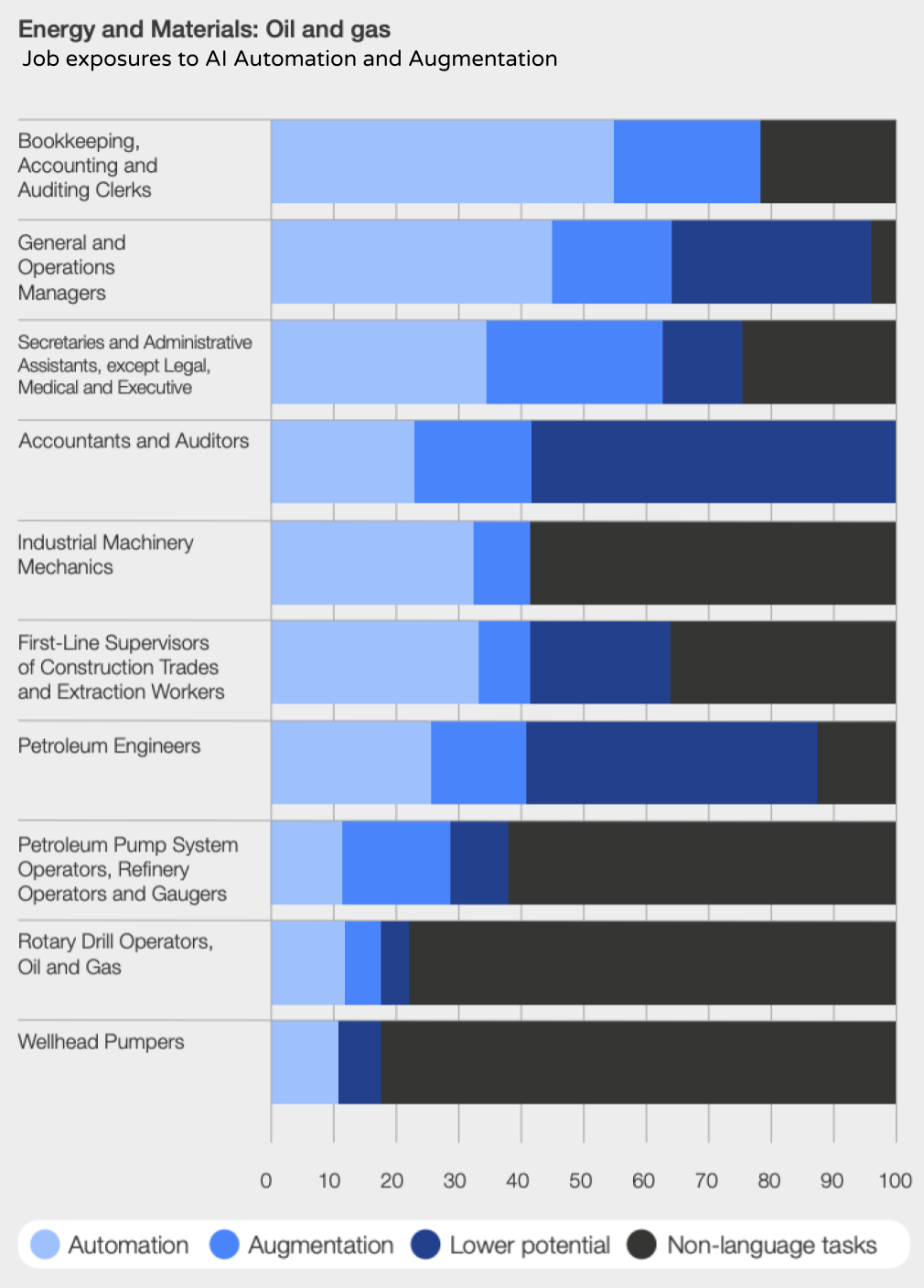
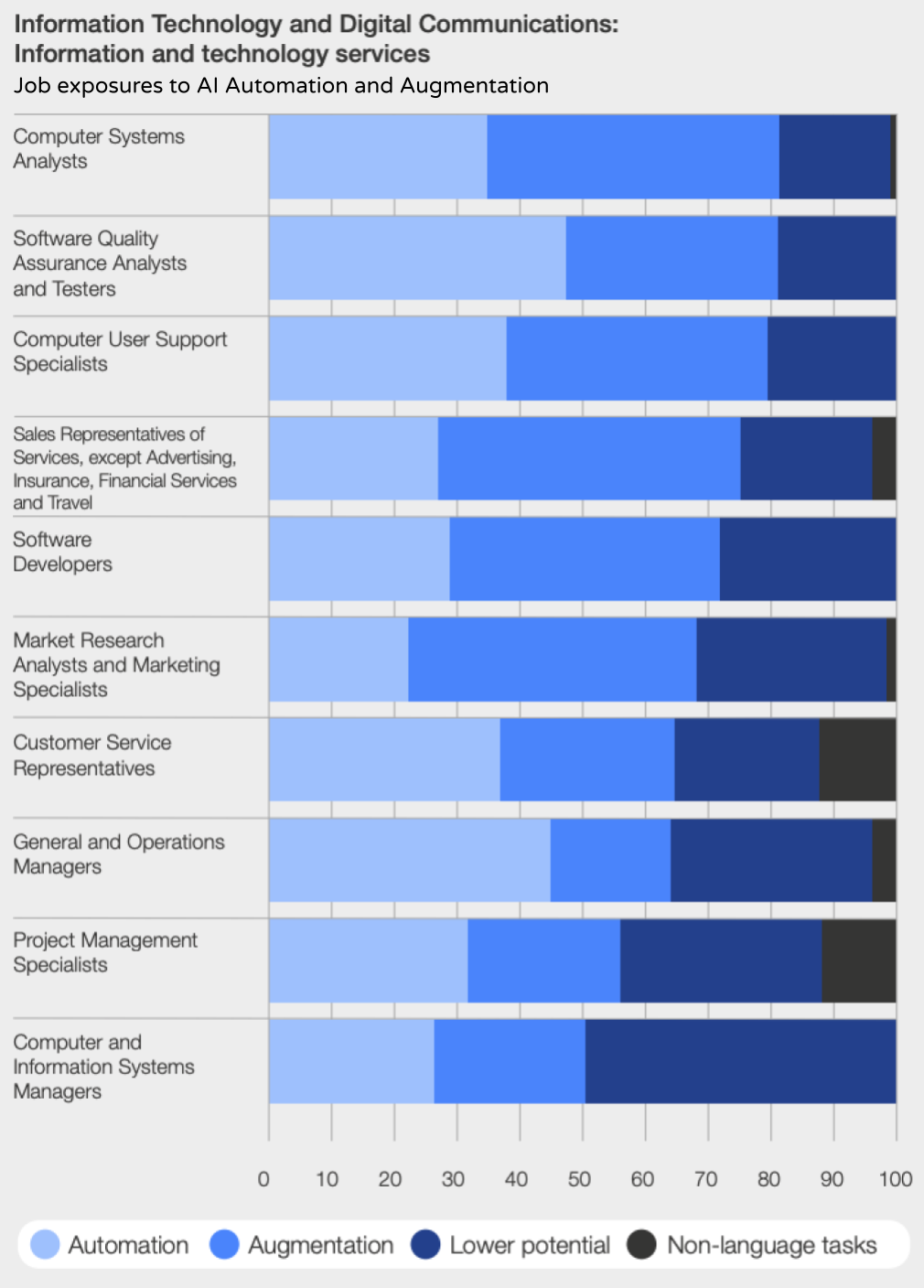
I will point out that the appendix on pages 20-29 of the report is particularly interesting, as it has charts of the job exposure to large language model AI within specific industries.

For example, here are the exposures in my own career field of education:

Bartlesville’s largest employers are still in oil and gas, and here are the AI exposures for that industry:

For some time, students have been encouraged to pursue careers in information technology, but those positions are now among the most exposed to AI disruptions:

That final chart reminds me of the ouroboros, the snake eating its tail. Some perceive it as a symbol of the cycle of life, representing continuity and eternity. However, I have always perceived it as a symbol of self-destruction. Automation’s spread into new realms is certain to bring disruptions that will again shift employments.

Posted in technology | Leave a comment

Puzzled

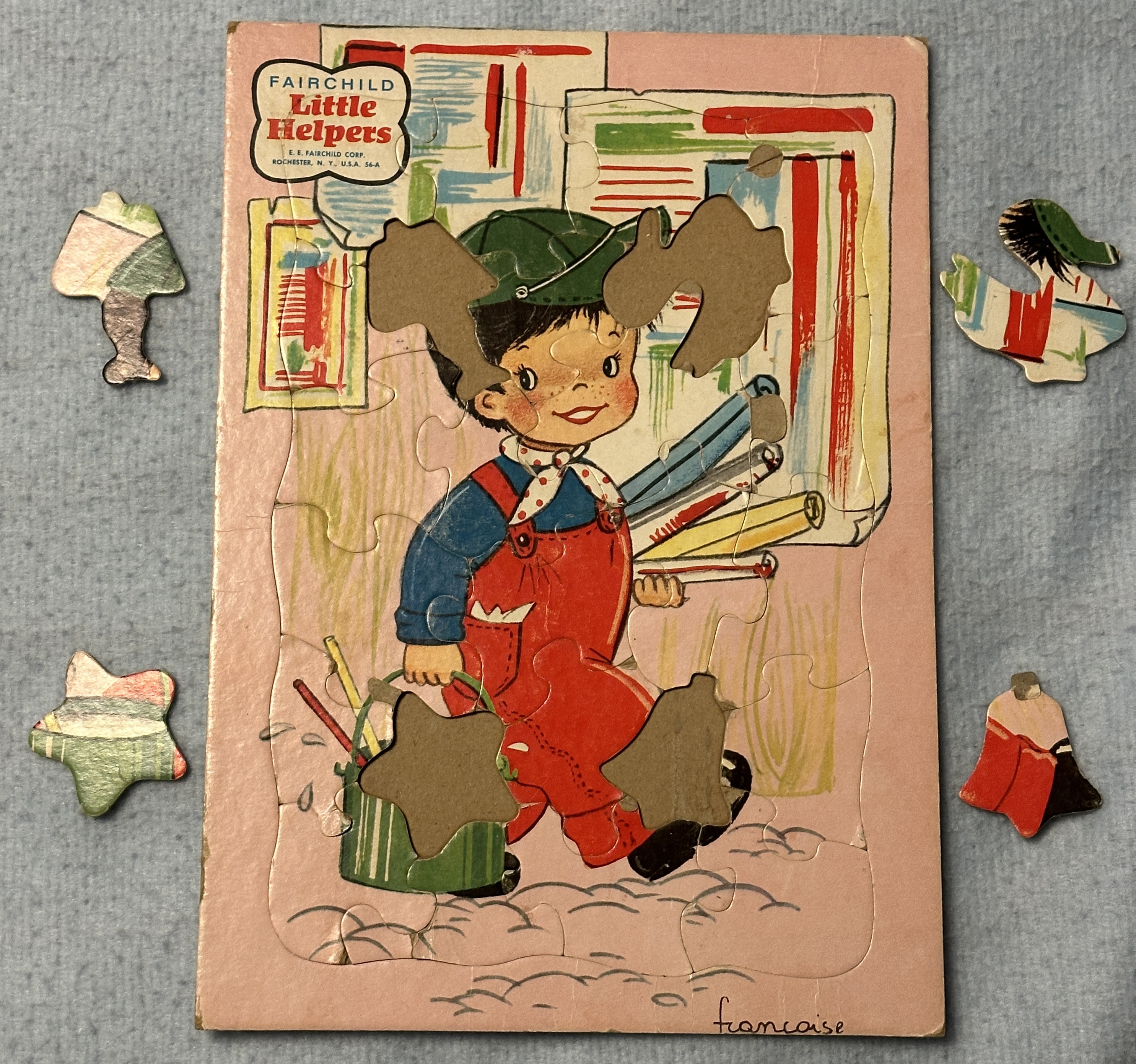
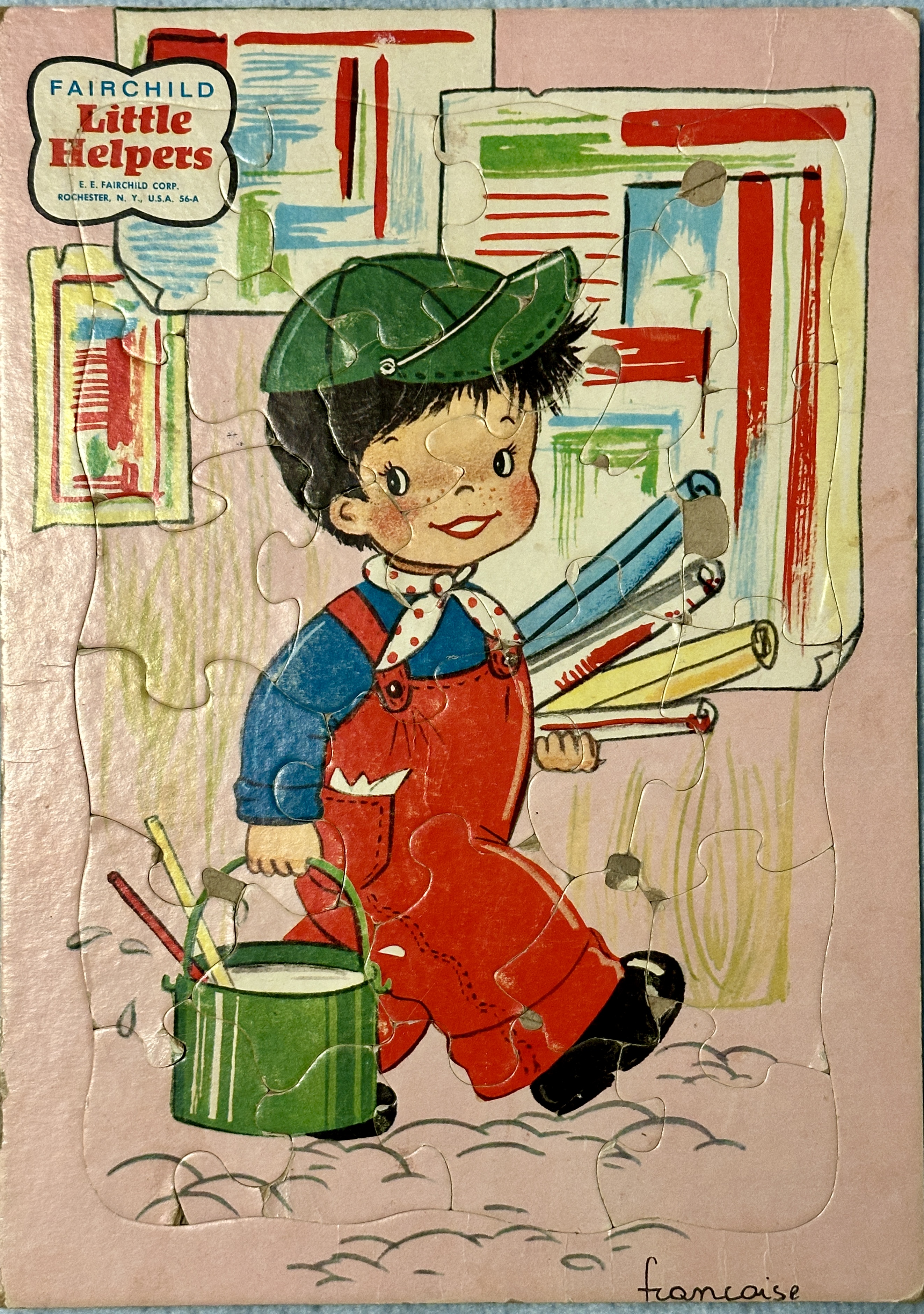
The oldest item I have from my childhood is a jigsaw puzzle of a boy pasting up posters. When I was very young, I enjoyed putting it together, charmed because it had four “figure pieces” in the shape of objects: a lamp, a duck, a star, and my favorite, a little bell.

My oldest childhood item is this cardboard puzzle
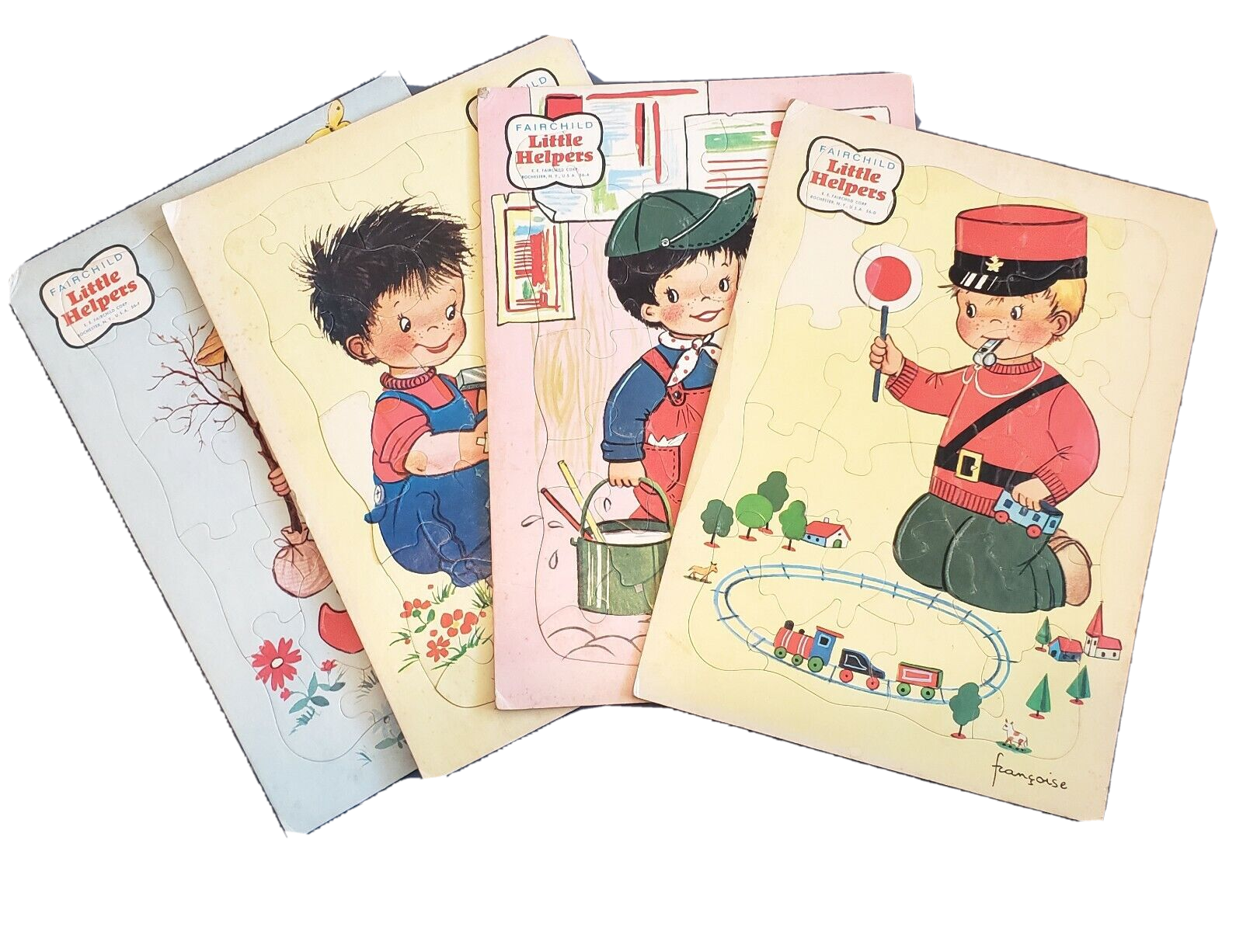
Little Helpers puzzles

That was one of several such puzzles produced as Fairchild Little Helpers. Henry Alderman and Elmer E. Fairchild formed a company in Rochester, New York in 1900 that initially printed paper goods and cardboard boxes for clients such as candy companies. They branched into games after World War I, constructing a factory in 1926 in the Churchville suburb. Alderman left after 1928 and the E.E. Fairchild Corporation continued to produce paper goods as well as games and jigsaw puzzles under the All-Fair brand, taking advantage of a craze for the latter during the Great Depression.

Elmer passed in 1954, and his son, E. E. Fairchild, Jr. kept the firm afloat making puzzles and card games until a 1974 fire wiped out much of his inventory and a competitor bought out what was left.

Françoise Seignobosc

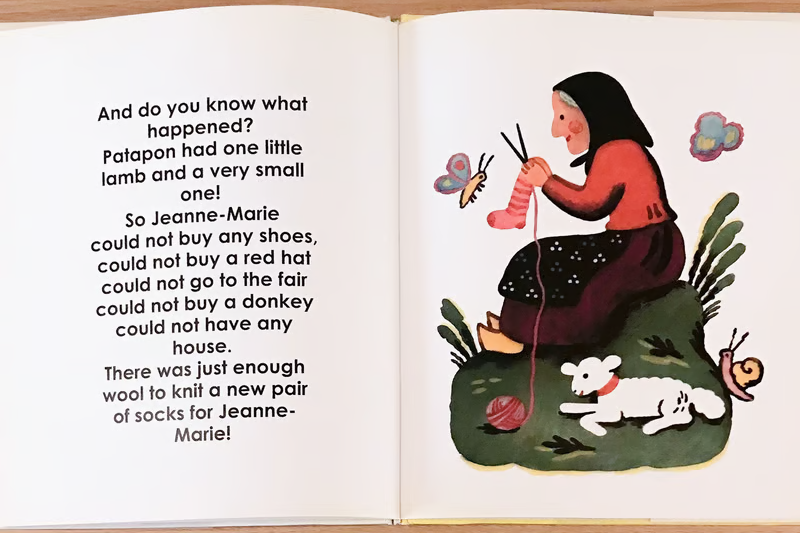
My puzzle’s imagery was by children’s book illustrator and author Françoise Seignobosc (pronounced say-nyoh-boh). She was born in 1897 in Lodève, a commune in the département of Hérault in southern France. She emigrated to the United States and wrote over 40 children’s books before she died in 1961. Many of them were tales about a little girl named Jeanne-Marie. Jeanne-Marie Counts Her Sheep was the Book of the Year for the American Institute of Graphic Arts and won the New York Herald Tribune prize for children’s books.

That was a numbers book about a little girl dreaming of how many lambs her sheep, Patapon, would have, and what Jeanne-Marie would be able to buy with the money she made from the lambs’ wool. Patapon agreed that she might indeed have many lambs, but that being in the sunshiny green pasture all day long was all they really needed to be happy. Jeanne-Marie imagined many lambs and many purchases, but it turned out there was just one lamb. In the end, an aged Jeanne-Marie was able to knit only one pair of socks. “But Jeanne-Marie tried to look very happy, anyway, for she did not want Patapon to feel sad. Patapon was so pleased with her one little Lamb!”

When I was a preschool-age child, I loved puzzles. My mother provided me with a wooden Playskool Winnie-the-Pooh puzzle and various others, but only this Little Helper survived later garage sales and giveaways, as it had been forgotten in an unused side table drawer at our cabin on Table Rock Lake.

Jigsaw puzzles were invented by John Spilsbury, a British cartographer. Around 1767, he pasted one of his maps of Europe onto a piece of wood, cutting sections and countries into individual pieces. He gave the puzzle to schoolchildren to help them learn geography. I can relate to that, as I remember school puzzles of the states of the USA and how some of the small New England states had to share a piece to avoid creating choking hazards. Oklahoma always stood out, thanks to the Panhandle.

Spilsbury’s first puzzles did not interlock, leaving them vulnerable to a slip of the hand or table wobble. Since the jigsaw wasn’t invented until the 1880s, the early puzzles were called “dissected puzzles”.

Jigsaw puzzles play a symbolic role in one of the greatest films ever made: Citizen Kane. At my first viewing, I remember being struck by how thick its wooden puzzles were compared to the cheap cardboard puzzles I was familiar with.

In the early 1900s, lithographic printing, saws, and plywood were combined to create somewhat cheaper high-quality puzzles. From 1907-1911, when Oklahoma became a state, a puzzle craze gripped America’s northeast, but a 400-piece puzzle still cost about $4 at a time when an average worker only earned $12 per week. So puzzles were often shared and swapped.

Some people started wanting more difficult pieces with trick edges, no cover image, and images on both sides. Game manufacturer Parker Brothers entered the puzzle business in 1908, and in 1909 shifted entirely to creating hand-cut wooden puzzles, with 225 puzzle cutters crafting 15,000 puzzles per week. It was producing interlocking, non-interlocking, and color-line cutting puzzles. The latter are ones where piece edges fall along color boundaries, reducing pictorial clues and forcing one to rely much more on the shapes of pieces.

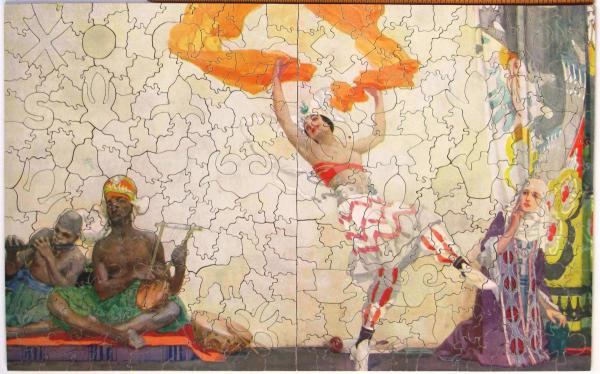
Their Pastime Puzzles were the first commercially successful puzzles that used figure pieces in large single-color areas, in the shapes of animals, flowers, letters, numbers, and geometric shapes. They usually included a dozen figure pieces among every 100 puzzle pieces. The large white area in 1928’s Before Jazz puzzle makes it easy to spot several of its 35 figure pieces.

Before Jazz, a 1928 300-piece 15×9″ plywood puzzle, had 35 figure pieces [Source]
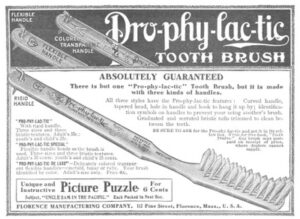
In 1932, a toothbrush company offered a low-cost puzzle to buyers, setting off a new advertising trend

The fad faded after a few years, but another craze came in 1932 as people sought distractions during the early years of the Great Depression. A switch to cardboard allowed for a standard die-cut rather than paying teams of women to cut pieces by hand. A 300-piece puzzle could then be had for just a quarter dollar, subsidized by advertising.

By early 1933, 10 million puzzles were produced each week, with 7 million of them being advertising puzzles. Some were themselves ads, some featured just the name of a company on them, and others were double-sided.

That craze also quickly faded, perhaps due to the loosening of prohibition restrictions, or an improving economy, or because puzzles were then being taxed. A third brief craze came in 2020 during the lockdowns of the COVID-19 pandemic.

With Truman over 40 years ago and my little Starcraft runabout at the Eagle Rock Marina; Truman would pass away seven years later

My childhood love for jigsaw puzzles did not endure, but I remember how Truman Thompson, a sweet retired high school history teacher who lived near our lake cabin in Missouri, enjoyed them. Since I was a little boy, if he wasn’t out tending the flowers in his bluffside beds, he might be in his home doing a puzzle.
When his frame home burned and was replaced by a mobile home, he had a big picture window in one end looking out over the lake. He had placed a card table in front of it, and I remember him happily seated there, a cigarette burning in an ashtray, as he assembled a picture puzzle, sometimes glancing up to contemplate the ever-changing puzzle of the outside world.

Posted in history, nostalgia, random | Leave a comment

Shift Happens

Pew Research Center periodically examines religious and political beliefs of the populace, and it is interesting to note their shifts over time.

They recently released their latest Religious Landscape Study, a decade after the previous one. It is interesting to note Oklahoma’s proportions of various religious and political beliefs and how they have changed over time and how they compare with national statistics.

Religion

Oklahoma is known as a very religious and politically conservative state, but the study confirms a significant increase in the religiously unaffiliated over the past two decades.

Source

Christians still dominate with 47% of Oklahomans being Evangelical Protestant, 11% Mainline Protestant, 8% Catholic, 4% Historically Black Protestant, and 1% Latter-day Saints (Mormons), while all of the other Christian categories combined are less than 1%.

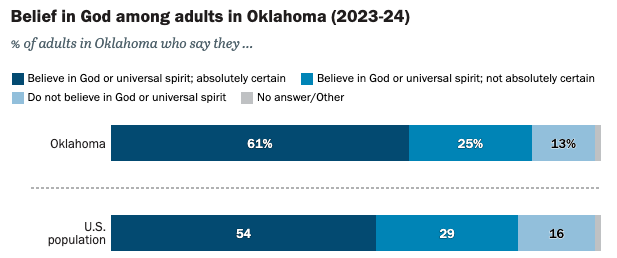
Since 2007, the percentage of Oklahomans who believe in nothing in particular has risen from 9% to 12%, agnostics have risen from 3% to 9%, and atheists have risen from less than 1% to 5%. Another lens to apply is belief in God:

I threw in the nationwide percentages for comparison, and you can examine many other religious beliefs and practices in the study, including religious attendance and belief in heaven and hell.

Politics

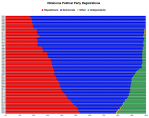
The Republican party is particularly dominant in the central and southern states, but I well remember the decades when the Democratic party had a lock on the Oklahoma legislature and most statewide offices. In 2007, most Oklahomans were Democrats, but now the Republicans hold immense sway.

The lopsided party affiliations in Oklahoma in 2024 contrasts to how nationwide 46% identify with Republican politics, 46% with Democratic politics, and 8% with neither.

Back in the day, many Oklahomans were conservative or “Blue Dog” Democrats. In 2007, when most Oklahomans were still affiliated with the Democratic party, 39% of Oklahomans identified as conservative, 36% as moderate, 18% as liberal, and 7% gave no answer. Since then, liberals have increased to 20% and conservatives to 41%.

Notice how nationwide conservatives still outnumber liberals, with the plurality going to moderates. The tendency to overestimate Republican enthusiasm for all conservative ideological stances and Democratic support for all liberal ones is perhaps why some who look at how 46% of Americans lean Republican and 46% lean Democrat then wonder at the current seismic shifts in national politics.

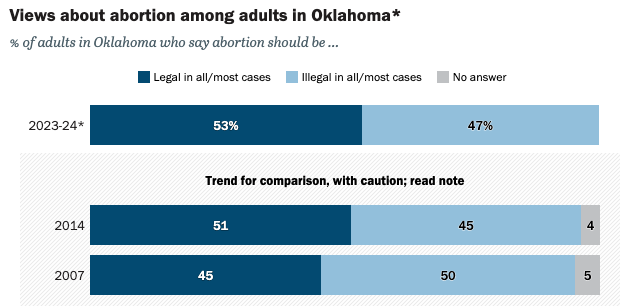
The lopsided politics in Oklahoma have yielded a draconian approach of abortions only being legal if necessary to save the life of a mother. However, it is worth noting that the majority say abortion should be legal in all or most cases.

Such views were in the minority back in 2007.

The study explores other social and political topics, including homosexuality, same-sex marriage, immigration, and evolution. I find it helpful to see actual data about Oklahomans’ views, as opposed to the hyperbole and rhetoric of politicians and the intensely anecdotal and biased posts one finds on social media.

Posted in politics, religion | 1 Comment