Vodpod videos no longer available.
more about “Robot Chicken Attacks Crusher“, posted with vodpod
Robot Chicken took a swipe at Wesley Crusher.
Vodpod videos no longer available.
Robot Chicken took a swipe at Wesley Crusher.

My Walking Routes
This summer on a number of mornings I walked different routes in Bartlesville both for regular exercise and to prepare myself for my Oregon day hikes. There are three routes I like to walk.
Caney/Silver Lake Loop
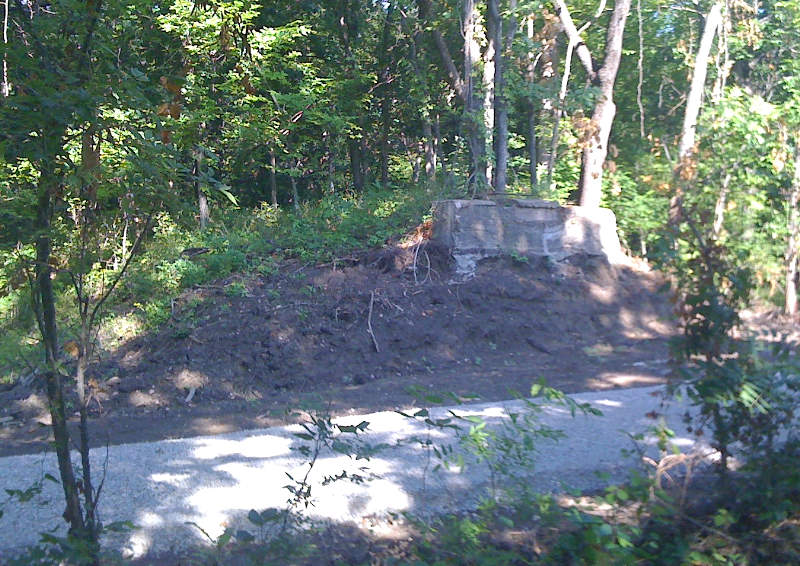
My favorite is to park near the Memorial Bridge on Adams and make a 4.5 mile loop. I walk up over the bridge and follow the bike trail under Adams and then south along Silver Lake Road until I reach the Wesleyan fields. Then I turn west on the Pathfinder Parkway and follow it across the Caney River, then parallel the river northwards past the high school and back up to Memorial Bridge.
I’ve used my iPhone’s MotionX GPS app to record these walks. Here’s a KMZ file for the Caney/Silver Lake Loop you can open in Google Earth. To use it, RIGHT-click on that link, save the link to your computer and then open that KMZ file in Google Earth.
Adams to Atwoods
I took advantage of the cool weather this morning to walk this route, which is a 4.0 mile roundtrip. This summer the city has been working to widen and redirect portions of this route around erosion along Turkey Creek and the Caney River, so I haven’t been on it as much as usual. I park either at Atwoods or the Memorial Bridge and take the woodsy Pathfinder Parkway along and over Turkey Creek and past M.J. Lee Lake and along the Silver Lake road extension to Robinwood Park. There I cross the Caney on the Frank Phillips bridge and take the southern fork of the Pathfinder down to the Memorial Bridge on Adams. You can get a good view of the old interurban trolleyway near the Caney River along the latter part of the walk, and I always enjoy walking past the orchard between Frank Phillips and Tuxedo boulevards.
Here’s the KMZ file for the Adams to Atwoods route.
Baird Loops
For several years John Baird, former BHS calculus teacher, has kindly invited me to walk with him through the Woodland Park neighborhood where he lives. John pieced together a two-loop route that adds up to 3.0 hilly miles, contrasting to the above level Pathfinder Parkway routes. After this walk I’m always happy to join John for a drink at Jude’s, although he prefers coffee over my pricey Italian soda.
Here’s the KMZ file for the Baird Loops.
Other Options
There are other routes I could take, of course. The Pathfinder Parkway extends from Robinwood to Johnstone Park, for example. I like the part of the path around the orchard, past Blazer softball fields, and then by some fields where there are a couple of horses. There is an oddball bench along there that is great to lie down on for some sun in the autumn. But I seldom venture on west from there past the sewage treatment plant.
The Pathfinder Parkway also extends from the Wesleyan fields up a steep hill past the church and out from the woods onto the open land and developing neighborhoods near Wayside school and down to Jo Allyn Lowe Park and even under Price Road into Colonial Estates. This portion of the Pathfinder seems to be the busiest, but I prefer the woodsy river or creek portions of the trail.
I used to ride my bike a lot along the Pathfinder Parkway from the Will Rogers School over to Sooner Park, back when I rented a house on Yale Avenue. But that segment is too short to attract me these days. I’d love for the city to extend the Pathfinder from Colonial Estates eastward south of the Food Pyramid, cross under Washington Boulevard, and on northeast along Bird Creek past my own neighborhood over to Tri-County Tech. But I won’t hold my breath.
Hotels and Motels
Here is my personal rating of the hotels and motels I used on this trip, with true daily cost, from best to worst:
 Fireside Motel in Yachats ($124.20; gorgeous location)
 Microtel in Seaside ($97.12; continental breakfast, convenient, and quite pleasant)
 Quality Inn in Bend ($120.99; continental breakfast, hot tub in the bathroom)
 Best Western Agate Beach Inn in Newport ($163.09; nice beach location, but hotel beginning to show some wear)
 Motel 6 in Lincoln City ($76.24; convenient and clean)
All of the establishments provided free wi-fi, showing that even the budget motels have caught up with modern times. Note that my ratings don’t take into account in-room entertainment, since only once on the entire trip did I turn on a television. (Those who know me won’t be surprised at that.)
Planning the Trip
This trip was fairly easy to plan, since I’d been on a long loop through western Oregon in 2006 guided by the AAA TourBook and Oregon: An Explorer’s Guide

Google searches turned up various sites to fill in details on some hikes, particularly the Eagle Creek hike along the Columbia River. I used Tripit.com to share my trip itinerary, including hotel and airplane info, with friends and family and for easy access from my iPhone. I also took along printouts of my reservations since technology can fail. I booked the plane tickets, car rental, and hotel rooms online ahead of time, sometimes using AAA’s website and other times going directly to a vendor’s website.
Executing the Trip
Restaurants
While on the road Yelp.com was a godsend for restaurant recommendations, and easily accessed with my iPhone as needed. Only one place I picked through Yelp didn’t meet expectations, while others were unexpectedly great, sometimes exceeding anything I’ve found back in Oklahoma.
Navigation
Trixie the GPS for navigation was of course instrumental to helping me go solo on this trip. I never consulted a paper map, and only in Bend did one recent road change cause consternation. I’m grateful that GPS units now have large touchscreens – they are much easier to use than my old Garmin Quest unit was.
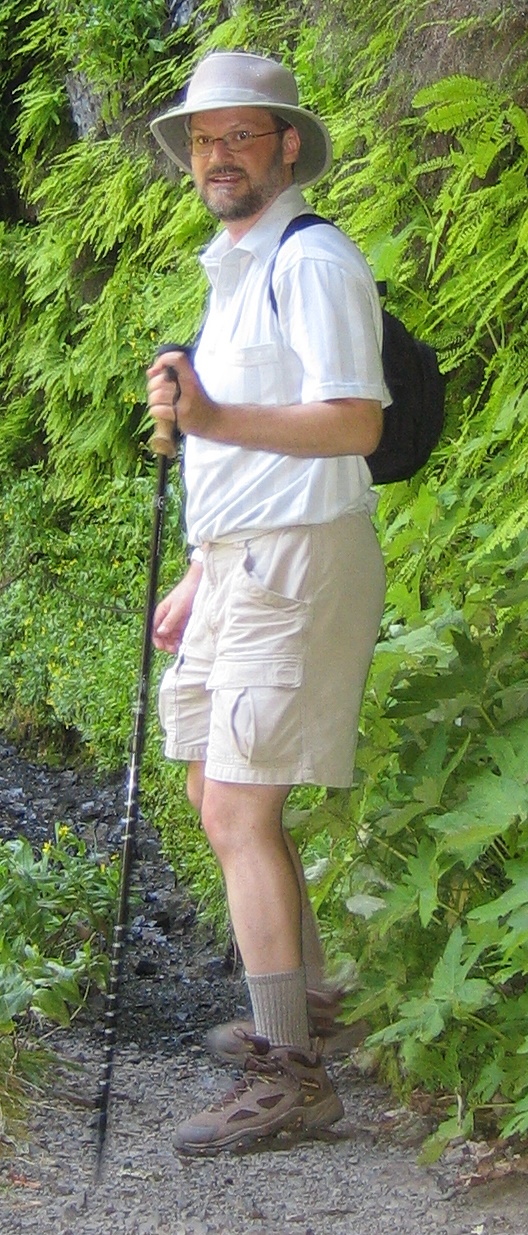
My dayhike attire: Tilley hat, small backpack, cargo shorts, trekking pole, hiking boots and socks.
Day Hikes
I don’t hike for more than seven hours at a stretch, so I use a tiny backpack that can hold three water bottles, trail snacks, hand cleanser, and my personal technology devices. I prefer cargo shorts since they provide easy access to the camera, iPod, and BluePack powerpack. Next time I might pack light cargo pants as well, since I missed those extra pockets when wearing jeans. I forgot to pack a first aid kit, although I never needed one.
This was the first trip I used Swiss Gear Lighted Hiking Pole, 2 Pack


Netbook and iPhone
For photo and video editing and uploading and blog posts I travelled with my ASUS Eee PC 1000H
Tracking with Brightkite and Audioboo
I used my iPhone on the road to get information and post updates to Brightkite so loved ones could track my location through the day since it was a solo trip. Brightkite posts your position with a map and lets you include a brief note or photo if you like. The iPhone app crashed sometimes and was balky on the slow Edge network in most of Oregon – it still needs improvement, but it worked well enough. I used the Audioboo app a few time to post audio updates, but didn’t find it all that compelling.
Photography
This trip was all about photos, and I am still using my old Canon Powershot SD300 4MP Digital Elph Camera with 3x Optical Zoom
Learning While Travelling
On the trail, in the car, and on the plane I kept myself entertained with my Apple iPod nano 8 GB Black (2nd Generation)
GPS on the Trail
I tried using the GPS MotionX app on the iPhone on the trail, but it had trouble getting a consistent GPS signal and couldn’t download a map without cell service. So I really only made good use of it on a couple of the hikes. If you really want to hike with GPS, you need a more sensitive dedicated hiking unit.
Battery Life Issues
While the old iPod Nano had plenty of battery life, the iPhone is a power hog, especially when you are surfing the web and using its GPS unit. The very convenient solution was my Dexim BluePack S3 for iPhone/iPod, which was easy to charge up in the hotel room and could recharge the iPhone multiple times in a day if needed, as well as charge the iPod. It has cabling so you can charge the BluePack and also charge your other devices while only using one wall jack, a big plus in hotel rooms. The only drawback is there is no easy way to strap the BluePack onto the iPhone while charging it on the trail, so I just slipped them into a pocket side-by-side, sometimes linking them together with a rubber band. If you carry an iPhone on the road, the Dexim unit is highly recommended.
What I Did Not Use
I didn’t have time to read much except during the plane flight. So I shouldn’t have bothered bringing my Kindle – the Kindle app on the iPhone would have sufficed. I also shouldn’t have bothered packing a car charger for the iPhone, since charging the Dexim BluePack each night meant I had plenty of power available during the day. I also had no use for my iPod/iPhone cassette adapter, since the rental car had an audio input jack.
Tunnel Falls (click for slideshow)
On July 26, the final day of adventure for this trip, I woke up in the unpleasant Motel 6 at The Dalles. In my subsequent blog posting Oregon Trails 2009 Tools and Ratings I give my ratings of the hotels and motels on the trip and describe what I used to plan and execute this adventure. But this post deals with a day hiking at Eagle Creek off the Columbia River.
After escaping the Motel 6 I drove to the nearby McDonald’s for another Sausage McMuffin with Egg and then bought some extra bottled water at a convenience store so I’d be ready for a long hot hike. It should have been a 40-minute drive down I-84 from The Dalles to the Eagle Creek trailhead, but I failed to carefully read the trailhead location portion of the extremely helpful online trail directions I had discovered the day before. So I was looking for exit 41 and there is no such westbound exit. So I had to drive onward and backtrack to figure out how to get onto the old Columbia River Highway and find the trailhead. In this case, Trixie the GPS wasn’t very helpful since she didn’t have an entry for the trail. But my iPhone’s Google Maps function showed me what to do. Thank goodness I had service, since it does fade out in the boonies. Cell service faded out about a mile into this hike, so I was glad I had pre-loaded another helpful trail map.
I parked in the main parking lot at 9 am and heeded the park’s posted precaution to leave the car there rather than drive another 1/2 mile to the actual trailhead. I presume there are break-ins of vehicles, especially if they are parked overnight, down on the narrow trail road. And I later noticed the road was only one lane for stretches, so I was glad I had avoided it.
This brought today’s hiking total to well over 13 miles when I include my side trips to some of the falls. The weather was not cooperative: the hike began at 77° F and reached 92° by the end of the hike at 3:45 pm. But at least I was hiking downhill in the heat – those I met in the afternoon coming up the trail looked rather stressed, except for those indulging in swimming in the cold waters of the creek. This part of Oregon is suffering a heat wave, which means that the high is a bit below normal for Oklahoma, a trade-off I will happily make. Bend was also warm, but being high desert it lacked the humidity of the Oklahoma summer. This part of the Columbia River Gorge, however, has plenty of humidity. Just ask the waterfalls and ferns.
Eagle Creek is a popular trail, so I saw people all day long, some several times what with the side trips. Everyone was friendly, although some afternoon hikers headed uphill struggled to return my sunny greeting as I bounded past them shedding gravitational potential energy. I took along one trekking pole, which was handy in a couple of spots. And for this long hike I was glad to have the use of my hiking shoes, which had finally dried out after their immersion at Green Peak Falls three days back.
Eagle Creek trail was a bear to construct back in 1910. They had to dynamite a number of rock faces to build a trail. Some areas are narrow with precipitous drops, but a heavy steel cable along the cliff wall with firm anchors provides security. I didn’t observe anyone using the cables much – those afraid of heights no doubt avoid the trail.
If you travel all the way to Tunnel Falls six miles up the creek, you’ll use about six bridges over the creek or side streams, ranging from some fallen logs to steel walkways spanning the creek over a hundred feet below.
Besides the ever-present and pleasant views of the creek, the trail’s main feature is waterfalls. First up is Metloka Falls 1.5 miles in; it is a long spray out of the side of a cliff and, at over 100 feet tall, the second-highest fall on the trail, but its distance from the trail belies its size. A kind young couple from Kentucky and their Portland tour guide friend (who is afraid of heights – a brave fellow to be on this trail!) snapped a photo of me there after I observed them trading snapshots of each other and offered to take a group shot of them.
The big feature for most trail users is Punchbowl Falls, since they haven’t the stamina to hike all the way to Tunnel Falls six miles in. You can turn off the main trail about two miles in, and see Punchbowl Falls head-on about 75 feet downstream from them. There are some tiny falls farther downstream as well.
This is a nice area for a very cold swim as well, and I was surprised to find that crazed young males like to climb into the basin of the punchbowl and ride over them for a 35 foot plunge. Never underestimate the stupidity of the human male – testosterone is a brutal master. I did not take the plunge – perhaps I’ve been exposed to estrogen-imitating plastic. But I did capture the craziness on the Punchbowl Falls video. A group of survivors came down to my location, discovered a large floating log, and took it upstream with them for further mischief.
Farther up the main trail you get a nice look down at the Punchbowl, and after bridging a side stream you arrive at the 90-foot Loowit Falls three miles in. Then you cross the High Bridge, which is 120 feet above a gorge carved by Eagle Creek. I took an unmapped bushwhack, an unsanctioned side trail, at one end of the bridge, but it got mean and I retreated quickly, offering my apologies.
The rest of the trail has a few camps, which are little more than wide spots to the side of the trail with room for a few tents and with access to the water. I used one as a good spot to sit and eat some more Fiber Fit S’mores bars and finish off the jelly beans I’d bought back in Seaside. I crossed Eagle Creek again on the aptly named 4 1/2 mile bridge and liked the view of the bridge from downstream.
On the far side of that bridge another section of trail had been dynamited out of the rock face, but they had a section headed downstream as well as the main trail upstream. I followed the downstream section, which provided access to the creek bed and then a bushwhack where I managed to scratch my legs up in brambles, which had tangled in them the only bits of trash I ever saw on the trail, and saw at least one snake. I tested the rhyme I learned at the Museum of the High Desert to distinguish nice king and venomous coral snakes:
Red and yellow, kill a fellow. Red and black, friend of Jack.
Singing the rhyme out really works: the snake was so affronted by my off-key rendition that it rapidly slithered away. And I decided that I didn’t need to be bushwhacked by any more bushwhacks and stayed on the main trail from there on.
I then entered the official “Wilderness Area” where the forest service wants you to fill out a special form and attach one part to your backpack and leave the other behind in a receptacle. They had run out of forms at their little unattended kiosk, so I trudged onward. I didn’t need no stinking badge since my goal was only another mile in: the spectacular Tunnel Falls, which I reached after traversing a couple of talus piles.
Back in 1910 they not only dynamited a path around the edges of these falls, but also blasted a tunnel behind them. Now I’ve walked behind the immense North Falls at Silver Falls State Park, but approaching and then travelling through a rough manmade tunnel so close behind some falls was a new experience. You get up close and personal to these 175 foot falls, which dwarf hikers on the trail. I got a nice shot of the tunnel entrances on either side of the falls – the far entrance is so close to them that you get a spray shower, which was most welcome in the heat. This place also got its own Tunnel Falls video.
I was now 6.5 miles up Eagle Creek from the parking lot and happily set out on the return trip. There were far more people on the return, particularly around Punchbowl Falls where more males were taking the plunge. It got warm enough that I briefly wondered if that would be fun – but then I decided I still wanted to live. I didn’t see many flowering plants on the hike, although I did take a snapshot of one near the end of the trail.
When I reached the car I stripped off my sopping wet shirt and drove shirtless to nearby Cascade Locks. A grocery store there was willing to sell me an ice cream bar if I’d put my shirt back on. I don’t know why the cashier was so strict, since I now have a truly becoming hiker’s tan. My pale chest and Derringers (they call big biceps guns, so I call mine Derringers), with red sunburned forearms, are something to behold. No, I will NOT post a picture of this, for I’m holding out for money.
Leaving Cascade Locks, having devoured the ice cream bar in record time, I drove on into Portland. I’d booked a Motel 6 in North Portland closer to the airport and near the historical downtown of Kenton, a town founded for a meat packing plant and later annexed into Portland by vengeful vegetarians.
But now Google Maps tells me the peculiar layout of the city means that the actual travel time to the airport isn’t much different from that of the downtown Motel 6. This one is stuck in-between a motor speedway and a horse racing track, but there are no big events on and the place is practically empty. Thankfully it is quite clean and leaves me with a much better impression of the chain than the one back in The Dalles.
Dinner was at the nearby Shari’s Restaurant, which is a northwest chain somewhat like an upscale Denny’s. My swiss-and-mushroom hamburger was delicious (although anything might taste great after today’s long hike) and I polished it off with a slice of lemon sour cream pie.
It’s another late night of photo editing, movie clip making, slideshow creation, and blogging about today and offering my general trip evaluations. And then I’m sleeping in tomorrow with my only focus for the day, which happens to be my 43rd birthday, being to fly back home by midnight Central daylight time. I’m packing the camera away so I won’t even be tempted.
I hope you’ve enjoyed looping through northwestern Oregon with me. Myself, I’m ready to return to Bartlesville and face five school-related meetings next week. And if I zone out at the meetings, you know where I’ll be…hiking the Oregon trails.
[Next post: Oregon Trails 2009 Tools and Ratings]

Columbia River Gorge (click for slideshow)
I woke up in Bend and grabbed the continental breakfast at the hotel before scooting south to the Museum of the High Desert right after it opened for the day. The outside featured exhibits and artwork, including some impressive dueling elk and a mare and foal constructed of barbed wire.
Inside, the first exhibit I saw was about quilts from the 1800s. I’ve never been much of one for quilts, but I did like three on display that featured the mariner’s compass, oak leaf, and Whig rose designs.
The museum had dioramas and western town storefronts reminiscent of Oklahoma City’s Cowboy Hall of Fame. I was almost grateful the banning of flash photography kept those pictures from coming out, as I would have wondered if they were taken in Oregon or Oklahoma, save for the Asian shop.
But the visit picked up when I joined a nature walk with an enthusiastic volunteer docent who was formerly a topographer for the defense department and moved to Bend from St. Louis in the past year. Her presentation was pretty basic but charming. I was grateful it was basic, since I made the mistake of telling her, in a conversation before the tour began, that I was certified to teach botany but couldn’t identify most plants. She put me on the spot several times on the tour about botanical terms and the like, but I pulled off the hat trick and managed to dredge them up. I barely passed the botany teaching certification test twenty years ago and I’ve never taught anything but physics, but my sap was up and I didn’t embarrass myself. Well, at least not more than usual.
She made me smell various plants and showed me how to distinguish ponderosa and lodgepole pine trees. And thankfully she set me straight on one common confusion – the monument has some chipmunks, but it also has golden-mantled ground squirrels that look just like chipmunks except they’re missing the stripes on their heads and are a tad larger. Sure enough, those “chipmunks” I encountered yesterday at Lava Butte were in fact golden-mantled ground squirrels. Now don’t you feel better knowing that? I did.
The museum had an otter (asleep), a scorpion (hiding), lizards and fish (boring), and I was beginning to feel like I was at the Oklahoma City Zoo when it gets really hot and all of the animals flee to their houses and sleep out of sight. But then I went to their live animal show where we saw a badger dig his way out of a sand pit, a porcupine slowly climb a model tree/bush, a red-tailed hawk and a barn owl. That’s more like it!
A group of somewhat elderly musicians began performing in the museum lobby, and it frankly didn’t hurt that several toddlers were banging away at rattles and the like down front. I think some of the musicians had their hearing aids turned off to preserve their dignity. But it did lend a jovial atmosphere as the museum became more crowded with families.
I drove back into Bend, locating the trendy new Old Mill district. New because all of the stores and restaurants were recently constructed. Old because the site was once the location of some large sawmills along the Deschutes River. I was envious of the folks I saw floating down the river in their tubes or even paddling upriver while standing on a kayak. It would be great if we could do that on the Caney in Bartlesville. And get a free mud bath while we’re at it.
I had a delicious Alaskan silver salmon with salad, rice pilaf, and vegetables at Anthony’s. Only later did I realize that the restaurant is part of the same chain that has served me wonderful Copper River salmon up in Tacoma in the past.
Then I drove north, passing Mount Jefferson and winding my way down and then up out of the rugged Deschutes River valley. I drove around the southeastern flank of Mount Hood to a viewpoint I had not visited in 2006, the Jonsrud in the town of Sandy. I took a snapshot of the mountain and the Sandy River and then a close-up of Mount Hood since it blended somewhat with cloud and sky.
I was happy to discover the viewpoint was on a quiet cross-country road that I suspect was once one of the narrow old-time highways. It led right to the historic Columbia River Highway, the wonderful road built in the 1910s along the south bank of the Columbia River Gorge and which I enjoyed back in 2006. I knew I wanted to navigate that quiet, slow, delightful old road in lieu of Interstate 84 toward The Dalles.
This time I did not stop off to photograph the many waterfalls, but did take in several viewpoints I missed last time. I found Women’s Forum Park provided a great long-distance shot of the Vista House and panorama of the Columbia. I took the time to stop off at Vista House again and enjoy the, er, vista.
I exited the large surviving western part of the old Highway onto I-84, but this time I took a later turnoff onto the remaining eastern part (some of the Highway was destroyed to build I-84). There I wound my way around at the Rowena viewpoint, which offered impressive views of the town of Lyle down below, the Columbia, and a plateau where an immense flood long ago scoured the northern side down to bedrock.
The old Highway led me straight down into The Dalles, where Yelp led me to the Baldwin Saloon downtown. The exterior was nothing special, the booths looked a bit cheap, and the menu was pricey. Ah, but my prime rib dinner was some of the best I’ve ever eaten, and I loved how above my head up on a platform an elderly lady was playing old standards on a big old upright piano. It was a great way to end the day.
Now I’ve spent a few hours posting all of this and today’s slideshow to the web from my Motel 6 room, and I need to hit the sack. Tomorrow I dash back down the Columbia to Eagle Creek, which I did not visit in 2006. There I’ll take a final hike, a 12-mile round-trip journey, before I drive back into Portland.
[Next post: Eagle Creek: Day 10 of the Oregon Trails]







 Meador Manor