Yeah, that’s Greek to me too. In the 1750s, Elizabeth Carter made the first translation of it into English as follows:
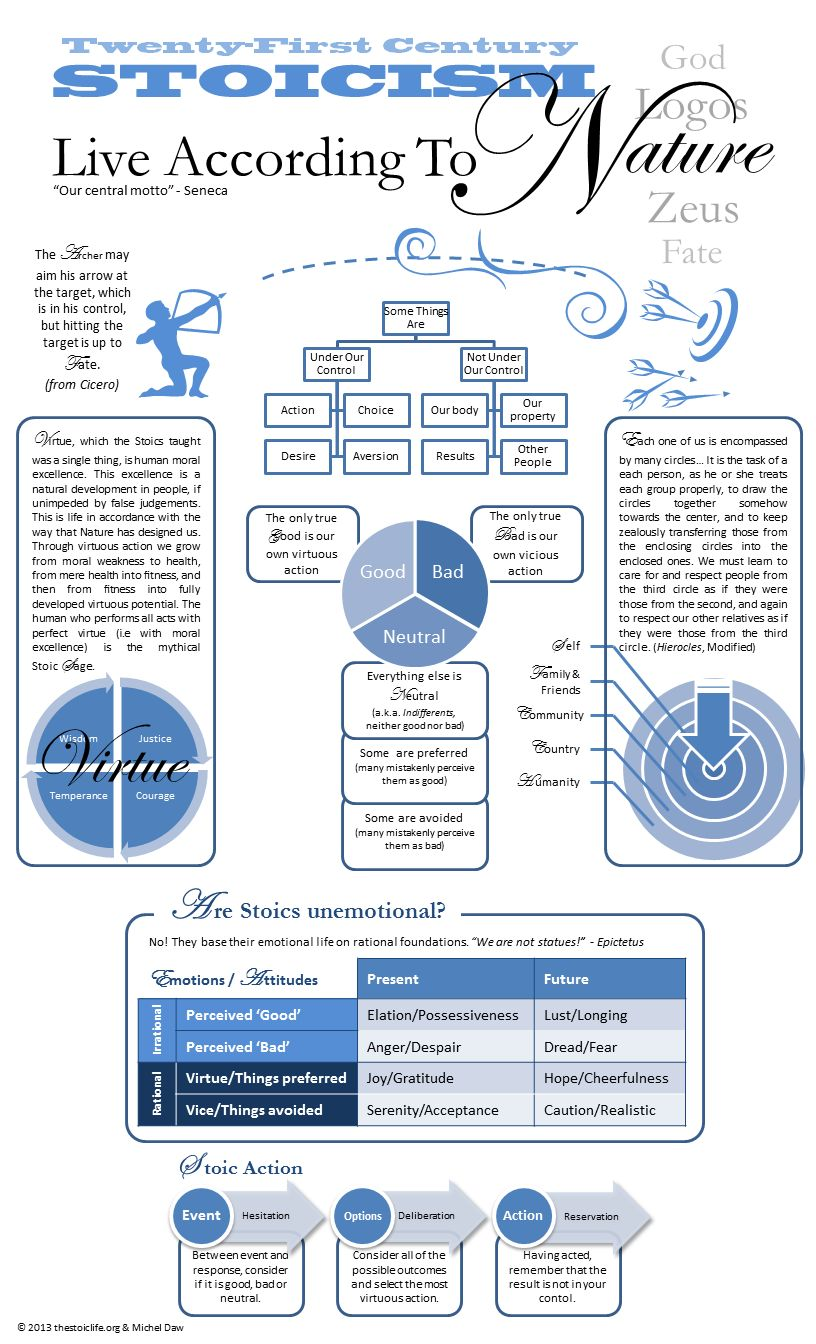
Some things are in our control and others not. Things in our control are opinion, pursuit, desire, aversion, and, in a word, whatever are our own actions. Things not in our control are body, property, reputation, command, and, in one word, whatever are not our own actions.
Epictetus urged us to focus on our thoughts, emotions, and actions and recognize that the actions of others and external events and outcomes are not under our control.
Personal Applications
In recent years, I have come to rely on the Dichotomy of Control to help me navigate in troubled times.
When I am frustrated by a U.S. president, for example, I note how the Electoral College and the lopsided political make-up of Oklahoma have ensured that no vote I ever cast in a presidential race ever mattered one whit. So while it is a thing that matters it is certainly not a thing I can control, so I should avoid focusing too much on presidential elections.
A mix of stoicism and realpolitik, valuing practical objectives over ideals, is also why I base my political party registration not on my alignment with a party’s platform but instead to maximize the tiny influence of my vote in Oklahoma’s semi-closed primary system.
Two particularly stressful periods of my administrative career were the state educational funding crisis in 2018 and, a couple of years later, the COVID-19 pandemic. I wielded my influence in both situations for the common good, but some blowback was inevitable. I dealt with that by regularly revisiting two touchstones.
The first came from the Roman emperor Marcus Aurelius. He was a dedicated Stoic, and offered plenty of tailored advice in his Meditations. A statement he made in Book 4 helped me keep things in perspective, which is shown in the graphic.
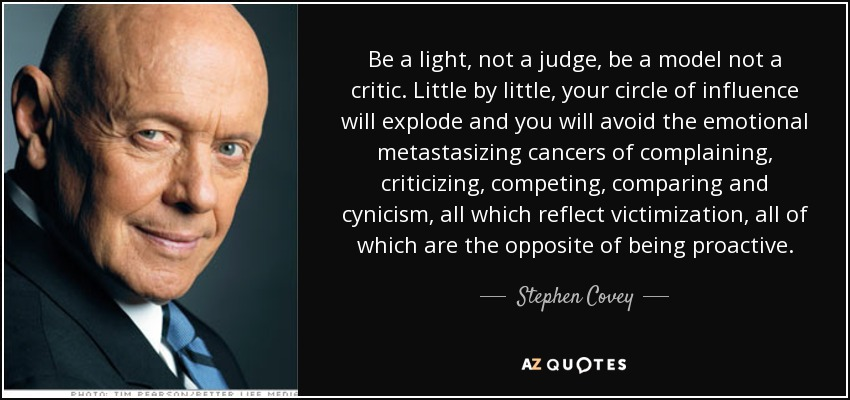
The second came from Stephen Covey, the author of The 7 Habits of Highly Effective People, which I studied in my master’s degree program back in the 20th century. I appreciated how his advice helped me avoid a potential trap in carelessly applied stoicism: while it encourages accepting things outside your control, the Dichotomy of Control does not urge passivity. Instead, it urges that you actively focus on what you can control, thereby taking a proactive approach to life instead of simply resigning yourself to external circumstances. Stoicism urges you to direct your energy where it can truly make a difference.
Below is Stephen’s advice:
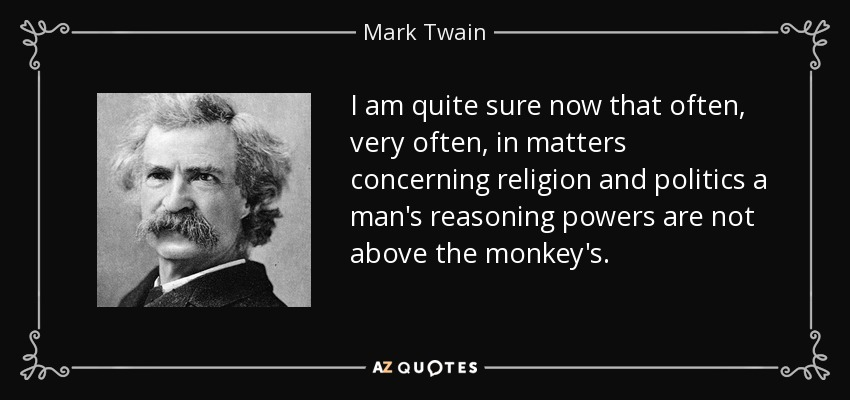
I am composing this post in a time of intense political turmoil, and my Facebook Feed was inundated with posts that amply illustrated something Mark Twain dictated in 1907 for his autobiography:
Rather than simply ignore Facebook, which is still useful in some ways and is still part of my job, I opted to curate it. Every time I saw someone posting about religion or politics in a manner that ignored the Dichotomy of Control, I snoozed that person, page, or group for 30 days. I wound up hitting the snooze 30 times, and my Feed improved noticeably.
In a couple of cases, I went further and unfollowed someone or something, but most of my curation was temporary. In a few weeks, I will undoubtedly notice when my snoozes end, and I can then unfollow anything that remains overly distracting.
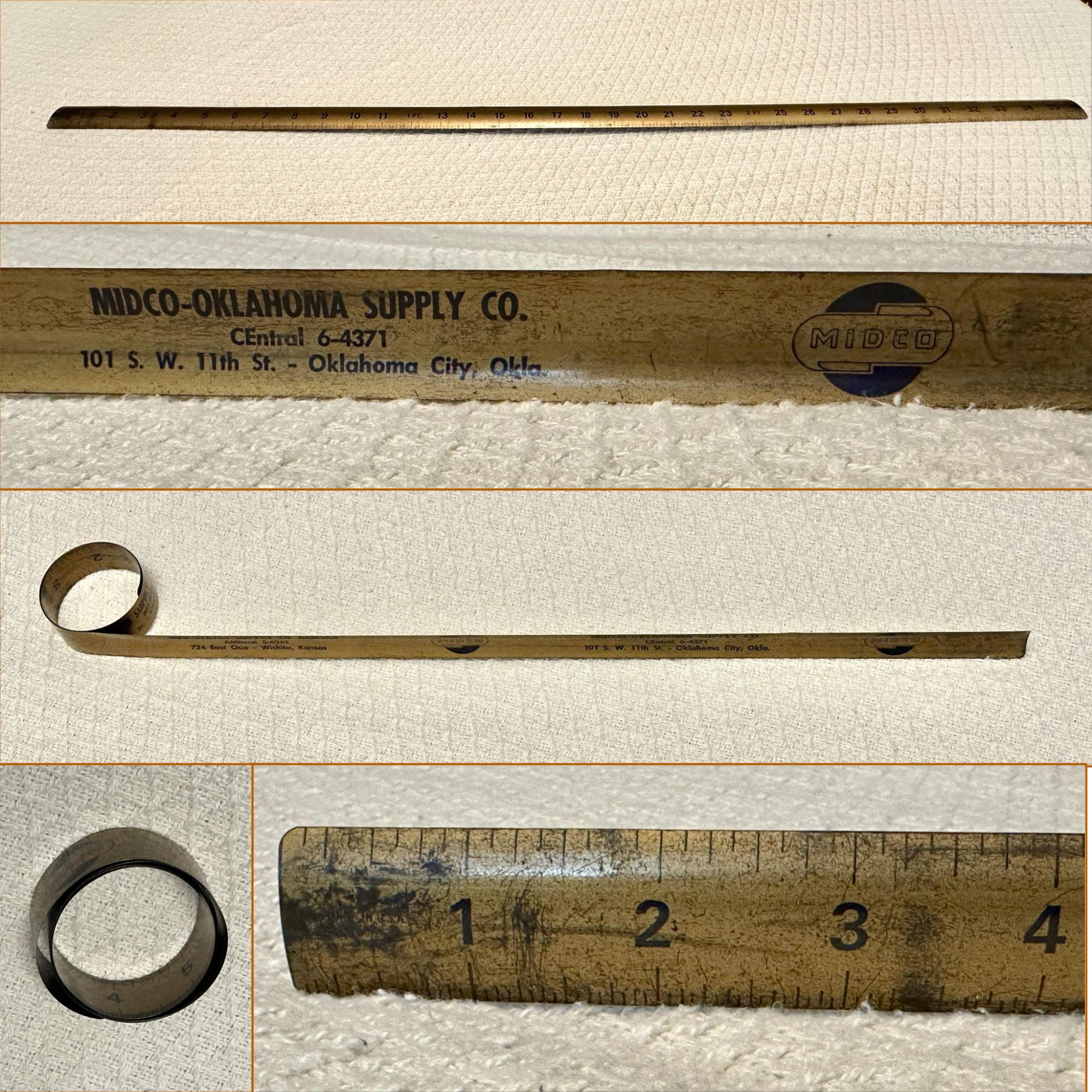
One of my favorite tools is from the early 1960s and has been superseded by its cousins. My parents received it around 1963, when Mid-States Supply Company of Kansas City, Missouri opened a warehouse in Oklahoma City. It’s a metal roll-up yardstick.
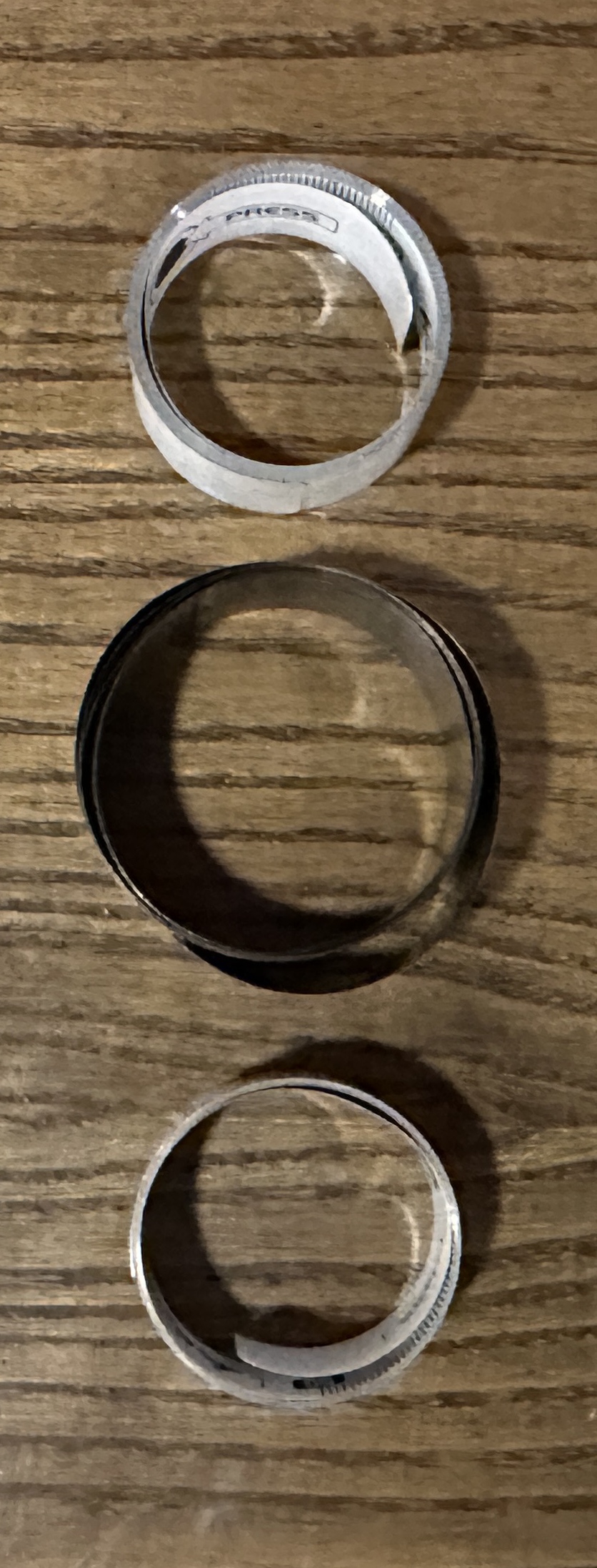
It is similar to what one finds in a retracting cased tape measure, but when you roll it out to be read, its convexo-concave blade rolls downward against the surface, not upward, and it needs no case. When unrolled completely, it stays extended and when you’re finished with it, you just flex one end and it will roll up into coil two inches in diameter.
My vintage roll-up yardstick
My only complaint is that it is so old that it has 1/8 and 1/16-inch scales, and I would sometimes prefer a finer scale in millimeters. I had no luck finding a roll-up meterstick on Amazon, but I was able to set up an account and order uncased metric roll-up tape measures from the Hoffman Group in Germany, which were delivered by DHL some weeks later.
So now I have three of these gems, which will serve me for the rest of my years. I would much rather carry one of them in my pocket than wear a bulky cased measuring tape on my belt when I am headed to a store where I will need to check dimensions.
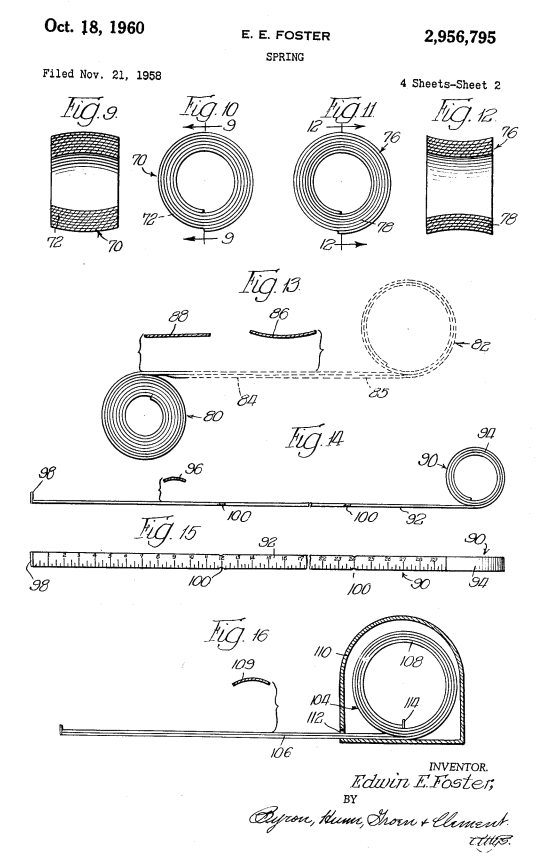
My examination of the yardstick did turn up the patent on its design: U.S. Patent 2,956,795 filed in 1958 by Edwin E. Foster of Austin, Texas and awarded in October 1960. He held a number of patents on various springs and similar mechanisms. I perused them and was surprised to find dozens of them filed over a 66-year period from 1923 to 1989. Egad!
My vintage uncased measure flanked by new metric rules
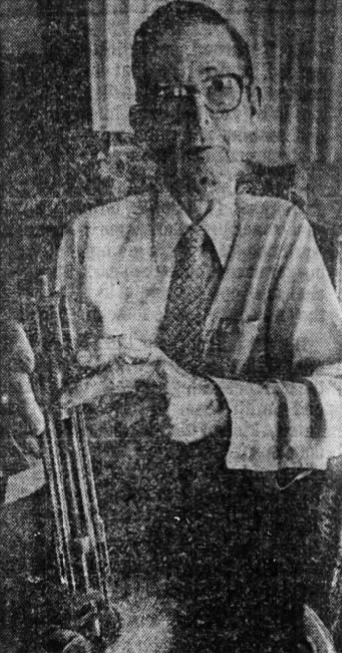
Foster was born in Athens, Texas in 1903 and went to Austin to study at the University of Texas toward the end of World War I. By then he had already invented a pump to inflate Model-T tires. He took it to Chicago to sell, but removable rims were about to come on the market and that negated the appeal of his pump.
Foster didn’t give up. Instead, he rented some space in a machine shop and turned his pump design into a new kind of shock absorber. However, manufacturers feared the shocks might be susceptible to mud caking, so he struck out again.
Inventor Edwin E. Foster
He next put his inventiveness with springs to work on a system to allow one to iron clothes while sitting down. It had springs counterbalancing the iron, which was held in place by an arm above the ironing board.
He was still toying with ironing boards, with no reported great success, by the time World War II began. Some U.S. tanks had a clutch pedal that took five times as much force as normal to operate since Chrysler had chained together five engines for them. Foster devised a new clutch with his springs and the army used it in 50,000 medium tanks. General Eisenhower recognized him for the role his “clutch booster” had in the war in North Africa.
That was a success, but he didn’t profit greatly from it. He next devised a steel spring for window balances, but it wasn’t until the 1950s that he patented his real “money maker” — the “spirator” steel band. It had just the right curvature so that when rolled out and released, it rolled back up again. It was used in seatbelt retractors, tape measures, and my roll-up yardstick.
Mr. Foster died at age 93 in 1997. He had been awarded over 100 patents, from wind-up baby swings to toys to the devices used in gas pumps, seat belt retractors, wheel covers, cameras, windows, early spaceships, and…roll-up yardsticks.
Their tapes were not concavo-convex, so they had little standout or reach distance, which refer to how much the tape can be extended without buckling. I used to have a little tape measure of that sort, and enjoyed pressing a center side button that caused the long white flexible tape to whip back into the case.
What is meant by a tape measure’s reach and its standout
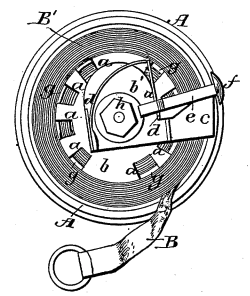
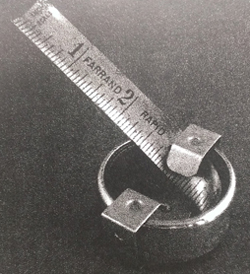
Hiram A. Farrand received a patent for concavo-convex tape in 1922, although his version had no locking mechanism or spring. Instead, the tape was manually coiled inside an open-ended can.
A Farrand tape measure
Stanley tools purchased the rights to produce Farrand’s push-pull tape from him, and he went to work for them in 1931. Their tapes were all in closed housings and in the late 1930s Stanley released a model that locked, but it still did not self-retract.
Later innovations included the floating hook to ensure a correct measurement whether you push the end of the tape against a surface or hook and pull it. Stanley finally added a retracting spring in 1956. I presume that it was the self-retracting nature of Foster’s spring that made it special, but I’m no patent examiner with all of the answers.
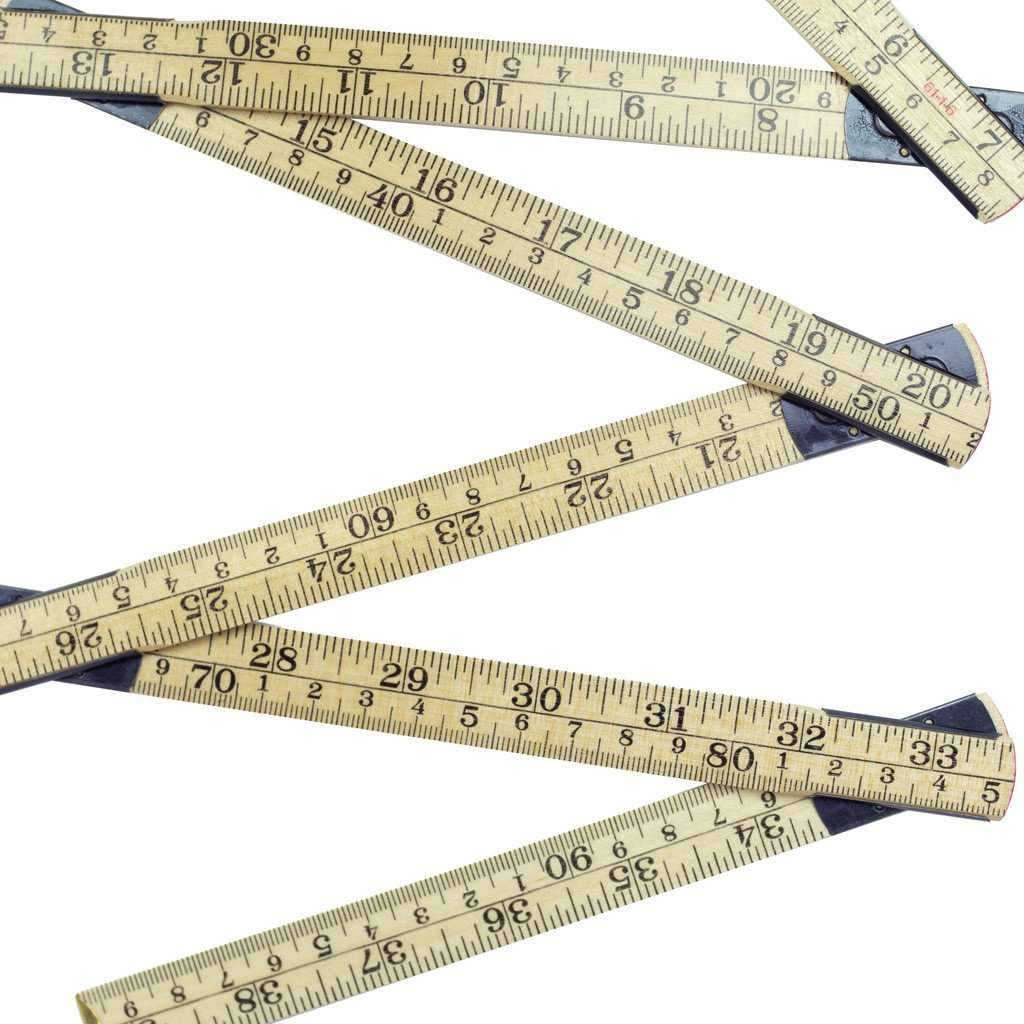
Before World War II, metal retracting tape measures were still relatively expensive, and many carpenters still used those yellow folding rulers. My father had one, but I never liked using it.
Folding rulers used to be more commonly used by carpenters than tape measures
Stanley’s PowerLock patent was awarded in 1963, allowing you to extend and lock the tape in place one-handed. Back in 2013, Stanley celebrated 50 years of selling tape measures. It noted how at that time it was manufacturing 31 versions of their PowerLock tape in seven different sizes and producing over nine million tapes each year in its Connecticut plant.
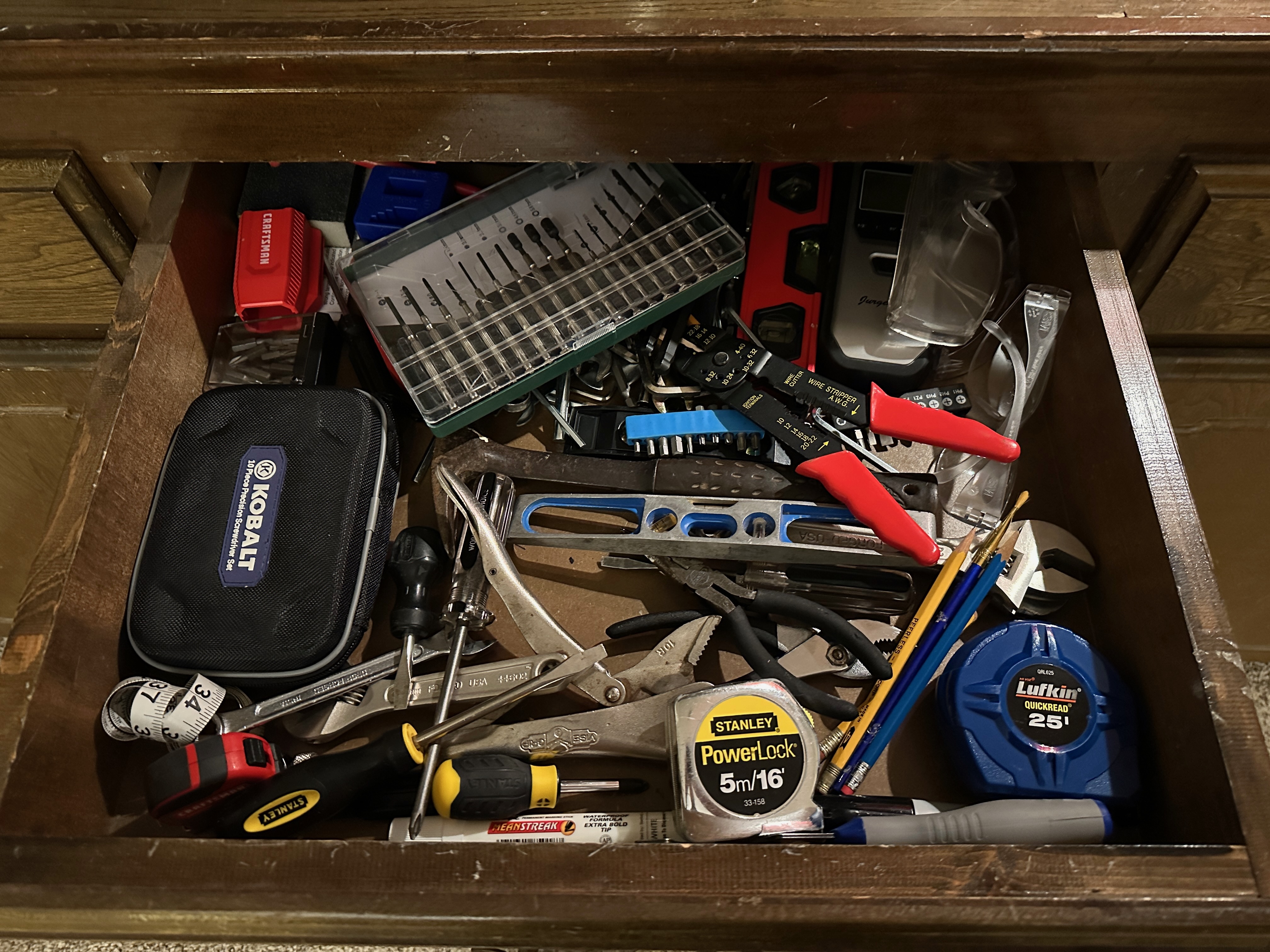
I yanked open my main tool drawer and noticed three retractable locking measuring tapes: a 9′ Craftsman, a 16′ Stanley, and a 25′ Lufkin plus one 5′ sewing tape. I have at least two more cased measuring tapes at work, and I wouldn’t be surprised if another is lost somewhere in the garage.
That conforms to how retractable cased tapes are far more popular than roll-up yardsticks or metersticks these days, which have become obscure and far harder to source. I’m so proud of my old-fashioned uncased tapes that I refuse to toss them in the drawer with their more popular cousins. Instead, I keep them at hand beside my desk. Thanks, Edwin E. Foster!
Children’s toys usually require materials that are cheap and durable. My dad, who was born a century ago, recalled playing marbles with his cousins, mumblety-peg with a pocketknife, spinning tops, darts, yo-yos, jacks, and stilts. He later graduated to bean shooters, rubber guns, and a Daisy air rifle, but the only item that survives with us today is a sturdy cast iron bank.
Cast Iron
My dad’s penny coin bank from the 1920s weighs 1.3 pounds empty and is in the form of a colonial house. Such banks were produced from 1910 to 1931 by the A.C. Williams Company of Ravenna, Ohio. Their miniature banks were available in several hundred types and styles and distributed through F.W. Woolworth’s, S.S. Kresge’s, and other five-and-dime stores.
To create cast iron toys, iron ore was melted in a blast furnace and poured into molds made from tightly packed sand. The casting sand used in the old days was often finer than what is used today, yielding a smoother surface with finer details.
Downtown Bartlesville long ago
Perhaps my father’s bank came from one of the five-and-dime stores in Bartlesville; his parents had a custom of driving the four miles from Dewey to Bartlesville on Saturday nights after his father got off work at the Dewey Portland Cement Plant. They would do a bit of shopping, but downtown Bartlesville was also cheap entertainment. They would find a good parking spot in front of the lighted stores and watch the people come and go. As my late father once wrote, “This type of entertainment has been replaced by radio, television, and now the internet. It was a slower pace back then.”
As for me, one of the first of the kids born into Generation X, I don’t recall having any cast iron toys; mine were mostly wood, Masonite, and, of course, plastic.
Plastics
Eventually, plastics displaced cast iron as the moldable material in children’s toys. My wife, Wendy, enjoys re-rooting the hair in new and vintage Barbie dolls. In her childhood, she loved Mattel’s Pink & Pretty Barbie from the early 1980s. That doll, which includes an outfit with 20 different configurations, is now a collector’s item. Some time ago, Wendy snagged one at a good price and re-rooted its hair.
The types of plastic used in Barbie dolls varies by body part. Early dolls were mostly polyvinyl chloride, with phthalate-based plasticizers added to improve its flexibility and durability. Later ones tended to have ethylene-vinyl acetate arms, acrylonitrile butadiene styrene torsos, polypropylene leg armatures, outer legs of polyvinyl chloride, and heads formed of a hard vinyl compound.
The first synthetic plastic, celluloid, was invented in 1863. Bakelite, a fully synthetic plastic, was invented in 1907, the same year that Oklahoma achieved statehood. By 1967, plastics had revolutionized consumerism such that they were what Mr. McGuire advised Benjamin Braddock to pursue. Of course, in that context, plastics were also symbolic of a cheap, meaningless, and ugly way of life.
Celluloid
Celluloid billiard balls were explosive
By the 1850s, the industrial revolution had begun to strain animal-derived materials like horn, ivory, and turtleshell. In 1862, Alexander Parkes patented in England the first man-made plastic, a semi-synthetic thermoplastic material made from cotton fibers dissolved in nitric acid, intending it for waterproofing woven fabric clothing.
Across the Atlantic, John Wesley Hyatt acquired Parkes’ patent and experimented using cellulose nitrate to manufacture billiard balls, which until then were made of ivory. Hyatt admitted that sometimes hitting two of the celluloid balls together could produce “a mild explosion like a percussion guncap.”
Hyatt also noted, “We had a letter from a billiard saloon proprietor in Colorado, mentioning this fact and saying that he did not care so much about it, but that instantly every man in the room pulled his gun.”
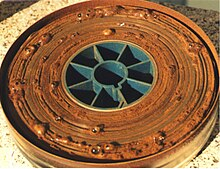
Decomposing nitrate film
Celluloid went on to important uses in film, but its flammability was a significant problem. Many old films shot on nitrocellulose have been lost to fire and decomposition. In 1978, both the National Archives and the George Eastman House had their nitrate film vaults auto-ignite, destroying the original camera negatives for 329 films and 12.6 million feet of newsreel footage.
Films were later shot on acetate, which was once called “safety film” since it melts, rather than burns, when heated. However, heat, moisture, or acids break acetate down into acetic acid, and vinegar syndrome plagues old films and magnetic tapes. It might interest you to know that while polyester, in the form of polyethylene terephthalate, was eventually used for film prints, it was not suitable for actually shooting films because it was so strong that it could damage a camera in a film jam. Polyester also requires tape or ultrasonic splicing, while acetate can be spliced with film cement, so acetate film was easier to edit before almost everything went digital.
Bakelite
Leo Baekeland
In 1907, Leo Baekeland of Belgium beat his rival, James Swinburne of Scotland, to the patent office by one day. Thus I grew up associating Bakelite with molded items like older telephones and radios, which was named for him. Swinburne and Baekeland were intrigued by the product of the reaction of phenol with formaldehyde, with Swinburne unable to produce a good, solid resin but using it for hard lacquer. In 1927 Swinburne merged his Damard Lacquer Company with Baekeland’s English licensees to form Bakelite Limited for United Kingdom products.
Meanwhile, Baekeland systematically experimented with controlling temperature, pressure, and composition until he could produce a hard moldable plastic out of polyoxybenzylmethylenglycolanhydride. Thank goodness he called it Bakelite!
Bakelite items
Bakelite’s advantages included excellent heat resistance, high electrical insulation, good strength, moldability into complex shapes, and a distinctive appearance. However, it was brittle and lacked the flexibility and impact resistance of modern plastics. It also had limited color options, is difficult to recycle, and offgases formaldehyde, a known carcinogen.
So Bakelite was superceded by a variety of different thermoplastics such as polypropylene and polyethylene terephthalate (PET). I kept on hand some Bakelite electrical meters and old Dial-An-Ohm boxes in my physics lab at Bartlesville High School, but offhand I can’t think of any Bakelite items at home.
Modern Plastics
ChevronPhillips’ Plastics Technical Center is in Bartlesville, OK
I live in the city where crystalline polypropylene was invented by Paul Hogan and Robert Banks of Phillips Petroleum Company, and I recently toured the ChevronPhillips’ Plastics Technical Center on the west edge of town where 190 chemists, scientists, and technicians focus on the development of new plastics, work to improve existing ones, and provide technical support for customers worldwide with polyethylene, normal alpha olefins, and more.
The most commonly used plastics now include:
Polyethylene (PE): Considered the most widely used plastic overall, including its different densities like HDPE and LDPE.
HDPE (High-Density Polyethylene): Known for its strength and rigidity, commonly found in milk jugs and detergent bottles.
LDPE (Low-Density Polyethylene): More flexible than HDPE, used for plastic bags and food wraps.
PET (Polyethylene Terephthalate): Often used for beverage bottles and food packaging due to its transparency and ability to prevent oxygen from entering.
PVC (Polyvinyl Chloride): Used in pipes, construction materials, and some flexible packaging, but concerns exist regarding its environmental impact.
PP (Polypropylene): Often used for containers, lids, and some food packaging due to its heat resistance.
PS (Polystyrene): Commonly found in disposable cups, food containers, and Styrofoam packaging.
There are others, of course, including polylactic acid (PLA) and acrylonitrile butadiene styrene (ABS), which are commonly used in 3D printers.
Many of my favorite toys were plastics, with ABS forming my Tog’l blocks and Legos.
I received my Tog’l blocks when I was two-and-a-half years old, and I first encountered Legos at my spinster aunts’ home some years later. I played so much with the Legos that my mother bought me the 135 and 145 Universal Building Sets with hundreds of bricks, and my aunts eventually gave me all of theirs, so I had about 1,000 bricks to play with.
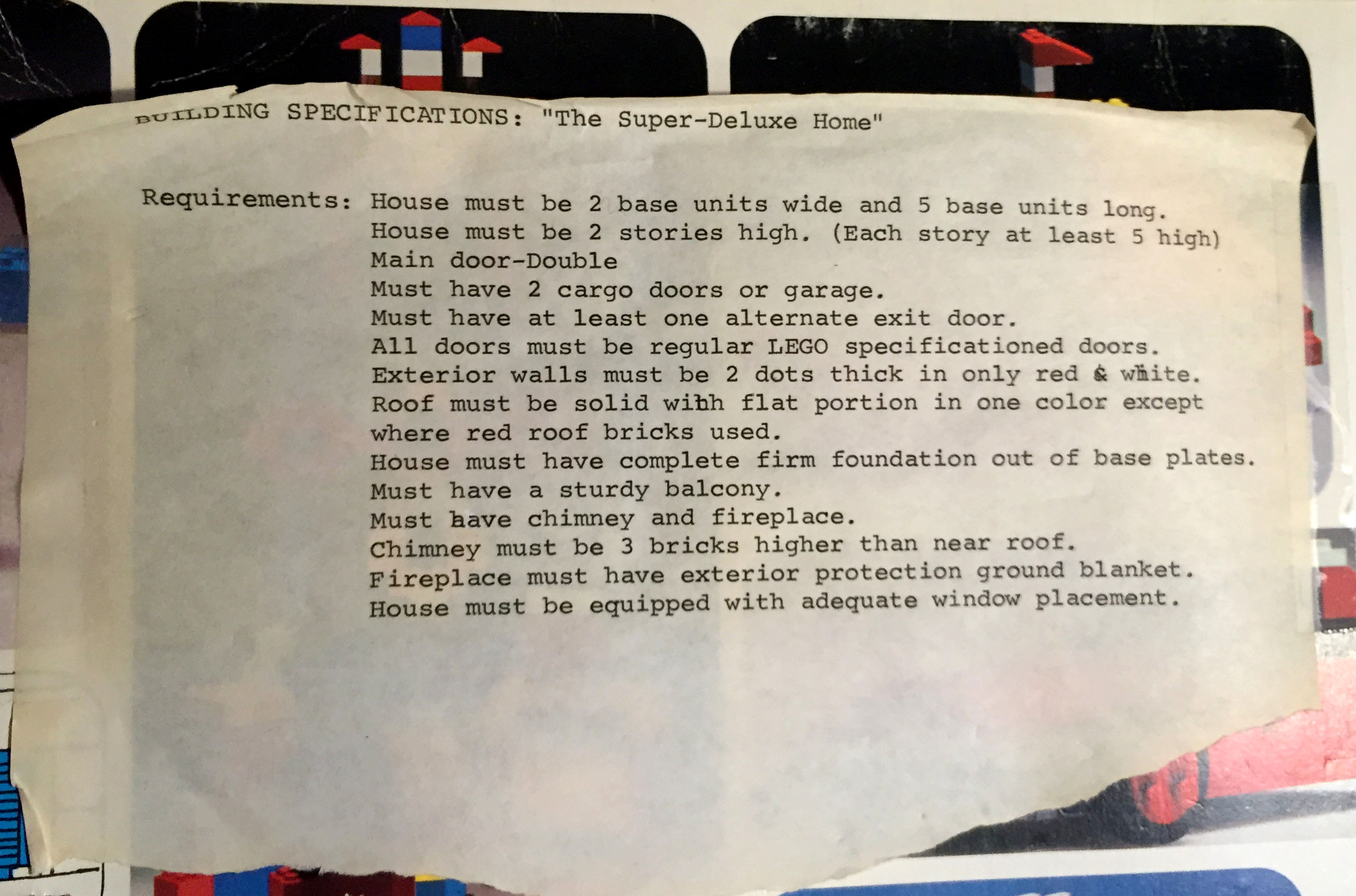
Back in 2016, when Wendy and I were engaged and cleaning out Meador Manor for her later move-in, she gathered up the Legos and we donated them. In the process, she discovered taped to each box the “Building Specifications for The Super-Deluxe Home” which as a child I had typed out and affixed.
How to build The Super-Deluxe Home
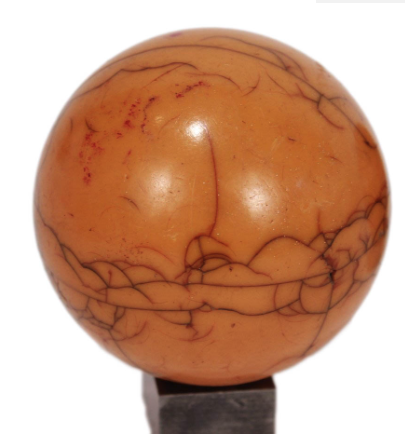
Clearly my Lego constructions were serious business. But, just as only one cast iron bank remains with us from my father’s childhood, I only retained a couple of my childhood items: a bouncy ball made of elastomers and a hippie figurine molded not out of plastic, but of diatom skeletons. However, my ABS Legos may still be in use by some child somewhere. .they certainly held up better than anything else of mine did.
Like most adults of my age in the USA, my use of social media is primarily YouTube and Facebook. I have accounts with some other services that I created just to access something specific at some point in time, but my use of them is quite limited. I thought it would be interesting to open up the apps and share my impressions of what was on offer.
Please note that I’m just having fun; I’m not looking to actually engage with any additional services. To hopefully prevent any vituperative comments, I will acknowledge in advance that my impressions are no doubt biased, ignorant, privileged, out-of-touch or otherwise objectionable to someone…and I simply don’t care. If this post isn’t fun for you, my advice is for you to go take a hike…both literally and figuratively.
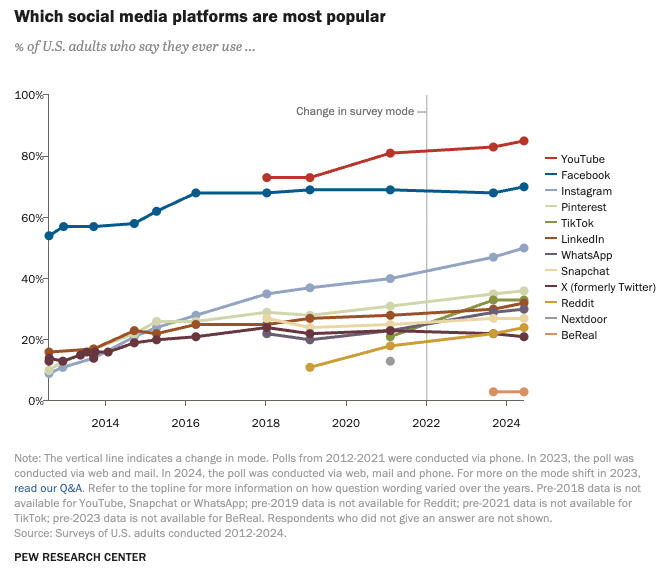
Here’s a look at what social media platforms US adults had ever used from 2012 to 2024:
I have accounts for Instagram, Pinterest, TikTok, LinkedIn, and X. I’ve consulted Reddit, but I don’t have an account for it, and I killed my Nextdoor account years ago because I found it to be concentrated ignorance.
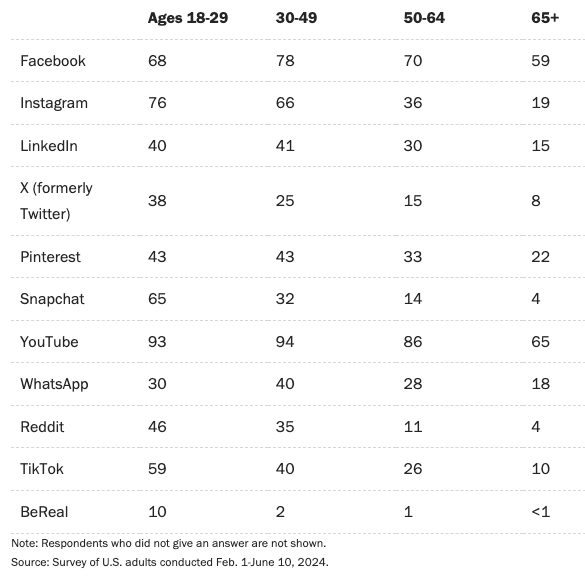
I’m 58 years old, and my reliance on just two of the popular platforms fits my age demographic pretty well:
% of US adults who say they ever use a platform by age range [Source]
I have no interest in the ephemeral Snapchat, and texts and Facebook Messenger are already sufficiently distracting that I have no intention of using WhatsApp. Reddit strikes me as similar to the Usenet newsgroups I accessed via a university engineering network from 1985 to 1988. As for BeReal, I’d never heard of it, and a daily notification about sharing photos of day-to-day life sounds truly annoying.
To put things into perspective, I was accessing CompuServe back in 1982 on a 300-baud modem when it had 40,000 subscribers. It grew to about 3,000,000 by the early 1990s, and it was sold to AOL in 1997. I accessed and ran dial-up computer bulletin boards from 1983 to the early 1990s, and I acquired the MEADOR.ORG domain for my online blog on the world wide web back in 1996.
Instagram
The Instagram search screen my dormant account provided
The Instagram app shows I joined in December 2017, have 0 posts and 192 followers, and that I am following one account, that of science fiction writer J. Michael Straczynski. Evidently seven years ago I wanted to see something he had posted. Clicking on the search icon produced what is shown at right.
Hmm. Off-putting images of tattoos, veins, and anatomical drawings, a blood-stained graph, some meme about alcohol, a stupid map, and multiple images displaying the breasts and bikinis of women I don’t recognize — a distillation of lowbrow titillation.
To make Instagram bearable I would need to follow accounts of people that I know or who produce work I’m interested in. The default is just trash.
NEXT!
Pinterest
I joined Pinterest in October 2016 because some school district staff had requested it no longer be blocked for their accounts by the district’s internet filter, and I was checking on its content moderation.
Over the past eight years, I have used the service to “pin” about 30 images, mostly historic images of Bartlesville, but there was a funny doctored image of The Gorn driving Captain Kirk in the 1966 Batmobile and some other random images I had saved.
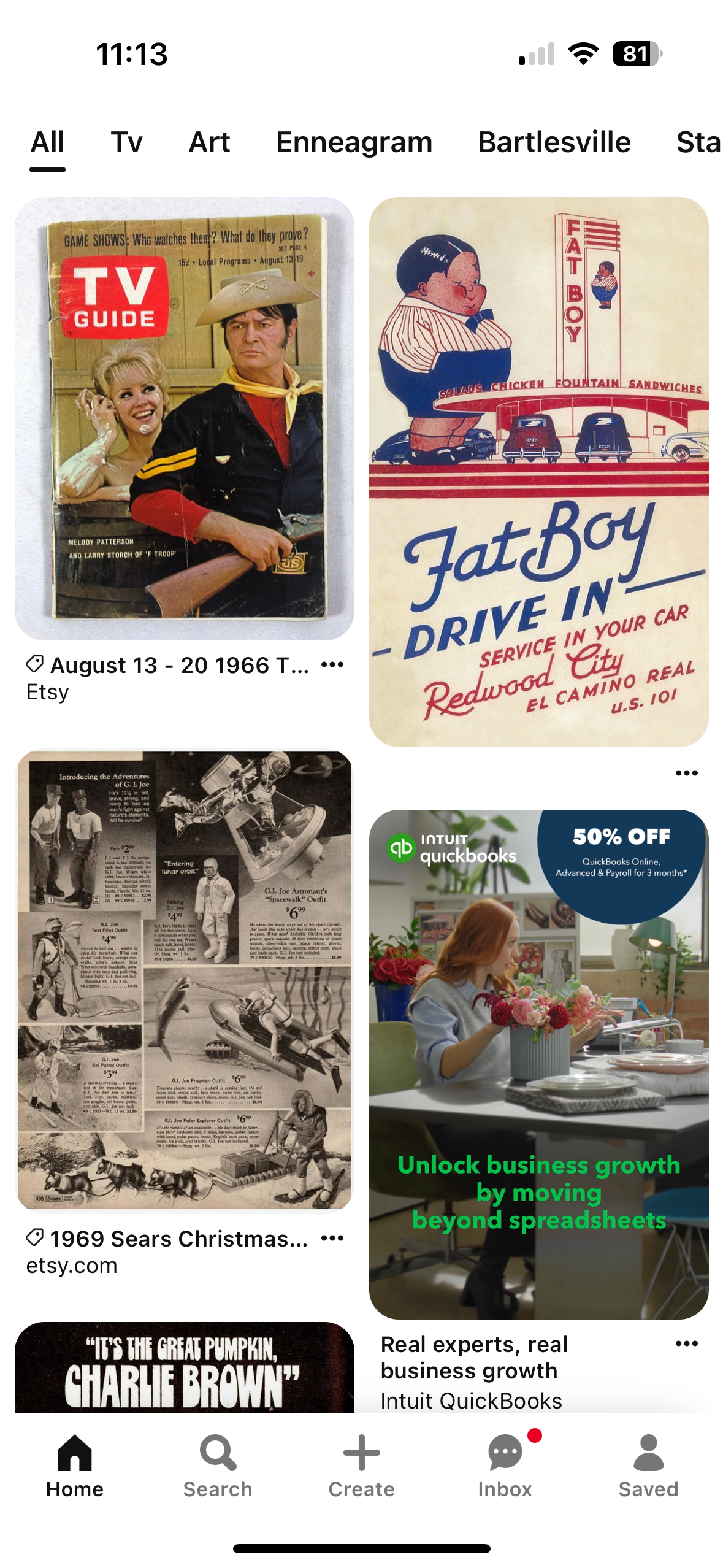
The Home page showed me an ad along with some items based on past searches. For a recent blog post on television, I had accidentally pinned an image of the cover of a 1967 issue of TV Guide that had a television equipment overview, so the service thought I might be interested in more vintage TV Guide covers, in this case one of F Troop — that was a swing and a miss.
It also showed me a vintage ad for a Fat Boy Drive In on US 101, which no doubt was based on searches I did almost two years ago while researching a blog post on Oklahoma drive-ins, although I grew up with Coit’s, not Fat Boy, and US 101 is quite far from Oklahoma. Research for another blog post on Fisher Price toys prompted the algorithm to offer up an image of dolls for boys (action figures for those with fragile masculinity) from the 1969 Sears Christmas catalog. The ad was for Intuit QuickBooks. None of that interested me, but at least it wasn’t off-putting imagery like Instagram offered up to my blank account there.
The app says I have 0 followers and that I am following nothing there, and that is A-OK with me.
TikTok
My wife watched a lot of funny videos on TikTok, but I abhor how it autoplays when you open the app. I found a setting to mute videos by default, which was a slight improvement.
My impression is that most of its videos are about 15 seconds long. I’m a long-form guy, preferring in-depth YouTube videos that are 20 minutes or longer, and I used to subscribe to The New Yorker magazine for its long articles before editorial decay led me to cancel my subscription. I find most YouTube Shorts and Facebook Reels unsatisfying, so TikTok doesn’t appeal to me, regardless of whether or not its Chinese ownership poses some sort of security risk.
I checked out the Explore option on its Home screen, and it showed me several women in a pool displaying a great deal of cheek while wearing football shirts, an ad about a muscleman who supposedly used a hair tonic to speed up growing long locks to create a wig for his daughter, clickbait about a terrorist, and an AI Jesus. Again, all repellent trash.
Later this month TikTok might be banned in the USA, but I don’t care one way or the other.
LinkedIn
I use this service to look up vendors who contact me or customer service representatives and customer success managers who are assigned to our district’s accounts.
I set up an account with my credentials and background information in June 2013, which I’ve maintained since I think it is a valuable business directory service, but I’ve never posted, and I’ve only had a couple of interactions with others via the service.
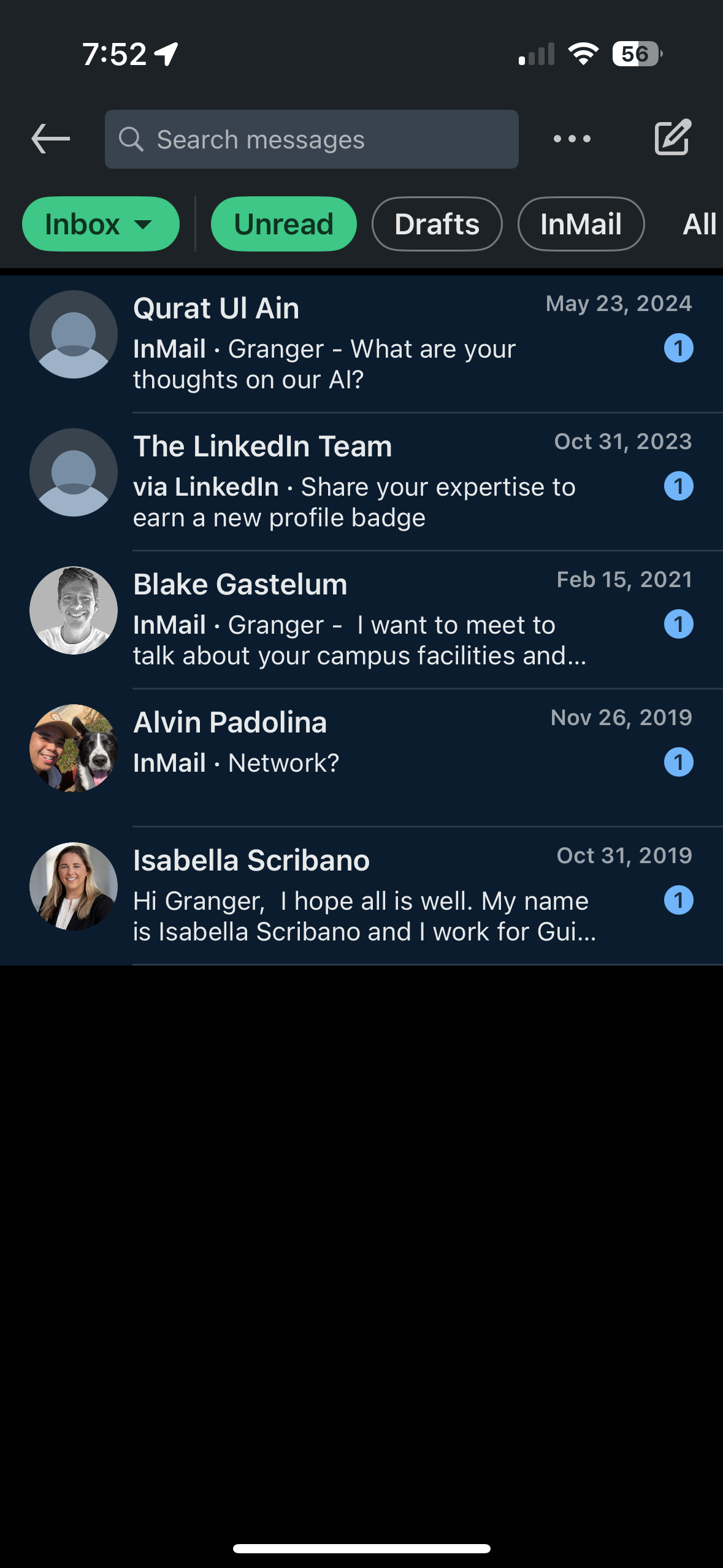
At right are unread messages in my Inbox. I’ve worked for the same employer for over 35 years, so I’m certainly not a job hunter, and I directly hire and evaluate only three positions in the district, so my usage will remain very limited. I had another LinkedIn account years ago with a personal email address, and it generated huge quantities of spam and annoying notifications, causing me to kill that account, not have the app on my phone, and set up an account with just my work email along with filters to redirect all LinkedIn emails to an unread folder.
After taking the screenshot, I deleted the app from my phone and moved on.
X
X, previously known as Twitter, has long held an outsized cultural influence because of journalists, who crave the timeliness and pithiness of its posts. I found their reliance on it emblematic of the decline in long-form quality journalism. Sound bites in text form…how depressing.
I created a Twitter account back in June 2009, about three years after it was created and three years after I set up my Facebook and YouTube accounts.
For many years, I’ve heard some pundits refer to Twitter/X as a toxic dumpster fire. However, I knew it was one way to drive web traffic, so I linked my Twitter and WordPress blog accounts so that for some years each blog post I made would generate a tweet with a photo and a link. That ended in mid-2023 when Twitter raised the pricing on its application program interface and WordPress dropped the service. I haven’t bothered manually sharing my blog posts on X.
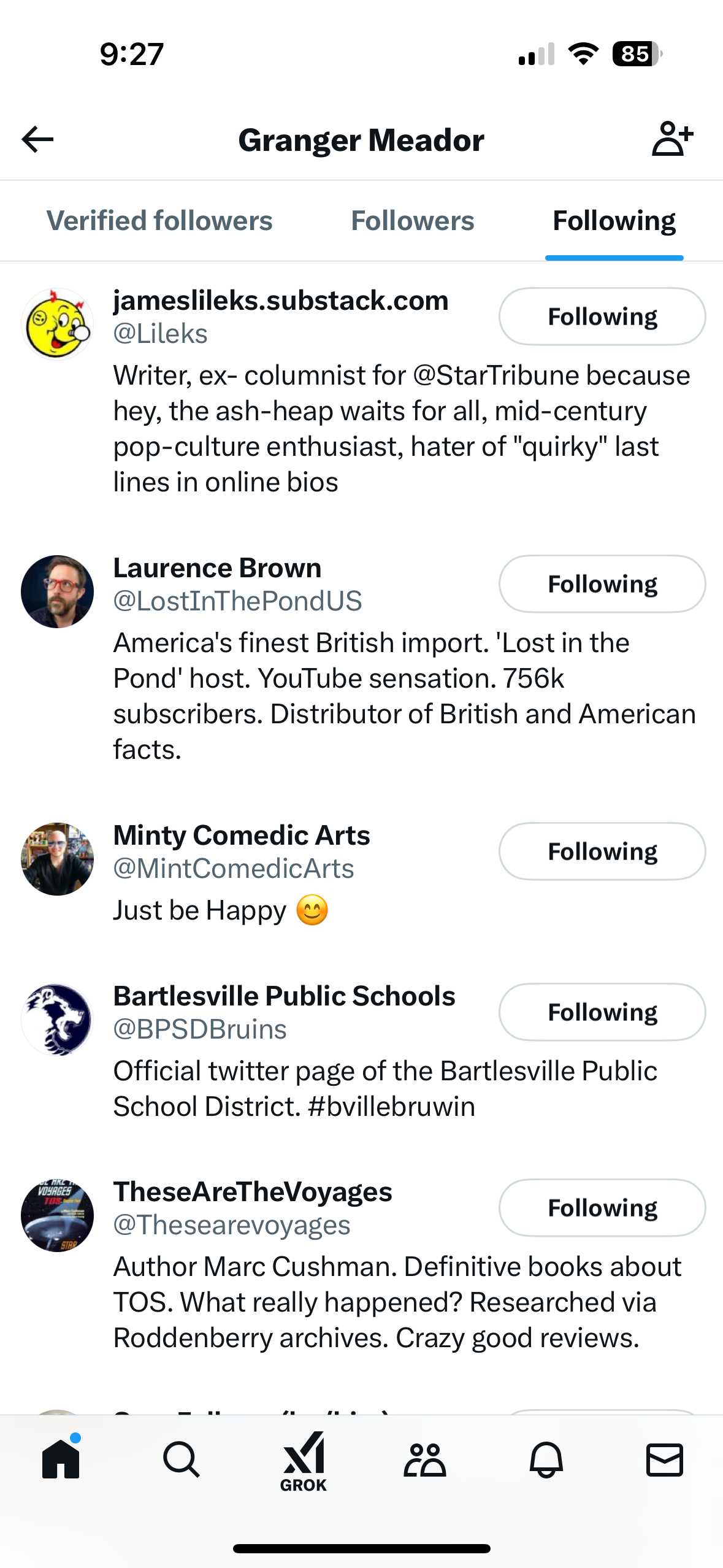
The X app’s For you home screen showed me an uninteresting post about politicians at Jimmy Carter’s funeral, while the Following section showed me a post from Bartlesville High School about a basketball tournament. That led me to wonder what X accounts mine was set to follow.
I found eight: a former newspaper columnist in Minnesota, a couple of YouTubers, a couple of school district accounts, an author of non-fiction books about Star Trek, an old friend, and a technology podcaster. Nevertheless, I’ve never paid attention to my own automated posts on Twitter/X, let alone whatever someone else posted.
Oh, there was a ninth account, which was a former technology columnist. I noticed that he was now constantly sharing misinformation from Libs of TikTok, the handle for a lady whose lies have instigated bomb threats against various schools, libraries, and hospitals across the country, including in Tulsa. I took the time to UNfollow him to clean up the feed I’ve long ignored.
The app also showed I had 75 followers. Most of those were co-workers or former students. My posts in recent years before the WordPress tweets stopped had a handful to a few dozen “impressions” while posts a decade ago had well over one hundred. I read that X posts generated an average of over 2,000 impressions in 2024, but also that there were significant declines in user engagement in 2023 and 2024 after Musk acquired Twitter. Twitter used to bring to mind birds chirping and bluejay jeers, but now I just hear crickets and flames.
Well, that’s enough of this grumpy old man griping about social media. I’ll post this and be sure to share a link on Facebook. 🤦♂️
Life is all about change, and television technology, programming, and my own viewing habits have evolved significantly over the past half-century. As broadcast and cable television diminish in favor of streaming, and the optical disc fades away, I’m taking a look back at television as I knew it.
Cathode Ray Boob Tubes
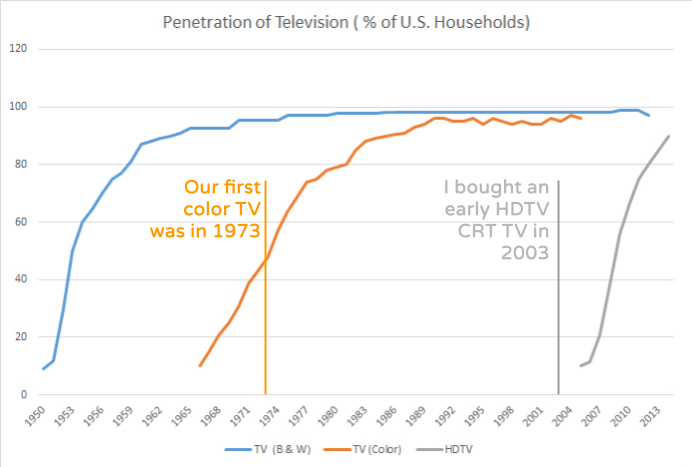
The chart shows the growth in the penetration of television technologies into U.S. households from 1950 to 2013.
Original chart uploaded by BronHiggs in 2016 [Source]
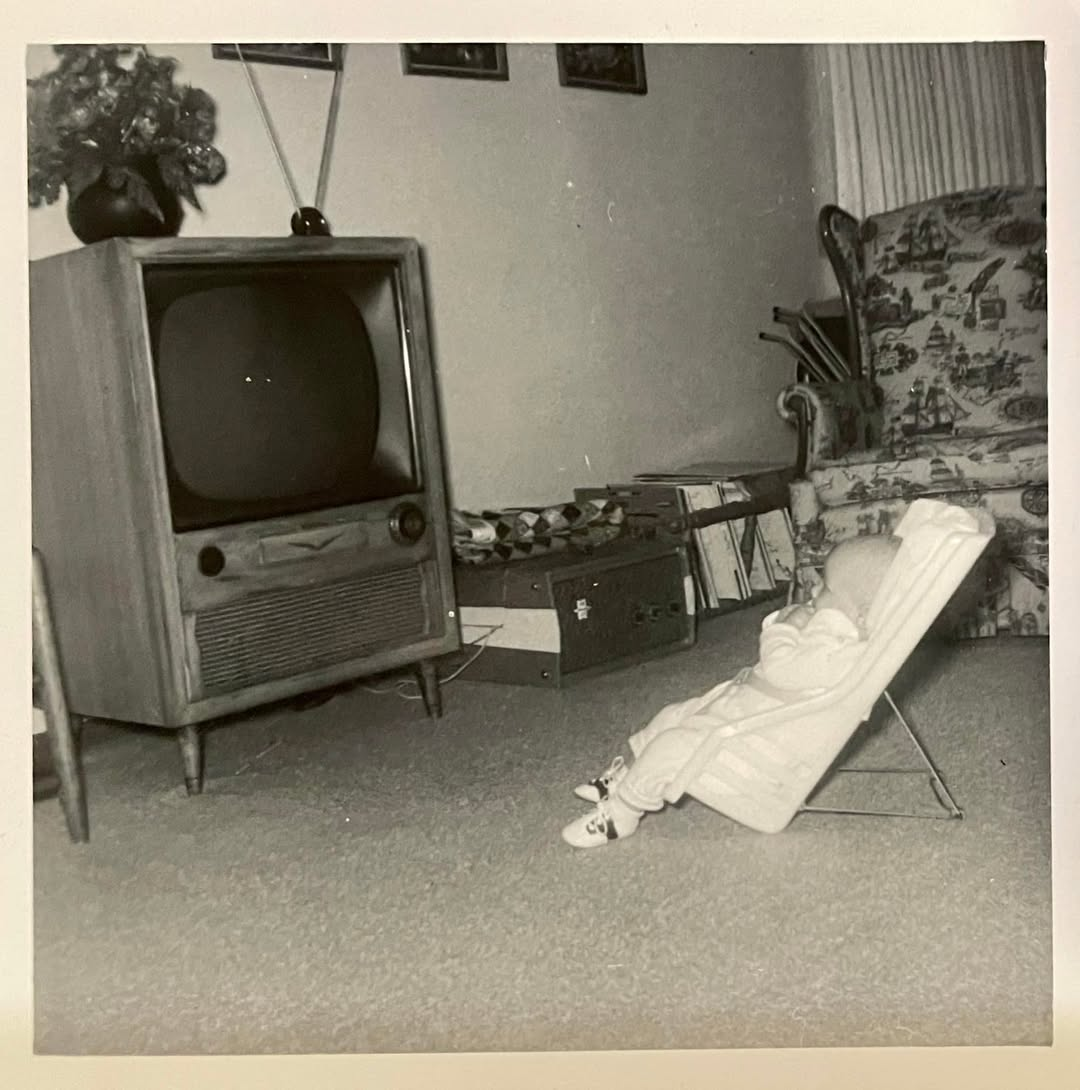
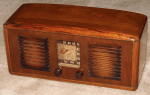
My parents’ black-and-white RCA Victor television in the 1960s
By the late 1950s, 4 out of 5 households had a television, and that proportion had a color television by the early 1980s and a high-definition set by the early 2010s.
I’m one of the eldest members of Generation X, and my Greatest Generation father and Silent Generation mother only had black-and-white televisions until 1973. Our first home television was a RCA Victor in a wood cabinet with rabbit ear antennas, and I remember how you had to turn it on and wait. It took several seconds for the vacuum tubes in its circuitry to heat up and the sound to begin, and the picture tube remained dark for about a minute until the cathode ray gun could heat up. When you shut the set off, the picture would collapse into a glowing dot for some time.
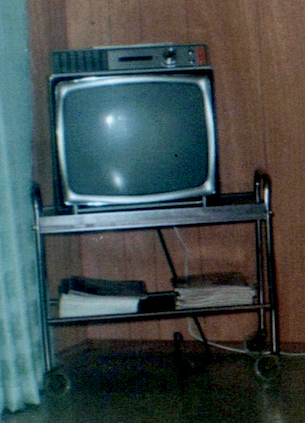
The set my father won at a hunt
In 1967, my father won a 19″ RCA portable television at a hunt. It was placed on its rolling stand at our bluffside cabin on Table Rock Lake in southwestern Missouri.
That television was also slow to warm up, and tuning it was more difficult, as the ABC affiliate we could pick up was on an ultra high frequency (UHF) channel, somewhere in the 20s as I recall, instead of the very high frequency (VHF) channels 2-13. At that time, our home in Oklahoma City was less than three miles from the television broadcasters’ aerials on Britton Road, so we just used set-top rabbit ear antennas there. But at our cabin, the NBC and CBS affiliates were KY3 and KTTS/KOLR Channel 10 in Springfield, Missouri over sixty miles away, requiring the use of a big antenna mounted on a three-story pole outside.
We had to tune in UHF stations on a slide tuner
Eventually we could pick up an ABC affiliate in Arkansas as well, but that required re-aiming the big antenna and using a slide-style tuner on the television to tune in on the UHF band. I had to put on gloves and go outside to manually rotate the antenna pole (we didn’t have a motorized aimer like some around us did) and then return to the television, turn its channel knob to U, and then twist the knob’s perimeter dial to tune in the UHF station, depressing that dial while turning it for fine tuning. If I hadn’t re-aimed the antenna quite right, I might not be able to get a clear signal and would then have to go back outside and repeat the process. I definitely tended to stick with NBC and CBS while at the cabin!
Our first color TV looked much like this, but we didn’t have a Space Command remote control
Color television broadcasts began in the USA in 1954, but it wasn’t until 1973 that my father sprung for a television with a 23″ cathode ray tube with three electron guns aimed by a shadow mask at red, green, and blue phosphors. At that age, I could still hear very high frequencies and my folks took me with them to Delmar Buckner’s shop to ensure I didn’t hear noise from the Zenith console they purchased.
I was fascinated by the technology, avidly reading the user manual. One feature the television lacked was a Space Command remote control. My aunt and uncle in Kansas had long had a television with that handy little box. When you pressed a button on it, a spring-loaded hammer struck an aluminum rod in it, and the television would respond to the resulting ultrasonic tone. Unlike later remotes that produced infrared light signals, you didn’t need to aim the remote nor did it require batteries.
The Space Command remote that my Dad didn’t spring for
Our first color TV had several controls
But at home in OKC we still had to get up and manually turn on and off the set and adjust the channel or volume knobs. Even with its “Chromatic Tuning” button, we would also have to fiddle with its contrast, brightness, tone, peak pix, and vertical hold knobs.
I appreciated how that set came on instantly, since when turned off it still drew enough power to heat the electron gun. However, my parents would always unplug the set when we went on vacations, and when we returned, I would plug in the set, turn it on, and for that first viewing I would have to wait for the picture to show up just like on the older sets.
Occasionally the heavy set would malfunction, and Mr. Buckner would make a house call to work on the circuitry. That sort of home repair is unimaginable today, although I do know some people hire specialists to come tune their sophisticated audiovisual systems.
The cabin remained stuck with the old black-and-white television until 1986, by which time 9 out of 10 households had a color set. I was halfway through my undergraduate studies and vacationing with a friend at the cabin, stuck inside on a rainy day, and I had had enough of the 1967 B&W TV. A Wal-Mart had just opened in Cassville, so we drove through the rain for 17 miles to purchase a new color television. We then had to drive another half-hour through the hilly Ozarks back to the cabin, and by the time we had the new set going the rain had ended, but at least the cabin had finally received a belated audiovisual upgrade.
Four years earlier, I had received my own 13″ Zenith color television, complete with infrared remote. It was on a desk in my bedroom and was not merely a TV but also the low-resolution monitor for my TRS-80 Color Computer. My parents were happy to get it for my computer since they knew that in a couple of years I could take it with me to college for watching television.
In the freshman dormitory, I made the mistake of placing my fancy DUōFONE-140 telephone next to my television, and over a few weeks the magnet in its handset magnetized the shadow mask, deflected its electron beams, and created a color shift in the lower left corner. I had to move the telephone across the room and degauss the TV.
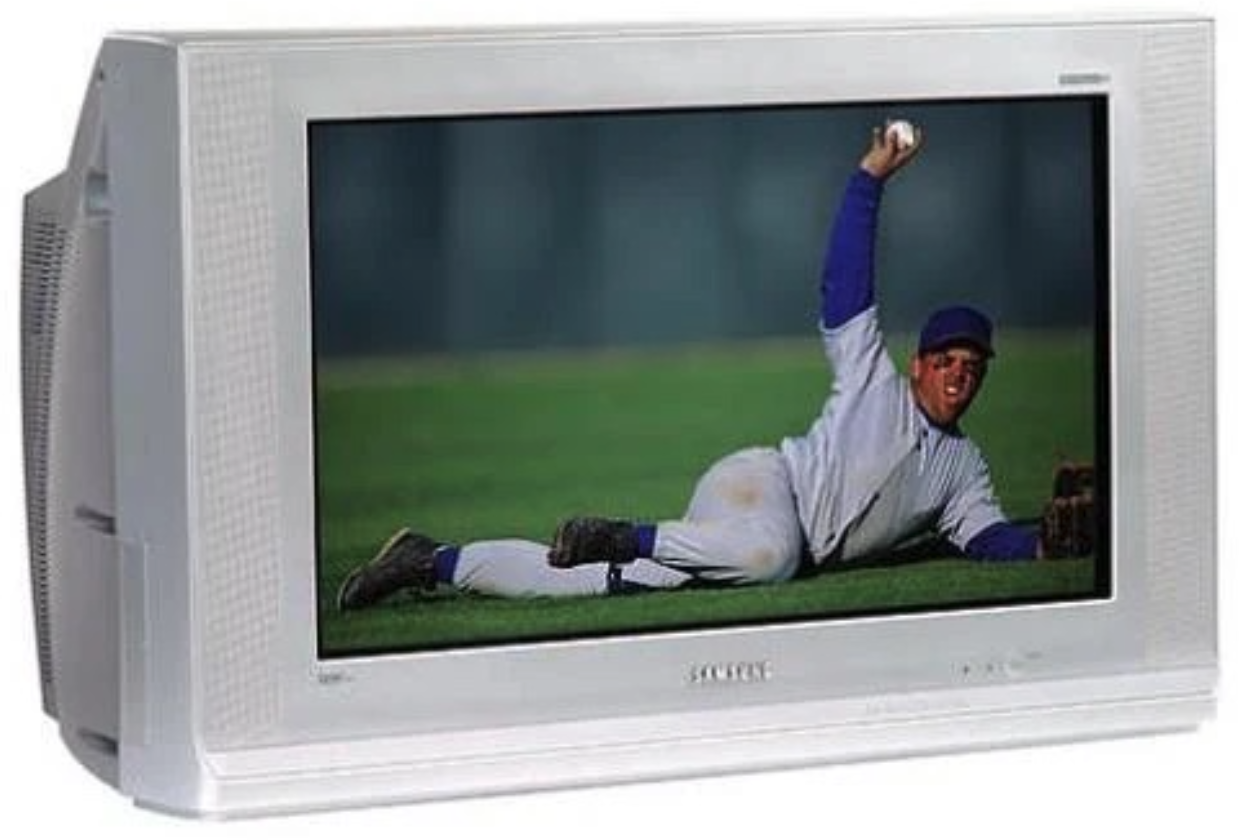
My first HDTV was a 30″ CRT that weighed over 120 pounds, and I’m certain I never watched sports on it
Around 1987 I moved to an apartment with a long living room where my 13″ television was too small. My father gave me a used 19″ Zenith color television, and I used that until 2003, when I paid $1,000 for a 30″ Samsung wide-screen flat CRT television. I liked its 16:9 aspect ratio and that it had about 800 lines of resolution, so it was an early high-definition set that could accept 1080i signals. However, it was still a cathode ray tube set and consequently weighed over 120 pounds. I had to buy a special swiveling stand for it, and I still use that stand in our living room for our lightweight 55″ OLED television.
Back in 1994, I had purchased our current house in Bartlesville. It came wired for cable television, but in 1995 Star Trek: Voyager was about to premiere, and none of the cable channels was slated to carry it, while a broadcaster in Tulsa would carry it. I waited, hoping things would change, but the show premiered on January 16, 1995, and I still couldn’t see it. So on January 19-21, I spent $157 on a big VHF/UHF antenna that my friend Carrie helped me mount to the chimney and wire into the television with a booster amplifier. After all that was set up and working, wouldn’t you know, one of the cable channels announced it would start carrying Voyager! So I only used the antenna when the cable was malfunctioning or on occasion after 2008 when I cancelled my cable TV service.
The old cathode ray tube technology is still valued by some retro gamers who like its fast response time for vintage computer games and consoles, and I was fascinated by how it worked. If you want a history of the technology, I recommend the 1996 book Tube: The Invention of Television in the Sloan Technology Series, but you could also just watch Tim Hunkin and the late Rex Garrod:
I finally got away from cathode ray tubes in 2010, when I spent $800 on a 40″ Sony LCD HDTV. That set is now hanging in an office at the district’s Education Service Center, connected to a Chromebox for use in conferences, since in 2017 I spent $1,600 on a 55″ LG OLED HDR 4K television. That fancy set is better in every way than the ones I grew up with, but the irony is that I mostly use it to watch low-resolution VHS aerobics tapes I recorded off Lifetime television 30 years ago…with the sound off. I haven’t regularly watched any television shows since 2009 when the Battlestar Galactica reboot ended, and almost all of my video entertainment is via YouTube on my iPad using bone conduction Bluetooth headphones to avoid disturbing Wendy, whose hearing is far more acute than mine.
1960s and 1970s TV Programming
However, as an only child, while I was growing up I watched a lot of television, along with reading scads of books. The first show I remember watching was Ed Sullivan with plate spinning by Erich Brenn, but the musical segments were the parts with staying power.
Bear in mind that when I saw this, it was on a black-and-white television
Regular children’s shows I enjoyed were Captain Kangaroo and very politically incorrect Mr. Magoo cartoons that aired each morning on KWTV at the end of the boring Evergreen Farm Report with Bill Hare, who later lived just around the corner from us.
I watched cartoons and live-action children’s shows all morning on Saturdays, especially enjoying anything by Sid & Marty Krofft.
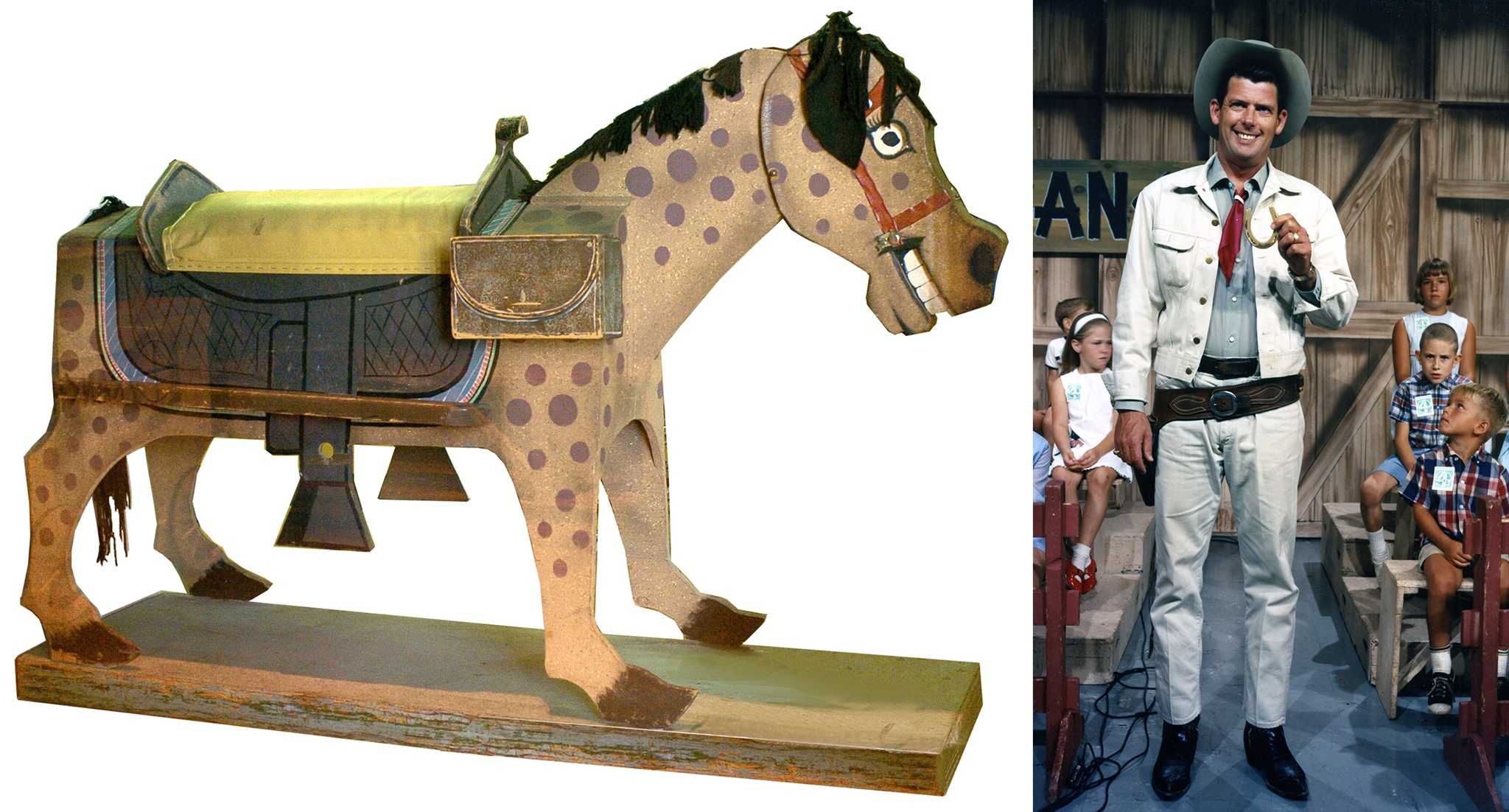
On weekday afternoons when I was very young, I would watch the Foreman Scottyshow on WKY television, and I got to sit on Woody the Birthday Horse twice at their studio. My only memory of the experience is of being backstage in a dim hallway and them showing us Flintstones cartoons on a monitor to keep us entertained. However, I found that terribly confusing, as we were seeing that on a television at the wrong time of day…I was so used to live television that it was a revelation that they could show something on a closed-circuit system. Decades later, I showed Wendy the horse in the Oklahoma History Center, and she was mightily unimpressed.
Woody the Birthday Horse and Foreman Scotty
Another childhood favorite was HOHO the Clown with Pokey the sock puppet on KOCO Channel 5, but I didn’t particularly care for Miss Fran on KWTV.
I was a music fan, and in prime time from 1969-1971 my favorite shows were The Glen Campbell Goodtime Hour and The Johnny Cash Show. On weekdays, if I wasn’t at school, there were lots of soap operas, which I didn’t understand. I remember how my mother would watch All My Children, and my being confused as to why Erica put up with the scoundrel Nick.
Right after that, we would watch the noon news on WKY Channel 4 with George Tomek, weatherman Jim Williams, and Bob Barry, Sr. with sports; that was several years before the legendary Linda Cavanaugh came along. At the time, they didn’t use a set for that newscast. Instead, it looked like a production of Our Town. Tomek just sat behind a podium with a spotlight on him, and Jim Williams had a few wall-mounted meters and one rotating cube with different formica maps, which he wrote on with water-based paint that was dispensed via a wick in a glue dispenser.
Much more to my liking were game shows like Password, which I enjoyed watching while eating fish sticks and catsup.
My favorite show of all was, of course, Star Trek. Reruns were shown every weekday afternoon in the 1970s, and I made my mother or any friends who were around stop and watch it with me.
Gene and I loved The Six Million Dollar Man
My favorite prime time television show was The Six Million Dollar Man, which had a magnificent title sequence. Gene Freeman, who died in his early 50s of a brain tumor, was my best friend in elementary school. Although he moved away to attend a different school, for years we still played together each Saturday at each other’s homes.
We avidly watched the show and would frequently make up our own adventures to act out. Gene was more athletic and fascinated with motorized vehicles, so he was always the bionic cyborg Steve Austin. I played his boss, Oscar Goldman.
My mother would think that made sense, as she once admonished me, saying, “I don’t know why the neighborhood kids let you boss everyone around when you play.” She says I responded, “But mother, they simply have no imagination!”
As I grew up, I convinced my parents to get cable TV after it became available in OKC in 1980, and I watched a lot of music videos on MTV. Another TV highlight in 1980, when I was still in junior high, was the Shogunminiseries, which led me to read several books in James Clavell’s Asian saga.
My favorite shows eventually shifted to things like St. Elsewhere, L.A. Law, and Moonlighting, and some of the last shows I watched were escapist fare such as Lois & Clarkand Babylon 5 in the 1990s, as I steadily drifted away from watching series to watching movies instead.
Movies on TV
Until the 1980s, most of the movies I saw were shown on network or local affiliate television, interrupted by plenty of commercials. Movies made after the mid-1950s were often widescreen, so they were usually shown in pan-and-scan on TV, since 16:9 widescreen televisions did not become popular until in the late 1990s, and I didn’t have one until 2003.
I remember periodic prime time network showings of the 1939 classics The Wizard of Oz and Gone with the Wind, The Ten Commandments of 1956, and various early films from the James Bond franchise. Eventually OKC gained some independent UHF stations (OKC did not have cable television until the early 1980s), and I could watch old B-movies on the weekends. Some memorable ones were Tarantula, William Castle’s The Tingler, and the original The Fly from 1958.
Trust House Jewelers hosted late night movies on OKC TV
When I was a teenager, I watched some films from 10:30 p.m. to midnight on Sundays via Trust House Theater, which was hosted by jewelers Jim and Gloria Berkey. Their interstitial commercials always had them displaying gaudy gold nugget rings and diamond jewelry, which Jim would always say was, “Paved in diamond property!” as Gloria wriggled them on a tabletop to make them sparkle. They would pre-tape their segments, and sometimes things went awry. My favorite was when the movie was Jesus Christ Superstar and at the end of a commercial segment, Jim turned to Gloria and said something like, “Let’s get back to the movie. I just love these westerns!”
One of the oddball characters of OKC television was Count Gregore, but I never cared for his schtick. Far more to my liking, although it didn’t begin until 1988 when I was about to graduate from college, was when B.J. Wexler hosted the OETA Movie Club.
I became enamored of Alfred Hitchcock’s films by seeing them on television, although his Alfred Hitchock Presents television anthology was off the air before I was born. I sought his movies once VHS videotapes became available for rent in the 1980s. However, videocassette recorders were still quite expensive, so I would have to rent one along with the cassettes. I usually rented them at Soundtrak in OKC and Norman, which was also where I bought 45 rpm 7-inch vinyl singles.
My 2001 VCR is still going strong and is used five days a week
I was finally able to purchase my own VCR when I was in college, and I was grateful to discover that a small video store in downtown Norman stocked many of Hitchcock’s movies on VHS. In 1990, a year after I moved to Bartlesville to teach, I invested $400 in upgrading to a Sharp 4-head VCR. In 2000, I spent $76 having it repaired at Balentine TV on Tuxedo Boulevard, and a year later I purchased a Sony Hi-Fi VCR for $150. I still use that one each weekday morning in 2025 to work out to aerobics shows I taped from 1993-1997.
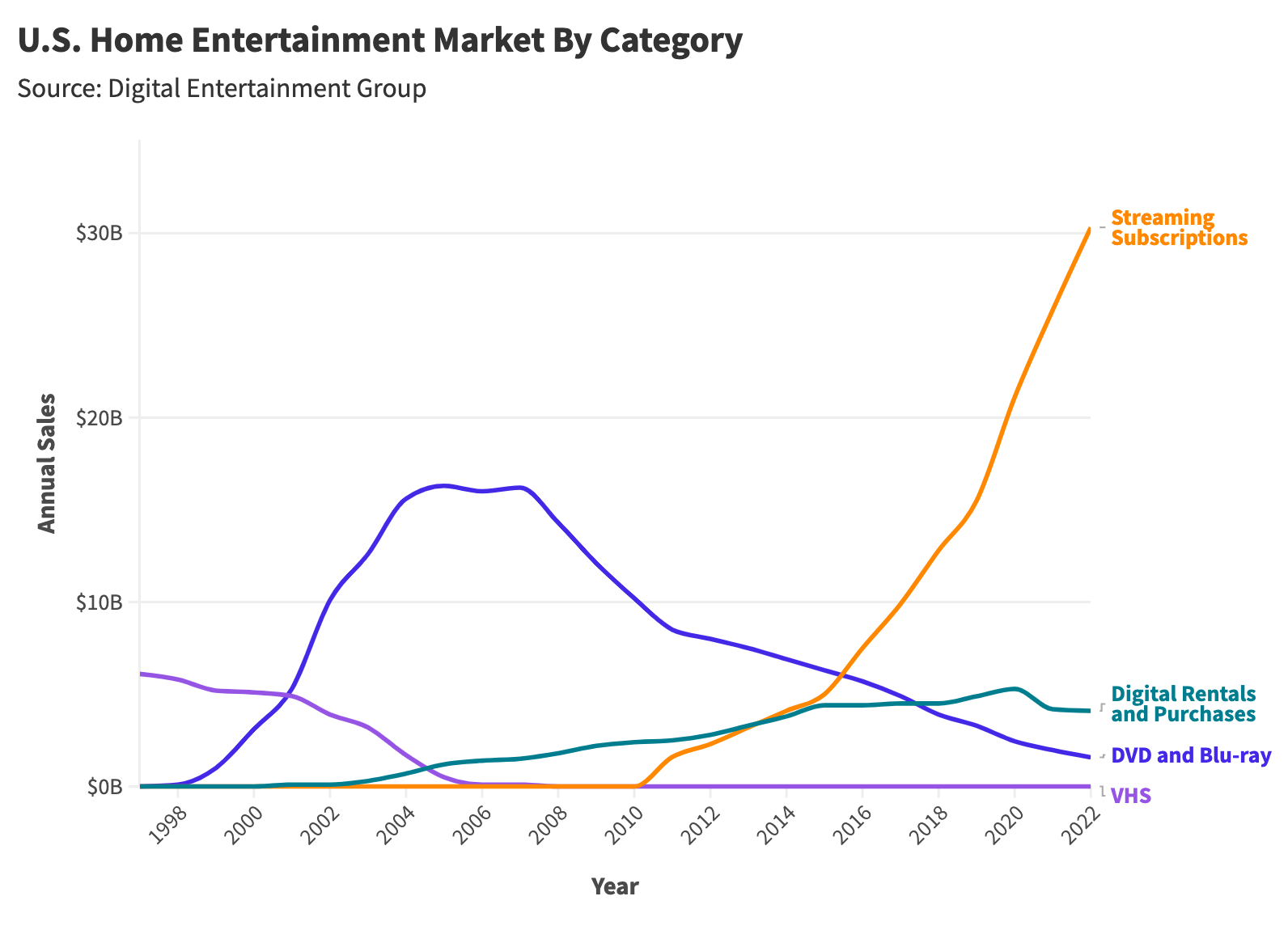
My last optical player is a Sony Ultra HD Blu-ray player that I purchased in 2019 for $152. I still have a cabinet full of discs, but now whenever Wendy and I fire up the system to watch a movie at home, we almost always stream it with the Amazon Prime app on the television. If Amazon doesn’t have a movie, I’ll check to see if I can stream it with YouTube. The only time we use my Apple TV, which in 2017 was the third one I had purchased, is when we’re mirroring video from one of our iPads.
The era of the optical disc for computer data, audio, and video is winding down. Compact discs debuted in the early and mid-1980s for audio and computers, respectively, and DVDs debuted in the late 1990s, but now few computers come with any sort of optical drive, and consumers stream both their music and their videos thanks to widespread high-speed internet access.
In 2008, Sony’s Blu-ray beat out HD-DVD in a format war, but disc sales began to slide. Ultra HD Blu-ray players supporting 4K resolution of 3840×2160 came out less than a decade ago, but that failed to halt the decline. As of early 2025, Best Buy has stopped selling and Netflix has stopped mailing discs, Redbox has gone out of business, Samsung and LG no longer produce any players, and Sony has killed off recordable Blu-ray. The only remaining major producers of video optical disc players are Sony and Panasonic.
Die-hards who insist on owning their media and value the better picture quality of an Ultra HD Blu-ray over 4K streaming may be able to keep discs alive in a niche form. After all, enthusiasts have somehow kept vinyl from going completely extinct, and my own continued reliance on VHS tapes I recorded from 1993 to 1997 shows that some optical discs will remain in use for decades to come, regardless of their fate in the marketplace. But once Blu-ray players are no longer being manufactured, movie studios will eventually reach a point where the profit in producing discs is too marginal to continue. One alternative will be high-quality digital downloads, such as Kaleidescape, but currently only the wealthy can afford that service, and collectors want the physical discs, cases, and inserts. I greatly enjoy the extras bundled on collector discs, and wish that streaming services made it easy to access similar bonus documentaries and the like, but for now those are marketed as reasons to buy discs.
Returning to traditional television shows, those were already dying off over a decade ago, except among the oldest viewers. Consider these charts from 2010-2015:
Over a decade ago, traditional TV was losing the future [Source]
Digital media in general overtook traditional media five years ago, and digital internet activities continue to siphon off time from traditional media such as print, radio, and TV.
Our 55″ TV will get more use in about 1.5 years, but probably not for traditional television
I’ll be retiring in the summer of 2026, and Wendy will likely continue working for a few years. Some of my iPad viewing will switch back to the big screen when she isn’t home, so our big television will be on for more than just my aerobic workouts and the occasional shared movie. But I will also be out walking, reading more books on my Kindle, listening to more books with Audible, and continuing to write blog posts and research local history. The boob tube may have become a dream screen, but it will have plenty of competition.



























 Meador Manor
